Showing posts with label White City. Show all posts

Sunday, January 5, 2020

1/5/20 Report - Piece of White City History Unearthed. More on Proto-Money. Bigger Surf Coming.


Written by the TreasureGuide for the exclusive use of treasurebeachesreport.blogspot.com.

1815 One Skilling.
Find and photo by Jeff C.

Had to pass on my find from a week ago in White City. As you know it was a settled by the Danish originally in 1839. So I was very excited to find this 1815 2 Skilling coin.. I’ve found many older coins in the area, 3 wheatbacks over 100 years old in one visit. Also a 1923 mercury dime in very good condition. Can’t help but feel the 2 skilling coin was lost by one of the original settlers due to its condition and depth. It was approximately 8-10” deep with several inches of top soil removed from the construction. Found with my equinox 600.

Congratulations Jeff. Thanks for sharing.

Here is a clearer picture of a similar coin from the internet.

1815 2 Skilling Coin.

The community of White City on the southern border of Fort Pierce is named for the utopian Great White City built by architect Daniel Burnham for the 1893 Chicago World’s Fair. The community’s main road is Midway Road after the fair’s Midway.  (Source: visitflorida.com/white-city/)

---

Not long ago I posted an article about "hoe money," supposedly a type of proto-money used in Pre- Columbian South America and Mexico.  The subject intrigued me and I wanted to find out if any had been found on shipwreck sites.  So far I've not been able to find anything about nautical or other archaeological discoveries of axe or hoe money, but I did find one very good article, Aztec Money: An Inquiry into Substance, Sources and Heuristic Value, by Kenneth D. Jacobson, University of Massachusetts.

While the article didn't answer my questions about axe or hoe money, it did provide interesting descriptions of the market place that was in operation upon the arrival of the Spanish.  It also provided thought provoking observations that you might find relevant to today's politics and economics.

Here is the link.


I'm still looking for any descriptions of axe or hoe money found on shipwrecks or other sites.

---

Somewhat related, I did find an article on proto-money, although it is about Celtic ring money, not Aztec hoe or axe money.  Still interesting.

Source: See link below.


Before coinage was introduced to Britain in the Late Iron Age, people had to conduct transactions by bartering their products, goods and/or services.  This process of payment and exchange may have been facilitated by gold “ring money” (most of which seems to date from the late Bronze Age, therefore they are not ‘uniquely’ Celtic and may not have even been used by the Celts as a ‘proto-currency’).

For example, we now know that by the 2nd century BC (the Late Iron Age in Britain) the locals were trading iron “currency bars” shaped like swords, spits, plough-shares and bay leaves.  The use of the so-called ‘ring money’ as a proto-currency may have died out well before this...
Here is the link for the rest of the article.

https://oldcurrencyexchange.com/2015/03/31/what-is-celtic-ring-money/

---

I hadn't watched any of the Oak Island curse TV show for a year or so, but yesterday happened to see that they haven't learned much of anything and are still popping off instantaneous wild interpretations of finds while ignoring any number of more reasonable alternative explanations.   It seems that anything and everything is either "searcher" or "depositor" related. whether it is a piece of wood or rusty metal.  So tiring!

---

Mike F. says he reads Japanese but not Chinese, but recognized a couple of the characters on Steve's ring as being Chinese.

Thanks Mike.

---

I've been observing changes along the Indian River lagoon for some twenty or thirty years and hope to soon discuss how things have changed and what I've concluded from some of those observations.  I need to take some photos before I discuss that topic much, but one general thing I've noticed is that the big changes are rare.  The storms that hit the Treasure Coast in 2004 dramatically changed the west bank of the Indian River and are still predominant even though there have been numerous storms and hurricanes since.   After the 2004 storms I would walk down the river and not recognize where I was.  The storms that occurred since did not cause changes that were as big or as sustained.  Some objects, such as a boat battery, that were deposited in 2004 have been visible since 2004.  I'll try to document some of that kind of thing in a post someday soon.

---

There is a little bump in the surf today, but a bigger surf is predicted in a few days.
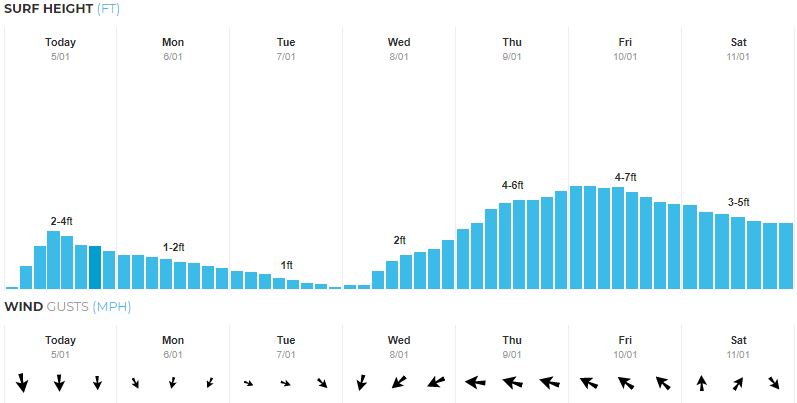
Source: MagicSeaWeed.com
Happy hunting,
TreasureGuide@comcast.net


Tuesday, June 14, 2016

6/14/16 Report - 1715 Fleet Copper Bracelet Find by Capitana Crew. How "Stray" Finds of Historic Items Are Made.


Written by the TreasureGuide for the exclusive use of treasurebeachesreport.blogspot.com.

Three 1715 Fleet Artifacts Found Last Week by the Capitana Crew.
Photo by Captain Jonah Martinez
I talked about this silver spoon and the nested weight in previous posts.  Here is also a copper bracelet that was also found by the Capitana guys.

Notice the nice old wood too.

Copper Bracelet Find.
Photo submitted by Captain Jonah Martinez
I once found a silver bracelet very much like this copper one.

Good finds, and thanks for sharing!

---

James F. sent me a bunch of excellent links.  Several of those link to posts in a blog called Past Times and Present Tensions.

Here is a question for you.   What percent of stray coin finds of possible historic or archaeological interest are made by metal detectorists?  By stray, I mean to exclude those made as a part of a systematic archaeological excavations or salvage operations.  Just take a guess.  Try to come up with a number.

I found some numbers that might seem surprising.  I found those numbers in a post in the blog I just mentioned.  The author of the blog presented data that he found in the book, Iron Age Coinage in South-East England: The Archaeological Context by Colin Haselgrove, Oxford, 1987, p. 104.  It is data on "stray" finds of 286 British Celtic coins.

Here is how those stray finds were made.

Large scale earth-moving, including extractive industries and railway cuttings   4%
Building and construction works    14%
Cultivation and ploughing     16%
Digging and allotments, such as drainage trenches and pits    13%
Home gardening    10%
Coastal or riverine erosion    20%
Erosion or other disturbance to the grounds surface    13%
Archaeological prospecting (field-walking) and metal detecting    10%

To state the obvious, that means 90% were not found by archaeologists or by people metal detecting! Most of the finds are made in other ways.

The numbers are old, being from 1987, and they are limited to Celtic coins found during a single year. Those are serious limitations, but it appears that most "stray" historic finds are made during earth removal, construction projects, farming, gardening or just walking along an eroded beach or river.

It seems that the archaeologist's concerns about the detecting hobby is definitely misplaced.  The unfair characterization of detectorists as looters is not only unfair in the vast majority of cases, but detectorists are involved in very few finds of a historic or archaeological nature anyhow.  According to these numbers, home gardeners are every bit as likely to be involved in making such finds.  I suspect that it would be more difficult to villainize a petunia-planting granny, though.

Erosion accounted for about 33% or one third.  I frequently talk about erosion and we all look for erosion on the beaches.

Earth-moving, building construction and drainage ditches and the like, accounted for a little over 30% of the stray finds.

As I said, there are serious limitations to this data.  Nonetheless, it is eye-opening.  I don't know of any other similar data.  Maybe there is more somewhere.

Thanks for the links James!

---

Fort Pierce makes national news as another terrorist has ties to the Islamic Center in White City.

http://www.wptv.com/news/region-st-lucie-county/fort-pierce/omar-mateen-second-muslim-behind-a-terror-attack-with-ties-to-islamic-center-of-fort-pierce

---

We'll have a smooth surf for a few days.  There is no significant tropical weather activity.

Happy hunting,
TreasureGuide@comcast.net

Friday, March 6, 2015

3/6/15 Report - White City Florida History Research. Lost City Found. More On Palm Beach Beaches. Big Surf Next Week?


Written by the TreasureGuide for the exclusive use of treasurebeachesreport.blogspot.com.

1901 White City Mercantile Building.
Photo source:
https://www.flickr.com/photos/mainmanwalkin/7059137399/ 


You might have noticed that a lot of finds that I've been posting lately have come from inland hunting sites.  Research can help you find good old inland sites. 

Several days ago I mentioned JSTOR as a research tool.  Below is just one example of the kind of thing you can find through JSTOR.

One old local community is White City, between Fort Pierce and St. Lucie.  It was settled by Danish settlers in 1893.  Goods were shipped from Titusville on the steamboat "Lillian" to be sold at a store that was built on the St. Lucie River.

A dance was held to celebrate the first birthday of White City on Dec. 16, 1894.  The dance was held at a large pavilion at the picnic grounds.  Every fall the picnic grounds were flooded by the rising river.

There were two ferries across the river - one for passengers and one for horses and wagons. 

Now there are some nice hints.

That information was published in the Florida Historical Quarterly, Vol. 33, No. 1 (Jul. 1954), pp 48-50.  The article was authored by Sandra Lewis, who won an assay contest sponsored by the Florida Historical Society.  Like I said, I found it using JSTOR.

-----

The past couple of days I've talked about the Palm Beach beaches.  Joe D. sent additional information on that.  Here is what he said.
 
Just read today's post! And saw the video from Jason T. north of the Breakers Hotel! This is one of two types of beach renourishment happening in Palm Beach! As Jason stated, there's a barge offshore pumping to the north side of the Breakers where the beach had disappeared! I don't search there because there has been little to no beach to search! On the south side of the Breakers, at the Midtown Beach is where my pictures have been from! They are trucking in the beach sand there; (different type of sand) and at Phipps Park further south at the other public beach! The North end of the island is mostly intact, but unless you know people who will let you park in front of their house, which is highly unlikely, (residents and police have zero tolerance! and ZERO public parking; SAD!!) then its a city bus, bike, or boat ride to hunt up there!

Just wanted to give a better picture to anyone planning a hunt there! Oh, and buy the way, very little one and two hour free parking at Midtown! And paid parking is FIVE DOLLARS
AN HOUR!! No joke!! "There's only one Palm Beach."

Thanks for the report Joe.

Some of my favorite old hunting spots in the Miami/Fort Lauderdale area were places where parking was difficult or expensive. 

-----

I'll sum up what people have said about how fast coins sink in rich soil very soon.  If you have some thoughts to add, please send them.

------

We are having some very nice weather along the Treasure Coast.  Not too hot or too cold.  No wonder there are so many snow birds on the road.

Today the wind is from the North, but not very strong.   Tomorrow the wind will continue from the North but the surf is supposed to increase up to something like five or six feet.  That could possibly do us some good if the angles are right.

Right now the surfing web sites are predicted a big surf (10 feet) for the thirteenth.  As I always point out, there is a good chance that won't happen, but I hope it does.  The next few days should give us some idea.

Happy hunting,
TreasureGuide@comcast.net