Showing posts with label history. Show all posts

Thursday, June 25, 2020

6/25/20 Report - Treasure Coast Historic Places - Fort Pierce Casino and Sea Mist. Some Recent Fossil Finds.


Written by the TreasureGuide for the exclusive use of treasurebeachesreport.blogspot.com.


Fort Pierce Casino
Submitted by GM.

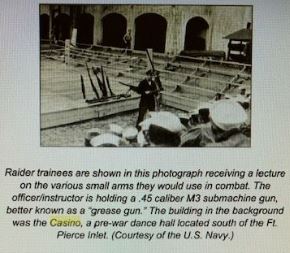
I received the above postcard image of the Fort Pierce casino from GM, who also sent the following picture of the casino being used during WW II. That caption refers to the casino as "a pre-war dance hall located south of the Ft. Pierce Inlet."


Thanks GM.


Nick, who sent the following pictures of the casino said, The casino was right where you make the left curve into ty he now jetty parking lot. 


Fort Pierce Casino (Bottom Right)
Submitted by Nick.


Fort Pierce Casino
Submitted by Nick.

Thanks Nick.
---


Guapo (GM) also sent me the following photos and captions showing the Sea Mist.  Sorry if it is a difficult to read, but you can see the original source - the Vero Beach Press Journal.


Thanks again GM.

---


Recent Beach Fossil Finds by Timothy M.
Photo submitted by Timothy M.

Timothy M. recently found the above fossils and sent the following message.


Hello again. My wife and I were out around low tide Monday afternoon just walking some beaches cleaning up trash and doing some eyeballing. She has an eye for sea glass and picked up a few nice greens. I had been talking about fossils when just north of middle cove I found a small bone with a joint, leg, wing? Little later on at the north end of Walton rocks, she found this nice dark black bone fragment with visible marrow! She trumps me again.

Your blog always encourages people to think above lost human treasures. We had a great time wondering about the origin of these obviously truly ancient objects.

Once again thanks for sharing your knowledge and joy of discovery.

Thanks for sharing Timothy.  Glad you enjoy the various types of treasure that can be found on the Treasure Coast beaches.

---

On the Treasure Coast the surf is still small, but we have some negative tides.

We are getting some dust from the Sahara dust storm.

Happy hunting,
TreasureGuide@comcast.net


Sunday, May 3, 2020

5/3/20 Report - Details on State Park Openings. Slide Bracelet Watch Find. Checking Rolex Watches. Watch History.


Written by the TreasureGuide for the exclusive use of treasurebeachesreport.blogspot.com.


Laser Inscribed Rolex Mark Around Inner Rim of Genuine Rolex.

A few days ago I did a post on finding watches.  Then I followed that with a post on identifying fake and counterfeit watches, especially Rolex.  I decided to show a bit more about that today.

Counterfeiters are becoming more and more skilled.  They can even change serial numbers these days.  But one of the most difficult things for a counterfeiter to reproduce is the high resolution laser-inscribed "Rolex" that you will find around the inner rim of the dial (Above and below.)

Source: DetectAFake.com.  See link below.

I posted a photo I took of a genuine example at the top of this post.  I was really surprised that I was able to capture it so well in a photo.  It wasn't easy shooting at an angle through the crystal, so I was very proud of the result.

Here is a link with excellent tips on detecting fake Rolex watches.


---

Of course there are many other types of interesting watches that you might find.  I've referred to some of those in the past, but here is one find that I like.  It is a watch with a slide bracelet.  They are unique

Watch With Slider Band.

You can purchase individual "slides" to be placed on the chain.  Individual slides can be silver, gold, or less expensive materials, and have emeralds or other precious gems.  You can find them online selling for hundreds of dollars each for the ore valuable slides.

Three "Slides."
You can create a very unique and personal bracelet, very much like you can do with Pandora charms, but these slider bracelets predated Pandora.

---

A bit of wrist watch history.

Watch-barcelets were created for ladies of wealth beginning around 1790.  Small miniature watches had been made earlier though.  David Rosseau made a watch about the size of a dime in the late 1600s.

Mass production of wrist watches was started around 1880 by the Girard- Perregaux factory to  be used by officers of the German Navy.

The Swiss introduced wrist watches to the United States around 1895, but they weren't popular at first.

Around 1907 the Elgin and Illinois watch companies were manufacturing wrist watches and by 1912 Hampden and Waltham had started.


From Shugart and Gilbert's Complete Price Guide to Watches.
---


Early 5/3 At Sebastian Inlet
Source: webcam

Effective Monday, May 4, DEP will implement phase one to reopen the Florida State Parks. As these parks are re-opening, DEP will be taking measures to ensure the protection of staff and the public. During this early phase of re-opening, visitors should expect limited hours, capacity and amenities.

Phase one includes approximately 80 parks and trails throughout Florida. Portions of these parks and trails have been identified that can be reopened for day use with limited risk to visitors and staff.

Here is the link for details on specific parks.

https://www.floridastateparks.org/learn/safety-updates

Sebastian Inlet Park will be open.

By looking at that web site I also learned that Indian River Lagoon Preserve is state land just south of Frederick Douglass park.

---

Today the surf is two feet, and Tuesday and Wednesday it will be down to one foot.

Happy hunting,
Treasureguide@comcast.net


Wednesday, April 15, 2020

4/15/20 Report - 1944 Metal Detecting Experiences. Keeping Detecting Records. Using Statistics.


Written by the TreasureGuide for the exclusive use of treasurebeachesreport.blogspot.com.

Illustration From 295 Combat Engineer Battalion History.


If you want to really learn history, one of the best things to do is research your own family.  You'll be surprised by the stories you'll find.

Here is how the young men of America were using metal detectors in 1944, as described in the history of the 295th Combat Engineer Battalion.

July, 1944. Normandy Campaign.   We didn't have much time to step back and admire that road.  There was too much to be done.  The Krauts had done their spring sowing early and well.  Mines were everywhere.  There were mines in roads, around roads, under dead cattle, and under dead doughboys.  We had to clear them.  

There's nothing quite so nerve-wracking as mine clearance.  One man walks along waving his mine-detector in the area before him.... suddenly the electric impulse from the apparatus detects something metallic lying in the ground.  A second man, walking in the footsteps of the first, cautiously digs his bayonet into the ground, feeling for the mine.  We must be very careful not to dig too hard.  

The mine is then uncovered and either de-activated or removed, or else blown where it lies.  There are booby traps to add to the discomfort and fear.  The krauts had lots of new tricks and ways to kill, but we were careful, and we had learned our lessons well in training.

It wouldn't have been so bad if there were always mines where the detector picked up something, but there would be days when only pieces of shrapnel were found, and days when miles of sweeping was accomplished, with nothing found at all.  The temptation to rush and become a little careless was always present.  Then we would hear stories of men who had rushed and we became careful again.  We swept mile after mile of road, scores of fields, and myriads of twisting footpaths.

There was a stretch of road near Villieres-Fossard which had been swept previously by three other engineer units and it was reported that vehicles were still hitting mines there, a  half-track being the most recent casualty.  "B" Company swept it and studied the pattern as reported by mines found in previous attempts at clearance.  They found three French mines and one German Tellermine still there.  The shrapnel was so thick in this sector that they still couldn't pronounce it cleared with assurance, so they got a bulldozer in there and cut off several inches of road surface and sept it again, then pronounced it cleared.  No more vehicles hit mines in that area.

Here is the link for more history on the 295 Combat Enigneer Batallion.

http://lct376.org/us295th/

And you complain about trash!

The young men of America, from coal mines, farms and city streets, went to foreign lands and saw unspeakable things nearly 76 years ago.  Many never mentioned them again when they came back home.

My father was clearing mines too, but from a minesweeper.

Thanks to my wife's research skills and patience, I've been lucky learn many interesting family stories, such as the one above and more.  They include Indian scouts, Revolutionary War battles, Civil War battles, and some very colorful stories that I might present some other time.

I tell you that to encourage you to research your family history.  While locked down in your house, besides developing comorbidities that put you at higher risk to COVID-19 as a result of the enforced sedentary lifestyle, you might as well do a little research.  You might also get some good clues for metal detecting sites.

---

Data can be useful.  I highly recommend keeping data on your ventures.  I was lucky to find some of my earliest records on my metal detecting finds.  Below is one page of that.

My Records of My First Metal Detecting Outings.

Having been a researcher before starting metal detecting and having a natural inclination to observe, collect data and analyze things, I started keeping records right off the bat.

I think this is my second page after I began metal detecting.  Here is what I found.

On 9/26, near the beginning of the entries I had $7.53 total face value of coin finds, and on the back of the page the last row shows that by 1/3 I had found a total of 2653 coins with a total face value of $197.48.  including 432 quarters, 622 dimes, 300 nickles and 1299 pennies.  Dollar coins and halves were not included in the total value (because of their relative rarity).  Foreign coins were recorded by not counted.  Jewelry was recorded too.  I see some Susan Anthony dollar finds, for example. The math seems to be off by less than a dollar.
As I said, I recorded the number of coins from each decade for each denomination.  Most of the hunts resulted in coins from the 60s, 70s, and 80s.  As I scan the records, I see that the first time I got many coins from the 20s, 30s and 40s was when I made a trip to Pennsylvania and West Virginia.

My record keeping evolved, and I learned things such as which sites produced the most coins and gold, the average time in the field it took to find a gold ring, how many coins I would find relative to each gold ring, the relative number of coins and rings found in the water as compared to land, which sites were most productive on average, etc.

Those records were from my time in South Florida.  Results on the Treasure Coast these days would be different.

For more on assessing the relative profitability of different detecting sites see my 1/11/19 post.

https://treasurebeachesreport.blogspot.com/2019/01/11119-report-few-important-facts-about.html

---

It seems I was not clear, so I went back and modified the following.  I added underlining and additional comments.  The recently added comments are in square brackets.

General impressions are fine some of the time, but statistics can reveal a lot if the data collection techniques are valid and reliable.

I found an interesting article entitled, Let’s Visualize State-by-State Shutdown Effectiveness on COVID-19.  It is not in a peer reviewed journal, and I am not saying that the data or conclusions are valid, but the study does ask the type of question that needs to be asked, and attempts to address that question with statistics.

[So why do I present this study if the conclusions are not the point?  One reason: The study gives an example of the type of researchable question that could be addressed with real data, which is what I'd like to see done.]

Here is a short excerpt from the article to give you the idea.

I graphed the projected total deaths (past and future) using the IHME model versus how long it took a State to shut down from the time it started seeing people dying (when it reached 0.5 deaths per million).

[Notice that the study uses projected total deaths, not actual death statistics.   My point is that important questions can be addressed by using real data, although, as I've expressed before, I also have reservations about how cause of death is being coded.]


One would expect that the faster a State shuts down, the less deaths it would incur, but that’s surprisingly not what we find. There is virtually zero correlation between speed of shut down and expected death totals.

[Again, the conclusions were reached using projected death statistics, not actual real world data.  I'd like to see important research questions addressed using real data.]

Here is the link if you are interested.


Again, I have not really looked at this research thoroughly yet, and I am not saying that it is valid (in fact I can think of one confounding factor right off the top of my head) but the study does suggest that statistical techniques can be used to inform significant real world decisions.

In metal detecting or other more serious business, you'll do better if you collect valid data rather than go on general impressions.  If you are open minded, you might be surprised by what the numbers actually tell you.

---

Thursday evening there will be a short period of seven or eight foot surf and ENE winds.  That might be interesting.

The tides are small.

Happy hunting,
Treasureguide@comcast.netr

Monday, April 6, 2020

4/6/20 Report - Great Finds. Thousand Year Old Atlatl Point. Lead Railroad Seal. Making History Every Day.


Written by the TreasureGuide for the exclusive use of treasurebeachesreport.blogspot.com.

1000 - 4000 Year-Old Atlatl Point Found on Treasure Coast Beach.
Find and Photo by Doug R.

Here is one super find that could be up to four thousand years old!  It was found by Doug R., who sent me the following message.

I’m a snowbird from CT and have come down to Sebastian for the month of February for the last 15 years. I do a little bit of metal detecting but not so much the past few years as conditions haven’t been that great. I’ve never found anything Spanish on the Treasure Coast (even that really good Saturday this year). I read your blog every day while I’m there and often when I’m not. I appreciate the work, time and effort that you put into doing the blog. It is truly outstanding. The first week of February I found this point on the beach about halfway between Wabasso Beach and Golden Sands. It was in a shell line that was 1-2 feet wide. At the time they were doing beach renourishment at that spot but the water had not reached that area at the base of the dunes yet so I’m pretty sure it didn’t come from this years renourishment sand. Could have come from previous years renourishment or the ocean?? I showed it to the guy at McClarty’s and he was extremely excited. He said it’s an atlatl point from one to four thousand years ago. It’s 4 inches long. I believe you’ve always said something to the effect “keep your eyes open at all times” so this proves your point. I never expected this.

Thanks again,
Doug R.

Congratulations Doug!  Thanks for sharing.

---

Open St. Johns County beach (top) and a closed Duval County beach (bottom) on March 29.
Source:  Click here.
Now, of course, St. Johns County beaches are closed too.

===


Lead Railroad Seal Find.
Photo submitted by Al C.

Al's buddy found this lead railroad seal.  Very cool!

Al also sent the following information about lead seals.


Thanks Al.

I've found some FEC seals.  Here is link to a post that shows some of those.

https://treasurebeachesreport.blogspot.com/2012/09/92912-report-florida-east-coast.html

And here is a photo of the same.

Four Lead Railroad Seal Finds.

My photography wasn't as good back then.

---


Most detectorists are interested in history.  We study history, but we live and create it everyday.

Yesterday I was most struck by the Palm Sunday services at St. Patrick's Cathedral in New York being conducted without a congregation.  I don't know if that was the first time that happened since it opened 140 years ago, but it felt like it could have been.

There are events such as World Wars and pandemics that change the way that generations see the world. such as World Wars and pandemics.  In more recent history it was the 9/11 attacks.  In the 1960s it was the Cuban missile crisis.  You can't read a social psychology textbook without reading about JFK and the decision making process during that crisis.  It popularized the concept of groupthink.  Many people in the U.S. built bomb-shelters.  My own father built a concrete block room in our basement.

The Spanish flu pandemic of 1918, the deadliest in history, infected an estimated 500 million people worldwide—about one-third of the planet’s population—and killed an estimated 20 million to 50 million victims, including some 675,000 Americans. The 1918 flu was first observed in Europe, the United States and parts of Asia before swiftly spreading around the world. At the time, there were no effective drugs or vaccines to treat this killer flu strain. Citizens were ordered to wear masks, schools, theaters and businesses were shuttered and bodies piled up in makeshift morgues before the virus ended its deadly global march...

With no cure for the flu, many doctors prescribed medication that they felt would alleviate symptoms… including aspirin which had been trademarked by Bayer in 1899—a patent that expired in 1917, meaning new companies were able to produce the drug during the Spanish Flu epidemic.
Before the spike in deaths attributed to the Spanish Flu in 1918, the U.S. Surgeon General, Navy and the Journal of the American Medical Association had all recommended the use of aspirin. Medical professionals advised patients to take up to 30 grams per day, a dose now known to be toxic...  
(https://www.history.com/topics/world-war-i/1918-flu-pandemic)

---

The lawn service showed up at my neighbors house this morning and started mowing.  Essential service?  No!  Are they safe distancing?  No.  Big problem?  No.  Better to allow them to keep themselves financially afloat?  Probably.   That's my opinion.

All men are created equal, but some are not essential?  I saw the phrase "non-essential individuals" in one government order.  Essential to who?  I just don't like the phrase.  Seems like a very slippery slope that can end up in a very bad place.  You don't have to go back far in history to see where that can lead.

---

The surf is supposed to be seven feet or so today.

Too bad so many beaches are closed.  Nice and rainy too.

Have a blessed Holy Week,
TreasureGuide@comcast.net.

Sunday, February 16, 2020

2/16/20 Report - Mucking Through Heavy Trash With a Metal Detector. Last Hutchinson Island Black Bears.


Written by the TreasureGuide for the exclusive use of treasurebeaches report.

Broken Old Salter's Eye Lotion Bottle.

That would be a bottle I'd like to have if it wasn't so badly damaged.

Can anyone provide any information on Salter's Eye Lotion?

If you want a challenge or you want to learn to understand your metal detector a little better, here is a recommendation: visit the banks of the Indian River Lagoon where you can get to the river without passing on private property, find an area where the surface trash covers the ground and try to pick out any good targets that might be hiding between the trash.  That isn't easy.  First of all there isn't a lot of good metal targets down there.  And secondly, the trash is horrendous.  You might find something interesting, and if you don't, you'll still improve your detecting skills.  I don't think I really have to tell you that the exercise will require a ton of patience.

As sad as it is to say, the shallow water and banks on the west side of the river are virtual trash pits.  Before garbage pickup, many residents just dumped their garbage over the hill.  Much of it is still there, appearing and disappearing with the storms, weather and whatever.  You'll see the remains of everything and anything; wrecked cars, model T parts, wrecked boats, tires, cans, bottles and glass, old commodes, pressure tanks, etc. etc. etc.

Trashy Area Along the West Bank of the Indian River.
Some of the residents have tried to clean up the areas in front of their property, but it is a seemingly unending task.  One day it will look good but eventually the trash will show up again.

Recently I took a metal detector down to the edge of the river and gave it a try.  I quickly found out that many of the bottle tops gave a coin tone and a conductivity number to match.

You might want to focus on a particular tone or conductivity number for a while.  After digging enough of those, change it up and focus on another range of targets for a while. 

It won't take long to get to know link signals with target types.  And there is no end to the number of targets that you can quickly sample.

You might find to pick good targets out of the trash.  It isn't easy because of the amount of trash.  The trash can be so dense that you are almost always over more than one target.

It isn't likely that you will find many coins, but there are some to be found.  On my trip, I found a few.  One was a 1982 penny that had lost one third of its weight to corrosion.

It is like reading any beach bur different too.  There are signs that will tell you where coins are more likely, and where they are highly unlikely.

The sand on the west side of the river is about six feet deep.  That is what I was told by a fellow that builds docks.  Like on the ocean beach, there are places where coins will be closer to the surface.  The penny was found in an area where weeds had been growing in past years, and even though they weren't there now there was still a dense patch of organic material where the roots were.  That is the reason the penny did not get buried more deeply, and the organic material caused it to quickly corrode.

It is not likely you'll find many coins and it will be difficult to find quality coins, but that is the challenge.  There is a good chance, however that you will find some older things of interest in the process if you keep your eyes pealed.  The bottle at the top of this post was found when I was mucking with my metal detector through the trash.

When picking through such dense trash, you'll be forced to go slow enough that you'll have a good chance of making a sight find of some sort.


Side Rail of Houseboat That Sank In The River During the 2004 Storms.

There are some old shipwrecks in the river too, as well as more recent ones.  I've mentioned some in the past.

Metal detecting in the river will test your patience.

An occasional fossil can also be found in the river.  In fact, almost anything can be found in the river.

---

DJ sent me a link to the story of the last black bear killed on Hutchinson Island.  Interesting local history that you might find interesting and maybe sad.


Monday, January 20, 2020

1/20/20 Report - Some History of Treasure Coast Treasure Hunting: Bruce Ward. Bigger Surf Coming.


Written by the TreasureGuide for the exclusive use of treasurebeachesreport.blogspot.com.


January 1965 Issue of Argosy Magazine Containing Story of Bruce Ward's Treasure
Submitted by JaminJackUSA.


If you are interested in the history of treasure hunting on the Treasure Coast you might want to find a library copy of the January 1965 issue of Argosy Magazine.  

Several days ago I posted a nice four-reale that was purchased by JaminJack from the estate auction of Bruce Ward.  Jack sent me a copy of the Argosy article as background on the adventures of Mr. Ward.  The article describes Ward's big find, which was made in 1964, early in the history of modern Treasure Coast treasure salvage, and at a time when the Real Eight Corporation and a variety of other smaller and less documented treasure hunters were working along the Treasure Coast.  This is the type of article that no Treasure Coast treasure hunter will want to miss.

Photo Appearing in January 1965 Argosy Magazine.
Submitted to TBR by JaminJack.

Bruce accumulated a lot of treasure, which he did not sell because he planned to make start a museum.

Here is a photo of a homemade dive platform that he created and used until he upgraded.


Photo of Homemade Dive Raft Shown in January, 1965 Argosy Magazine.
Sent to TreasureGuide by JaminJack.
And here is his salvage boat, the DeeGee.

The DeeGee Salvage Boat.
Source: Jan. 1965 Argosy Magazine.

Thanks JaminJack.

---

I was working in the yard this morning when I noticed that the wind had changed direction.  It is now coming more from the north, and it feels like a bit of a cool front came through, so it was not surprised when I looked at the surf predictions and saw that the surf will be increasing.


Source: MagicSeaWeed.com.

Looks like maybe up to a ten feet surf by Wednesday.  And some north winds before that.

That is a big enough surf to move some sand.  I just wish the wind kept coming from a northerly direction for a longer time.

Happy hunting,
Treasureguide@comcast.net


Sunday, January 5, 2020

1/5/20 Report - Piece of White City History Unearthed. More on Proto-Money. Bigger Surf Coming.


Written by the TreasureGuide for the exclusive use of treasurebeachesreport.blogspot.com.

1815 One Skilling.
Find and photo by Jeff C.

Had to pass on my find from a week ago in White City. As you know it was a settled by the Danish originally in 1839. So I was very excited to find this 1815 2 Skilling coin.. I’ve found many older coins in the area, 3 wheatbacks over 100 years old in one visit. Also a 1923 mercury dime in very good condition. Can’t help but feel the 2 skilling coin was lost by one of the original settlers due to its condition and depth. It was approximately 8-10” deep with several inches of top soil removed from the construction. Found with my equinox 600.

Congratulations Jeff. Thanks for sharing.

Here is a clearer picture of a similar coin from the internet.

1815 2 Skilling Coin.

The community of White City on the southern border of Fort Pierce is named for the utopian Great White City built by architect Daniel Burnham for the 1893 Chicago World’s Fair. The community’s main road is Midway Road after the fair’s Midway.  (Source: visitflorida.com/white-city/)

---

Not long ago I posted an article about "hoe money," supposedly a type of proto-money used in Pre- Columbian South America and Mexico.  The subject intrigued me and I wanted to find out if any had been found on shipwreck sites.  So far I've not been able to find anything about nautical or other archaeological discoveries of axe or hoe money, but I did find one very good article, Aztec Money: An Inquiry into Substance, Sources and Heuristic Value, by Kenneth D. Jacobson, University of Massachusetts.

While the article didn't answer my questions about axe or hoe money, it did provide interesting descriptions of the market place that was in operation upon the arrival of the Spanish.  It also provided thought provoking observations that you might find relevant to today's politics and economics.

Here is the link.


I'm still looking for any descriptions of axe or hoe money found on shipwrecks or other sites.

---

Somewhat related, I did find an article on proto-money, although it is about Celtic ring money, not Aztec hoe or axe money.  Still interesting.

Source: See link below.


Before coinage was introduced to Britain in the Late Iron Age, people had to conduct transactions by bartering their products, goods and/or services.  This process of payment and exchange may have been facilitated by gold “ring money” (most of which seems to date from the late Bronze Age, therefore they are not ‘uniquely’ Celtic and may not have even been used by the Celts as a ‘proto-currency’).

For example, we now know that by the 2nd century BC (the Late Iron Age in Britain) the locals were trading iron “currency bars” shaped like swords, spits, plough-shares and bay leaves.  The use of the so-called ‘ring money’ as a proto-currency may have died out well before this...
Here is the link for the rest of the article.

https://oldcurrencyexchange.com/2015/03/31/what-is-celtic-ring-money/

---

I hadn't watched any of the Oak Island curse TV show for a year or so, but yesterday happened to see that they haven't learned much of anything and are still popping off instantaneous wild interpretations of finds while ignoring any number of more reasonable alternative explanations.   It seems that anything and everything is either "searcher" or "depositor" related. whether it is a piece of wood or rusty metal.  So tiring!

---

Mike F. says he reads Japanese but not Chinese, but recognized a couple of the characters on Steve's ring as being Chinese.

Thanks Mike.

---

I've been observing changes along the Indian River lagoon for some twenty or thirty years and hope to soon discuss how things have changed and what I've concluded from some of those observations.  I need to take some photos before I discuss that topic much, but one general thing I've noticed is that the big changes are rare.  The storms that hit the Treasure Coast in 2004 dramatically changed the west bank of the Indian River and are still predominant even though there have been numerous storms and hurricanes since.   After the 2004 storms I would walk down the river and not recognize where I was.  The storms that occurred since did not cause changes that were as big or as sustained.  Some objects, such as a boat battery, that were deposited in 2004 have been visible since 2004.  I'll try to document some of that kind of thing in a post someday soon.

---

There is a little bump in the surf today, but a bigger surf is predicted in a few days.

Source: MagicSeaWeed.com
Happy hunting,
TreasureGuide@comcast.net


Monday, November 11, 2019

11/11/19 Report - History Between the Pages of Old Books. Memorable Metal Detecting Experiences.


Written by the TreasureGuide for the exclusive use of treasurebeachesreport.blogspot.com.


I decided to pull out an old book that I hadn't read, and I'm glad I did.  The book is George Gable's The Grandissimes, originally published in 1880, I had an 1899 copy.  Gable writes historical novels, or what I might call dramatized history of old New Orleans.   His books give you a better idea of what life was like than a history book would.  He fleshes out actual historical people and events with realistic interactions and dialogue that is authentic to the times and period.  It presents a complex detailed picture of society and racial relations as they were.  In my opinion, the George Gable books are much better than "history" books in more ways than one.

Anyway, I found the obituary of Captain Benjamin Saxon clipped from the Dec. 11, 1901 Times-Democrat newspaper.  Captain Benjamin Saxon Story was a prominent citizen of New Orleans who passed in 1901, and the obituary mentions actual places and people mentioned in the book.  

There is much more to the clipping than what I am showed above.  The obituary talks about Captain Story's experience in the Civil War and his feelings of the defeat of the Confederacy.  It also mentions his acquaintance with Bulwer Lytton, a very prolific author of many books which I have. 

Treasure hunting is to me a broader subject than metal detecting.  Metal detecting is one kind of treasure hunting.  

Valuable books are treasures too.  Not only can old and rare books be valuable, but old books can conceal other treasures.  I've found money, old photos, and a business card of a famous person between the pages of an old book.   And  the information in a book can be a valuable treasure too.

---

This morning I was thinking about my most memorable metal detecting finds.  Two that first came to mind were valuable finds.  They were both diamond rings.  One had the largest and finest solitary diamond that I ever found, and one had the largest total diamond weight.  

You would think that the most memorable finds would be the most valuable, but while thinking about it, I discovered there are a lot of other factors involved besides the value of the find.  Some of the finds that stick out in my memory are not the most valuable.  In fact I think those diamond rings are so memorable to me because of more than their value.

The first, my largest and finest solitaire diamond, was found on a particularly beautiful day.  The sky was deep blue and the water was bath-water calm.  I distinctly remember when that scoop of sand was lifted from the bottom, I could see the diamond sparkling while it was still under a few feet of water.  At that point I didn't know that it was a valuable diamond ring at all, but I remembered the sensory experience of that beautiful day and the diamond sparkling in the scoop under the water.

The other diamond ring that I remember so well, involved an experience too.  It was a day when I had very little time to hunt.  In fact before I went hunting, I had a hard time deciding if I would go because I had so little time.  I figured that by the time I got to the site I wouldn't have more than a half hour of time to actually hunt.  Despite how little time I had, I finally decided to go.  When I got there I stepped into the water, not much above my ankles, and bingo - I hit the ring in just a few minutes.  It turned out I didn't need much time, but something told me to go, and I was glad I did.

I also well remember finds that were not valuable at all.  For example, my first piece of Treasure Coast shipwreck silver.  I remember that find detail for detail.  I dug it up, my wife took it out of my scoop, looked at it, and started to throw it away.  I told her to keep it.  It was a black sliver of silver.  I didn't really know for sure it was silver until I got it home and tested it.  It isn't worth much of anything but it was a first for me, and it was a long time coming.  

Surprisingly, unlike the experiences I just described, I had to think a while to remember exactly where I found my first escudo.  For some reason, I don't remember that one so well.  I do remember that it was on my birthday weekend and I also found a gold US coin the same weekend.  Maybe that made the escudo less memorable to me as a unique experience because what I remember is finding two totally different kinds of gold coins in the same birthday weekend, but I don't really remember the details of finding those two coins very well.

It seems that I do not so much remember the details of individual finds on days when there were many finds.  On days when I dig a lot of good stuff, that is what I tend to remember - the quantity of finds. 

When I think over my memorable finds, there are several factors that make them stick out.  Value is only one.

I tend to remember first finds, especially when they are something that I have sought for a while.  I had been trying to find shipwreck silver for a quite a while when I finally found my first.  I think that made it more memorable.  Also the experience of not knowing for sure immediately and having to go through the process of testing before getting the final answer made it more memorable.  And also sharing the experience and telling the story made it more memorable.

Many of my most memorable finds involved interactions with other people - for example, sharing the experience with my wife.  In some cases, it was returning the item to a grateful person.  And telling the story never hurts.  I'm sure that sharing the experience and sharing the story makes the find much more memorable.  

I remember, for example, the day when I arrived at one site after leaving another with a pocketful of quarters and encountering a fellow that asked if I could spare any change.  I gave him a couple dollars worth of blackened quarters, and he told me, "God helps those who help others."   I stepped into the water and, bingo, I found a diamond ring in just a few sweeps.  A few sweeps more and I found another diamond ring.  What I remember most about that is what the fellow said to me and then what happened and the very coincidental nature of the whole thing.  

It isn't all about the value of the find.  It is very much about the experience and sharing with others, and also the meaning it has to you.

---


Source: MagicSeaWeed.com

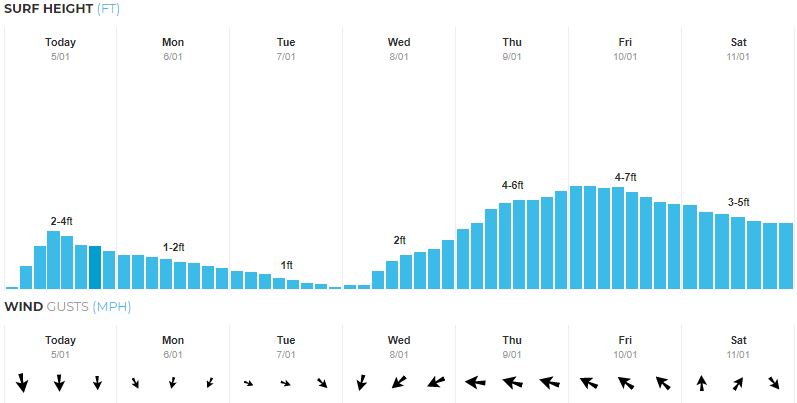
We're supposed to have another increase in the surf for Wednesday and Thursday and then another one next weekend.  

Like I've been saying, this is the time of year when we often have cold fronts coming through.   November is often a decent hunting month.  Hopefully we'll get something that moves enough renourishment sand to improve conditions.  There is a lot of sand in front of the beaches and covering the dunes.
Remember the veterans today.

Happy hunting,
TreasureGuide@comcast.net