Showing posts with label shark teeth. Show all posts

Thursday, June 11, 2020

6/12/20 Report - Miscellaneous Sampling of Treasure Coast Fossils: Some Being Millions of Years Old. Evolution of Horses of North America. Labeling Finds.


Written by the TreasureGuide for the exclusive use of treasurebeachesreport.blogspot.com.

Rhino or Teleoceras Skull Cap Fossil

I decided to show a different kind of Treasure Coast find today.   I often tell you to keep your eyes open when you metal detect.  You can find different types of things - some of them being really old.  One example would be fossils.

I think the fossil shown above is my favorite Treasure Coast fossil fins.  A real fossil expert told me it was a rhino or teleoceras skull cap from the Miocene period (25 - 5 million years ago).  I had no clue what type of animal it  came from but got an expert and friend of this blog to identify it for me.

I guess I like that one best simply because I find it difficult to think of anything like a rhinoceros being in Florida.

I think most detectorist like to find old things, but we are usually thinking in terms of maybe hundreds of years rather than millions of years.

Fossil Great White Shark Tooth.

A lot of people like shark teeth, and fossilized shark teeth are fairly common on some Treasure Coast beaches.  This one was found on the banks of the Indian River.  I wasn't fossil hunting when I found it.  In fact when I first saw it I thought it was a piece of glass.  And it is in very nice condition.

Below are a few more examples.


Camel Phalange Fossil.

If you are like me, you don't readily think of camels being on the Treasure Coast either, but above is what I'm told is a fossilized camel phalange.

Below are a few more examples.


Whale Inner Ear Bone.


Alligator Scute.

Fossilized Ivory From Mammoth or Mastadon.

I once saw a nice section of a tusk sticking out of the Treasure Coast sand.


Fossil Bone With Shark Teeth Marks.

Some fossils will show something a little extra.  Maybe it shows that it was worked by man or perhaps another animal left its mark like the bone shown above, which shows what appears to be teeth marks.

Keep your eyes open while metal detecting.  You might see something older or more interesting than what you were looking for.

I'll add one tip here.  It goes along with the mistakes I've been talking about in some of my previous posts.  Label your finds with as much as you know about the identity of the item and also the place and details of the find.  You might think that you'll remember all about it, but time takes its toll.  As you can see from the above photos, I had some of these labeled, and I am glad of that.  Some were not labeled.  That is a mistake I made a lot.  Don't put it off.  You might remember the details for some finds, but you might regret forgetting the details of others.


Fossil Hoof.
Concerning the item shown immediately above, I suspect it is a horse hoof, but I never got it checked out.  I'm sure an expert could give me the details, but at this point I simply don't have enough information to label it with any precision or certainty.

You might be interested in the history of horses in North America.  If so here is a link.

https://www.statelinetack.com/content/general-information/the-prehistoric-horses-of-north-america/

Horses changed a lot over the millions of years.


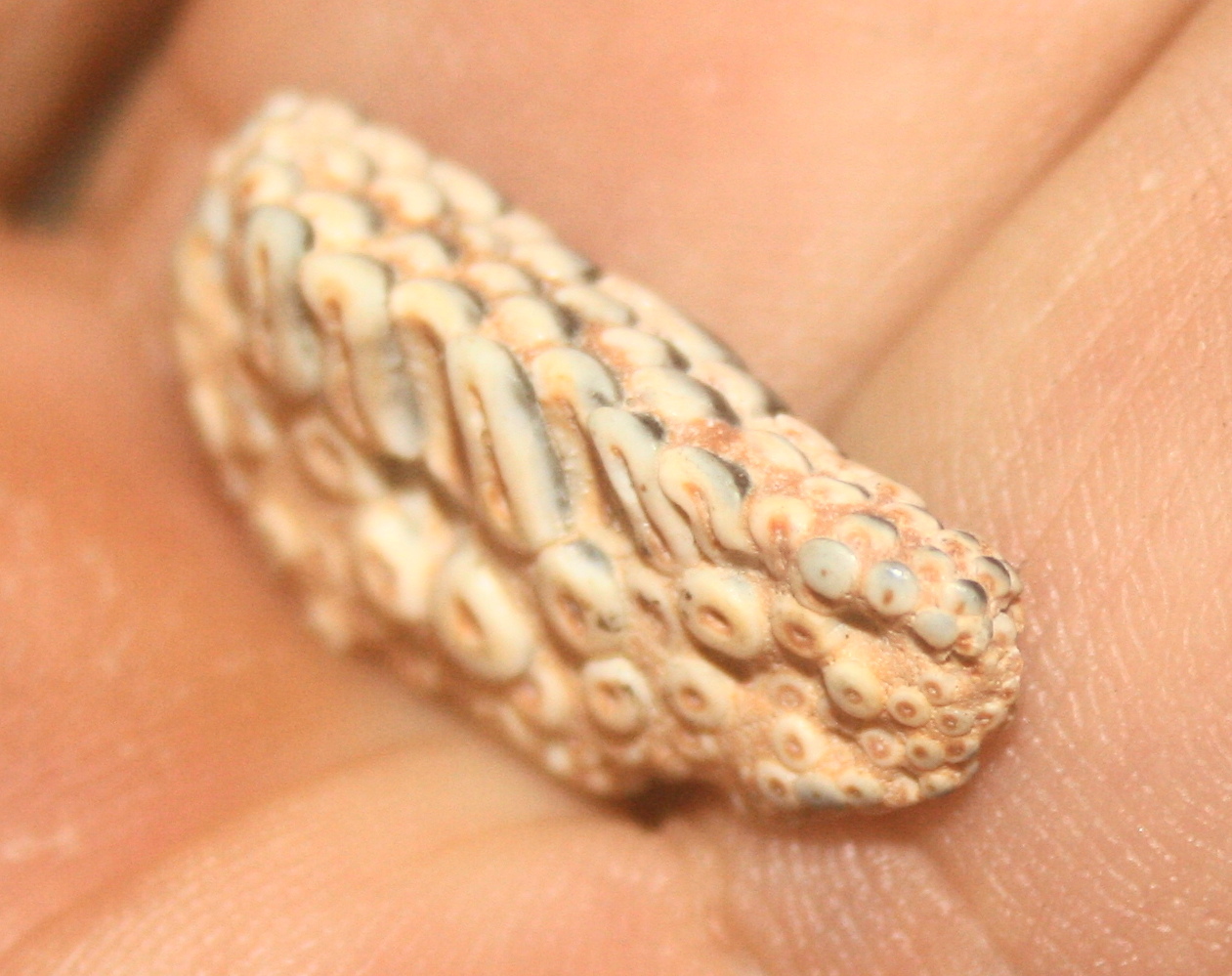
Horse teeth fossils are very common finds on the Treasure Coast, as are turtle scutes.

Bison, deer, peccary, sloth, snake, fish, wolf, bivalve and mollusk, coral, crab and wood fossils are some of the others fossils that have been found on the Treasure Coast.

If you are interested in finding fossils and haven't done it before, I'd recommend paying a professional guide to take you for a day trip to the Peace River.  It is worth the money, and you'll learn a lot.  I did it once several years ago.

---

The surf is going to be around two feet today, and the tides are now small.

Happy hunting,
TreasureGuide@comcast.net


Sunday, January 5, 2020

1/6/20 Report - Beach Conditions Sunday. Mystery Find for ID. Time to Consign.


Written by the TreasureGuide for the exclusive use of treasurebeachesreport.blogspot.com.

Turtle Trail Sunday Morning,
Photo by Steve M.

Steve M. visited Turtle Trail Sunday morning and sent these photos and the following report.


Beach had some cuts down near the water about 2 foot.   Beach above that was still high.    About a quarter mile south of the walkover, the green bags are still visible for another quarter of a mile along the middle of the beach.   Just junk and one dime.   Several sharks teeth. Surf was 2 to 3 foot.   Very windy.   Glad I did a great modification to my headphones...   

Turtle Trail Sunday Morning.
Photo by Steve M.

Turtle Trail Sunday Morning.
Photo by Steve M.

Turtle Trail Sunday Morning.
Photo by Steve.
Finds by Steve (left) and his wife (right).
Thanks for showing the types of objects that were found Steve. That helps a lot. Steve also had a good tip on a modification that can be made to your earphones. Here is what he said about that.
I bought some headphones from Harbor Freight that have very good springs.   They keep out the wind and underwater they stay on tight.   Good modification to do.


Earphone Modification As Implemented by Steve M.

Thanks for the great photos and report Steve.  Also I think the earphone modifications is great.  I found the submersible Minelab Equinox earphones loose and noisy.  I think this will help.

---

Captain Jonah sent me the following.

My daughter and I were doing a little river hunting. Finding some neat broken bottles and glass and she dug this up. Not sure what it is or age but thought maybe you could help her ID it with years of knowledge. Thanks for any help.
Mystery Find for ID
Photo by Captain Jonah.
I haven't done any research yet, but I'm thinking the "MADE IN JAPAN" marking puts it in the 1920s or 1930s. If the normal position is as shown on the left, I'd guess maybe something like a restaurant tooth pick or condiment holder. I'm sure somebody can some up with this. Let me know what it is. --- April 29-30 will be the next Sedwick auction. Time to consign.
---

The surf will be decreasing for a few days but increasing again towards the end of the week.

Happy hunting,
TreasureGuide@comcast.net


rare and infrequent events have the largest effect.


Wednesday, December 25, 2019

12/25/19 Report - Merry Christmas: Art of Treasuring. Princely Bronze Age Treasures Discovered. Seagrape Trail.


Written by the TreasureGuide for the exclusive use of treasurebeachesreport.blogspot.com.


Source: Edition.CNN.com link below.


(CNN) Archaeologists in Greece have discovered two "princely" Bronze Age tombs containing engraved gold jewelry and other artifacts.

The discovery of the beehive-shaped tombs, which date from 3,500 years ago, sheds new light on life in ancient Greece, the team behind the excavation said...

During an 18-month excavation, the archaeologists unearthed objects such as a gold ring engraved with two bulls surrounded by sheaves of grain, as well as a gold pendant depicting an Egyptian goddess who protected the dead...

Here is the link for more about that.  


Thanks to SuperRick for that link.


---


Super Viral YouTube Video You Must See If You Haven't Already.
Here is the link.


So what does that have to do with metal detecting, you might ask.  It is the essence.   The video teaches an important lesson.  Treasure doesn't have to be gold or silver.  It doesn't even have to be worth much of anything.  Treasure is different things to different people.  Treasure can come in many different forms.  No matter what the form, the important thing is that it gives joy.  Some people find treasure everywhere.  Others can't find it anywhere - even if you dump a pile of it in their lap.  Instead of joy, they turn to selfish greed, suspicion, anxiety, fear and anger, and are more bitter and sour than before.

I call it the art of treasuring.  Some people have it and others don't.  You can treasure family, other people, experiences, memories, coins, sea glass, fossils or shells - and even bananas.

---

Seagrape Trail Beach on 12/24/19
Photo by DJ.
DJ said that with the exception of one low spot, it was sandy.

You can probably see the low spot just above the center of the photo.   That is an area where shell piles often occur, and where you can sometimes find shark teeth.

Thanks for the report DJ.

---

Source: MagicSeaWeed.com.

It was raining on the Treasure Coast earlier.

It looks like we'll have some pretty good surf today.

I MIGHT get out to see one or two beaches for a short time.

---

Use treasure as a verb as often as a noun.  When "treasure" is a verb, the power is in the person.

Matthew 6:21 For where your treasure is, there will your heart be also. 

---

Wishing you once again a great Christmas.
From the TreasureGuide@comcast.net


Thursday, May 16, 2019

5/16/19 Report - One Way To Accelerate Your Learning Curve. Beaches Where You Can Find Fossils. Finds. Trash and Treasure.


Written by the TreasureGuide for the exclusive use of treasurebeachesreport.blogspot.com.

Fossil Finds by DJ
Photo by DJ.

I received these photos and message from DJ about his first fossil hunt.  The photo above shows the finds of DJ's first fossil hunting trip.

I had read some past blogs on fossil hunting and Peace River. Saw some finds you posted from Bill and Dan.

I went with a guide since I believe if time is limited, that may be a good way to find things until you learn the ropes.

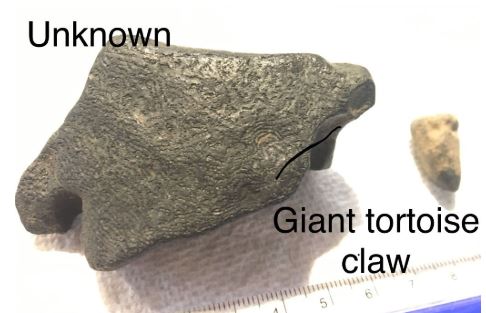
Our guide was very sharp and explained a lot of things, in the picture you can see many shark teeth, part of a broken mammoth tooth, several DuoGong rib bones, fossilized shell ‘molds’, stingray teeth plates and a claw from a giant tortoise.

Others found parts of Megladon teeth, horse teeth.

I like to hear the explanations and hunting techniques.

Like you have said, the story behind the find is fascinating, there is always something to find and most importantly (for me) don’t throw anything away until you get an ID.

And the places to look have to be learned, gravel holds the smaller stuff and deeper gravel holds larger better finds. Some people use a golf club with the head cut off as a probe to see how deep the gravel is. And the gravel moves and builds up over time like sand on the beach!

Learning where not to hunt is important as well, people have to throw out the stuff from their screens and it is easy to find yourself digging in someones spoil pile.

Here are a couple closer views of some of his finds.


Photos by DJ


Can anyone identify the unidentified bone?

I went with a paid fossil hunting guide on my first trip to the Peace River too.  It does save time on the learning curve.  They put you on some good spots so you don't waste hours trying to figure out where to hunt.  If you go with a guide, you will definitely find some fossils.  In my opinion, it is definitely worth the money if you are interested in fossils.

You'll do some sifting.  That might be a good introduction to a technique that can be used for other things.

Guides for some other types of treasure hunting and other locations may not be such a good idea, but for Peace River fossil hunting, I think you'll find it worth the money.

It is a lot like metal detecting.  It helps to know where to look and how to identify the good spots.  Find identification adds to the fun.

Nice finds DJ.  Thanks for sharing about your trip.

You can sometimes find fossils on Treasure Coast beaches, but it depends upon beach conditions.  There was a time a few years ago when they were plentiful.  One area was very rich with fossils, but they can be found form time to time all along the coast.  I've seen them at Ambersands, Wabasso, Seagrape Trail, Turtle Trail and along South Hutchinson Island down as far as Jensen Beach, and probably farther.  I also have seen some found at Rio Mar.  Some of the Indian River spoil islands also have fossils on them.

After some very high rough seas there were some large fossil bones, from mammoths, whales, etc. on the beaches.  Fossils have been scarce on the beaches for the last few years.

Native American artifacts can also be found on the beaches at times too.  They are more common when the fossils can be found, and I've seen them at some of the same beaches.

---

As part of RR Auction's The Fine Autographs and Artifacts Featuring JFK’ collection, the rosary beads used by Father James Thompson on the fateful day of President Kennedy's death were sold for $13,401.25...

https://spiritdaily.org/blog/news/rosary-beads-used-in-jfks-last-rites-auctioned-for-over-13k

---


On the deepest dive ever executed into the Mariana Trench, an American investor-turned-explorer discovered what appeared to be plastic bag and other litter nearly seven miles below the surface of the Pacific Ocean.

Victor Vescovo, a retired naval officer from Texas, broke the record for the deepest dive into a part of the Mariana Trench known as Challenger Deep, the deepest known point in the Earth’s seabed. His dive went 52 feet lower than a 1960 dive to the bottom of the Mariana Trench completed by U.S. Navy lieutenant Don Walsh and Swiss engineer Jacques Piccard in a vessel called the bathyscaphe Trieste...


https://www.foxnews.com/science/plastic-litter-discovered-deepest-dive-pacifics-mariana-trench

We all know how much junk there is out there.  We can all remove a little of it.

Removing junk metal can help you find good targets, and removing old worthless bottles can help you find good bottles.

I remember way back to high school when one day our gym teacher sent us out to pick up the junk on the football field.  I found a dollar under the bleachers.  Guess I liked eye-balling way back then.

---

The surf will be slowly increasing over the next few days.

Happy hunting,
TreasureGuide@comcast.net

Sunday, August 19, 2018

8/19/18 - Really Old Stuff That Can Be Found On the Treasure Coast Beaches. Fossils.


Written by the TreasureGuide for the exclusive use of treasurebeachesreport.blogspot.com.

Great White and Megaladon Tooth.
I've always encouraged people to keep a keen eye on the beach while they metal detect.  You can find so many interesting and potentially valuable things.  As I've said before, you can find almost anything on a beach, and if you are out there enough and look around, you will find a lot.

I recently did a few posts on my all-time favorite finds.  For some types of finds, it is easy for me to pick out a clear favorite.  That was the case with sea glass.  There was one piece that really stood out from all the rest.  For modern jewelry it was difficult to pick a favorite.  It was the same way for fossils.

I don't go out to look for fossils, but I did once.   I went with a fellow who had a permit and takes people on fossil hunting ventures to the Peace River.  It has been quite a few years now, and I don't know if he still does that.   I just picked up a few fossils over the last thirty or so years while metal detecting.

Fossils can be valuable, but of course, most aren't.  Value depends upon the usual factors; including rarity and condition.  I've never sold any fossils, but I've seen megalodon teeth offered for sale in some of the Sedwick auctions, and there are many web sites where you can find all kinds of fossils for sale.

On the beaches you find more when there are big new shell piles.  We haven't had much of that for several years now.

If you like old things, fossils can be very old - even millions of years.  Its amazing to see something that while just walking along a beach.

One of my favorites is the Great White shark tooth on the left in the photo above.  It was found on the Treasure Coast.   I was just walking along, and there it was.  I never saw another one in the same area even though I've been there many times.

It is in great condition.  You can see the sharp serrations in the photo.  They show up even better in person.  I don't think it is my favorite fossil find, but it is my favorite shark tooth find and ranks right up there.

On the right in the above photo is a megaladon tooth.  It is one that was found on my trip to the Peace River.  The serrations on that one are gone.

On the Treasure Coast beaches, it is more common to find smaller shark teeth, like those below.

Tiny Shark Teeth.
You can find fossils on most beaches along the Treasure Coast when conditions are right.  Just a little north of the Seagrape Trail access is one good place to find small shark teeth when there are a lot of shells.  One of the fellows that lives by the beach in one of the condominiums hunts shark teeth there a lot.

But shark teeth aren't the only fossils of marine animals you can find on the beach.

Small Fossil.

The small fossil show above is the first fossil that I found and kept.  I didn't know that it was a fossil for probably twenty years after I found it.  I was in the water hunting jewelry and saw the unusual item in my scoop.  I didn't know what it was, so I decided to keep it.  I kept it for many years until I finally had a fossil expert tell me what it is.  It is a fossilized grinding tooth from a fish such as a red fish.

Fossilized Inner Ear Bone of a Whale.
I found this larger fossil near the waterline on a Treasure Coast beach when there were a lot of big shell piles.  It is a fossil of an inner ear bone of a whale.

Large things will wash up when beach conditions are right, and some of them won't make your detector beep.

Fossil Dolphin Vertebra.
Back a few years ago there were more fossils on the beach.  They'll return again some day.

Among the most common Treasure Coast beach fossils are turtle shell and horse teeth.  I just wanted to talk about marine animal fossils today.

Not much new with beach conditions to report.

Keep looking down.


Happy hunting,
TreasureGuide@comcast.net

Saturday, April 23, 2016

4/23/16 Report - Treasures In Renourishment Sand. Jupiter Inlet Beach. Ring: How Old Is It? Dare.


Written by the TreasureGuide for the exclusive use of treasurebeachesreport.blogspot.com.

Big Cut South of Jupiter Inlet
Photo by John B.
T,his cut is in renourishment sand, but that doesn't necessarily mean there is nothing good in it.  Although it doesn't happen often, very good things can be found in renourishment sand.  WW II items were found in renourishment sand at Fort Pierce.  Silver U. S. coins were found in the renourishment sand at Ambersands not too long ago. Even Spanish galleon materials have been found in renourishment sand.  It is good to know where renoruishment sand is collected, and it can be worth checking renourishment sand.  There are times when there will be tons of old aluminum cans and other junk, but sometimes there will be things that are millions of years old.

Same Cut Showing Layers of Shells Etc.
Photo by John B.
Check the face of any cut to determine what might be in the sand.  In the photo above, you can clearly see some layers.

Thanks for the great pictures John!


Very Nice Shark Tooth
Find and photo by John B.
Here is what John said.  There was a pretty good cut along the beach just south of Jupiter inlet but it was all renourishment sand.  Lots of small iron junk targets, shells and shark teeth.    

That is a nice tooth.  Notice the serrations.

---

Yesterday I posted some items from the beach at Corrigan's.  That prompted Paul B. to send me the following email.

Hello, found this ring on one of the Ft. pierce beaches several years ago. I thought it was a more modern piece, but after looking at the pictures you posted today of the gold rings, now I'm not sure. It's silver with no markings and the stone looks as if it could be jade. What do you think? I'm attaching pictures.
Thanks,
Paul B.

Find and photo by Paul B.

What do you all think?  I have a hard time telling from photos.  Most modern rings would have a marking, especially if it is gold or silver.   

Paul provided a number of excellent photos.  Still there are some things I can't tell without actually handling.  It can be difficult enough even when having the item in your hand.

I'd appreciate any comments though.

---

The crew of the Dare is using Dolores (HAUV) to explore the deep mud at the south of the Atocha trail.

---

Happy hunting,
TreasureGuide@comcast.net

Sunday, June 21, 2015

6/21/15 Report - Crew Of Capitana Finds Gold Escudo & More. Florida Fossils.


Written by the TreasureGuide for the exclusive use of treasurebeachesreport.blogspot.com.


2 Escudo Just Found by Crew of Capitana
Photo sent by Dan B.


Captain Jonah and the crew of the Capitana are hot.  They just keep coming up with great finds.

Here is a nice freshly dug 2 escudo from the 1690s.

Great picture Dan!

Below is a picture of the other side of the same escudo along with a picture of Bill holding the escudo.

Thanks for sharing guys!


Close-Up Of Same
Escudo.


Bill With Found Two Escudo


And that isn't all.  Here is a good close-up view of some more reales fresh up.


----


Everybody thinks of the 1715 Fleet when they think of the Treasure Coast, and there is good reason for that, but not all treasure wrecks on the Treasure Coast were part of the 1715 Fleet.

When Kip Wagner discovered the Green Cabin Wreck they figured it was one more of the 1715 Fleet wrecks.  However cannon were dated to 1594 and Eugene Lyons eventually identified that wreck as the San Martin, which sank in 1618.

The Green Cabin Wreck is one of few Spanish wrecks of that period in the Western Hemisphere for which there is published hull data.

You can see that data by using the following link.

http://nautarch.tamu.edu/NAPwiki/index.php?title=Green_Cabin_Shipwreck,_Florida_(c._1620)

You might find that site useful.

----

Other salvage boats are finding neat stuff as well.  One thing that was recently found was a mastodon tooth.

Old fossils are found all the way along the Treasure Coast.  My fossil-expert friend figures that an ancient river ran just off shore back when the water level was lower.

Here is a map showing a larger Florida land mass from the Ice Age period.  You can use this link to find that illustration and read more about that.

http://thenaturalhistorian.com/2012/07/08/doggerland-sea-level-rise-human-migration-dispersal-creationism-ice-age/.


You'll occasionally see fossils on the beach after either a period of rough seas or sometimes as the result of human activity such as beach replenishment or construction projects.

I've seen both mastodon teeth and a mastodon tusk section on the beach in the past.  I think I once showed a picture of a piece of a mastodon tooth found on the beach, as well as other fossils.

I recently mentioned the fossil shark teeth being found on a West Palm Beach beach in replenishment sand.  People are also finding shark teeth on a replenished South Carolina beach.

----

Back in 1978, Gary Johnson was a junior at Rolling Hills High School in Rancho Palos Verdes, California with a keen interest in archaeology. Around that time, he noticed a large rock sticking out of the ground with a bone pattern in it. With the help of friends, he rolled the 1,000-pound rock (using logs) about 200 yards into his family's backyard.

After chipping away shale and dirt, Johnson called in an expert to get an opinion of his find. The expert deemed the fossil not very significant and the rock sat in the backyard for over 35 years.  It was later discovered to be a balleen whale fossil that was somewhere around 15 million years old.

http://www.dailybreeze.com/science/20140214/fossil-found-on-rock-rolled-home-from-chadwick-school-in-1978-at-least-12-million-years-old

Things aren't always correctly identified right off the bat.  Some of my biggest regrets are the result of things not being correctly identified.

----

I'm a little handicapped.  A few stitches in my right arm right where it would fit into the detector arm cuff.  Have to wait for that to heal.

As far as Treasure Coast beach conditions, it is still hot and the surf darn near flat.  No change expected real soon.

Happy hunting,
TreasureGuide@comcast.net

Tuesday, June 9, 2015

6/9/2015 Report - Rare Indian Head Penny Found. Olive Jar & Musket Ball. Deep Quarters.


Written by the TreasureGuide for the exclusive use of treasurebeachesreport.blogspot.com.

1872 Indian Head Found by William M.
Photos by William M.


William M. made a very rare find.
He found this 19th Century Indian Head, which is a rare key date -  1872.

You can see what the coinstudy.com site says below.  The 1872 is one of the most rare Indian Heads.  In fact it is so rare, that even worn coins bring a minimum of $80, and the price quickly escalates with condition.


Great find William!

Congratulations and thanks or sharing.


-----

Joe D. sent in a report on the Palm Beach beaches.

Hello, your description on the 6/6 post pretty much matches Palm Beach now. I took my son today to hunt for sharks teeth that were recently discovered after the renourshment. Many people had obviously  been doing the same! I've got to say that I was shocked at the amount of holes that were dug and left open on the beach! Some of the holes were huge! Others were small but deep enough to break an ankle. The sand is full of shells and coral, and is much harder packed than original sand! ...  I think we spent more time covering holes than we did hunting! I Guess we will see what happens here! All the old finds are covered under a million cubic feet of sand now anyway!

Thanks for the report Joe, and for covering holes even though they weren't yours.  Even when a hole isn't dug by a detectorists, detectorists might get the blame.  We don't need that.

----


Olive Jar Bottom And Musket Ball Found
By The Crew of The Capitana.


Yesterday I showed a cannon ball found by the crew of the Capitana on the Treasure Coast.  Here is an olive jar bottom and musket ball that they found.


----

I went out to the beach early Monday morning to do a little detecting.  As soon as I got there I could see it was no different than the three South Hutchinson Island beaches that I showed you on the sixth.

The front beach was higher than it was a few months ago.  And it was littered with sea weed.  Very few shells.

Here are a couple of pictures showing what it looked like.

Treasure Coast Beach Monday Morning Near Low Tide.

I did a little detecting even though conditions looked poor.  I scanned the front beach just to see.

Every target was deep.  The first three or four targets were too deep and close to the water to be removed.  The hole kept filling before I could get the target out.

I did eventually get a few quarters.  They were all a foot or so deep.  It was unusual to get quarters and not hardly any other coins.  I figured that was because the smaller coins were too small to detect that deep.  I'm not absolutely sure any smaller coins were there but it would be unusual for such a high proportion of quarters, so I'm guessing that most everything, including the quarters were under about a foot of sand, and the smaller items weren't detected that deep.

If you pay attention to target depth and what you are getting as well as what you aren't getting, that will help you analyze just what is going on.

Also check the holes for any layers of different types of sand or shells or whatever.

There were no layers visible in the holes this day.  It was all one thick layer of the same type of fine brown sand, undoubtedly accumulated over the recent weeks of unchanging calm surf.

I didn't have much hope of finding much of anything very good, but managed to find one piece of gold, which was only and inch or so deep - evidently a recent drop.

I'm going to be talking more about analyzing a detecting site and how it might have developed  over time.  If you get a good idea of what has been going on, you'll have a better idea of where to spend your time and where you shouldn't spend your time.

As usual, the dry sand had very little.  There were few good targets and very little junk.  As I said recently, some of these beaches have been cleaned up.  I'm proud of how little junk is left at some of these previously junky beaches.

----

A boy was bitten by a shark off Daytona Beach on June 7.

http://abcnews.go.com/US/boy-bitten-shark-florida-beach/story?id=31594612

Shark bites do occur but they are probably much more rare than you might think.

I've seen a few while I was in the water.  One was very large, but seemed startled by me and went the other way.  I always wondered if he didn't sense the metal detector pulses.  Or he might just have left for some unrelated reason.

----

A nuclear physicist and an archaeologist at the University of York have joined forces to produce a unique appraisal of the cultural significance of one of the world’s most important locations for scientific inquiry.

In a paper published in the journal,Landscapes, Professor David Jenkins, of the Department of Physics at York, and Dr John Schofield, Head of the University’s Department of Archaeology, have investigated CERN, the home of the Large Hadron Collider on the Franco-Swiss border.


Situated between the Jura Mountains and the Alps, CERN was established in 1954 to promote peaceful co-operation between nations still recovering from the Second World War.
The study, the product of a visit to the complex near Geneva, focuses on physicality of a location of which researchers say: “It is hard to think of anywhere more significant for all of humanity.” They describe this as an archaeological enquiry, with the buildings, the equipment within them, and a range of everyday objects at the center of their research.

Here is the link.
http://www.york.ac.uk/news-and-events/news/2015/research/cern-heritage/
Is there anything that they do not or will not consider to be an archaeological site?

---

It looks like we'll have another week of calm surf.

Happy hunting,
TreasureGuide@comcast.net

Thursday, February 20, 2014

2/20/14 Report - Fossil Shark Teeth From Beach, Shards Found In Shell Piles, and Bits of Florida History


Written by the TreasureGuide for the exclusive use of treasurebeachesreport.blogspot.com.

Fossil Shark Teeth and Pot Shard Finds
by Eva S.

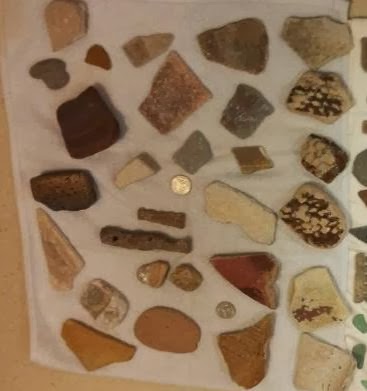
A few days ago I posted a note from Eva S. who has been finding fossils and shards on the beaches between Sebastian and Vero.  Here are a few of her finds.  (Many more are shown below.)

That is the kind of thing you are likely to find these days.  I'm sure the detecting snow birds, who are on the Treasure Coast in great numbers now, are disappointed with the beach detecting conditions.  Since our good detecting back in November conditions have been consistently on the poor side.

You just can't control beach conditions.  You have to adapt and make the best of it.  Another alternative is to take a little trip.

Yesterday I talked about abandoned and hidden beaches.  Some were not ideal beaches to begin with.  I'm thinking of some of those that you'll find in parks where they tried to make a nice beach on a lake, bay or stream by bringing in nice white sand and and spreading it.  That usually doesn't last long.  The weeds will come up right through the new sand and nature will reclaim the beach.  I can think of a few like that.  Beaches like that might look nice at first but they aren't used much by people because the area just beyond the dumped sand is still muddy or mucky in the shallow water.  The result being that they give up on maintaining the beach before long and it is reclaimed by nature.  You can identify those beaches by the unnatural white sand on one part of the shoreline.

I can think of one abandoned beach inside the property of a very large Florida amusement park.  At one time there was a life guard station and dock at that beach.  Now you can hardly tell there was ever a beach there.  I first detected that one when it was in full operation.  Now it is very over grown, there is no sign of the life guard station and the dock is gone.


I'm still working on uploading my video clips of how objects move on a beach.  No success yet.  I also plan to make more videos and do some experiments to illustrate the processes of beach dynamics.

A few notes on Florida history follows.

Between 1513 and 1565 at least eight Spanish expeditions were sent to Florida with the aim of establishing Spanish rule.

In 1565 Menendez massacred 130 people at Fort Caroline, a French outpost near Jacksonville.  Nine days later he led the killing of 110 more Frenchmen near St. Augsutine, inspiring the name of  Mantanzas (massacre) Inlet.

It appears that Europeans had been to Florida before Ponce de Leon.   Many believe that John Cabot (Giovanni Caboto) was the first European to see Florida.

Several maps appear to show Florida years before its supposed discovery by Ponce de Leon.

They include the Juan de la Cosa Map, published in 1500.

The 1507 Waldseemuler Map that is housed in the Library of Congress and appears to show the peninsula of Florida.

And the Peter Martyr Map, which was circulating in Europe as early as 1511, two years before Ponce's supposed discovery of the area.

More than one hundred Florida missions were established by the Franciscans and the Jesuits beginning in 1566.  By 1705 they had all disappeared.

All of this is in J. D.Allman's book on Florida history that I referred to back a ways.


On the Treasure Coast the surf is increasing a little for a couple of days.  It looks like it will be up to about four feet or so.

The wind will be out of the south and southeast, so if anything, expect beach building.


Below are a number of photos of pieces that Eva has picked up along the beach.  You can look through them and see if you can help with identifying anything that might be older or interesting.  Note in the last photo, the couple of wooden handles, for example.

Here goes.


Happy hunting,
TreasureGuide@comcast.net