Showing posts with label musket ball. Show all posts

Sunday, January 12, 2020

1/13/20 Report - Beach Conditions Deteriorating On Some Beaches. Photos of Finds.


Written by the TreasureGuide for the exclusive use of treasurebeachesreport.blogspot.com.


John Brooks Beach Near Low Tide Saturday.
The first and main thing I want to say today is that the beach conditions of the South Hutchinson Island beaches that I checked are deteriorating.  The surf is decreasing and the beaches are building.  I suspect the same thing is happening at the other beaches, especially any of those that were freshly cut on Friday.  I'm therefore dropping my beach conditions rating back to a 1.

This is the third time that the stretch from the condos to John Brooks has had five or six foot cuts in just a few weeks.  Frederick Douglass and the beaches immediately to the south were not cut nearly as much in that time period.

The two following photos show the sand that extends out in front of the beach.  That is where the sand from the cut ended up.

John Brooks Beach Sunday.

John Brooks Beach Sunday Near Low Tide.

You can see the sand that extends out in front of Frederick Douglass beach below.


Frederick Douglass Beach Sunday Near Low Tide.

Frederick Douglass Beach Sunday.

You can see a bit of a bar in front of Fort Pierce South Jetty beach now too.


Fort Pierce South Jetty Beach Sunday.

Fort Pierce South Jetty Beach Sunday.
All three of those beaches have a pile of sand in front of the beach.

I think Fort Pierce South Jetty beach is now back farther than it was the last time they renourished it.  Expect that beach to be renourished again before long.  They just keep pumping the money onto that one.

---

Terry Shannon wrote of a good day he had back around the beginning of the year and sent some photos of his finds.


Finds by Terry S.
Here is what Terry said.


… I found a modern 14 k ring, a bunch of coins all greenies, sinkers and then what I believe is ship wreck stuff pictured above. A small musket ball, a latch hook, a large bronze square nail that they converted to a rivet and some smaller old square nails. What I think is interesting is the silver ring.  This is the silver band when I found it and after cleaning.


Silver Ring Find Before and After Cleaning.
Find and photo by Terry S.

The ring cleaned up well and looks nice but it had to be lost a long time to have eaten up to this extent, the inside of the ring is as rough as the outside and it was very thin. I sent a picture to an expert and asked if it could be a ship wreck ring. He said definitely modern. My point is that it is often hard to determine what you have at times. 

Thanks for sharing Terry.

Terry also sent a photo of a half reale, which I plan to show as soon as I get around to it.   I also have some interesting recent finds from other people to show, but I'm getting tired now and will have to pick that up some other time.

For now,
Happy hunting,
TreasureGuide@comcast.net

Friday, July 12, 2019

7/12/19 Report - Carved Lead Soldier Art: One Found Example. Gator Tooth. Tropical Storm in Gulf.


Written by the TreasureGuide for the exclusive use of treasurebeachesreport.blogspot.com.

Lead Mystery Item That I Believe Has Been Identified.
In my 6/29/19 post, I showed some items found on Pigeon Island.  Those items included 54th and 76th Regiment of Foot buttons, grapeshot, and some other items, including the one shown above.  When I found those items it was early in my metal detecting days and I knew very little about items of the Revolutionary War era.  For a long time I believed the above item was a finial.  There is a hole in one end (left end).  I asked the readers of this blog what they thought, and one person said it was soldier art - a carved cannon.

I recently saw the item when I had some others old finds out.  They were all from the same 1787 battle site that I described in my 6/29 post.

I decided to carefully remove some of the heavy brown patina to take a better look at the item.  Then I took a look at it using magnification.  And since I thought it seemed to have about the same volume as a lead musket ball that I also found at the same site, I weighed both the item and the musket ball.

First, after looking at the newly semi-cleaned item under magnification, I thought I could see how it some of the marks on the item were made with a sharp point.  (See photo below.)

Close-up View of Part of the Same Item.
There are several small oblong marks in a line above and left of center that I think you can easily see.  They definitely seem to be hand-made or carved like many of the other marks on the item.

After inspecting other carved lead bullets that I found online and comparing the tooling on those items with this item, I found the marks to be very similar.

The weight of the musket ball found very near this lead item is 31 grams.  The weight of this item is 27 grams.  That seems pretty close to me.  Some of the difference could be because of material being lost during carving.

The next thing I did is compare the item with photos of cannons actually on the island.

Muzzle End of Cannon Located on Pigeon Island.
The similarity is remarkable - especially the muzzle end.

Muzzle End of Carved Item.
The pennies in the photo didn't make the best background, but I needed something to hold the muzzle end up at an slight angle while I took the photo.

By the way, the lead item was found within a few feet of where a cannon would have been.

I noticed two obvious differences between the lead item and the real cannon.  One is that the lead item is shorter from the muzzle to the base than would be the case if it was created to scale.  The second is that the lead item has a lot more decorative lines and marks.

Putting it all together, I now, rightly or wrongly, strongly believe that the lead item is indeed soldier art.  It also seems to me that a single musket ball might have been used because of the weight of the item, which closely matches that of a musket ball found near where the item was found.  I also think that the soldier might have started at the muzzle end, which is most realistic, and ran short on material, but that is mere speculation.

I wondered about the deep groves at the base end of the cannon.  They are unrealistic, compared to the rest of the item, and could be an attempt to either save material, or part of an effort to stretch the item.

I don't know how the ball, if that is what was used was lengthened.  I'm thinking that maybe it was rolled out first, like dough,  Maybe heated.

One thing you can't see in the photos is indentations on each side of the cannon about two thirds of the way towards the base that could have been for mounting.

While researching this, I noticed that there is an active community of those who collect carved Civil War bullets.  Here is one link where you can see some of those.

https://relicrecord.com/blog/carved-civil-war-bullets/

Here is another.

https://www.facebook.com/groups/304389753070719/

The above item seems to be from an earlier era than the Civil War and also seems to be a bit more ambitious than most of the carved bullets that I've seen so far.  Most of those are chess pieces, have initials carved on them or something fairly simple like that.

I can see why carved bullets appeal to collectors.  There aren't tons of them, and they show the unique artistic expression of an individual.

Thanks to whoever originally suggested that the item was soldier art.  I now think they that is correct.

What do you think?

---

I posted this tooth for ID from Gaylen C. a few days ago.

Find and Photo by Gaylen C.

This has been identified as an alligator tooth.  Nice one.

---

I just received photos of some new 1715 Fleet finds.  I'll post those for you tomorrow.


It is the time of year to start keeping a close watch on the tropical weather.  These things come and go quickly, and you don't want to miss some prime hunting when the treasure window opens.

Tropical Storm Barry is in the Gulf and headed towards Louisiana or Texas, so shouldn't affect us much.

There is another system in the Atlantic to watch, but it is too far away to guess what it will do.

Tropical Storm Barry.
Source: nhc.noaa.gov
On the Treasure Coast the predictions are for another week or so of small surf.

Happy hunting,
TreasureGuide@comcast.net

Saturday, February 23, 2019

2/23/19 Report - Shipbuilding Fasterners: Clinched Spike and Rove Finds. EOs.


Written by the TreasureGuide for the exclusive use of treasurebeachesreport.blogspot.com.

Clinched Spike Find

I always recommend holding onto old finds, especially when you are not absolutely sure what they are.  I occasionally go back and look at old "junk" finds and discover something interesting that I never noticed before.  Sometimes things that weren't very interesting become interesting when I learn something.  That was the case recently.

I ran across some information on shipbuilding fasteners. The information is found in the book
Ships' Fastenings: From Sewn Boat to Steamship, by Michael Mccarthy.

That books shows many examples of how clinched nails or spikes were used.  I've only found a very few examples, on the beach and from my finds, guessed that they were not as common as the McCarthy book proves.

The clinched spike shown above evidently pulled through the wood.  Below you can see how the head was folded onto itself.

Folded Head of Clinched Spike.

Here is just one of many illustrations of clinched spikes that McCarthy shows in his book.


Now I know more about how clinched spikes were used and only wonder why I haven't found more of them.  

One of the other things I learned from the McCarthy book is how clinched spikes were used with roves.

I've found some roves, and it took me quite a while before I learned about them.  One thing I learned is that they were sometimes forced onto the clinched end of the spike.

Found Lead Rove With Musket Ball.
Below are some that I posted in my 2/5/13 post.  They definitely look the same even though the one above is filled with dirt.


Here we are years later and I just learned more about the roves I've had for some time.

You can continue to learn more about finds for years.  Some that might mean little or nothing to you today, might become much more interesting when you learn more about them in the future.

If you want to link to the McCarthy book, just click on the book title above.

---

I've been asking for ideas concerning an EO that I found.  Here are a couple.

John L. said. Especially due to the shape of the piece above the round portion,
my GUESS is that it may be a "deck ring" from a ship's deck.

They were made of bronze or even iron.

Sebastian Steve said, ...all the above is dependent on the center piece having the 3 large holes for the line to pass through.  No holes, no DEADEYE.  

I have one other EO that is smaller, but similar in shape to the one I've been talking about.  Here they are together.


Two Hollow EOs.
They are both very hollow.  Could possibly be the same type of thing in different sizes.

---

The dental cap that I recently found tests as 10K.

---


It looks like we'll have a bigger surf Monday.  The tides are getting more moderate though.

Happy hunting,
TreasureGuide@comcast.net

Monday, July 3, 2017

7/3/17 Report - State of Treasure Coast Beaches. JFK's Rosary. Musket Ball.


Written by the TreasureGuide for the exclusive use of treasurebeachesreport.blogspot.com.

Fort Pierce Area Beach This Morning Before Low Tide.

I went out to one Fort Pierce area swimming beach this morning to see what was going on.  I checked the dry sand first.  I could tell it had been heavily hunted, as has been the case for at least the past couple of years.  It is detected frequently and thoroughly - probably multiple times a day. Of the targets in the dry sand the vast majority were bottle caps, although they were relatively few.  Some detectorists at that beach are in the habit of removing the trash, and overall it is pretty clean.  

I did find one big spill of coins (couple dollars worth) in the dry sand and one small 9K band that was hidden under three bottle caps.

I could tell that there were a lot of people at the beach this weekend.  You could see where the crowds were.  They covered the beach farther north and south than usual.

If you want to detect the dry sand at the popular swimming beaches this summer, you might want to go when the crowds are just beginning to leave.  If you wait too long, most things will already be picked up by other detectorists.

The coins I found in the dry sand were all really recent drops - still nice and shiny.  Even the coins I found in the wet sand were still nice and shiny.  

As you might expect, the shallow water conditions were not good.  Neither were conditions for finding old things.  Sand has been accumulating in the shallow water and on the beach fronts for months now.

Fort Pierce Area Beach This Morning Before Low Tide.

There is one tropical disturbance way out in the ocean to keep track of.

Source: nhc.noa.gov
On the Treasure Coast don't expect any changes real soon. A one foot surf is predicted for several more days.

---

The late president John F Kennedy’s rosary beads – valued at up to $400,000 (€356,000) – failed to sell at auction in New York last month.

In this centenary year of his birth, mementoes associated with JFK continue to attract intense interest but, for once, bidders baulked at the steep estimate ($300,000-$400,000). The rosary, described by auctioneers Christie’s as “one of the most important and personal possessions” of America’s first Catholic president, had “impeccable providence”, having been later given by JFK “to his best friend and special assistant, David Powers”.

Following his death, his family discovered a hidden cache of mementoes

The rosary beads are made of onyx (a black, semi-precious stone) and are attached to a silver crucifix with the name “John F Kennedy” engraved on the reverse. The decade beads are connected to the antiphon beads by a silver circle containing an image of the Holy Spirit inside of a triangle...


It might have done better if it showed heavy wear from use or there was a photo of him with it.  

Here is the link for more about that.

https://www.irishtimes.com/life-and-style/homes-and-property/fine-art-antiques/no-buyer-for-jfk-s-rosary-beads-in-ny-sale-1.3135589

---

Archaeologists take musket ball of evidence that they are digging in a Revolutionary War trench.

Here is the link.

http://www.postandcourier.com/news/tiny-lead-ball-confirms-archaeologists-are-digging-in-right-place/article_4e92c066-5d02-11e7-b92a-47d8da82a83c.html

---

Yesterday I added a new post to the blog.  It will help us get an idea of how many people depend a lot upon intuition, which was also the subject of my post yesterday.

I hope you'll take the time to respond to the post.

Be careful with the driving and fireworks.

Happy hunting,
TreasureGuide@comcast.net


Tuesday, June 9, 2015

6/9/2015 Report - Rare Indian Head Penny Found. Olive Jar & Musket Ball. Deep Quarters.


Written by the TreasureGuide for the exclusive use of treasurebeachesreport.blogspot.com.

1872 Indian Head Found by William M.
Photos by William M.


William M. made a very rare find.
He found this 19th Century Indian Head, which is a rare key date -  1872.

You can see what the coinstudy.com site says below.  The 1872 is one of the most rare Indian Heads.  In fact it is so rare, that even worn coins bring a minimum of $80, and the price quickly escalates with condition.


Great find William!

Congratulations and thanks or sharing.


-----

Joe D. sent in a report on the Palm Beach beaches.

Hello, your description on the 6/6 post pretty much matches Palm Beach now. I took my son today to hunt for sharks teeth that were recently discovered after the renourshment. Many people had obviously  been doing the same! I've got to say that I was shocked at the amount of holes that were dug and left open on the beach! Some of the holes were huge! Others were small but deep enough to break an ankle. The sand is full of shells and coral, and is much harder packed than original sand! ...  I think we spent more time covering holes than we did hunting! I Guess we will see what happens here! All the old finds are covered under a million cubic feet of sand now anyway!

Thanks for the report Joe, and for covering holes even though they weren't yours.  Even when a hole isn't dug by a detectorists, detectorists might get the blame.  We don't need that.

----


Olive Jar Bottom And Musket Ball Found
By The Crew of The Capitana.


Yesterday I showed a cannon ball found by the crew of the Capitana on the Treasure Coast.  Here is an olive jar bottom and musket ball that they found.


----

I went out to the beach early Monday morning to do a little detecting.  As soon as I got there I could see it was no different than the three South Hutchinson Island beaches that I showed you on the sixth.

The front beach was higher than it was a few months ago.  And it was littered with sea weed.  Very few shells.

Here are a couple of pictures showing what it looked like.

Treasure Coast Beach Monday Morning Near Low Tide.

I did a little detecting even though conditions looked poor.  I scanned the front beach just to see.

Every target was deep.  The first three or four targets were too deep and close to the water to be removed.  The hole kept filling before I could get the target out.

I did eventually get a few quarters.  They were all a foot or so deep.  It was unusual to get quarters and not hardly any other coins.  I figured that was because the smaller coins were too small to detect that deep.  I'm not absolutely sure any smaller coins were there but it would be unusual for such a high proportion of quarters, so I'm guessing that most everything, including the quarters were under about a foot of sand, and the smaller items weren't detected that deep.

If you pay attention to target depth and what you are getting as well as what you aren't getting, that will help you analyze just what is going on.

Also check the holes for any layers of different types of sand or shells or whatever.

There were no layers visible in the holes this day.  It was all one thick layer of the same type of fine brown sand, undoubtedly accumulated over the recent weeks of unchanging calm surf.

I didn't have much hope of finding much of anything very good, but managed to find one piece of gold, which was only and inch or so deep - evidently a recent drop.

I'm going to be talking more about analyzing a detecting site and how it might have developed  over time.  If you get a good idea of what has been going on, you'll have a better idea of where to spend your time and where you shouldn't spend your time.

As usual, the dry sand had very little.  There were few good targets and very little junk.  As I said recently, some of these beaches have been cleaned up.  I'm proud of how little junk is left at some of these previously junky beaches.

----

A boy was bitten by a shark off Daytona Beach on June 7.

http://abcnews.go.com/US/boy-bitten-shark-florida-beach/story?id=31594612

Shark bites do occur but they are probably much more rare than you might think.

I've seen a few while I was in the water.  One was very large, but seemed startled by me and went the other way.  I always wondered if he didn't sense the metal detector pulses.  Or he might just have left for some unrelated reason.

----

A nuclear physicist and an archaeologist at the University of York have joined forces to produce a unique appraisal of the cultural significance of one of the world’s most important locations for scientific inquiry.

In a paper published in the journal,Landscapes, Professor David Jenkins, of the Department of Physics at York, and Dr John Schofield, Head of the University’s Department of Archaeology, have investigated CERN, the home of the Large Hadron Collider on the Franco-Swiss border.


Situated between the Jura Mountains and the Alps, CERN was established in 1954 to promote peaceful co-operation between nations still recovering from the Second World War.
The study, the product of a visit to the complex near Geneva, focuses on physicality of a location of which researchers say: “It is hard to think of anywhere more significant for all of humanity.” They describe this as an archaeological enquiry, with the buildings, the equipment within them, and a range of everyday objects at the center of their research.

Here is the link.
http://www.york.ac.uk/news-and-events/news/2015/research/cern-heritage/
Is there anything that they do not or will not consider to be an archaeological site?

---

It looks like we'll have another week of calm surf.

Happy hunting,
TreasureGuide@comcast.net

Wednesday, June 3, 2015

6/3/15 Report - Join The Enironmental Metal Detecting Movement. Various Finds By Readers Of This Blog.


Written by the TreasureGuide for the exclusive use of treasurebeachesreport.blogspot.com.


Great Military Button Find.
Find and photo by William M.

I'm going to start it right here right now - I was going to call it the Green Metal Detecting Movement, but that might be taken as a broader political statement, so for now I'll use the term Environmental Metal Detecting Movement instead.

Detectorists remove metallic items that otherwise might be in or on the ground for centuries.  If you think about it, who else will remove all of the lead sinkers and fish hooks from the beach?  Who else is going to pick up the pull tabs in the parks?   Nobody!  And those beer cans are not biodegradable.  The same old cans and pull tabs will be littering the ground for thousands of years if they are not removed by somebody, and that somebody is us.

I like to leave a location in some way better than I found it.  That might mean removing iron, aluminum, lead, glass or whatever.  You don't have to do it all at once.  You can do it gradually..

I don't pick up every piece of junk on any one visit.  That would be impossible.  But I do remove some junk on every visit.  You'd be surprised how that helps.  If nobody ever picks it up, in time the entire area will be covered with a solid blanket of junk.

Some Treasure Coast beaches that were once heavily littered with beer bottle caps, pull tabs and what have you, are now much much cleaner.  I know that for certain.  You can now detect some beaches with absolutely no discrimination and find almost no junk.  That is a big change and a real accomplishment.  It was accomplished little by little over time.  I'd like to think that I had some small amount of influence in getting that done.

Who wants our fields and beaches to be covered with junk?  If you see junk, how hard is it to pick it up and stick it in a bag?  Some of it can be recycled for cash.  Recycling junk is another benefit o the movement.

If you see trash and don't remove it, how are you whole lot different from the person that littered in the first place?

I like the beach.  I like nature.  I like the woods.  I like that old path I showed the other day.  And I hate to see it junked up with all kinds of trash - buried or not.  Some of it might be buried now, but that doesn't mean it always will be.

If you remove the trash, not only are you preparing the site for better detecting, but you are also cleaning up the natural environment.  I think that is a good thing.

We don't do a good job of letting people know how everybody benefits from the detecting hobby.  I think this is something we should promote, do and publicize.  In time people might come to appreciate it.

If we all become a part of the movement, it will make a difference.

---
Same Button
Find and photo by William M.

The picture at the top of this page shows a military button found by William M.  I previously said that it was from the Seminole War period.  That was wrong.  My mistake.  This button actually would date something like 1875 to 1902.

Very nice condition with a lot of gold still on the front.

The back mark is Horstmann Philadelphia 


Below is a picture of some miscellaneous finds by William, including the button and a ring along with a close-up of the ring.

Congratulations William!  Thanks for sharing.


Miscellaneous Finds by William M.
Photo by William M.

Closer View Of Ring.
Find and photo by William M.


James F., his wife and several friends have been hunting an old Seminole era fort site in Central Florida on private land where they received permission to hunt. 

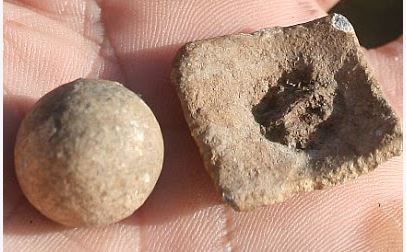
Musket Ball From Central Florida
Photo by James F.
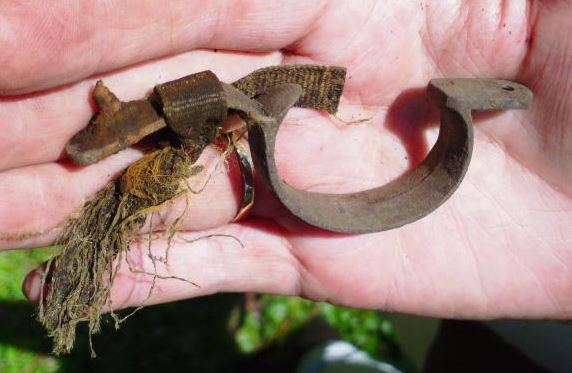
Trigger Guard with Material Attached.
Found by Mrs. James F.


James said they were using a good bit of discrimination because of the foil, aluminum, pull tabs, and crushed beer cans.

As you know, I showed a lead shot from West Virginia a couple of days ago.  James said he was surprised to read that I was talking about lead shot when that is the kind of thing they were finding.

 Congratulations to Mr. and Mrs. James F.!

Very nice finds.  Thanks for sharing.

And from the Treasure Coast, Dan B. submitted this picture of some partially cleaned old props.

Find photos submitted by Dan B.


Those old boat props could bring in a pretty penny.


And here is a toe ring find by Dan B.

Looks like silver.

Thanks for sharing and congratulations Dan!


People are finding things.  Not too much from the Treasure Coast beaches though.  You know how that goes.  Conditions just haven't been very good for beach hunting.  A lot of people are more interesting in the older item.  There are different types of hunting, and as I advised the other day, it is good to switch it up once in a while.

It is sometimes surprising what is most valuable.  It pays to be aware of the prices of different types of items even if you don't plan to sell things.

---

On the Treasure Coast it looks like we'll have a one to two foot surf for a few days.  At least we have a decent negative tide.

Sometime we'll get an actual change in beach detecting conditions.  Hopefully sooner rather than later.


Happy hunting,
TreasureGuide@comcast.net