Showing posts with label soldier art. Show all posts

Friday, July 12, 2019

7/12/19 Report - Carved Lead Soldier Art: One Found Example. Gator Tooth. Tropical Storm in Gulf.


Written by the TreasureGuide for the exclusive use of treasurebeachesreport.blogspot.com.

Lead Mystery Item That I Believe Has Been Identified.
In my 6/29/19 post, I showed some items found on Pigeon Island.  Those items included 54th and 76th Regiment of Foot buttons, grapeshot, and some other items, including the one shown above.  When I found those items it was early in my metal detecting days and I knew very little about items of the Revolutionary War era.  For a long time I believed the above item was a finial.  There is a hole in one end (left end).  I asked the readers of this blog what they thought, and one person said it was soldier art - a carved cannon.

I recently saw the item when I had some others old finds out.  They were all from the same 1787 battle site that I described in my 6/29 post.

I decided to carefully remove some of the heavy brown patina to take a better look at the item.  Then I took a look at it using magnification.  And since I thought it seemed to have about the same volume as a lead musket ball that I also found at the same site, I weighed both the item and the musket ball.

First, after looking at the newly semi-cleaned item under magnification, I thought I could see how it some of the marks on the item were made with a sharp point.  (See photo below.)

Close-up View of Part of the Same Item.
There are several small oblong marks in a line above and left of center that I think you can easily see.  They definitely seem to be hand-made or carved like many of the other marks on the item.

After inspecting other carved lead bullets that I found online and comparing the tooling on those items with this item, I found the marks to be very similar.

The weight of the musket ball found very near this lead item is 31 grams.  The weight of this item is 27 grams.  That seems pretty close to me.  Some of the difference could be because of material being lost during carving.

The next thing I did is compare the item with photos of cannons actually on the island.

Muzzle End of Cannon Located on Pigeon Island.
The similarity is remarkable - especially the muzzle end.

Muzzle End of Carved Item.
The pennies in the photo didn't make the best background, but I needed something to hold the muzzle end up at an slight angle while I took the photo.

By the way, the lead item was found within a few feet of where a cannon would have been.

I noticed two obvious differences between the lead item and the real cannon.  One is that the lead item is shorter from the muzzle to the base than would be the case if it was created to scale.  The second is that the lead item has a lot more decorative lines and marks.

Putting it all together, I now, rightly or wrongly, strongly believe that the lead item is indeed soldier art.  It also seems to me that a single musket ball might have been used because of the weight of the item, which closely matches that of a musket ball found near where the item was found.  I also think that the soldier might have started at the muzzle end, which is most realistic, and ran short on material, but that is mere speculation.

I wondered about the deep groves at the base end of the cannon.  They are unrealistic, compared to the rest of the item, and could be an attempt to either save material, or part of an effort to stretch the item.

I don't know how the ball, if that is what was used was lengthened.  I'm thinking that maybe it was rolled out first, like dough,  Maybe heated.

One thing you can't see in the photos is indentations on each side of the cannon about two thirds of the way towards the base that could have been for mounting.

While researching this, I noticed that there is an active community of those who collect carved Civil War bullets.  Here is one link where you can see some of those.

https://relicrecord.com/blog/carved-civil-war-bullets/

Here is another.

https://www.facebook.com/groups/304389753070719/

The above item seems to be from an earlier era than the Civil War and also seems to be a bit more ambitious than most of the carved bullets that I've seen so far.  Most of those are chess pieces, have initials carved on them or something fairly simple like that.

I can see why carved bullets appeal to collectors.  There aren't tons of them, and they show the unique artistic expression of an individual.

Thanks to whoever originally suggested that the item was soldier art.  I now think they that is correct.

What do you think?

---

I posted this tooth for ID from Gaylen C. a few days ago.

Find and Photo by Gaylen C.

This has been identified as an alligator tooth.  Nice one.

---

I just received photos of some new 1715 Fleet finds.  I'll post those for you tomorrow.


It is the time of year to start keeping a close watch on the tropical weather.  These things come and go quickly, and you don't want to miss some prime hunting when the treasure window opens.

Tropical Storm Barry is in the Gulf and headed towards Louisiana or Texas, so shouldn't affect us much.

There is another system in the Atlantic to watch, but it is too far away to guess what it will do.

Tropical Storm Barry.
Source: nhc.noaa.gov
On the Treasure Coast the predictions are for another week or so of small surf.

Happy hunting,
TreasureGuide@comcast.net

Saturday, April 16, 2016

4/16/16 Report - Surf Increasing This Weekend. Beach Photos. Toy Cannon Soldier Art.


Written by the TreasureGuide for the exclusive use of treasurebeachesreport.blogspot.com.


Frederick Douglas Beach This Morning.


Walton Rocks Beach This Morning.
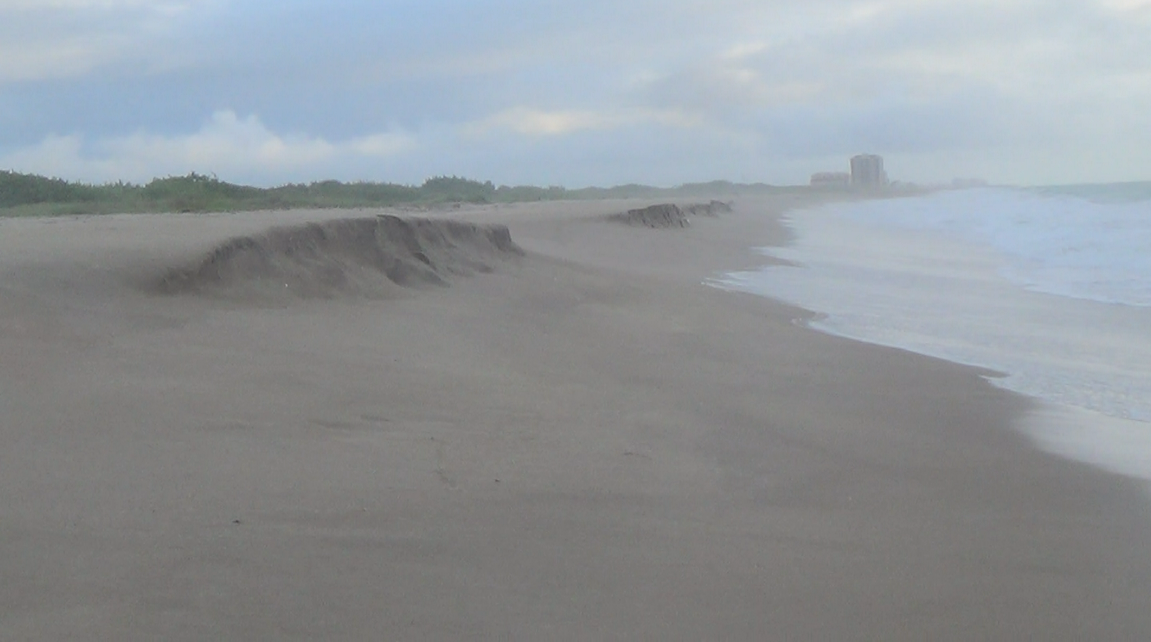
This morning the wind was coming from the east, and I went out to see if anything was starting to happen on the beaches.  I checked a couple of beaches on South Hutchinson Island, and neither had changed much.  If you go back and look at the last time I posted these beaches, you'll see they look about the same.

The surf is supposed to increase Sunday and Monday.  I'll be watching to see what is happening.

--- 


Mystery Object Submitted by John C.

I posted this mystery object some time ago.  I didn't receive any guesses.  My thought is that it is a lead melt.  Whether it was melted accidently or intentionally is unknown.  The chips or material on the bottom might be accidental too.  Other than that I have no answer.

Melted lead is common.  Lead was carried and made into musket balls and was used for a wide variety of other uses.  Musket balls pounded or melted to be used for other things too.


---

I posted the following before but thought it would be worth repeating today.

Toy Lead Cannon
From Old Sedwick Auction.


This toy lead cannon is from a mid-1800s shipwreck The reason it caught my attention is that I once found a similar lead item. For a long time I thought it was a finial, but now I am convinced that it is probably a soldier-art cannon.


The one I found (below) was found near an 18th century cannon emplacement on Pigeon Island.

Carved 18th Century Soldier-Art Cannon

It is always fun to metal detect new places when you travel. It was a lot easier to travel with a metal detector before the 911 tragedy.

I would take my detector with me as carry-on luggage. Security would look at it, ask me what it was, I'd tell them, they'd scratch their heads and I'd walk on the plane with it.

St. Lucia is one island I visited a few times. On a couple of occasions I explored Pigeon Island, which is now connected to St. Lucia by a causeway. 

There was a lot of history on the ground to see. There were a lot of historic ruins, and shards all over the place. I even eye-balled a grapeshot at the base of tree.

I left the grapeshot where it was. If it was taken on the plane and considered an explosive device, which I suppose would have been the case, the fine at the time, if I remember correctly, would have been something like $250,000. I wasn't going to chance anything like that.

Here is a little of the history of the Pigeon Island. 

Pigeon Island was first occupied by the Amerindians, mainly Caribs. The island was later occupied by pirates whose leader was a Norman Captain called Francois Le Clerc. He had a wooden leg and was known to the French as Jambe de Bois. The French who owned the island in 1778 declared war on the British, who retaliated by attacking them in Saint Lucia and capturing the island. The British then built a Naval Base at Gros-Islet Bay, heavily fortifying Pigeon Island. From there they were able to monitor the French fleet in Martinique which resulted in the defeat of the French at the Battle of the Saints in 1782. Pigeon Island was therefore a key factor in the Battles between the British and the French. In 1909 a whaling station was established at Pigeon Island.

That came from the following web site. 

http://search.aol.com/aol/search?q=st+lucia+pigeon+island+le+clerc&s_it=tb50-ie-aolmail-ab-en-us

If you look at the photos of the island, I think you will see that it is an interesting looking place.

---

The salvage vessel Dare is deploying a hovering autonomous underwater vehicle equipped with an EM detector to scan the deep hard-packed mud and clay in search of new targets south of the Atocha's main pile.

---

The surf is supposed to be up to 4 - 6 feet today and larger tomorrow.

Happy hunting,
TreasureGuide@comcast.net