Showing posts with label pewter. Show all posts

Friday, January 3, 2020

1/3/20 Report - Tajaderos: Mexico Hoe or Axe Money Cache Returned. New Years Finds. Roman Coin Repro.


Written by the TreasureGuide for the exclusive use of treasurebeachesreport.blogspot.com.

Source: See MexicoNewsDaily link below.


The United States returned a collection of over 3,500 pre-Hispanic copper coins to Mexican authorities in a ceremony in Miami on Monday.

The coins were used in what are now Michoacán and Guerrero between the years 1200 and 1500, according to Jessica Cascante, spokesperson for the Mexican Consulate in Miami.

A U.S. collector acquired them in Texas at a numismatic fair in the 1960s, she said, but at that time neither Mexico nor the United States was part of a UNESCO convention that guarantees the return of such heritage artifacts to their countries of origin...


Cascante did not divulge the name of the collector who obtained the coins in the 1960s, but said that he did so before it constituted a crime and turned them in voluntarily...


Here is the link for more about that.

https://mexiconewsdaily.com/news/us-returns-3500-copper-coins/


They call these coins, and they were used like coins, but it seems they evolved from tools that were bartered to being used as coins with a fixed value.  Columbus, on his fourth voyage, encountered native traders carrying a large stack of these, and Cortes described the natives using trajaderos in the 1520s.

One source values the "hoe money" or "axe money" at 8,000 cacao seeds.  Another source describes the four of the tajadero as being worth on reale.  The items are unmarked and seem to vary in weight and size.

The shape varies with the location and what you see at the top of this post looks like it might have been from West Mexico.

Similar tools seemed to evolve in proto-money in different parts of the world including, for example, China.

Here is a good resource for more information about "hoe money."

http://www.moneta-coins.com/library/Hoe%20Money%20of%20the%20Americas%20-%20Martin.pdf

I'd be glad to hear of anyone who can point to any examples being found on shipwrecks.

---

Ring and Coins Found by Joe D. On New Years Day.
Photo by Joe D.

Here is how Joe described his hunt.
  

I went out this morning (Jan. 1) before sunrise again! I was determined to start the New Year right! Since the inlet beach is now ruined, i went South a little to have a look! First beach was a total bust, and just a few pop tops after an hour and a half, and multiple passes! The pop tops where all in the shell line! I finally gave in and moved to another beach up the road!

      A few swings in i got a little redemption with a small ring, missing the stone! I think it may be pewter; and not silver, due to the way it looked after cleaning! There are no markings, and it hard to say how old! 

      I only found several newer coins, pop tops, and lead fishing lures after that, and it was time to call it quits!    But good enough for the New Year!


Ring Found by Joe D.
It has a heart on each side of the setting, and it looks like the stone was heart-shaped.

Thanks for sharing Joe.

---

Susan B. was researching Sharon's Roman looking coin and found the following nice site.


Here is what Susan said.  Reverse:  The coin (if it is real) is from Dacia. (See the word “Dacii” just beneath the line near the bottom.). Although it is somewhat the worse for wear, I found on Google Images a Reverse that is close to Sharon's coin.

Here is the link Susan provided.


Thanks for the research Susan.   Everybody benefits from the research.


Just a little later I received a the following email from Sharon.

I took my coin to a coin dealer to be checked out. Unfortunately, it’s a fake electroplated Denarius Roman Coin. He said if it was real, it would be worth $50. So I guess I’m back to hunting, but for a gold coin this time.

Thanks for your help.

Sharon

Thanks for letting us know the outcome Sharon.
--- I hope someone can help Iowa Steve with the marks on his ring (See yesterday's post.). Let me know if you can identify the language or anything. The Treasure Coast surf is still small and the tides pretty flat. We will have some higher surf before long though.
Source; MagicSeaWeed.com
Happy hunting, TreasureGuide@comcast.net

Wednesday, October 16, 2019

10/16/19 Report - The Hesse Crown Jewels. A Silver Cross Find Examined. Pax.


Written by the TreasureGuide for the exclusive use of treasurebeachesreport.blogspot.com.

Princess Margaret Wearing Some of the Hesse Crown Jewels.
Source: See GemSelect,com link below.

The story of the Hesse Crown Jewels illustrates how a cache can be secreted, discovered, distributed and found.  Some of the Hesse Crown Jewels could still be buried somewhere.

The story of the Hesse Crown Jewels heist began during the time of WWII. To help secure the future of the Hesse family, in October of 1944, Prince Richard and Prince Wolfgang of the House of Hesse secretly placed a large collection of their crown jewels into a wooden box lined with lead and zinc, which was buried in the basement of the Kronberg Castle. The box was lowered into a hole they had dug into the floor and then covered and sealed over with concrete. The contents included several diamonds, gemstones, bracelets, rings, necklaces, tiaras, rare coins, pieces of silver, gold and family heirlooms. After burying the jewels, they abandoned the castle and planned to return and retrieve the jewels after the end of the war...

The cache was discovered by U. S. soldiers, who helped themselves and dispersed the jewels.

Almost immediately after arriving in the United States on March 12, Durant set about hiding or trying to sell all the jewels he had managed to send from Europe.

On at least two occasions he and his brother James—the recipient of most of the packages Durant had mailed—buried large glass jars filled with jewels and cash along Route 7 near James’s home in Falls Church, Virginia. Durant sold gems to several private individuals, pawned other items, and, using a false name, sold several stones to a large Washington jewelry store. He even managed to use one particularly nice diamond as partial payment for a new Hudson convertible...

If you want to learn more about the Hesse Jewels, here are the source links for both of the above excerpts.

https://www.gemselect.com/other-info/the-hesse-crown-jewelry-heist.php

https://www.historynet.com/soldiers-of-fortune.htm

---


Crude Silver Cross
Same as posted yesterday

I posted this picture yesterday.  It was just one example of a few items that I thought were probably made by an individual for their own use rather than commercially made to be sold.  It is almost exactly one inch high and wide - a fact that I neglected to mention yesterday.

As I looked at the photo, it captured my attention and made me wonder about it more than I had before.  I don't know that I ever noticed the lettering until I took this closeup photo yesterday.

The cross appears to be inexactly made.  The lines are not perfectly straight or perpendicular. The bottom part of the stapes, which is the vertical member of the cross, looks wider and offset to the right when compared to the upper section.  And the lines of the horizontal member, the patibulum, are not parallel or straight.  Rightly or wrongly, I would expect the cross to be more precise if was made commercially.  Some of the original lines could have been changed slightly by wear and corrosion, but not that much.

Despite being imprecisely made, the use of a precious metal suggests but does not prove that it was an item of some reverence for the person who carried it.  The form, of course, also suggests that.

It is possible I didn't notice the word before, since the item is very dark and rough and smaller than it appears in the picture, but now that I notice the word "PAX," I also see that the word is not centered.  I would guess that is just another example of being made with less planning and care than you would expect of a commercially produced item.

I do not see any sign that there was ever a loop or appendages for attachment, but those could have been worn or corroded away.

It shows some age, but I have no idea how much.  I wish I remember where and when I found it, and I wish I had conducted the experiments I thought about to learn how long it takes for silver to corrode after being immersed in salt water.  It could be very old, but I don't know if it is.  I've seen silver coins just a decade old as well as items centuries old, that have a similar look.

The word PAX, of course, is Latin for "peace."  Peace, the peace symbol, and homey crafts were the vogue in the seventies, but that is not the only time period that it could be from.  I can see it being made either by a Jesus Freak of the seventies or someone in the 1700s needing a point of contact with a source of peace.

I think the Jesus Freak explanation is the more likely of the two even though there are other reasonable possibilities.  Maybe I shouldn't even say "think."  It is more like a feel.

PAX has a few other meanings.  In Christian liturgy, "the Pax" refers to "pax vobis" or "pax vobiscum," which are salutations used in Catholic mass or Lutherin Diving Services.  There were also Pax tablets, which I'd expect to be much more elaborate than this simple cross, and also Pax pendants, which I'd expect to be more formal, except possibly in the most desperate circumstances when a person might have to make do with whatever poor materials they had available.

Like many metal detecting finds, this humble cross started me on a thought-journey.  I didn't solve the puzzle, but journey was fun and I learned something.  I hope you did too.

---

Here is another find that looks to me to be a craft project from the seventies.


Earring Craft Project.
I think it is pewter but not sure.
---

The National Hurricane Center map looks pretty quiet now - especially in our area.

The surf is down to around two feet and won't be any higher, at least for a few days.

Happy hunting,
TreasureGuide@comcast.net

Friday, June 14, 2019

6/14/19 Report - Two-Piece Lead and Pewter Bottle Caps from 1600s. Metal Detectable Bottles. Medical Infusion Bottle. American Eagle Gold Coins.


Written by the TreasureGuide for the exclusive use of treasurebeachesreport.blogspot.com.


Neck Ring Portion of Old Two-Piece  Lead Bottle Cap (?) Find.

The Odyssey Virtual Museum has the following to say about two-piece lead and pewter bottle caps from the 16 and 1700s.

A total of 127 fragments of glass were excavated from the “Tortugas” shipwreck, including square-sectioned case bottles. The bases of these bottles are all medium olive green in color and contain air bubbles. Glass rims and neck sherds were recovered still attached to 14 lead screw collars and caps that originally sealed some of the “Tortugas” ship’s bottle mouths...

The two-piece permanent lead collars and caps that originally closed the bottles’ mouths feature everted sides and a horizontal shoulder surmounted by a short vertical mouth. Each collar, 1.4-1.9cm high, is subdivided into two seamless elements: at top a narrow screw thread (W. 1.5-1.9cm, Th. 0.2cm) consisting of three convex external edges between two inner recessed threads for receipt of a lead cap, and below the main section (max W. 2.1-3.3cm, bottom W. 1.9-2.9cm, Th. 0.2-0.4cm) that originally covered and protected the glass bottle neck and rim. The two zones are separated by a horizontal ledge, furrowed on the lower edge. The bottom edge of the inner diameter, reflecting the bottle’s neck diameter, ranges from 1.2-1.7cm. The collar was a permanent component cast over the bottle.

Especially significant for the case of the “Tortugas” shipwreck are the identical glass bottle bases and lead bottle caps associated with two of other vessels of the 1622 Tierra Firme fleet. As in the case of the “Tortugas” wreck, square-sectioned bottles are the most common glasswares aboard the Atocha. The Margarita wreck site also yielded a number of bottle closures comparable to the “Tortugas” examples, evidence that the same products were aboard this ship as well.

Similar glasswares have been excavated from other Spanish shipwrecks. An intact square-sectioned green bottle was stocked on the Spanish galleon Nuestra Señora de la Concepción, sunk off Hispaniola in 1641. Pewter caps from square-sectioned bottles were recovered from the San Martin, the Almiranta of the Honduras fleet en route from Havana to Spain in 1618, and were still in use a century later on the 1715 fleet wrecked off Florida. On the basis of this evidence, is it reasonable to propose that one line of lead-capped square bottles conceivably may have been manufactured in Spain, mirroring in glass the overwhelming dominance of Seville wares amongst the "Tortugas"ceramics.
That is what I think this find is, but am not yet positive.  While the Odyssey Virtual Museum shows several examples of such lead collars, I have not been able to find amywhere a photo of a bottle with the entire two-piece lead or pewter cap intact.  If you know where I can find such a picture, please let me know.

---

Sometimes people who metal detect aren't much interested in old bottles or jars, but bottles can have good value, as can their contents.  My best cache finds were contained in old canning jars.  Glass containers can also help you put a date range on a site.

Some bottles can be detected by a metal detector even without anything in them.  They can have metal parts, usually stoppers, caps or lids, but also handles and other things.

Here is a nice example.

Hutchinson Soda Bottle With Stopper.
"Hutch" bottles can be valuable, especially if they have embossing for a soda, mineral water or something like that.

The stopper in this one is metal and rubber.

Bottles and canning jars can have a variety of wire attachments for the closure.  Here are a couple example of that.


Bottle and Jar with Closures.
There are also many bottles and jars with the more modern screw tops that can be interesting.  Here is a medical bottle that looks like it was used for the infusion of dextrose.  That was before they used the bags they use today.


Infusion Bottle

This infusion bottle has a rubber seal with a glass tube that extends nearly to the bottom of the bottle.  I didn't capture that very good in the photo, but you can maybe see the glass rod which is pretty much hidden by the corner of the bottle.

The measurements are upside down as the bottle sits because it would be hung upside down.

Cap on Infusion Bottle.


The bottom reads "Cutter Laboratories" and "Berkeley California."

I saw a number of these for sale on eBay, but none with the cap and glass rod or tube intact.

So from as early as the 1600s metal parts were used on bottles.  That obviously means you will be able to detect them with a metal detector.

Again, please let me know if you know where I can see a photo of a 16 or 1700s two-piece lead or pewter bottle cap on the bottle or neck.

Here is a great link to a fantastic web site on bottle closures, which shows examples and date ranges for most bottles through the last few centuries.  Very detailed and helpful.

https://sha.org/bottle/closures.htm#Inside Thread Stopper

---

WASHINGTON – The United States Mint (Mint) will open sales for the 2019 American Eagle One Ounce Gold Uncirculated Coin (product code 19EH) on June 13 at noon EDT.

This coin is a collector version of the Mint’s American Eagle Gold Bullion Coin. Struck at the United States Mint at West Point, the obverse (heads) features a version of Augustus Saint-Gaudens’ full-length figure of Liberty with flowing hair, holding a torch in her right hand and an olive branch in her left. The reverse (tails) features a male eagle carrying an olive branch flying above a nest containing a female eagle and eaglets...

Here is the link.


---

Happy hunting,
TreasureGuide@comcast.net

Thursday, October 19, 2017

10/19/17 Report - Treasure Coast Beaches. Pewter Find and Testing Pewter. Pavement Treasures.


Written by the TreasureGuide for the exclusive use of treasurebeachesreport.blogspot.com.


John Brooks Looking South Wednesday Afternoon.
I got out to take a look at a few beaches Wednesday.  You can see them here.

I thought yesterday's north swells might do something, but it didn't do much to these South Hutchinson Island beaches.


John Brooks Looking North Wednesday Afternoon.
Even though the high tide had been fairly high on the beaches, there was no significant erosion.

The slope was mushy down to the flat area, which was nice and firm.  I would normally check out that flat wet sand area.

Walton Rocks Wednesday Afternoon.
The sand in front of the beach was high out about 70 yards or so.  There was only a slight dip in front of the beach.

These beaches didn't look real promising.  There could be some better beaches somewhere - maybe in the Vero Sebastian area.  I didn't get a look at any of them.

Fort Pierce South Jetty Wednesday Afternoon.
Just south of the Fort Pierce jetty there was a lot of erosion.  As you probably know, that is renourishment sand that was spread there this summer.  And despite the erosion, you can see the sea weed or whatever it is, which shows that the sand was most recently building rather than eroding.

---

Found by on a Treasure Coast Shipwreck Beach.
 One blog reader found this piece on one of the common 1715 Fleet beaches, and thinks it might be a part of a pewter platter or plate.

Here is what he said.

In my investigation of the piece I compared it to plates at the Survivors museum south of Sebastian and it seems to be very similar to some of the plates and platters they display. Attached are pictures.


Find Compared To Peweter Pate Displayed at McLarty Museum.

There are a few ways to test suspected pewter.  I'm not really experienced with any of them.  When it comes to telling the difference between silver and pewter, it seems easy enough.  I can identify silver by sight with a high degree of accuracy and confidence.  There are other metals that can look a lot like pewter.

Older pewter was made with more lead than most modern pewter.  If you can tell how much lead is in it, that can give you a clue to its age.

Here is an brief article on the subject.  I'll have to try some methods for myself to see how well they work.

Here is the link.


https://ourpastimes.com/test-pewter-8380973.html

---

I got out of the car in the parking lot at WalMart and spotted a gold ear ring that had been run over.  It was small.  I doubt that most people would notice it, but my eye is trained for that sort of thing.  Over the years I've found a good number of gold items in parking lots, on roads and other paved areas.  They include gold chains, rings, ear rings and watches.

---

We'll have a three to six foot surf for a few days on the Treasure Coast.  I"m not expecting any significant changes now. 

We've had a lot of surf this year, and even some north swells, but little erosion.  It looks to me like there is a lot of sand in front of the beach and that is protecting the beach from cutting.

It looks like its going to take a lot to change that.

October and November can be pretty good months as the cold fronts start coming through.   We've had some good storms in those periods in the past.

Happy hunting,
TreasureGuide@comcast.net


Tuesday, May 17, 2016

5/17/16 Report - Pewter Artifacts. Punta Cana Shipwreck. Factors Leading to Success.


Written by the TreasureGuide for the exclusive use of treasurebeachesreport.blogspot.com.

Pewter Shipwreck Plates.
Source: ibtimes link below.


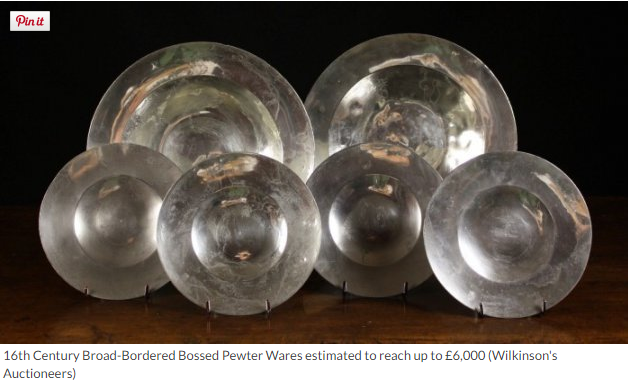
Pewter is an attractive metal which has been used for the production of household and other items in Britain since Roman times. It is an alloy consisting mostly of tin which has been mixed with small amounts of other metals such as copper, lead or antimony to harden it and make it more durable...

During the 17th and 18th centuries pewter would have been found in every household. Jugs, plates, buttons, pilgrim badges, tankards, wine cups, inkwells, candlesticks and spoons are just some of the many items for which it was used.


That is from the link immediately below.


The Pewter Society gives the following tip for cleaning encrusted pewter.

Whilst hydrochloric acid is commonly used to remove calcareous encrustation from objects recovered from the seabed, it should not be used on pewter objects. This is because of the destructive action of chlorides on tin, which can continue despite best efforts to rinse the acid away after treatment. You should instead use dilute nitric acid (a 5 – 10% solution). This will remove the encrustation safely. It usually has no effect at all on the underlying patination, but at very worst it will simply put a thin oxide layer on the surface.

Pewter items were found on the Atocha site.  Many of those were kitchen wares such as plates or spoons.  There are three pewter spoons listed in the Mel Fisher database, and a photo of one of those.

One wreck that was carrying a lot of pewter is the Punta Cana wreck, which was found off the Dominican Republic.  Over 1200 pieces of pewter tableware were salvaged from that wreck.

Findings show the wreck was a Spanish ship that was lost in the 1540s near the end of its journey from Seville to the colonies. It is one of the earliest European wrecks discovered in the Americas.


Many of the pewter plates bore the same mark found on items discovered in the wreck of Henry VIII's warship the Mary Rose, which sunk in the Solent in 1545. Around a third of the pewter has the mark of Sir Thomas Curtis, one of the most important pewter makers from the 16th century.


Here is that source link.

http://www.ibtimes.co.uk/punta-cana-pewter-wreck-dominican-republic-shipwreck-519437

You might find the  story about that wreck interesting.  Although it was a Spanish ship, much of the pewter on it was from an English maker.

There are, of course, huge differences between what you might expect to find on a ship coming to the New World as opposed to one taking treasure back to Spain.

As with most artifacts, proper care and storage is required in order to maintain the item in the best condition possible.

Antiques Magazine had the following to say.

Apparently, then, pewter disease (tin pest, it is sometimes called) is born of the unholy wedlock of cold and moisture, each of which by itself is fairy innocuous. The first principle of conservation, therefore, is: keep pewter both warm and dry; but at any rate, do not allow it to become simultaneously cold and damp.


Here is that link.

http://www.themagazineantiques.com/news-opinion/from-the-archives/2013-03-11/care-of-pewter/


---

The current Sedwick Coins auction goes live from the floor on May 18th and concludes on the 19th.

---

Maybe I've talked about this before, but it appears to me that some of the biggest obstacles to success are internal.  Take a look at Hilary and Donald.  Both are very successful and both are very driven - perhaps too much.  Although they might both think that they are uniquely intelligent and able, there are probably many people who are just as capable but not nearly as successful.  Some would say that those two people are uniquely gifted or had opportunities or situations that most other people have not had. They might say that Donald inherited millions or that Hilary rode into the White House on her husbands coat tales, and that would seem to me to be at least partly right, but what I am more focused on is the personal qualities that has permitted their success.

Both are very driven.  You might say obsessed.  And while you might wonder if that is healthy, it is a big factor in where they are.  People with similar levels of wealth or opportunity have not done nearly as much.

I'm not talking politics today.  I'm talking about success or the lack of success, and that applies to everybody and everything you might want to do, even metal detecting.

Do you detect just to pass some time?  Is it just a hobby for you?  How badly do you want to succeed? What do you want to accomplish?  Why?

There is no right answer, but I think those are all important questions. Your answer will have an effect on how much you find.

Those who find the most generally hunt the most.  Yes, there is the element of luck to some extent.  You might be one of those rare people who finds a gold coin on your first hunt - as unlikely as that is.  Or you might stumble on the world's largest treasure while walking your dog.

Those kinds of things do happen, but the odds are very long against it.  Generally speaking, those who find the most, hunt the most and work the hardest.  They have the drive, and when they encounter obstacles they overcome them one way or another.  They are willing to pay the price.  They might work smarter than someone else, but they also work harder.

Don't expect big success to come easy.  If you want it enough, there is a better chance that you will achieve it.

I'm not saying you should want it.  For me there are other things in life that are much more important. Each and every person has to determine what is important to them.  I think you'll benefit from being clear about your goals and what you want to accomplish with your life.  Wishing won't make it true.  If you really want it, you should be willing to work for it.  Your drive and effort should match your goals and priorities.

---

The surf will be a little rougher today, but not much.  It will decrease back to about one foot the next couple of days, and we'll have mostly a south wind.

Happy hunting,
TreasureGuide@comcast.net

Saturday, July 25, 2015

7/25/15 Report - New Treasure Finds Made By The Capitana! Possibility of Tropical Activity Developing Near Florida Next Week. New Poll.


Written by the TreasureGuide for the exclusive use of treasurebeachesreport.blogspot.com.

Cob Found By Crew of The Capitana.


Captain Jonah Martinez and his crew continue to make great finds.

Here is one of the latest, a nice OM and maybe J cob.

For those of you who don't know, the OM indicated the Mexico mint.  The J would be the assayer initial.

Nice find guys!

But that isn't all.

One of Captain Jonah's Top Notch Divers
Showing Off Some Great Finds.

In the plate is a buckle, a button and some more cobs.

A closer view of those finds is shown below.

The last picture shows a close-up of some very clean reales and the button.

They are nice and clean showing good detail.

You can tell they are also from the Mexico mint from the style of cross.

Thanks for letting us get a look at your finds Captain!

All of these photos were sent by Captain Jonah Martinez.


Plate Full or Finds.
Nice View of Button and Cobs.
Lots of Musket Balls.

With the picture of the musket balls, Captain Jonah sent the following  message.

A couple weeks ago we got in to some musket balls so we went back skipping ground by about two days south here's what we found about 850 musket balls grape and pistol shot hopefully more at the end of this new trail. These balls appear to be from the green cabin but we find 1715 mixed in this area.  

Here are the densities of some common metals given in grams per cubic centimeter.

Aluminum 2.7
Copper 8.96
Gold 19.3
Lead 11.3
Platinum 21.5
Silver 10.5

Silver is just a touch less dense than lead, with gold being quite a bit more dense than lead.

Here is the link.

https://sites.google.com/site/chempendix/densities-of-pure-metals

Besides being the same density another thing that would group the musket balls together is their round shape, which means they will move easily, but down more than up.

---

The same stationary front that has been causing afternoon showers along the Treasure Coast also provides conditions that could produce tropical activity near Florida next week.


http://www.accuweather.com/en/weather-news/atlantic-tropical-systems-southeast-us-coast-danny-erika/50652073

Thanks for your poll responses.

Happy hunting,
TreasureGuide@comcast.net