Showing posts with label cache. Show all posts

Thursday, October 17, 2019

10/17/19 Report - Two Hoards. Columbus Landing. 17th Century St. Augustine Shrine.


Written by the TreasureGuide for the exclusive use of treasurebeachesreport.blogspot.com.


Ancient Coin Cache Found.
Photo by Denis Glicksman


A HOARD OF EXCEPTIONAL COINS FROM THE END OF THE XVTH CENTURY DISCOVERED IN DIJON

During an archaeological diagnostic in the center of Dijon, near the old abbey of Saint-Bénigne, an Inrap team has brought to light a coin hoard of about thirty gold and silver pieces from the second half of the XVth century, coming from Italy and the Holy Roman Empire states. This hoard, of great numismatic interest, bears the likeness of a catalog of portraits of all the great princes from the end of the Middle Ages.

Here is that link.


---


Depiction of Christopher Columbus Landing.
Source: SpiritDailyBlog.  See link below.

Columbus day, which has traditionally been celebrated in the United States and other countries on-Oct. 12, in today's super-divisive hyper-political world, instead of a day of pride has become an opportunity to hold up and celebrate the uniquely egregious sins of Caucasian Christians.

For Christopher Columbus was not only a devout Catholic, but — like other explorers who would follow in his wake — a missionary. He considered the evangelization of the New World his primary goal...

Here is a link to an article about the religious feelings and motives of Christopher Columbus.
https://spiritdailyblog.com/commentary/hidden-history-columbus-amazing-catholicism

---


.- Bishop Felipe Estévez of St. Augustine announced Friday that the Shrine of Our Lady of La Leche has been elevated as a National Shrine by the US bishops' conference.

The Shrine is located at the Nombre de Dios mission in St. Augustine, founded in 1587. According to the Diocese of St. Augustine, it is America's oldest Marian shrine... 
Here is that link.


https://www.catholicnewsagency.com/news/historic-marian-shrine-in-florida-elevated-to-national-shrine-54052

---

Found Contents of a Bronze Age "Tool Kit."

Bronze Age Europe was a violent place. But only recently have scientists uncovered the scope of the violence, at a 3000-year-old site in northern Germany where thousands of well-armed young men fought with sophisticated weapons in in what appears to be an epic battle. Now, a bagful of bronze artifacts and tools found at the bottom of the river in the middle of the battlefield suggests some of these warriors traveled from hundreds of kilometers away to fight. That suggests northern European societies were organized on such a large scale that leaders could call warriors to distant battlefields, long before modern communication systems and roads.

Here is the link for more about that.

https://www.sciencemag.org/news/2019/10/3000-year-old-toolkit-suggests-skilled-warriors-crossed-europe-fight-epic-battle

Thanks to Douglas for that link.

---


Source: National Hurricane Center.
As you can see from the map, there is a system in the Gulf that is expected to become a cyclone in the next forty-eight hours.

If that one affects us at all, it won't be before several days.

Happy hunting,
TreasureGuide@comcast.net

Wednesday, October 16, 2019

10/16/19 Report - The Hesse Crown Jewels. A Silver Cross Find Examined. Pax.


Written by the TreasureGuide for the exclusive use of treasurebeachesreport.blogspot.com.

Princess Margaret Wearing Some of the Hesse Crown Jewels.
Source: See GemSelect,com link below.

The story of the Hesse Crown Jewels illustrates how a cache can be secreted, discovered, distributed and found.  Some of the Hesse Crown Jewels could still be buried somewhere.

The story of the Hesse Crown Jewels heist began during the time of WWII. To help secure the future of the Hesse family, in October of 1944, Prince Richard and Prince Wolfgang of the House of Hesse secretly placed a large collection of their crown jewels into a wooden box lined with lead and zinc, which was buried in the basement of the Kronberg Castle. The box was lowered into a hole they had dug into the floor and then covered and sealed over with concrete. The contents included several diamonds, gemstones, bracelets, rings, necklaces, tiaras, rare coins, pieces of silver, gold and family heirlooms. After burying the jewels, they abandoned the castle and planned to return and retrieve the jewels after the end of the war...

The cache was discovered by U. S. soldiers, who helped themselves and dispersed the jewels.

Almost immediately after arriving in the United States on March 12, Durant set about hiding or trying to sell all the jewels he had managed to send from Europe.

On at least two occasions he and his brother James—the recipient of most of the packages Durant had mailed—buried large glass jars filled with jewels and cash along Route 7 near James’s home in Falls Church, Virginia. Durant sold gems to several private individuals, pawned other items, and, using a false name, sold several stones to a large Washington jewelry store. He even managed to use one particularly nice diamond as partial payment for a new Hudson convertible...

If you want to learn more about the Hesse Jewels, here are the source links for both of the above excerpts.

https://www.gemselect.com/other-info/the-hesse-crown-jewelry-heist.php

https://www.historynet.com/soldiers-of-fortune.htm

---


Crude Silver Cross
Same as posted yesterday

I posted this picture yesterday.  It was just one example of a few items that I thought were probably made by an individual for their own use rather than commercially made to be sold.  It is almost exactly one inch high and wide - a fact that I neglected to mention yesterday.

As I looked at the photo, it captured my attention and made me wonder about it more than I had before.  I don't know that I ever noticed the lettering until I took this closeup photo yesterday.

The cross appears to be inexactly made.  The lines are not perfectly straight or perpendicular. The bottom part of the stapes, which is the vertical member of the cross, looks wider and offset to the right when compared to the upper section.  And the lines of the horizontal member, the patibulum, are not parallel or straight.  Rightly or wrongly, I would expect the cross to be more precise if was made commercially.  Some of the original lines could have been changed slightly by wear and corrosion, but not that much.

Despite being imprecisely made, the use of a precious metal suggests but does not prove that it was an item of some reverence for the person who carried it.  The form, of course, also suggests that.

It is possible I didn't notice the word before, since the item is very dark and rough and smaller than it appears in the picture, but now that I notice the word "PAX," I also see that the word is not centered.  I would guess that is just another example of being made with less planning and care than you would expect of a commercially produced item.

I do not see any sign that there was ever a loop or appendages for attachment, but those could have been worn or corroded away.

It shows some age, but I have no idea how much.  I wish I remember where and when I found it, and I wish I had conducted the experiments I thought about to learn how long it takes for silver to corrode after being immersed in salt water.  It could be very old, but I don't know if it is.  I've seen silver coins just a decade old as well as items centuries old, that have a similar look.

The word PAX, of course, is Latin for "peace."  Peace, the peace symbol, and homey crafts were the vogue in the seventies, but that is not the only time period that it could be from.  I can see it being made either by a Jesus Freak of the seventies or someone in the 1700s needing a point of contact with a source of peace.

I think the Jesus Freak explanation is the more likely of the two even though there are other reasonable possibilities.  Maybe I shouldn't even say "think."  It is more like a feel.

PAX has a few other meanings.  In Christian liturgy, "the Pax" refers to "pax vobis" or "pax vobiscum," which are salutations used in Catholic mass or Lutherin Diving Services.  There were also Pax tablets, which I'd expect to be much more elaborate than this simple cross, and also Pax pendants, which I'd expect to be more formal, except possibly in the most desperate circumstances when a person might have to make do with whatever poor materials they had available.

Like many metal detecting finds, this humble cross started me on a thought-journey.  I didn't solve the puzzle, but journey was fun and I learned something.  I hope you did too.

---

Here is another find that looks to me to be a craft project from the seventies.


Earring Craft Project.
I think it is pewter but not sure.
---

The National Hurricane Center map looks pretty quiet now - especially in our area.

The surf is down to around two feet and won't be any higher, at least for a few days.

Happy hunting,
TreasureGuide@comcast.net

Sunday, October 6, 2019

10/6/19 Report - Gold and Bonze Coins Found. Metal Detectors and Iron. Surf Building,


Written by the TreasureGuide for the exclusive use of treasurebeachesreport.blogspot.com.


Coin Cache
Source: See SofiaGlobe.com link below.


Archaeologists have found a valuable gold treasure in the town of Devnya, about 25km from Bulgaria’s Black Sea city of Varna.

Fifteen gold coins were found on September 29, along with more than 20 bronze coins, and another gold coin, with the image of Emperor Theodosius II and dating from the fifth century, was found on September 30.

This brings to 16 the number of Theodosius II gold coins that have been found. Also found was a gold coin with the image of the emperor’s cousin Valentinian III.

It is though that the hoard was hidden during an attack by the Huns on the ancient city of Marcianopolis in the fifth century, according to Dr Hristo Kuzov of the Regional History Museum in Varna, a statement by the municipality of Devnya said...

Here is the link for more about that.

https://sofiaglobe.com/2019/09/30/archaeology-hoard-of-gold-coins-found-in-bulgarias-devnya

---


Yesterday I listed the metal detectors that I've owned and used.  For me the detectors tell a lot about my metal detecting journey.

The first metal detector I ever used was the Radio Shack detector.  It wasn't a very good metal detector and I didn't have much success with it, but that was partly because I knew nothing about metal detecting at the time.  I didn't know what was out there to be found, and I didn't know the metal detector's capabilities.  I didn't know what I was doing.  I hadn't even read about metal detecting.  That was several decades ago.  It was long before the internet and I knew nothing about the hobby.

 Radio Shack was founded in 1921 and published their first catalog in 1939.

My grandmother purchased the detector and we took it out to the remains of the old home site where she grew up.  As I recall we found a horse shoe and some door hinges or something like that.  Later I discovered that the detector would not detect coins very well, if at all.  I didn't know back then what I always preach in this blog - get to know your metal detector.   Now I know that I should have tested it out before going out to hunt.

The old Radio Shack detector would and did detect iron, which is an important topic for me today.  My most recent metal detector has the capability of  giving an audio and visual signal in response to iron, but you can set it to NOT give an audio signal to iron.  Obviously metal detectors are more sophisticated today.

The topic of iron is still an important one.  Today we often can either detect or discriminate iron, but which you do depends upon a variety of factors.

I always recommend having specific goals.  You can be much more effective if you define your goals well.  If you don't have well defined goals, it is difficult to measure or evaluate success, and measuring success will definitely help anyone improve.  You have to know if you are on target and if not, how far off you are and in what direction.  Specific goals will help you develop effective strategies and improve performance.

On my first metal detecting outing, I lacked awareness of the situation.  I did not know the detector and had no strategy other than to take it out and wander around and see what I found.  It is no wonder that I had little success and my metal detecting was set back ten or twenty years as a result.

I want to address the iron issue today as an important example.  Many people hate iron.  They do not want to hear it, and they don't want to dig it.   But there are many interesting iron objects out there to be found.  So you really want to pass up gun parts, swords, knives, cannon balls and iron shipwreck spikes?  Maybe you do, but there are still reasons that you might want to know if there are any iron objects in the area.

Iron objects can be interesting artifacts.  Iron objects can tell you something about the site, whether it is a beach or inland site.  And iron objects can mask other objects - even gold.

I like to know where iron objects are, whether they are bobby pins, nails, or other more interesting things.  I might or might not dig them.   That depends upon my goals and strategy.  But I like to make those decisions intentionally, strategically and with as much information as I can get.

When I got my Garret pulse induction machine, the first thing I did was detect an inland swimming hole.  It was one of those places that had a bit of a beach, but also grassy areas.  There was little or no water action there so things stayed pretty much where they were dropped.  Things weren't sifted and sorted like they would be on an ocean beach.  The result was that there were a lot of bobby pins and other small bits of iron and junk laying all over the bottom.  At a site like that, the junk doesn't tell you as much as it would at some other kinds of sites.

The Garrett pulse induction detector loved those bobby pins and was not a good choice for that location.  One strategy I might use at a place like that would be to remove the junk bit by bit in stages - not all at once.  Anyhow, the Garrett was not the best choice for beginning to clean out that swimming hole.  I forget now what I used to clean it out, but I think it was either a Steve Noga or Herb MacDonald modified Nautilus.  Both of those nulled on iron but were very good on small gold.

I also remember using the same Garrett pulse detector to dig the deepest ring I ever dug.  I was in the water at an ocean beach in North Miami and dug a base metal class ring very deep out of a sand bar.  I regretted digging so long for a base metal class ring.  Had it been gold, it would have been another story.

Iron objects can be interesting and they can tell you a lot, but it is your goals and strategy that will determine how you want to treat them and what kind of detector you want to use.  I generally want to know where even if I don't want to dig them.

---

It is one of those days that I call "beachy."  The wind is blowing and it is a little cloudy.  I didn't expect to see so much wind this morning.   I looked at the National Hurricane Center map and saw a yellow X out in the middle of the Atlantic.  I suppose it is the remnant of Lorenzo or one of those storms.

It looks like the surf will be building up to Monday.  A 4 - 7 foot surf isn't bad, but the tides are near flat.  Looks like the wind will be from the south.  I haven't checked the beaches or swells yet.


Happy hunting,
TreasureGuide@comcast.net

Friday, May 10, 2019

5/10/19 Report - 3000 Ancient Coins Found by Deterctorists. Beach Conditions on the Treasure Coast.


Written by the TreasureGuide for the exclusive use of treasurebeachesreport.blogspot.com.

Roman Coin Hoard Found By Detectorists.
LINCOLNSHIRE, ENGLAND— The Sleaford Standard reports that a cache of early fourth-century A.D. Roman coins was discovered in eastern England by metal detectorists Rob Jones and Craig Paul. Paul assisted archaeologists Adam Daubney of the Lincolnshire County Council and Sam Bromage of the University of Sheffield with excavation of the more than 3,000 copper-alloy coins. Daubney said the coins were found in a ceramic pot buried in the center of a large oval pit lined with quarried limestone...

Here is the link.

https://www.archaeology.org/news/7643-190509-england-roman-coins

There is always more to find.

---

John Brooks Beach Early Friday Morning.
I visited some beach some beaches this morning to see if anything was going on.  My first stop was at John Brooks.

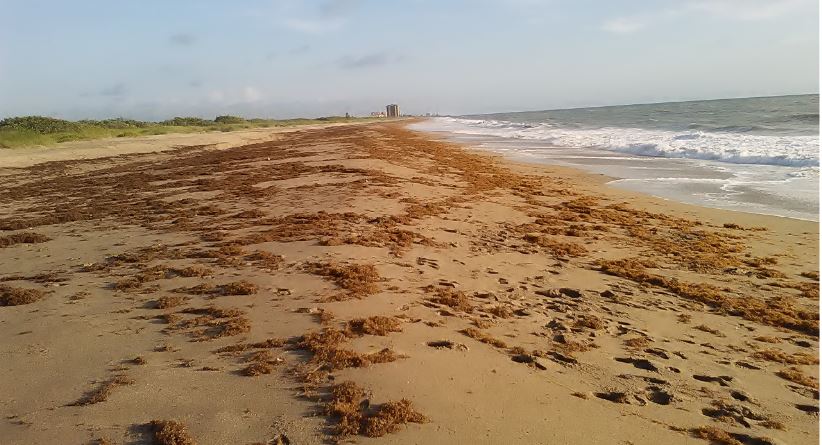
The water had been high.  It washed over the first berm and hit the remains of the old cliff behind that.  Sea weed and sand was washed up onto the beach.

John Brooks Beach Friday Morning.
There were some small cuts where the water hit the old deteriorated cuts.


Frederick Douglass Beach Friday Morning.
Frederick Douglass beach also had seaweed and accumulating sand.

Small Dip In Front of the Beach.
I'm not sure which beach this is, but it is one to the south of Frederick Douglass.  I wanted to show the nice little dip in front of the beach.

Walton Rocks Friday Morning.
This is Walton Rocks.  Again, more seaweed and accumulating sand.

The beaches that I saw were all pretty much the same.  The water had been high, but the angle wasn't good and sand was getting washed in.

---

Once again I wish I had stored and labeled finds better.  I learned a good bit about black powder guns in the last two days that I wish I had known before.  I now realize that there are a number of finds that are probably associated.  I'm going to put my percussion hammer, nipple cap and percussion caps together.  The percussion hammer stumped me for a long time.  It just didn't look like any gun hammer that I was familiar with.  I would have recognized a more modern hammer or a flint lock hammer, but I didn't know much of anything about percussion hammers.

I'll also get back on the subject of bullets and shell casings before long.  I got some more emails on that.  It looks like the exploded copper items I found and posted are not of the same era as the black powder gun parts.  I think they came from the same beach area though.  It isn't unusual for items of different ages to be found together.  I'll expect to have more on that tomorrow.

Happy hunting,
TreasureGuide@comcast.net


Sunday, March 17, 2019

3/17/19 Report - The Manila Galleons. Big Cash in The Sofa. New TV Treasure Shows. Big Surf.


Written by the TreasureGuide for the exclusive use of treasurebeachesreport.blogspot.com.


A few days ago I wrote about the Kang His porcelain that you can find on the 1715 Fleet beaches.   Of course that pottery came from China.  The porcelain and other items from Asia and the Phillipines first crossed the Pacific on the Manila galleons before being loaded on the galleons that would cross the Atlantic.

There are wrecks of the Manila galleons that have been investigated.  You can find them described in The Archaeology of the Manila Galleons, by Robert Junco.  Here is the introduction.

This paper presents a brief recount of the Manila Galleon sites investigated to date. It also proposes, some ideas of what the archaeology of Manila Galleons could consider in its research objectives. The Manila Galleons, loaded with their rich cargos of oriental goods are still a great mystery to researchers, especially those belonging to the sixteenth and seventeenth centuries. Furthermore, studies of Asian ceramics and other products of exchange in New Spain and beyond are scarce. While the work of historians and art historians has contributed significantly to the topic, archaeological studies are rare given the few sites located. In this paper, I shall mention the Manila Galleon sites that have come to my attention, and then present some ideas that I deem relevant in the pursuit of what can be termed the archaeology of Manila Galleons.

And here is the link if you want to read the rest of that article.

http://www.themua.org/collections/files/original/61b274c68e00272c5e50f0af53f5b140.pdf
I think you'll find a lot of interesting information if you read that study.  It summarizes seven different wreck sites and has an extensive bibliography that you might also find useful.

Another study of the Manila Galleons is The Arrival of The Spanish Galleons in Manila from the Pacific Ocean and Their Departure Along the Kuroshio Stream, by Jose Eugenio Borao Mateo.  This one is historical rather than archaeological.

Here is the abstract from that one.

The aim of this paper is to revisit some well-known features of the seasonal conditions and geographical incidences of (1) the yearly arrival in Manila of the galleons coming from Acapulco and (2) the first stage of their return voyage along the Kuroshio stream. It will be based on existing published data, like the well-known Blair&Robertson (BRPI), the less known Navas&Pastells (CDF), the collection of Spanish Documents of Taiwan (SIT) published by the author, and other documents from Spanish Archives. The paper will try to present the routine of these trips, and some of the nautical conditions (specially the monsoons and typhoons contingencies) as explained by sailors like Cevicos, and to revisit some particular well-known cases of shipwrecks like the ones of the Spanish galleons San Felipe (1597) and San Francisco (1609) in Japan, and Nuestra Señora de la Concepción (1638) in Marianas Islands. Finally, some conclusive ideas will focus on Taiwan as one of the last ramifications of the Acapulco-Manila route; and the fact that for the sailors was much more important the winds than the currents, which—as it seems—their knowledge was not yet totally clear.

And here is the link.

http://homepage.ntu.edu.tw/~borao/2Profesores/Kuroshio.pdf

Again, you will find a useful biography with references from some unusual sources.

There haven't been many books on the Manila galleons since the one written in the 1930s, but here is one you can preview online.  It is The Manila-Acapulco Galleons: The Treasure Ships of the Pacific, by Shirley Fish.

You might want to get it at your local library.  If they don't have it, ask for an interlibrary loan.

Click here to preview that book.

---

You might like this story about how three students found $40,000 cash hidden in a sofa they purchased at a thrift store.  Good story how it turned out.
https://people.com/celebrity/cash-couch-students-return-40000-found-stuffed-in-thrift-store-sofa/

---

There are some new treasure hunting TV shows this season.  I ran into one the other day.  It is Lost Gold.  I think it was on the Discovery channel.   I didn't find it very exciting.  The best thing about it for me, in the short time I saw it, is that they talked about some famous treasures and early treasure hunters and detectorists, such as Frank Fish.

You can read more about Frank Fish in this issue of The Tombstone News.

It begins...

In April 1963 death came to one of the most famous and successful of the treasure hunters, Frank Fish. To all appearances and evidence he died by his own hand. But did he? Frank was my close and personal friend; my family and I spent many hours in his Gold Rush Museum listening to him spin yarns of lost and buried treasures. To say the least, it is my honest opinion that Frank Fish was not the suicidal type. He loved his museum and its thousands of relics too well. In addition he was close on the track of a large treasure cache for which he had searched many years...

I also saw advertisements to a program on Civil War gold and a Japanese treasure in the Philippines.

I'm a little over most of the TV treasure shows.  They have generally been disappointing.  Too much foolish hype and showmanship, and not totally trustworthy.  It is better to go out and do it for yourself anyhow.  Still, we all have a little downtime for foolishness.

---

The Treasure Coast surf forecast has changed a little.

Source: MagicSeaWeed.com.
It looks like the peak of about seven feet will be Tuesday.  It doesn't look like it will be as sustained as forecast earlier.   Still a pretty good size, along with some good tides.  And still a couple days for things to shape up.

Happy hunting,
TreasureGuide@comcast.net


Thursday, December 6, 2018

12/6/18 Report - Treasure Signs and Symbols. 3000-Year-Old Cache. EM61 Metal Detector. Your Personal Life Story.


Written by the TreasureGuide for the exclusive use of treasurebeachesreport.blogspot.com.


Some Treasure Signs
Source: See TSEATC.com link below.

---

A three-thousand-year-old leather bag of jewelry was found by archaeologists.

The treasure itself consists of jewelry of Bronze spirals and tin funnel-shaped hangers that were probably put into the ground in a leather package with three Bronze disk-like objects sewed to the top. The remains of organic leather material that is about 3000 years old were kept between them and the jewelry...

Here is the link.

https://spectator.sme.sk/c/20971362/archaeologists-found-treasure-from-the-bronze-age.html

---

The funeral of George Herbert Walked Bush was a time for reflection.  It was something I think our country needed as the political leaders from both sides came together to honor an exemplary life.  It was a time for everybody to step back and gain some perspective.  I'm sure it won't have any huge long-term impact, but I am hoping that people on both sides learned something.  If they don't, it is not the fault of the Bushes or any of the speakers, each of which provided plenty of food for thought.

I was especially impressed by the Presidential historian, Jon Meacham.  Too bad everybody doesn't have a personal historian.  Georg H. W. Bush's story is exceptional, but everybody has a story.

Many people don't know their own story.  Maybe they've never thought about it, and they haven't taken the time to step back and get the larger picture.  It is worth considering.

Each person's story consists of more than the things they did and the things that happened to them.    There is a theme, and plots and subplots.   Introspection, analysis and insight is required.  There is psychological element and interpretation.

Personal stories are part fiction and part fact.  They are often influenced by family stories, such as grandpa was the toughest man in the county, or grandma as a great musician that was descended from royalty, or you come from a long line of achievers, or great great grandpa was a slave brought here from Africa.

Those stories might or might not be entirely true.  Often they have some basis in fact but are not entirely accurate.   But true or not, they can become part of each family members personal story.

How would you describe yourself?  How do you want your children to see themselves?  Think about it.  You might not have someone like Jon Meacham to tell your story, but if you think about it, you will discover that you are developing a story worth passing on.

---

Yesterday I incorrectly referred to the EM61 as a GPR system.  When I watched the TV show I didn't catch the full name of the system.  It is actually a metal detector.

I made corrections to my references in yesterday's post and provided a link for more information about the EM61.  Here is the link to information about the EM61.

http://www.geonics.com/html/em61-mk2.html

---

I once had a book, I think it was by Frank Hudson, that had a list of pirate treasure signs and symbols in it.  I couldn't find it so went looking for it online.  I didn't find it, but I did find a document detailing pages of treasure signs.

http://www.tseatc.com/files/Download/THAPI_pgs1-10.pdf

The symbols shown at the top of this post are from that document.

This is the largest list of treasure signs that I've seen compiled.  I know the same symbols can be found in other less extensive sources.

---

It looks like the Treasure Coast surf will remain small for a few days.  According to the MagicSeaWeed predictions, there is the possibility of a bigger surf in about a week.

Surf Predictions.
Source: MagicSeaWeed.com.


We've had a few days of north wind, and I suspect there will be a few small insignificant cuts on the beaches.

Happy hunting,
Treasureguide@comcast.net

Tuesday, December 4, 2018

12/4/18 Report - A Pot of Gold Coins Found. A President Laid To Rest. More Lady Liberty Coins.


Written by the TreasureGuide for the exclusive use of treasurebeachesreport.blogspot.com.


Cache of Gold Coins.
Source: See BBC.com link below. 


The rare cache was found - along with a single gold earring - in a bronze pot between stones in the side of a well.


The hoard of 24 coins appears to have been hidden by someone who hoped to retrieve it, but never returned.


Archaeologists say the owner may have died when the city's inhabitants were massacred by a Crusader army in 1101.

The discovery was made during an excavation and conservation project at the Caesarea World Heritage site...


Here is the link for more about that.

https://www.bbc.com/news/world-middle-east-46429990


Many caches are found during construction projects. I think I forgot to mention that when I listed ways they are often found.

---


Yesterday the nation's attention was focused on a flag over a coffin in the rotunda of the Capital Building.  Despite the strong feelings, thoughts and memories of those who gathered around the coffin or watched it on TV, George Herbert Walker Bush was no longer there.  The spirit of  life was drawn to and illuminated by its mirror image.

It was mentioned that George Herbert Walked Bush went to war at 18 to serve his country.  I thought of the many thousands of young men who did the same, including those who died on foreign soil only a short time later; as well as those that came back to live long lives never speaking much of the matter again.

While my mind was with those who gathered at the Capital building yesterday, my mind was also drawn to the Tomb of the Unknown Soldier and the many silent cemeteries around the country, as well as the families those silent nameless soldiers created, protected, supported and left behind.

Without at all lessening the honor and respect deserved by the former president, I thought of the nameless or forgotten men and women, who lived well, gave much, were perhaps unfairly judged, and lived honorably out of the public light doing the best the could where they were planted.

Every person is unique, but in some ways we are also the same.  All men begin their journey at a different place, and travel a different path, but end up at the same narrow gate.

May we seek and find understanding, judge as we would like to be judged, and respect and honor others to the best of our ability.

---

Yesterday I posted some information about Lady Liberty as seen on our coins.  Warren D. sent me a couple examples along with the following message.


1781 Coin or Token


One I believe is a Gaelic (Irish) token which is copper and was given to Irish immigrants who came to North America probably Canada at the time.
It is dated 1781. I think it was given to them as a form of currency, I'm not sure if it truly was. It looks like lady liberty seated on one side and a sailing ship on the other side.

The other is a US large cent dated 1816.
1816 Large Cent.


Thanks Warren.

---

There were over a thousand page views of this blog yesterday.

Last night I observed a lot of lightening in the distance over the ocean and this morning we got some rain.

The high tides are still fairly high.

The surf will be increasing later in the week, but only up to about two or three feet.  That won't help much.

Happy hunting,
TreasureGuide@comcast.net

Thursday, November 29, 2018

11/29/18 Report - Cache Of 7000 Coins Uncovered. World Coins. Unidentified Coin. Denticles.


Written by the TreasureGuide for the exclusive use of treasurebeachesreport.blogspot.com

Cache of Silver Coins Found in Pots.
Source: See Archaeology in Bulgaria link below.

A hoard of over 7,000 silver coins minted by the Ottoman Empire and hidden in two treasure pots has been discovered by accident by inmates from the prison in the city of Pleven in Northern Bulgaria.

The Ottoman coin hoard with the two broken treasure pots was stumbled upon on November 9, 2018, by prisoners during agricultural work on land owned by the Pleven Prison.

The newly discovered silver treasure, which is believed to have been buried in the ground in the 19th century, was formally presented to the media by the Pleven Regional Museum of History on November 19, 2018
...

Here is the link for more about that.


A few days ago I listed a number of ways that caches are found.  This is another example of a accidental hoard found as the result of farming.

---

As I said the other day, you can find coins from many countries on Florida beaches.  I posted a list of the countries that I have found coins from.  Alberto S. sent me some additional ones that he found (blue) and I added a few that I previously overlooked (red).  Here is the updated list.

Argentina, Armenia, Bahamas, Barbados, Belgium, Canada, Cuba, Chile, Columbia, Costa Rica, Guatemala, Denmark, England, France, Germany, Haiti, Iceland, Indonesia, Ireland, Isle of Man, Israel, Italy, Jamaica, Kenya, Mexico, New Zealand, Norway, Panama, Poland, Russia, South Africa, South Korea, Spain, Switzerland, Sweden, Trinidad and Tobago, Ukraine, Uruguay, Virgin Islands.

Here is one that I haven't identified.

Unidentified Coin.


Can anyone identify this coin for me?  Thanks.

Sorry I couldn't get a better photo.

Send  me any other additional countries that you have found coins from and I'll add them to the list.  Photos would be nice too.

---

Denticles Around Coin Rim.
Source: See TheSpruceCrafts link below.
Here is a brief article on denticles  (the irregular raised areas around the inside rim shown above).

https://www.thesprucecrafts.com/denticles-on-coins-768440

---

Turkey is moving gold bullion to Iran for oil.

Here is the link about that.

https://invest.usgoldbureau.com/news/us-moves-keep-valuable-gold-out-iranian-hands/

---

It looks like the surf on the Treasure Coast will be only one or two feet for a few days.

We'll have a north wind for a while today, but not much surf.  The wind will then shift and we'll get some warming weather.  

The tides still are decent.

Let me know if you have found coins from additional countries or can identify the unidentified coin.


Happy hunting,
TreasureGuide