Showing posts with label slaves. Show all posts

Wednesday, June 10, 2020

6/10/20 Report - Christopher Columbus Statue In the Lake. Trade Relations Between Spain and Indigenous. On Missing Items With Your Metal Detector.


Written by the TreasureGuide for the exclusive use of treasurebeachesreport.blogspot.com.


A Christopher Columbus statue in Richmond Viginia was torn down, torched and thrown in a lake by protesters.

https://www.msn.com/en-us/news/us/christopher-columbus-statue-torn-down-thrown-in-lake-by-protesters/ar-BB15hVGk

I suppose you can find a lot of interesting things in lakes, especially where there have been wars and uprisings.

---

Speaking of Columbus, you might find Trinkets (f)or Treasure? The role of European material culture in intercultural contacts in Hispaniola during early colonial times, a 260 page thesis by Floris Keehnen interesting.  It describes trade between the Old World and New World in the early contact days along with much history and analysis.

Below are a couple brief excerpts discussing the objects of trade.

 European exchange commodities furthermore included “horses, saddles, and stirrups; cloth, caps, and hats; saffron, wine, wheat, and salt; and lead, iron, steel, copper, and brass” (Phillips and Phillips 1992, 55). Next to slaves and gold, the local African rulers offered “animal skins, gum arabic, civet, cotton, malagueta pepper, cobalt, parrots, and camels” (ibid.). Not only Portugal, but also Castile profited from the African gold that reached their markets in high quantities where it contributed to a flourishing economy. The Iberians were now making good profit from the trade in gold and slaves and this would continue for a couple of centuries more (Bovill 1995; Thomas 1997; Thornton 1998)...


In the above fragment of the first documented exchange, the things mentioned by name to have been
traded are red caps, glass beads and bells by the Spanish, against parrots, cotton and javelins by the
Indians. Indeed these were among the items that were most frequently bartered between the two
cultures. But also tableware, like “pieces of (clay) bowls” and “broken glass cups” (Dunn and Kelley
1989, 71, 107), “fragments of dishes and plates” (Chanca in Parry and Keith 1984, 87), as well as coins, clothes and lace-ends, were swapped. At one instance it is mentioned that some of the Spanish sailors had caught a sea turtle, of which the ship’s boys traded pieces of the shell, the size of a fingernail, for which they were given javelins in return (Dunn and Kelley 1989, 197). The exchange is remarkable, since the Spaniards here trade a local and, for the natives, familiar (though rare) commodity with the TaĆ­no, assuming the presence of a certain ethos of hospitality or social strategy with strangers. As regards gold, this was not traded in the first couple of days of contact. Though, upon seeing some pieces of gold a Lucayan Indian was wearing as ornamentation, Columbus was covetous to find all there was. This he made explicitly clear to the local people by dangling gold, but also pearls, in front of them, asking where to find it (e.g. ibid., 133).79 As appears from the ethnohistoric accounts, the people of the Greater Antilles soon perceived the Spanish enrapture of the material, often before their actual arrival (cf. Mol 2008).

And here is the link for the entire lengthy thesis.

https://www.academia.edu/4804086/Trinkets_f_or_Treasure_The_role_of_European_material_culture_in_intercultural_contacts_in_Hispaniola_during_early_colonial_times?email_work_card=title

---

Last night confederate statues were being torn down in Portland, and a statue fell and critically wounded one of the participants, so the protestors slinked off into the night.

Same type of things is going on in other countries. See  https://www.cbc.ca/news/world/statue-slave-trader-toppled-threw-in-river-edward-colston-bristol-england-1.5602443

---


Detectorists like metal detectors.  If they find something they often credit their trusty detector, and if they fail to find something, the metal detector is one of the first things to be blamed, but there are a lot reasons you might miss objects.

I remember back many years ago not long after I began metal detecting I was detecting Hollywood beach and a fellow asked me if I could detect his watch.  Of course I said yes, but he wanted to test me.  He buried his watch under some sand as I looked the other way.  Then I used my detector.  I walked right over the watch without getting any signal from my metal detector.

I suppose that my sweep pattern wasn't very good.  I was probably moving too fast and leaving space between sweeps, but it could have also been that I was using discrimination.  Either one of those could have been the case, but I know that a Fisher 1280, properly used, should detect any watch.  I am certain it was not the fault of the metal detector.

I do remember that in those days I was using discrimination, so that could have been the reason I missed the watch.  In fact, at first I was finding a lot of men's rings, but few women's rings.  I remember thinking  that men must lose more rings than women.  Of course later I learned that if I turned my discrimination down I found just as many women's rings.  It wasn't the metal detector's fault that I was not getting the valuable women's rings with diamonds.  It was my fault for not using the detector well.  Of course you need a metal detector that works, but you also need to use it well.

I've often said, if I was depending upon someone finding me my next meal, I'd trust a wise old hunter with a bow and arrow over a novice with the best gun ever.   There is more to hunting game than shooting it.  It helps to know the habits of the game and where it can usually be found.  It helps to know how to track it and get in position to get a good shot.

Your metal detector does make a difference.  Some are better than others, but if you have a decent detector, and know how to use it well, there are other important factors, including knowing how to use it.

I know darn well that I miss a lot of things.  I expect to miss things.  You can't cover the entire beach.
Remember that your detector coil only covers a few inches at a time.  And if you are doing a normal sweep, you are probably skipping some ground in between sweeps.

I often do a lot of checking around using a very loose pattern first, and then if I find a spot that looks more promising I'll slow down and cover it more tightly.  I can't go into all the signs that indicate it is time to slow down and tighten the pattern now.  There are quite a few of those. Some involve the lay of the land, and others include other types of clues.

As I've said before, unless I have reason to believe one particular area is worth inspecting well, I'm not going to slow down, and I know I might miss some things.  I'm looking for an area that looks like it is a better area than most other areas and then I'll slow down.

If an area looks very promising, I'll not only cover it very tightly, but I'll cover it multiple times, and perhaps with more than one metal detector.

Yes the detector makes a difference, but if you have a decent detector for the job, how you use it is just as important or more important than the detector you are using.  If you aren't finding anything or if you miss something, don't jump to the conclusion it is the metal detector's fault without checking to see if your settings, sweep speed and pattern and other things are good.  Those things can make a huge difference.  A poor detector used well can perform better than an excellent detector used poorly.

You can find coins without a metal detector if you know where to look.  It will only be a fraction of the total you can find with a metal detector, but you can often find coins laying on the surface if you know where to look.  If you do find coins laying on the surface, you can bet there will be a lot more just beneath the surface.

There is a lot more to say, but I'll stop there for now.


Happy hunting,
TreasureGuide@comcast.net


Monday, June 8, 2020

6/8/20 Report - Shipwreck Bochie or Manillas From 1600s Wreck. Fenn Treasure Finally Found. Sebastian Beaches.


Written by the Treasureguide for the exclusive use of treasurebeachesreport.blogspot.com.

Sebastian Sunday
Beachcam image submitted by JaminJack.

Jaminjack sent these two beach images.  The first was a little earlier when there were fewer people out.

You can see the scooped front beach and some dips in the water.


Sebastian Later Sunday.
Beachcam image submitted by JaminJack.

Thanks Jack.

---

Odyssey Marine explored a shipwreck found at the Western Approaches to the English channel.  the wreck, dated to circa 1660 - 1680, appears to be a merchant vessel of the Royal Africa Company.  36 iron cannon, a quantity of elephant tusks and copper bracelets were among the artifacts discovered on the site.


Manillas or Bochie
Bracelets Used As Money in West Africa Up To The 1940s.
Source: Odyssey Marine, Paper 23.

In Odyssey Marine Paper 23, bronze or copper bracelets that were used as money in West Africa since at least the 1500s, were discussed.  It is thought that originally they were created by the indigenous Africans from rods or spikes salvaged from shipwrecks.  Later they were manufactured in great numbers by Europeans who traded them for slaves, gold, ivory and other products.

 West African exchange demanded enormous quantities of this form of currency. As early as 1504-07, just one trading station along the Guinea coast imported 287,813 manillas from Portugal (Davies, 2002: 47). In modern terms of monetary exchange they yielded high dividends. In 1505 a Portuguese merchant reported that at Calabar a large elephant tooth could be exchanged for one manilla and a slave purchased for eight to ten copper manillas (Einzig, 1949: 150-1; Johansson, 1967: 12)…

The Odyssey paper provides a detailed study of the wreck, including much damage by fishing trawlers and provides many pictures of the site and artifacts found on the site.

Here is the link for more of the study.

https://www.academia.edu/3597456/Neil_Cunningham_Dobson_and_Sean_A._Kingsley_A_Late_17th-Century_Armed_Merchant_Vessel_in_the_Western_Approaches_Site_35F_?email_work_card=title


---


SANTA FE, N.M. (AP) — Famed art and antiquities collector Forrest Fenn, who hid $1 million in treasure in the Rocky Mountain wilderness a decade ago, said Sunday that the chest of goods has been found...


Fenn posted clues to the treasure’s whereabouts online and in a 24-line poem that was published in his 2010 autobiography “The Thrill of the Chase."...


Fenn told The New Mexican in 2017 that the chest weighs 20 pounds (9 kilograms) and its contents weigh another 22 pounds (10 kilograms). He said he delivered the chest to its hiding place by himself over two separate trips...

Here is the link for more about that.


---


Cristobal weakened as it moved inland.

On the Treasure Coast we'll have a few days of smooth surf.

Happy hunting,
TreasureGuide@comcast.net

Friday, May 24, 2019

5/24/19 Report - Beach Conditions and Observations. Wreck of the Clotilda Found. Another Bottle Find.


Written by the TreasureGuide for the exclusive use of treasurebeachesreport.blogspot.com.

John Brooks Beach Early Friday Morning.

I checked out a few beaches this morning.  As you can see, John Brooks had a little recent erosion, but had filled in a little again since the erosion.


John Brooks Beach This Morning.
I did a quick check, maybe about thirty minutes and found a few crusty modern coins.  Nothing interesting.


Frederick Douglass Beach Friday Morning.
Frederick Douglass beach also had some small cuts, but less than John Brooks.


Blind Creek Friday Morning.
Blind Creek had no cuts.  The only detectorist I saw this morning was the nude detectorist of Blind Creek, if you didn't know better you might think that has something to do with the name of the beach.


Blind Creek Friday Morning.
I really didn't really look, but I know that was  no goody bag.  I don't know what he does with finds.


Fort Pierce South Jetty Friday Morning.
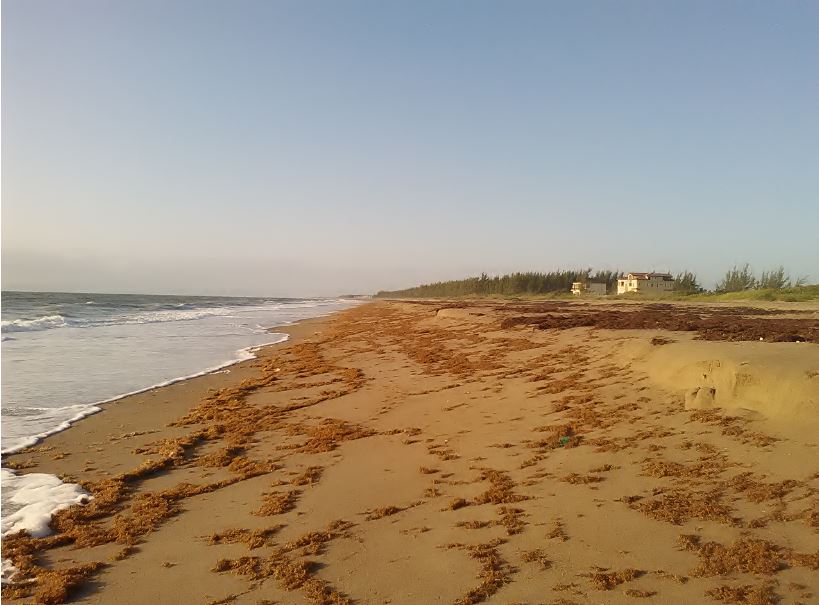
South Jetty Park had a little erosion but was pretty much covered with seaweed.

As you can see, seaweed was seen on every beach this morning.

There had been a little recent erosion on most of the beaches, but still they didn't look very good to me.  My quick check only turned up a few crusty clad coins.

The tides are flattening out now and the surf will be slowly decreasing for a few days.

My favorite find this morning was a plastic milk bottle carrier.  The last time I was at a store I thought about buying one, but I didn't like the price.  The plastic crates are good for storing bottles.

---


The remains of the last known ship to bring enslaved people to the United States have been found nearly 160 years after its illegal voyage from Africa to Alabama, state officials say...

In 1860, the Clotilda transported more than 100 people from Benin, Africa, to Mobile, Alabama, a voyage that took place 52 years after the United States banned importing new enslaved people...

The leaders of the Clotilda voyage, Timothy Meaher and Capt. William Foster, evaded authorities and destroyed the ship by burning it after their illegal trip, the state's historical commissions says...

Here is the link for more about that.


---

Here is another of my ink bottle finds.

Cone Carter's Ink Bottle. 

The bottom reads:  CARTER - MADE IN USA - NO 5.

The William Carter Company was founded in 1858 as an ink manufacturer, and became the world leaders in this field at the end of 1800. In the mid of 20s they entered the fountain pen market, that at the time was in its full development. But after the great depression of 1929, which caused a sharp reduction in the fountain pen market, the company decided to stop producing pens and mechanical pencils in the early 30's.

The pens produced by Carter were excellent quality, and they made in unusual colors much different than those of its competitors of that time. Because the short period of activity of the company, its pens are quite rare and quite sought by the collectors.

Carter cone bottles come in different colors. I have a brown one and have sold both brown and green.

I remember finding my first cone ink bottle - a brown CARTER'S cone that I sold.

The bottom of the brown one I still have is similar and reads:  CARTER'S - 1897 - MADE IN USA.

That one can be seen in my bottle barn web site.


---

Happy hunting,
TreasureGuide@comcast.net


Friday, June 12, 2015

6/12/15 Report - Lost Ring Found & Returned Months Later. Do Your Good Deed And Let Everyone Know.


Written by the Treasure Guide for the exclusive use of treasurebeachesreport.blogspot.com.


Ring Found By Warren D.
Photo by Warren D.
Happy To Have Her Ring Back
Photo by Warren D.
Warren D. sent me an email telling the story of this returned ring.  Here it is.

I was metal detecting the wet sand with a Detector Pro Headhunter pulse detector at Ocean Ave, Melbourne Beach when a woman approached me and asked if I could find a lost ring. She said her family was posing for family pictures by the sand dunes a couple of blocks to the south when the ring was lost by her niece. I got a general description of the area as being where there was a lot of sea grapes as a back drop. I told her my detector was good for the wet sand but I have other detectors that can discriminate in dry sand and avoid a lot of the junk. I asked her when was it lost and she said about 4 months ago. She later told me it was last October, 8 months ago. I made 4 separate trips to detect the area with my pulse detector and a White's MX5 detector and a Minelab Sovereign. Each detector taught me something about the area and when I thought it was fairly clean I went back with my Detector Pro pulse and found it yesterday. It was in a area that I did not cover with my first 3 trips but it was close. On the fourth trip I was confident I knew where the ring "wasn't" if that makes sense.

Way to go Warren!  Good deed accomplished.


That is the kind of thing that doesn't happen if metal detecting is banned.  You lose your engagement ring, Rolex watch or locket with the only picture you have of grandma - too bad.  If detecting is banned we can't find it for you.  It will have to stay in the ground with the millions on millions of pull tabs, beer cans, fishing sinkers, along with knives and other dangerous items.


There are places where detecting is already banned.  They don't seem to care about your lost items.  I'm sure this woman and many more are happy that a detectorist went to the effort and was able to find and return a cherished lost items.  


I bet that if those in control lost something, they'd make an exception and go out with a detector to find it.  That is, if it is something that belongs to them.


I've shown a few returned items in this blog.  I've found and returned a good number myself over the years, and I'm sure that the others that read this blog have too.


 Thankfully metal detecting hasn't been banned everywhere yet.  Yes, there are some places (too many) where it has been banned.  We can theoretically detect in the St. Lucie County Parks, but if the item is covered at all, we can' t get it for you.  They say digging of any type is banned.  It has to stay in the ground no matter what it is.

Warren did several things that I want to point out.  First he looked several times and used different detectors.  He said Each detector taught me something about the area and when I thought it was fairly clean I went back with my Detector Pro pulse and found it yesterday. 

In my 7/22/14 post I described a strategy that I called an intensive step search, which employs various detectors and settings for multiple searches of the same area in order to gain greater understanding while progressively cleaning out an area in steps or stages while you learn more about the site.

Warren also said, It was in a area that I did not cover with my first 3 trips but it was close. On the fourth trip I was confident I knew where the ring "wasn't" if that makes sense.

Very often people will be off when they describe where they lost an item.  That is especially true when the item is lost in the water.  They don't usually understand the currents and tides.  That can throw them way off.  If you ask them what time of day it was that will help you figure out the tides and depth of water.

And it is important to learn where things are not. That is how you will narrow down a search.

For me, it is important to know where the junk is, especially in the wet sand and shallow water.  That is a part of my analysis and helps point me to the better areas.

Thanks much for doing and reporting this good deed Warren!  People need to know how much good we do.  They generally have no idea.  The detecting hobby might depend on it.

---

Yesterday the first thing I dug was a pair of reading glasses.  They were found where such things are often found - near the swash.  Watches are often found in that area too.  

A lot of people lose their glasses when they are surprised by a wave.  I've found and returned glasses to tourists that otherwise would have been in trouble without their glasses while far away from home.

Keys are another important item that we often find.  Of course, getting your keys returned can save the day.  I've found keys for both individuals and businesses.  

One time the beach concession guys at the Fountainbleau lost their keys before they got started in the morning.  They were literally out of business until the keys were found.  They offered me fifty dollars to find the keys and gladly paid that when they were found just a few minutes later.

---


SW added this clarification on the issue of the Seminoles owning slaves.  ...not all blacks with the Seminoles were their slaves, the runaways from the north that went into Florida were allowed to join them. This was done for protection of both parties. The runaways were protected from recapture and the Indians protected from raids. The Seminoles were very big slave owners, they never tended their own fields. They were actually quite wealthy, They got a lot of money from Jackson at the end of the 1st war and were still getting payments from the initial treaty.

Thanks SW.  I remember reading in one of the digital books that I recently mentioned in the blog that the Seminoles wanted compensation for their slaves, but someone said that they were runaway slaves and therefore not the legal property of the Seminoles so the slaves should be returned to their previous owners.


Just something that caught my attention as I quickly browsed the book.


You can get a lot of interesting history from those old books.


----

A group of undocumented immigrants came ashore on South Hutchinson Island this morning.  Some were detained, at least one initially escaped.  Here is the link.

http://www.tcpalm.com/news/local-news/st-lucie-county/crime/search-on-for-at-least-15-immigrants-who-came-ashore-on-hutchinson-island-in-st-lucie-early-friday_66586608

One time when this happened in the past, they set up roadblocks on the bridges and checked everyone's trunk before allowing them to pass to the mainland.


Bill M. said, There was helicopters in the air, Coast Guard in the water and officers on land because of this early this morning on the north end of Jensen Beach near nettles island... There was between 12 and 15 people aboard that boat.

No change in beach conditions.  Boy it has been a long time!

Do your good metal detecting deed today and let people know about it.

Happy hunting,
TreasureGuide@comcast.net