Showing posts with label South Hutchinson Island. Show all posts

Monday, May 4, 2020

5/4/20 Report - TreasureGuide's Formula For Metal Detecting Success. Tragic Treasure Coast History. Analyzing Your Goals.


Written by the TreasureGuide for the exclusive use of treasurebeachesreport.blogspot.com.


I developed a formula for metal detecting success. I presented the first version a few years ago but have continued to improve upon the formula.

The previous version of my success formula looked something like the following.

Success = L + T + Sk + E + D


I defined Success as the number of finds. I suppose it would be better to define success in terms of total value. Value, of course, is subjective. 

How you define success is very important. You should be very clear about what you want to accomplish so you can quantify and measure your progress. Keep track of what you accomplish as it relates to your goals. That feedback will help you improve your level of skill. It might not seem like it is very important, but you will be surprised by how much it helps to measure and monitor your success in a very precise way.

In my old formula, L represents location, T is time spent detecting. Sk stands for skill level, D, the detector used, and E is amount of effort.

I discussed those factors to some extent in previous posts. I talked about the effort factor in my 1/9/18 post, for example.

Extreme effort can really pay off. It refers to really pushing the boundaries in a variety of ways. I've discussed that before and won't get into it again now. Extreme effort can be limited by your determination, physical fitness, and courage, or should I say stupidity.

D is for the type of detector you use and its capabilities - not how you use it. How you use your detector is part of the skill factor.

I wanted to revisit the formula because I am going to add a couple new factors.

The most important factors are listed first. The two new factors were added to the end of the formula but that might change after I more carefully evaluate their relative importance.

Location is the most important factor in my opinion. If you are not where the targets are, none of the rest matters much. And time is definitely right up there at the number two spot.

Factors can interact. I suspect that most of them do. If you have a quality detector, it still doesn't matter much unless you know how to use it well. So the skill factor definitely interacts with the detector factor.

Not long ago I mentioned the importance of the time you spend scouting around and how that time can be as important as the amount of time you spend detecting. Time spent on the beaches and time spent scouting the beaches can dramatically improve your chance of being at the right spot at the right time. The time factor therefore includes time spent in the field scouting as well as time spent actually detecting. It also includes researching sites. Therefore to be more specific, my time factor includes three factors: time scouting (Ts), time detecting (Td), and time gathering and assimilating information (Ti).

The new factors that I am adding today are networking (N) and access (A), so the new revised formula is  Success = L + T + Sk + E + D+ N + A.

Networking, like employment networking, includes relationships that provide you with important information. It helps you find out what is going on where. That includes internet as well as other relationship networks. This blog has a networking component.

The other new factor that I am adding to the formula today is access. Some people have more access than other people. For example, if you are a park ranger that can metal detect in a park while others can not, that gives you an advantage. Or if you have access to restricted areas because of your employment or occupation or other reasons, that can als be an advantage. Or if you have access to the beaches when others do not, such as having a beach-side residence so you can get on the beach while the beaches are closed, that is an advantage too. Perhaps the most obvious example is having a state lease to shipwreck site that excludes others from being able to detect that site.

So that is my new and improved version of my formula for metal detecting success. Expect future adjustments to the formula.

---

The Treasure Coast was the scene of some very gruesome 20th century history as mass murderer Gerard Schaefer tortured and killed along South Hutchinson Island and A1A in the 1970s. One incident occurred at Blind Creek. If you have a weak stomach, you might not want to read anymore about this, but here is the link in case you do.

https://murderpedia.org/male.S/s/schaefer-gerard.htm

----

Definitions are important if you want to communicate clearly or think clearly. I highly recommend using "operational definitions," but I won't attempt explain anymore about that now.

Having some meaningful measure of success will help you assess how well you are doing, but first you have to know exactly what it is that you want to accomplish.

If you just look at detecting as a hobby or a form or relaxation, you don't need anykind of measure, but if you want to accomplish something specific, it will help to have good data.

First, ask yourself what you want to accomplish. Is it old coins, modern jewelry, artifacts or whaat? Are you going for quantity or quality? Or are you going for total value? Just what is it? You'll often find that quality is sacrificed for quality or vice versa, but you need to be clear about your goals.

If your target is something really big, you'll probably need a lot of a patience. Maybe you don't have the patience to do that. Maybe your personality would be better suited to something that makes it easier to see occasional success. That is something to consider.

Your personality will determine to some extent the types of goals that will best suit you. If you can't tolerate long periods of time without any clear successes, you might mix types of hunting, You might find yourself taking time off from your big target to do a bit of something that provides more frequent feedback.

If you watch Gold Rush on TV you'll see guys spending huge amounts of money on big equipment and land and then processing untold amounts of paydirt to accumulate a decent amount of flour gold. That is not for me. First, I'm not going to make a huge investment out front and then work a long time trying to make back my original investment. Secondly, processing endless yards of dirt to get that kind of gold just doesn't interest me. It requires a lot of repetition.  It might be profitable, eventually, but it is just not my style.

It is important to know yourself, and it can be very helpful to be very clear about your goals and keep good records that will provide feedback on your progress. But that also requires you to be a certain type of person.

---

The tides are big, but the surf is getting smaller. Tuesday and Wednesday the predictions say we will be getting a one foot surf.


Happy hunting,
TreasureGuide@comcast.net


Saturday, November 2, 2019

11/2/19 Report - Sand Accumulating on Treasure Coast. USS Johnston Found. Hunley Theory.


Written by the TreasureGuide for the exclusive use of treasurebeachesreport.blogspot.com.

Fort Pierce South Jetty Beach Friday Evening.
Friday we had some good wind and a higher surf.  It did nothing good to the north end of South Hutchison Island.

Even up by the Fort Pierce inlet where it had been eroded, it had filled again.  Like the other beaches I looked at, it was very mushy.


John Brooks Beach Friday Evening.

Nothing but accumulating sand down around John Brooks.


John Brooks Beach Friday Evening.

Shells were up near the high tide mark.


John Brooks Beach Friday Evening.

From what I saw at the few locations I visited, it looks like nothing but accumulating sand.  Things could be different elsewhere.


North of John Brooks Friday Evening.

---

A few days past the 75th anniversary of the Battle of Samar, researchers from Vulcan Inc.’s research vessel R/V Petrel believe they’ve found wreckage from the engagement’s famed Fletcher-class destroyer, USS Johnston (DD-557).
Images of twisted metal, a destroyed deck gun, a propeller shaft and other less recognizable debris were posted to Petrel’s Facebook page Wednesday, with a video narrated by Rob Kraft, Vulcan’s director of subsea operations, and Paul Mayer a submersible pilot with the team started by the late billionaire and philanthropist Paul Allen...
See more at...

https://news.usni.org/2019/10/30/wreck-of-famed-wwii-destroyer-uss-johnston-may-have-been-found

---

Ever since the Confederate submarine Hunley was discovered off the South Carolina coast, theorists have wondered what caused it to sink in 1864.

Now Clemson University researchers might have found an explanation to what caused the world’s first successful combat submarine to vanish.

Researchers discovered the Hunley’s air circulation system was not in use when the sub and her eight-man crew disappeared in 1864, the Friends of the Hunley said Wednesday in a news release.

The Hunley held enough oxygen for the crew to survive for roughly two hours, and there were only two ways to replenish the air supply, according to the release...


See https://www.thestate.com/news/local/military/article236813773 for more about that.

---

Live bidding on the Sedwick Treasure Auction number 26 continues today

Happy hunting,
TreasureGuide@comcast.net


Monday, September 23, 2019

9/23/19 Report - From the Treasure Coast to the Palm Beaches - Conditions and Finds. Triton Submarines Visit the Titanic.


Written by the TreasureGuide for the exclusive use of treasurebeachesreport.blogspot.com.


Palm Beach
Photo by Joe D.

Palm Beach.
Photo by Joe D.

The South Hutchinson Island beaches were not looking good this morning.  In fact those beaches haven't changed much at all in the last few weeks even though they were hit by Dorian and a lot of high surf.  The swells have continued to hit the beach directly at a ninety degree angle for weeks now.  Its amazing how little the beaches have changed during that length of time.

John Brooks was unchanged this morning, except for some very shallow dips, which could also be found on other beaches.

Walton Rocks Beach Monday Morning.
Walton Rocks looked very much like the other beaches I saw.  The beach was more convex than is apparent in this photo, but there was a very sparse coin line just above the water line.  I'm pretty sure those coins and other items were washed up out of the water, but I'm not completely sure.  The water had been up to the vegetation.

A bit farther south ( I don't know the name of the beach ) I found the cut shown below.

Eroded Bank in Renourishment Sand.

Even though there is a cut here, the cut is in renourishment sand and the same beach was cut down much lower a year or so ago.

I found an MRE this morning.

MRE on Beach This Morning.

Overall, beach conditions remain poor.

Before long I'm sure they'll use Dorian or any other excuse to spend some FEMA money to dump more sand on the beaches.

DJ sent a link to the coastal management plan for our region.

Here it is.

https://connect.xfinity.com/appsuite/#!!&app=io.ox/mail/detail&folder=default0/INBOX&id=176559

---

Triton Submarines of Sebastian recently made the first manned dive in fourteen years to the Titanic to document changes to the wreck.

Here is that link.

https://www.tcpalm.com/story/news/local/indian-river-county/2019/08/21/triton-submarine-sebastian-documents-titanic-wreckage/2071692001/

---

There are three storms in the Atlantic, but it looks like they'll stay away from Florida.

Happy hunting,
TreasureGuide@comcast.net


Friday, September 20, 2019

9/20/19 Report - So Much Wind, So Little Erosion. Jupiter, Hobe Sound, and South Hutchinson Island. A Few Finds.


Written by the TreasureGuide for the exclusive use of treasurebeachesreport.blogspot.com.

Jupiter Inlet Beach Friday Morning.
Photo by Joe D.


There was a lot of eroded renourishment sand just south of the Jupiter Inlet this morning. You can see that in the above photo by Joe D.

After visiting the beach this morning, Joe decided to detect at an inland site and found his first pocket watch.


Pocket Watch Find.
Find and photo by Joe D.


Hobe Sound Thursday Morning.
Photo by Joe D.

Yesterday Joe took the above photo at Hobe Sound.

Congratulations on the pocket watch find Joe!  Very nice.  Thanks for sharing.


John Brooks Early Friday Morning.

I looked at John Brooks and Frederick Douglass along with a couple other South Hutchinson Island beaches.  Despite all the wind and surf, there were no cuts.  It wasn't very impressive at all.  Still pretty mush.

John Brooks Early Friday Morning.
I didn't detect either of these wreck beaches, but went where I thought I could find some easy targets to practice with the Equinox.

Frederick Douglass Beach Early Friday.
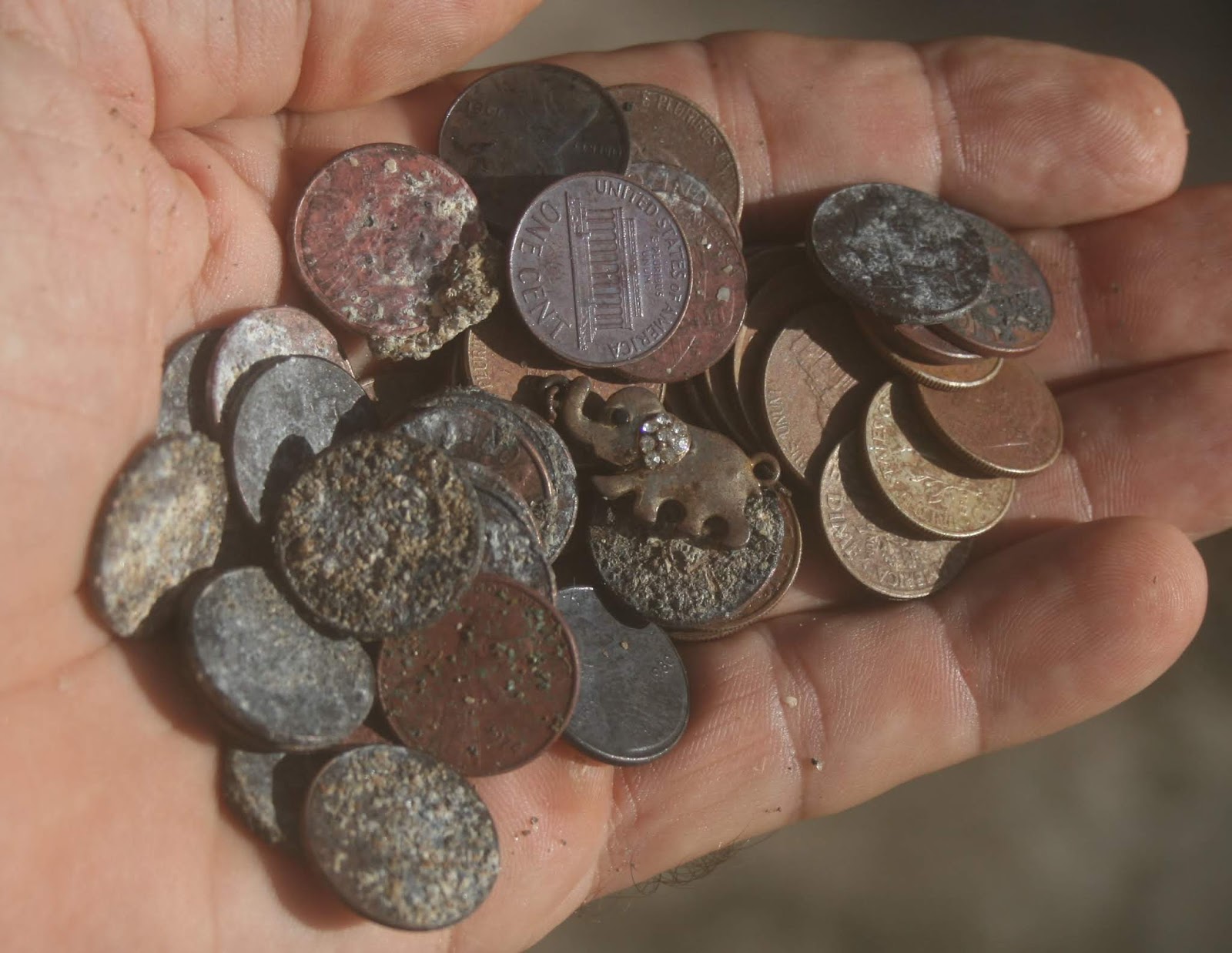
Yesterday I did the same thing.  I have not detected very much this year and had some fun picking up 54 coins in just a little over an hour.  Nothing good though.


54 Coins Dug Yesterday.
Today I did the same thing, but didn't detect as long and only got a few coins, but did get a silver and diamond ring.  It is marked 925.  I'd think they are diamonds because they are so small I can't see any sense in making fakes that small.  

The ring was broken and gave a very weak/poor signal.

I'm sure some people are getting frustrated that all this wind and surf isn't helping the beaches more.  

I could see that there was a huge amount of sand in front of the beach yet.

Humberto seems to be off the map now, but Hurricane Jerry is still out there.


Source: nhc.noaa.gov

It looks like the surf will remain fairly big for a couple of days.


Source: MagicSeaWeed.com.


Happy hunting,
TreasureGuide@comcast.net


Saturday, September 7, 2019

9/7/19 Report - A Few Post-Dorian Finds. South Hutchinson Island Beaches. Minelab Equinox Performance On Salt Sand.


Written by the TreasureGuide for the exclusive use of treasurebeachesreport.blogspot.com.

South Hutchinson Island Beach Early Saturday Morning.

---


Below are some post-Dorian finds from DJ.


Four Iron Finds by DJ
Photos by DJ


Here is how DJ described these finds.

… The four pictures are the four pieces of iron I found yesterday and taken today after a night soak in white vinegar/water. Today I tried to chip a little off and you can see what happened. (Which I knew was a possibility from my research, but also electrolysis might damage them as well)

It really bothers me that I may not be able to preserve these, these are obviously old square straight and bent spikes (except for the shorter blob looking one). One looks as some wood remains.

They are a piece of an amazing history and world wide journey, they were found in a grouping (as you have often said) and in a small area of orange grainy sand (which you also mentioned)... 

DJ also found an unusual rectangular piece of silver.  When he was researcher it, he found a very similar piece that I found and posted in 2010.

Rectangular Silver Piece
Found by DJ 2019
Rectangular Silver Piece 
Found by TreasureGuide 2010

Below is what DJ said I about this silver find.


Yesterday I sent you a greenish flat almost perfect rectangle of metal that rang up 18+ on the NOX 800. My acid test kit came in with a greenish color change or .500 silver. I cannot imagine it is old or what it might have came from. it looked broken at each end. No markings visible.Maybe you have an idea. Here is a pic with scale.

And below is what I said about my find in my 11/7/2010 post.

Small Rectangular Piece of Silver Found on a Treasure Coast Shipwreck Beach Yesterday.

This is one of those types of finds that will probably never give up its secrets. It is definitely silver. I could tell that when I inspected it with a high power loop and when I did an acid test on it.


And it has definitely been exposed to salt water for some time. Close inspection of the considerable surface corrosion shows that. It has some age to it. I can tell it has been exposed for some time, but can't tell if the time period is years, decades or centuries.

The other side of the object is about the same and presently shows no markings.

The long oval mark in the middle of the object is where it could have been attached to something. The oval area is slightly raised even though you can't tell that from the photo. It could be a sprue if the item was formed using a mold. I don't know if that is the case, or, like I mentioned, it might have been attached to something else.

I suppose I will never know the age or identity of this little silver rectangle. The best chance of learning more about it is to clean it and see if there are any marks underneath the green. I'll probably do that someday, but won't hurry into it.

If any one has any ideas about this little silver piece, I'd appreciate receiving an email.


See http://treasurebeachesreport.blogspot.com/2010/11/117-report-mystery-small-silver.html

---

Despite the fact that I expected some of the beaches in the Vero area to open today and I didn't get a chance to see them when I visited the area yesterday, I decided to use my limited time to explore some South Hutchinson Island beaches that I hadn't seen since the passing of Dorian and check out the performance of the Equinox 600, which I had not yet used at the beach.

I went out early this morning and found that the beaches I visited on South Hutchinson Island didn't look very promising at all - certainly not what you would hope to see after a hurricane passing nearby.  I expected the two days of north wind to do more to our beaches than it did, and even though I knew it didn't do much to John Brooks or Frederick Douglass, hoped that I would find a few better spots.  As it turned out they were not as good as John Brooks and Frederick Douglass.

The beaches shown at the top of the post and immediately below are fairly typical of what I've seen on South Hutchinson Island.  There is a lot of sand.  At least John Brooks and Frederick Douglass beaches had some cut dunes.

South Hutchinson Island Beach Early Saturday Morning.
Anyhow, I got a better idea of what the Equinox could do.  It was the first time I used the Equinox on the beach and in the wet salt sand.  I used the factory settings and the Beach 1 mode.

The Equinox did well at detecting small targets at depth in shelly sand.  I was actually surprised by how well it did.  It easily picked up nickels and small pieces of copper in the wet sand with water moving in and out over the sand, and it did not false when salt water washed over the coil.  I was impressed with that.  Small targets were found at good depth under fairly difficult conditions, and due to the lack of falsing, faint targets could easily be heard.

I have not found the conductivity numbers to be real useful yet.  Maybe that is because of the lack of experience I have with this detector, but it seems to me that the numbers are inconsistent (jump around), and there seems to be a lot of overlap with many different targets giving about the same numbers.

I found a line of coins and other metal running close to the water's edge on a convex beach front.  Also there were targets near the top of the beach just below the dunes.  Given the poor conditions, it was not the most productive detecting, but I did learn more about the Equinox, which is what I wanted to do.

Just to give an idea of what the Equinox was detecting at around six inches, here are a couple targets recovered in course loosely-packed shelly sand.

Thin Piece of Copper
The second piece is thicker than the first, and I'm not sure but I think it is also copper also.  It definitely is not iron.

Unknown Metal Suspected To Be Copper.
 Actually the first target I dug at the waters edge in mushy sand was a green modern nickel.

I just mention those finds to give some idea of the performance of the Equinox.

---

I was expecting the Indian River County beaches to be open today - at least most of them, but I don't know if they did.  I'd appreciate a report on that.

GB sent me the following message.


As a daily reader of your blog and a retired long term beach hunter I saw a question as to why the acceses at turtle trail and seagrape warrant manned attention. 


It is common knowledge, among some, that this area of Corrigans is treated by some officers as their private detecting beach especially after storm activity and discourage and restrict others.  As you may know they have made some impressive and valuable finds over the years. 

---

We won't be getting any more rough surf for a little while.

I expect to hear from some of the areas that I didn't get to detect this time and am expecting to see photos of more finds. I feel certain there will be some even though overall beach conditions weren't improved much.

I'll be watching some of the other weather systems that could come our way.

Happy hunting,
TreasureGuide@comcast.net

Saturday, April 13, 2019

4/13/19 Report - Revisiting Factors For Successful Detecting. Whats Different: Now and Then.


Written by the TreasureGuide for the exclusive use of treasurebeachesreport.blogspot.com

Recent Falcon Heavy Liftoff From Kenny Space Center

Thanks Alberto!  Great photo!

---

South Hutchinson Island Beach As Seen Yesterday.
One thing that impressed when I saw the above beach heavily eroded a couple weeks ago, is how much sand there is on our beaches now.  Like many beaches along the Treasure Coast, this beach was renourished a year or two ago.  The cliff you see is in renourishment sand.  I don't know where it came from.

But what struck me most is when I looked at the first condo you see to the south.  I remember when there was a rock outcropping exposed all the way back almost to the condo about twenty years ago.  I wish I knew what year that was.  But back then, around the same time, Jensen beach was eroded back to the seagrape trees, and north of John Brooks the erosion was all the way back to very near the condos.

People sometimes say that most of the treasure has been found.  I don't buy that.  Obviously some of it has been found, but I don't think that is the big problem.  I think the big problem is all of the sand.

This year we saw some pretty big erosion at John Brooks and Frederick Douglass, but nothing much was reported found.  I believe the reason for that is that the erosion was into renourishment sand.  It didn't get down to the older layers of sand.  The erosion was far from where it had been in the past.  As recently as 2004, when we had the hurricanes of Francis and Jeane, John Brooks was eroded all the way back and under the board walkway.  That is much farther than anything we've had in more recent years.

On beaches like John Brooks on South Hutchinson Island, you don't have high dunes behind the beach to erode and dump new targets on the beach.  And it is unlikely that many old targets will show up on the beach while the renourishment sand is piled up on the beach and in front of the beach.

---

I developed and presented a metal detecting success formula in this blog.  One of the advantages of doing something like that is that it really forced me to think it through. And then when it is communicated, it is open for review, criticism and discussion, which leads to additional refinement and improvement.

My success formula, as I posted it in the past, is as follows.

S = L x T x Sk x E x D.

I defined Success as the number of finds. I suppose it would be better to define success in terms of total value.  Value, of course, is subjective.  (You might be interested in my post on metal detecting math.)

L is location. T is time spent detecting. Sk stands for skill level, D, the detector used, and E is amount of effort.

I discussed those factors to some extent in previous posts. I talked about the effort factor in my 1/9/18 post, for example.

Extreme effort can really pay off.  That refers to really pushing the boundaries in a variety of ways.  I've discussed that before and won't get into it now.  Extreme effort can be limited by your determination, physical fitness, and courage, or  should I say stupidity.

D is for the type of detector you use and its capabilities - not how you use it. How you use your detector is part of the skill factor.

I wanted to revisit the formula and refine it a little more.

The factors on the right side of the equation are listed in order of my estimation of their relative importance.  Location is the most important factor in my opinion.  If you are not where the targets are, none of the rest matters much.

All of the factors interact.  If you have a quality detector, it still doesn't matter much unless you know how to use it well.  The skill factor interacts with the detector factor. 


The factors that I have been thinking about a lot lately are the Location and Time factors.  I mentioned not long ago the importance of the time you spend scouting around and how that time can be as important as the amount of time you spend detecting.  Time spent on the beaches and time spent scouting the beaches can dramatically improve your chance of being at the right spot at the right time.  

The time factor includes time spent in the field as well as time spent actually detecting. It also includes research and information gathering.  Therefore to be more specific, my time factor includes three factors: time scouting (Ts), time detecting (Td), and time gathering and assimilating information (Ti). 

I have some things to say about scouting beaches, but I'll keep that for another time.  Scouting interacts with beach reading, which is a part of the Skill factor.  

You might think I'm making much about nothing, but if you take time to think it all out in a clear and specific way, you'll notice things and increase your understanding even when you don't realize it.


Happy hunting,
TreasureGuide@comcast.net

Monday, March 18, 2019

3/18/19 Report - Some Treasure Coast Beaches Eroding Already.


Written by the TreasureGuide for the exclusive use of treasurebeachesreport.blogspot.com.

A Few Hundred Yards of Erosion This Morning.
I wanted to see what was happening on the beaches this morning.  I visited a few beaches on Soputh Hutchinson Island and found that there was some erosion.  I went out just after high tide.

The wind was blowing from the north.

Not all of the beaches were eroded, but some were.  The biggest cliff I saw was about four feet,  The stretch above was a few hundred yards long.

Here is the biggest erosion that I saw.

Near Four-Foot Stump in Front of Erosion.
Up at John Brooks there was very little erosion.

John Brooks Beach This Morning Just After High Tide.
There was a little erosion at the bend between John Brooks and Frederick Douglass beach.

Small Erosion Just South of John Brooks Beach Access.

Frederick Douglass Beach was not erosded.

Frederick Douglass Beach This Morning.

I wanted to get this posted.  Maybe I'll be back later.

Happy hunting,
TreasureGuide@comcast.net

Monday, September 3, 2018

9/3/18 Report - Erosion Alert! Beach Conditions Upgrade. Tropical Storm Gordon.


Written by the TreasureGuide for the exclusive use of treasurebeachesreport.blogspot.com.

Erosion at John Brooks Beach This Morning.
I woke up this morning and saw the kind of weather I like -windy and rainy - so I decide to take a look at the beaches.  I haven't been to the beach hardly at all this summer.  Among other things I've been working an inland site.  But the weather is more like what i like to see, so I checked some South Hutchinson Island beaches.

Above you can see what John Brooks looked like this morning.  The cut was about three feet high and ran for hundreds of yards at about the same height.  I guess that happened either late yesterday or last night.  

You can also see the seaweed, which shows that after the cut occurred, the beach started to fill again as the tide went down.

When I got there, the surf was from the east, which is what I expected from MagicSeaWeed and Ventusky.com.

The tide was already coming in, but I did a quick check and found some greenies.

John Brooks Looking South This Morning.
In front of the cut there was still a lot of sand but almost no shells.  Unfortunately all the erosion is in sand that accumulated this summer.

Surf at John Brooks This Morning.
I haven't posted a beach conditions rating for quite some time, but I'd give the Treasure Coast beaches a 2 rating right now.

My scale is a five point scale.  1 is poor, and 5 is excellent.  I use 2 for transitional beaches.  By that I mean beach conditions that are improving but not yet good.  There is a chance of a few scattered cobs being found during level 2 conditions.

Frederick Douglass Beach This Morning.
As you can see, Frederick Douglass Beach looked almost exactly like John Brooks Beach this morning.

I went a little farther south and found the beaches down there to be a little different.

Blind Creek beaches had some sand removed.  The beach front was low and flat.  Last spring this same beach was eroded back to the dunes in places.  The erosion now is far from the dunes and the cuts were not nearly as high as those at John Brooks.

Blind Creek Beach This Morning.

Walton Rocks Beach This Morning.
You can see the flat front beach at Walton Rocks.  You can also see the sea weed and a small cut.  


Shell Bits at Walton Rocks.
I saw very few shells anywhere, but there were a few small pieces at Walton Rocks.

That gives you an idea of what is happening on some of the beaches.  

I don't believe conditions will improve any more for a few days.

Tropical Storm Gordon is headed into the Gulf and towards Louisiana.

Tropical Storms Gordon and Florence.

I had other things ready to post today, but this blog's main purpose is to keep up with beach conditions.  There has been very little other than poor beach conditions to report this summer.  I was happy to see a nice rainy day, and hope to see better beach conditions this fall.

Happy hunting,
TreasureGuide@comcast.net