Showing posts with label success. Show all posts

Sunday, May 17, 2020

5/17/20 Report - One of the Time Factors in My Formula For Success. Talking About Two Metal Detectors.


Written by the TreasureGuide for the exclusive use of treasurebeachesreport.blogspot.com.

Tropical Storm Arthur.
Source: nhc.noaa.gov
So we had the first named tropical storm of the year - Arthur.  Unfortunately Arthur didn't do a lot for us and is heading north and away from us.

I was glad to recently put in a few hours of metal detecting time, even if it wasn't the most productive.  My weak spot in recent years has been the amount of time I've spent on metal detecting.

As you probably know, the TreasureGuide formula for metal detecting success has several factors, and the one that I rank as the second most important is the time factor.  The time factor is second only to the location factor.

I posted my most recent version of my formula in my 5/4/20 post.  The formula is Amount of Success = L + T + Sk + E + D+ N + A.  I won't go over all of the factors again now.

My time factor can be broken down into three factors: time scouting (Ts), time detecting (Td), and time gathering and assimilating information (Ti).

Not being able to spend a lot of time in the field, I haven't done much scouting around.  When I was doing my most serious detecting, which was between my consulting and teaching jobs, I spent a lot of time detecting, but I also spent a lot of time scouting beaches.  I closely monitored a lot of beaches along nearly a hundred miles of coastline.   When I decided to detect a beach a few miles away, I would stop to take a look at some of the other beaches in between, and might detect beaches several miles apart on the same day.

If you are metal detecting during low tides, you can still do some scouting during high tides.  Although you might not be able to see the lower beach at high tide, you will be able to see enough to give you a good idea if the beach is cutting or how it is developing.  

I was glad I got to put in some good time metal detecting this week, but I am not sure I was at the best location because I had not been doing a lot of scouting.  I didn't know what some of the other beaches were doing because I didn't spend hardly any time other than the time I spent metal detecting.  I did take a look at one or two other beaches, but not many.  I would have liked to have known what some of the other beaches were doing.

---

The other day I mentioned using both the Equinox and ATX.  One person essentially asked if one is better than the other.  It is not that simple.   It depends upon a variety of factors, including where you are working and what you are trying to accomplish.   How well you use your detector is another important factor.  Sometimes it is more about how you use a metal detector rather than the detector's capability.

To give a quick answer to the question, for doing a quick scan on a Treasure Coast shipwreck beach I'd choose the Equinox over the ATX, but if I was focusing in on a small area I might choose the ATX.  I might also use more than one detector on the same hunt  (See my post on 7/24/14 post, for example.).

The ATX is in my opinion a very good metal detector, but it is very heavy, and when I was having a lot of back trouble I decided to get a lighter detector with the thought that it might not put as much strain on my back.  Well, this year my back has been doing fine and I'm glad about that, but the Equinox has proved to be a good detector.  I've heard other people say that they didn't like the Equinox or that it wasn't very good, but I have no problem with it.  As I've shown, I've found a variety of targets with it, including a very undersized half reale and other very small objects.  I feel confident when using the Equinox, which is important.  You have to feel confident with your metal detector.  That, of course, means learning to use it well and using it enough to know what it can do.

I also like the ATX, but the ATX, besides being heavy, will respond to the smallest and deepest pieces of iron.  You can turn the sensitivity down if you want to.  It also has an iron check feature, which works, but takes a little extra time.  The sensitivity to iron can actually be a good thing in some situations.

I found a lot of cobs before I ever found a shipwreck spike.  I'm sure I went over them but never dug them up.  Back when I was doing mostly jewelry hunting, I was usually using metal detectors that nulled over iron or were not very sensitive to iron.  That didn't bother me much then, because of what I was doing.  In fact most of the time it was a good thing.  There are times, though, when I do not want to miss iron.

To sum it up, I like the Equinox, especially for covering a lot of ground and doing a fast scan.  The ATX I might use when I tighten up and focusing in on a smaller area and certain types of targets.  I might use it when targets are scarce.  You will not be digging a lot of junk then anyhow.

Of the twenty or so metal detectors that I've used, they are all good for something, but not ideal for everything.  They have their advantages and disadvantages, or as you might say, indications and contraindications.

---


 I think I mentioned that the COVID data is not much good.  According to CNN, Birx agrees.

Specifically, Birx believes the way the CDC gathers data on the coronavirus is antiquated, causing inaccurate and delayed numbers on both virus cases and deaths...

Here is the link.


You can't do good science with bad data.


Happy hunting,
Treasureguide@comcast.net

Monday, May 4, 2020

5/4/20 Report - TreasureGuide's Formula For Metal Detecting Success. Tragic Treasure Coast History. Analyzing Your Goals.


Written by the TreasureGuide for the exclusive use of treasurebeachesreport.blogspot.com.


I developed a formula for metal detecting success. I presented the first version a few years ago but have continued to improve upon the formula.

The previous version of my success formula looked something like the following.

Success = L + T + Sk + E + D


I defined Success as the number of finds. I suppose it would be better to define success in terms of total value. Value, of course, is subjective. 

How you define success is very important. You should be very clear about what you want to accomplish so you can quantify and measure your progress. Keep track of what you accomplish as it relates to your goals. That feedback will help you improve your level of skill. It might not seem like it is very important, but you will be surprised by how much it helps to measure and monitor your success in a very precise way.

In my old formula, L represents location, T is time spent detecting. Sk stands for skill level, D, the detector used, and E is amount of effort.

I discussed those factors to some extent in previous posts. I talked about the effort factor in my 1/9/18 post, for example.

Extreme effort can really pay off. It refers to really pushing the boundaries in a variety of ways. I've discussed that before and won't get into it again now. Extreme effort can be limited by your determination, physical fitness, and courage, or should I say stupidity.

D is for the type of detector you use and its capabilities - not how you use it. How you use your detector is part of the skill factor.

I wanted to revisit the formula because I am going to add a couple new factors.

The most important factors are listed first. The two new factors were added to the end of the formula but that might change after I more carefully evaluate their relative importance.

Location is the most important factor in my opinion. If you are not where the targets are, none of the rest matters much. And time is definitely right up there at the number two spot.

Factors can interact. I suspect that most of them do. If you have a quality detector, it still doesn't matter much unless you know how to use it well. So the skill factor definitely interacts with the detector factor.

Not long ago I mentioned the importance of the time you spend scouting around and how that time can be as important as the amount of time you spend detecting. Time spent on the beaches and time spent scouting the beaches can dramatically improve your chance of being at the right spot at the right time. The time factor therefore includes time spent in the field scouting as well as time spent actually detecting. It also includes researching sites. Therefore to be more specific, my time factor includes three factors: time scouting (Ts), time detecting (Td), and time gathering and assimilating information (Ti).

The new factors that I am adding today are networking (N) and access (A), so the new revised formula is  Success = L + T + Sk + E + D+ N + A.

Networking, like employment networking, includes relationships that provide you with important information. It helps you find out what is going on where. That includes internet as well as other relationship networks. This blog has a networking component.

The other new factor that I am adding to the formula today is access. Some people have more access than other people. For example, if you are a park ranger that can metal detect in a park while others can not, that gives you an advantage. Or if you have access to restricted areas because of your employment or occupation or other reasons, that can als be an advantage. Or if you have access to the beaches when others do not, such as having a beach-side residence so you can get on the beach while the beaches are closed, that is an advantage too. Perhaps the most obvious example is having a state lease to shipwreck site that excludes others from being able to detect that site.

So that is my new and improved version of my formula for metal detecting success. Expect future adjustments to the formula.

---

The Treasure Coast was the scene of some very gruesome 20th century history as mass murderer Gerard Schaefer tortured and killed along South Hutchinson Island and A1A in the 1970s. One incident occurred at Blind Creek. If you have a weak stomach, you might not want to read anymore about this, but here is the link in case you do.

https://murderpedia.org/male.S/s/schaefer-gerard.htm

----

Definitions are important if you want to communicate clearly or think clearly. I highly recommend using "operational definitions," but I won't attempt explain anymore about that now.

Having some meaningful measure of success will help you assess how well you are doing, but first you have to know exactly what it is that you want to accomplish.

If you just look at detecting as a hobby or a form or relaxation, you don't need anykind of measure, but if you want to accomplish something specific, it will help to have good data.

First, ask yourself what you want to accomplish. Is it old coins, modern jewelry, artifacts or whaat? Are you going for quantity or quality? Or are you going for total value? Just what is it? You'll often find that quality is sacrificed for quality or vice versa, but you need to be clear about your goals.

If your target is something really big, you'll probably need a lot of a patience. Maybe you don't have the patience to do that. Maybe your personality would be better suited to something that makes it easier to see occasional success. That is something to consider.

Your personality will determine to some extent the types of goals that will best suit you. If you can't tolerate long periods of time without any clear successes, you might mix types of hunting, You might find yourself taking time off from your big target to do a bit of something that provides more frequent feedback.

If you watch Gold Rush on TV you'll see guys spending huge amounts of money on big equipment and land and then processing untold amounts of paydirt to accumulate a decent amount of flour gold. That is not for me. First, I'm not going to make a huge investment out front and then work a long time trying to make back my original investment. Secondly, processing endless yards of dirt to get that kind of gold just doesn't interest me. It requires a lot of repetition.  It might be profitable, eventually, but it is just not my style.

It is important to know yourself, and it can be very helpful to be very clear about your goals and keep good records that will provide feedback on your progress. But that also requires you to be a certain type of person.

---

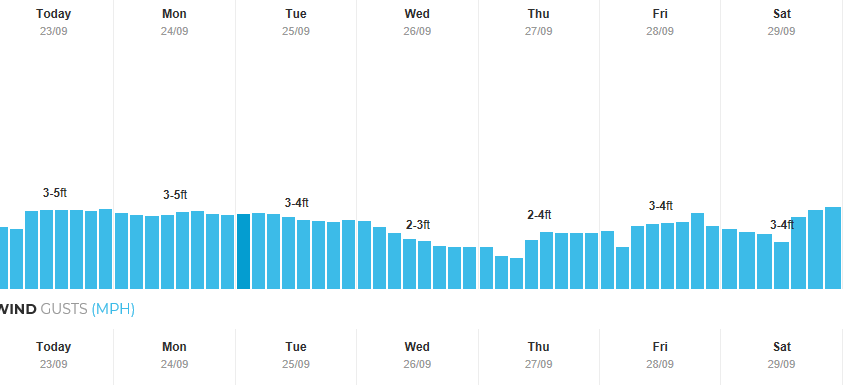
The tides are big, but the surf is getting smaller. Tuesday and Wednesday the predictions say we will be getting a one foot surf.


Happy hunting,
TreasureGuide@comcast.net


Saturday, April 13, 2019

4/13/19 Report - Revisiting Factors For Successful Detecting. Whats Different: Now and Then.


Written by the TreasureGuide for the exclusive use of treasurebeachesreport.blogspot.com

Recent Falcon Heavy Liftoff From Kenny Space Center

Thanks Alberto!  Great photo!

---

South Hutchinson Island Beach As Seen Yesterday.
One thing that impressed when I saw the above beach heavily eroded a couple weeks ago, is how much sand there is on our beaches now.  Like many beaches along the Treasure Coast, this beach was renourished a year or two ago.  The cliff you see is in renourishment sand.  I don't know where it came from.

But what struck me most is when I looked at the first condo you see to the south.  I remember when there was a rock outcropping exposed all the way back almost to the condo about twenty years ago.  I wish I knew what year that was.  But back then, around the same time, Jensen beach was eroded back to the seagrape trees, and north of John Brooks the erosion was all the way back to very near the condos.

People sometimes say that most of the treasure has been found.  I don't buy that.  Obviously some of it has been found, but I don't think that is the big problem.  I think the big problem is all of the sand.

This year we saw some pretty big erosion at John Brooks and Frederick Douglass, but nothing much was reported found.  I believe the reason for that is that the erosion was into renourishment sand.  It didn't get down to the older layers of sand.  The erosion was far from where it had been in the past.  As recently as 2004, when we had the hurricanes of Francis and Jeane, John Brooks was eroded all the way back and under the board walkway.  That is much farther than anything we've had in more recent years.

On beaches like John Brooks on South Hutchinson Island, you don't have high dunes behind the beach to erode and dump new targets on the beach.  And it is unlikely that many old targets will show up on the beach while the renourishment sand is piled up on the beach and in front of the beach.

---

I developed and presented a metal detecting success formula in this blog.  One of the advantages of doing something like that is that it really forced me to think it through. And then when it is communicated, it is open for review, criticism and discussion, which leads to additional refinement and improvement.

My success formula, as I posted it in the past, is as follows.

S = L x T x Sk x E x D.

I defined Success as the number of finds. I suppose it would be better to define success in terms of total value.  Value, of course, is subjective.  (You might be interested in my post on metal detecting math.)

L is location. T is time spent detecting. Sk stands for skill level, D, the detector used, and E is amount of effort.

I discussed those factors to some extent in previous posts. I talked about the effort factor in my 1/9/18 post, for example.

Extreme effort can really pay off.  That refers to really pushing the boundaries in a variety of ways.  I've discussed that before and won't get into it now.  Extreme effort can be limited by your determination, physical fitness, and courage, or  should I say stupidity.

D is for the type of detector you use and its capabilities - not how you use it. How you use your detector is part of the skill factor.

I wanted to revisit the formula and refine it a little more.

The factors on the right side of the equation are listed in order of my estimation of their relative importance.  Location is the most important factor in my opinion.  If you are not where the targets are, none of the rest matters much.

All of the factors interact.  If you have a quality detector, it still doesn't matter much unless you know how to use it well.  The skill factor interacts with the detector factor. 


The factors that I have been thinking about a lot lately are the Location and Time factors.  I mentioned not long ago the importance of the time you spend scouting around and how that time can be as important as the amount of time you spend detecting.  Time spent on the beaches and time spent scouting the beaches can dramatically improve your chance of being at the right spot at the right time.  

The time factor includes time spent in the field as well as time spent actually detecting. It also includes research and information gathering.  Therefore to be more specific, my time factor includes three factors: time scouting (Ts), time detecting (Td), and time gathering and assimilating information (Ti). 

I have some things to say about scouting beaches, but I'll keep that for another time.  Scouting interacts with beach reading, which is a part of the Skill factor.  

You might think I'm making much about nothing, but if you take time to think it all out in a clear and specific way, you'll notice things and increase your understanding even when you don't realize it.


Happy hunting,
TreasureGuide@comcast.net

Sunday, September 23, 2018

9/23/19 Report - Two Named Storms Now. Very Early Shipwreck Discovered. One Important Factor For Success.


Written by the TreasureGuide for the exclusive use of treasurebeachesreport.blogspot.com.

Source: nhc.noaa.gov

We have two named storms in the Atlantic now: Kirk and Leslie.

It looks like Leslie will just hang around out there for a while.

Tropical Depression Eleven is weak and not expected to strengthen much.

The area just to the east of us is expected to head north. We might get some angled waves from that one.

The one to watch, in my opinion, is Kirk.  It still has a long way to go, but it looks like Kirk will be heading this direction.  It is supposed to remain a storm for several days.

Predicted Path of Kirk.
Source: nhc.noaa.gov


Source: MagicSeaWeed.com
We'll have a decent surf for a couple of days, and an east northeast swell.

----

Archeologists have found a centuries-old shipwreck off Portugal's coast near Lisbon, a local mayor's office said Saturday.


Aboard the ship, thought to have sunk between 1575 and 1625, divers found spices, including pepper; Chinese ceramics from the period; and cowpies, a type of shell used as currency for the slave trade in some parts of Africa at the time.
The project's science director, Jorge Freire, called it the "discovery of the decade."
Very nice discovery, but "discovery of the decade"?  I don't think it is all of that.
Here is the link for more of the article.
https://www.msn.com/en-us/news/world/centuries-old-shipwreck-found-in-portugal/ar-AAAufJr?ocid=spartandhp

---

I saw this quote today and thought it was worth posting.

"Success is not the way to happiness; happiness is the way to success."

Here is the link to the article: https://www.spiritdaily.com/happiness.htm

I really agree with the quote, and in more ways than one.

First, how can you say someone is successful if they aren't happy.  It doesn't matter what they have or get, they just aren't happy people.  That is no kind of success that I'd be interested in.

Happiness helps people succeed.  Happy people attack projects with optimism, joy and energy.  If you love what you are doing, the chances are very good that you will do it well.

There is a clerk at my local Dollar Tree.  I enjoy meeting him every time I'm in the store.  He is young and geeky looking and his contemporaries might consider him weird, but he is always up-beat, goes beyond what he has to in order to make sure he is serving you well.  He greets people like he likes them and his work.  He knows what he is doing.  He is making his job enjoyable for both himself and his customers.  I have no doubt he will do well in life.  I know that it is only a temporary job for him and I feel certain he is working towards other things.  If I had a business and needed a worker, I'd try to recruit him.  He is excellent.

There are detectorists (very few) that have written to the TreasureGuide who seem to be unhappy.  They seem to think the world is treating them unfairly.  They criticize others and wonder why no one thinks as much of them as they should.  That won't get you anywhere.

I like to make a distinction between joy and happiness.  Joy is internal.  It doesn't come from what happens to you.  Happiness does.  When things go well you can be happy. I  don't think the author of the quote was making that distinction.

In any case, I think the quote is worth thinking about.  To me it seems very wise.

---

I'll be watching for changes to the beach in the coming days.

Happy hunting,
TreasureGuide@comcast.net


Angry grouch people never seem to be successful. How can you say someone is happy if they aren't happy.

Tuesday, February 13, 2018

2/13/18 Report - Future of Metal Detecting. How To Become Successful.


Written by the TreasureGuide for the exclusive use of treasurebeachesreport.blogspot.com.


 St. Valentine's Skull in St. May's Basilica
Source: https://www.atlasobscura.com/places/st-valentines-skull


Watching the Olympics I was noticing how young the athletes are.  They're kids.  It seems like most people are kids these days.  What happened?  It made me wonder what metal detecting will be like in the future.

I feel confident that metal detectors will continue to improve, although I'm surprised how slowly they have improved over the past few decades.  I know some of you disagree with me about that, but I remember many years ago reading about metal detectors that will show you what is in the ground before you dig it  That hasn't happened - at least not the way I expected  to see it.  Maybe I was expecting too much.

Will there even be metal detecting.  Maybe it will be made illegal.  Maybe there will be a better means of detection.

Will there be anything worth detecting that you will be allowed to detect?  Money seems to be on its way out.  

There are a lot of questions you could come up with.

I once conducted a poll to determine the age of detectorists.  Here are some of the results as reported in a 2014 post.


Only 3, or 1% of those responding, are fifteen or under.

In this poll, only 1 person, (less than 1%) was 16 to 25.

Even more surprising to me is the fact that only 7 (2%) of those that responded to the poll are 35 or under.

Here is the biggest finding for me. 93% of those that responded to the poll are 36 or older. That is pretty astounding even taking into account any margin of error or any possible interpretation of the results.


That seems unfortunate considering how educational metal detecting can be.


Speaking of age - there are a lot of studies of when people are most productive in different endeavors.  Most peak accomplishments come around middle age, but that is a gross generalization.

Here is an interesting article on how to become expert at anything.

http://www.businessinsider.com/anders-ericsson-how-to-become-an-expert-at-anything-2016-6 

If you read the article, two things are emphasized that I preach for metal detecting.  The author uses the term deliberate practice, which is not just hours of practice.  Here is an excerpt.

...To become an expert, you may need to be willing to sacrifice short-term pleasure for potential satisfaction of success down the road. A key tenet of deliberate practice is that it's generally not enjoyable.


Instead, it's about doing things that don't come naturally or easily, which can be tough. "Practice really involves failing a lot until you eventually reach your goal," Ericsson told me.
He cited research on figure skaters (which appeared in this book) that found elite skaters spent more time than average ones practicing jumps and spins in routines they hadn't yet mastered. By contrast, average skaters spent more time going over routines they were already good at.
Most people like to work those things they do well instead of their weaknesses.  Arnold Swartzeneggar always said,  "Work your weak areas."
But this isn't something that most of us take that seriously.  We're in it for the fun.  
---

Ink From a Twenty Dollar Bill Inside a Card.

My wife received this greeting card with a twenty dollar bill enclosed.  She noticed the ink imprint of the bill on the card and thought that might mean it was counterfeit, so she checked it out.  

Click here to view a video that will show you how to check a twenty.

There are a lot of security features on a genuine twenty.  I once saw a very poor counterfeit twenty.   It was really bad.

I was thinking about copies and reproductions.  I don't know how many you've found, but I'd guess that I've found probably six or seven fake cobs - only a small fraction of the number of genuine cobs.

I've talked about that before and showed some examples.  Some cobs are pretty convincing to look at, but none of those that I've found were solid silver or gold.

I'd recommend getting an acid test kit, but there are times when you don't want to do a rubbing of a coin.  There are less destructive test pens etc., but what I recommend these days unless you really do a lot of testing is take your item to a pawn shop or jewelry store that will test it for you.  Some will not only test for precious metals but also other significant metals.


Copies or reproductions are based upon the real thing.  Toys or fantasy pieces are not.  At least that is a distinction that I would make.  

---

Have other things to do,
Happy hunting,
TreasureGuide@comcast.net

Thursday, February 8, 2018

2/8/18 Reort - Rocket Launch. Importance of Detector in the Success Formula: Author's Opinion. More on Mystery Find.


Written by the TreasureGuide for the exclusive use of treasurebeachesreport.blogspot.com.

Tuesday's Rocket Launch As Seen From Sebastian.
Photo by Alberto S.
Great photo Alberto!  The bigger you blow this up the better it looks.  I saw the rocket go up but didn't get any photos.

---

On 1/21/18 I showed on some reale finds reported by Terry S.  You might recall that two of those reales were sight finds.  They were seen lying on the surface. They weren't deep.  In fact they weren't buried at all.

A few weeks ago I showed a cut and told about a few modern coins that were lying on the surface.  I've also seen cobs on the surface in the past.

Obviously not all cobs are found on the surface, but most that I've found have been fairly shallow.  I can't recall digging any that were real deep.

When you find a good hot spot on a beach ( as opposed to land sites ) most of the coins will not be deeply buried.  If you find the best spots with the largest concentration of coins, it there is a good chance that some will on the surface in plain sight.

In the past I identified five ways that coins move on a beach.  Despite what people say, coins do not sink down through the sand.  They get buried, but they do not get pulled down through the sand by gravity.  I've discussed that in detail in the past and talked about trigger points and the things that determine how sand and different objects move relative to each other.

All of the above is to set the stage for my main point which is that detecting depth is not the the primary factor for most cob finds.  The important thing is being at the right spot at the right time.  The big thing is to put your coil over a cob, which is not that easy, and as you know, it happens too infrequently.

Everybody always wants the best and deepest seeking detector.  If they aren't finding much of anything they think it is because their detector isn't working well.  If you don't have a decent detector, that won't help you, but the lack of finds is more often due to other factors.

You don't need a super detector to detect reales.  Other than worn down fractional half reales, most reales will not be difficult to detect if you are using a decent detector and put your coil on one.
The trick is to put your coil over what you want to find.  That is why I say that a detector won't find you anything.  All it does is beep when your coil is over a target, but you have to put your coil over the target, and that is where most of the knowledge and skill comes in.

I'm not saying that the detector has no effect.  You do need a decent detector and you need some level of skill.  You must have confidence in your detector.  That is very important.  That is one reason I suggest a lot of experimenting and testing.  If you do that, you'll know what your detector will or will not do and how to use it for best results.

I've been saying that I was going to revisit my formula for metal detecting success, but I've been putting it off.  Here is is.

 S = L x T x Sk x E x D.

S is the amount of success in terms of number of finds.  L is location.  T is time spent detecting.  Sk stands for skill level.  D, the detector used, and E is amount of effort or determination. 


I talked about the first four factors in the recent past.   I talked about the effort factor in my 1/9/18 post, for example.  

D is for the type of detector you use and its capabilities -  not how you use it.  How you use your detector is part of the skill factor.  

There is a detector factor.  I agree with that, but as long as you have a decent detector, it is not a big factor.  I put the detector factor last in the formula because I think it is the least important of the factors listed.

There is one more factor that I will be adding to the formula.  It is something that I am personally not good at, which might be why I missed it.

---

Concerning Sebastian Steve's mystery find that I posted a couple days ago, Darrel S. said, I forgot to mention that I visited the old Piper shop on Aviation Blvd many years, ago. Yes, there were planes from that period, but was told the pieces I showed them (same as in your blog) were probably old flashing from construction sites. Most of the snips used in cutting metal have serated edges.


 However Steve P. offered the following: I agree with DB, as an aircraft mechanic, it looks like aviation snips pattern.

Thanks guys.

---

I recueved a great Ole Timer Talk to post soon concerning holed coins.

---

The tides are now small, and it looks like the surf will remain in the two to four foot range for a couple weeks.

Happy hunting,
TreasureGuide@comcast.net


Monday, January 15, 2018

1/15/18 Report - Metal Detecting Videos. Factors For Metal Detecting Success.


Written by the treasureguide for the exclusive use of treasurebeachesreport.blogspot.com.

I watched football this weekend.  Maybe you've noticed that when I miss a day it is usually a football day.  I love the strategy part of football. I enjoy figuring out how to get things done, whether it is win a football game, develop computer software or find things.

Saturday I started a discussion of the factors that lead to successful metal detecting. Today I'll address a few factors,but leave discussion of some of the more complex and interesting ones such as skill for later.

Before I really get started on that I wanted to briefly talk about something else.  I don't often watch YouTube videos, but I was looking for something specific and watched a few metal detecting videos a couple days ago.  The first thing that struck me was something that I commented on before.  It drives me crazy when they take several minutes to retrieve a target.  They pass the coil over the target I don't know how many times to pinpoint and get a good reading on the meter or whatever, and then they spend a lot of time on top of that probing around with a pinpointer.  If I took me that long to dig a target, I'd have time for about two targets per hunt.  If my wife did that I'd be screaming at her to dig the thing and get on with it.

In one video a fellow was comparing a CTX 3030 with an Ex Deus.  He detected an area first with the Ex Deus and found some things.  Then he took the CTX and found some more things "that the Ex Deus missed."  Then he detected the area with the Ex Deus again and found some more things that the CTX "missed."  In my opinion that was no comparison of the two detectors, as the detectorist suggested.  It was more a test of the detectorist.

I'm not exactly sure of the order.  Maybe he used the Ex Deus first or maybe it was the CTX first.  I'm not sure now, but it doesn't matter.  That was not a very good comparison of the two detectors.  I've posted some notes on how to really compare two detectors, but even then it would be a comparison of two detectors using a specific set of settings under a specific set of circumstances.

The detector that was used the third time, obviously found items previously missed by the other detector, but also items missed by itself.

Now I'll continue with my discussion of the factors that result in successful detecting.

Using my old rough formula as a starting point, one of the most important factors that determines metal detecting success is location.  That one is obvious enough.  You can only find things where they are.  If you want to find Spanish shipwreck treasures, you are better off on the Treasure Coast than in Arizona.  You'll find a lot more gold jewelry in South Florida than the West  Virginia hills. That might be obvious, but that isn't all that needs to be considered.

Site selection is not what I'm talking about when I talk about location. I'm talking about where you live and where you can hunt on a regular basis without lengthy or expensive travel.  Site selection is a different matter and is a component of the factor I call skill (S).

One option is to travel, but another option would be to take advantage of what the local area has to offer. SuperRick, for example, does both.  He lives in Arizona and hunts meteorites and gold nuggets there and also travels to Florida and the Treasure Coast to detect.  If you are trying to maximize success defined in economic terms, then take into account the time and expense lost in travel.

I show a variety of types of treasure, including things such as sea glass, shells, fossils and bottles.  Besides the fact that I like all of those things, it is easier to be successful if you are aware of a wide variety of types of treasure..  If you can't find one type of treasure on a beach, you can usually find another.  That expands the range of opportunities.

The other important factor I'm going to talk about today is time (T). It is actually the amount of time spent detecting and does not include things such as research, which is also valuable, cleaning finds etc.

You will find more if you hunt more. I'm sure of that.  But it is not only because you cover more ground.  When you are out in the field detecting areas, both good and bad, you learn a lot.  You learn more about the beach or area that you are detecting.  You learn more about your detector.  And perhaps most importantly, you are there to see what is going on so you'll be Johnny on the spot when the widow of opportunity opens.  There are many ways that spending more time detecting will help you.  I've only mentioned a few.

When I originally posted the first draft of my crude formula for success, some people said perseverance should be included.  I think it is included to some extent in the time factor.  It certainly helps.

I'll get into the skill factor soon.  It is a very complex factor, because there are so many different skill areas.
---

Tomorrow the surf is supposed to be up to five to seven feet.  I might not get out to take a look, so would appreciate any reports.

Happy hunting,
TreasureGuide@comcast.net

Saturday, January 13, 2018

1/13/18 Report - Beginning Discussion on Factors That Determine Success With Metal Detecting. North Winds Coming.


Written by the TreasureGuide for the exclusive use of treasurebeachesreports.blogspot.com.

If you ever wondered why some people find more than others or why you aren't finding more, the discussion I'm going to start today will help you answer those questions.

I once developed a rough formula for metal detecting success.  Today I'll start with that rough formula and in the future refine and expand on it.  That will provide a framework for discussing the various factors that determine success.

Here is the rough formula I threw out there a few years ago.  S = L x T x Sk x D x E.

S is the measure of success. L is location.  T is time spent detecting.  Sk stands for skill level.  D, the detector used, and E is amount of effort.  I talked about the effort factor in a recent post (1/9/18).

In the above formula, the factors were listed left to right in order of approximate importance.  Location, time on task and skill are therefore all shown as more important than the detector (D), which comes fourth in the list.  There might be some changes to the order in my revised formula, but the detector is one of the most overrated factors.  Yes you have to have a detector that works, but if you have a detector made by one of the major brand names, how you use the detector (skill) is more important than the detector you use.  I don't want to get into this too deeply now, but as I've said before, I'd trust the wise old Indian with a bow and arrow to come home with the bacon over the city slicker with the best rifle money can buy.  When people are not finding much, the first thing they wonder is if there detector is good enough.  I have to move on, but I'll return to this some time in the future.

Where was I?  I hope you can see from that little discussion how the formula forces you to think more clearly about the factors involved in success even if it all seems very obvious at first glance.  Things seem obvious until you are forced to think about them more clearly and precisely.  You might agree or disagree, but thinking it out can be helpful in either case.

The first thing I need to do is talk a little about success.  It can be defined in many ways.  When I originally developed the formula, I was thinking of long term success as measured by the total number of finds, but as you know, not all finds are equal.

While quantity can be relatively easy to define, quality is not as easy.  It can be the total economic value, but even that is a bit of a guess.  But some people do not seek the most economically valuable targets.  They might be more interested in history, for example.  Some might like to find "old" things or things that tell a story.  So success can be defined in many ways and in different ways for different people.  One person might highly value a find that has no real economic value and might routinely target things that are not at all interesting to other people.

Each person has to define success for him or herself.  I do think you should try to quantify success though.  There should be some measure of value, however you define that for yourself: not just a total number.  You can find tons of low value finds that are not as valuable as a single high value find, therefore your measure of success should probably be a weighted quantity.

I once conducted a poll on what people wanted to find.  A few people told me they weren't looking for anything in particular but hoped to some day stumble onto an amazing treasure, maybe like a chest of gold coins or something.  That is like winning the lottery.  If you are seeking one of those once-in-a-lifetime finds, that isn't what I'm talking about today.  You can still increase the odds somewhat by putting in a lot of time (or buying a lot of tickets) but chance plays a bigger factor than the type of long term strategic hunting that I'm talking about today.

It seems I've never been able to convince people of the importance and effect of simply keeping a good running measure of success of what they are trying to accomplish, whether it is weight control, blood pressure, or metal detecting.  Regularly monitoring performance has a definite effect upon performance.  People who weight themselves every day will be aware of where they stand and any trends, and that will have an effect on behavior.

You might be aware of studies such as when the lighting was changed in a factory, and they wanted to see if improved lighting led to improved productivity.  It seemed to.  When people knew there was a study of their performance (that they were being observed) their performance improved.  I forget the name of that.  I think it might be the Hawthorne Effect.

Anyhow, I encourage you to keep track of your performance in some quantifiable way that is meaningful to you.  When I began detecting, I kept track of the number of coins I was getting. I posted some of my early records not too long ago.  I could see the totals increasing over the weeks and months.  Later I quit recording clad coins and started recording only gold and precious metal finds.  That is what I was targeting then, and I kept good records of the number and type found, where and when.  I've shown some of those records too.  But that goes to show how success might be defined differently not only by different people but also different years for the same person.

Your measure of success might include multiple types of targets.  Hunting treasure coins and shipwreck artifacts on the beach is very different than hunting modern jewelry on a resort beach.  I'll get more into those types of differences some other time.

Things can change a lot over a few decades of metal detecting.  There have been times when I went hardcore and times when, because of a change in circumstances, I only hunted infrequently and very casually.  The time of my most intense detecting ( Perhaps I should say extreme detecting, although not in terms of the amount of time spent because that was very limited due to my teaching and consulting work) was quite a few years ago.  There were years when I detected often, andalso many years when I didn't detect much at all.   It varied a lot.  There were years when I picked up hundreds of pieces of gold and others when I only picked up a few, but the amount of time spent was  different.  Total number of finds or a total value of finds is not a very meaningful number when you are not spending much time.  Since I now spend so little time detecting (because of a variety of factors that I won't get into now) a measure of efficiency seems like a more relevant measure.  How much is accomplished per unit of time?  That is what I would want to know.

Just to illustrate what I mean by that, I have probably not detected much more than a couple hours so far this year.  I actually spend more time checking beaches and taking photos for the blog than I spent detecting.  Most of that was targeting modern targets.  Some of that was on a mid 1900s site.   Less than an hour was on targeting shipwreck coins.  In those two hours I picked up two pieces of gold - both modern jewelry.  They were both on the small side and not too valuable.  Was that success or not?  In terms of total finds, I'd say no.  If the amount of time is considered, it wasn't bad.

You'll note that the second factor in my original formula was T (time spent detecting).  If success is defined as some total number of finds, total time spent detecting is definitely one of the most important factors.  For comparing success for times when a lot of time was spent with times when little time was spent, I took time into consideration, by comparing success per unit of time.  How much was found per hour of detecting.  That makes it somewhat, though not perfectly comparable.

I'll quit there for today and pick up with the factors determining amount of success in the future.

---

The surf on the Treasure Coast will not be big this weekend, however the wind will be from the north on Sunday and Monday.  That is good.  On Monday the surf is supposed to be up to 5 - 7 feet.  That combined with the north wind might do us some good.

Happy hunting,
TreasureGuide@comcast.net

Monday, December 4, 2017

12/4/17 Report - Focus, Goals, Feedback Loops and Analysis For Improving Metal Detecting Success. Perspective.


Written by the TreasureGuide for the exclusive use of treasurebeachesreport.blogspot.com.

Focus, Objectives and Strategies.

I don't think there is anything that improves the chance of success in anything more than a good clear specific statement of the objective.  I used to teach that a lot when I did consulting for fortune 100 companies and government agencies.   It is very obvious that you need to know exactly what you want to accomplish, yet most people don't see the need to develop a good clear specific statement of the objective.  I'm not just talking about having a a general idea of what you would like to happen or what you would like to accomplish.  There is a great benefit in thinking it out completely and being able to specify the goal in very specific terms along with some kind of quantitative measure of success.

It is perfectly OK to just go out and bop around and see what pops up, if that is what you want to do, but if there is something you really want to accomplish then you need to be clear about exactly what that is.  If, for example, you really want to find a Spanish shipwreck coin, then set that as a goal, and make decisions based upon that goal.  If you want to find a big glitzy diamond ring or a lot of glitzy rings, that is an entirely a different matter, and you might want to choose a different type of detector and visit a different set of sites.

If you watch what people do over any length of time, you can often tell that they don't have a very well defined goal.  They don't have focus.  They jump around from one thing to another and seldom make any real progress.  That is what I see on the Oak Island TV show.

One of the things that drives me crazy when I watch that show in particular is the apparent lack of focus, goals and strategy.  They only go far enough in any one direction to come up with new questions.  That might be OK for keeping a TV show going, if that is their primary goal, but it is not the most efficient way to accomplish a serious goal of any type.  At different times they express different goals, and that is one reason the search appears to be such an unfocused hodge podge of unanswered questions and dead ends.  I'm sure the goals of the TV production company adds to the apparent disorganization.  They want to keep the excitement level up. and to do that they encourage wild unwarranted assertions that do little but keep the viewer watching.  It doesn't bother them when someone picks up a find and excitedly exclaims that it is a gold coin even when it is a plated button.

Whatever happened to the shipwreck spike and plank found in the swamp?  Not important?

Exploring the TV side of things for a minute, they have to keep it interesting while the big longer term projects plod along.. They have to find something to get excited about every once in a while.  An endless series of frustrated attempts and questions without answers would be too much for most TV viewers, so the production company has found a savior in metal detecting, which, while not recovering anything near the magnitude of the Holy Grail or treasure chests overflowing with gold, at least it provides something to entertain the viewers, even if it is nothing more than broken toy guns, chunks of iron, spikes without ships, with some old coins and buttons thrown in, all of which is standard detecting fare for any location with history that has not been cleaned out by detector wielding hoards. 

What does all the metal detected surface trash and treasure have to do with the money pit or answering the big questions?  Very little.  Maybe there might be some clue discovered that actually answers an important question, but most of the metal detected finds are little more than momentary diversion to keep viewers entertained while the big finds remain elusive.  It has little to do with what I would suspect is the major objective.

How does that relate to you?  First, if you want to accomplish something, it helps to be very clear about exactly what that you want to accomplish.  Secondly, it helps to have a quantitative measurable way to evaluate your progress.

When I started metal detecting, I wanted to find a lot of coins.  I kept records of each hunt.  I could tell how I was doing and if I was improving.  Then I started keeping track of the value of the coins I found.  That is slightly different than finding a lot of coins.  Later my goal was to find a lot of gold items.  Then high value gold items.  As I improved, I changed my goals.  But it was important to have a way to measure progress.

In these days when AI and robotics are talked about so much, you probably know that the feedback loop is an important element.  You can't make the best adjustments unless you have some way of measuring analyzing performance.  You need to keep on track.  That is the function of the feedback loop.  If you have a very clear objective (or objectives) and some way of measuring progress, you can keep track of how you are doing and continually make improvements.

For example, I look at the number of hits and page views on my blog daily.  That helps me get an idea of what people are interested in and what they like.  The total number of page views is near two million now, and the daily hits are usually somewhere between 500 and 1000.  Of course, I also use other things, such as emails.

It isn't always simple to analyze the data.  Some people love certain posts, but the posts that some people really like are not always the ones that get the most views.  They touch certain individuals powerfully but don't particularly appeal to the mass audience.  There are various reasons for that and I won't get into all of that now.

In summary, I'd encourage you to be real clear about what you want to accomplish, and come up with some measurable way to keep track of your progress.  I know I won't get a lot of people to do that, but if you do, I think you'll be happy with the results.

I don't really think this will be one of my most popular posts, but to me it is probably one of the most important and can help you a lot if you take it to heart.

---

I thought I might need to add some perspective.  If my Ole Timer Talk post about Clint's finds back in 1984 and 1991, you might be tempted to conclude that those were the good old days, and now it is all gone.  If that is what you think, what you are missing is the rarity of those times.  Thanksgiving 1984 is known as an exceptional time for treasure hunting on the Treasure Coast.  It doesn't happen all the time.  And did you notice that Clint went from 1984 to 1991.  That is a period of seven years.  When it is hot it is hot, and when it is not it is not.  There are times when the beaches are exceptionally good, and when they are not.  You can't take blowers and remove all of the sand from the beach.  You have to wait, and hopefully you'll be at the right place at the right time.  That is why I put so much attention on the wind, waves and surf.  If you keep up on that, you'll have a better chance of being there at the better times.  You can spend everyday on the beach for a year and not get as much as you would in a week when the conditions turn good.  We've had some better beach conditions a few times this year and finds were made, but it wasn't anything like Thanksgiving of 1984.  2004 was good after Francis and Jeanne.  Some of the other hurricanes since then didn't do nearly as much for metal detecting.

----


They've been running the Shooter movie a lot lately.  It is an interesting movie, but I found it more interesting and less far-fetched than when I saw it about a year ago because of the current political environment and what we've learned about the intelligence agencies the past year.

---

We're having some nice big tides but the surf is only running around two or three feet.  The winds aren't particularly favorable.

Happy hunting,
TreasureGuide@comcast.net

Sunday, July 23, 2017

7/23/17 Report - Capitana's Mexico Escudo Find: A Closer Look. Turning Failure Into Success.


Written by the TreasureGuide for the exclusive use of treasurebeachesreport.blogspot.com.


2-Escudo Found by Grant of the Capitana a Couple Weeks Ago.
I thought I'd take a closer look at the shield design on Grant's recent find today.  Unfortunately it does not show either the date of the mint mark or assayer initial.  It does show the denomination (II ) to the right of the shield.

When I first looked at it, I thought it would be a 1714 escudo.  After taking another look, I see at least one thing that makes me think I was wrong and that it might actually be a 1715 escudo. There are a number of signs that might help you determine the date.

The following illustration shows the design elements for a 1713 escudo.

Design Elements For A 1713 Mexico 8-Escudo
Source: 1977 Bowers and Ruddy auction catalog.

Notice that the middle panel does not cover the lower castle that appears in the upper right quadrant.

Below is the shield for a 1714 Mexico escudo.

Design Elements For A 1714 Mexico 8-Escudo
Source: 1977 Bowers and Ruddy auction catalog.
The middle panel now covers the lower castle entirely.  That suggests that the escudo is later than 1713.

There are a number of variations on the 1714 design, but they are mostly smaller things such as ornamentation around the denomination indicator.  Sometimes GRAT appears where other times the date is displayed.  That is another variation.

Below are the design elements for a 1715 escudo.  Take a close look at the shield.

Design Elements For A 1715 Mexico 8-Escudo
Source: 1977 Bowers and Ruddy auction catalog.
The red arrow points to what I missed before and why I now believe that Grant's find is a 1715 escudo rather than a 1714.  There are 2 rather than 3 fleur de lis there.  That is what I missed before and what makes me think it is 1715 instead of 1714.

 I can't see some of the other elements on the real escudo.  That is typical, but my opinion now is that it is a 1715 escudo.

I'm no expert on these things and there might be other things I'm missing, but you might benefit from looking at these designs and realizing that there are a lot of clues to the identity of a cob even when it does not display the date or other information.  It might take an expert to identify them all, but it is always interesting to take a good close look at your finds.

If I'm still wrong about the date, I hope you'll let me know.

---

Almost anyone can deal fairly well with success.  You celebrate, congratulate yourself and feel good about yourself and whatever is going on.  Maybe you don't learn as much from your success as you could.   Maybe you give yourself a little too much credit and don't acknowledge all the factors that led to success.

Despite the pitfalls of success, it is usually even more difficult to deal with failure - especially a lot of failure.   How you react to failure can be extremely important.  It is during the difficult times that you can learn a lot about the task and about yourself. As Thomas Edison said, “I have not failed. I've just found 10,000 ways that won't work.”   (I don't know if he really said that.  They say he did, and it is a good thought anyhow.)

When you're not having success, strive to learn something from it.  Make use of the time and the experience.

I recently watched someone having trouble with a job.  He was having trouble doing something he had done many times before.  He became upset, and ranted and cussed.  The more emotional he got, the more mistakes he made.  He got stuck in a self-defeating spiral.  The more trouble he had, the more upset he got, and the more mistakes he made.

How you react when things aren't going well is very important - maybe more important than how you react to success.  Don't get to emotional.  Look at the situation analytically and see what you can learn or change.

Thomas Edison also said, “Many of life's failures are people who did not realize how close they were to success when they gave up.”   There were a couple of 49ers that had no success.    They finally gave up and were headed home when one of the discouraged miners shot himself.  On that spot a large nugget was discovered by his partner who was digging a hole for the burial. He retired very wealthy.  ( I wish I could remember the names of those fellows.  Maybe one of you can tell me their names.)

If you are not an eternal optimist, you have one strike against you.  You'll have to work harder to keep yourself encouraged and moving ahead.  If you are afraid of work, you have another big strike against you.  Edison also said, “We often miss opportunity because it's dressed in overalls and looks like work."  


There are other factors, but if you want it bad enough to work hard and stick to it, you have a very good chance of success.  Don't give up  when things aren't going well, but make it a time to learn and grow.


---

Regarding the ring inscription that I asked about yesterday, I received a number of replies, first from Bill A., saying that it referred to a date.  All agreed that Dic 22/87 probably was Spanish for Dec. 22, 1987. Thanks to all for the help.  


---


I enjoyed watching the commissioning of the USS Gerald R. Ford yesterday.


---


No big changes in beach conditions to report.

Happy hunting,
TreasureGuide@comcast.net


Friday, December 23, 2016

12/23/16 Report - The Flip of A Fin: The Dividing Line Between Success and Failure.


Written by the TreasureGuide for the exclusive use of treasurebeachesreport.blogspot.com.


By the Flip of a Fin.

Some of the best and most amazing finds are accidents.  Almost all of them are to one extent or another.

The gold coins of a lost old army payroll was discovered while a couple guys were hunting lobsters. It was the sudden flip of the tail fin of a startled shark that exposed the  gold at just the right time.  You can't plan that.

How about the gold glove tray.  It is the largest gold artifact ever found along the Treasure Coast.  That is another example of a happy accident.  The gold tray was discovered when the swim fin of one of a group of guys that were spear fishing exposed the glint of gold.

Many of the most amazing finds were not  sought - at least not specifically.  They were unexpected.

You can set out to find a specific lost ring that has been described to you in detail.  In that case you know what you are hunting for, you have a specific goal and intend to find that specific object, but when you are searching for a centuries old treasure, you seldom if ever are hunting a particular object. You hope to find something, but not a specific item.

One story I have told many times and to many audiences, including radio audiences, is the story about how one Easter my wife and I tried to make a special memory for my young nephew when his parents were going through a difficult divorce.  We bought tons of candy, decorations and things, and did our best to make that Easter special for him.  In the morning when he came out and saw everything, he excitedly exclaimed, "I must have been really good, huh?" (He is now 36, has been nominated for a Pulitzer Prize and still thinks he is really good.)

Over the years I realized how well my nephew's statement illustrated the nature of man.  When we have good fortune, we think it must be because we did something good and fail to recognize when some of the credit should go elsewhere.

None of us can take credit for the good fortune of being born with relatively good health, having two arms and legs and a pretty good head on our shoulders, not being born into the poverty of a third world country, and being raised to adulthood by someone who cared.  We had not control over that.  We were just lucky.  We like to take the credit, but other things - things out of our control -  had to happen for us to be where we are.

Most big treasure finds are usually to one extent or another happy accidents.  There are those rare times when someone is targeting something very specific in a very planned way, but usually there is a large element chance.  Despite our skills and effort there is the element of surprise when a great find is made.

I once described skill as intentional action that increases the probability of success.  Probability is the key word.  Even with great skill, there is still the possibility of failure.  The element of luck (factors outside of your control) is usually there whether you want to recognize it or not.

I'm not saying there is no skill involved in treasure hunting.  I've spent a lot of time talking about ways to improve your skill and therefore the probability of success.

Effort and skill are to be celebrated, but it is also good to recognize good fortune.

There are truly great finds, but if you think about it, many of them could have been made by a total beginner if they just happened to put their coil over a treasure or if the item happened to be exposed to them at just the right time.  (Of course there is some skill involved in being at the right place at the right time on a regular basis.)

Many who have worked just as hard and skillfully failed in their endeavors, and many who were less skilled but happened to be in the right place at the right time succeeded wildly.  It is good to celebrate accomplishments that occur as the result of effort and skill, but it is just as important to recognize the factors outside of your control -  good or bad.  Sometimes, probably more often than we realize, success or failure is a matter of little more than the flip of a fin.

---

I intended to finish yesterday's post today, but got off the subject.  I'll finish yesterdays post some other time.

This afternoon the surf is supposed to be up to four to six feet.  Tomorrow and for a few days it will decrease a foot or so.

Happy hunting,
TreasureGuide@comcast.net