Showing posts with label 8-escudo. Show all posts

Thursday, November 2, 2017

11/2/17 Report - Top Gold Coin Prices For 1715 Fleet Lima 8-Escudo and Bust Mexico One-Escudo. Sebastian Inlet To Turtle Trail Report.


Written by the TreasureGuide for the exclusive use of treasurebeachesreport.blogspot.com.
The Sedwick Treasure Auction went live today.  There were some gold coins that brought very  good  prices.  I picked out a couple of those to post.

First is the 1715 Fleet Lima 8-escudo that I mentioned shortly after the auction catalog went online.  Here it is.  The winning bid was $32,500 with a $5,687 buyers premium added.


Here is the lot description from the Sedwick catalog.

Lima, Peru, cob 8 escudos, 1697H, "PVA" variety, very rare, encapsulated NGC MS 62, finest and only specimen in NGC census, from the 1715 Fleet (designated on label). S-L25; KM-26.2; CT-8. 26.85 grams. Broad flan with good full cross, clear king's ordinal II, bold full crown above full pillars-and-waves, minor peripheral flatness, frosty surfaces. This is one of only six dates (1696-1701) struck under Charles II, whose name on these coins appears simply as "C.II.," which are naturally highly sought for the type. One of two varieties for this date--with and without dots in the motto--but this is the only specimen of either variety in the NGC census. NGC #4485215-002. From the 1715 Fleet.

One of the other high priced gold coins from the first session was a Mexico City bust.  There were a few of those that did very well.

This one is a 1732 one-escudo.  The winning bid was $30,000 plus buyers premium.

Mexico Bust One-Escudo

Mexico City, Mexico, bust 1 escudo, Philip V, 1732F, extremely rare, encapsulated NGC MS 61, finest and only specimen in NGC census, ex-Rudman. CT-unl; KM-113. Quite choice in strike on a broad flan, in fact struck so strongly as to impart a minor flaw at rim 1 o'clock, the fields positively resplendent with high luster despite annular friction marks on obverse that appear to be the only reason this coin is not graded higher, nonetheless decidedly the finest known of only four in existence (one permanently impounded in the Banco de Mexico collection), and the only one listed in the NGC census. A gem of a coin whose extreme rarity can be summed up by this statement in CT: "some catalogs list the escudo of the date 1732... [but] we omit [it] for doubt of its existence." NGC #2784567-001. Pedigreed to the Isaac Rudman collection.

---


Darrel S. sent me the following photos of the Turtle Trail and Seagrape beaches yesterday.  About these beaches he said, Was able to check Wabasso, Sea Grape and Turtle Trail around 4:30pm. Tide was full at 6 on.

Beaches showed some shells but very mushy and heavy amount of dirt.


Darrel also sent the following photos of the beach south of Mclarty and south of the Sebastian inlet today.  About those beaches he said, Polluted river and ocean. Brown water and yellow foam. Hopefully, next week better.

Went to Wabasso, Ambersand, etc. Detected south of inlet, but way too much dirt and nasty water. Low was around 12:30pm.


 Thanks much to Darrel for the photos and report.

---

l was in Orlando this morning.  You probably heard about the butcher who sat on the meat grinder and got a little behind in his work.  That is how I was today.

The surf has been small, but will increase up to 3 - 4 feet by Saturday.

Happy hunting,
TreasureGuide@comcast.net

Tuesday, October 10, 2017

10/10/17 Report - 1715 Fleet Eight-Escudo. How High Will It Go? Evaluating Metal Detecting Zones.


Written by the TreasureGuide for the exclusive use of treasurebeachesreport.blogspot.com.


Lot  In Current Sedwick Treasure Auction # 22.
Source: auction.sedwickcoins.com
Here is the lot description.

Lima, Peru, cob 8 escudos, 1697H, "PVA" variety, very rare, encapsulated NGC MS 62, finest and only specimen in NGC census, from the 1715 Fleet (designated on label). S-L25; KM-26.2; CT-8. 26.85 grams. Broad flan with good full cross, clear king's ordinal II, bold full crown above full pillars-and-waves, minor peripheral flatness, frosty surfaces. This is one of only six dates (1696-1701) struck under Charles II, whose name on these coins appears simply as "C.II.," which are naturally highly sought for the type. One of two varieties for this date--with and without dots in the motto--but this is the only specimen of either variety in the NGC census. NGC #4485215-002. From the 1715 Fleet.

This is an exceptional cob that already has a bid of $20,000.The auction estimate was 20 - 40 thousand.

What is your guess on the final price?   Make a guess and send me your estimate.

Here is the link,

http://auction.sedwickcoins.com/Lima-Peru-cob-8-escudos-1697H-PVA-variety-very-rare-encapsulated-NGC-MS-62-finest-and-only_i28138985

---

I recently wrote about a stretch of beach and various metal detecting zones I identified along that stretch.  I mentioned how those areas differed.  Some differences were apparent by simple observation.  You could see the people, how many were there, what they were doing, what types of things they had, etc.  You could see the natural environment, including the sand, slopes, sea grass, etc.  But there were some things I had to check with my metal detector.  I sampled every area at least a little - some more than others. 

I had to pass by some areas to get to others.  Even if I didn't want to spend much time at a particular zone, I would at least pass through it quickly with my detector to check it out..  I always like to collect a little data to check my previous conclusions.  Occasionally I would run across an unexpected good find or something that might make me want to check a little more.

My main point here is that it is important to really get to know different areas and don't write them off too soon. Check things out, and improve your understanding of any area.

I highly recommend keeping detailed records.  I've said that before.  I never regretted keeping records, but often wished I had kept more.

Areas change over time.  You might want to compare observations over the years and it is difficult to remember everything over a lengthy time span.  Those fifteen zones I described were only along one 8 mile stretch, and I detected a lot of places other than that small area.  

It is nice to have a good long stretch with a variety of different types of zones.  When one zone isn't producing another might be.  You can select different ones to work at different times, depending upon what is going on.  And as you walk from one to another, you can always check those in between.

Different zones had different concentrations and types of targets.  That is something important to keep track of.  I once did a post on math for metal detecting.  You can probably still find it.

When the value of targets can be quantified, you can calculate the most likely value of your finds per time unit at the different zones.  That will help you compare and select detecting sites.  Some zones produce more finds, but on they might be low value finds so that your average find value might actually be higher at an area where you find fewer things.  The numbers will help you assess the situation much better.  It is amazing how a very few remarkable finds can quickly add up to hundreds or thousands of low quality finds.

Of course you can't go entirely by the numbers even though the numbers will help you get a good picture of the situation if you put in enough time and keep records.  Some people just want to go by feel.  Some people are just more interested in certain types of finds even though they might not be as valuable.  Some people just like old coins or other old things, for example.  On the other hand, a lot of people don't have the patience for the low-quantity zones even if there are some very high quality finds to be made there.

One of the zones I mentioned yesterday was supposed to have produced old shipwreck coins, according to one book..  I never found that to be the case, but by looking at the area I could tell that it would take a very good storm to wash old coins in even if the book was right.  The book, by the way was written by an author not known for the highest standards of accuracy.  That is another reason I tend to go by my own observations and data.  I try to experiment and test everything that seems important and questionable.  Having spent part of my career in science, it is just my nature.  One thing I emphasize and teach a lot is an empirical scientific approach to metal detecing.

More on metal detecting zones some other day.

---

I hope you will take time to respond if you have not yet responded to the blog poll.  I know of finds that were made that do not show up in the poll yet.  In fact there are some that I showed in this blog that are not represented in the poll yet.  I know that because the area the cobs were found still shows zero finds for that area.  Of course the poll isn't complete yet, so I expect it to fill in.

Thanks for your help.

---

Tropical storm Ophelia is out in the middle of the Atlantic and won't affect us.

We are back to three and four foot surf for the Treasure Coast.

Happy hunting,
Treasureguide@comcast.net

Sunday, July 23, 2017

7/23/17 Report - Capitana's Mexico Escudo Find: A Closer Look. Turning Failure Into Success.


Written by the TreasureGuide for the exclusive use of treasurebeachesreport.blogspot.com.


2-Escudo Found by Grant of the Capitana a Couple Weeks Ago.
I thought I'd take a closer look at the shield design on Grant's recent find today.  Unfortunately it does not show either the date of the mint mark or assayer initial.  It does show the denomination (II ) to the right of the shield.

When I first looked at it, I thought it would be a 1714 escudo.  After taking another look, I see at least one thing that makes me think I was wrong and that it might actually be a 1715 escudo. There are a number of signs that might help you determine the date.

The following illustration shows the design elements for a 1713 escudo.

Design Elements For A 1713 Mexico 8-Escudo
Source: 1977 Bowers and Ruddy auction catalog.

Notice that the middle panel does not cover the lower castle that appears in the upper right quadrant.

Below is the shield for a 1714 Mexico escudo.

Design Elements For A 1714 Mexico 8-Escudo
Source: 1977 Bowers and Ruddy auction catalog.
The middle panel now covers the lower castle entirely.  That suggests that the escudo is later than 1713.

There are a number of variations on the 1714 design, but they are mostly smaller things such as ornamentation around the denomination indicator.  Sometimes GRAT appears where other times the date is displayed.  That is another variation.

Below are the design elements for a 1715 escudo.  Take a close look at the shield.

Design Elements For A 1715 Mexico 8-Escudo
Source: 1977 Bowers and Ruddy auction catalog.
The red arrow points to what I missed before and why I now believe that Grant's find is a 1715 escudo rather than a 1714.  There are 2 rather than 3 fleur de lis there.  That is what I missed before and what makes me think it is 1715 instead of 1714.

 I can't see some of the other elements on the real escudo.  That is typical, but my opinion now is that it is a 1715 escudo.

I'm no expert on these things and there might be other things I'm missing, but you might benefit from looking at these designs and realizing that there are a lot of clues to the identity of a cob even when it does not display the date or other information.  It might take an expert to identify them all, but it is always interesting to take a good close look at your finds.

If I'm still wrong about the date, I hope you'll let me know.

---

Almost anyone can deal fairly well with success.  You celebrate, congratulate yourself and feel good about yourself and whatever is going on.  Maybe you don't learn as much from your success as you could.   Maybe you give yourself a little too much credit and don't acknowledge all the factors that led to success.

Despite the pitfalls of success, it is usually even more difficult to deal with failure - especially a lot of failure.   How you react to failure can be extremely important.  It is during the difficult times that you can learn a lot about the task and about yourself. As Thomas Edison said, “I have not failed. I've just found 10,000 ways that won't work.”   (I don't know if he really said that.  They say he did, and it is a good thought anyhow.)

When you're not having success, strive to learn something from it.  Make use of the time and the experience.

I recently watched someone having trouble with a job.  He was having trouble doing something he had done many times before.  He became upset, and ranted and cussed.  The more emotional he got, the more mistakes he made.  He got stuck in a self-defeating spiral.  The more trouble he had, the more upset he got, and the more mistakes he made.

How you react when things aren't going well is very important - maybe more important than how you react to success.  Don't get to emotional.  Look at the situation analytically and see what you can learn or change.

Thomas Edison also said, “Many of life's failures are people who did not realize how close they were to success when they gave up.”   There were a couple of 49ers that had no success.    They finally gave up and were headed home when one of the discouraged miners shot himself.  On that spot a large nugget was discovered by his partner who was digging a hole for the burial. He retired very wealthy.  ( I wish I could remember the names of those fellows.  Maybe one of you can tell me their names.)

If you are not an eternal optimist, you have one strike against you.  You'll have to work harder to keep yourself encouraged and moving ahead.  If you are afraid of work, you have another big strike against you.  Edison also said, “We often miss opportunity because it's dressed in overalls and looks like work."  


There are other factors, but if you want it bad enough to work hard and stick to it, you have a very good chance of success.  Don't give up  when things aren't going well, but make it a time to learn and grow.


---

Regarding the ring inscription that I asked about yesterday, I received a number of replies, first from Bill A., saying that it referred to a date.  All agreed that Dic 22/87 probably was Spanish for Dec. 22, 1987. Thanks to all for the help.  


---


I enjoyed watching the commissioning of the USS Gerald R. Ford yesterday.


---


No big changes in beach conditions to report.

Happy hunting,
TreasureGuide@comcast.net


Thursday, April 6, 2017

4/6/15 Report - Eight-Escudo and Silver Bar. Fossil Sea Shell. Cold Front.


Written by the TreasureGuide for the exclusive use of treasurebeachesreport.blogspot.com.

1713 J Mexico 8-Escudo From 1715 Fleet
The big news for me this morning is that the new Sedwick Coins Auction catalog is now online.  That is the Treasure, World, U.S. Coin & Paper Money Auction #21 catalog.

There are lots and lots of lots to look through.

The first session starts with the gold coins, including some 1715 Fleet escudos.  One of the stars of this session, as well as the entire auction, is an encapsulated 1714J Mexico 8-escudo graded MS 64.  Bold full cross, 100% full date and oMJ, nearly full crown and shield, muted luster and toning but technically very well preserved. NGC #3349433-001. (See photo above.)

The price estimate of this one is $15,000 to $30,000.

There are gold coins, for example Charles III busts and a one dollar Indians that are much more inexpensive, with lower end estimates below $200.

Here is the link.

http://auction.sedwickcoins.com/Treasure-World-U-S-Coin-and-Paper-Money-Auction-21_as47081

The afternoon session begins with ingots.  One of the more expensive items in the auction is an Atocha silver bar.  The estimated price range is $35,000 to $70,000.

Three Views of the Atocha Silver Ingot.
And here is the catalog description.

Large silver bar #72, 83 lb 7.52 oz troy, Class Factor 1.0, dated "Po(tosi) 1622" in cartouche, foundry / assayer MEXIA in cartouche, five tax stamps (two different designs), fineness IIUCCCLXX (2370/2400 = 98.75% fine), manifest number DCCCCXXXII (932), silvermaster A, from the Atocha (1622). 13-3/4" x 4-3/4" x 3-3/4". Attractively marked "silver loaf" (typical shape) that is particularly interesting for the fact that it shows two kinds of tax stamps (three with lions and castles and two with monogram) and an "overdate" manifest number with the second C punched over a D (probably just a mistake), although the clarity of the assayer and date cartouches is remarkable as well. Most of tax stamps appear to be more complete than usual. The middle of the top of the bar contains the usual peanut-shaped assayer's "bite." At one end is what appears to be the letter V with an up-arrow to its left for the owner/shipper, who is/are apparently not listed on the manifest. The surface of this bar is relatively uncorroded, with a couple small pits on top that existed before sinking and mostly contain small pieces of coral now. From the Atocha (1622), with Fisher photo-certificate #S72.

---

Couple of Fossil Sea Shells In Rock Matrix.
Here are some fossil sea shells from the Treasure Coast.  They are embedded in rock.  Just the top part of each shell shows from this view.

As you can see from the picture below, the shells are actually larger than the part of the tops that show.  You can see much of the outline of the bottom of the shell on the left.  It encompasses most of the area of the rock.  You can see the edge of the other shell on the right at the top edge of the rock.  The size of the shell is pretty much the same as the rock on that one.

Bottom Side of Same Shells.
I just thought they were interesting.  I think they might have been totally enclosed at one time, but maybe the rock was eroded until the shell protruded.

If any of you fossil experts can tell me anything more about the shell or rock would be called, I'd appreciate hearing from you.

---

A cold front came through the Treasure Coast today.  The surf is still small.

Later, maybe Saturday the wind will shift and the primary swell will begin to come from the north.

I don't see any hope for big seas though.

Happy hunting,
TreasureGuide@comcast.net


Friday, August 19, 2016

8/19/16 Report - 68 Karat Treasure Coast Emerald Find. More On The Recent 1809 8-Escudo. Tropical Storms.


Written by the TreasureGuide for the exclusive use of treasurebeachesreport.blogspot.com.

The 68 Karat Emerald Found At Golden Sands Beach.
Photos submitted by Darrel S.


This emerald was found while the lady below was collecting shells at Golden Sands beach.  She took it to the McLarty Museum and showed it to Ed Perry, who took the photos.  Ed sent an email to Darrel S. who sent the photos and information to me.

Lady Who Found 68 Karat Emerald On Treasure Coast Beach.
Photo submitted by Darrel S.
Unlike the coin I showed the discussed the past couple of days, this emerald is not a new find.  It was found back around 2005.

People sometimes ask me where to detect. I've been posting a lot of finds lately and sometimes even telling you where they were found.  That should give you some ideas.

---

A few days ago I was talking about thumb rings and gimmel rings and showed some pictures from James Planche's book, An Illustrated Dictionary of Historic Costume, From the First Century B C. to c. 1760.   Larry had a book that was printed in 1940 in which the same illustrations and text appeared, so it looks like the information that I presented came from an earlier source than the one I referenced.   Thanks Larry.

---

The 1809 8-escudo that I showed yesterday shows FERDIN VII in the legend, which would undoubtedly refer to Fernando VII who took the throne in 1808 but who was not the king in 1809 when the coin was made.  Fernando VII was replaced by Napolean's brother, Jose Bonapart, from 1808 to 1814 before Fernando was returned to the throne.

That type of coin ( referrred to as type 15 in Monedas Espanolas desde Juana y Carlos a Isabel II ) was made in years 1808 through 1812.  Assayer H.J. is listed only for the years 1809 -1811.

There appears to be a long unbroken series of silver coins for each year leading up to 1810 in the Florida Collection.  I'd guess probably from wrecks affected by the 1810 hurricane.

---

Source: nhc.noaa.gov
Fiona still is headed for Bermuda.  It appears that another storm is forming behind Fiona.

The tides are fairly large now, but the surf will remain small for at least a few more days.

Happy hunting,
TreasureGuide@comcast.net


Sunday, May 22, 2016

5/22/16 Report - Potosi 8-escudos Contemporary Counterfeit. A Brief Analysis of Seville Escudos. Meteor News.


Written by the TreasureGuide for the exclusive use of treasurebeachesreport.blogspot.com.

Contemporary Counterfeit Sold for $2350 in Recent Sedwick Auction.
Source: Sedwick Auction Catalog.
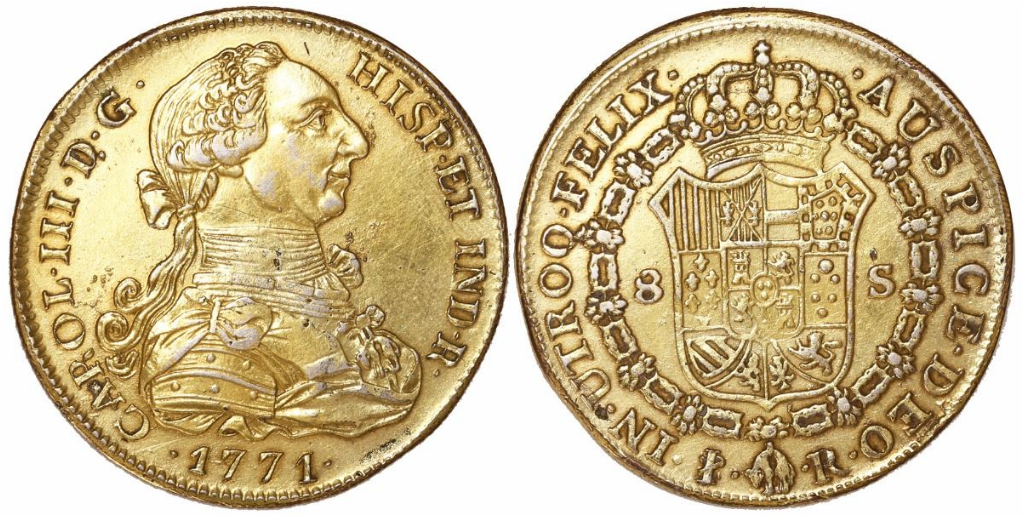
This contemporary counterfeit sold for $2350 in the recent Sedwick auction.  It is gold gilt over platinum.  That might seem funny to you if you don't know the history of platinum.  While platinum today is a precious metal, there were times when it was little more than a nuisance.

...Despite being worked with some skill by South American Indians over 1,000 years ago, it was not until after the Spanish conquest of the New World during the fifteenth and sixteenth centuries that news reached Europe of a new white metal with unusual properties.

By the end of the 17th century, the Spanish Conquistadors had discovered alluvial deposits of platinum while they were panning for gold in the Choco region in what is today Colombia. They considered the metal a nuisance because it interfered with their gold mining activities. In fact, since platinum was considered of little value, it was soon being used by forgers to adulterate Spanish gold coins.

Here is the link for the source of that quote. http://www.azom.com/article.aspx?ArticleID=1210

And here is the Sedwick auction description.

Gilt platinum contemporary counterfeit of a bust 8 escudos of Charles III, 1771, fantasy mintmark and assayer R. 26.81 grams. Incorrect but convincing details, the mintmark somewhat like the Potosi monogram, AU- (lightly circulated) with traces of platinum peeking through the slightly worn high points.

"Contemporary counterfeit" is the term used to describe a copy that was made to be used when the coin was in circulation. It does not refer to later copies or reproductions such as fantasy coins or souvenirs.


---

You might recall that the crew of the Captiana found hundreds of escudos during the 2015 season. Three, if I correctly I recall, were minted in Seville.

Previously there had been very few, if any, Seville minted coins found on the 1715 wrecks.   In the Florida collection of about 24,000 silver coins, most of which came from Spanish shipwrecks and approximately 600 of which are illustrated in Alan Craig's book, none of those illustrated are from Old World mints.  I can't swear that I didn't miss a  mention or two of Seville minted coins in his book, but it is clear that there were few if any Seville minted silver coins in the nearly 24,000 coins in the Florida Collection.

Also as I recall, in the distribution from the 2015 salvage season, the state selected one of the three recovered Seville minted escudos.  With all that they had to choose from this year, the fact that they chose a Seville minted coin must say something about how rare and interesting it is.  The state also selected a Royal that was found this year - a rare coin indeed.

I was therefore interested in the good sample of Seville minted escudos that were offered in the recently concluded Sedwick auction.  That sample provided a good opportunity to take a look at the relative prices and the factors that affect the price.

If I didn't have so much else to do, I'd go through auction results and develop an equation that would give a good estimation of the value of auctioned Spanish shipwreck coins.  It wouldn't be difficult, and I'm sure I could develop an equation that would account for some 90 percent of a coins perceived value.  I'd bet it would take no more than eight variables, including such things as year, mint, assayer, denomination, condition, etc.  I like analyzing data and doing that type of thing.

I did a very limited and simple partial analysis of the realized prices of a few of the Seville escudos sold in the recent Sedwick auction just to illustrate how easy and productive it could be.

Below is a graph showing the prices of ten Charles and Johanna one-escudos sold in the auction.  The prices are the winning bids, not including the buyers premium.  If I were to do it again, I would probably include the buyers premium.


As you can see the range is $500 to $900, with an average of $685.  The progression in price is gradual.  There are no real outliers, suggesting that there were no really exceptional escudos in the group.

Comparing the Seville minted Charles and Johanna one-escudos with three Phillip II Seville one-escudos sold in the auction shows no huge difference in prices.  The Phillip IIs had a range of 600 to 900, and an average of 800.  The average is higher, but the sample size is simply too small to be very useful.  I just did this comparison for illustration purposes.  It appears from this very small sample, that there is no big difference in perceived value between the Charles and Johanna and the Phillip II one-escudos.


There were seven Seville four-escudos of the Phillip II era that sold in the auction, so I did a chart for them.  The range for this group was larger, 750 - 2600.  The average was 1471.


The range of this group was about five times greater than the range for the group of Charles and Johanna one-escudos.

There appears to be two distinct groups shown by that chart.  The lower priced grouping with prices ranging from 750 to 1000, and another group ranging from 2050 to 2500.

Actually, there was a happy mistake.  I thought I'd go back to see what factors separated the two groups, and what I found was that the low-priced group was composed of two-escudos, while the high-priced group was composed of four-escudos.  I only wanted to include four-escudos, but pricing showed that there were really two distinct groups included.

The mistake actually illustrated how useful price charts can be.  This one shows that two-escudos and four-escudos are valued very differently.  There are other factors besides denomination that cause price differences, but in this case the priced differences that can be attributed to denomination is considerable.  It could have been condition issues, a rare date or something else.  And if those factors affect prices enough, I would expect those differences to also be apparent in similar charts.

The lower-price group that is actually composed of Phillip II two-escudos falls into the same price range as the Charles and Johanna one-escudos.  The era difference appears to be significant there.

On the other hand, the three Phillip II four-escudos shown on this chart are about three times more expensive than the Charles and Johanna one-escudos.

I could go on and on about this, but the sample size is so small, and I just wanted to illustrate how easy it would be to figure out how coins should be priced and what factors most influence price. With more data I don't think it would be difficult to work up a good regression equation that would give a weight to each factor that affects a coin's price.  The sample size could be increased by going back to the records of previous auctions.

I noticed one coin that didn't sell.  It wasn't included in the chart.  The starting price was more in line with a more expensive group than the group to which it belonged.  From a quick analysis of results, it looked like the "no sale" could have possibly been predicted.

In some forums there is probably no more common question than "What is it worth."  This type of analysis can help answer that question.  A person equipped with the equation and relevant data could figure out a good approximate price very much like an expert.

Just a couple more notes on Seville cobs.  Seville cobs documented to a shipwreck, especially a New World shipwreck, tend to be more expensive.  With more analysis I could probably give a good estimate of how much more.

I used the terms "cob" and "coin" interchangeably.  If you want to be more precise, there is a real difference between a cob and a coin.

---

Puebla. Residents in a Mexican city woke in fright before dawn on Saturday to bright light in the sky and then a thunderous noise, fearing a nearby volcano had suddenly erupted, AFP reported.

But officials said Popocatepetl volcano had not stirred and no earthquake had registered.
Instead, the phenomena witnessed by the inhabitants of Puebla de Zaragoza, a city of three million people 50 kilometers (30 miles) from Mexico City, was "most likely a meteor," the local Astronomic Society tweeted.


The rock from space probably burned up in the atmosphere and no impact was detected, it explained.
"It was horrible, we thought it was the volcano, but it wasn't," said one resident, Emma Chavez.
"There was a light that shone for a couple of seconds like it was daytime and then there was tremendous thunder."


Another resident, Alvaro Morales, said: "It was really strong. Windows were shaking. We thought it was an earthquake, but it wasn't. There was a sound like an explosion. We were truly terrified."


---

Happy hunting,
TreasureGuide@comcast.net

Tuesday, May 3, 2016

5/3/16 Report - 1715 Fleet Gold Royal and Disc Displayed in 1968. Commerce in Havana and Atlantic in 16th and 17th Century.


Written by the TreasureGuide for the exclusive use of treasurebeachesreport.blogspot.com.


1702 8-Escudo Royal Displayed At Wakeman House in 1968

1715 Fleet Gold Disc Displayed at Wakeman House in 1968

The Wakeman House is a reconstructed historic house in St. Augustine that housed displays including the above, which were said to be displayed in 1968.

These photos were found on a searchable web site that you can access using the following link.

http://maps.fiu.edu/saug/

Scroll down to the digital collection and use the search box.

---

As a result of some recent discussions and the research I was doing, I came across some interesting things. One thing I found was the book, Havana and the Atlantic in the 16th Century.  It discusses the history of Havana and the central roll it played in commerce and transportation.  You can read some of that book online by clicking the above link.

Here is just one sample table.  It shows that Havana imported a lot of wine, textiles and slaves from across the ocean.  That was in the time period 1578 - 1610.

Transoceanic exports (items exported to the Old World) included primarily bullion or specie.  That isn't surprising.  Another big export was hides.  They raised oxen.  That to me was entirely new information. They also exported a lot of dye (such as cochineal) and ships from Havana.  

Havana imported from other colonies a lot of bullion/specie (again not surprising), but also a lot foodstuff.  (Specie is money in the form of coins.)

Bullion/specie was being shipped around a lot.  One interesting figure is the relatively large amount of bullion/specie imported into Havana from across the ocean.

Florida was in the same region and controlled by the same governor that controlled Havana.  Money sent for the maintenance and defense of St. Augustine went to Havana before going to St. Augustine. St. Augustine bought a lot of supplies from Havana, so some of the money sent to Havana never got to St. Augustine, but stayed in Havana to pay for those supplies.

There are other good books online that you can view partly or completely that give information on commerce and transportation during the days of Spanish colonization.

From what I've been reading of Spanish colonial history, it seems that the government regulations provided a lot of opportunities to make money for those who were well connected and were in position to take advantage of the regulations and also those who found ways to circumvent the regulations.

---

CORRECTION.

Yesterday I mistakenly labeled the pictures as if all eight rings were from the same cut.  I corrected that.  The coins and two rings shown in the first picture came from the same cut, but the six rings shown in the second picture were found at other times.

---

We're having a nice small surf.  It is getting hot though.  The tides are getting bigger.

Happy hunting,
TreasureGuide@comcast.net

Thursday, August 20, 2015

8/20/15 Report - Nine 8-escudo Royal Beauties From Mexico. More On New Treasure Coast Discoveries. Brent Brisben on Fox News.


Written by the TreaureGuide for the exclusive use of treasurebeachereport.blogspot.com.

Newly Found Royals
Photos submitted by Captain Jonah Martinez.

Here are nine newly discovered royal beauties for your viewing pleasure.  Mostly dated 1711, but also a a couple 1712s.  All are mint marked OXMJ, as I hope you can see.


Here is a Fox News Video interview with Brent Brisben, co-founder of 1715 Fleet Queens Jewels, talking about the new finds, which besides Royals, also included 300 2-escudos as well as other denominations.  I showed some of those yesterday.

Brent Brisben Being Interviewed On Fox News
Source: link immediately below.
http://my.xfinity.com/video/treasure-hunter-finds-over-1m-in-gold-coins-off-fla-coast/508582979985/Comcast/Today_in_Video?cid=hero_sf_TIV

As exciting as all that is, you might wonder what all of that has to do with the beach hunter.  People will get excited and get out on the beach wanting to find gold coins, but not a lot has changed for the beach hunter since the big find.  Beach conditions remain unchanged.

Beach hunters have been marching up and down that beach just yards away from where those coins were found for months now with little result.  Think about that.  Think about how close all that gold was. So close and yet so far.  The Capitana guys weren't a hundred yards off-shore. These finds were made in just a few feet of water in front of the beach.

Metal detecting, like horse-shoes is a game of inches.  As much as we love our super detectors, coins have to be right under the coil, and not only that, they can not be down very far under the coil.  You can miss a coin by an inch one way or another, either being to one side or down too deep.

Did you ever imagine that there was so much treasure so close to where you were walking?  Those things have been out there for three hundred years.  Some people have said, its all gone.  There's nothing left.  How wrong they were!

The main point for the beach detectorists is that you never know what is just below your feet or just a little over to one side or another.

Don't forget.  This isn't the norm for the salvage crews either.  This is a BIG hit.  It was years in coming.  It has been a long time since anything like this.  It took perseverance.  It took work.  There have been many hot frustrating days and dry holes.  Then the big hit.

It makes it all the more special that it doesn't happen all the time.  It is so hard to come by and so rare that the celebration is that much greater.

We don't have their feelings.  We didn't have their experience.  But we can relate to it in one way or another.  And we can all share in the celebration.

We all know what it is like to work and work and work with little to show for our efforts, not knowing when we might finally hit the big one, and then one day, there it is.

Let us all celebrate work and the human spirit, Let us all celebrate adventure and life itself, as we go through the ups and downs of life.  Let us all learn the lesson of perseverance too.

I've said before in this blog that there is a lot of treasure under the sand right in front of the beach. Some day we'll have a storm like the famed Thanksgiving Day storm that I wrote about a few months ago, and beach conditions will change.  The beach will be littered with coins.  Maybe you'll be lucky enough to be in the right place at the right time.

Not all of the coins will be gold or old.  But when discovered they will all be a part of the adventure and become a part of someone's life.

You might remember when I posted an ad for Captain Jonah in this blog before the salvage season began when he was looking for one more diver.  He found that diver through this blog.  And that diver, who had contributed to this blog from time to time before that, got to be a part of this big find. I'm really happy for that diver.  And I'm glad that this blog played some very small part - as infinitesimally small and remote as it was. And I'm happy that the captain and crew of the Capitana just became a big part of treasure history.

We are all fortunate to be able to see these newly discovered historic coins.  Thanks for sharing guys!

---

Rejoice with those who rejoice, and weep with those who weep.  Romans 12:15.

---

Don't forget to look at yesterday's post if you didn't see it.  More coins shown there.

The Atlantic is heating up.  Besides tropical storm Danny, there are two other disturbances.

Keep watching Danny.

Happy hunting,
TreasureGuide@comcast.net

Thursday, August 13, 2015

8/13/15 Report - Lima 8-escudos: Rare and Not So Rare. Animas River Toxic Pollution. Kudos To Garrett Detectors.


Written by the TreasureGuide for the exclusive use of TreasureBeachesReport.blogspot.com.


1711 Lima 8-escudo Up For Sale On eBay.

You might remember the post I did on 7/28 showing a pile of gold coins found this year by salvors working the Treasure Coast.  I mentioned that I could see some Pillars and Waves cobs from Lima in that group.

A couple days ago I did a post about what is called the Jeweled Cross Series of gold cobs.  Those are early Mexico minted cobs.

Today I'll post a bit about Peruvian gold cobs.  They were produced from 1696 to 1750.  I'll only consider those up to 1715 in today's post, and I'll just consider 8-escudos for no good reason other than brevity.

Of course the first thing you'll notice about these cobs is the nice pillars and waves design.

Compared to Columbian and Mexican gold cobs, Peruvian gold cobs are usually relatively round rather than odd shaped,  well centered, and have a clear date and mint mark.  In general they are well struck.

The mint mark is in the top left and the mint mark top right, and the date is on the bottom row.  That makes it easy enough.

There are some Lima 8-escudos that are very rare and others that are relatively common.

The 1696 H, 1701 H, and 1709 H are the most rare Lima 8-escudos of the period that I am talking about.  H is the assayer initial.  There are only five or so known examples of each of those.

The most common of those up to 1715 are the 1711 M, 1712 M, and 1713 M.  I don't doubt that one of the main reasons they are more common is because those dates would have been ready to be shipped with the 1715 Fleet.


A 1711 M 8-escudo
currently
offered for sale on eBay


I would be surprised if there were none like this in the group salvaged this year.  And maybe there are a even a few of the rare dates.

I think I'll be able to show you more of this years finds before long.

For a good detailed report on Lima gold cobs of all denominations, here is a link to a good detailed report by Sedwick Coins.

http://www.sedwickcoins.com/articles/limagoldcobs.htm

---

Since posting about the jeweled cross series of gold cobs yesterday, I've heard from two people who have found one.  I might be able to post a picture of one of those in the near future.

---

One of the most scenic train rides you can ever take is the Durango to Silverton narrow gauge railroad.  If you ever get a chance take that train.  It goes past some amazing scenery as it follows the Animas River, which at one point you can see running through a famous gorge just as you enter a tunnel.  Then when you get to Silverton, it is like you just stepped onto a TV set.  The town looks like the old West the way you see it on TV.  You can see the old silver mine right outside of town, and there is still placer mining in the area.

Maybe you've heard about the Animas River in the news lately.  That is the river spoiled by millions of gallons of toxic waste spilled into the river by the EPA!  Yes, it is the same Environmental Protection Agency that is so zealously regulates and fines anyone from huge corporations to small scale recreational miners.  And it was their fault that this horrid mess took place.  They'll pay for some of the damage, but it will come out of our pockets.

Hopefully the beautiful Animus River and other streams downstream will recover quickly.  I can only hope so.  It is a shame to see such beautiful country spoiled like that.  When it gets cleaned up, I highly recommend visiting the area if you never have, and take the train to Silverton.  Oh, and they run a Christmas Special, just like the Polar Express that would be utterly fantastic if you have kids - or not.  When it comes to things like that I still am a kid.

---

If you send me pictures or anything by email it would be good idea to if you put like Do Not Post (DNP should do) or OK To Post on the top.  I usually don't post something if I'm not sure about it.  It would just make it a little easier for me if I don't even have to think about it.    Thanks to all.

---

Kudos to Garrett Detectors.  I had a problem with a slipping arm cuff.  I called and told them and they promptly sent out a new one, which I put on my detector, and it seems to work find.  Good customer response.

---

I watched a Youtube video in which a guy was going to test and compare an ATX and CTX 3030.   After watching about a minute I could tell that the guy didn't know how to use those detectors very well.  Sometimes the detector comparisons you see are worthless simply because the detectors aren't used well.  Some detectors are easier to use than others, but it is very easy to use the ATX poorly.  You can't tell much about a detector if you don't know how to use it.  I can't believe that fellow was buying these high end detectors and was so clueless about how to use them.

---

Happy hunting,
TreasureGuide@comcast.net

Wednesday, August 12, 2015

8/12/15 Report - The Jeweled Cross Series of Mexican Escudos and How To Identify. Also, Bell From HMS Hood Recovered.


Written by the TreasureGuide for the exclusive use of treasurebeachesreport.blogspot.com.


1695 8 -escudo Royal (Left)


1702 8 - escudo Royal (Right)


Last month I was able to report on some of the amazing treasure being found along the Treasure Coast.  Finds included a magnificent 8-escudo Royal along with a variety of other escudos.

Today I thought I'd take a look at some other very rare 1715 Fleet coins.  I'm talking about some of the first gold cobs minted by Mexico from 1679 to 1699.  They are referred to as the The Jeweled Cross Series.  Escudos in the Jeweled Cross Series are very unique and can be easily identified by one very prominent and unique design feature not found on the escudos shown above.

Unlike the escudos shown above, the excellent example from the jeweled cross series shown beow, clearly features a series of holes or depressions along the surface of the cross.  That is the prominent characteristic of thee cobs of that series.


Note the rectangular depressions all along the cross.

In addition to the "jeweled cross" this series has another identifying feature that clearly distinguishes the jeweled cross series from Colombian escudos and escudos made in Spain.  See if you can tell what it is.

It is the rectangular shape of the tressure (box around the cross), which is completely different from the arcing tressures of the Spanish and Colombian escudos of the same period.

There are distinguishing features on the other side too.


I won't comment on the differences found on this side other than to mention there are differences in the shield.

The jeweled cross design was discontinued around 1695.  There are some jeweled cross escudos after that date, but there is some question about that.  Some are thought to be over-dated and some are thought to be incorrectly dated.

As of 2012, 80 - 90% of all known jeweled cross escudos came from the 1715 Fleet.  There are very few known examples.  Perhaps there will be new examples discovered this year.

As of October 2012,  Division reports from the State of Florida record over 6500 gold cobs reported to the state by 1715 Fleet salvors since 1963. Private salvage reports from Real 8 and other groups supplement the state reports.

All of the above photos and quotes are from a 2012 draft of a report entitled The Jeweled Cross Series of 1679-1699 by Philip Flemming.

There is much more information in that report.  Here is the link if you want more details and historical background.

http://www.goldcobs.com/pdf1.pdf

---

The bell from the battle cruiser HMS Hood, which was sunk by the Bismarck, was recently retrieved from the ocean floor.


Here is the link for the photo, story and video.

http://news.usni.org/2015/08/10/bell-of-sunken-wwii-battlecruiser-hms-hood-recovered-from-ocean-floor

---

Still no change in beach detecting conditions for the Treasure Coast.

Happy hunting,
TreasureGuide@comcast.net