Showing posts with label surge. Show all posts

Wednesday, January 27, 2016

1/27/16 Report - Most Recent Observations On How Water Moves Objects On A Beach.

Written by the TreasureGuide for the exclusive use of treasurebeachesreport.blogspot.com.


Yesterday was an excellent day for observing how objects move on a beach.  The surf was about three to five feet.  That was rough enough that there were significant waves and enough force, while not too rough to be able to get close to the crashing waves.  There were also lots of shells and small rocks.  That made it possible to observe how things move.

At low tide I stood near the low point of the beach where the waves were crashing at the time.  There were a lot of shells and things periodically exposed as the waves crashed and the water and sand came and went.  Shells and things would be exposed, moved up and back down the beach, and then sometimes covered by sand again, and then exposed and moved again and again.  Occasionally some were moved higher on the slope where they remained for a while.

I focused on one small roughly coin-shaped shell and watched the water rush back down the slope over that shell.  At first it didn't move as the water rushed over it.  No movement.  No movement.  Then all of a sudden it popped up off the sand, into the current and quickly retreated down the slope and disappeared into the swash.

The thing that struck me most about that observation is how quickly it popped up off of the sand and how quickly it moved after a period of hugging the sand and not moving as the water rushed over it.

Here is a quiz to see if you read my blog in the past.  What have I called the point when the water force becomes sufficient to move a specific object?

It is the trigger point.  And what I have just described is an excellent illustration.  Again, what struck me was how sudden it was.

I think it is tempting to think that it is a more gradual process and that if the water is moving, objects are being moved in a similar way at and at similar rate.  But water moves more gradually while objects being moved by the water can be moved not at all and then very suddenly. The trigger point is all or nothing.  Eight it has been reached or it has not.  Once the trigger point is reached and the object becomes suspended it moves very quickly until the what I have called the "settle point" is reached, and the object settles down on the bottom again.

Objects such as coins, which are relatively flat and settle against flat the surface, sometimes even settling slightly into the surface, move differently from round objects, which roll around - first up the beach and then back down.  Rounder objects do not hug the surface and provide more surface area for the water to push against.

Flat coin-shaped objects quickly settle into the surface and do not provide much surface area for the water to push against, until they are lifted off the surface, and then they are moved quickly, sometimes flipping.

You can not observe how this works when the water is very rough.  You can't stand in the crash zone when the surf is strong, and if you could you would still not be able to see small objects because the water is so rough and turbulent.

If you look at the illustration  at the top of the post, the red area is where the waves were hitting with force and masses of shells were exposed.  Occasionally they would get covered with sand and disappear, but often the sand was removed to expose the shells and rocks.

When a wave crashed, the water would dislodge settled objects and some of them would get washed up the slope.  Many would get washed back down the slope with the returning water, but those that settled near the top (blue area on the illustration) formed a shell pile.  Occasionally the water would hit the shell pile and wash some objects back down the slope.

This was all happening at low tide.  As the tide gets higher, the crash zone moves up, as would other the surge and objects. At other times the shell pile might be pulled down into the water and disappear again.

All of this is very well explained by trigger points, and the increasing and decreasing water flow interacting with various characteristics of the objects, including density, size, shape and surface characteristics.

I was observing shells and rocks today, but coins are moved in a very similar way.  Coin lines are formed in the same way as shell piles.  You can't often observe the same process with coins though. There are much fewer coins, and they are more difficult to see.  Shells will be moved slightly differently than coins, because of differences in density, size and shape, but the same basic principles apply.

I had plenty of other things to post today but thought I should post this while I was thinking about it.

Even when you are not finding what you want, take advantage of your time on the beach to observe how it all works.  You might find something else in the process.

Remains of An Old Cut As Seen Yesterday Afternoon.

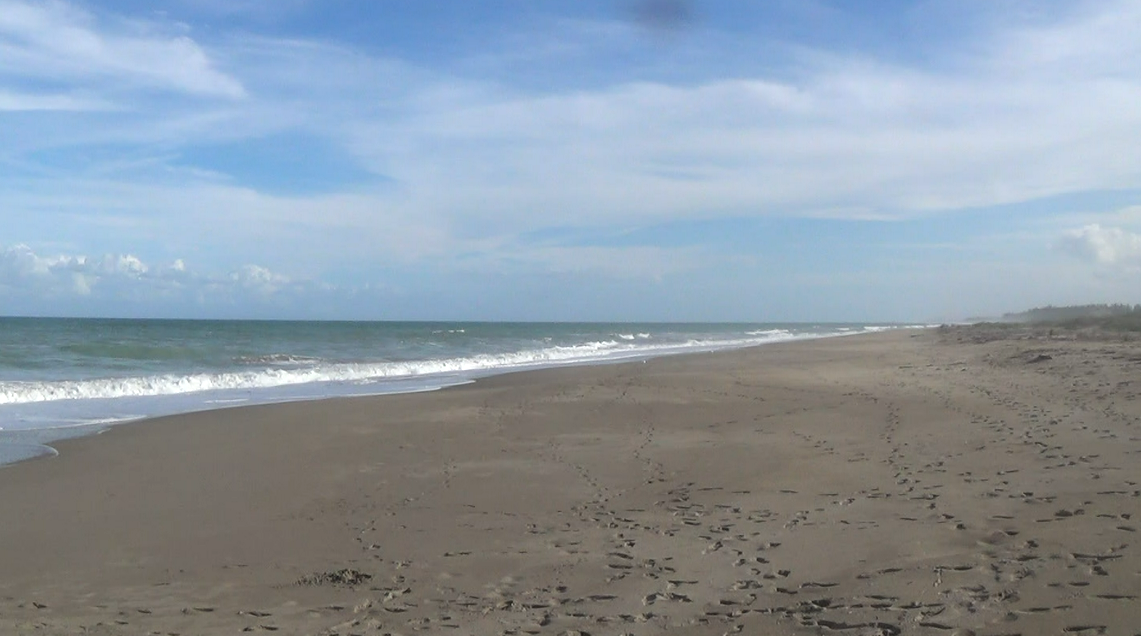
One Formless Beach As Seen Yesterday Afternoon Near Low Tide.
I'll try to get some good close video of the things I described above.  I guess I was so intent on watching that I forgot to take a video.

Every time I do try to catch a video of something in the crash zone, it seems things don't happen when I want.

It rained last night and much of today.  The surf is down today and will be nearly flat for a few days.

I'll get back to recent finds in my future posts.

Happy hunting,
TreasureGuide@comcast.net

Monday, September 28, 2015

9/28/15 Report - Surge and Backwash and Cut Beach. Tropical Depression Eleven. Higher Waves.


Written by the TreasureGuide for the exclusive use of treasurebeachesreport.blogspot.com.


Illustration Showing Surge and Backwash On A Beach With A Cut
A few days ago I presented a couple of illustrations to show how coin lines were formed.   My intention was to continue on that subject, but I got on some other subjects.

The illustration in the previous post showed how the surge went up the slope and gradually decreased and then washed back down the hill.  When there is a cut, the surge can hit the face of the cut before the water slows.  When that happens the surge bounces off of the cut and washes back down the slope with greater force than if it had gradually slowed down on the slope.

The tide is important.  When a cut is created before high tide, as the tide increases, more and more water hits the cut as the tide comes in.  When the tide starts to go down, and if the waves are not big enough, the water will no longer be hitting the cut at all.

If the cut is created at low tide, the high tide can over-wash the cut and smooth it out if the water is hitting the beach straight on.

The main thing to notice is that when the water continues to hit a cut with force there is no gradual slowing of water as the surge slows and reverses.  Instead the water can hit the cut with force and bounce back sending the water back down the slope with force.

When the waves are hitting straight on, the backwash will be colliding with new surges.  If the wave period is small, that will happen frequently.

When the surge and backwash collides there will be a reduction in force at that point, and items can be dropped off.

Any items washing out of the cliff can be temporarily covered and protected by sand eroded from the cliff.

If the water is hitting at a angle from the north, then the water can wash up onto the beach and curve back down without losing as much force.  That can move a lot of sand and other items.  Of course if it is coming in at a good angle it can still carve away at the cut when the water is high enough.  You get more erosion when there is a good angle and high water.

High water washing directly up the beach will not cause nearly as much erosion as water washing in at an angle.

---

Treasure Coast Beach This Afternoon


Last night we had a super moon and a lunar eclipse.  The tides were high, and I hear that in some areas there was flooding.  On the Treasure Coast the tide was about two feet higher than normal.  I didn't see any type of flooding.  In fact I thought the water was not any higher than yesterday.

Ida has finally disappeared.  We have Tropical Depression Eleven to the east of the Bahamas.  I expect it to stay out there and move north and not affect us much.  The waves were bigger though.  I thought in some places they looked like six to seven feet.  I saw a few surfers.

I found one cut that was close to two feet high.  I'm sure there were others around the Treasure Coast. I only looked at a couple of beaches.  One was mushy.  The other wasn't.

I wasn't finding anything old where I was.

There were some shells and fossil pieces.

We also have a disturbance in the Gulf.

The surf is supposed to be 3 to 5 feet until Wednesday when it is supposed to be up to 6 feet.

You might be able to find a good cut somewhere.  The waves are hitting directly from the East though.

---

The history of money diggers article that I presented yesterday is a good read.  You might be able to pick up a few good clues from it.  In any case the folklore and history is interesting enough by itself.

Also check out the bibliography at the end.

---


Happy hunting,
TreasureGuide@comcast.net

---

Tuesday, September 22, 2015

9/22/15 Report - How Coin Lines Are Formed: The Basic Beach Dynamics. CSS Georgia Salvage.


Written by the TreasureGuide for the exclusive use of treasurebeachesreport.blogspot.com.

Yesterday I talked about finding coin lines.  Today I will attempt to illustrate the basics of how coin lines are formed.

The above illustration shows how the amount of water and force decreases as it goes up the slope of a beach.

The key concepts are those I've mentioned many times before.  First is the trigger point, which is the amount of force needed to pick up and move specific objects - in this case coins.

The force is greatest near the bottom of the slope and decreases as the water goes up the slope, sometimes eventually ceasing altogether.

At some point the water slows enough that it can no longer carry the objects and they settle out.  In my simple diagram that would be about at the number two.

That is the most simple scenario capable of creating a coin line.

However, not only does the water rush up the slope, very often there is a backwash.


In this illustration the red line shows the backwash.  If the water retreating back down the beach is strong enough to carry coins, it can carry coins back down the slope.

Remember, when the water slows to the critical "drop off" points, objects will be dropped.

But different objects have different "trigger points" as well as different "drop off" points.  Both the surge and the backwash can move coins and sand, or if not strong enough to move coins, it will just move the sand, leaving coins behind.

If the backwash has enough force it will carry coins back down the hill and also sand.  Sometimes it will have enough force to carry sand but not coins.  That applies to both the surge and backwash.

To additionally complicate matters, the coins can start out either in the water or in the sand.  They can be washed up or down.  They can be carried up the beach and dropped off at some point, or if they start out in the sand, they can be uncovered as the sand is washed away and washed down the slope.

A coin line can be very narrow when the surge is consistent or wide when you have a waves and a surge that varies more.

Once a coin gets covered by sand, it can be protected from the flow of water, which will flow over it without moving it until the sand is moved and it is uncovered.  If the water is moving enough to move the coin, of course it will also move the sand.

The backwash can be very strong in some cases, and in others virtually non-existent.  The balance between the two is important.  You'll often see the surge colliding with the backwash,

This is overly simplified, but I think it is still a decent illustration of the key concepts.

I'll possibly add to this in the future, considering things such angles, different sources and abrupt changes in beach profiles.

---

Terry T. recently found these coins in a coin line.  You might remember that I mentioned that discolored coins are good signs or markers.  They have been out there long enough to have been sifted and sorted and dropped in a line.

Coins Recently Found In A Coin Line On The Treasure Coast.
Photo submitted by Terry T.
Here is what Terry said in response to yesterday's post about a coin line.

...All in the picture were found to the south of a public beach about 300 yards a few days ago. I had about an hour to detect. A cut approximately 3 ft ran for about 60 yards. 26 years ago people were able to park off of A1A on top the dune very close to the beach ( an old party spot). I have got stuck there many times in the sand. Only to come to the conclusion that a couple of 8 inch wide pieces of wood cut 3-4 feet in length stored inside my vehicle, and a little patience along with a small shovel (and a lot of sweat back in the day) would get me out of the situation. Now AAA will be called -lol. All are modern U.S. coins, but have been there for sometime ( I excluded the pop tabs - both modern and old school types from the picture). Not one fishing sinker was found - nor any gold, but this area has produced gold in the past along with other items. I went back 2 days later after digging the coins in the picture, and the cut was filled in. She hides it well.....

Thanks Terry.

The primary purpose of hunting a coin line is not to find modern coins, but they can also be made of old coins and sometimes even better things as well.  The thing about the coins is that they reveal a pattern that can then be exploited.

Any old green coin like those shown above can be a sign of a coin line or coin hole.

---

Many artifacts and a 9,000 pound Dahlgren cannon has been recovered from the wreck site of the CSS Gerogia.

Here is that link.

https://www.dvidshub.net/news/176414/second-dahlgren-rifled-cannon-surprises-css-georgia-archaeologists#.VgBQ1t9Vikq

---

It looks like Ida will fizzle out in the Atlantic.  There is a disturbance to the north of Florida that can be helping some of the states to the north of us.

The Treasure Coast is supposed to have a slowly increasing surf for the next week.  I'm not real hopeful.  We are getting into the Fall when typically we get some kind of storm.

Happy hunting,
TreasureGuide@comcast.net