Showing posts with label beach dynamics. Show all posts

Tuesday, May 26, 2020

5/26/20 Report - Encrusted Objects and Mystery Item. Beach Dynamics Resources.


Written for by the TreasureGuide for the exclusive use of treasurebeachesreport.blogspot.com.


Three Small Encrusted Objects.

I decided to investigate a few small encrusted objects this weekend.  The item on the left is a broken or repurposed spike that is partially encrusted.  The item on the right is still totally encrusted.  When I shook the totally encrusted object, it rattled.  It sounded something like a small lead ball within a cavity.

I soaked the broken spike head in acid for about a day and little progress was made.  I should have removed some of the crust mechanically before using the acid.  That is my normal procedure, but I neglected to do that this time.

I decided to just break open the totally encrusted object.  Here is a closer look at it.

Small Encrusted Rattling Object.


Below is what I found when I broke it open.


Copper Casing Within EO and Shell Removed From Casing.

Maybe someone can help me with this, but it looks like what I would call a double-cased shell.  Is that right?  Below you can see the lead core at the tip and butt of the bullet.

Lead Bullet Core At Point (left) and Butt (right).


And below is the outer casing for both sides of the bullet.  The two halves of the outer casing are still stuck in the encrustation.

Two Ends of Casing With Bullet Removed 
(Butt end left and point right.).
 I wouldn't think there would be that much room between the outer casing and the bullet so that it would rattle like that.  Maybe that was caused by corrosion, and maybe someone that knows more about bullets and casings can tell me about that.

---

Yesterday I posted the mystery object shown below, which was found by Bill M.  It gave a detector reading.  I thought it looked like it could be an EO.  SuperRick, who hunts meteors and nuggets, gave the following informative response.

Mystery Object
Find and photo by Bill M.
The photo is just a river rock better known as an igneous rock! A lot of rocks will have iron in them to prove me wrong take a file to a high point on the rock and file it. If you see shiny metal then take it to your bathroom toilet and lift the cover and rub your rock on the inside part of the [tank] cover.

If your rock leaves a streak you have what I said it was just a rock. You can also use a rare earth magnet to see if the rock will jump to it! 

If your rock doesn't streak and the magnet makes the rock jump to it you might have found a meteorite but all kinds of rocks are what we call hot rock when we are hunting for meteorites! Those rocks will hit on a metal detector and you have to know what you are looking for! ...

Thanks Rick.

It is always good to hear the knowledge of the various experts that read this blog.  He suggested some good tests too.

---

If you are interested in learning more about beach dynamics, here are a variety of excerpts and abstracts from a number of studies.


---

Source: MagicSeaWeed.com

Looks like some more small surf for this week.

Happy hunting,
TreasureGuide@comcast.net


Sunday, March 22, 2020

3/22/2020 Report - Beach Dynamics and Beach-Specific Knowledge. Many Beaches Closed.


Written by the TreasureGuide for the exclusive use of treasurebeachesreport.blogspot.com.

Source: madkeen.com  (See specific link below.)

There are at least two distinct types of beach knowledge.  One is the general ability to read beaches, and the other is knowledge about the unique characteristics of specific beaches.

These days it seems almost everybody talks about "reading a beach."  My first posts on that topic were done back in 2008, although I was reading beaches long before that. 

People have been reading beaches for a long time - well before most of the current generation of detectorists was doing it.  It didn't take treasure hunters long to notice that blackened coins showed up on the beaches after storms.

One thing that is very different today is that a lot more gets published.  You can watch YouTube videos and read blogs and forums.  Those didn't exist back thirty or forty years ago.  Back then detectorists were generally much less talkative.  Some went to great lengths to remain invisible.  Some of the best detectorists hunted at night so they wouldn't be observed.  They weren't about to give anyone else their secrets.  Of course there were always a few who liked to talk, but most remained very tight lipped.  Now people come along, observe what others have been doing, read what others have to say, put it in a book, slap a picture of their face on the cover along with some finds and sell it as their own.

I remember once getting a call from somebody who wanted me to sell me some type of oil investment.  I thought if it was as good as he says, why is he on the phone trying to sell it to me.  According to him, a small investment would quickly become a fortune, so why didn't he just do that.  I feel similarly about people who are trying to sell books filled with information they got from somebody else without giving any credit.  There are all kinds of people in the world.

One thing you must do if you conduct any kind of serious academic or scientific research is give credit to the various sources that you use.   In a research report, you would include a review of the literature.  That includes everything relevant that has been published up to the point of your investigation. The literature review gives a history of the state of knowledge on the subject and gives credit to the people who contributed that knowledge.

If you've been watching the daily Coronavirus task force you'll notice that Dr. Fauci has a very conservative approach that demands good hard research and data.  You'd expect that from a person in his position.  He would naturally have a different attitude and perspective than somebody working alone with people in poor remote regions of the world that have to do what they can with what they have to solve immediate problems.  The press doesn't seem to understand that or much of anything else.

But back to reading beaches - detectorists are not the only people who do it these days.  I just ran across a fishing blog that talks about reading beaches.  It seems that many fishing sites talk about it.

Here is the link to the one I bumped into.

https://blog.madkeen.com.au/how-to-read-a-beach/

I didn't actually read much of it but saw some good illustrations on one post.  At the top of this post is one of those.

To me that seems more like reading the water than reading the beach, but that isn't important, and it is still food information for both shallow water hunters as well as land hunters.  The tides will go out.

You'd think the gutter is a good place to hunt, and it can be, but sometimes it is too shallow and is filled with loose sand and shells.  Even then it can be a good spot to find some types of objects - watches for example.

I still remember the first time I got caught in a rip tide.  At that time I knew nothing about rip tides. I just felt myself getting pulled out.  That was between Hollywood beach and Dania beach.  It was a little scary.

It is helpful to know how the sand is moving.  One thing I used to say a lot is "Follow the sand, but don't catch it."  When the sand moves it ends up in one location, but has left another.  Generally you want to be where the sand was - not where it is.

A sand bar can be moving in or out.  If people have been playing on it, there can be good items on the sand bar.  If the bar is moving towards the shore, things that were dropped earlier can be uncovered.   That is something that applies more often but not exclusively to hunting modern jewelry.

Gutters can be good, but they aren't always good places to hunt.  It depends upon how deeply they are scoured.  You can usually tell in just a second or two.  If the gutter is filled with coarse pieces of shells, it probably isn't very good.  There are a few types of items, however, that will often be found in shallow gutters,  That includes watches.

Rip tides and gutters can create fantastic hunting.   If the loose cover gets cleaned out down to bedrock, it can be a real bonanza until it fills in again.

One mistake I made on more than one occasion is not staying to clean an area like that out before it refilled.  Sometimes those types of spots can last for days, but they can quickly disappear.

What I started out to talk about was the difference between the general skill of reading a beach, and beach-specific knowledge.  If you know the general principles, you can walk onto any beach and use those skills, but it also helps to have a good knowledge of specific beaches.

If you hunt a particular beach enough, you will learn its unique habits.  You will learn where things tend to show up, and under what conditions.  If you hunt a particular beach enough, you will know where the good spots are.  Very seldom will somebody give you that kind of information.  And it takes a while to acquire.

Beaches will change over time though.  I've known some spots that were good for years or even decades, but they eventually changed.

To sum up my main point today, there is a general knowledge beach dynamics that you can apply to any beach, but there is also beach-specific knowledge, which is best acquired by working that beach for months and years.  If you have a good beach and are lucky enough to be able to hunt it enough so that you know it inside and out, you will have a huge advantage over anybody who does  not know it as well.

---

Many of the Florida beaches are now closed.  Indian River and Vero beaches will be closed Sunday.  So will the Hobe Sound beaches.

St. Lucie County beaches, I understand, at this point will remain open.  One local official thought it would provide a good outdoor outlet for people, but the situation will be monitored and the decision could be changed.  Safe outdoor activities can provide relief from stress that might otherwise cause some people to go stir-crazy and do something less safe.

---

Both Mitch King and Joe D. identified the silver item that looked something like an small but unclosed ring as a girls toe ring.  That seems conclusive.

Thanks guys.

---

Don't let the beach closures stop you.  There are still places to hunt.  It might be a good time to try some new types of areas.

Happy hunting,
Treasureguide@comcast.net

Tuesday, September 22, 2015

9/22/15 Report - How Coin Lines Are Formed: The Basic Beach Dynamics. CSS Georgia Salvage.


Written by the TreasureGuide for the exclusive use of treasurebeachesreport.blogspot.com.

Yesterday I talked about finding coin lines.  Today I will attempt to illustrate the basics of how coin lines are formed.

The above illustration shows how the amount of water and force decreases as it goes up the slope of a beach.

The key concepts are those I've mentioned many times before.  First is the trigger point, which is the amount of force needed to pick up and move specific objects - in this case coins.

The force is greatest near the bottom of the slope and decreases as the water goes up the slope, sometimes eventually ceasing altogether.

At some point the water slows enough that it can no longer carry the objects and they settle out.  In my simple diagram that would be about at the number two.

That is the most simple scenario capable of creating a coin line.

However, not only does the water rush up the slope, very often there is a backwash.


In this illustration the red line shows the backwash.  If the water retreating back down the beach is strong enough to carry coins, it can carry coins back down the slope.

Remember, when the water slows to the critical "drop off" points, objects will be dropped.

But different objects have different "trigger points" as well as different "drop off" points.  Both the surge and the backwash can move coins and sand, or if not strong enough to move coins, it will just move the sand, leaving coins behind.

If the backwash has enough force it will carry coins back down the hill and also sand.  Sometimes it will have enough force to carry sand but not coins.  That applies to both the surge and backwash.

To additionally complicate matters, the coins can start out either in the water or in the sand.  They can be washed up or down.  They can be carried up the beach and dropped off at some point, or if they start out in the sand, they can be uncovered as the sand is washed away and washed down the slope.

A coin line can be very narrow when the surge is consistent or wide when you have a waves and a surge that varies more.

Once a coin gets covered by sand, it can be protected from the flow of water, which will flow over it without moving it until the sand is moved and it is uncovered.  If the water is moving enough to move the coin, of course it will also move the sand.

The backwash can be very strong in some cases, and in others virtually non-existent.  The balance between the two is important.  You'll often see the surge colliding with the backwash,

This is overly simplified, but I think it is still a decent illustration of the key concepts.

I'll possibly add to this in the future, considering things such angles, different sources and abrupt changes in beach profiles.

---

Terry T. recently found these coins in a coin line.  You might remember that I mentioned that discolored coins are good signs or markers.  They have been out there long enough to have been sifted and sorted and dropped in a line.

Coins Recently Found In A Coin Line On The Treasure Coast.
Photo submitted by Terry T.
Here is what Terry said in response to yesterday's post about a coin line.

...All in the picture were found to the south of a public beach about 300 yards a few days ago. I had about an hour to detect. A cut approximately 3 ft ran for about 60 yards. 26 years ago people were able to park off of A1A on top the dune very close to the beach ( an old party spot). I have got stuck there many times in the sand. Only to come to the conclusion that a couple of 8 inch wide pieces of wood cut 3-4 feet in length stored inside my vehicle, and a little patience along with a small shovel (and a lot of sweat back in the day) would get me out of the situation. Now AAA will be called -lol. All are modern U.S. coins, but have been there for sometime ( I excluded the pop tabs - both modern and old school types from the picture). Not one fishing sinker was found - nor any gold, but this area has produced gold in the past along with other items. I went back 2 days later after digging the coins in the picture, and the cut was filled in. She hides it well.....

Thanks Terry.

The primary purpose of hunting a coin line is not to find modern coins, but they can also be made of old coins and sometimes even better things as well.  The thing about the coins is that they reveal a pattern that can then be exploited.

Any old green coin like those shown above can be a sign of a coin line or coin hole.

---

Many artifacts and a 9,000 pound Dahlgren cannon has been recovered from the wreck site of the CSS Gerogia.

Here is that link.

https://www.dvidshub.net/news/176414/second-dahlgren-rifled-cannon-surprises-css-georgia-archaeologists#.VgBQ1t9Vikq

---

It looks like Ida will fizzle out in the Atlantic.  There is a disturbance to the north of Florida that can be helping some of the states to the north of us.

The Treasure Coast is supposed to have a slowly increasing surf for the next week.  I'm not real hopeful.  We are getting into the Fall when typically we get some kind of storm.

Happy hunting,
TreasureGuide@comcast.net

Monday, September 8, 2014

9/8/14 Report - Great Finds on the SS Central America. Odyssey Marine Reports. Gold Coins and Artifacts. More On Beach Dynamics.


Written by the TreasureGuide for the exclusive use of treasurebeachesreport.BlogSpot.com.


A Few of the Gold Coins Salvaged From The
SS Central America July - Aug.
Source: See link below.
Odyssey Marine Explorations has been working on the SS Central America.  They have been recovering a lot of gold and artifacts and doing a lot of research.  They provide monthly reports on their web site, which I find both fascinating and informative. 

The reports show site maps with artifact distributions, photos of the site, items recovered, and even experiments conducted in the process, such as one experiment that studied how wood deteriorates on the ocean floor.

In the June/July report you will read about how they recovered loose gold that was lost in the wreck.  The gold was being returned from the gold fields when it was lost when the ship went down.  Now they are mining it for a second time, this time from the bottom of the sea.

I think it is interesting that they are using a dredge and a sluice, very much like the sluice that might have been used by the original miners.


I've mentioned before about the gold dust in the ocean off of Rio Mar.  At least one attempt was made to recover it, but it was very difficult and not very effective.


Source of photo: Odyssey report link.
I also find the idea of twice-found objects interesting.  I've mentioned an escudo that was mined and minted in Mexico, then lost in a shipwreck, then salvaged and put on another ship which sank, salvaged and sold, and then lost by whoever purchased it before I found it.  In other words, it was lost in the water and found three times.


Below is the link to the Odyssey Marine June16 to July 15 report.

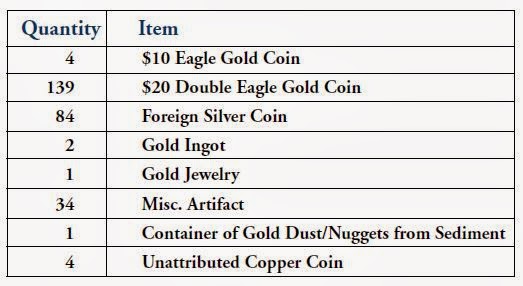
Also below is the summary of finds for that period.

To the left you see a photo of the sluicing operation on board the salvage ship.

http://www.shipwreck.net/documents/OMECourtReport14-3_000.pdf


Summary of Finds From the June - July Odyssey Report.
Source: Odyssey report link above.


And here is the link to their July 16 - Aug. 15 report.

http://www.shipwreck.net/documents/OMECourtReport14-4.pdf


They found a lot of coins during that reporting period.

Below is a photo of a neat pin manufactured from a gold nugget found in the gold fields.\

The report and nugget pin are both from the July16 - Aug. 15 report.


As you know I've done a few posts giving the results of some observations I made on how objects sink at the beach. 

Here is what Bill F., our resident oceanography expert, sent via email concerning objects sinking.

Why do objects sink rapidly?  Look at our beaches..coarse material, or
in some cases, stuff from offshore pumped onto our beaches.  Both of
these materials create a relatively steep beach front.  The high
velocity incoming wave moves material toward the shore. and it drops
out of suspension as the water velocity drops, forming a steep beach.
Now, another aspect takes over.  The water soaks into the coarse
substrate, with very of the wave actually running back out.
Basically, the beach surface churns in place, and the water slowly
returns to a lower elevation.  You've probably seen it running out of
the upper beach at low tide, usually along a line of denser material.

I'm sure you've encountered this well packed shell layer under all
this loose top material.  That's where objects will settle to.

Wave action moves a tremendous amount of material.  If you draw a line
from the dunes to the water, sand will move north and south across it,
but the NET TRANSPORT will be as much as 400,000 cubic yards SOUTH in
our area.

Bill
Thanks Bill!


On the Treasure Coast we still have a very small surf.  We'll have that for at least a few more days.

At least the tides are getting little bigger.  I suspect the rain kept a lot of beach goers from going to the beach this weekend.

There isn't much to be concerned with in the Atlantic.

Happy hunting,
TreasureGuide@Comcast.net


Monday, February 24, 2014

2/24/14 Report - Iron Flakes or Silver, Driftwood, & Groins and Beach Dynamics


Written by the TreasureGuide for the exclusive use of treasurebeachesreport.blogspot.com.


Example of Nice Piece of Driftwood That Could Be Easily Sold
Before I get into my main topic today, you might remember that I talked a little about the market for driftwood.  Here is one of my favorite driftwood finds.

It is flat on the back and could be easily hung on a wall as is, but I have another idea for it.

You might be able to see the quarter shown for size.


A couple of days ago I posted some pictures of flakes of iron that people often ask about.

Pete L wrote and said,

  I was thinking back a few years when I found my first two 1/2 reales.

I remember vividly that both of those 1/2s looked exactly like the piece

of iron to the right of the dime in your photo!  I actually almost tossed them

but looked closely and saw the tell tale little cross in the middle of them.

  Now, whenever I find something like that i simply try to snap it in half.

If it snaps it's most likely iron but if it resists snapping there's a good

chance it's Silver!

Thanks for the good tips Pete.  Most half reales if they show nothing else will have some sign of the cross showing, but not always. 

My first Spanish silver was not a cob, or if it was it was what is sometimes called a razor because it is worn so thin and featureless.  No sign of cross or anything else could be seen on it, but it is silver.  I did an acid test on it.

Many detectors will tell you if an item is iron or silver.  And another quick test is a magnet.
I always say don't throw an item away if you aren't sure about it.  You won't regret holding onto it as much as you'll regret throwing something good away.

Two or three days ago I showed how sand moves back and forth up and down a beach with each wave and with the tides.  I said there are normally additional factors.  Today I'll address one of those additional factors.   It is long-shore, or littoral, drift, which I observed while detecting long before I knew what it was called.

Here is a simple animation that shows how sand moves with the waves and with long shore currents, assuming a straight beach line.

When you go to the link, click on the graphic to see the animation.

http://oceanica.cofc.edu/an%20educator'sl%20guide%20to%20folly%20beach/guide/driftanimation.htm

You will see that zigzag pattern while detecting near the water.  If you dig a target, in the moving water and the target falls out of your scoop, it will move either up or down the slope and in the same direction as the water north or south on the beach.  I've seen that a million times.

Sometimes I'll throw a coin into the waves on the beach just to see how they move the object.  Sometimes they'll move a lot and sometimes not as much.   I've done a lot of experimenting and observing.

If you lose something like a pull tab out of your scoop it will be moved farther than some other objects such as coins.

If you want to keep the object from moving when it is on or near the surface when a wave comes, quickly put your foot on it.  I've talked about that before so I won't repeat all of that.

Another thing you can do to keep from losing the object is to keep sweeping your coil over it and track it while it moves.

You want to know how the sand and objects are moving so you can look at a beach and get a good idea of where to spend your time.  You can learn to know where any hot spots are likely to be.

The littoral drift along the Treasure Coast as well as most of the Florida East Coast is north to south.

So what happens if you don't have an entirely straight beach, but instead there are obstructions to the flow of sand.  One good example that illustrates what happens is when there are groins.

I learned about groins a long time ago.  The sand will pile up along one groin or another depending upon the direction of the waves.  By the way, groins and similar structures create some very good hot gold spots.

Below is a good diagram from this web site.

http://ohiodnr.com/LakeErie/ShoreStructure_Groins/tabid/9257/Default.aspx


First,notice the direction of the waves.  That is a critical factor.

Second, notice the direction of longshore transport (the direction that long-shore currents are carrying sand.) that in this illustration goes left to right.

Focus on the first two areas in between the first groins.  I don't want to get into tapered groins or other complications now.

The sand is tilted between groins, as is usually the case.  It will usually pile up more on one side but will change sides if you have a change in the direction of wind and waves for a long enough time.

When the waves come from the left they are going along with the longshore transport to some extent.  If the waves were hitting more from the right, they would be going against longshore transport.

Although I won't elaborate on that now, Ive touched on some factors that partly explains the differences between the effect of nor'easters and southeasters on Treasure Coast beaches.

As shown in this illustration, with the waves hitting as they are in the illustration, a small amount of sand will be removed from the left of the area in between groins and a greater amount of sand added to the right side of the area.

As I said, this will occasionally reverse to some extent when conditions are extreme enough.  That will uncover pockets of heavy accumulations.

Groins provide a good illustration.  A similar thing happens with coves or simple curves in the beach or other situations that cause a protected  pocket of some sort that prevents a natural flow of sand along the beach.  It could be rocks or sand bars or other things.

There are still a lot of factors I haven't added to the system.

Here is an extra reading on Cross-shore and longshore sand transport.

http://www.csc.noaa.gov/archived/beachnourishment/html/geo/sediment.htm


We are stuck with a small surf on the Treasure Coast.  That is bad for beach detecting, but it is good for water detecting and there is still gold coming from the water at swimming beaches.


Happy hunting,
TreaureGuide@comcast.net