Showing posts with label trade. Show all posts

Monday, June 1, 2020

6/1/20 Report - Manila Galleons and Archaeology. Porcelain. Beach Cusps or Scallops.


Written by the TreasureGuide for the exclusive use of treasurebeachesreport.blogspot.com.

People find blue and white shards on the Treasure Coast 1715 wreck beaches and wonder if they might be Kang Xsi.  I get a lot of questions about that and in the past have posted some information about Kang Xsi, including  tips on identification.  Below are two intact Kang Xsi (various spellings) cups that sold in the recent Sedwick auction for $700 plus buyer's premium.  We usually just find shards on the beach, but they can be worth a little too, especially when attractively mounted.

Here is the Sedwick lot description for the two cups.

Intact blue-on-white Chinese porcelain cup with handle, Kangxi period, ex-HMS Winchester (1695), very rare provenance and condition. 72 grams, 2-1/2" tall and 2-1/8" in diameter. A lovely little piece with nothing missing (the handle manufactured separately and applied or possibly re-applied after glazing), the glaze worn away but with clear flowers in vase on balcony design on exterior, highly desirable as the only intact specimen found on this rare wreck. From the HMS Winchester (1695), with photo-certificate.


I found a good book with a lot of information on Chinese porcelain and the Manila galleons.  The title is Archaeology of Manila Galleon Seaports and Early Maritime Globalization, Part II.

That resource contains tons of photos, including the photo below of a wreck still containing a cargo of Chinese porcelain.


Source: Academia.edu link below.


That photo reminds me of the fellow who found a stack of plates recently exposed by new erosion to a wreck beach and didn't pay much attention to them. When he learned they could be valuable, he returned to find them, but couldn't.

During the sixteenth to nineteenth centuries, the Spanish navigators established and operated the Manila Galleon maritime route which connected East Asia and New Spain in the American continent. The galleons sailed across the Pacific via the hub seaports and trade centers of Manila in the Philippines and Acapulco in Mexico, forming a prosperous sea route for more than 250 years. This pioneering navigation of pan-Pacific regions promoted early global maritime trade as a new maritime Silk Road between the East and the West...

The Spanish conquest of the Philippines began with the arrival of Ferdinand Magellan in March 1521 (Pigafetta 1969). When Magellan was killed in April 27, 1521 by a local chieftain in the island of Mactan by the name of Lapu-lapu, the remaining Spaniards hastily left and went back to Spain. It was not until exactly 44 years after the death of Magellan that another expedition arrived in the Philippines (Cebu) under the command of Miguel Lopez de Legaspi, with specific instructions from the King of Spain to find the return route from Manila to New Spain (present day Mexico). The discovery of the tornaviaje or the return journey from Manila to Acapulco by Fray Andres de Urdaneta, Legaspi’s pilot and navigator in 1565 completed the maritime route that was later utilized by the Manila-Acapulco Galleon Trade (Schurz 1985). The first few galleons left from Cebu until Legaspi transferred his capital to Manila, leaving Cebu in economic disarray (Fajardo 2018). The galleon trade represents one of the earliest manifestations of economic globalization where Asia, the Americas and Europe were linked together through maritime high ways. 


The Galleon trade fostered both economic and cultural exchanges between the Philippines and Mexico, which can be observed up to this day (INQUIRER.net US Bureau 2017). The Manila-Acapulco galleon trade route was operational for 250 years (1565–1815) where merchant ships traversed more than 18,000 km across the Pacific Ocean from Manila to Acapulco and vice versa. At the western terminus, Manila became the world’s premier entrepot during the sixteenth and seventeenth centuries that linked peoples, cultures and material goods between Asia and the Americas (Schurz 1985; Fish 2011)...

I highly recommend reading this lengthy document.

Here is the link.

https://www.academia.edu/41712660/The_Chinese_Porcelain_from_the_Port_of_San_Blas_Mexico?email_work_card=title

Not only did the Manila galleons distribute items that ended up on the 1715 Fleet and Treasure Coast beaches, but Spanish colonial items also ended up in the ports of Asia.

Source: See academia.edu link above. 

---

In the past I received questions about how scallops or cusps are formed on the beach.  Here is an illustration that explains that.


---


Gold has been doing well.


The stock market is up this morning, which is really a statement for all of the positive things going on with economy, space exploration and pharmaceutical industry.


The surf is small today but will increase tomorrow.  The wind has already changed.


Source: MagicSeaWeed.com.

TreasureGuide@comcast.net


Monday, October 31, 2016

10/31/16 Report - CSA Plate. Various Detecting Goals and Strategies. Indigenous Alaskan Trade. Pre-Clovis Americans.


Written by the TreasureGuide for the exclusive use of treasurebeachesreport.blogspot.com.

Find Photo By Dan B.
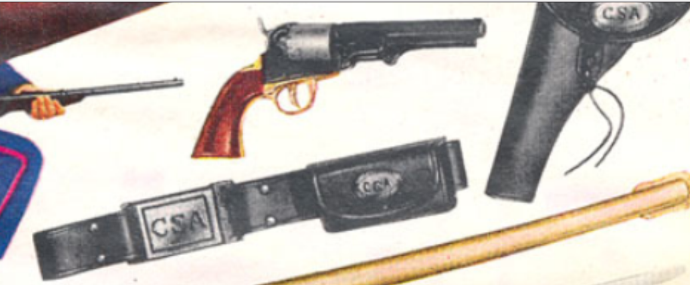
Notice the small CSA plate in the middle.  That could get a person excited.

As I often say, the find is sometimes only the beginning of the hunt.  That is especially true if you are a relic hunter.  After the find comes the research to find out as much as you can about the item.

Dan did his research.

Pictures of CSA Cap Gun Set.
It looks like the plate came off a a cap gun set like the one shown above.

Good research Dan!

---

I started to talk about strategies the other day.  It can be a complex and lengthy subject.  One of the first things is to define your goals.  The goals of a modern jewelry hunter will usually be economic. They want to find the most valuable finds that they can.

Non-detectorists usually assume that treasure hunters are driven by economics.  They assume that they are in it for the money, and they often ask, "What is the most valuable thing you ever found." That can be a difficult question for many detectorists to answer because they are interested in things other than the economic value of their finds.  Some want to find old things or unusual things or things that tell a story.  They might not ever want to sell anything.  That is not why they hunt.

One of the most important things in developing an effective strategy is to know exactly what you want to accomplish.  Why are you detecting and what do you want to find?  Sometimes people detect just for the fun of it or the exercise.

I mentioned a few days ago about when I was digging tons of clad coins.  If I was trying to maximize the economic value of my finds, I might not be interested in digging tons of clad.   It would hardly pay off economically.  There are other reasons to dig clad though.  One is to gather information.  You can gather information about what went on at the location, how long things been accumulating there, how old are the items that are being uncovered, and where the items are coming from - for example if they washing out of the dunes or being washed up onto the beach out of the water.

You can tell a lot from the distribution of coins.  If you are finding a disproportionate number of nickles for example, maybe someone usually detects that area discriminating out targets in the nickle/aluminum range.

Zinc pennies will often be near the outside borders of a coin line or coin hole while quarters will be nearer the center and also closer to gold rings.  If you are detecting a lot of pennies, that is just a bit off of detecting a lot of aluminum.  In either case, you might want to move towards the heavier items.

Another reason to dig clad is to uncover things that might be associated with the coins or masked by the coins.  Pennies and other things can mask better targets.  I often find that after clearing away a coin hole, I am then able to find targets in the area that I did not notice before when all of the coins were in the way.  After clearing away the loud targets, listen for the more subtle signals.

Be clear about your preferences.  Be clear about how you value things.  That will help you be more strategic in your detecting.

I'll continue with this topic in the future.

---

A bronze buckle and a cylindrical metal bead found in Alaska are the first hard evidence of trade between Asia and the indigenous peoples of the North American Arctic, centuries before contact with Europeans, archaeologists say.

An analysis of the artifacts has shown that they were smelted in East Asia out of lead, copper, and tin, before finding their way to an indigenous village some 700 years ago...


http://westerndigs.org/asian-metal-found-in-alaska-reveals-trade-centuries-before-european-contact/

---

For more than a decade, evidence has been piling up that humans colonized the Americas thousands of years before the Clovis people. The Clovis, who are the early ancestors of today's Native Americans, left abundant evidence of their lives behind in the form of tools and graves. But the mysterious pre-Clovis humans, who likely arrived 17,000 to 15,000 years ago, have left only a few dozen sources of evidence for their existence across the Americas, mostly at campsites where they processed animals during hunting trips. Now a fresh examination of one such campsite, a 14,000-year-old hunter's rest stop outside the city of Tres Arroyos in Argentina, has given us a new understanding of how the pre-Clovis people might have lived.


http://arstechnica.com/science/2016/09/14000-year-old-campsite-in-argentina-adds-to-an-archaeological-mystery/

---

The surf has decreased down to around four feet or less and will remain about that for the rest of the week.  I'm not anticipating any improvement in detecting conditions until possibly around a week from now.

Happy Halloween,
TreasureGuide@comcast.net

Tuesday, August 23, 2016

8/23/16 Report - Storm Aiming At Treasure Coast. Iron Shipwreck Objects. French in Pacific New World.


Written by the TreasureGuide for the exclusive use of treasurebeachesreport.blogspot.com.

Tropical Wave Heading Our Way
Source: See link below.
This is the big news for me today.  The weather system following Fiona is heading our way.  You can see that in the picture above.  It is still a few days away.  The strength and possibly the track could change before it gets here.

Here is the link to that.

http://blog.spiritdaily.com/news-links/tropical-wave-could-develop

Fiona is still heading north of us, and Gaston is expected to become a hurricane soon, but is still expected to head out into the North Atlantic.

Below is the relative position of all three.

Source: nhc.noaa.gov
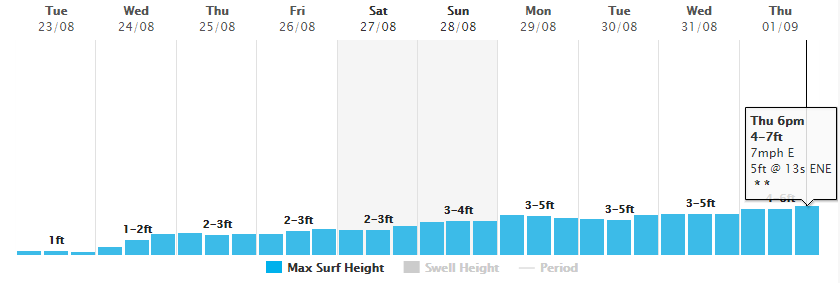
The surf is expected to increase daily for several days.  See the chart below.

Surf Predictions For Fort Pierce
MagicSeaWeed.com

---

Here is some good reading.  It isn't about the Treasure Coast, but it does relate to the exploration and discovery of the New World.

It is the 1918 text of the Annual Publication of the Southern California Historical Society - a lengthy but interesting bit of history about the French and the Pacific trade.  Take a look.

https://archive.org/stream/annualpublicatio19181920hist/annualpublicatio19181920hist_djvu.txt

---

Collection of Iron Finds by Darrel S.
Photo submitted by Darrel S.
Here is what he said about the photo.

Image from my personal collection. Fortunate to have John Powell and Lance restored my ferrous artifacts. Some took years, others less time. From Corrigans over past 25 years. You will see an awl as well as a double pointed object believed to be used as an enscriber (I believed part of crossbow.) I will send images from McLarty Museum later of both possibilities.


The double pointed object that he refers to is at about the five o'clock postiion.

Happy hunting,
TreasureGuide@comcast.net