Showing posts with label California. Show all posts

Sunday, December 3, 2017

12/3/17 Report - Sphinx Found in California. Get Your Ark Ready. Anchoring Information. Mystery Find and Museum Engraving Tool.


Written by the TreasureGuide for the exclusive use of treasurebeachesreport.blogspot.com.

An Egyptian sphinx was uncovered in the Guadalupe-Nipomo Dunes in California.
"The Ten Commandments" film was a masterpiece in its day. Hollywood director Cecil B. DeMille had Paul Iribe, a French artist known as "the father of art deco," create 21 sphinxes for the movie. DeMille placed the sphinxes in the movie's biblical Exodus set, where he filmed scenes of the Jews toiling under the Egyptians and later escaping through a parted Red Sea. DeMille filmed the Exodus portion of the movie in the Guadalupe-Nipomo Dunes, because it looked like sandy Egypt, Jenzen noted.
The Exodus set was enormous. It had pharaohs, sphinxes and colossal temple gates that, in all, reached 12 stories high and spanned 800 feet (240 meters) in width, Jenzen said. But legend has it that DeMille realized two things when he was done filming: The set was too expensive to move and too valuable to leave behind for rival filmmakers to steal, Jenzen said.
DeMille solved his dilemma by having the Exodus set buried in the sand...

Here is the link to that LiveScience article if you want to read more.

https://www.livescience.com/61045-hollywood-sphinx-found-in-dunes.html

Like I was saying the other day, it can be difficult to identify an item.  There are different ways that items can end up somewhere, and sometimes those ways are unexpected and surprising.  And t
here is also the problem of copies or reproductions.  I've posted some of those in the past.  I've found reproduction coins that were actually made of silver and gold.   They should be marked as such, but aren't always.  

---

Get your ark ready.


Sea-level rise in this century may threaten Jamestown in Virginia, the first permanent English settlement in the Americas; the Kennedy Space Center in Florida, which launches all of NASA's human spaceflight missions; and the Cape Hatteras Lighthouse in North Carolina, the tallest brick lighthouse in the United States, a new study finds.

These iconic locales are some of the more than 13,000 archaeological and historical sites on the Atlantic and Gulf coasts of the southeastern United States that rising sea levels will endanger this century, researchers in the new study said.

Global warming may lead sea levels to rise by about 3.3 feet (1 meter) in the next century and by 16.4 feet (5 m) or more in the centuries afterward, according to research from the Intergovernmental Panel on Climate Change and others. These rising sea levels could have severe effects, as more than 40 percent of all people worldwide currently live within a 60-mile (100 kilometers) distance from a coastline, many in low-lying areas vulnerable to sea-level rise, according to reports from the United Nations and others...


That comes from another LiveScience article.  Here is the link for the rest of the article.

https://www.livescience.com/61063-rising-seas-may-destroy-archeological-sites.html

---

Concerning the found anchor that I posted yesterday, Captain Jonah said, The anchor is most likely not Hartmans. They didn't use stern anchors. Instead use to use rims with tires attached to crown lines. And would have the guys dig deep holes burying them up to the crownline. They are still there every once and awhile we come across one. Just to clear up.

---

Concerning the mystery find that I posted on 12/1, Galen went back to McLarty Museum and found a good comparison piece.

Tools On Display At McLarty Museum.
Photo by Gaylen C.
Below is a photo of the engraving tool shown in the middle of the above photo (left) beside the point of the item Gaylen found (right).

Engraving Tool Point Beside Point of Mystery Find.
Photo by Gaylen C.

Here is what Gaylen said about that.

Went back to McLarty yesterday with grandson. Saw something I missed on the first trip in the display donated by Douglas Armstrong regarding the very early french explorers in FL.  This is an extremely similar piece. As displayed it could perhaps explain what I thought looked like wood remains. In an article I was reading it was reported to Menendez that some of the French escaped the slaughter and had traveled at least 75 miles to the south. We need some historians to address that. But the imagination can use that as the reason I found this in Ft Pierce. If it indeed is an engraving tool it fits into the activities in this area in these times. It could very well be Spanish as well as it could be French. I am curious as to who identified the piece on display. Is Douglas Armstrong still in the area? If so perhaps he could offer some insight. As I said, unless this is determined to be a positive ID, it kind of expands the realm of possibilities:

1. It is an early French tool, and even older than thought.
2. Frenchmen carried it south?
3 Spaniards acquired it by raiding the French.
4 It's really Spanish.
5 It is something totally different.

Last photo shows the two items in comparison. What think ye mateys?

For me - they sure do look alike.

Gaylen is cleaning the item and thinks he might see remnants of a wood handle.

Thanks Gaylen.

---

On the Treasure Coast we have beautiful weather - if you like beautiful weather.  I prefer windy and rainy.

The moon is beautiful too.   Good high tides but small surf.

Happy hunting,
TreasureGuide@comcast.net

Tuesday, January 24, 2017

1/24/17 Report - New Sand On Treasure Coast Beaches. Record Waves In California. Eye-balled Diamond Ring.


Written by the TreasureGuide for the exclusive use of treasurebeachesreport.blogspot.com.

John Brooks Beach Yesterday Close To Noon.
Above you can see the new sand that recently accumulated on John Brooks Beach.  It was a beautiful day, unless you are like me and like it windy and rainy.

I saw some county officials gathered there.  They took a look at the beach.

I also saw the dredge boats up at the port of Fort Pierce.  Looks like it won't be long before they start dumping sand again.  Most of the sand from the last replenishment effort is now no longer on the beach.  There is about a ten foot cliff right below the inlet.

The west wind was blowing the top off of the waves, as you might be able to see in the picture above. That was a pretty sight.

Turtle Trail South From the Access
Yesterday Near Low Tide.
 New sand also accumulated on the beach at Turtle Trail and Seagrape Trail.  I looked at a couple of other beaches that are not shown in these photos, and they all had new light brown sand with some shells on the front of the beach.

Couple Detectorists Coming Off the Turtle Trail Access Monday.
 Despite the poor beach conditions, I saw a good number of beach detectorists out yesterday.  Here are a couple.

Looking South From The Seagrape Trail
Access Yesterday.
 Everywhere I looked, the front beaches looked about the same.  New sand everywhere.

North From The Seagrape Trail Access Yesterday.
 The west wind was still pretty stiff.  It wouldn't have been a bad time to be in the water.

---

The National Weather Service (NOAA) buoys recorded waves from 20 to 30-plus feet between Cape San Martin to the south and Point Arena to the north. 
Monterey Bay recorded the largest waves it has seen in 30 years with the swell reaching 34.12 feet at one point. The previous record was 32.8 feet in 2008...
Here is that link.

http://www.sfgate.com/bayarea/article/Monster-waves-pounded-NorCal-coast-Saturday-10875391.php

---

Dan C. sent this report from Cocoa Beach.

Just a followup from that report.

Yes I did hit the 5 am low tide at the pier the next morning.

Only one find and it was kind of silly : a hippy talisman made from a quartz crystal capped with a gold plated end cap at the base of the crystal which held the chain loop. Of course I had to know why someone valued the thing and per the website that sells such things , it allows a person to "tune in to the Lemurian vibrations" by rubbing the crystal. Ohhhh kay.

I will try again Tuesday am low tide. I am due for a good find.

In the meantime, my co-worker asked me to examine a diamond ring he found in the sand at Sebastian breakwater beach.

A sight find while he was fishing. My diamond tester confirmed it was real, about .25 carat, nice diamond in 18k.

True luck ! The previously mentioned sea beans were all gone, evidence that the sea bean collector crowd had got the word and raided Cocoa Beach.

I will be detecting Clearwater Beach Jan 31 thru Feb 2 in a marathon of detecting, mostly at night at low tide but some in-water work planned. This westerly storm front may do some good things to the beach for me.


Thanks Dan.  

With a lot of practice, a person can actually develop some level of skill at eye-balling.  It is like programming your brain to key into certain small features.  If you do it enough, you'll notice how certain kinds of things, such as the faint glint of gold, will catch your attention and your head will snap to the item before you make a conscious decision.

---

Low tide will be just before noon.  We'll have a good week of small surf.  It might be a good time to check out some shallow water areas.

Happy hunting,
TreasureGuide@comcast.net


Tuesday, August 23, 2016

8/23/16 Report - Storm Aiming At Treasure Coast. Iron Shipwreck Objects. French in Pacific New World.


Written by the TreasureGuide for the exclusive use of treasurebeachesreport.blogspot.com.

Tropical Wave Heading Our Way
Source: See link below.
This is the big news for me today.  The weather system following Fiona is heading our way.  You can see that in the picture above.  It is still a few days away.  The strength and possibly the track could change before it gets here.

Here is the link to that.

http://blog.spiritdaily.com/news-links/tropical-wave-could-develop

Fiona is still heading north of us, and Gaston is expected to become a hurricane soon, but is still expected to head out into the North Atlantic.

Below is the relative position of all three.

Source: nhc.noaa.gov
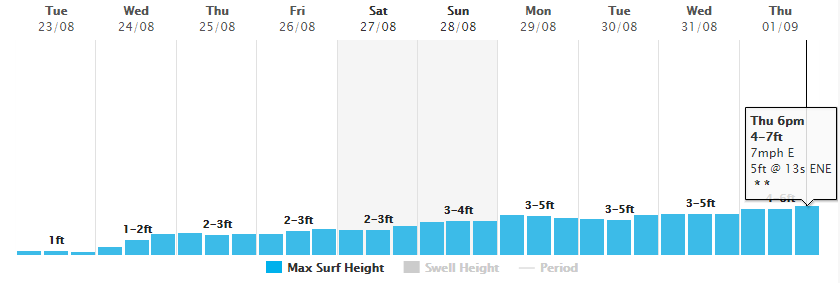
The surf is expected to increase daily for several days.  See the chart below.

Surf Predictions For Fort Pierce
MagicSeaWeed.com

---

Here is some good reading.  It isn't about the Treasure Coast, but it does relate to the exploration and discovery of the New World.

It is the 1918 text of the Annual Publication of the Southern California Historical Society - a lengthy but interesting bit of history about the French and the Pacific trade.  Take a look.

https://archive.org/stream/annualpublicatio19181920hist/annualpublicatio19181920hist_djvu.txt

---

Collection of Iron Finds by Darrel S.
Photo submitted by Darrel S.
Here is what he said about the photo.

Image from my personal collection. Fortunate to have John Powell and Lance restored my ferrous artifacts. Some took years, others less time. From Corrigans over past 25 years. You will see an awl as well as a double pointed object believed to be used as an enscriber (I believed part of crossbow.) I will send images from McLarty Museum later of both possibilities.


The double pointed object that he refers to is at about the five o'clock postiion.

Happy hunting,
TreasureGuide@comcast.net

Friday, May 2, 2014

5/2/14 Report - Sedwick Auction Results, 5000 Years of California Violence, Digging Up Your Personal Past and My Most Valuable Find


Written by the TreasureGuide for the exclusive use of treasurebeachesrport.blogspot.com.

There was one standout among the gold cobs auctioned off by Sedwick yesterday.  It brought in over $76,000.  The next highest price for a gold cob was around 23,000.  A common price range for gold cobs was one to two thousand, with just a handful bringing in less than one thousand.

Here is the lot description for the big winner.

Lima, Peru, cob 8 escudos, 1701H, Philip V, extremely rare, from the 1715 Fleet. S-L25a; KM-38.1. 26.95 grams. Almost round, evenly struck and perfectly centered, this would be an exceptional specimen for any date, let alone one that is missing in Calico and the State of Florida collection (theirs is Charles II). In fact we can trace only one other example for Philip V, an AU 55 of demonstrably inferior strike but with perhaps slightly more evidence of the coins' having been created from a modified 1700 die. The present coin is at least AU 58 but bears areas of red staining and gray coral that preclude professional encapsulation. What is more important is that the strike is nearly perfect--well centered and even--and the effect in hand is sheer beauty. From the 1715 Fleet.

The two standouts among the world gold coins were two had final prices of nearly $5000. 

Both of those were Brazil (Rio mint) reis.  Each of those sold for just under five thousand dollars.  A good number of lots in this category did not sell.  An the expected standout in this category did not sell.

There was a clear standout in the US gold coins.  It was the USA (Philadelphia mint), $10 capped-bust Liberty, 1801, encapsulated NGC UNC details / improperly cleaned. KM-30. Lustrous and attractive, with minor marks only, the surfaces very faintly hairlined from cleaning, popular early gold with high catalog value.

It sold for just over $15,000.

The auction continues today.


Two more days remaining to respond to the blog poll.  It is proceeding very nicely.  I'll get more out of the results than might be immediately apparent.


On the Treasure Coast the wind is out of the South right now.   The higher surf will be this morning, then decreasing through the day and for a few more days.


It seems to me that we get a very sanitized, or should I say "politically correct" version of history, so much so that I was really surprised when I learned just how dangerous life was on the US frontier in the 1700s.  I did some research and read about some of my ancestors, including one thirteen-year-old boy, who, with his mother and brother were captured by the Indians, took a bullet in the leg but managed to heal during captivity, later escaping to freedom by swimming across the Monongahela River in an area that I personally know to be about a hundred yards across. 

I guess I actually bought into the sanitized view of history that I received.  However a new study shows that California, the land of Flower Power and Peace, has a long history of violence that goes way back before the white man arrived.

Here are some excerpts taken from an article describing an archaeological study that examined 16,820 burials from over 5000 years of history in Central California.

From shooting their enemies with darts and arrows to crushing their skulls and even harvesting body parts as trophies, the ancient foragers of central California engaged in sporadic, and sometimes severe, violence, according to a new archaeological study spanning 5,000 years.

The article goes on to say, Chronicling 16,820 burials from 329 sites among 13 different ethnographic groups, the data reveal that the most common type of violence over the millennia was so-called sharp-force trauma, caused by projectiles like arrows or atlatl darts, which appeared in 7.2% of the burials studied.

Another 4.3% of the hunter-gatherers suffered apparent blunt-force trauma to the head, while just under 1% showed evidence of dismemberment, with limbs, scalps, or heads having been removed after death.

Interesting article! 

Here is the link if you want to read more about that study.

http://westerndigs.org/from-stone-darts-to-dismembered-bodies-new-study-reveals-5000-years-of-violence-in-central-california/


I'm going to recommend genealogical research to you once again.  I know I've done it before, but I am continually amazed by what all can be found on the computer these days.  It has been very productive for me and in ways that I never would have imagined.  Not only have I learned a lot about my ancestors, but I've discovered tons of good detecting leads in the process.

I've mentioned this before, but you can join Ancestry.com for a free trial period.  That will give you a access to a lot of very good resources.

Yesterday I showed an example of a land use map from 1870 that I found on the web site.  That was only one example of the many types of excellent research resources you will find there.

Of course you can compare those old maps to more current maps if you need to.   I was using maps of land that I was very familiar with, so I didn't have to do that.

One thing I learned is that reading history is one thing, but finding your personal connection makes it really come alive.  There is another step beyond that though.  You can visit the places where your roots were formed and actually touch the past.

One thing I learned in a new way is that history can be very personal.  If you make the connections,  you can learn a lot about out how your family ended up where it is today and how it connected to what was going on in the world.

I have learned a lot about my father's family that I am sure he never knew.  He was too young to know some of the whys and hows of his early life, yet through all of the digitized records I've been able to piece much of it together. 

I've communicated with cousins this year on both coasts that I never knew I had until I did this research and learned that they were also researching the family.  That is how I was able to make contact with them and learned from them what they had discovered through their research.  We exchanged both information and pictures.
  . 
Besides discovering relatives that you never knew about, and you might even learn what happened to crazy so and so.  After going through the process myself, I'd be surprised if you don't discover a lot you never knew about your family.  I benefited greatly from the time my wife put into the process.  It is much like detecting, the more time you put into it, the more you benefit.  Things come together more quickly when you have already collected some of the pieces.

Every day history is being made.  Every day information about you and I is being accumulated online.   More of it is going online than I ever suspected.   It is really surprising how much can be found.

History is going into the ground every day too -  much more than could ever be excavated or studied.

My now deceased father nearly a half century ago told me that his father or grandfather had tools stamped with a swastika.   I don't know why he told me that or why it is something that I remembered, but I guess it made an impression.  Not only did I remember that one statement, but now I have a pair of those pliers and found the swastika, which proves what he said.  It seems unlikely that one casual comment made about fifty years ago would result in an item of personal history being resurrected from the earth. 

I thoroughly enjoyed digging up some of my personal history, including some of my old toys from the small home where I was raised.  When I visited that home, I was able to walk directly to the exact area where there was a slight depression just to one side of an old Pussy Willow tree that created a nice shady spot to play in the cool dirt in the summer.  I made roads in the dirt with my toy tractors and trucks there, and sadly, that is also where my yellow baby duck that I had just won at the county fair by throwing coins into cups ate a toadstool and died. 

I could not see it any more clearly than if I were there today, and I guess in a way I am.

Nobody else in the world knew that spot like I did.  Nobody else knew how I played there, what toys I used and how special that one small area was to one young boy.  Talk about an advantage for a detectorist!  I can actually see the past, and in more ways than one.  

Nobody knew that one small spot like I did and never will.  I walked right to it, and quickly dug up a part of my personal history.  No find has ever been more valuable to me than that.


I think I'll leave it there for today.


Happy hunting,
TreasureGuide@comcast.net