Showing posts with label treasure coin. Show all posts

Wednesday, January 15, 2020

1/15/20 Report - One Thing That Can Make It More Difficult To ID the Date of Dug Items. Dug Coin Revealed As Fake. More Surf.


Written by the TreasureGuide for the exclusive use of treasurebeachesreport.blogspot.com.

Winged Liberty Head Imprint.

It can be difficult to tell what an item is and how old it is when you dig it up.  We might have a first impression that tells us that the item is old or that it is modern.  But those two terms are very general and we might not know precisly how old the item is, and our impressions can be way off.

Bot "modern" and "old" are very general terms that might mean different things to different people.  You might even use them differently at different times.  When I say an item is modern, I'm usually thinking that it is 20th century or later, but that can vary.

In the absence of any definitive marks, when it comes to estimating an item's age I think most people look first at wear and deterioration.  That is the first and most obvious thing you will see.  An old item will generally look worn or corroded, but that really doesn't tell you much.  Appearances can be very misleading.

Many years ago I thought that items that are hundreds of years old would look crude or primitive, but I learned that many really old items were very skillfully and wonderfully made, at times being every bit as nice as the finest modern items.  If an item looked too good, I could have mistakenly dismissed it as being more modern.  I probably made some mistakes like that.

It does take some time for items to wear down or corrode, but that process can take place very rapidly or very slowly, so the amount of wear or corrosion can be a very poor indicator of age.

The environment can have a lot to do with how quickly an item corrodes.  Coins will corrode faster in salt water environments than fresh water, for example.  I was always impressed by how well silver coins held up in the cold fresh water lakes of the north.  And coins buried in the acidic soil around mangroves, on the contrary, corroded very rapidly.  Nearby items can also accelerate corrosion or protect an item from corrosion.

Buried items can become encrusted.  At the top of this post is an imprint of an winged liberty head.  The imprint is in a clay coating that encased a mercury dime that I once dug up.  After finding the coin, I took it home and placed it in Muriatic acid to clean it.  The Muriatic acid appeared to have absolutely no effect at all on the crust or coin.  I tried a stronger solution and left it longer, but the crust was completely resistant to the acid and completely protected the coin no matter how long I left it in the acid.

The imprint you see at the top of this post is on the inside surface of the crust that was removed from one side of the dime.  The other side of the dime and the edges were completely coated too.

Outside Surface of the Crust Removed From The Same Dime.

When the crust was removed, other than discoloration, the Mercury dime was still in great condition and looked very much like it probably looked when it was lost.  The protective crust protected the dime very well until the crust was manually removed.

Here is another example.  I've used this example before.  It really shows how an item can be protected by a crust.

Here is how one side looked when it was dug (below).  It actually wasn't so much dug as scooped up from the rushing water that was bouncing off an eroding cut.

Heavily Encrusted Side of Half Reale.
That shell/sand crust was very hard and strongly attached to the surface of the coin.  I couldn't budge it mechanically without doing damage to the coin.  Muriatic acid did the job though.

Here is the extremely well preserved surface that was revealed when the crust was removed.

Surface of the Cleaned Coin That Was Protected by the Crust.

The details on the side that was protected by a crust are unusually nice and sharp.  The other side of the half reale had no protective crust when I picked it up.  Here is the other side, which is not much different than it appeared when it was taken out of the scoop.

Same Reale  
Side That Did Not Have a Protective Crust.

You can see that the edges, which were not covered by the crust are worn and the side that was not covered by the crust is not nearly as clear as the details on the side that was covered. If you go by the amount of wear or corrosion alone, one side looks older than the other.

Time alone does not cause an item to look older or newer.  It depends upon where the item was and what happened to it.  An item lost hundreds of years ago can easily look newer than an item that is actually very new.  How well an item is preserved depends upon the material, the environment, and how the item reacts to the environment.  An item can appear to age either very quickly or not hardly at all.  You can not judge the age of an item with any precision from the amount of wear or corrosion, even though that is what we usually tend to do.

Today I gave two examples of items that were protected to some extent by protective encrustation.  In the future, I plan to present other examples illustrating other things that can radically affect the apparent age of a beach find.

Items that are hundreds of years old can look days old and other items can deteriorate very rapidly, making them look much older than they are.

---

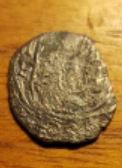
Yesterday I showed a Facebook photo of a find by a Tom J. who was visiting the Treasure Coast and found what looked like a reale.  Although the photo was not real clear, I thought I could see a raised edge on the object that made it look incorrect.   I didn't have the entire text of the Facebook page yesterday, but DJ sent me the rest of the text, so I'll present that now.

So the bottom line is that Tom J.'s find is a fake treasure coin.  Don't you wonder how they end up on the beach?  I think some are souvenirs that are lost just like many of the other things we find.  I think others might be put out to entertain children who want to play pirate.  And perhaps others are meant to fool someone.

Thanks to DJ.

---

Looks like we'll get another bump in the surf - but only for one day.

Source: MagicSeaWeed.com

Too bad the wind will be mostly east/southeast.

I'll be talking more about corrosion on coins, Kang Hsi shards, Aztec gold and a variety of other topics that I've already started.

Happy hunting,
TreasureGuide@comcast.net

Tuesday, September 10, 2019

9/10/19 Report - Treasure Coin Found After Dorian. Coils and Area of Sensitivity. Storms Coming.


Written by the TreasureGuide for the exclusive use of treasurebeachesreport.blogspot.com.

Find Posted on Facebook.
Photo Forwarded by Kenneth T. 
Looks like someone got their first.  This coin was posted on Facebook as some one's first shipwreck coin find.  The posting was on Sept. 5th at 8AM, and it says it was found near the Disney Resort.  So it looks like at least one was found, and probably a few more. The photos and report was sent to me by Kenneth T.

Other Side of Same Coin
Forwarded by Kenneth T.
I wish I had a clearer closeup of that silver reale.

Thanks much Kenneth!

---

I was going to do a detailed look at sweep patterns today, but I didn't get it ready yet.  It will take some time for me to make the illustrations.

I've talked before about the importance of knowing the area of sensitivity for your coil.  The area can vary for different areas of your coil.  Here is a simple illustration.


A concentric coil will typically have a more cone shaped area of sensitivity.  It will be most sensitive near the center of your coil.

A Double D coil will have an area of sensitivity that is consistent from the front to back of your coil.  A target under the front or back of the coil will be detected about as deeply as a target that is under the center of the coil.

I haven't always found that to be true when I personally tested coils, but that is what you'll see in the literature.  I believe in mapping the area of sensitivity for a coil by using an air test.  Move objects under different areas of the coil and see what kind of depth you get under different areas.

I've had some coils that for which the area of sensitivity was very wide.  I could detect targets to the edge and beyond.  Other coils on the same detector wouldn't do that.  In any case, it is good to know what the area of sensitivity is for the coil you are using.

If you have a concentric coil with a cone shaped area of sensitivity and make three sweeps without overlapping your sweeps, you'll be missing half of the area you thought you covered.

Lets say you have a coil that has a cone shaped area of sensitivity and you make three sweeps but are not careful to overlap each sweep.

You can see from the above illustration that you would be missing about half the ground that you thought you had covered.  A lot of overlapping would be required to get maximum depth over the area you are covering.

No matter what type of coil you have and no matter what the literature says about it, I recommend personally mapping out the area of sensitivity for you coil.  You will then know for sure what you are working with and what you need to do.

---

Three Systems Shown on the National Hurricane Center Map.
Here is the National Hurricane Center outlook text.

1. A weak area of low pressure, associated with a tropical wave located
a little more than 900 miles east of the Lesser Antilles is
producing disorganized showers and thunderstorms. Although some
slight development of this system is possible today or tomorrow, by
Thursday, upper-level winds are forecast to become unfavorable for
tropical cyclone formation.  This disturbance is expected to move
slowly westward across the tropical Atlantic Ocean for the next
several days.
* Formation chance through 48 hours...low...20 percent.
* Formation chance through 5 days...low...20 percent.

2. Shower activity associated with a surface trough interacting with
an upper-level low near the north coast of Hispaniola northeastward
over the southwestern Atlantic has increased a little since
yesterday.  Little, if any, development of this disturbance is
expected during the next few days while it moves west-northwestward
across the Bahamas and the Florida peninsula. However, environmental
conditions could become a little more conducive for development
when the system moves into the Gulf of Mexico over the weekend.
Regardless of development, this disturbance will produce periods
of locally heavy rainfall across the Bahamas through Thursday, and
across Florida on Friday and continuing into the weekend.
* Formation chance through 48 hours...low...near 0 percent.
* Formation chance through 5 days...low...30 percent.

3. A tropical wave located just off the west coast of Africa is
expected to move quickly westward during the next several days.
Some slow development is possible late this week and over the
weekend when the system is several hundred miles east of the
Lesser Antilles.
* Formation chance through 48 hours...low...near 0 percent.
* Formation chance through 5 days...low...20 percent.


So it looks like Number Two could move across Florida, but probably not as a strong storm.

Keep an eye on these.  It won't be long before we get into the Fall season, which is when we got some of our most productive storms in the past, including the famed Thanksgiving Storm of 1984.

---

Happy hunting,
TreasureGuide@comcast.net


Monday, March 25, 2019

3/25/19 Report - Life-Saving Penny. Treasure Magazine Dies. Another Way to Get a Treasure Coin. Six to Nine Foot Surf.


Written by the TreasureGuide for the exclusive us of treasurebeachesreport.blogspot.com.


This dented penny saved a soldier's life.

Here is the link for that story.


---

I heard that Lost Treasure Magazine went out of business.  It isn't easy to for magazines these days.  Paper and postage is expensive, and people can find so much information online.

Sharon said, Did you hear that Lost Treasure Magazine shut down and isn’t refunding any prepaid subscriptions? I really enjoyed the magazine, and I’m sure many other hunters did too. I prepaid for the next 2 years. Any idea who to contact for refunds?

Do you have any suggestions for Sharon or others wishing to get refunds?

I wrote a couple articles for Lost Treasure many years ago.

There are a lot of times that I still prefer looking at a book rather than a digital screen.  And I often prefer text to a video.

---

Estate Sale Purchase
Photo by Scott C.


-
Scott C. recently purchased this coin at an estate sale.

--

I've been talking about Kang Hsi porcelain and showed a piece of found porcelain yesterday.  I found this web site on identifying Chinese porcelain.

You might be surprised to learn that the markings that people often look for are the last thing an expert looks for. 

Here is the link.

https://www.chinese-antique-porcelain.com/identifying-chinese-porcelain.html

One thing that makes it complicated for a novice like myself, is that the Chinese were making export porcelain for Europe as early as the 16th century.  Europeans would design pieces and order them from China.  That means that some Chinese pieces display European designs that you would not expect to see on Chinese porcelain.

One thing that I've learned is that most of the Chinese reign marks are NOT from the period indicated by the mark.  That is just another example of why it can be difficult to identify the age or period of an isolated artifact.  It can be much more complicated than what you see on TV when an item is dug and an identification is immediately blurted out as if a word-association game was being played.

---

Source: MagicSeaWeed.com

MagicSeaWeed is predicting a six to nine foot surf for Thursday.  That is bigger than what we saw on the Treasure Coast last week.  However, the tides will be decreasing.  Still, the surf prediction is the biggest story for me today.  It is definitely something to watch and definitely could lead to improved beach hunting conditions.

Happy hunting,
TreasureGuide@comcast.net

Thursday, January 25, 2018

1/25/18 Report - Treasure Coin/Pendant (?) Find From The Treasure Coast. Dive Watch Find. Bigger Surf On The Way.


Written by the TreasureGuide for the exclusive use of treasurebeachesreport.blogspot.com

Found by DB
Photo submitted by Terry S.
From the photo, it looks to me like this might be a genuine cob with a loop attaches.  I can't see it as well as I'd like in order to be able to offer any opinion.

Here is how Terry S. described it.

Now this is interesting and part of what makes it so interesting is that it was found the same time we were finding the 8 reales. It’s about the size of a dime and this same treasure diver said it’s not a coin but a pendant and in his mind a better find than just a coin. This of course got DB all excited but he is trying to get several opinions from other experts. You see folks we often can never be 100 percent sure but really that is a lot of the fun. If any of you out there know anything or have an opinion we would value your input. 
Terry S.

Terry's request for information and opinions applies not only to this find but also to those that I showed yesterday.   Feel free to email me about any of those.

Tomorrow I will share some information that I already received from a leading researcher relative to DB's ornate key find that I showed yesterday.

---

Working Dive Watch Found by Mike S. in Namibia.
As I've said several times in the past, I like to celebrate firsts.  Mike S. said this is the first working watch he found.  Here is the story of the find.

Spent last weekend in the water with my Excal 11 seeing if I could get into any gold.

Wasn`t to be ….started with a pretty much bummer occurrence.  After having kitted up and gotten into the water, gone to the bottom, got myself sorted and decided in which direction to move, I turned the threshold knob on to start the Excal and…….aaaargh….it broke away!

In cool water trying to turn only the remnant post is like …well…. I didn`t manage…but a thought occurred to me…take one of the other knobs of and use that instead. Unfortunately in trying to remove the second knob it also came away, as did the third and fourth! The inside of the knob has a blue insert that is divided into four sections. Looks like they might have a shelf life after which they tend to crumble. Ok so that was it, abandon dive and go home to figure on how to fix my baby.

So like we have Pratley Putty here which is a double component glue that you mix in equal quantities. Made up a batch of this and was able to then repair the breakages, left overnight to cure and gave them a shot the next day and yipppeee…we are back in the game.

So back to the water and after about thirty minutes came up with the first Sport Divers watch I have ever found in about five meters of water, and some 30 cm deep in the sand.  Looked ok and so took it into the local watchmaker who then opened it up and replaced the battery, (which had leaked,) but then professed the piece to be in 100% working condition. Speculation puts the watch to have been in the ocean for quite some goodly time. The casing and strap were coated in conglomerate yuck and I know that takes a while to build up. Unfortunately I don’t have the resources to figure out the build year of the timepiece. Up to now I have only ascertained from the net, that it is an older model that seems to be no longer in the makers range.

Anyway still no gold, but  still chuffed on the find.

Thanks for sharing Mike.  I've received emails from all over the world, but this is the first from Namibia, which coincidentally appeared on an TV episode about the lake possibly containing Nazi gold there.  That was just minutes after receiving this email.

Watches can be found in great numbers on the Florida coast, both in the water and in the dry sand.  It seems a little surprising that watches are lost so easily in dry sand.  One of the best places to find watches is in a dip in shallow water near the water line.  When a dip like that is filled with shells and coarse materials, items like coins and rings will often be buried deeply, but can find watches there.

Thanks for sharing Mike.

---

John Brooks Yesterday
Photo submitted by Gaylen C.
Gaylen sent this photo from yesterday and the following report.

Attaching a photo of Douglas  beach I shot today. I worked the shell line for a good ways and came up with some scrap aluminum. Went over some small cuts with no finds. 

I was at Ft Pierce Jetty Park on Friday. The dunes had collapsed. What were 7-8 ft tall vertical dune faces were now 5 ft with no cleanly cut bases at all. 

Thanks for the report Gaylen.

The wind started picking early Thursday.  The predictions are still showing a five to seven foot surf for the Treasure Coast this weekend.

The tides won't be huge, but the wind will be out of the north as this starts, then turn to be more from the east.

I have a lot that I didn't get to today.  As I said, I'll have information to share relative to the ornate key found by DB.  I'll also be adding a new factor to my formula for detecting success.  
Happy hunting,
TreasureGuide@comcast.net
Tuesday, July 14, 2015

7/14/15 Report - Where Gold & Silver Treasure Coins Were Found. Unexplained Beach Explosion. Shark Working Shallow Water.


Written by the TreasureGuide for the exclusive use of treaurebeachesreport.blogspot.com.

Cocoa Beach Detectorist Makes The News
Photo source: See link.


A Cocoa Beach detectorist made the news, but not in the way he probably hoped.

Notice the fins to the left of the detectorist.  Very shallow water where you might feel safe, but sharks work the shallow water too.

Here is the link for the story.

http://news.brevardtimes.com/2015/07/video-sharks-close-beach-in-cocoa-beach.html

John M.  sent me the link.  Thanks John.

I've seen some pretty big sharks while detecting, but none of them ever paid me much attention.  That isn't to say they won't.

The ones I saw seemed to go the other way when they saw me.

---

Beach Erosion After Hurricane of 2004
Photo submitted by Jonah Martinez.

Here is something you don't get very often - a good look at the exact area where gold treasure coins were found. 

It is also a good illustration of erosion.


Captain Jonah sent me this photo and said, ... here's a pic showing the water channeling behind the beach and between the dune. A lot of goodies were found along with some gold coins. Thanks for all your info you post up it keeps me motivated to keep on working and to try old and new techniques to keep finding treasure.


Thanks Captain!  Great over-head photo.

I'm glad the blog provides motivation and inspiration.

If you didn't see the finds Captain Jonah's crew made this year already, I have three or four posts on that not long ago.  You might want to go back a few weeks in this blog and take a look.

---

This is a strange one.  A woman was injured by an unexplained beach explosion.  No evidence of explosives were found.  To me it seemed like it might have been something like a rogue lightning strike, but there was no thunder or flash or anything like that reported, so evidently not.  See if you can figure it out.

http://www.cbsnews.com/news/womans-ribs-fractured-in-unexplained-r-i-beach-explosion/

---

www.nhc.noaa.gov

Tropical Storm Claudette is out to sea off of the northeast U. S.  We won't see any effects from that storm.

---

Friday we have a 0 - 1 foot surf predicted for some of the Treasure Coast.  You don't see that very often.  Really smooth for that one day.

---

I have three wild topics percolating in my mind, but they aren't quite ready yet.  Will take a little more time for me to put them together in a post.

That is all for today.

Happy hunting,
TreasureGuide@comcast.net

Wednesday, May 27, 2015

5/27/15 Report - A Mexican Four Reales. Wreck of the Nuestra Senora de la Concepcion. Survivor Camp Dagger.


Written by the TreasureGuide for the exclusive use of treasurebeachesreport.blogspot.com.

Same Four Reale
Coin To Be Auctioned By
Public Lands For The People.
Photos by Jerry S.


A few days ago I mentioned that Public Lands for the People, an organization that works to preserve outdoor recreational activities such as prospecting and mining on public lands, was going to auction a treasure coin.

The coin had been donated to the organization.

Here are two photos of that coin, which is nicely mounted in a gold bezel.

It is a 4 reale from the Nuestra Senora de la Concepcion.

Its always nice to see a good treasure coin.

I like having them displayed in this manner rather than being stored away unseen somewhere.

It also comes with the certificate of authenticity shown below signed by Burt Webber.


You might know the story of the Concepcion and Burt Webber.  Here is a little of that story as printed in the Ocala Star-Banner in 1979.


Click here if you want to read the entire newspaper article.

Here is a short history on the wreck of the Concepcion as presented on the Sedwickcoins.com web site.

Concepcion sunk in 1641 off the northeast coast of Hispaniola

The Concepcion was one of the most significant Spanish wrecks of all time, serving the Spanish with a loss of over 100 tons of silver and gold treasure. The almirata of a 21-ship fleet, the Concepcion was already in poor repair when the Europe-bound fleet encountered a storm in September, leaving her disabled and navigating under makeshift sails amid disagreement among its pilots about their location. Weeks later, she grounded on a reef in an area now named the Silver Shoals, just to the east of another shoal known as the Abrojos, which the pilots were trying to avoid. After another storm hit the wrecked ship and the admiral and officers left in the ship’s only longboat, the remaining crew resorted to building rafts from the ship’s timbers. Survivors’ accounts pointed to drowning, starvation and even sharks for the loss of around 300 casualties. In the fallout that ensued, none of the survivors could report the wreck’s location with accuracy, so it sat undisturbed until New England’s William Phipps found it in 1687 and brought home tons of silver and some gold, to the delight of his English backers.

The Concepcion was found again in 1978 by Burt Webber, Jr., whose divers recovered some 60,000 silver cobs, mostly Mexican 8 and 4 reales but also some Potosi and rare Colombian cobs (including more from the Cartagena mint than had been found on any other shipwreck). Unlike the Maravillas of just 15 years later, however,  the Concepcion did not give up any gold cobs in our time, and any significant artifacts found were retained by the government of the Dominican Republic, who oversaw the salvage. The bulk of the silver cobs found on the Concepcion were heavily promoted, even in department stores! The site is still being worked from time to time with limited success.

---


Here is an interesting item shown online shown at http://www.nelsonshipwreckpirate.com/NauticalAntiquities.html

It says it was found in a Spanish salvor's camp in southern Brevard County.

----

The next day or two on the Treasure Coast we'll have something like a two to four foot surf.  Just a touch higher later in the week.

Happy hunting,
Treasureguide@comcast.net