Showing posts with label France. Show all posts

Saturday, June 30, 2018

7/1/18 Report - Farmer Finds Gold Digging Drain. Some Say Cape Canaveral Shipwreck Likely Trinite. Shipwreck Site Sampling Plan.


Written by the TreasureGuide for the exclusive use of treasurebeachesreport.blogspot.com.


Norman Witherow uncovered the gold objects on Saturday when he was digging a drain in a field near Convoy.
The artefacts remained in his kitchen and car boot until Tuesday when his friend, who is a jeweller, told him that it needed to be reported.
Initial observations by staff from the National Museum of Ireland date the gold from the bronze age or earlier.

Here is the link for the rest of the story.

https://www.bbc.com/news/world-europe-44644347


---

Chuck Meide of LAMP recently wrote in the St. Augustine Report about the GME discovery of the shipwreck near Cape Canaveral that I recently posted about on 6/25/18.  Meide thought it was almost certainly the Trinite, one of Ribault’s 1565 shipwreck.  Anyhow, it appears the case is closed and the shipwreck will be the property of France.

In the report Meide states,  We led a search for Ribault’s wrecks in 2014 in the waters of Canaveral National Seashore, near the French survivor camp sites on land. This was probably in the vicinity of the other three shipwrecks, as opposed to Trinité further south. NOAA helped fund our research, as did the State of Florida...  In addition to all of these searches, the State of Florida also led a marine survey searching for the remains of the Trinité, around Cape Canaveral, starting in 2014. They were probably pretty close to the site discovered by GME.

To sum that up, a lot of tax payer dollars went to organizations that failed to find the Trinite, but a private company without tax dollar support, Global Marine Explorations, actually found it.  Never mind, GME will get totally cut out of the deal so state employees, and their contractor friends can get the credit and more trips to Paris.

Here is the link for more of that article.

http://staugustinereport.net/index_htm_files/Trinite.pdf

Like I've said multiple times, I'll be very surprised if Florida ever issues a new treasure salvage lease.

---

Source:: See link below.

You might find the following interesting.  It is, A STRATIFIED SITE SAMPLING RESEARCH PLAN FOR THE 2005-2006 INVESTIGATIONS AND RECOVERY AT NORTH CAROLINA ARCHAEOLOGICAL SHIPWRECK SITE 31CR314 Mark Wilde-Ramsing, May, 2006.


 Introduction: North Carolina shipwreck site 31CR314 has been under investigation since its discovery in 1996 and continues to reveal a rich assemblage of early 18th century maritime cultural materials. The analysis of datable artifacts that have been collected from the site provides a mean date of manufacture of 1706 with predominately French and English affiliation (Wilde-Ramsing 2006). Ship's features reveal a vessel of 200 to 300 tons (Moore 2001; 2006). Armament represented on the site is equivalent to that of a Royal Navy Sixth Rate warship, while the presence of langrel shot in one of the small caliber guns suggests a predator or heavily armed merchantman rather than a Royal Navy warship (Henry 2006)...

This is about shipwreck sites and artifact distribution.

Here is the link.

https://files.nc.gov/dncr-qar/documents/files/32-Spring-2006-Recovery-Plan.pdf

---

This feels unfinished.  I might rework or add to it tomorrow, but decided to go ahead and post it now.

Happy hunting,
Treasureguide@comcast.net


Friday, February 23, 2018

2/23/18 Report - Three Ring Finds. Treasure Coast Clay Pipe Sight-Find. One Method of Dating Colonial Sites.


Written by the TreasureGuide for the exclusive use of treasurebeachesreport.blogspot.com.

Three Rings in Three Days
Finds and photo by DB
The good Lord opened Davey Jones locker for me a little at a time this week with a three day progression. First day Tungsten Carbide, two days later with this silver and today's gold. Maybe a platinum is out there for me tomorrow, here's to hoping anyway.

Congratulations and thanks DB.

---

I don't think I've detected at all this February.  If I did it was very little.   I always liked eye-balling and took a little walk along the banks of the Indian River yesterday.  I probably walked a hundred yards or so, but was amazed to find the worn remains of a broken clay pipe.  Even though it is broken, it is a wonder that it survived in as good condition as it did for all those years.

Broken Clay Pipe Find.
I was mostly looking for bottles, but didn't find any old bottles that were whole.  I did find a couple necks and tops of some cork-top bottles, but that was about it for the bottles.  Its amazing what you can find without a detector if you check out areas things get uncovered by moving water.

Archaeologists sometimes attempt to use the diameter of the hole to get a date for a clay pipe, but that doesn't always work well unless you have a number of them, then you might be able to date a site by using the average hole diameter.  The hole in this pipe measures 3/16.

I've seen a lot of old things around there, including fossils dating back thousands or millions of years old and some really old indigenous pot shards but this was a surprise.  There was also plenty of modern junk laying around too.

The world is covered with evidence of the past.  It is everywhere. And more is being made everyday.

Here is a paragraph from a great web site about clay pipes ( See link below.).

In the archaeological studies carried out on clay pipes (and believe me there are many!) mathematical formula's have been applied to explore the possibilities of dating them by the size of the hole in the stem. While these have been proved to work fairly well where large groups (usually dozens-hundreds) have been found it is not always possible to date a random piece of broken stem by the size of the hole because there are many other factors that come into play. The thickness of the stem, surface finish and porosity, alignment of sides, tool marks, junction at base of the bowl etc. are just some of these. However, the larger thick more weathered pipe stems that are often found with a bigger hole in the middle tend to be earlier from the 17th-18th Centuries, whereas thinner stems with even sides, smoother surfaces and much smaller holes tend to be from the 19th Century. It is worth mentioning also here that Dutch pipes of the 18th Century have very long narrow stems with smaller holes whereas English pipes of the same period tend to have larger holes so this is another thing to be considered according to where finds are made. During the Victorian period some pipes were made in such a hurry and without thought for the smoker that the hole in the stem was not always practical or even joined with the bowl.


http://www.dawnmist.org/gallery.htm

Pipe Stem.


A web site by the National Parks Service gave the following hole sizes for English colonial sites of various time periods.


If you are wondering how to measure such things with any degree of precision, I used these bead calipers.  They are useful for measuring gem sizes or anything small and are inexpensive.

Bead Calipers.


Below is the link for the National Park Service web site about dating sites.

https://www.nps.gov/archeology/afori/howfig_mar4.htm

---

I'm still working on a post with recommendations for archaeology.  I hope to have it ready soon.  It is taking a little time and I've had a lot of other things to post.

Between 7 PM last night and 8 AM this morning, this blog had over three thousand page views, many from foreign countries, with France in the lead.

---

The Treasure Coast beaches have been a holding pattern for a few weeks, and there is not immediate change in site.  Hurricane season will be coming around again before you know it.

I plan to post some on a Florida treasure ship claimed by France someday soon.

Happy hunting,
TreasureGuide@comcast.net

Thursday, November 16, 2017

11/16/17 Report - Cache of Silver and Gold 12th Century Coins. Nice Old Ring. Beach Sign. Clad Coins.


Writen by the TreasureGuide for the exclusive use of treasurebeacesreport.blogspot.com.

Signet Ring Uncovered Along With Coin Cache
Photo by Alexis Grattier
See link below.

More than 2,000 silver and gold coins from the 12th century were found buried in the rubble as the archaeologists were digging the ground to try and identify the corner of an infirmary that was once situated at the abbey, said the researchers from University of Lyon II and France's National Centre for Scientific Research (CNRS)....


Cache of Coins Uncovered.
Source: See link below.

The medieval loot included 2,200 deniers (or pieces of silver) mostly issued by Cluny Abbey itself as well as 21 gold dinar coins, originally from the Middle East which were stored in a canvas bag... 


Gold Dinars Recovered with Coin Cache
Photo by Alexis Grattier
See link below.

Here is the link to read more about that.

https://www.thelocal.fr/20171115/medieval-treasure-trove-discovered-by-archaeologists-in-france


---

Joe D. sent the following message and find photos.

Just returned from my semiannual trip to Georgia to visit family! Of course I had to throw in a little detecting while there! On the last day ( yesterday) in my last few minutes of detecting some old torn down house lots, I found a nice silver solitaire about 5 inches down! Got confusing signals, but dug anyway! It was near other metal of course! And I was lucky to find it at all! Here's a before and after polishing! I will have to get the stone tested, but the ring says sterling! Looks to be pretty old! Also found some wheaties and some other interesting house stuff! 


Sterling Silver Ring Find After Cleaned.
Find and photo by Joe D.


Same Ring as Found by Joe D.

 Joe also mentioned a show on Netflix called "Detectorists." He said, "It's from the BBC! So English humor, but there are 2 seasons and it's pretty good! Don't know if you have heard of it, but it's not a reality show! Worth a look! Takes a few episodes to get into, but I think you will appreciate the finer points of the story! I bing watched the first season already!"


---


Darrel S. dug up the following sign on the beach a few days ago.  It reads "Stay Off Dunes."


Find and photo by Darrel S.

Darrel said the parking lot at Turtle Trail was full yesterday while the lot at Seagrape was empty.

---

Tuesday I detected less than an hour, which I think was still the most that I had a chance to do all year.   No serious detecting or anything, just a little quick entertainment.   I mentioned that there were coins on the beaches of South Hutchinson Island.  Here is what i found with my little light-weight Ace 250.

Coins and Crematory Tag Found Tuesday.

Couldn't tell what the crematory tag was until I got it cleaned.

Looks like we'll have a few more days or three to five foot surf.  I'd say beach conditions are still what I'd rate as a level 2.

Happy hunting,
TreasureGuide@comcast.net

Thursday, June 1, 2017

6/1/17 Report - 2700 Year Old Artifacts Discovered. Number of Shipwrecks Discovered. Cognitive Analysis of Shipwreck Location Data.


Written by the TreasureGuide for the exclusive use of treasurebeachesreport.blogspot.com.

Photo by Denis Gliksman, Inrap.
See International Business Times link below.

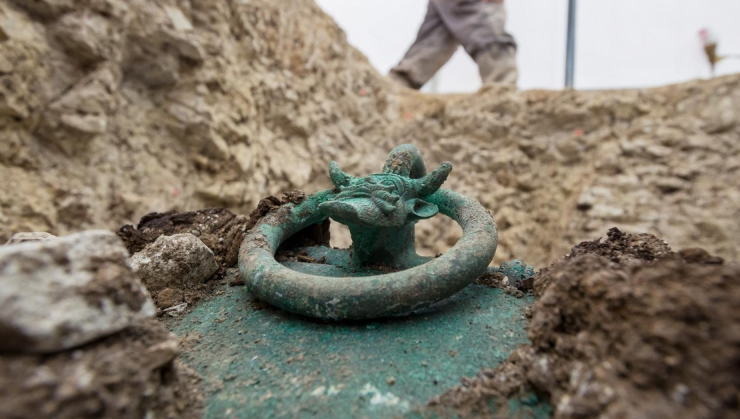
After finding well-preserved Greek and Etruscan artefacts, the French state ordered a more detailed exploration of the area. The archaeologists ended up discovering beautiful artefacts from the 5th century BCE, starting with a bronze cauldron ornamented with the head of the god Dionysus.

The remains of the prince were found a little later laid out on his chariot. The skeleton was still wearing the same fine golden jewellery he was buried with.

This was considered to be the most important archaeological discovery made in France in recent decades - comparable to the 1953s discovery of the cave belonging to the so-called "Lady of Vix."

To see more photos and read more about that, here is the link.

http://www.ibtimes.co.uk/lavau-celtic-prince-2500-year-old-royal-tomb-starts-reveal-its-secrets-1623933

---

Photo from the Greek Reporter.
See link below.

The remains of ancient coastal structures and a port, a large number of shipwrecks dating back to various eras and significant smaller finds were found in underwater archaeological excavations conducted by the Ephorate of Underwater Antiquities at the island of Delos from May 2 until May 20, the Culture and Sports Ministry announced on Monday....

Here is that link.

http://greece.greekreporter.com/2017/05/30/culture-and-sports-ministry-significant-finds-from-underwater-excavation-at-delos/

---

Here is the abstract from article published in Frontiers of Psychology (2015; 6: 1615) that looks at the cognitive processes of evaluating and assimilating various types of evidence to locate shipwrecks.

The research described in the present article was implemented to define the locations of two World War II shipwrecks, the German raider Kormoran, and the Australian light cruiser HMAS Sydney. The paper describes the long and complex trail that led through inefficient oceanographic prediction to ambiguous historical prediction involving a single report and on to precise cognitive prediction based on nine reports from more than 70 survivors, a process that yielded a single target position or “mean” just 2.7 NM (nautical miles) from the wreck of Kormoran. Prediction for the position of the wreck of Sydney opened with wishful thinking that she had somehow reached the coast more than 100 NM away when cognitive analysis of the survivor's reports actually provided the basis for accurate prediction in a position near to the wreck of Kormoran. In the account provided below, the focus on cognitive procedures emerged from, first, a review of a sample of the shipwreck hunts, and, second, growing awareness of the extraordinarily rich database available for this search, and the extent to which it was open to cognitive analysis. This review touches on both the trans-disciplinary and the cognitive or intra-disciplinary issues that so challenged the political entities responsible for supervising of the search for the wrecks of Kormoran and Sydney. One of the theoretical questions that emerged from these debate concerns the model of expertise advanced by Collins (). The decomposability of alleged forms of expertise is revealed as a fundamental problem for research projects that might or might not benefit from trans-disciplinary research. Where expertise can be decomposed for operational purposes, the traditional dividing lines between experts and novices, and fools for that matter, are much harder to discern, and require advanced and scientifically informed review.

Here is the link to that academic article. (Another one that isn't light reading.)

https://www.ncbi.nlm.nih.gov/pmc/articles/PMC4623394/

---

We've been having a south wind.  Its really hot now.  Still we have a small surf along the Treasure Coast.  The tides are moderate.

Happy hunting,
TreasureGuide@comcast.net