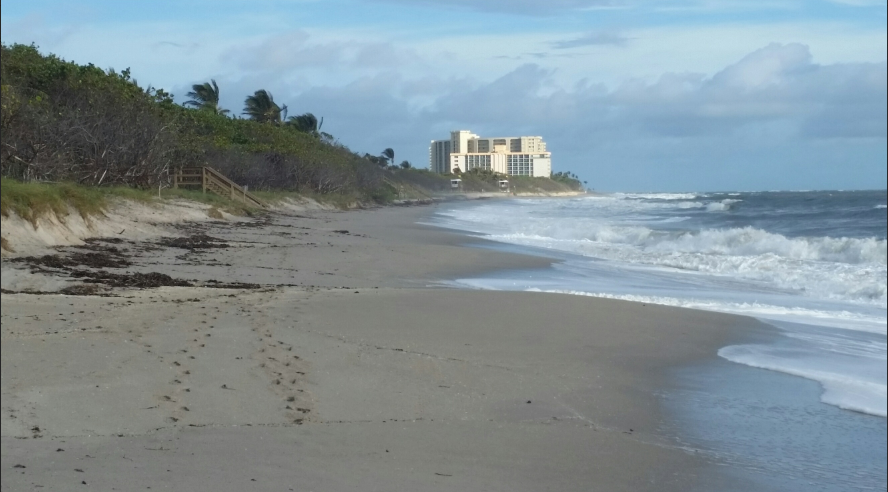
Showing posts with label Jupiter beach. Show all posts

Tuesday, December 31, 2019

12/31/19 Report - Valuable Roman Coin and Unknown Coin Find. Jupiter Beach. Passing It On.


Written by the TreasureGuide for the exclusive use of treasurebeachesreport.blogspot.com.

Left: Very rare and valuable Roman coin found by detectorist in England.  
Right: Similar coin recently found by Sharon and submitted for ID shown in yesterday's post.

Looks like we have an interesting story.  Yesterday I posted a photo of a coin (right above) found by Sharon and submitted for ID.  On the left above is a Roman coin that sold for over half a million dollars.  

Of course there are apparent differences as well as similarities.  One seems to be gold and the other not.  The portrait seems to be of a different person and the wording is different.  Still there seems to be enough similarity, most notably in the head wear, which suggests to me that Sharon's find could be Roman.  Whether it is genuine or a reproduction or copy has not yet been determined.

Here is a bit of the story of the valuable Roman coin shown on the left.

A rare 1700-year-old coin depicting Roman ruler Allectus found by an amateur metal detectorist in a field in Kent, England, has been sold for a staggering price in the UK. The gold coin is very rare, and this set off a bidding war that smashed the auctioneer's estimate for the piece and set new records, finally being sold for £552,000 (US$700,000). It is the most money ever paid for a coin depicting Allectus and the most valuable Roman coin minted in Britain to have been sold at auction. 

The exact location of the find has not been stated, but it was near Dover, in the English County of Kent. 

Dix Noonan Web announced that the find was made by a 30-year-old amateur metal detectorist, who has followed the pursuit for seven years, while he was searching some tilled farmland with his brother... 

You can find out more about that coin by using the following link, which was submitted by William K.


Thanks much William.

---


Jupiter Inlet Beach
Photo by Joe. D.

I received the photo above and the following photo along with the following message from Joe D. yesterday.

Hello,
   I was out before the sun for low tide at the inlet! Sorry to say that the constant march of bulldozers and sand has already affected the inlet beach! Very few targets now!  They are past the condos heading north to the inlet beach, and the sand is washing ahead of them!
   Carlin Park now has a 100 yards of beachfront, and the rocks are buried under about 15 feet of sand! The only eroded beach left, is basically the Reef Club south now!
  It would be cheaper to build new buildings west of the beach, than to keep throwing money away on beach sand! If i had a nickel for every dollar they spent on sand, I'd be rich!⛱💰 
Joe D.


Jupiter.
Photo by Joe D.
Thanks Joe.

Lots of shells for the shell hunter there.

Nothing more appropriate to the New Year than the moving sands of time.

It has been said that we don't own treasure.  We are only the caretakers for a while.

That fits right in with my New Years theme and the following message I received from DB.

---


I recently volunteered at a Christmas present giveaway and created a chest full of sand for the kids to dig in. I slowly filled it with every treasure I come across in my treks.


My family and I provided plastic baggies and answers to children of all ages.  I had my detector there and gave a few special kids some stories and info about hunting.  I even had a handful of children more interested in burying the treasures to replenish the box for the 125 children that came through. 

We gave over 1000 shark teeth away including some very large megs. Marbles, metal detecting finds, pottery, shells, coins, seaglass. You name it and it was in there. It was over 10 years of collecting but was my overflow. 


I cant explain how rewarding it was and hope I can store up enough to do it again someday. I know that those items sit proudly in many hiding spots. Hidden in a satchel or tucked away in a box. Only to be the seed of excitement created by the thrill of the hunt to hopefully someday bring the same joy over and over again. 


For some, it was something they had already done and found more interesting now, but others, it was just beginning.  


The best gift I could ever give on Christmas. The ability to find treasure in many things.  '

DB.


Thanks DB. Very good idea. Its good for the hobby and the children that I am sure enjoyed the experience and benefited from it.

---

Source: MagicSeaWeed.com

It looks like we'll be starting 2020 off with a week of small surf on the Treasure Coast.

Happy hunting,
TreasureGuide@comcast.net


Here we are about to step into a new decade.  It seems like yesterday that we were preparing for the a new millenia.  There were apocalyptic fears that every computer in the world would crash because of some glitch having to do with the computer's inability to handle a year that didn't start with 19.   Businesses wasted tons of employee time and money on preparing for some feared disaster.  Well, not much happened.   The world went on with barely a hiccup.


I just had a funny thought.  I find all kinds of junk that I end up using in one way or another.  I just enjoy using the junk I find rather than buying stuff.   I decided to list some of the useful junk I've found.

1.  Boots.  I've found boots that fit and that I used.  One pair were attached to ruined waders.  I just cut the boots off.   I got some good use out of them.  I also found fireman's boots in the Indian River that came in handy.  They have steel toes and steel plates under the soles.

2.  Reflectors.  I just found nine orange reflectors on a metal plate.  They were probably used at the end of a dead end or something like that.  I mounted them on some posts along the driveway.

3.  Wire.  I like finding old wire and have a variety of gauges.  I use it all the time.  One recent use was to make outdoor Christmas decoration hangers.  I used some to make hangers for Orchids.

4.  Old bottles.  Used as décor on a window ledge or book shelf.

5.  Tools.   Pliers, Wire Cutters, etc.  Some are badly corroded and useless, but some are in good condition.

6.  Wood and boards.  Used to make various things.

7.  PVC pipe.  Used to make a variety of things. including an outdoor Christmas tree and indoor Christmas tree stand.

8.  Coconuts.   The shells can be cut and used as planters.  I used one to make a Jack-O-Lantern for Halloween.

Those are just some off the top of my head.


Sunday, November 3, 2019

11/3/19 Report - 1715 Fleet Cobs Dated 1715 Bring High Prices. Half Reale and Famous Four Escudo. Erosion at Jupiter Beach.


Written by the TreasureGuide for the exclusive use of treasurebeachesreport.blogspot.com.


Lot 379 In Sedwick Coins Treasure Auction No. 26.
You can learn a lot from auctions.  There are all the items to inspect, and you also find out what people are willing to pay for things.  The Sedwick auctions are among the most informative for those of us interested in treasure coins and related items, including those from the Treasure Coast and the 1715 Fleet wrecks.

The live bidding for all but one session of the current Sedwick Coins Auction No. 26 has concluded.  I'd have to say that the auction was a big success.  Extremely few items did not sell, and the bidding was enthusiastic.

Above is one item that caught my attention.  It is a half reale from the 1715 Fleet that brought a winning bid of $1,150, not including the buyers premium.  That is a lot of money for a half reale.  So what made it so special?

First of all, it, like many other half reales included in the second session, was dated.  You can see the date (1)715 in the photo above.  Most half reales do not show a date, snd this date is unusual as it is the same as the year of the wreck, being very recently minted before making it onto the ship and being lost off the coast of Florida shortly thereafter.

This reale, in my opinion, other than the fact that it does show a rare date and is pedigreed to Real Eight and the Pullin collection, is not very exceptional.  Below is the lot description.

Mexico City, Mexico, cob 1/2 real, (1)715(J), rare, ex-1715 Fleet, ex-Real Eight (Ullian). S-M22; KM-24; CT-1828. 1.37 grams. Bold full 15 of date above full but weak crown, nearly full cross despite flatness, minimal surface corrosion, toned all over, desirable as the date of the wreck. From the 1715 Fleet, with original Real Eight Co. certificate signed by Lou Ullian. Auction lot-tag personally signed by John Pullin. The John Pullin Collection of Dated Mexican Cobs.

The other dated half reales from the Pullin collection mostly sold for between $200 and $400.  Those are still high prices for half reales.

Take a look at the undated half reales in the one internet-only session (Session VI) of the same auction that will close Monday.  The half reales in that session could still increase in price but will probably sell mostly for well below $100.

If you take a look at those lots and the lot descriptions, including the photos, you can learn a lot.  Many of the reales and escudos are from the 1715 Fleet, so you'll get a good idea of the kinds of things that have been found and are still out there to be found on the Treasure Coast.

---

Among the higher priced coins was lot 7, which is also from the 1715 Fleet and dated 1715.  The winning bid for this one was $24,000.

What is surprising is that it is a four-escudo - not an eight-escudo, as you might expect from such a high-priced escudo.  So what makes it so special?   Below is the photo and lot description.


Lot 7 In Current Sedwick Treasure Auction No. 26.

Mexico City, Mexico, cob 4 escudos, 1715J, NGC MS 62, ex-1715 Fleet (designated on label), Practical Book of Cobs Plate Coin (3rd edition), ex-John Pullin (stated on label). S-M30; KM-55.2; CT-235. 13.26 grams. It is hard to imagine a nicer example of this desirable final year of 1715-Fleet cobs (and in fact there may not be any nicer, as it is tied with two others for finest known in NGC census), for this coin shows a 100% full and bold date and oMJ while still bearing a full shield and cross, all with muted luster and no doubling or wear. Little wonder Frank Sedwick chose this piece for plating in his Practical Book of Cobs! From the The John Pullin Collection of Dated Mexican Gold Cobs from the 1715 Fleet, pedigreed to our Auction #8 (lot #6) and plated on page 106 of the 3rd edition (1995) of The Practical Book of Cobs. Auction lot-tag personally signed by John Pullin. NGC #5705323-001.

So it is also a late and rare date for a 1715 Fleet escudo, but it also has a lot of other things going for it, including being one of the finest of its type known, according to the NGC census.


There are other lots in the auction that brought even higher prices, including some of the ingots and bars.

Session VI, which is an internet-only session, will conclude tomorrow.  That session will include a wide variety of lots.  A number of less expensive half reales will be included - mostly undated.

---

John B. sent the following photos of Jupiter Inlet beach.


Eroded Beach At Jupiter Inlet.
Photo by John B.

John said there weren't many targets.  As you can see it is very mushy sand.  You can tell that from the footprints and the coarseness of the sand and the shape of the beach.

Cut At Jupiter Inlet Beach
Photo by John B.
Despite all the big surf we've had the past few months, there have been few good finds.  Conditions just haven't been good, and I blame that on all of the renourishment sand.  Beaches like the one shown here are covered with renourishment sand, and even when you get erosion, it is just the renourishment sand moving around.   When it leaves the beach, it piles up in front of the beach covering anything old and protecting the beach against the force of the surf, and eventually gets washed back in again.

Unfortunately, I think it is going to take a lot to create good beach detecting conditions.  There is a lot of sand on the beaches.

Next week we'll have mostly two to four foot surf.

Happy hunting,
TreasureGuide@comcast.net

The way they keep dumping sand


https://www.bbc.com/news/uk-england-northamptonshire-50186758

Thursday, October 26, 2017

10/26/17 Report - Erosion in Jupiter/Juno Area. Cuban Silver Ten Centavos. Erosion Is Erosion.


Written by the TreasureGuide for the exclusive use of treasurebeachesreport.blogspot.com.


Joe D. sent the above pictures from the Jupiter/Juno area.  He says that the got more erosion this week.  You can see that in the pictures.  Notice also the nice shell line.

Thanks much Joe.

I haven't been able to get out since the last pictures I posted, so I have seen what the beaches are doing for myself.  Thanks for any reports.

UPDATE:  Joe D. tells me these beaches have changed in the past 21 or so hours.  More on that later.

---

It looks like Brian M.could have identified the mystery coin I showed yesterday.  The mystery coin looks very much like the Cuban 10 centavos shown here.


The coin is silver and was made in this design from 1915 to 1949.

Here is the link Brian sent.


Thanks much Brian.  Looks like a good match me.

I very much appreciate the help.

---

The Dare is returning to Key West from the hunt for the Lost Merchant and will be gearing up to work on the Atocha or Margarita site.

Storms move sand in the ocean as well as on the beach. The Fisher organization flew over the Atocha and Margarita sites and was able to see the Margarita main pile from the air after it was uncovered by the storm.

---

Treasure hunting, especially beach and shallow water hunting is very much about moving sand. Erosion is key, no matter how it happens or where it happens.

Erosion can be caused by wind, rain or waves and currents. We don't often mention wind or rain erosion, but whenever it happens to any significant extent, I always check it out. 

Erosion caused by wind is usually not a big factor, but it can be helpful.  There have been times when I walked a beach looking for anything that might have been uncovered after the beach was scoured by strong wind. Wind erosion can uncover non-metallic as well as metallic targets.  You might find shards or fossils or other things.  It also gives you a chance to take a look at whatever is normally hidden by the top layer of sand.  Important clues can be uncovered.

Rain can also be an important source of erosion. There are places on the Treasure Coast where million-year-old fossils are uncovered any time it rains.

Back from the beach or inland, little gullies produced by rain can be worth checking. I remember finding some nice historic artifacts in a little gully back from the beach near a historic site.  There are places like that which you can't detect, but a little erosion gives you a chance to see what lies under the surface.  I've also found some older silver coins in gullies cause by rain.

On the Treasure Coast we are always waiting for some good erosion to the beach or dunes, but I very much enjoy checking out erosion at inland sites too. Creeks and rivers are always moving earth. One of my friends usually hunts river banks up north and has found a lot of Native American artifacts by that way.  Camp sites were often near creeks or rivers.  Bottle dumps are often found in small dips or valley running downhill towards a larger creek.

Always check out erosion no matter how it was created. It doesn't have to be huge to be helpful. You might discover a find or at least see something that provides a good clue.  

---

Enjoy the nice cool weather.  

Happy hunting,
TreasureGuide@comcast.net

Thursday, October 19, 2017

10/20/17 Report - Diamond Earring Lost. Jupiter to Juno Beaches. Hurricane Ophelia Uncovers 1500-Year-Old Remains On Beach.


Written by the TreasureGuide for the exclusive use of treasurebeachesreport.blogspot.com.


Hurricane Ophelia caused erosion and uncovered some very old things - not on the Treasure Coast but in Ireland. The Irish Post reports the 1500-year old skeletal remains shown above being uncovered on an eroded beach.

Here is the link for more about that.


---

Joe D. sent the following photos of the Jupiter to Juno beaches.  Excellent photos Joe!  Thanks much.

Photo by Joe D.

Photo by Joe D.
You might have notices how similar these beaches are to those of Hutchinson Island that I showed yesterday.  The beach shape is about the same: fluffy convex slope with flat front.  Also note the sea weed, which is common to the other beaches.

Photo by Joe D.

Photo by Joe D.

Photo by Joe D.
---

I received an email from a fellow whose wife lost he diamond ear ring in the water near Juno.  That would be a very tough find now with the rough surf, but if anyone wants to give it a shot, I'll try to hook you up with the fellow for more details.

---

I also heard from a fellow who is looking to hook up with some hunting buddies in the Loxahatchee area.  George said, ...was wondering if there are any groups that hunt the Florida beaches. I picked up a new detector (AT MAX) and would like to find a hunting buddy. I am in Loxahatchee.

If interested you can contact Geroge at gtbehary@gmail.com. If you are in a club, you might want to contact him about meetings.

---


On the Treasure Coast Friday you can expect more of the same.  It will be a 4 - 6 foot surf with an east/northeast swell.

Happy hunting,
TreasureGuide@comcast.net

Wednesday, October 4, 2017

10/4/17 Report - Beach Erosion and Conditions. Jupiter Beach. Musket Balls and Lead Shot Finds. Nine or Ten Foot Surf. PM Update.


Written by the TreasureGuide for the exclusive use of treasurebeachesreport.blogspot.com.

Seven Foot Cliff At Fort Pierce South Jetty Park Yesterday Afternoon.


Most of the sand they dumped here a couple of months ago is almost gone.  It is all renourishment sand.  That doesn't mean there can't be something old in it.  I showed one WW II hat emblem that I found in renourishment sand there once.  It depends upon where the new sand came from, and I don't know where that is, although I think it is from near the south bridge in the river.

Fort Pierce South Jetty Park Looking South Tuesdsay Afternoon.
You can't see it in the picture, but there was a detectorist working the slope at the bend.  That is the an area I mentioned once as producing a lot of WW II dog tags.  It is also not far from an old wreck that is believed to well picked over.


Frederick Douglass Park Looking South Yesterday Afternoon.
As I said yesterday, the water was high and getting back over the berm, but there were no cuts or other erosion at John Brooks or Frederick Douglas Tuesday afternoon.  I suspect most erosion will be around barriers or obstacles such as rocks, jetties or erosion control structures ( irony ).

I was going to take a picture at John Brooks too, but the rain started pouring down and I couldn't get the picture.  It turned out to be so much like Frederick Douglass that it wasn't necessary anyhow.

---

Joe D. sent the following report from Jupiter.

South of inlet conditions are pretty much unchanged! Worked a little farther south past the renurished beach and did find a small coin line along a small cut that had formed from morning high tides! Hoping the King Tides will create a few more cuts since the wind and waves are making low tide hunting unavailable awhile!

Thanks much Joe!
---

I showed a lot of lead and musket ball Irma finds.  In one other post I mentioned the following web site that was referred to me by Trez.

http://woodsrunnersdiary.blogspot.com/2016/04/more-on-small-shot-for-smoothbores.html

If you do some research, you'll find that musket balls can be tell you a lot.  Don't just look at them as round balls of lead even though that is what they look like.

The size can tell you a lot.  You can find tables that tell you the size to be used for different types of wild game, for example.  One size is recommended for pigeons and another size for ducks and another size for geese.

The size can also tell you something about the type of gun.  Smaller sizes were used as buck and sometimes shot with larger size balls.  The next larger size would be used for pistols, and then carbines and muskets.

You can find tables giving the size and weight of lead shot recommended for both different kinds of wild game and different fire arms.

By looking at the examples I've posted the last few days, I think the musket balls were being made at a camp on the beach.  Any spare lead could be melted and poured into molds.

Here are a couple links to start, if you want to learn what you might be able to tell from musket balls, or perhaps more properly, lead shot.

http://www.rubiconheritage.com/2011/12/16/biting-the-bullet-the-archaeology-of-musketballs/

https://finds.org.uk/database/artefacts/record/id/266828

The PAS finds database is a good resource.  Too bad we don't have something like that in Florida or the U. S.

---

There was a time when everyone would be eagerly hoping for a nine or ten foot surf.  Now after the hurricanes and big surf that brought very little erosion, it seems that a lot of people are discouraged, but even without big cuts and erosion this is still better than the continual summer south winds.  It gives you a chance, and at any time a window of opportunity could open up.  I'm rating Treasure Coast beach detecting conditions as a 2 on my 5 point scale.  It is far from excellent, but certainly better than those boring summer conditions.  Some old things will be found.

Here is the Wednesday prediction summary.


I love the windy rainy weather.  I guess I associate it with some of the better hunting days of the past and for me it is a lot better than the hot beating sun.

---

One day remaining to respond to the blog poll.  Shortly after that one, there will be another blog poll to follow up.

---

PM Update

I took a look at John Brooks, Frederick Douglas and Waton Rocks and saw very little change in any of the beaches from yesterday.  No cuts other than to the base of a few new front beach dunes in one case, and some renourishment sand near the back of the beach in another case. 

It looked like a the first two beaches might have a flat spot near the waters edge.  There seems to be a wide sand bar in front of those beaches.  Maybe it will separate from the beach a little at low tide.  I still feel a few old things will be found on the Treasure Coast.  I thought there were some spots worth checking out even if they weren't terribly exciting.  I have not seen and have no reports from Vero/Sebastian yet.


Happy hunting,
TreasureGuide@comcast.net


Wednesday, September 27, 2017

9/27/17 Report - Lost Gold Ring. Jupiter Beach to Cocoa Beach. Shoreline Changes, Obstacles, and Special Opportunities.


Wtitten by the TreasureGuide for the exclusive use of treasurebeachesreport.blogspot.com.

Jupiter Inlet Beach.
Photo by Joe D.
Joe D. sent me these photos along with the following message.   

After just reading today's post, we have similar conditions here! In fact the beach has added 2-4 feet in places! Same problem; tons of seaweed and a mushy beach all the way up to eroded dunes! Waves from the east and little wind, even though it's large surf! All targets were light aluminum trash!
Some of pics are near same spots as I sent a few weeks ago so you can see the addition of sand
Looks like it will take a few week to normalize!


Joe D.

Thanks for the great photos and report Joe.  It does indeed look very much like the Treasure Coast.


Beach at Jupiter.
Photo by Joe D.
So what is it like just north of the Treasure Coast?  Dan C. sent the following.

... I have been hunting mainly Cocoa Beach due to its convenience -proximity to Orlando.
The post Irma hunting was good , meaning at least one gold find per 5-6 hour hunt.
The Post Maria hunting is not good.
You mentioned seaweed in your recent blog.
Actually, in the case of Cocoa Beach, it is about 80-90 percent Mangrove roots and branches, mixed with some seaweed.
Where did all these tree roots come from ? Indian River ? FL. Keys ? Bahamas ?
It would be kind of interesting to know where this stuff originated.
Or perhaps it is some variety of trees that grow in the dunes....... hard to tell as they are so pulverized, but the stumps are multi branched, the roots are short and fat.
There is enough of it to fill a dump truck for every 100 feet of beach.
It has formed clusters where it holds the sand, even in the wash zone- the waves don't break it up.
So, today hunted from 4 am to 930 to catch the low tide.
A few shell piles were formed close to the waters edge, produced nothing.
The shell line produced one stainless ring, one silver/enamel tiny pendant, one fake earring, a silver toe ring.
Higher up on the beach, I can see about a foot of new sand since last week, which came from Maria. I know it's at least a foot since it is full of those branches/roots even down deep.
Basically it's now all sanded in. Very little in the way of targets, even trash.
Perhaps if I can catch a flat day I will try a water hunt next.


Take care,
Dan in Orlando.


So these clumps of whatever are to be found at least from Jupiter to Cocoa. They were heavy on the Treasure Coast beaches today.  I also wondered where they came from.  Maybe we have a marine biologist or someone that can tell us.

On the Treasure Coast the biological materials, whatever they are, were catching sand and shells and in some cases being covered by sand.

One thing I should mention, and I haven't lately, is that when I talk about beach detecting conditions, I'm usually talking about finding shipwreck cobs and treasure coins.  I used to say that often and make it clear when I was giving a numerical beach conditions ratings.  At other times I might not always make that clear.

There is a correlation between beach conditions for finding old shipwreck items on the beach and finding more modern items, but the correlation isn't perfect.  Very old things surface less often than things that are just years or decades old..

Also when I give a rating or talk about beach conditions, I'm talking about general conditions.  I'm most often talking about those stretches of beach that produce shipwreck coins when the conditions are right.  You shouldn't forget, though, that when overall conditions are not great, there can still be small nooks and crannies where there is a chance to find something very good.  Often those places are beside a sea wall, jetty, rocks or foundation or something that provides an obstacle and opens a small pocket.  You might want to look around for some of those nooks or crannies.

Historic Shoreline Changes Around Present Day Fort Pierce Inlet
Source: marine.usgs.gov/coastalchangehaardsportal/
Here is the color key that goes with that.


Dark blue indicates the shoreline in 2012, and dark orange indicates the shoreline in 1830.

First you'll notice that the inlet was not open in the early 1800s.  The orange and yellow lines indicating the shoreline goes right through the inlet.

One thing I want you to see is that the shoreline north of the inlet has been moving out while the shoreline south of the inlet has been moving west.  They have tried to stop the erosion to the south of the inlet in recent years by dumping new sand there every year. Obstacles, like the jetty, large or small, disrupt the flow of sand and create what I call special opportunities.

There are some important lessons you can get from this illustration.  One very general principle is that when sand accumulates in one place, it leaves another.  That seems very obvious, but a lot of people don't appreciate the importance of that.  When sand builds one place, always ask yourself where it is coming from.  It is good to find where the sand is coming from and check where the sand is leaving.

You might have noticed that I posted some old wood finds since Irma hit our area.  There was the sheave and some other pieces.  That tells you something if you think about it.  Why did that old wood suddenly show up after all that time?  It was uncovered.  Where?  It could be from the beach, but we have not seen much beach erosion, or it could have been uncovered in deeper water and floated in.  Again stating the obvious, wood floats and therefore can travel very quickly and far once it is uncovered.

There is a lot to think about.  I'll stop there for today.

---

I just wanted to add this as soon as I found out.  Someone just reported that they lost a gold Claddagh wedding band in the John Brooks or Frederick Douglass beach area. Please help get it returned.

Thanks much.

---

Happy hunting,
Treasureguide@comcast.net

Tuesday, April 4, 2017

4/4/17 Report - Ship Remains Dated to 17th Century. Complexities of Beach Erosion.


Written by the TreasureGuide for the exclusive use of treasurebeachesreport.blogspot.com.

Jupiter Beach.
Jupiter Beach, as you can see above, has tons and tons of new sand.

Thanks to Joe D. for the photo.

---

Uncovered Ship Remains Buried Near Alexandria Virginia.
Source: See WTOP link below.

... Skolnik said some of the earliest tree rings from the ship are from 1603 — four years before John Smith showed up in Jamestown and 17 years before the Pilgrims showed up in Massachusetts.
“So the wood in the ship comes from a time of early American history that even predates the earliest permanent English settlements here in the New World,” he said.
But the ship was sunk on purpose by early Alexandrians.
He said documentary records show between 1788 and 1796, the ship went from being a vessel to being buried...
Here is the link for the rest of the article.

http://wtop.com/alexandria/2017/04/uncovering-mystery-behind-alexandria-waterfronts-18th-century-ship/slide/6/

They dated this ship by looking at the tree rings on the lumber.

Notice the number and size of the rods.

---

Yesterday I posted a list of ten factors that contribute to beach erosion.  Predicting erosion is complicated by not only the number of factors, but also how quickly those factors can change.  Furthermore, there are interactions.  For example, wave size interacts with tides.  Big waves are most effective when the tides are high.  So the timing of both factors as they relate to each other is important.

Water force is obviously the primary factor that causes sand and other items such as coins to move.  Many of the factors change the force of water at different locations.

The same force of water will move one type of object but not another, therefore you get separation or sifting of objects.

Erosion is a good sign and always present during the very best beach conditions, but beach old coins sometimes appear on the beach when there is no erosion.  I explain that more some day.

One complication is that the direction of water from an individual wave will wash up and then back down the beach, so the force of water from each wave changes direction.  Not only does the direction of the force change, but  the amount of force also changes as the wave goes up and down the beach. That might be obvious enough, but figuring out how the sand and other objects move is more complicated.

Another complication is that each wave interacts with other waves.  The outgoing water from one wave will hit the incoming water from the next wave.  The force from both waves is changed when they interact.  When outgoing water hits the incoming water from the next wave, temporary much of the force is lost at that point.

I'll continue with this some other day.

Here is a little puzzle.

Coins and other objects can actually move in the opposite direction of the water rushing over and around them.  Think about how that might happen.  I actually explained that once before.

---

If you have never seen the Northern Lights before, you might want to check it out.  For me, it is something that I'll never forget.

http://blog.spiritdaily.com/news-links/northern-lights-in-real-time

---

Yesterday the wind picked up in the afternoon and we had some good southerly winds.  I wish I'd get a chance to get out today to check out one of my spots that gets hit better by southerly winds.  Perhaps tomorrow.

We're supposed to get a cold front later this week.  It doesn't look like it will increase the surf though.

Happy hunting,
TreasureGuide@comcast.net

Friday, March 17, 2017

3/17/17 Report - New Margarita Finds. Industry Shipwreck and St. Augustine. SS Central America Search Strategy.


Written by the TreasureGuide for the exclusive use of treasurebeachesreport.blogspot.com.

Beach Renourishment Begins At Jupiter Beach South.
Submitted by CladKing.
Thanks CladKing.

---

The sea is usually rough in the keys in March, however the Mel Fisher organization reports some very nice finds were made recently during a calm spell by the Sea Reaper on the Margarita site.  Exploring a less explored area to the east, a variety of artifacts were found including a large encrusted iron pot.  A iron key and a sword handle was found the next day a little distance away.  These new finds added new possibilities to what is known about the distribution of wreckage.
A second iron pot was found the next day nearly a half mile away, but in a direct line with the first.  It appears that a second scatter lies parallel to that previously plotted.

Here is a three-legged 18th century iron cooking pot from the Industry shipwreck off St. Augustine.
Source: TAMU Dissertation.  See link below.

The pot shown above is not one of those found on the Margarita site. The photo is from a 2005 dissertation by Marianne Franklin entitled BLOOD AND WATER; THE ARCHAEOLOGICAL EXCAVATION AND HISTORICAL ANALYSIS OF THE WRECK OF THE INDUSTRY, A NORTH-AMERICAN TRANSPORT SLOOP CHARTERED BY THE BRITISH ARMY AT THE END OF THE SEVEN YEARS' WAR: BRITISH COLONIAL NAVIGATION AND TRADE TO SUPPLY SPANISH FLORIDA IN THE EIGHTEENTH CENTURY. (More on recent Margarita finds below.)

Franklin's dissertation is something that anyone interested in 18th Century Florida will want to read. It gives a good history of St. Augustine (one of the best I've read) and especially how they were provisioned, both legally and illegally. The Lawrence family of New York was one big player.

The dissertation provides a lot of information on Spanish St. Augustine and how they were supplied by British ships, the Industry being one that sunk outside of the inlet to St. Augustine. Also covered are the artifacts. A good bibliography can be found at the end.


Here is the link.
http://nautarch.tamu.edu/pdf-files/Franklin-PhD2005.pdf

Picture of a Similar Iron Pot In a Ship's Hearth.
Source: TAMU  link immediately above.
--- 

Here is another good read.  It discusses the search for the SS Central America.  It is not about what happened when the wreck was found - just search strategies prior to the location of the wreck.

Here is that link.

http://www.columbia.edu/~dj114/SS_Central_America.pdf

---

Well the surf is still small along the Treasure Coast.  The tides have also decreased.  Not much hope for much improvement over the next few days.  It is however an chance to check the low tide area.

I expect a lot of beach renourishment this summer.  It has started, but there is more to come.

Happy hunting,
TreasureGuide@comcast.net