Showing posts with label Pigeon Island. Show all posts

Saturday, June 29, 2019

6/29/19 Report - Vacation Metal Detecting. Pigeon Island. Coin Cleaning. D. B. Cooper Mystery. Reader Comments.


Written by the TreasureGuide for the exclusive use of treasurebeachesreport.blogspot.com. 

Pigeon Island, St. Lucia.
Photo I took from resort across bay.

It's the time of year when you might want to take a vacation and go somewhere else.  Above is a photo that I took back years ago.

I made a number of personal firsts on that island.  I don't know if it was in the eighties or nineties, but it was a good trip.

If it looks familiar, I talked about it before in this blog, but you might have seen it on the Sandals TV commercial that has been running lately.  They show the island from almost the same angle.

Pigeon Island is now a National Park and there is an admission fee.  When I was there it was virtually abandoned.

I found grape shot, musket balls, military buttons, musket parts, and some other neat stuff.

It always made me laugh to watch the crab pull in their legs in and roll down the hill.

At the resort, I didn't do as well as expected - a lot of coins, but not a lot of gold.

One lady at a restaurant refused to accept the coins I found.  She said they looked like they had been burned.  I did spend most of them though.

I found this picture on the internet and added arrows to some of the places of interest that I remember

Aerial View of Pigeon Island From St. Lucia Commerce Web Site.
I added the arrows.

A.  Fort Rodney.  There was only one at the time I was there.
B.  Trash dump over the hill.
C.  Steep hill where things were found showing evidence of battle.
D.  Cave with indigenous carvings, supposedly also used by pirates.  Must dive to enter.
E.  Remains of old stone buildings.
F.  Building now converted to restaurant.
G. Cannon emplacement on other side of hill.

The causeway was made in 1972.  The red roofed resort in the photo wasn't there when I was.

Here is a little of the history.

Pigeon Island was first occupied by the Amerindians, mainly Caribs. The island was later occupied by pirates whose leader was a Norman Captain called Francois Le Clerc. He had a wooden leg and was known to the French as Jambe de Bois. The French who owned the island in 1778 declared war on the British, who retaliated by attacking them in Saint Lucia and capturing the island. The British then built a Naval Base at Gros-Islet Bay, heavily fortifying Pigeon Island. From there they were able to monitor the French fleet in Martinique which resulted in the defeat of the French at the Battle of the Saints in 1782. Pigeon Island was therefore a key factor in the Battles between the British and the French. In 1909 a whaling station was established at Pigeon Island. Legislation to control whaling in 1952 put an end to this operation. Pigeon Island was leased to Josset Agnes Hutchinson, an actress with the D’Oyle Carte Theatre of England in 1937. When the American established a Naval Base at Rodney Bay in 1940 she left the island. In 1947 she returned to establish a thriving yachting industry, entertaining many guests and giving the island the reputation of a paradise island. She relinquished the lease in 1970, finally retiring to England in 1976...

See https://www.slunatrust.org/sites/pigeon-island-national-landmark/

Here is a photo of a grape shot, which I left.  I wasn't about to take a chance it being considered an explosive.  It might still be snuggled between the roots of the tree where I left it.

Grape Shot Found on Pigeon Island.

54th and 74th Regiment of Foot and some other buttons were found.  I believe they came from the 1778 Battle of Morne de la Vierge, also known as the Capture of St. Lucia.

Pewter British Buttons.


I know a lot more about it now than I did when I was there.  I often find myself wishing that I knew then what I know now.  I don't care how much it has been searched or excavated, I know where I'd go to find artifacts, metal detector or not.

---

Same Dime Before and After Additional Immersion in Acid.
On the left is the silver dime after about 12 hours in Muriatic Acid.  After two additional similar periods of immersion, once with a strengthened solution (right), I can see no significant difference in the appearance of the surface.  My conclusion is that leaving the dime in a Muriatic solution for a period of time will achieve results.  Continuing immersion seems to produce neither additional results nor damage.

The difference in color of the two photos is caused by lighting, not a change in the color of the dime.

---

James F. added his thoughts on the article I posted about the "comtemporary archaeology" of Woodstock. 


Interesting to know that "Contemporary archaeology is a very big thing right now..," And I thought that I'd heard everything at this point. I have previously looked up the definition of archaeology in the past and find that it is defined as 1) the scientific study of historic or prehistoric peoples and their cultures by analysis of their artifacts, inscriptions, monuments, and other such remains, especially those that have been excavated. or 2) Rare. ancient history; the study of antiquity. Apparently "contemporary archaeology" meets none of those conditions. I studied archaeology as a minor course of study in college, and none of this new take on the subject really complies with the study of ancient or prehistoric cultures.


I find this sort of thing by the archaeological community as waste of time and resources...50-years later collecting surface samples from the Woodstock Festival. Seems like they are really reaching here, their scientific findings reveal Woodstock "...took on a life of it's own."  All they really needed to do was watch a few documentaries in full color with sound on the festival, filmed by people who were actually there, most of whom are still alive today. Or type "Woodstock" in the little window on YouTube for all the sound and video you could stomach. This is the sort of thing that may bring about the un-funding of archaeological groups...and maybe it should!

James F.

---

Here is an excerpt from a lengthy article on the D. B. Cooper skyjacking mystery.

… Eric Ulis has been researching the famous skyjacking for years. And like many amateur Cooper sleuths before him, he believes he’s solved the mystery. The Phoenix entrepreneur, one of the creators of the defunct poker-playing TV show “High Stakes Hold ’Em,” says he’s “98 percent” convinced that Peterson is D.B. Cooper.

That’s why he was hacking through thick foliage on Bachelor Island, near Ridgefield, Wash., last weekend. He believes the FBI misidentified Cooper’s “jump zone” and so searched the wrong stretch of forest in the weeks and years after the high-profile crime. This small isle along the Columbia River, most of which is part of the Ridgefield National Wildlife Refuge, offers pristine woodlands that have been largely untouched by humans for decades. Ulis has analyzed wind speeds, “free fall” data and other information that led him to conclude the skyjacker likely came down here...

Here is the link for more.

https://www.oregonlive.com/pacific-northwest-news/2019/06/db-cooper-search-leads-to-bachelor-island-ex-fbi-agent-says-suspect-will-get-away-with-it-unless-he-confesses.html

Thanks to Dean R. for that link.

---

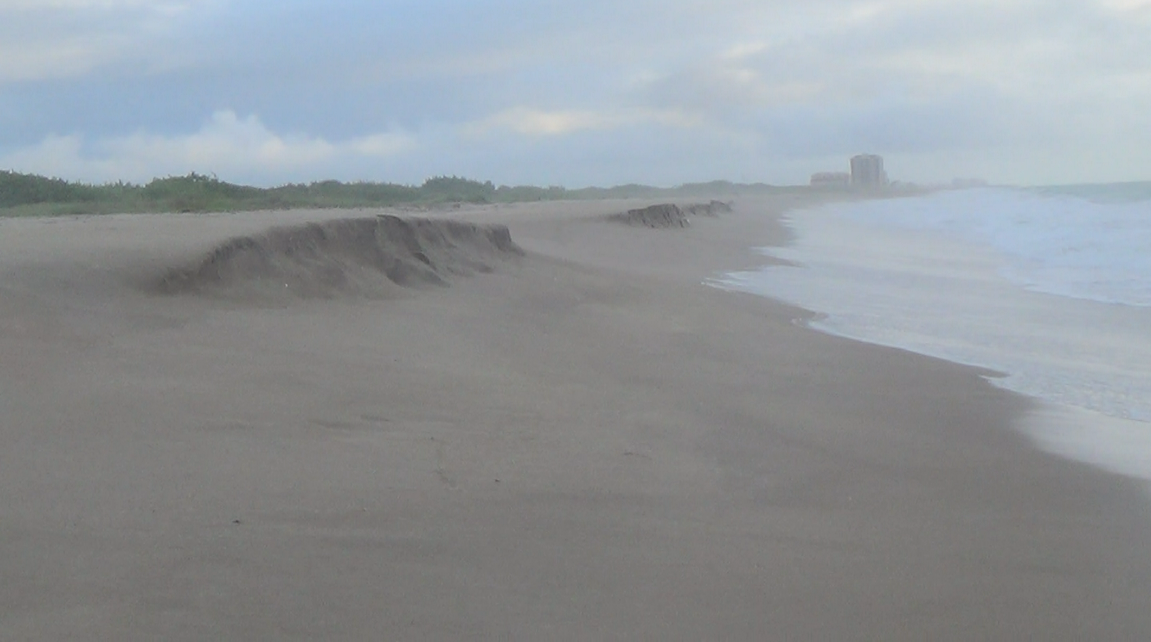
More of the same beach conditions.  A lot of thunder early this morning, but just a little rain.

Happy hunting,
Treasureguide@comcast.net

Thursday, September 22, 2016

9/22/16 Report - Pigeon Island. How To Metal Detect a Steep Hillside. Spys In The American Revolution.


Written by the TreasureGuide for the exclusive use of treasurebeachesreport.blogspot.com.

Photo by Dale Lutchman
Source: Pinterest
Obstacles are often opportunities in disguise.  That is particularly true when it comes to metal detecting.

Pigeon Island was detected many years ago when it was overgrown and in disrepair. (See photo of old building above.). It is now a national park, has a restaurant and is a tourist spot, and of course, should not be detected.

Pigeon Island.
Source: pinterest
Photo by Sally R.
You can't see it well in this photo but the peak on the left has a cannon emplacement.  Another canon emplacement was located at the base of the taller peak, now hidden by the trees.

The building shown in the first photo is located by the trees in the flat area under the tallest peak.

The peak was used by the British to observe the French fleet at Martinique.

Here is a little of the history of Pigeon Island.

Pigeon Island was first occupied by the Amerindians, mainly Caribs. The island was later occupied by pirates whose leader was a Norman Captain called Francois Le Clerc. He had a wooden leg and was known to the French as Jambe de Bois. The French who owned the island in 1778 declared war on the British, who retaliated by attacking them in Saint Lucia and capturing the island. The British then built a Naval Base at Gros-Islet Bay, heavily fortifying Pigeon Island. From there they were able to monitor the French fleet in Martinique which resulted in the defeat of the French at the Battle of the Saints in 1782. Pigeon Island was therefore a key factor in the Battles between the British and the French. In 1909 a whaling station was established at Pigeon Island.

Sorry, I can't find the link to that anymore.

Steep cliffs such as some of those on Pigeon Island can be difficult to detect.  Notice the steep cliff on the right side of the tallest peak leading down to the water.  Some of it is very steep and virtually impossible, but some of it could be detected using the technique I'll now describe.

If you are on a steep hillside, use a shortened rod as shown below.  You might choose a dive rod.  I have used a short length (just over a foot) of furring as a short rod or handle.  All you need is a bit of a handle for the coil.

You can hold onto a tree with one hand while detecting with the other.  You can also use a rope around the tree.

Another advantage of using a small length of wood instead of your standard detector rod is that it can be easily stowed in a backpack with your control box and coil.

Any hillside like that can hide nice finds.  It won't be easy though, at least until you get the technique down.

Good boots are also helpful in keeping your feet dug in and steady.

I should mention that recovery can also be tricky.  After pinpointing, you'll want to be able to attach your coil to your belt and use the free hand to dig.  Be careful to not let items roll down the hill.

---

The summer 2016 issue of the SAR magazine has an article written by Liam O'Connor about spying in the American revolution.

One American spy that we all know is Nathan Hale who uttered the famous line, "I only regret that I have but one life to lose for my country," before he was hanged.

The Culper Ring was an American military spy organization operating in New York City during the British occupation.

Spys were referred to by coded numbers.  Robert Townsend, a very productive spy for the Americans, was 723, for example.

Robert Townsend uncovered a British plot to flood the American economy with counterfeit dollars and warned the Americans of Benedict Arnold.

Code names, ciphers, dead drops and invisible ink were all used by the Americans during the revolution.

---

The storm situation remanins unchanged.  Karl is a tropical depression, and Lisa is still a tropical storm.  I don't believe either will affect our beaches.

The surf will be picking up a little.

Happy hunting,
TreasureGuide@comcast.net

Saturday, April 16, 2016

4/16/16 Report - Surf Increasing This Weekend. Beach Photos. Toy Cannon Soldier Art.


Written by the TreasureGuide for the exclusive use of treasurebeachesreport.blogspot.com.


Frederick Douglas Beach This Morning.


Walton Rocks Beach This Morning.
This morning the wind was coming from the east, and I went out to see if anything was starting to happen on the beaches.  I checked a couple of beaches on South Hutchinson Island, and neither had changed much.  If you go back and look at the last time I posted these beaches, you'll see they look about the same.

The surf is supposed to increase Sunday and Monday.  I'll be watching to see what is happening.

--- 


Mystery Object Submitted by John C.

I posted this mystery object some time ago.  I didn't receive any guesses.  My thought is that it is a lead melt.  Whether it was melted accidently or intentionally is unknown.  The chips or material on the bottom might be accidental too.  Other than that I have no answer.

Melted lead is common.  Lead was carried and made into musket balls and was used for a wide variety of other uses.  Musket balls pounded or melted to be used for other things too.


---

I posted the following before but thought it would be worth repeating today.

Toy Lead Cannon
From Old Sedwick Auction.


This toy lead cannon is from a mid-1800s shipwreck The reason it caught my attention is that I once found a similar lead item. For a long time I thought it was a finial, but now I am convinced that it is probably a soldier-art cannon.


The one I found (below) was found near an 18th century cannon emplacement on Pigeon Island.

Carved 18th Century Soldier-Art Cannon

It is always fun to metal detect new places when you travel. It was a lot easier to travel with a metal detector before the 911 tragedy.

I would take my detector with me as carry-on luggage. Security would look at it, ask me what it was, I'd tell them, they'd scratch their heads and I'd walk on the plane with it.

St. Lucia is one island I visited a few times. On a couple of occasions I explored Pigeon Island, which is now connected to St. Lucia by a causeway. 

There was a lot of history on the ground to see. There were a lot of historic ruins, and shards all over the place. I even eye-balled a grapeshot at the base of tree.

I left the grapeshot where it was. If it was taken on the plane and considered an explosive device, which I suppose would have been the case, the fine at the time, if I remember correctly, would have been something like $250,000. I wasn't going to chance anything like that.

Here is a little of the history of the Pigeon Island. 

Pigeon Island was first occupied by the Amerindians, mainly Caribs. The island was later occupied by pirates whose leader was a Norman Captain called Francois Le Clerc. He had a wooden leg and was known to the French as Jambe de Bois. The French who owned the island in 1778 declared war on the British, who retaliated by attacking them in Saint Lucia and capturing the island. The British then built a Naval Base at Gros-Islet Bay, heavily fortifying Pigeon Island. From there they were able to monitor the French fleet in Martinique which resulted in the defeat of the French at the Battle of the Saints in 1782. Pigeon Island was therefore a key factor in the Battles between the British and the French. In 1909 a whaling station was established at Pigeon Island.

That came from the following web site. 

http://search.aol.com/aol/search?q=st+lucia+pigeon+island+le+clerc&s_it=tb50-ie-aolmail-ab-en-us

If you look at the photos of the island, I think you will see that it is an interesting looking place.

---

The salvage vessel Dare is deploying a hovering autonomous underwater vehicle equipped with an EM detector to scan the deep hard-packed mud and clay in search of new targets south of the Atocha's main pile.

---

The surf is supposed to be up to 4 - 6 feet today and larger tomorrow.

Happy hunting,
TreasureGuide@comcast.net