Showing posts with label Report. Show all posts

Sunday, April 14, 2019

4/14/19 Report - Old "Imitation" Cob. Treasure In The Sewer. Artifact Collection. Coil Test Report.


Written by the TreasureGuide for the exclusive use of treasurebeachesreport.blogspot.com.


Imitation Cob
Source: Current Sedwick Auction Listings.

There are some very interesting lots in the current Sedwick auction.  Lot 912 is this "imitation cob."  It looks very much like a 1752 2-reale, although it is said that it was struck in the 1820s.  I don't  know how they know when it was struck.  

Was it meant to be used as money or sold as a collectible? I have no idea.  It says it was "struck."  There are really a lot of questions about this one.   It would be very difficult to figure that all out if you dug it up. The lot description doesn't tell what metal it is made of either.

It has a bid of $400 already.

Here is the lot description.

Tucuman, Argentina, "imitation cob" 2 reales, date "752" (struck 1820-24), rare. 5.83 grams. Bold full date above waves, good full cross, AVF with coppery sediment around details.

And here is the link.

https://auction.sedwickcoins.com/Tucuman-Argentina-imitation-cob-2-reales-date-752-struck-1820-24-rare_i33012225

There is at least one other "imitation cob" listed in the auction.

---

Crews went digging through Annapolis sewer lines — and found pottery dating back thousands of years...

Here is that link.

https://www.capitalgazette.com/news/annapolis/ac-cn-green-street-dig-20190412-story.html

Turn over enough ground and you are going to find something interesting.

---

U.S. returns 2 pre-Hispanic artifacts to Mexico...

The artifacts were among thousands ranging from arrowheads to shrunken heads that U.S. federal agents removed in a 2014 raid at an Indiana farm. The farm’s owner, Don Miller, amassed the 42,000-artifact collection over several decades. He died in 2015 at age...

Here is that link.

https://yucatanexpatlife.com/u-s-returns-2-pre-hispanic-artifacts-to-mexico/

---

Here is a test report from Sebastian Steve.

... I just reluctantly bought a 7" Concentric for my Nokta Anfibio Multi (3 frequencies 5,14, 20 kHz.  Already owning the 9" Concentric, I pretty much thought later on that this purchase was a waste of money.  Not at all the same as the 9"  Moral of the story:  "Do not judge a coil by just the number of inches in diameter, far more changes come into effect."   

I was digging very small non-ferrous items in my yard today with the 7" Concentric.  Areas that have been passed over literally 30-40 times already.  But change up the coil or machine modes, and there is ALWAYS SOMETHING MORE TO BE FOUND...ALWAYS...an odd tapered copper/brass bullet, a small round magnet in a conglomerate the size of an acorn, a half of a bronze screw.  All very tiny items, but monster targets due to this coil.  And again goes to show...there is ALWAYS MORE TARGETS TO BE FOUND...NO MATTER THE BEACH (ESPECIALLY THE BEACH) Your own back yard, Park, old home sites, etc., just by changing modes, tuning levels, coils, direction of approach to the field, etc.

---

The tides are moderate. The surf is about two or three feet, but will be decreasing for a couple of days. Low tide will be around noon.

Happy hunting,
TreasureGuide@comcast.net

Tuesday, September 4, 2018

9/4/18 Report - Tropical Storms Gordon and Florence. Local Beach Conditions Report.


Written by the TreasureGuide for the exclusive use of treasurebeachesreport.blogspot.com.

Gordon, Florence and Third Area That Could Develop.
Source; nhc.noaa.gov
Tropical Storm Gordon is now in the Gulf and quickly moving towards Mississippi, possibly landing as a hurricane.

After a very quiet summer with nothing but souteasth winds and accumulating sand on the Treasure Coast, the Atlantic has become much more active.

Tropical Storm Gordon.
Source:nhc.noaa.gov


It looks like Florence (below) will stay out in the Atlantic and far away from us, the undeveloped system behind her could possibly come our way.

Tropical Storm Florence.
Source:nhc.noaa.gov
This morning the Treasure Coast beaches looked very much like they did yesterday.  There was no additional erosion, and in most places a small amount of filling in.

John Brooks Beach Tuesday Morning.
Here are two photos of John Brooks beach this morning.


John Brooks Beach Tuesday Morning.
Two Foot Cut Showing Layer of Seaweed.
About half way up the small cut shown above you can see a layer of sea weed.  That is not what you want to see.  It tells you that this sand is sand that accumulated during a very light surf.  And that means there is not much chance of coins being in that sand.


Three Foot Cut.
Above is another cut that I saw that was around three feet high.  This one couldn't be seen from the beach access.  It was around a corner and good walk down the beach.

The cut will often be either south of north of a bend, and the bend can hide good cuts.

The lack of sea shells is not a good sign either.

I haven't been up to the Vero and Sebastian beaches and haven't received any reports, so I can't way what they are like.

On the basis of what I've seen my beach conditions rating will probably drop back to a "one" by tomorrow.

Happy hunting,
TreasureGuide@comcast.net

Tuesday, March 6, 2018

3/6/18 Report - Understanding Why Big Waves Sometimes Lead To Finds and Other Times Not. Mystery Find Identified.


Written by the TreasureGuide for the exclusive use of treasurebeachesreport.blogspot.com.

After all of the big surf the past few days, there was more accretion than erosion along the Treasure Coast.  I talked about a couple of the reasons for that yesterday.  I mentioned the amount of sand in front of the beach that was absorbing most of the wave energy before the waves hit the beach, along with the angle of the waves.

You've probably heard of the legendary Thanksgiving Storm or 1984.  I've mentioned it several times before and I posted the exciting story of one person that was there that day.  I also posted a NOAA report that explained why that storm damaged the beaches so much.  While people are wondering what happened and why the recent waves didn't do much for us, I thought it would be a good time to post some of that report again.  It really explains what happened back then and why it happened.

Here is part of that NOAA report.

...The meteorological conditions just described produced one of the most damaging storms to affect the eastern coastal sections of Florida during the past several decades. Much of the damage from Fernandina Beach southward to North Miami Beach, nearly 400 miles, was caused by the easterly winds of gale force with gusts as high as 60 miles an hour blowing for nearly four days. This action of the wind over the ocean produced shoreward moving swells of around 20 feet which pounded the Florida east coast and produced the most severe beach erosion in recent years in many areas. An example of the destruction was the reduction of the newly completed l100 foot pier at St. Augustine to 300 feet. Sand dunes were obliterated leaving barrier islands void of any natural protection against the next onslaught of a coastal storm in the future.To add to the destructiveness, the highest monthly astronomical tide period coincided with the highest period of storm tides which occurred on the morning of Thursday and Friday, the 22nd and 23rd. All of this produced tides 4 to 6 feet above mean yea level (MSL} at times of high tide. In some places, this was the highest tide in the last 30 years. Alt Mayport, Florida, just north of Jacksonville, the tide of 5.2 feet above MSL was the third highest tide of record. Much of state road A1A, the famous coastal highway, was closed in Indian River County between Vero Beach and Sebastian Inlet because of high water. In this area several beach front buildings collapsed, and 600 to 1,000 people were ordered to evacuate their homes. In Palm Beach County, five blocks of A1A were seriously damaged by the high tides and heavy surf. Bridges were closed because of flooded approaches which caused some barrier islands including the large Hutchinson Island to become isolated for periods of time around the time of high tide. In the storm's aftermath, severe coastal beach erosion stretched from Jacksonville to Palm Beach. ...

At the West Palm Beach weather office, a new station rainfall record was set on Thanksgiving Day for the greatest amount in a calendar day, 7.41 inches....

Another factor was that these strong onshore winds continued for many days. Winds of near gale force (about 40 miles an hour) began blowing along the north Florida coast the evening of the 20th. They did not subside until late on the 24th. Therefore, much of Florida experienced strong onshore winds for about 4 whole days. These winds were frequently between 30 and 40 miles an hour. The direction of the winds was from the north northeast which is probably the best angle of incidence for beach erosion along the coast from Fernandina Beach to Palm Beach. The coastline south of Palm Beach was spared from most of the adverse effects of the storm because the wind was actually blowing offshore throughout much of the storm. However, this northwest wind caused significant damage to the coastlines of the western Bahama Islands Friday and Saturday. This was all due to the position of the storm center remaining over Grand Bahama Island from early Thursday morning through early Saturday...

As noted earlier, the time of the month that the storm occurred was coincident with the highest astronomical tides of the month and nearly the highest spring tide of the year. Tide tables indicated that the highest predicted tides for the month of November fell on the mornings of the 22nd and the 23rd, exactly during the time of the highest storm tide. Reports from the storm survey teams of the Florida Department of Natural Resources indicate that the storm tide was over 6 feet above low mean water. Tide gauge readings at Mayport were 7.5 feet above mean low water or 5.2 feet above mean sea level. The one factor of the storm episode which magnified the entire situation was the nearly stationary nature of the storm for 3 days. This lack of movement produced the prolonged onshore winds which resulted in at least 4 days of heavy surf pounding the shore. Portions of the coastline experienced 9 high tides during this period, with each succeeding high tide higher than the previous one, thus making the erosion of sand greater with each tide. These are the reasons for the extensive damage that resulted from this particular storm....

Before commenting, here is the link if you want to read the entire report.

http://www.srh.noaa.gov/images/mlb/pdfs/Nov_1984_storm.pdf 

Notice that the report says,  The direction of the winds was from the north northeast which is probably the best angle of incidence for beach erosion along the coast from Fernandina Beach to Palm Beach.  As is often the case, the wind has been shifting the past few days.  It started from the north and one person said they saw some cuts (Saturday I think it was), but they disappeared a day later.  Often that is what happens when a front moves through: the wind shifts around as the front moves through.  As the direction changes the swells change and the sand moves one way and then another. 

Unfortunately we're going to continue getting changes in wind direction as another front moves through.  However, I'm still thinking the biggest problem is the tons of sand piled up in front of the beach. 

Knowing when and where to go isn't an exact science.  You can learn enough to improve your chances considerably, but there will still be hits and misses.  If you get it right every time, you're a lot better than I am.  I go out to check to see what is happening.  Sometimes I'm surprised and sometimes I see exactly what I expected.  If you go out after a long period of south winds and small surf, your chances of finding any old treasure coins is very slim.  As with many things, learning is a matter of probabilities.  In fact I say that skill is a matter of doing the things necessary to improve the probability of success.

I don't know if I've ever said this before, but I believe that heavy rains can add a little to erosion by agitating the top layer and cliff faces.  I have no idea how significant that might be, if at all.

I think the NOAA report on the Thanksgiving Storm is worth studying.  It tells you what caused one of the most legendary treasure beach days ever.

One factor they do not address is the longer term changes that occur over years or decades.  It seems to me that there are times when you have net erosion or accretion that occurs over a period of years.  I can remember times when that big sand bar was not in front of John Brooks beach and if you stepped off the front of the beach into the water there was a drop off.  There were pot holes right in front of the beach.  The bottom wasn't covered with a layer of sand.  That lasted for some years, but it hasn't been that way for at least a few years now.  In my opinion, that has a lot to do with why John Brooks has not been too productive in recent years.

---

We have consensus on yesterday's mystery find.  Lloyd D., Joe R., William M. and Bill P. all said it is a sheet music holder.  Thanks guys. 

No other ideas offered, so I think that is it.  Below is an example from Pinterest.


The holes were for attaching the shelf and some of them had other attachments for holding the sheet music firm, which explains some of the other holes.

The interesting thing would now be to see if there is a story behind it and how it ended up where it was found.

----

Happy

Thursday, October 1, 2015

10/1/15 Report - Beach Conditions Along The Treasure Coast. Artifacts Of A Deep-sea 1622 Navio. Artifacts of The HMS Erebus.


Written by the TreasureGuide for the exclusive use of treasurebeachesreport.blogspot.com.

The main thing I want to do today is present a survey of Treasure Coast treasure beaches.

Douglas Beach This Morning.
Douglas was mushy and relatively formless.  Only a few small scallops or dips.

Weed On Douglas Beach
The reason I'm showing the weed is that you can see that there is an inch or so of new sand that recently washed over it.  Just one of those things you can notice that will give you an idea of what has been going on.

Turtle Trail This Morning
There were some scallops that had some depth to them.  There was also a cut, but it was in renourishment sand.  Actually the most promising place I saw this morning, even though it was still poor.


Seagrape Trail This Morning.
Notice the six foot cliff.  It is still renourishment sand.

Wabasso
Amber Sands.
I also looked at Rio Mar.  It wasn't worth taking another photo.  The waves were a good bit smaller this morning than they were a day or two ago.

I think you get the picture.  I might have missed some good spot somewhere, but overall beach conditions are still not good.  Definitely not enough to increase my treasure beach conditions rating.

At this point, I'm betting that we won't get any beach improvement from Joaquin.

The wind was coming from the west this morning and as Joaquin heads north,  As Joaquin moves north, the wind will be pulled over the state from the west.

It looks like North Carolina could get some good conditions as Joaquin heads up past there.

Well, that is disappointing.  As I've been saying for so long, it has been a long time since we have had good beach conditions.  It will change someday.  Hopefully sooner rather than later.

---

After another season of searching in the cold waters off Nunavut for the ships of the Franklin Expedition, HMS Terror remains elusive, but new photos released today show some of the 39 artifacts recovered during the latest search of the HMS Erebus wreck site...

Here is the link for the rest of that story.

http://www.cbc.ca/news/canada/erebus-terror-artifacts-1.3244303

---

The Deep-Sea Tortugas Shipwreck, Florida: A Spanish-Operated Navio of the 1622 Tierra Firme Fleet. Part 2: the Artifacts by Greg Stemm and Ellen Gerth of Odyssey Marine Exploration, Tampa, Florida, USA.

You might want to take a look at that paper.  The link is below.

It examines a broad range of types of artifacts.  There are a lot of good photos.

http://www.shipwreck.net/pdf/OMEPapers27-2013.pdf

---

Happy hunting,
TreasureGuide@comcast.net

Sunday, May 6, 2012

5/6/12 Report - Big Low Tides Continue & Mystery Find From Wabasso


Written by the Treasureguide for the exclusive use of treasurebeachesreport.blogspot.com.


Wabasso Beach Find For Sale on EBay.

Wabasso Beach Metal Detector Find.

I saw this item for sale on eBay.   Can you identify it?  Let me know.

That is the type of thing that could easily pop up under current conditions.  Like I've been reporting, there are a lot of miscellaneous iron and other objects on some of the beach fronts. 

That Super Moon was big and round last night.  Really a pretty sight.

Aquanaut John said that 115 treasure hunters gathered at the recent treasure hunter's cookout.  Quite an affair.  Very successful in every sense of the word.  Except the dowsing didn't seem to go as well.  The dowsed targets didn't prove out.

There have been a number of studies on such things.  Arizona State University and Duke University are two that do a lot of research on parapsychology, ESP and things like that. 

One major difficulty in conducting research on topics like mediumship is that mediums don't do well when they are around skeptical people.  They will tell you that, and it seems that science supports that.  That makes it difficult to study scientifically because researchers should maintain an objective skeptical attitude.  Therefore the conduct of  science and paranormal activities are often incompatible by their very nature.

I once talked about dowsing and did a poll in this blog on the topic.  I was a little surprised by the large percentage of people that indicated that they believed in it to some extent, not because I don't believe in it, but I simply didn't think so many others did.

Another complication was pointed out by one blog reader who said they believed in dowsing, but not when done for personal gain.  As you can see there are many complications and factors to be considered.  

In ESP research, even though some subjects seem to consistently do better than chance, they are still far from perfect.   And if you study enough subjects, some should by chance do better than chance, as odd as that might sound. 

There are certainly times when it seems that intuition or something is at work.  I've had those experiences, and I am sure that many of you have too.  Sometimes it seems like you are drawn to a particular find.   Although there appears to be some kind of sixth sense operating at times, I don't consider things like dowsing to have been either proven or disproven beyond a shadow of a doubt, and certainly not completely understood. 

Some times you.re hot, and other times your not.  Call it what you will.


Skill is the intentional process of improving the probability of success.  Even the most skilled fail sometimes.


Forgive my rambling, but the Super Moon (or should I say "Fool" Moon) seems to be affecting my thinking.    ; )


Coin Discoveries in Your Own Home.   That is the title of the following linked article.  It briefly discusses a number of cache and coin discoveries made in and around homes.  It is an older article (2007) but you might find it both interesting and useful.

I've never seen too much written about hunting caches.  A book by Glenn Carson on the topic comes to mind, but not much else.

Here is the link to the article on coin discoveries made in and around homes.

http://www.scvhistory.com/scvhistory/signal/coins/soltaylor062307.htm


A mock archaeological dig turned out to be on top of an old Roman temple. 

Here is the link.


The world has been here for a while.  So have people.  And people have been almost everywhere.   And anywhere they've been, they've had an impact and probably left some things behind. 

If you consider any object over a few years old to be archaeologically significant, as archaeologists seem to want to do these days, the entire world becomes an archaeological site.  That is why archaeology needs to become more mature in its approach and instead of trying to protect the entire world from any human activity other than archaeology itself, needs to define priorities and focus their efforts better.

Sunday won't be much different from Saturday.  The swells will come a little more from the north, but not much.  

Get used to summer beach conditions.

Happy hunting,
TreasureGuide@comcast.net

Sunday, March 11, 2012

3/11/12 Report - Spring Ahead & Mystery Objects


Written by the TreasureGuide for the exclusive use of treasurebeachesreport.blogspot.com.

Did you remember to turn your clock ahead? It is hard for me to believe we are already well into the third month of the year.

Button For ID.


This item was found with other items such as the St. Ignatius religious medallion that I posted two days ago and other items such as musket balls.

There is a lot of very good information clearly visible on this one.


By the way, someone mentioned that the religious medallion reminded him of St. Patrick who is often depicted killing snakes. Good point.


The wind is from the east again. Too bad! Later tomorrow the seas should be peaking at above seven feet and then decreasing a bit by Monday.

Although the high tides have been fairly high, I'm not expecting much erosion, and i am not expecting an increase in my beach detecting conditions rating. It looks like the wind will continue out of the east.

There may be a few spots were there will be some sand loss. That would be where there are local obstructions and erosion earlier in 2012.


Here is another item for ID. Unfortunately we don't have a lot to go on other than this photo which was submitted by one reader.


The object appears to be about two fingers in diameter. I asked about the material, and was told they thought it was lead. The whitish crust on the bottom left of the object in the photo seems consistent with that. If you look at the upper right of the object, it appears to be maybe a quarter inch deep with a flat edge.

That is all I can offer on this one at this point.

The three letters (OMD) immediately make me think of something, but I won't say what yet because I don't want to affect your responses.


On eBay, there is now listed a 1 reale that was minted in Seville that it is said could possibly be from the Atocha. I don't know how many Spanish coins minted in Spain have been found on Florida galleon wrecks, but as far as I know they are very few.

I would not doubt that the Atocha reference was thrown in to make the coin more interesting to potential buyers. My observation is that coins from famous shipwrecks like the Atocha generally bring better prices than coins minted in Spain. The coins from mints in Spain are often not as interesting to collectors as the New World coins.

I remember someone once asking what coins minted in Spain have been found on 1715 Fleet wrecks. This coin might be of interest to anyone seeking that answer, although this coin is not said to be definitely from the Atocha.

If you are interested, I'm sure you can find the coin on eBay.


Happy Hunting,
Treasureguide@comcast.net

Monday, January 23, 2012

1/23/12 Report - Cobs, Defective Planchets & Odyssey Marine Stock Action


Written by the TreasureGuide for the exclusive use of treasurebeachesreport.blogspot.com.

What can you tell about this cob? There is a lot of information clearly seen on this one.

See if you can tell the date, mint, assayer?


The stock price for Odyssey Marine was up over 12% in early trading this morning. There must be some news. It will probably come out before long. I'll let you know when I find out what it is.

The price of gold is up to about $1675 this morning too. It has been on an upward trend for about three weeks now after dropping way off of earlier highs.

In Alan Criag's book, Spanish Colonial Coins of the Florida Collection, a variety of cobs are shown that have unusual holes in them. Not the type of hole that would be used to suspend a coin on a strap or chain, but larger irregular holes. They are mostly elliptical or tear shaped holes that have sloped sides, vary in size and shape, and appear on cobs dated 1708 through 1715.

Mr. Craig discusses some of the possible causes of these holes. One explanation is that the depressions or holes were caused by removing dross with a scoop from the molten surface of the silver. That appears reasonable to me.

The reason I bring this up though, is I just noticed one possible example like that being sold on ebay. Here is picture of that cob.

Cob Showing Possible Defective Planchet.

This example looks very much like those that Craig presents in his book. Even though the date is not given for this cob, I would guess that it fits in the same date range as those shown by Craig.

The wind is from the south now and the seas are calm and expected to stay that way for several days.

It therefore doesn't look like conditions will be improving any time soon.

There are a lot of snow birds in town and a good many beach goers these days. At least there should be some recent drops to replenish the beaches.

People do carry the strangest things. You never know what you might find.


Happy hunting,
TreasureGuide@comcast.net

Monday, November 28, 2011

11/28/11 Report - Wrecks of Assateague & Multi-Million Year Old Find


Written by the Treasureguide for the exclusive use of treasurebeachesreport.blogspot.com.


From Shipwreck Off of Assateague Island.

A National Park Service Photo.

The La Galga and Juno shipwrecks were located off of Assateague Island and were awarded by the courts to Spain. Artifacts from those wrecks were "loaned" by Spain to the NPS for display.

Does this seem crazy to anyone else.

Here is a link to the story.

http://www.nps.gov/archeology/sites/npsites/assateague.htm

Here is one paragraph from that article.


Under the Abandoned Shipwreck Act of 1987, the Congress gave the states title to most abandoned shipwrecks embedded in or on state submerged lands. Under this law, the Commonwealth of Virginia claimed the wrecks of La Galga and the Juno but in 1998 the Kingdom of Spain asserted legal ownership over them, arguing that the ships had not been declared abandoned. After a lengthy jurisdictional and ownership dispute, the United States Court of Appeals for the Fourth Circuit upheld the Kingdom of Spain’s status as the rightful owner of its sunken sovereign vessels and any artifacts and materials associated with such vessels as well as Spain’s rights to prevent salvage activities conducted without consent on its vessels. Sea Hunt, Inc. was ordered to return to Spain’s possession all artifacts and materials it had removed from the sites. The United States Supreme Court rejected without any comment or dissent appeals by Virginia and Sea Hunt, Inc. and so the precedent-setting decision of the United States Court of Appeals remains intact.


On another but related subject...

I've mentioned before how protected inlets often cause erosion to the south of the inlet because the natural flow of sand from the north is cut off. Here is a good example.

http://earthobservatory.nasa.gov/IOTD/view.php?id=51596

I believe that the reason so many shipwrecks are found south of inlets is because of this. I also believe that there are just as many wrecks to the north of the inlets, but those tend to remain covered by the continual accumulation of sand.

If you look an aerial photo of Jupiter inlet, or many other inlets, you will see that the beach to the south of the inlet is farther west than that to the north, very much like that shown in the photo from the link above.


As usual, the readers of this blog come through. About the fossil tooth that I posted the other day, Fred D. says, YOU ARE CORRECT. IT IS A SLOTH TOOTH. THIS SPECIES IS VERY RARE. IT IS: THINOBADISTES WETZELI (MIOCENE). VERY, VERY NICE FIND. KEEP 'EM COMIN'!

If you like to find old things, you should like this. The Miocene was over 5 million years ago. I said 5 million - not hundreds or thousands, but million.

Here is a link about that.

http://en.wikipedia.org/wiki/Ground_sloth

Picture of Giant Ground Sloth Found in Above Wikipedia Article.


The wind is now from the south and the beaches look like it. It is beginning to look a lot like summer on the beach fronts.

Joan T. said she visited three different beaches and they all looked the same. Not even any shell piles to sift through.

I'd say this wouldn't be a bad time to get out as far as you can in the low tide zone while the seas are relatively calm.

They'll stay calm until around Friday if the predictions are correct.


Happy hunting,
TreasureGuide@comcast.net

Friday, November 18, 2011

11/18/11 Report - Medallion, Belaying Pins, and Condition Watch


Written by the TreasureGuide for the exclusive use of treasurebeachesreport.blogspot.com.

Medallion Excavated at Jamestown.

Looks like something you might immediately discard as child's play.

The excavation at Jamestown has yielded over a million artifacts including this medallion, which some think represents the father of Pocahantas.

The article reports that they have discovered the church and the spot where Pocahantas was baptized and where she married John Rolfe. Interesting story. Seems fanciful to me.


Here is the link.

http://www.nytimes.com/imagepages/2011/11/14/us/CHURCH-3.html


This Saturday, the 19th, is the November St. Lucie metal detecting club hunt at Bonsteel park which will begin at 7:30 am.

Contact Bernie at twiprod001@att.net for information.


You might very well have wondered how the clump shown in my blog photo yesterday was identified as a pair of scissors. Well equipped conservation labs have access to S-ray, MRI and other technologies.


Belaying pins have been used on sailing vessels for hundreds if not thousands of years. I was wondering why I've never heard of any being found on any of the treasure wrecks around the Treasure Coast. A single galleon might have employed over a hundred belaying pins.

Although some ships used brass or bronze belaying pins, some were made of wood. The answer to my question must be that those on the Spanish shipwrecks of the 17th and 18the centuries must have been mostly wood. Otherwise I would think that they would be more often found.

If you don't know what a belaying pin is, they were used to secure lines from the riggings. You might be more familiar with those used by pirates as clubs.

Here are a bunch of pictures of belaying pins.

http://www.google.com/search?hl=en&safe=active&biw=1243&bih=904&gbv=2&tbm=isch&sa=1&q=belaying+pin&aq=f&aqi=g10&aql=&oq=#q=belaying+pin&hl=en&safe=active&gbv=2&tbm=isch&bav=on.2,or.r_gc.r_pw.,cf.osb&fp=ac2da4d7a20b2719&biw=1027&bih=565

If you can tell me about a belaying pin being found on any of the treasure ships of the Treasure Coast, I'd like to hear about it.


The wind picked up Thursday night and seemed to come from a direction favorable for erosion. It was coming almost directly from the north for a little while, and is predicted to come from the northeast for a while. We'll see.

I checked a few spots this morning. There are a few little scallops and cuts. Small though, and didn't look like they would be productive. Not much has happened yet.

The past couple of days there was a lot of filling on the front beaches and what little erosion that did occur, so far is only eating a little into that recently accumulated sand.

You'll see a lot of recently accumlated sea weed, shells, sand and junk on some of the front beaches at this point.

The swells are coming too much from the east right now.

You might be able to find a few spots where there wasn't too much recent accumulation. That is what I would look for right now.

I can't upgrade my beach conditions rating yet.

There is some aluminum and other junk to be found along with layers of shells on some front beaches.

It shouldn't take long to know if this is going to improve conditions or be a big disappointment. The wind is continuing at 25 or thirty knots.

Tomorrow morning should tell the story.


Happy hunting,
Treasureguide@comcast.net

Monday, November 14, 2011

11/14/11 Report - Nautical Archaeology Theses & Dissertations


Written by the TreasureGuide for the exclusive use of treasurebeachesreport.blogspot.com.


Fossil Bone Found on Treasure Coast Beach.

I don't know what kind of bone this is. It is just over a foot long. Unless one of you knows, I'll have to do some research on it.


If you have some stuff you want to sell, here is what Sedwick has to say.

Now we're preparing for another successful auction with our Treasure and World Coin Auction #11, scheduled for April 3-5, 2012. We have begun taking consignments already; only two months remain before the consignment deadline of January 15, 2012. Now is the time to contact us about your potential consignments and even long-term plans for selling your collection.

Bidders all over the world are anxious to buy now, and we are attracting many new buyers with every auction. For the upcoming auction we seek shipwreck coins, especially gold cobs (which have done very well lately); gold coins (particularly from Latin America); early and dated cobs from Mexico, Lima and Potosi; rare world silver crowns; and high-end shipwreck artifacts in good condition with proper certification. It almost goes without saying that gold and silver ingots are doing very well in the current market of record melt values, and since we have all the top customers for shipwreck bullion, our auction is by far the best place to sell treasure ingots.

As with any of our auctions, consigning early has significant advantages: more time for us to research and promote your pieces, better exposure at coin shows we attend, and preferential positioning in our catalog if we get more than one consignment of the same item and have to defer duplicates to later auctions.


The Sedwick Treasure and World Coin Auction #10 was a big success. The Brazilian gold monetary ingot sold for $218,500 (including buyer’s fee), which is a new world record. That auction brought in nearly $1.5 million total.


Sometimes I forget where I got things. I didn't always label everything well. Some things just didn't seem worth labeling, and I guess sometimes I thought I would remember. As a result I've made some regrettable mistakes and wish I could recall where some items were found. This is just a reminder for you to label items, providing all of the detail that might be relevant. You might end up wondering about an item that you found five, ten or twenty years ago. Time does pass, and so do memories sometimes.

On the other hand there are finds that are remembered for years like it was just yesterday. I found a ring with a really nice big diamond probably over twenty years ago that I remember how it sparkled in the scoop while it was still two feet under the water. I remember exactly where that was found and how it looked at the time.

There are many finds that really stick in memory. But some don't.

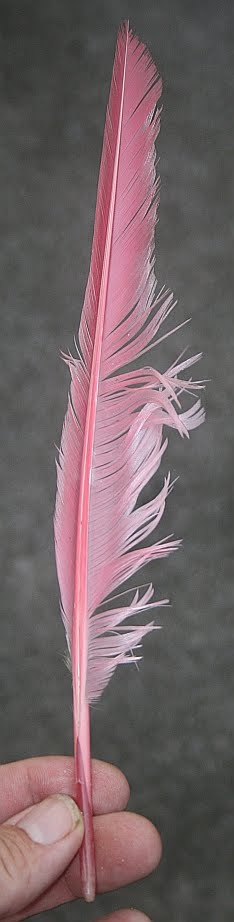
Pink Feather Found on Treasure Coast Beach.

I never saw one like this on the beach before. At first I thought it was from a flamingo, but I guess flamingos aren't found here. After a little reading, I think it might be from a Roseate Spoonbill.

Here is a good web site that provides links to the theses and dissertations produced for the Texas A&M nautical archaeology program. Lots of good information can be found here.

http://nautarch.tamu.edu/academic/alum.htm


One of the Treasure Coast treasure beach maps is now listed on ebay with two days to go. Item number: 110773504603


The wind is from the east and the seas around two or three feet, remaining that height for a few days.

Conditions are now level 1, and I expect that to continue for a few days too.


Happy hunting,
TreasureGuide@comcast.net

Saturday, November 12, 2011

11/12/11 Report - Treasure Hunt at DuBois Stopped & Sheathing


Written by the Treasureguide for the exclusive use of treasurebeachesreport.blogspot.com.

Unusual Jade and Gold Ring Find.

I like this one, partly because it seems so unique.

I good bit of lead and copper sheathing has recently been found at different locations on Treasure Coast beaches. I was having a discussion with someone that found some copper sheathing and mentioned that copper sheathing replaced lead sheathing in the mid 1800s. That was not very accurate. Although there were trends at different times, both lead and copper sheathing have been used for a very long time. Its hard to make any generalizations about that without a lot of ifs, ands and buts.

Here is a link to an article that discusses the history of the use of lead and copper hull sheathing.

http://www.globalsecurity.org/military/systems/ship/copper-sheathing.htm


The treasure hunt at DuBois Park is off. It seemed like some of the officials were actually excited about the possibilities, and then in came those who believe that history should remain buried unless they are the ones to discover and uncover it. And it seems that anything and everything in the ground these days is considered historical or archaeologically significant. If they really wanted to uncover history, I'm sure they could have easily recruited a lot of volunteers and made arrangements to do this hunt properly.

Thanks to Joan T. for providing the link to this story.

http://www.sun-sentinel.com/news/palm-beach/fl-treasure-dig-palm-20111110,0,7136565.story


The wind is now from the northeast but the seas have calmed down to around four or five feet. Yesterday there were still a few spot where the waves were cutting a little out of the back dunes. At other location the water wasn't getting near the dunes. You have to look around.

The surf web sites predict calmer seas through the weekend and much of next week, eventually increasing again around Friday.

Sean is now well away from us and nothing much is showing up in the Atlantic.

Due to the few recently eroded dune areas and the decreasing seas, there will be some good spots to check this weekend. I'm keeping my beach conditions rating at a 2.

You might be able to get into some of the low tide areas that haven't been accessible for a while as the seas decrease.


Happy hunting,
TreasureGuide@comcast.net

Monday, September 19, 2011

9/19/11 Report - Religious Medallion From 1715 Fleet, & Hunt for Super Bowl Ring


Written by the TreasureGuide for the exclusive use of treasurebeachesreport.blogspot.com.

I've shown the front of this medallion before. Laura Strolia, author of the book on the Marigalera of the 1715 Fleet, has done a lot of research on it, and has found that it is Franciscan and shows St. Anthony on the other side. She says there was a Franciscan priest traveling with the 1715 Fleet.

One Side of Medallion from 1715 Fleet Bearing a Prayer.

We are trying to make out the words, which are in Latin. If you can make out any of this, even a single word, please send your thoughts in.

The clearest word that I see, is FACIE, which is Latin for face. Maybe you can pick that out in the photo.

I know its a small photo and difficult enough to make out in person.


Yesterday I mentioned that some people were expecting a drop in gold prices this week. It is certainly starting out that way.


Do you know what the most valuable US coin is? Take a guess.

It is the 1933 Saint-Gaudens double eagle which sold for $7,590,020 in July of 2002.

Here is an article that argues that rarity is not the only determinant of the price of a rare coin.

If the coin has a publicized history, that often increases its value.

Here is the link to that article.

http://www.numismaticnews.net/article/even-rarities-priced-by-popularity


The other day I mentioned a Super Bowl ring that was lost a number of years ago down in Fort Lauderdale. It turns out the fellow that did some hunting for that ring read the post and sent in his account. The diver was James F. who was contacted by Kevin Reilly, the owner of a metal detector store in Pompano, who was contacted earlier about the ring.

James says he was told that one of the Miami Dolphin's players was celebrating their win against Dallas and had been having a few cold ones aboard somebody's yacht, and when he was trying to get off the boat and onto the dock, his ring came off his finger, rolled along the dock and plunked into the water.

That would give you a sinking feeling, wouldn't it.

James said it was an oily muddy nightmare under the dock. He says, I still remember the weird stares I got as I clomped through the restaurant wearing my scuba tank, BC, mask and my bright orange Whites PI-1000 pulse detector! I didn't think that was any way to keep the operation low-key, but there was no other way to the dock but through the place.

Continuing, James said, It was about fifteen-feet deep below the dock as I descended toward the muddy bottom. I switched on the Whites and scanned the mud. Signals were everywhere. The first one I got, I stuck my arm down into the mud almost up to my armpit and pulled out a broken aluminum flagstaff with a couple of Semaphore flags still attached! Of course this brought the visibility down to absolute zero...literally couldn't see anything at all but brown-black soup. Finally I had to surface, as I had no way to determine where I had searched while in zero visibility...not to mention, I could hear the amplified engines of pleasure boats passing by or above, that scared me half to death.

James said he used a rope with knots in every couple of feet, which I secured on the bottom, and moved along scanning the mud by feeling each knot in the darkness. At any rate, I found a hashish pipe, a women's watch, 200,000 beer cans (well, seemed like it anyway), a pretty nice Zippo lighter, a hair dryer(?), and other metallic junk. The PI-1000 underwater detector had one setting...on or off, and no discrimination settings whatsoever, so you had to sort through every signal you got...try to figure out what it was by feel, or slapping against the Plexiglas on your mask. Two scuba tanks and three hours later, no ring.

James got a few bucks from the shop owner for his efforts and and a day or so later, came down with a raging ear infection that took half a truckload of antibiotics to cure...don't know what was in all the mud, but I'd never go down there again. Maybe somebody younger with newer detector technology might take a crack at it, as I am sure, beyond a shadow of a doubt, the ring is still down there.

Thanks for the story on that James.


Treasure Coast Beach Conditions and Forecast.

There are two low pressure areas coming off of Africa. The first does not look like it will develop anytime soon, but the second has a 60% chance of developing into a cyclone in the next 48 hours. It is still too far away to say where it will go or what it will do for us.

The wind is from the southeast again, and that means hot humid air again.

The seas are running about 2.5 feet or the next day or two and then will slowly decrease.

That means no real change in conditions real soon.


Happy hunting,
Treasureguide@comcast.net

Sunday, July 10, 2011

7/10/11 Report - Fog on the Treasure Coast Ocean


Low Tide This Morning on a Treasure Coast Beach.

As you can see it was a little foggy out on the ocean this morning. I have a video of the waves below. Also a little virtual snorkeling video that I experimented with.

Some of the beach accesses have a lot of mosquitoes now. If you don't want to feed the mosquitoes, you might want to take some repellent.

It looks like we'll be having scattered thunder showers for at least another week if the forecasts are correct.


If you want to get a first look at a different metal detector, you might try YouTube. There are now a lot of videos on Youtube, and quite a few by detectorists showing field experiences. While most of these videos are definitely amature productions, they can still be useful. You can't always believe everything you see, but you can often get a glimpse at some of the various technologies that are being used and you can often get a bit of a sense of how well they work. I certainly wouldn't use YouTube videos as my only source of information, but the videos there can sometimes be helpful.


The internet is a really good research tool for researching finds too. I found an old blob top bottle that has the address of the bottling company embossed on the front. It was on Bedford Ave. in New York. I was able to find the address and photos of the buildings on the street where the bottle was made or distributed. I don't know if the existing building at that address is the original building, but it is interesting to actually be able to see the location where the item once was used nearly a hundred years ago. Found on the Treasure Coast but traced back to a New York address. I wonder if it was tossed overboard from a steam ship or what?


The question about the scapular has been answered. Laura Strolia, author of The Marigalera of the 1715 Fleet, found that the scapular with a picture of a galleon is a Carmelite scapular for Our Lady Star of the Sea.


Treasure Coast Beach Forecast and Conditions.

Here is the video of the beach this morning.

http://www.youtube.com/watch?v=2NRySvS8XrE

Notice how wide the beach is becoming. It seems that sand is continuing to wash in building a wider beach at locations like this. The new sand is real fine and silty, and covering old layers of shells.

I've been working this beach for a few days or maybe even weeks now and still finding iron and other items.

The finds are coming from just behind the wet sand area and are down a foot or more laying under the sand towards the top of packed shells near the water table.

I'm finding that once you get down a foot or so, sometimes you can remove the material from the hole more successfully by hand. You can keep the sides of the hole from falling in by carefully removing the material by hand rather than using the scoop. Also, when you get near the object you can feel around for it and retrieve it by sticking your hand down through the water and looser materials.

There is almost always a zone where you will find most targets. At different times the zone will be at different places. The zone on this beach right now, and I'd bet others like it in this area is in the area is back from the water and where the beach just starts to slant upwards - not too close to the water, and not in the dry fluffy sand.

You'll have some hard digging. As I said, sand is on top of a layer of packed shells, then you'll hit the water table.

The wind is still out of the southwest and the seas calm, running about one foot. that is predicted to remain the same for the next week.

There is nothing significant in the tropics now either.

Blogger is giving me trouble today. it seems I've lost some of what I typed. I'll give up for now.

I'll just leave you with this little virtual snorkeling tour.

http://www.youtube.com/watch?v=yBVnvRZLsy8


Happy hunting,
TreasureGuide@comcast.net

Wednesday, May 4, 2011

5//4/11 Report - Prospecting or Mining: That Is the Question


A Few Gold Medallions.

Medallions, or charms, often get separated from the chain. Even if the chain comes off, part of it will often stick out of the sand so it can be found, but a medallion is easily lost. Here are a few that have been found on Treasure Coast beaches.


It can be difficult to create and interpret surveys. I have a lot of academic work in survey construction and analysis, but the informal surveys in this blog are not of that level. Yet they do tell us something, even though they are far from perfect.

The survey that is running on this blog now is nearly complete. I've been having a hard time not commenting on it before it was actually complete, but I guess I should hold off just a little longer. I hope you will all vote and then I'll comment when it is complete.


I received an email from someone asking for a good "specific" spot to hunt. I know what they mean, but the question just doesn't feel right to me. I want to say if I give you a specific spot, you are leaving out a lot of what I find most interesting and enjoyable. I enjoy hunting those good spots. Or even those spots where something small and surprising becomes accessible. I guess that is the prospecting. When I find a good spot and the conditions are right, I switch from prospecting to mining. I've used the term "mining" before to refer to very thoroughly detecting and cleaning out a small well defined good spot.

There are some good spots that produce more frequently than others, but the big finds that haven't yet been made are probably places where the majority of detecting is not done. Think about it. Some of the beaches are hunted multiple times almost daily. And some places are hunted very seldom. If you choose to hunt the well known good spots, you'll be hunting where a lot of other people hunt. If on the other hand, you do a little prospecting, you might find a new good spot and have a chance of making some really good finds. I know it is a long shot. But I hope you see what I am saying. You can either hunt where things have been found most often in the past and where everybody else hunts, or you can work at being one of the first to find a good new spot. I would encourage you to do a little more prospecting rather than always following the crowd.

I didn't say what I started to say. The whole treasure coast is a good place to prospect. These wrecks are scattered over large areas. Yes there are some spots where cobs tend to reappear more frequently than other spots, but the entire area holds possibilities.

Also, the good spots change. It depends upon beach conditions. I'd rather hunt an eroded area where nothing has ever been found before than an area where many things have been found but where everything good is buried deeply in loose sand.

I think I've made one point, even if poorly.

One clarification here: deep loose sand is a bad sign if you are targeting shipwreck cobs or coins, but not necessarily other things like wood, ceramics, or some types of metal artifacts. Generally speaking if I don't clarify, I am talking about hunting shipwreck treasure cobs or coins.


Back to the point of not always hunting where everybody else hunts. I started detecting when I lived in a heavily populated area where there were a lot of detectorists. Sometimes I hunted the popular beaches where a lot of other people hunted, but more often I hunted spots where almost no one else hunted. I almost never saw anyone else hunt my favorite spots. Most of them just didn't look like they would be any good. Some were abandoned spots that weren't used much anymore, but they were used heavily in times past. Some looked junky or were over-grown. And some of them were difficult to get to for one reason or another. But they were good spots that I hunted over and over again.

It is the propsecting part that will help you be most productive. A lot of people simply want to mine a known location.

I know of some spots that aren't good very often, but underneath all of the sand are shipwreck items. Some of those spots might only produce once or twice in a ten year period. Most the time there is too much sand, but when the conditions are right, the items become accessible for a day or two or more and then quickly disappear again, not reappearing until the conditions are right again, whenever that is.


Prices of precious metals have been dropping quickly the last few days, but everything has - stocks, oil, the dollar. About the only safe haven right now is foreign currencies. That might all turn around very soon, but you might want to make a decision if you haven't already.


I know of one shipwreck that lies under the beach in front of a big hotel down in Dade County, but it rarely shows itself. Most people walk over it, and I dare say, don't have the foggiest idea that it is there.


Treasure Coast Beach Forecast and Conditions.


The beaches haven't changed yet, but the wind has shifted to the north and the seas are calm, down around two or three feet today. That gives you a chance to get pretty far out during low tide.

But here we go again. Did you notice that the surf web sites are now predicting less than five foot seas tomorrow? As usual the prediction of rougher seas is reduced as the time gets near. I sure wish they would fix their models. This has been very predictable for at least about two years now. That is obviously a systematic error in their models.

There is a cool front that is coming through and temperatures will be decreasing a little. I like that, but it won't help the beach conditions much.


Happy hunting,
TreasureGuide@comcast.net

Wednesday, April 13, 2011

4/13/11 Report. - Sand, VolleyBall Courts and Diamonds


A Typical Treasure Coast Beach This Morning.

I saw a tv program where they talked to a fisherman that found an old pot underwater. He brought it to the Antiques Roadshow. He had only one question. What was the pot worth. He made it clear he didn't care about anything else.

Well, it turned out the pot was medieval and turned out to be worth a good bit, but after the fellow learned more about the pot, his attitude completely changed. He said he wouldn't sell it for anything.

That is what happens. When a person learns more about the items they find, they often develop a completely different attitude towards the objects. It becomes more personal. They realize that the object is a link to the past and people and times of the past.

This particular fellow went out and found more pots and accumulated a very nice collection. As he discovered additional pots and relics, he developed a totally new relationship with those items. Not only did he discover these items, returning them to humanity, but he also cleaned, restored, protected and shared these items. That is what happened, and all mankind benefits when that happens.


People told me that the squid that I posted a few days ago was not a squid at all but rather a cuttle fish. Cool.


I'm trying to learn to blow that bugle Horse Conch. I can't do it consistently yet but get it right every once in a while.


Some people thought the encrusted object was a bullet. I thought so at first too, but I have my doubts about that now for a variety of reasons.


In talking about the dry sand area lately, I mentioned how the areas bordering the most heavily used areas on the beach often have more gold than where everybody sits or settles. I also mentioned volley ball courts as being good spots. Here is a volley ball court find.

Gold Thirty Three with Twenty Two Diamonds.

Unfortunately the photo didn't come out too good. There was too much sun and reflection from the stones and then I over sharpened the photo.

It is the kind of thing you might find on volley ball courts. Charms from chains are relatively common. Often chains break or open and the charm is lost. While the chain is sometimes also lost, it sometimes sticks up enough to be seen, while the charm is harder to find.

There are a number of things I've recommended for hunting volley ball courts. If the court is sprinkled, hunt it just after the sprinkling. You can often then eye-ball small chains etc.

If you know a small thin chain has been lost and that your detector is not good at detecting chains with small links, a rake or sifter often does the job.

In fact a good sifter can work well where detecting is not permitted. One fellow, named Merkitch (last name if I spelled it correctly) wrote a small book that tells how to construct and use a sifter with wheels on the beach.

There are many good strategies and techniques for specialized situations.

I'll get into some others some other day.


Treasure Coast Beach Forecast and Conditions.

Trucks Dumping Sand on the Beach Just South of the Fort Pierce inlet.


The front beaches continue to build all over the Treasure Coast with small shells and sand. The high tide got higher on the beach last night than I expected.

Conditions are very poor for finding cobs on the beach. The water is pretty nice for water hunting though, if you are somewhere where you can do that.

There were a good many artifacts on the front beach for a while, but it seems they are disappearing.

I've seen some places where the cliff in the dunes at the back of the beach is falling. Sometimes items fall out of the dunes when that happens. On some of the narrower beaches, it might not take those items long to get washed down to the front beach or into the ocean if there are some good waves and erosion. Of course, we've had neither of those for quite a while.

Seems like we should have a storm or two that rips the beach this summer. Until that time, you might be better off in the water or at some of the good tourist beaches in other parts of Florida.


Happy hunting,
TreasureGuide@comcast.net

Tuesday, March 1, 2011

3/1/11 Report - Big Seas Coming


Mammal Bone Fossil Embedded in Rock.

Evidently this fossil or bone was enclosed as the rock formed. I wish I knew more about the age of rock formations.

I recently found this fossil. It's not worth anything, but I thought it was interesting. It looks like a small limb bone. The fossilized bone either broke off and was worn down or maybe it was just worn down that much.

Anyhow, the lesson is, whenever you are finding old things, that is a good sign. It generally means that old materials have been uncovered or washed up at that area.

Some people decide before they go out what beach they want to detect, but it is a good strategy to look at the beach and decide if you really want to spend your time there or whether you might be better off checking out some other beaches.

I'd rather detect a beach that has never produced anything if it is cutting than a beach where numerous things have been found in the past if it is now sanded in.

The conditions of the beach are more important to me than what has been found there over the years. One exception is some of the modern jewelry beaches that are so heavily used that you can find some good things occasionally even when the beach conditions are poor.

Finding older items is always a good sign. If you are hunting old things, it means that you are in a good area, and if you are hunting modern things, it means you might be getting close to any pockets of accumulated heavy materials.


I just learned that Sedwick Coins is now auctioning items on eBay. They have some interesting items on eBay. For example, I saw this clump containing a gold coin and other debris from the shipwreck Fame that sunk in 1822.

Here is the listing.

http://cgi.ebay.com/Mysore-India-star-pagoda-Haidar-Ali-Shipwreck-Clump-/130492241052?pt=LH_DefaultDomain_0&hash=item1e61f1949c


And here is a nice shipwreck web site that gives information on a large number of shipwrecks.

http://www.wrecksite.eu/wrecked-on-this-day.aspx?14/06/2010


I recently received this from Sedwick Coins via email.

Our upcoming Treasure and World Coin Auction #9, scheduled for April 26-28, contains a very special Session II: The Dr. Frank Sedwick Collection of Colombian Republic Gold Coins. This collection will be sold as part of the main auction, but a special stand-alone catalog is available now. Earlier this year we submitted the entire collection of over 230 coins (spanning the years 1822 through 1980) to NGC for grading and encapsulation, and fortunately NGC finished in time for us to make this special-edition catalog well ahead of the usual schedule for our April auction. We offer this 64-page catalog in limited quantities for $15 postpaid by Priority Mail ($25 overseas), ready to ship starting March 3. (Note this special-edition catalog will NOT be sent to our regular mailing list of bidders and subscribers, who will receive the main catalog around the end of March.) To order the Dr. Frank Sedwick Collection catalog, please click here:

http://www.sedwickcoins.com/frank/cat2011.htm

Another advantage this time is that we will be showing ALL the coin lots at TWO major coin shows before the auction.


Lenny wrote in and said he heard that Golden Sands Beach on A1A Vero Beach, will be closed from 2/28 to 4/20 for beach and dune restoration.


Forecast and Conditions.

The weather report is in. Today a front will be coming through. The wind is supposed to pick up, and it is supposed to rain.

The wind is still coming from the southwest this morning and the seas are still calm but will be building later today. Tomorrow the prediction is that the seas will build to around six feet and then up to maybe 7.5 feet.

This does not look like it will be a short one-day thing. According to the predictions the wind will be blowing pretty good for a number of days. We haven't seen anything like what is now predicted for maybe two years, if my memory serves.

You hope for a sustained period of high seas, but we just haven't had that for quite a while. It will take a while to move a lot of that sand. The first places to erode will probably be places where there is some obstacle to the flow of sand, or where there was erosion not too long ago. It will also depend upon the angle that the waves hit the beach.

This could be a bust if the waves continue to hit directly on to the beach at a ninety degree angle. Still, since the beach isn't a straight north/south line, some places where the angle is right will probably erode.

Anyhow, this is the best looking opportunity I've seen for quite a while. I hope it turns out.

Get your detectors charged and make sure your gear is in good shape.

I broke a scoop handle not too long ago. I couldn't believe that that heavy thing broke the way it did.


Happy hunting,
Treasureguide@comcast.net

Thursday, December 30, 2010

12/30 Report - Low Tide Hunting Around Old Cuts


Cut at Low Tide This Morning.

A few days ago the beach south of Jensen Beach was eroded as shown in this photo. There were a lot of clad coins at this cut. One reader worked it a couple of days and took out a lot of clads.

I visited the spot this morning to see what it looked like now that the wind had shifted. As you can see the cut is still there but there wasn't much to be found directly in front of the cut.

What I did is what I talked about yesterday. I went outside the area that had already been cleaned up and found a good number of coins. The area south of the cut running for a couple hundred yards produced a coins in the wet sand at low tide.

There was a huge log (about 40 feet long and big around) that moved a couple hundred yards down the beach. That illustrates how quickly and how far wood or sections of a hull could travel along a beach.

I'm often surprised to find how many coins can still be found on our beaches. You just have to hunt out the right spots. I know that clad coins are not exciting, but they are out there. And when you find good concentrations of coins you can often find something else more interesting in between in them.

My experience this morning illustrated very well what I talked about yesterday.

After visually scanning a beach to find the best areas to check first, do some sampling. Run a loose scan and check to see what kinds of things are in the area. If the sample provides evidence of more good things in the area, tighten your pattern and hunt it better. If the sample isn't promising, move on and sample some other areas until you find a more promising place to hunt.

That applies to any type of beach hunting. Sample some areas before you decide where to focus your time.

The more you look at and the more you know about what is going on, the better off you will be.

Even knowing where the cuts are now, even if they are filling in to some extent, is a good thing to know. They can easily cut again. When there is a lot of sand on a beach, it will take more for it to cut.

When you dig a hole, notice the layers, if there are any. Become familiar with the type of sand that usually contains different types of targets at a particular beach.

You'll often notice that the coins you dig tend to be in a particular layer. That was the case today. The top layer was brown sand and then under that was a hard-packed grey layer of sand.


Here is a link to an article about a Chinese counterfeiting ring. They are manufacturing a variety of silver coins. The article has a lot of photos including the dies used to make the coins. I found it interesting.

http://coins.about.com/od/worldcoins/ig/Chinese-Counterfeiting-Ring/


Silver has been doing even better than gold on a percentage basis.

Here is a link to an article on metals investing.

http://www.coinnews.net/2010/12/28/gold-tops-1400-silver-jumps-above-30/


Forecast and Conditions.

As I mentioned the wind shifted and is now out of the southeast. Seas are relatively smooth, which gives you a chance to easily hunt the wet sand at low tide.

There are some cuts left and even though they are partially filled, you can still take advantage of whatever is left in the low tide areas around the cuts.

It doesn't look like there will be much change this week.

Happy hunting,
TreasureGuide@comcast.net