Showing posts with label treasure hunting. Show all posts

Sunday, July 5, 2020

7/5/20 Report - Waves, Liquifaction and Sand Movement on The Beach. NHC Map Lighting Up. Access to Technology and Data.


Written by the TreasureGuide for the exclusive use of treasurebeachesreport.blogspot.com.

Wave Photo by Clark Little Photography
Source: clarklittlephotography.com.
Although it seems like coins and rings and things sink in the sand, they don't sink in undisturbed dry sand without some disturbance of the sand.  You can easily prove that for yourself.  Just take a bowl or container of sand and place a coin or ring on top of it.  You can come back days later and clearly see that the item did not sink.

When you say a object sinks in sand, that seems to me to imply gravity as the primary force, which is misleading because the sand has to move to allow the object to "sink."  Maybe to you that is not an important distinction, and I can accept that, but for me, I'd rather place more emphasis on what has to happen with the sand.  That is what we have to know more about in order to be able to explain how an object will sink at the beach.

Clark Little takes amazing photographs of waves, like the one shown above.  If you visit ClarkLittlePhotography.com you'll see many great photos.

The above photo, besides being beautiful, shows some very interesting things.  Notice the brown area that the person is standing in.  There is brown all around the person, and there is also a brown vertical column in front of the camera.

The brown around in front of the wave shows that a lot of sand has been suspended by the turbulence.  And the brown vertical column, shows how sand has been picked up into the wave.  It seems clear that a lot of sand is being moved in that photo.

We don't often see a wave that big on the Treasure Coast, but the same thing happens with smaller waves, though to a lesser extent.  On the Treasure Coast we don't get waves like that, but the waves we do get will do the same thing - move sand.  And sometimes the waves do get pretty big.

Here is another great photo by Clark Little.  Once again, you can see the sand being sucked up into the wave.


Photograph by Clark Little.
Source: ClarkLittlePhotography.com.

As I've said many times, different materials and objects require different amounts of water force to move.  With a waves shown in these photographs a lot more than sand could be moved.

Here is an interesting explanation from Wikipedia explaining how sand fleas bury themselves.

Emerita is adept at burrowing, and is capable of burying itself completely in 1.5 seconds. Unlike mud shrimp,  Emerita burrows tail-first into the sand, using the periopods to scrape the sand from underneath its body. During this action, the carapace is pressed into the sand as anchorage for the digging limbs.   The digging requires the sand to be fluidised by wave action, and Emerita must bury itself in the correct orientation before the wave has passed to be safe from predators.

As the tides changes, Emerita changes its position on the beach; most individuals stay in the zone of breaking waves. This may be detected by the physical characteristics of the sand. As the tide falls, the sand is allowed to settle; when Emerita detects this, it uses the temporary liquefaction from a breaking wave to emerge from its burrow, and is carried down the beach by the wave action. Longshore drift also drag Emerita laterally along a beach.

Crashing waves cause liquification of the sand.  It burrows into the liquified sand, which settles when the tide recedes.

When you are talking about objects sinking into the sand, a number of things are going on.  Like I said above, it requires some disturbance of the sand.  In some cases that disturbance might be little more than sand moving away, while the denser objects remain.  When the sand is liquified, denser objects can actually sink into the sand, but that requires special conditions.  It does not happen unless the sand is being disturbed in one way or another.

In the near future, I plan to discuss some of the other variables and forces pertaining to how objects sink or appear to sink into sand.

---

Neural networks and AI could be a lot of help to the treasure hunter, but it would require a lot of research and development work, and access to the technology and data. For me the most valuable thing about going through years of higher education was access to technologies, labs and data.  I could  have done without the classes and lectures.  In fact, the thing in education that probably changed my life the most was discovering computers in 1969.

I started with batch processing, which involved punching computer instructions on punch cards, which were then submitted to the computer center.  You'd go back to the computer center in a day or two to get the output (you think your computer is slow).  As often as not, what you got was a listing of the many errors in your program that had to be identified and corrected before submitting the program again and waiting another day for the output.

I'll never forget the day I discovered a teletype machine that allowed me to use interactive BASIC to enter programs.  You'd hit a key and wait about two seconds before seeing the character typed on the computer paper on the teletype in front of you.  The delay in response took some getting used to but it was miles ahead of batch processing.  You know the rest - personal computers and then the internet.

If the general population had access to the most advanced technologies and data, progress would be accelerated many times.  If people had access to the raw data and information, there would be all kinds of genius geeks looking at the data.

A lot of things are accomplished by amateurs despite the barriers.  That is very true with archaeology.  Professionals have their own domain to protect and they seldom appreciate the talent that is sitting out there in the world.  Did you ever get a job when you were way beyond the person that would be your boss?  It won't happen.

In a very rare event about a week ago, a reporter actually asked a follow up question of Dr. Fauci, that elicited some useful information.  Dr. Fauci had mentioned in a very general way that something wasn't working, and the reporter asked what that was. Whoooaa - a reporter actually doing their job. Dr. Fauci said that contact tracing wasn't working because certain populations weren't responding to the calls.  In a moment of unguarded candor, he described those populations, but I won't.   I knew that very useful information was too politically incorrect to ever be mentioned in public again.  It wasn't.

Do you realize that a lot of the people at the top of the health agencies have been there longer than Moses wandered the wilderness?

The point I'm making is that the public only gets filtered information at best.  I'd love to see more good data put out there for the public to access.  Just yesterday I noticed a TCPalm headline that said something like 80% of corona cases are from minority populations.  I found some demographic breakdowns on the Florida Dept. of Health site and their numbers suggested nothing like that headline.

I don't do Facebook or Twitter.  I'm not much interested in the party line, the slogans, mantras, talking points or retweeted retweets.

I do very much like the idea of using neural networks and AI for contact tracing, but am personally more interested in tracing ideas and treasures than viruses, although that would be fun too if the data collection was more systematic and well defined.

---

Source: nhc.noaa.gov

Seems like the National Hurricane Center map is becoming a little more active.  Maybe we'll get some nice waves someday before long.

Tropical wave five is moving away from us and there is another area that has a small chance of developing in the next couple of days.

Happy hunting,
TreasureGuide@comcast.net

Monday, January 20, 2020

1/20/20 Report - Some History of Treasure Coast Treasure Hunting: Bruce Ward. Bigger Surf Coming.


Written by the TreasureGuide for the exclusive use of treasurebeachesreport.blogspot.com.


January 1965 Issue of Argosy Magazine Containing Story of Bruce Ward's Treasure
Submitted by JaminJackUSA.


If you are interested in the history of treasure hunting on the Treasure Coast you might want to find a library copy of the January 1965 issue of Argosy Magazine.  

Several days ago I posted a nice four-reale that was purchased by JaminJack from the estate auction of Bruce Ward.  Jack sent me a copy of the Argosy article as background on the adventures of Mr. Ward.  The article describes Ward's big find, which was made in 1964, early in the history of modern Treasure Coast treasure salvage, and at a time when the Real Eight Corporation and a variety of other smaller and less documented treasure hunters were working along the Treasure Coast.  This is the type of article that no Treasure Coast treasure hunter will want to miss.

Photo Appearing in January 1965 Argosy Magazine.
Submitted to TBR by JaminJack.

Bruce accumulated a lot of treasure, which he did not sell because he planned to make start a museum.

Here is a photo of a homemade dive platform that he created and used until he upgraded.


Photo of Homemade Dive Raft Shown in January, 1965 Argosy Magazine.
Sent to TreasureGuide by JaminJack.
And here is his salvage boat, the DeeGee.

The DeeGee Salvage Boat.
Source: Jan. 1965 Argosy Magazine.

Thanks JaminJack.

---

I was working in the yard this morning when I noticed that the wind had changed direction.  It is now coming more from the north, and it feels like a bit of a cool front came through, so it was not surprised when I looked at the surf predictions and saw that the surf will be increasing.


Source: MagicSeaWeed.com.

Looks like maybe up to a ten feet surf by Wednesday.  And some north winds before that.

That is a big enough surf to move some sand.  I just wish the wind kept coming from a northerly direction for a longer time.

Happy hunting,
Treasureguide@comcast.net


Monday, November 11, 2019

11/11/19 Report - History Between the Pages of Old Books. Memorable Metal Detecting Experiences.


Written by the TreasureGuide for the exclusive use of treasurebeachesreport.blogspot.com.


I decided to pull out an old book that I hadn't read, and I'm glad I did.  The book is George Gable's The Grandissimes, originally published in 1880, I had an 1899 copy.  Gable writes historical novels, or what I might call dramatized history of old New Orleans.   His books give you a better idea of what life was like than a history book would.  He fleshes out actual historical people and events with realistic interactions and dialogue that is authentic to the times and period.  It presents a complex detailed picture of society and racial relations as they were.  In my opinion, the George Gable books are much better than "history" books in more ways than one.

Anyway, I found the obituary of Captain Benjamin Saxon clipped from the Dec. 11, 1901 Times-Democrat newspaper.  Captain Benjamin Saxon Story was a prominent citizen of New Orleans who passed in 1901, and the obituary mentions actual places and people mentioned in the book.  

There is much more to the clipping than what I am showed above.  The obituary talks about Captain Story's experience in the Civil War and his feelings of the defeat of the Confederacy.  It also mentions his acquaintance with Bulwer Lytton, a very prolific author of many books which I have. 

Treasure hunting is to me a broader subject than metal detecting.  Metal detecting is one kind of treasure hunting.  

Valuable books are treasures too.  Not only can old and rare books be valuable, but old books can conceal other treasures.  I've found money, old photos, and a business card of a famous person between the pages of an old book.   And  the information in a book can be a valuable treasure too.

---

This morning I was thinking about my most memorable metal detecting finds.  Two that first came to mind were valuable finds.  They were both diamond rings.  One had the largest and finest solitary diamond that I ever found, and one had the largest total diamond weight.  

You would think that the most memorable finds would be the most valuable, but while thinking about it, I discovered there are a lot of other factors involved besides the value of the find.  Some of the finds that stick out in my memory are not the most valuable.  In fact I think those diamond rings are so memorable to me because of more than their value.

The first, my largest and finest solitaire diamond, was found on a particularly beautiful day.  The sky was deep blue and the water was bath-water calm.  I distinctly remember when that scoop of sand was lifted from the bottom, I could see the diamond sparkling while it was still under a few feet of water.  At that point I didn't know that it was a valuable diamond ring at all, but I remembered the sensory experience of that beautiful day and the diamond sparkling in the scoop under the water.

The other diamond ring that I remember so well, involved an experience too.  It was a day when I had very little time to hunt.  In fact before I went hunting, I had a hard time deciding if I would go because I had so little time.  I figured that by the time I got to the site I wouldn't have more than a half hour of time to actually hunt.  Despite how little time I had, I finally decided to go.  When I got there I stepped into the water, not much above my ankles, and bingo - I hit the ring in just a few minutes.  It turned out I didn't need much time, but something told me to go, and I was glad I did.

I also well remember finds that were not valuable at all.  For example, my first piece of Treasure Coast shipwreck silver.  I remember that find detail for detail.  I dug it up, my wife took it out of my scoop, looked at it, and started to throw it away.  I told her to keep it.  It was a black sliver of silver.  I didn't really know for sure it was silver until I got it home and tested it.  It isn't worth much of anything but it was a first for me, and it was a long time coming.  

Surprisingly, unlike the experiences I just described, I had to think a while to remember exactly where I found my first escudo.  For some reason, I don't remember that one so well.  I do remember that it was on my birthday weekend and I also found a gold US coin the same weekend.  Maybe that made the escudo less memorable to me as a unique experience because what I remember is finding two totally different kinds of gold coins in the same birthday weekend, but I don't really remember the details of finding those two coins very well.

It seems that I do not so much remember the details of individual finds on days when there were many finds.  On days when I dig a lot of good stuff, that is what I tend to remember - the quantity of finds. 

When I think over my memorable finds, there are several factors that make them stick out.  Value is only one.

I tend to remember first finds, especially when they are something that I have sought for a while.  I had been trying to find shipwreck silver for a quite a while when I finally found my first.  I think that made it more memorable.  Also the experience of not knowing for sure immediately and having to go through the process of testing before getting the final answer made it more memorable.  And also sharing the experience and telling the story made it more memorable.

Many of my most memorable finds involved interactions with other people - for example, sharing the experience with my wife.  In some cases, it was returning the item to a grateful person.  And telling the story never hurts.  I'm sure that sharing the experience and sharing the story makes the find much more memorable.  

I remember, for example, the day when I arrived at one site after leaving another with a pocketful of quarters and encountering a fellow that asked if I could spare any change.  I gave him a couple dollars worth of blackened quarters, and he told me, "God helps those who help others."   I stepped into the water and, bingo, I found a diamond ring in just a few sweeps.  A few sweeps more and I found another diamond ring.  What I remember most about that is what the fellow said to me and then what happened and the very coincidental nature of the whole thing.  

It isn't all about the value of the find.  It is very much about the experience and sharing with others, and also the meaning it has to you.

---


Source: MagicSeaWeed.com

We're supposed to have another increase in the surf for Wednesday and Thursday and then another one next weekend.  

Like I've been saying, this is the time of year when we often have cold fronts coming through.   November is often a decent hunting month.  Hopefully we'll get something that moves enough renourishment sand to improve conditions.  There is a lot of sand in front of the beaches and covering the dunes.

Remember the veterans today.

Happy hunting,
TreasureGuide@comcast.net

Saturday, May 18, 2019

5/18/19 Report - Exciting Treasure Found in Jensen Backyard. Beautiful Artifacts of the Atomic Age. Alchemy of Treasure Hunting.


Written by the TreasureGuide for the exclusive use of treasurebeachesreport.blogspot.com.

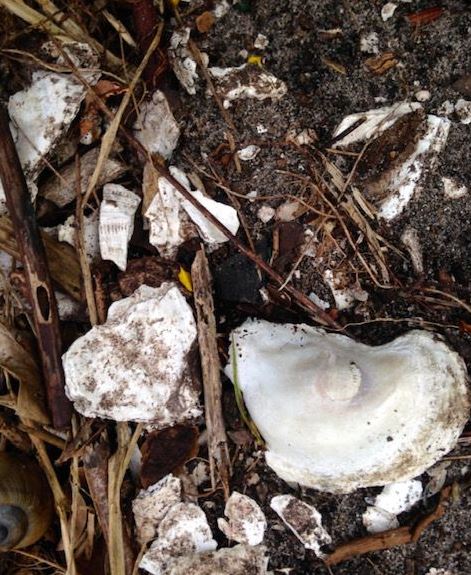
Cannon Ball and Oyster Shells Found In A Backyard On A Jensen Ridge.
Find and photo by K. K.

I received the following email yesterday, along with some photos. Happy Friday, a few weeks ago we were doing some renovations to our backyard in Jensen beach and under neath an old line of bushes we found all kinds of fun treasures from the Ais Indians, which isn’t uncommon.... We routinely find mounds of discarded oysters, small pottery shards and all kinds of later years fun types of glasses. Well this day we came across a large oyster bed and a second section where they had been shaped into different shapes and what looked like a huge heavy ball of some sort.  We called around and finally a lady from the local museum at Gilbert’s House of refuge came over and said it in fact looked like a very old maybe 16th century Spanish iron cannon ball to her and it looks like we may have a bit of a mound in our backyard a place where the Ais Indian, would have a outpost for fishing and hunting trips and later on a place to be on the look out for the British or Spanish and their Indian collaborators who routinely traveled the area... I guess it’s still crazy a 450 year old cannonball was in my yard unsound until now! (My family has been in this house since 1979) I attached some pics for you to take a look at.


Exciting finds!  Thanks for sharing K. K.

While our beaches have been heavily detected, most of the inland areas have not.  There is a lot to find out there.

---


Beautiful Beach Artifacts From a Horrendous Event.

Source: See Atlasobscura.com link below.

Wannier had been studying beach debris from different areas in order to compare the health of different marine ecosystems, when some particles from the Motoujina Peninsula struck him as unusual. Next to particles generated by plants or animals, these were “aerodynamic, glassy, rounded”—they reminded him of what he had seen in sediment samples from the Cretaceous-Paleogene (K-Pg) boundary, the geological marker of the mass extinction that erased the dinosaurs around 66 million years ago. 

But these particles from the Motoujina Peninsula were also notably different in several ways from the K-Pg particles: Some were rubbery, others had multi-layered glass shells. The variety reflected the wide range of materials present in the particles, identified under electron microscope at the University of California, Berkeley. X-ray experiments were also conducted at Lawrence Berkeley National Laboratory, which proved useful in analyzing the formation of the debris.* The range of materials is just one indication that the particles formed as a result of the Hiroshima bombing. An urban center presents a wider variety of materials—such as concrete, marble, stainless steel, and rubber—than a desert test site like Trinity, in New Mexico, where the first-ever nuclear explosion was tested. The resulting particles from that test, called trinitites, are notably less diverse in their composition than what Wannier and his colleagues are now calling “Hiroshimaites.” The presence of anorthite and mullite crystals in the particles, meanwhile, suggested that they had formed in temperatures hotter than 3,300 degrees Fahrenheit, or 1,800 degrees Celsius...
Here is the link for the rest of the article.

https://www.atlasobscura.com/articles/found-glass-fallout-from-hiroshima


---

I lost interest in the Discovery Channel's Gold Rush TV show years ago, however I caught a few episodes of Gold Rush: Parker's Trail last night and was glad I did.

Unlike the History Channel's three "Curse" treasure shows, the Parker's Trail episodes, filmed in New Guinea, illuminated the human condition.

The alchemy of treasure hunting is the transformation and purification of the hunter.  That was made clear as Parker and his crew shared blood, sweat and tears with the native populations and were refined in the process.  Meaningful and worthwhile TV!

---

The tides are big now, but the surf remains around two-feet.  The wind is mostly from the south.

Happy hunting,
TreasureGuide@comcast.net

Thursday, May 2, 2019

5/2/19 Report - Trough Now Off Florida Coast. Gold Cross Ole Timer Story. Changes. A Correction.


Written by the TreasureGuide for the exclusive use of treasurebeachesreport.blogspot.com.

Source: nhc.noaa.gov

It isn't hurricane season yet, but NOAA is already reporting a trough developing just off the Florida coast.  If you noticed the wind yesterday, you were observing the effects of the trough.

https://www.nhc.noaa.gov/gtwo.php?basin=atlc&fdays=2

A surf of three to five feet was predicted for last night and this morning by MagicSeaWeed.com.

Forbes.com says, Isn't it a bit early for the National Hurricane Center to be issuing outlooks? The Atlantic hurricane season typically starts on June 1st. The peak of the Atlantic hurricane season comes later in September when ocean temperatures are quite warm, and atmospheric wind shear is relatively low. Storms forming on May 1st are quite rare as indicated in the figure below. However, they are not unprecedented as I have written previously in Forbes.


A 2016 blog by the American Meterological Society said:

In the past decade, half of the Atlantic’s seasons had “preseason” storms. In 2012, two storms—Alberto and Beryl—were named before the season officially started. And last year, Ana formed east of Georgia on May 7. Granted, it was initially a subtropical storm, a hybrid with both tropical features and features of midlatitude cyclones. But waters were warm and Ana became fully tropical in just days, and moved ashore in South Carolina on May 10...
Here is the link for more of that article.


https://www.forbes.com/sites/marshallshepherd/2019/05/01/its-may-1st-the-national-hurricane-center-is-watching-something-near-florida/#2a1c4a8a3c54

---


Below is a story from Sebasstian Steve describing events that occurred around thirty years ago.

So the word "Tumbaga" reminded me of a day I went detecting down on the beach about thirty years ago,  down at the "Cabin Wreck" just south of the McLarty Museum.  It had blown real hard for a couple days, but the day I arrived there on the beach, it was an absolute "bluebird" day (as we used to say up on "The Lakes" on near perfect days weather wise)  The sky was clear and sunny blue, the ocean calm, calm, almost like a mill pond, with just a little tiny ripple rolling in.  

But you could however easily see what the heavy surf had done.  A hard cut, maybe four feet, and those big, erosion control bags are --right in front of Kip's Cabin-- if you know which house it is.  THAT IS THE GREEN LIGHT...when you see those big green or blue bags showing above the surface of the sand!  And there was __ A LARGE AREA OF THEM SHOWING__......not just a few square feet peeking out of one.

I was using my U/W diving detector that day on the beach... a Garrett Sea Hunter model.  Nothing fancy or powerful.  And I guess you could say all the myths were broken that day... a beautiful, calm day, no rain or foreboding weather, no wind whatsoever, and mid-afternoon.  There was no rush whatsoever....the good ole days.  And nobody else around...they all probably came and went with the morning tide.

As after a "grueling fifteen minutes" of detecting, I was about 4' out from the dune line.  And I got a good reading, nothing big or unusual about it, but strong enough to know it was quite shallow a target.  And so I took a scoop out, where I could have twitched it out with scrapping my fingernails down under the surface a few inches.  It could not have been down over 3 THREE INCHES.  I thought to myself..."Gee...any old machine would have found this!"

And what I held in my hand was a thin and delicate gold cross.  About 3-4" tall.  Without a doubt...straight in from the wreck.  As fresh as fresh can be.  Like a piece of bakery...still warm from the oven!  A sweet little double arm cross, that was poured out of Tumbaga gold according to a jeweler.  He was using the term in more of a generic way, to mean a lower than normal carat gold.  He thought 10-12 karat.  You could see the slight hollowed out area on the rear of the cross where the pour was.  But the face of this gold cross was very pretty, with The Virgin Mary holding Her Hands together as if in prayer.  She was standing up on a pedestal.  Quite pretty, and in very good condition.  Not worn or bent in the least.  A duller matt like gold tone on the front, and a very shiny gold in the rear pour area.  Seeing the rear gold pour, you would of thought pure gold, it looked like a molten puddle, shining as bright as the sun!  You knew immediately that this cross was gold.  (The McLarty Museum has in their collection from Kip Wagner, a similar cross).

It must of come from deep under the sand, or still tacked on a chest board, because to make it ashore without bending this thin gold cross was quite amazing!  Now I'm thinking it was on a chest of some sort, treasure or otherwise, or church papers chest, as the rear of the cross had two little "tangs" angled downward, so as to be able to gently drive this cross into a soft wood lid on a chest. (The treasure chests of the 1715 Fleet were made out of cedar).  Plenty soft for this type of application.

I actually did not have a safe place to put it in...while I continued detecting.  Had I stuck it down in my pocket, it might of easily got bent.  So I laid it on a large tree branch that was sticking out of the "wall cut".  It sat on there for another couple hours, while I continued detecting up and down the beach.   

Another detectorist arrived about an hour later, and I pointed it out to him.   Like... "That is my gold cross over there on the tree branch...you can look at it, but don't take it."  That's all...a different time and place.  Now how do we get the "Real" treasure back again ???  Words like "Trust" and "Admiration" come to mind.

God Bless All Who Read These Words.  
Sebastian Steve

PS:  If you would like to be detecting on the exact correct spot I speak about here....just contact me during a good blow.  I will take you there right after the storm abates.  What's the catch?  This ole boy ain't well anymore, and you would need to carry my detector for me...both ways!  I remember in my 20s or 30s, I would have jumped on such an offer...just to listen and learn.  But as I said...sadly we now live in a different time and place.  Here's proving me wrong...772 713-0965... leave message. (Storm times only please).

---


Times have indeed changed, but I think that most detectorists will go through changes if they stick with it long enough.  I know I have.

I don't look at treasure hunting the same way as I did a few decades ago.  There was a time when I was much more driven.  Like a lot of people at that time in life, I wanted to know how much I could accomplish.  I tested myself, and I found that out.  I learned what it would take for me to metal detect professionally, and I found out that I probably didn't want to.  For me, that seemed to take some of the fun out of it.  I didn't want to depend upon detecting for an income, yet for a short while when I was between jobs, I was able to test it out.

Over the years and decades, the find became less important to me.  No single find is worth risking life or limb.  There are always more finds to be made down the road.  That is the way I see it now.

Finds in general are less important to me.  I'd rather fail to make a good find than fail to make a good moral decision.  That is what determines the kind of person I am, not the finds that I make.

To cut it short, I've changed over the years, and how I look at metal detecting and treasure hunting has changed as well.  Different things are important to me now.   If you've been at it a while, you can probably look back and see how you've changed too.

---

I have a correction to make.  A couple days ago I posted an item found by Terry S. and mistakenly called it a copper ring.  In fact, it is a bracelet.  I wanted to make that correction and get some more ideas on the find.

Here are the photos again.

Three Views of Copper Bracelet Found by Terry S.
Photos by Terry S.
Let me know what you think of this item.  Any thoughts?

---

I just received an email from a professor in a New York university asking permission to use one of the beach dynamics illustrations I used in this blog.  I'm always glad to help the educational community when I can.

---

Live bidding begins on the current Sedwick auction at 10 AM today (Thursday).


Happy hunting,
TreasureGuide@comcast.net


Saturday, April 27, 2019

4/27/19 Report - Beam Finds. Shipwreck or Not? Archaeology and Theory for MDing. Cookout Saturday.


Written by the TreasureGuide for the exclusive use of treasurebeachesreport.blogspot.com.

Ten-Foot Long Beam Found by Kurt R.
A couple days ago I showed this beam and asked if anyone had any ideas about it.  One person suggested a railroad tie, but the other end is V-shaped and it has a lot of other cuts and holes that I wouldn't expect to see on a railroad tie, so I don't think that is it.

DJ found the beam shown below back about a month ago at Pepper Park after a few days of rough surf.  One of the interesting things about that beam is that it has a broken treenail in it.


Beam found by DJ (left).


Trennel or trennel being pointed out (right).


Wikipedia says, A treenail, also trenail, trennel, or trunnel, is a wooden peg, pin, or dowel used to fasten pieces of wood together, especially in timber frames, covered bridges, wooden shipbuilding and boat building. It is driven into a hole bored through two (or more) pieces of structural wood (mortise and tenon).
I also read that treenails, or trennals, were commonly used until around the 1780s.

Maybe these beams come from the same source and got uncovered last month during the rough surf.

Below is an example of a shipwreck beam with trennals.  This photo was snipped from a USF video of a shipwreck found near Jacksonville.


I really hope someone can help us out here.   I know DJ and Kurt would like the information, and I'd certainly like to learn a little something about the subject.

---

Yesterday I wrote about cannon aprons, but the discussion was about more than cannon aprons.  It was also about investigating artifacts in general.

Here is an excerpt from the Schnitzer thesis that I referenced yesterday.

As Knappett (2005:1) states: It is perhaps surprising…that archaeology, while developing ever more sophisticated methodologies for artifact study, has not yet constructed similarly sophisticated theoretical models for understanding the roles of artifacts in human societies. So complex and daunting is such a task that it must inevitably be interdisciplinary in its scope, drawing upon cognitive science, psychology, sociology, anthropology, and history.

Theory is important in all sciences because it provides a way to organize data in a meaningful way. Theories can be hypothetical or predictive. They are the overarching abstractions that form conceptual frameworks for scientific research. Archaeology is, in its strongest applications, an interdisciplinary science, and many of its theories are drawn from interdisciplinary concepts. The study of the QAR cannon aprons is no exception. According to Trigger (2006), “It is a fundamental tenet of science that nothing is significant by itself but only in relation to hypotheses; hence only theories can explain phenomena.” The goal of this project is to explain the “phenomena” that are the QAR cannon aprons using a blend of material culture theory and an adaptation of behavioral archaeology theory, as conceptualized by Michael Schiffer in the 1970’s.

 Here is that link again.

http://thescholarship.ecu.edu/bitstream/handle/10342/3842/Schnitzer_ecu_0600M_10612.pdf?sequence=1&isAllowed=y )

So what does that have to do with metal detecting?

I don't expect myself or anyone who reads this to turn into an archaeologist, but as detectorists we do find items that we want to know more about, and we can learn a lot from how the professionals investigate artifacts.

I encourage all detectorists to take a disciplined systematic approach to hunting and artifact identification.  I've had a few posts on that type of thing lately.

If you have an idea - a theory - it will help you assimilate the information and make predictions.  It will also help you develop hypotheses that can be tested.  That will help advance your understanding.

The piece of lead that I found was not hugely interesting by itself, but since it caused me to do additional research, I learned a lot from the research.  I learned about cannon aprons, but also about some other things.

I've always said that a find is more than a find.  Gaining more knowledge about a find not only makes the find more interesting, but it will sometimes point you to additional finds.

I didn't really think much about the lead find until I happened upon the cannon apron literature and saw pictures of other pieces that looked similar  I could have missed some interesting features of that find, and  I will be studying that piece more in the near future.

---

Don't forget the Treasure Hunter's Cookout Saturday.

You can find the details by using the following link.

http://treasurebeachesreport.blogspot.com/2019/04/42419-report-treasure-hunters-cookout.html

---

Happy hunting,
TreasureGuide@comcast.net

Wednesday, April 10, 2019

4/10/19 Report - Pre-Columbian Metallurgy and Gold Analysis. More On Terry's Gold Artifact. Avoiding Treasure Hunting Wild Goose Chases.


Written by the TreasureGuide for the exclusive use of treasurebeachesreport.blogspot.com.


What do you see in the above picture?  Some people will see a vase.  Others will see two faces.  You can see both, but you will generally see one first and stick with that until your focus changes.

The point is that who you are will determine in part what you see.  Perception involves more than simply what is there.  How you perceive things will be influenced by your history.

Your brain interprets what your eyes see.  As a result, different people see things differently.  People reveal something about who they are by what they see.  Perception is not as passive and simple as we tend to think.  That is the basis for the entire field of projective testing (a method of personality testing used in psychology that includes ink blot tests and word association, to name just two).

Almost everything presents something of a projective test.  That is something people can't entirely avoid.  They might think that what they see is what is out there in the world, but there is also a degree of interpretation. Past experiences, learning and memory play a roll in perception. Social scientists go to great length to keep their own biases from affecting their experiments.

This is a complex topic, but I'm going to try to keep it brief.

Treasure hunters approach the world with a perspective that is a little different from other people.  When they dig up something that is ambiguous to a degree, their unique perspective comes into play. That is just what humans do.

When a treasure hunter digs up a key or lock, one of the first things he might think of is a treasure chest, even though there are many other types of keys - those used for toys, clocks and music boxes, for example.  You see that type of thing all the time.  I see it all the time on some of the TV treasure shows.

Treasure hunters have a tendency to see coins in ambiguous lumps.  One of the most common questions I get is about those lumps of rust that are found on the beach.  People wonder if they might be old coins.

It is natural for a TV show that wants to attract viewers to manufacture drama.  The participants are rewarded for it.  That is how they get face-time.

Some people will see gold in any flash of yellow.  They'll see Spanish treasure galleon spikes in any old spike, or a cutlass in any long thin flat object, or a spear point in a cribbing spike.  It is natural for a treasure hunter to be excited by such things, but hopes and dreams won't solve the problem. 

You won't see the slow tedious work of archaeology or any other science on TV.  The pursuit of truth is too slow, and nobody wants to watch it.  It requires too much discipline.

Our hopes and desires influence our perceptions and interpretations.  Everybody has a unique perspective that they carry with them.  That is natural, but it is something that a scientist, or anybody that wants to find truth, needs to limit and control.  They go to great lengths to be objective.  Let the data speak - not your wishes.

If you are hoping to get clues from the things you find, you want to avoid wild goose chases.  An incorrect interpretation can be very costly.  It is better to avoid quick conclusions and continue to entertain competing theories and suspend judgment until you have a wealth of evidence, and even then remain open to changing your mind when new evidence is presented.

---

Yesterday one of my topics was XRF analysis, which determines the metallic composition of tested items.  It is a useful way to analyze items such as coins and artifacts.

I just found the following table giving the metallic composition of various types of gold.


Color of Gold                              Alloy Compositions Containing Copper

Yellow Gold (22 kt)                    Gold 91.67%, Silver 5%, Copper 2%, Zinc 1,33%
Red Gold (18 kt)                         Gold 75%, Copper 25%
Rose Gold (18 kt)                       Gold 75%, Copper 22.25% Silver 2.75%
Pink Gold (18 kt)                        Gold 75%, Copper 20%, Silver 5%
Gray-White Gold (18 kt)            Gold 75%, Iron 17%, Copper 8%
Light Green Gold (18 kt)            Gold 75%, Copper 23%, Cadmium 2%
Green Gold (18 kt)                     Gold 75%, Silver 20%, Copper 5%
Deep Green Gold (18 kt)            Gold 75%, Silver 15%, Copper 6%, Cadmium 4%

You can use the following link to go to the article that provides the above table along with a technical discussion of Pre-Columbian depletion gilding.  It was published in Mechanics, Materials Science and Engineering in 2017.


There is a lot in that article that you might find interesting.  Here is a very brief excerpt from the article just to give you the idea.

Because all the metals that reached Europe were melted back into their constituent metals in Spain, there is only an example of such a load, a group of over 200 tumbaga bars, discovered in the remains of an unidentified shipwreck (around 1528), off Grand Bahama Island. This shipwreck was found in 1993... 

---

Terry S. has continued to research his gold pendant-looking find.  He recently talked to a very accomplished world-wide expert about it.  I'll pass along what Terry was told, as Terry explained it in an email.  The following is what Terry said.

… He then told me that these were often low karat gold anywhere from 8 karat on up. I told him that the one I found was 22 karat and he said then it was probably made well before the Spanish arrived probably 1 to 2 hundred years before the 1715 Spanish fleet. He told me he knew of a sunken 1600 ship that was filled with this type of jewelry. He explained there were 3 ships that were filled with trade items, blankets, beads and other items of interest to the natives. They had orders to trade for this type of gold jewelry from the Aztec, Inca or Maya Indians in Mexico and Central and South America. Only two of these ships returned to Spain. He told me where he believes this ship sank and went on to say that this is the only sunken ship that he knows of that is filled with this type of native jewelry. 

When trying to identify any piece like this there is always room for error but I think I can be pretty comfortable in saying I have a small piece of history. I believe that it is probably from a Aztec or Inca funerary mask or another ceremonial gold jewelry piece.


Thanks Terry.  I hope you'll keep us up to date on any additional developments.

I saw a few more pictures of funerary masks with very similar attachments to Terry's mystery item.  I'm also reminded of the funerary mask find reported in my 1/24/19 and 1/27/19 posts. That was found in the Melborne area and was said to be associated in some way with a  4 billion dollar shipwreck that was being sought.  There was no evidence of such attachments on that mask, but it was not complete.  It was initially reported as Incan, which, was reported by another source as being wrong. With the inaccuracies and controversy, that story got to be pretty messy.

---

I have some other topics I've been working on.  One has to do to the slope of a beach.

I also have a detecting spot that I'm dying to check out when the conditions are right.

I should have gone into engineering.  I need a digging/sifting robot.

We won't have much surf for a couple of days at least.

Happy hunting,
TreasureGuide@comcast.net