Written by the Treasureguide for the exclusive use of treasurebeachesreport.blogspot.com.
 |
| Recent Small Gold Band, Silver Cross and Silver Coin Finds |
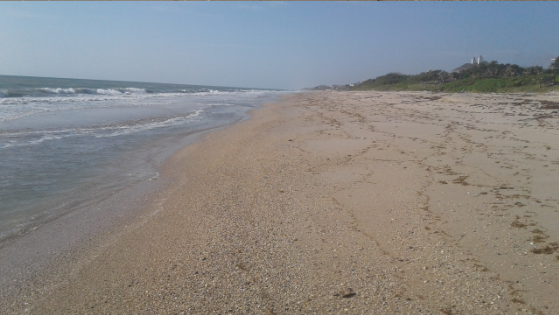
Sorry about the quality of the picture, but my better camera is refusing to upload images.
---
The past two days I found a nicely eroded beaches to detect. They weren't the primary shipwreck treasure beaches that we always think of, but they did provide some enjoyable detecting. I'd rather detect a beach that is cut and producing than a treasure beach that is not. If a beach is producing, you always have a chance of something good popping up even if it isn't a shipwreck treasure.
I had to walk a ways to find the beach I detected a couple days ago, and the next day I figured the other beach might be eroded because of its situation. I hadn't been there for a few years, and I was glad to find that it was indeed nicely eroded when I arrived.
There are a lot of factors you can use to evaluate a beach and whether it is where you want to spend your time, but that is not what I want to talk about now. The point I want to make is that the time you spend scouting around can be time well spent. Although evaluating a site can include many factors, one of the more important factors is the current condition of the beach.
The beach reports that that I share can save you valuable time, but even when the treasure beaches aren't producing, you might still want to do some detecting, and as I often say, there is always some place to hunt and something to find.
Not all of the beaches will be the same. One beach might be terrible, but if you go around the bend it you might find something entirely different. If you start a little early, you might look at a few beaches before you decide where you are going to spend your time.
There are some places that will erode more frequently than others They might have rocks or other obstructions to the flow of sand. Some beaches will even be angled to erode during easterly swells. The more you are out there and the more you look around, the better chance you will have.
---
The expertise of my readership is amazing. Southern Digger has decades of experience and has done a lot of archaeology around South Florida even though he has not always received the credit deserved. You can find his contributions to this blog by using the blog search box.
I always enjoy hearing about bygone days of the Treasure Coast and thought you would also enjoy reading Digger's email.
I always enjoy hearing about bygone days of the Treasure Coast and thought you would also enjoy reading Digger's email.
Always following the TG reports. I noticed the photo of found Chinese porcelain from aside the museum. It bothers me to this day that I used to cut through those exact woods north of the beach cabins to hunt the beach. If I only had knowledge from the Wagners of this site, I would have been better off searching above the bluffs with my old BFO detector which frankly was quite inadequate for the beachside in the wet sand. However, that is all that I had to use in the early 70's. But then again, I was very cautious about not searching above the bluff on properties that I had no business being thereon without permission. If that was not an issue for me then I would have much to show for it today. During those early years I would search Douglas Beach (then, known as Old C.Beach) from the park access and north for two or three miles--beyond where Brooks Park is now located. I recall the entire area was covered with Australian pines and a dirt trail heading northward from the park just behind the dunes. I know because I drove on it in about 1973 and became stuck, despite wide tires on a lightweight Datsun S/W. This was old A1A. I have a photo of that in my album stored away. Also, I recall that Mel's small barge was beached way north of Douglas Beach Park--at about where Brooks is now located. Back then, I would search from Douglas Beach and well north of the beached barge because that is where I believe gold was recovered in close to shore. Therefore, on Thursday, I drove up to Douglas Beach from South Florida, arriving just at daybreak. I donned a poncho and a canteen belt. I searched from just south of the Douglas Beach Access and northward for about 8 hours and 2 1/4 miles carrying a steel water scoop and my Excalibur 1. The saddest thing I noticed today is the lack of a natural beach, all now covered with a heavy dull-colored muddy sand. Nothing was more beautiful about the Treasure Coast years back than the blends of natural colored white and black sand, including debris from an occasional beach side midden. I thought those who allow such dredging destruction should be put in prison for life. Anyhow, I searched wet sand when surf allowed, chasing the waves back down the beach; and, I searched below and above the many small cuts although, they were dredging fill cuts. As you reported, clad coins and occasional fishing tackle was all that I recovered--and mostly from wet sand. I think the flat buttons are interesting, but have never found such on the beaches up there. It was good to see the beautiful surf during the North-Northeaster, but sad to see the shipwreck of an un-natural beach.
Southern Digger
I was recently noticing how some of the beaches have changed over the years and decades. Beaches naturally change, but there are also the changes caused by various projects. I don't know what year it was, but it wasn't too many years ago that the removed the Australian Pines from John Brooks. There aren't many of the old painted signs left that the salvors used to use to get a fix on their position. Many of them were in the trees. Maybe someone can send me an old photo of some of those.
---
It looks like the next several days there will be a three or four foot surf. The tides are pretty flat.
I could have used a west wind yesterday, but just the opposite, there was a rain shore pushing water in where I was trying to work.
Happy hunting,
TreasureGuide@comcast.net