Showing posts with label anchors. Show all posts

Wednesday, June 17, 2020

6/17/20 Report - Florida's Most Collected Gems. Fishing For Treasure.


Written by the TreasureGuide for the exclusive use of treasurebeachesreport.blogspot.com.

Florida Calcite Fossilized Clam Crystals.
Calcite crystals in fossilized clam shells are said to be the most collected Florida gems. I've talked about that and Ruck's Pit in previous posts but decided to make a few photos after finding one of my photos being used by Google or Bing or whoever it was describing fossilized shells.  They didn't give credit either, so they used copyrighted material without any mention whatsoever of the source.  But the photo was good, and evidently useful, so I thought I'd make a few more.


An internet search showed the photo below, which was originally posted in the above post.  It was made using ultraviolet light to show the fluorescence.  It wasn't an easy photograph to capture.  I guess I'll have to learn to label my photos better.

Fossilized Shell With Crystals Photographed in Ultraviolet Light.

Geologyin.com says, The calcite geodes [at Ruck's Pit] were also of special interest, as they had formed as large aggregations of dogtooth spar growing inside fossilized clams (bivalve mollusks) and whelks (gastropod mollusks). As far as is known, this type of dogtooth spar geode is unique to the Fort Drum Mine.  However, I've found them on Treasure Coast beaches. In fact, the one shown immediately above was found on South Hutchinson Island, and it is far from the only one that has been found there.


I even once showed crystals that formed in the hollow of a fossil bone.

Here is one more photo of a crystalized shell that I just took in natural light.

Fossilized Clam Shell Crystals.
---

Here is a link to a good article about the damage done by fish trawlers to shipwreck sites and the items that come up in the nets.

https://www.academia.edu/3597737/Sean_Kingsley_Out_of_Sight_Out_of_Mind_Fishing_and_Shipwrecked_Heritage?email_work_card=view-paper

Here are just a couple examples from that article.


Not only do the trawlers bring up the kinds of things you might expect. like olive jars and pottery, but also heavy and large things like cannons.

---

There is a fairly large statue of a mermaid in the Indian River that is not very recognizable because it is covered with oyster shells.

---
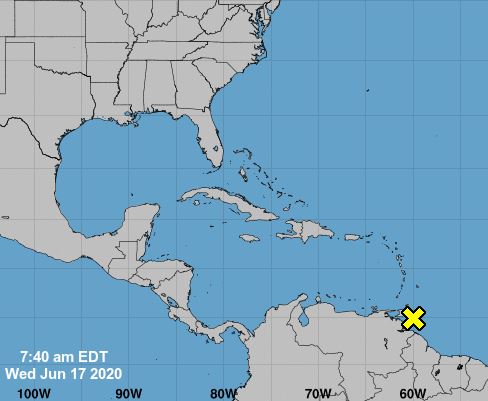


Source: nhc.noaa.gov

As you can see, there is a new system down by South America that could develop.  It is that time of year.

On the Treasure Coast today the surf is very small - only one or two feet.  The tides are not big, and the primary swell is ENE.

Happy hunting,
Treasureguide@comcast.net

Wednesday, February 15, 2017

2/15/17 Report - History of Anchors. The Florida Shore. Lost Cannon Ball. Fact Checking Pre-Columbian New World Maps Article.


Written by the TreasureGuide for the exclusive use of treasurebeachesreport.blogspot.com.

Source: See link below.


I received a number of emails the past few days and received some good information.  Brian B. sent me a link to a Master's Thesis on the history and development of the English anchor.  It provides a lot of good information, including some good information on Spanish anchors too.  If you find an anchor and want to identify it, or if you are simply interested in history and nautical things, you'll want to browse this thesis.  The title is The History and Development of English Anchors Circa 1550 to 1850, by Harold Jobling.  Below is a brief excerpt describing the contents.


You'll also find a good section on terminology and of course a good bibliography.

Here is the link.

http://nautarch.tamu.edu/pdf-files/Jobling-MA1993.pdf

---

Brian also sent a link to a useful book, Living With The East Florida Shore, by Pilkey et al.

Here is one brief excerpt from the online preview.

You might want to look at the table of contents and browse through that one too.  

Thanks to Brian B. 

---

I also received the following email.

My name is Kurt R...   I'm recently new to metal detecting. And am really enjoying your posts.  Lately you have been talking about mistakes and regrets.  About a month ago when we had that last storm that exposed the sandbags at turtle trail I had just got there and was having trouble with a failing coil... I had a large target and i;m pretty sure it was a cannonball in my haste to fix my detector i threw it up on the beach and fiddled with my detector for a bit when i went to grab the object it was gone.. If you could please post and see if anyone reading has it and would like to return it.. Best find i've ever found lost again? I should have taken it right to my truck but i was frustrated..  

Sincerly,
Kurt R...


---


I  posted a link to an article on Pre-Columbian maps of the New World in my 2/8 post.  Dan C. provided some links showing that the author, Dr. Thomspon, is not very credible.  

Here is what Dan wrote about that.


... Unfortunately, in treasure hunting and archaeology (and history), we have to be on the lookout for "fringe" science and lunacy.

As it turns out, this Dr Thompson has no qualifications in the field - his Phd is in some unrelated field, BUT, qualifications aside, even non-Phd folks deserve respect if they make sense.  This guy is a fraud and lunatic through and through:

Here he claims to "authenticate' a so-called ancient Chinese world map that has been clearly dismissed as bad forgery, a hoax:

http://www.1421exposed.com/html/wade_challenge.html

There have been a lot of people who write books to make a living off of the gullibility of others, and he is one of them.

Keeping an open mind  is healthy. We should not blindly follow assumptions by others who claim to "know".


Thanks much for the research Dan.


---


I very much appreciate the emails I receive and want to thank everybody.  Your input helps me a lot, as you can tell from today's post.

I hope your wife bought you a new detector for Valentine's Day.

We still have more one and two foot surf days coming this week.

Happy hunting,
TreasureGuide@comcast.net


Wednesday, December 14, 2016

12/13/16 Report - Treasure In The Indian River Lagoon.


Written by the TreasureGuide for the exclusive use of TreasureBeachesReport.blogspot.com.

There has been at least one Exploratory lease in the Indian River Lagoon.  As far as I know, not much was found in that lease area, however there is evidence suggesting the possibility of wrecks in the river. 

We know that just south of the nuclear power plant a large piece of an old wreck was found in the river.  Some think that it might have washed over the island during a storm.

I can't imagine that there are no old wrecks in the river.  There has to be.  The question is if there are any treasure wrecks there.

Caches of Spanish reales have been found west of the Indian River, such as those found when a bulldozer uncovered a large cache while clearing a site for the Sebastian Walmart.

How did those cobs get there?  I don't think anyone knows how they got there, but I think they must have crossed the river at some time.  Who moved them or when remains unknown.

I imagine that the Spanish salvage crews used the river for many purposes.  As in later times, the transportation would have provided easy transportation.

My thinking is that there has to be some treasure in the river.  Any treasure that might be in the river would probably be more scattered and harder to get to.

I've been told by the guys that build docks on the river that the sand is about six feet deep near the western edge of the river.  That is a lot of sand.  There is also a LOT of junk in the river.  Whether it is centuries old or not, there has to be shipwrecks and some amount of treasure in the Indian River.

Part of what appeared to be an old Spanish shipwreck was found in the river.  There are other rumors of wrecks in the river.  Items found in the river or on the banks also suggest the possibility of wrecks.

I've heard of or seen various nautical items found in the river or on the banks.  Besides native American artifacts and 18th century buttons and anchors and other nautical items, I know of about a half ton of lead ingots that were  found along the river.  I don't know how old those might have been. Where the ingots came from is anyone's guess.  They could be old or more recent.

Although I've done a little (very little) research, I've not found any newspaper articles reporting steamships or other wrecks in the river either Indian River or St. Lucie County.  Perhaps there are some, but I haven't found them.  Maybe someone can point me to some that they have found.  I'd appreciate that.

As we know, the inlets have changed position from time to time and there were times when inlets opened or closed for a period of time.

We also know that the inlets were dangerous and were near impossible to enter at different times.  We know, for example, how the army payroll was lost near the old inlet.  Not only were the gold coins from the army payroll found, but also a number of muskets that were found.

There are also reports of buried treasure along the Indian River, such as that found many years ago at Sewalls Point.

Some old items were dredged up onto the spoil islands at one time.  One spoil island in the Vero area is known for the fossils that are found there.

Just after hurricane Matthew the east side of the river along A1A was damaged opposite the McLarty museum.  I made a mental note of that, but never investigated it any further.  I wish I had taken a photo.  Maybe it hasn't been totally repaired yet.

Much of the east border of the river is artificial and there are tons of sinkers and a lot of trash.  That is a problem, but a few old items have been found along the east side.

Remember any old artifacts found in the Indian River are the property of the state of Florida.

I'm sure there is a lot of history in the Indian River that we'll never hear about.  If you have any old newspaper articles or other documentation of treasure in the Indian River, I'd like to hear about it.

---

We had a beautiful full moon last night.  We also had some nice low tides.  The surf is small too.

Happy hunting,
TreasureGuide@comcast.net

Tuesday, August 21, 2012

8/21/12 Report - Hurricane Maybe Heading Our Way & More On Anchors


Written by the TreasureGuide for the exclusive use of treasurebeachesreport.blogspot.com.

Calm Seas on Treasure Coast This Morning.
The big news for me today is tropical depression number 9.  It could become a hurricane by Thursday when it will be south of Peurto Rico.  After that, it is expected to work its way West, passing below Haiti and then over Cuba.  It could also turn north towards us.

There is also another area that could turn into a good storm right behind that.  And a distrubance down in the Gulf by Mexico that could form.

Despite all of the activity out there, the seas along the Treasure Coast are still calm.  See photo. 

There is good visibility for snorkeling today.  Low tide will be about 5:30 PM.

The surf web sites are predicting increasing seas this weekend, reaching 5 to 8 feet by Monday.

We haven't had anything like that for quite a while.


After all of  the news about the recent anchor discovery on the Treasure Coast, I wanted to find a good source that would help people identify different types and ages of anchors.  I didn't find much of anything that I found real helpful until I found the following study.  

It is a thesis on the history and development of English anchors from 1550 to 1850 written by Harold Jobling in 1993.  It focuses on documented anchors found on British wrecks but also includes a lot of information on Spanish wrecks of the same era.  

It is a great study of about 150 pages and includes illustrations, sources and many useful bits of information.  The biggest problem you might find with this study is that it isn't easy reading.  It is very technical and can't be absorbed in one quick reading.   On the other hand, if you really want to know what you can learn about anchors, you must read this.  I certainly learned a lot from quickly browsing the study and plan to go back and read it more thoroughly.   I think I now have a good chance of telling the difference between a 17th Century British anchor and a 17th Century Spanish anchor.

Just as an example, the hole through which the ring was attached at the top of the anchor on British anchors was usually punched, while the hole on Spanish anchors of the period was typically made by looping the bar and  welding.  

Spanish anchors also generally had a longer thinner bar.  They often failed because of the design and how they were manufactured.

http://nautarch.tamu.edu/pdf-files/Jobling-MA1993.pdf

You might have trouble loading this PDF file if you don't have the latest Adobe Reader software, and even then it will probably be slow.  It is worth it if you are interested enough to work your way through all of the technical detail.  I found many interesting facts.


The Terra Nova, a three masted sailing schooner, was discovered off of Greenland.

Here is the link

http://www.bbc.co.uk/news/science-environment-19288188


Keep watching.  We might actually see improved beach detecting conditions before long.

Happy hunting,
TreasureGuide@comcast.net