Showing posts with label antique. Show all posts

Saturday, February 2, 2019

2/2/19 Report - More Metal Detecting Reports From Around the Treasure Coast.


Written by the TreasureGuide for the exclusive use of treasurebeacheserport.blogspot.com.

Antique Furniture/Upholstery Screw and Red Sea Glass Finds
Finds and photo by John L.
John L. was one of the guys that hit John Brooks beach early Thursday.  He then went down to Frederick Douglas, where he found these two items.

He is now most curious about the red glass.  After some research he found that it could possibly be hundreds of years old.
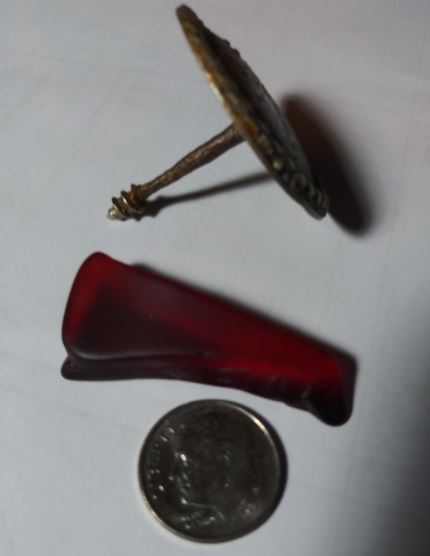
Same Treasure Coast Finds by John L.

He now believes the red sea glass is "gold ruby glass," which could be hundreds of years old.

He thinks the furniture screw could be a replica.  It does look in very good shape.

He found the following information relative to the red sea glass on the Corning Museum of Glass website.


"Gold ruby is arguably one of the most beautiful colors of glass. Beyond its aesthetic qualities, there is an alchemical connotation: Since ancient Greek times, descriptions of the sorcerers’ stone agree that it was believed to be a red substance and the key to the transmutation of metals, principally the making of gold (Ganzenmüller 1937;  idem 1956, pp. 85–128; Kerssenbrock-Krosigk 2001, p. 13). Whoever discovered how to color glass red must have thought himself to be on the right track to attaining the ultimate goal of alchemy. The 10th-century Persian physician and philosopher Rhazes (about 865–between 923 and 935) apparently believed that he had already fulfilled that objective. In his formula, the earliest known written account of a gold ruby glass, he stated that this glass attracted gold and silver like a magnet, and that it could convert 1,000 times its weight into gold. 1

About 800 years later, enthusiasm for gold ruby was at its peak. As far as can be determined from the legacy of princely treasures in today’s public collections, almost every central European sovereign seems to have owned one or more gold ruby glass vessels. This high point in the popularity of gold ruby glasses was confined to a relatively brief period: between about 1685 and 1705. It was preceded by a long history of developments that culminated in the production of large vessels that glow in a deep yet translucent ruby color. At its height, gold ruby glass was apparently considered to be not just another decorative folly but a genuinely new and precious material. It was ranked about as high as hard-paste porcelain, which came into production in Europe only a few decades later. During the 18th century, interest in gold ruby persisted in some regions and occasionally arose in others, but it never regained the widespread appreciation that it had engendered earlier.


The history of gold ruby has many beginnings. Red glass of some sort was produced almost from the time that glassmaking began. Knowledge was gained and then lost, and while there were rediscoveries on several occasions, this glass does not seem to have been produced again until it was revived in Brandenburg in the late 1670s and 1680s. It is here, with the arrival of the alchemist, pharmacist, and glassmaker Johann Kunckel (1637?–1703; Fig. 1) in early 1678, that the real story of gold ruby glass begins...

Interesting finds.  Thanks John!

---


Russ P. has done a lot of inland hunting, and found thousands of silver coins, was out to the beach this past week.  I've posted some of his research.

Here is what he had to report.


… I checked most of the known treasure beach access points from Sea Grape north, but only got my detector out at Bonsteel, with only a few trash finds. All the rest of the beaches seemed to have deteriorated from yesterday, in my opinion, with a lot of sand deposited at the base of cuts. Based on what I saw today, I don't think any of the cuts got close, at any point, to the size seen at John Brooks.

On the bright side, it was a beautiful day at the beach. I stopped at Melbourne Beach on the way home. It actually looked the most promising with a firm slope with black sand below a two foot cut. There were two other detectorists at the beach on my arrival. I have very little overall beach experience, but I found the coin line quickly. There weren't many coins, but it was stretched out over several hundred yards. There was no trash in the coin line. It was fun to put all the theoretical knowledge learned in this blog to good practical use. It really works!

Also, the Equinox 800 was superb. The coins were all six inches deep minimum, but gave strong signals. There was virtually no falsing, either in black sand or transition from dry/wet sand or vice versa. I picked up some very small pieces of fishing lures the size of earring backings. I was very impressed...


I've now heard from people from Juno to Melborne.  Various spots along the way eroded to some extent.  I haven't heard from Jupiter yet.

Although Russ hadn't done much beach hunting, he was able to apply what I've said about coins lines and quickly found one.

No matter if you walked away from the beach last week with a bunch of finds or not, you should walk away with some good new information.   Always be learning.

Depending upon how you define the Treasure Coast, it is around a hundred miles, more or less, long. That gives you over 5 million square yards of beach to scan.

Only a relatively small amount was actually detected, even if some beaches were hit by dozens of detectorists.  Many areas were just too far from the beach access for most people.  There are a lot of good spots that are far from the access.  Some of those will continue to hold good targets even after some of the other beaches fill in.

With the smaller surf, some areas (mostly higher on the beach) of the more productive areas will remain basically as they were a few days ago.  I know that there are coins just laying there still waiting to be detected.  I could get into that more some other time, but people tend to conclude it is all over just because the hottest of known spots have deteriorated.

We'll just have a two to four foot surf for a few days.

Happy hunting,
TreasureGuide@comcast.net


Saturday, March 17, 2018

3/18/18 Report - Tips for Estimating the Date of Jewelry. SB804 and HB631. Five Days of Detecting Back In The Day.


Written by the TreasureGuide for the exclusive use of treasurebeachesreport.blogspot.com.


Source: MyClassicJewelry.com link below.


I often get emails asking if finds might be old, and we try to identify and date finds all the time.  When it comes to jewelry, it is very difficult to provide an age for many items.  Many jewelry designs and functional features have been used or centuries.  Nonetheless, there are some things you can look for that might help you narrow down the age of an item.

I found one very helpful web site on vintage and antique jewelry that presents some very useful information.  One illustration from that web site can be seen above.  You can see different clasp types from three different periods.

Here is the link for more of that web site.

https://www.myclassicjewelry.com/blog/vintage-jewelry-hardware/

There are other good web sites on the subject.  The following list came from a good web site on necklace clasps.


There is more on that web site.  The above is just a small sample.

Here is that link.

http://blogs.houseofgems.com/index.php/2014/10/dating-vintage-necklaces-by-their-clasps/

I"m sure you can find other good web sites that can help you date jewelry finds.

---

In a previous post I referred to an article about Florida SB 804, which, according to the article, would allow beach-front property owners to restrict public access to the beach in front of their property.

See http://www.mynews13.com/content/news/cfnews13/news/article.html/content/news/articles/cfn/2018/3/11/residents_fighting_b.html.

After originally posting that article, I was told by a trusted source that the bill wouldn't do what the article claimed.  Then I received more emails about the danger of the bill.  Not wanting to become either a community organizer or legal analyst, and not being able to decisively unravel or provide a definitive conclusion to the matter, I'll provide just a few comments today and then get back to the normal business of this blog.

Among the things I was was told is that SB804 was “tabled, but that a similar bill, HB631, was on the Governor's desk.  After looking at the text of HB631, and without being able to determine the legal meaning of many of the terms for myself, here is what I decided to do.  I contacted the Florida representative for my district and sent him an email asking for clarification on HB631 and told him I was strongly opposed to any legislation that would restrict public access to the beaches.  That seems to cover it for me regardless of what SB804 or HB631 says or doesn't say.  I expect his interpretation, if received, will be skewed according to his political leaning, so that will be of limited value, but I did express my feelings.   Now it is up to you.

This post will replace any previous comments I made on the subject and will most likely be my complete and final post on the bills.

Here is a link you can use to find your Florida government representatives.

MyFloridaHouse.gov.

---

I've talked about my old detecting records before.  I just noticed an interesting five day span in which I found five gold rings at four different locations.  I must have had some time off.

On 5/26/89 on Lower Matecume Key I found 14K band marked 1988.  Someone didn't have that one long.  I was using a modified Nautilus 571 at the time.  That was one of my all-time favorite detectors.

On 5/27 there was a 16 dwt 1970 U. M. class ring found at Crandon Park and a interlocking silver and gold rings.  You could usually find some gold there but it wasn't usually of high quality.

On 5/28 the find was thin gold ring with the initial J at Bill Baggs park.

On 5//29 it was a gold ring with small diamond found at Jupiter Inlet Park.

On 5/30 the find was a 1967 class ring (didn't record the school).  I find it strange that I made the hour long trip to Jupiter two days in a row.  The conditions there must have looked OK.

None of those days was big, but each one produced a little gold.  It looks like I was ranging farther than usual for some reason.  The only day of the five that I remember the finds is 5//27.  I remember exactly where those finds were made.  The life guard stopped me after less than an hour of detecting.  He said that detecting wasn't allowed in the park, so I put my detector back in the car and left.
However, the next day or so, I called the Dade County Parks Department, and they told me that they were going to lift the detecting ban at the park very shortly.  And they did. 

I also talked to them once about a beach club on Key Biscayne that was telling me I couldn't detect in front of the club.  The county told me that I had every right to use the beach back to the erosion control markers.  That sand is paid for by the tax-payers and the tax-payers should remember that.

Happy hunting,
TreasureGuide@comcast.net

Monday, July 13, 2015

7/13/15 Report - Explanation Of Flip-Ups. Dating A Coca Cola Bottle. Palm Beach Island Detecting.


Written by the TreasureGuide for the exclusive use of treasurebeachesreport.blogspot.com.


Straight Side Fort Pierce Coca Cola Bottle.


Yesterday I gave you a link to a web site that lists the start dates of various Coca Cola Bottling Companies.

Here is an old straight-side Fort Pierce Coca Cola bottle that I found over a year ago.  I just cleaned it up a bit.

Unfortunately the top is badly damaged.

A few years ago I found and sold a West Palm Beach straight-side Coca Cola bottle that was more damaged than this one, and it sold for over $100.

The reason I am showing this one today is to show you the relevance of the link I gave you yesterday.

That site says the Fort Pierce bottling company began in 1914.

KovelsKomments says, Straight-sided glass bottles were used by Coke bottlers from about 1903 to 1916-17, when the now-standard Coca-Cola bottle was introduced.

That narrows the date of this bottle down pretty well.

It would be 1914 - 1917.

That is pretty good for a bottle that doesn't have much else that would give you the date.


---

I was thinking about what Clint L called flip-ups.  Those are coins or other objects that get flipped up and over a cut and settle just behind the cut.

There are times, when I think it appears that objects have flipped up but when there might be another explanation.  There are times when a layer of shells is deposited, and a few other things might be in with the shells.  The beach then cuts through that deposited layer leaving some of the layer behind the cut.  That happens with some frequency.

I know one detectorist who has found most of his cobs by hunting a thin layer of shells laying right behind a cut.  He thoroughly hunted one such area daily and found a good number of heavily worn half reales.  I found a few in the same location.  These were small half reales about the same size as some of the shell pieces.

Actual flip-ups do happen though.  Clint described one case, as did Bill P., and I've seen it myself.  In the case I recall best, a coin was resting on a slanted slab of sand that had just been separated from the face of a small cut.  It appeared to me that the coin had been in the sand that was being eroded.  That could have left the coin in a very peculiar vulnerable position on a slanting and very irregular surface.  It was definitely not settled into the sand.  I can't recall it in any more detail than that.

The illustration above shows what I think probably happens.  An object is laying on or in loose sand in front of the cut.  A wave crashes at the foot of the cut and splashes forcefully up, throwing any vulnerable objects.

When beaches are cutting a lot, water will be crashing right on the cut.  Waves can hit a cut very forcefully, splashing up.  I'm sure you've seen it.  The loose sand near the foot of the cut will direct the water and force up and back.

I've decided to make a distinction between flip-ups, like those I'm talking about today in which an object must jump up at least a short distance, and coins or objects that flip over but do not really jump - not much more than the length of the object itself.

Flipping coins are very common, but most of the time they do not flip very far at once  I remember watching a coin flip the last time I was on the beach.  In that case, I had just dropped the coin.  Before it had settled into the sand a rush of water came by and it flipped over.  Immediately after that rush of water went by, it settled.  The next couple of very small waves put a thin layer of sand over the coin, after which it did not move.

Anyhow, I wanted to distinguish between flip-ups, which flip good distances (I might start calling them jumps or something like that) from flips, which are much more common and less surprising.

I think flip-ups, or jumps, might happen

---

Photos by Penzfan.


Tony (penzfan) got this nice photo while hunting on the Palm Beach island the other day.

He found, One .925 ring, One Copper Bracelet, One Snake Ring, One Russian Ruble and some clad.

Below is a photo of his finds.


---

I need to update my treasure site link list.  If you find a link that no longer works, please let me know.

---

No significant change in beach conditions on the Treasure Coast again.  Expect very smooth surf towards the end of this week.

We've been having some nice low tides.

Happy hunting,
TreasureGuide@comcast.ent

Sunday, May 3, 2015

5/3/15 Report - Nice Antique Schickerling Silver Case Found. Beach Conditions Update. Find Photos.


Written by the TreasureGuide for the exclusive use of treasurebeachesreport.blogspot.com.

Find and photo by Dan B.
Another view of the same object.
Photo by Dan B.

Here is a real quality piece found by Dan B.

Congratulations Dan!

It is stamped
Alfred Schickerling jewelry co. 51 Maiden Ln., New York.

I would say it is most likely silver.

In the picture on the left you can see two hinges at the top.


At the bottom appears to be a knob for opening it.  At first I thought it probably held either a picture or a mirror.

The picture on the left below shows the Schickerling stamp on the back of the above item.

Alfred Schickerling Jewelry Co. Stamp.
Photo by Dan B.
Silver Card Holder Made by
Alfred Schickerling.


I did a little research on Alfred Schickerling.  It seems one of his specialties was silver cases.  He obtained a patent for a personal identification card holder in 1927.  He also made lockets and other small cases.

The silver card holder marked 1917 was for sale on the internet.

Schickerling also did other things.  He filed for a patent on a lap robe, for example.

It seems he was very active in the early 1900s.

---

I went out to the beach this morning to see what was going on.  I sampled a few beaches along an eighty mile stretch.  My camera batteries were dead so I didn't get photos.

I didn't really care for the direction of the waves.  I expected them to be more from the north. They were almost directly from the east.

I did find one nice long cut which at its highest was about two feet.  That was the only one of that size.

Other places I found scallops with very little cutting.

Most places were still mushy and very poor looking.

The high tide did make it over the berm in a few places.

Any cutting is welcome these days, yet there is no significant change in beach detecting conditions. The few cuts are near the high tide mark and will only produce modern coins and items.  It will take a lot more to get to the old stuff.

-----


Here are a few of my old find photos that I mentioned the other day.  I made them once a week or sometimes every two or three weeks, depending upon how fast they accumulated.

When I first started detecting I looked primarily for coins and kept good records on the number and type of coins found.

After a while, I started to target gold jewelry items and quit keeping track of the coins.  I started to photograph gold and other interesting finds on a periodic basis.  Like I said the other day, I wish I had put more information on the finds, such as date and location.

It surprises me when I look at so many of the items and can remember the find and exactly where they were found.

I just threw a few photos on the flatbed scanner.

I'm not really much interested in hunting modern jewelry these days, but do it when beach conditions are poor, which has been most of the time lately.

---

We're supposed to have a couple more days of five or six foot surf.  Later in the week the waves are supposed to be more out of the north. 

At this point I'm not expecting a big change in conditions.

Happy hunting,
TreasureGuide@Comcast.net

Thursday, December 11, 2014

12/11/14 Report - A Variety of Really Nice Recent Land Finds. Take A Look.


Written by the TreasureGuide for the exclusive use of treasurebeachesreport.BlogSpot.com.


Find and Photo by Dan B.
Here is a cool find by Dan B.  It is an antique toy Texaco railroad tank car. 

It has several things going for it as a collectible.  It would be of interest to old toy collectors, railroad enthusiasts and those interested in petroliana. 

That wasn't all Dan found, but it is one of my favorites.


Here are some more of Dan's finds at the site.

Miscellaneous Finds by Dan B.

Here is a photo of some of Dan's finds.  Notice the toy tank car near the brown bottle at the top left.

Also, there are a couple of embossed pepsin syrup bottles.

Some of the small metal objects look interesting too.

Here is one of those.   


Find and Photo by Michael E.
Michael E. has been doing a lot of land hunting around the Treasure Coast area and making a lot  lot of interesting finds.   Here are some that he listed -  1909 wheat non Vdb, 1905 Indian, a dozen smaller buckles and suspender clips, shield fob with the outline of where a swastika was attached. 1932 Washington hatchet stick pin, amid some other brooch and hat decor.  Concerning a backyard hunt by he and William M., Micheal said, it seems like we dug hundreds of bullets. William recovered a 1902 Indian, and I recovered a version 2, currently unable to see date shield nickel.

To the left is one of those finds.  Very nice.  Congratulations Michael!

And below is a FOB with the imprint of a swastika.  Again, very nice find Michael.  Congratulations! 

I wanted to show some of the older things that people have been digging around the Treasure Coast.  I planned on posting some of these earlier but had to show the big waves yesterday.

Find and Photo by Michael E.
Happy hunting,
Treasureguide@comcast.net


Friday, March 7, 2014

3/7/14 Report - Hidden Historic Florida Area, Dog License Tag Collectibles and More On the Ten Million Dollar Gold Coin Cache


Written by the TreasureGuide for the exclusive use of treasurebeachesreport.blogspot.com.

Source of photo: Link below.
Do you know this place?  It isn't on the Treasure Coast and it isn't known by the many, yet it is in Florida and a nice quiet place to visit.

It is a park, and there is no fee.  Perfect for a day trip or a little outing away from the big city crowds.

There are a number of out-of-the-way places from Florida's past that you can visit.


Here is a link for more about this place.

http://www.floridasprings.org/visit/map/suwannee-springs/


People collect almost everything it seems, but did you know there are people who are avid collectors of dog tags.  I'm not talking about military dog tags.   Sometimes a good term to use is animal license tags.

You might be surprised how long dog license tags have been used.

Dog License Tag Found While Beach Detecting
Dog licenses and the practice of taxing tags have a long and international history. Dog licenses were documented in Utrecht, Holland, as early as 1446, and there is evidence that dogs were taxed in Germany by 1598. One of the oldest known surviving dog licenses dates from 1775 and is from Rostock, Germany. The oldest known American dog license tag is an 1853 Corporation of Fredericksburg (Virginia) medallion.

The source of the above is text 

 http://thebark.com/content/collecting-antique-dog-tags

It is a very nice little web site that will get you started.

I can certainly see how dog tags would make nice collectibles.  They come in different shapes, are made of different metals and may present a lot of information such as location and year.

This dog tag is nothing special, just an example of a find.   I haven't found many dog tags while detecting because I mostly detect beaches.

Of course, where you detect will determine what you find.  You will occasionally get a few surprises though.


One of the bigger treasure stories of recent days is the story of the ten million dollar gold coin cache that was uncovered in California.

The following linked article says that many people wrote saying that the cache was theirs.  That will happen when something of value is found.  You always have people who are willing to claim anything of value whether they have any right to it or not.

I've warned you all about that before.  Take steps to make sure that any claimants are the real owners.

The cache find also gave rise to many theories.  One is that the cache was linked to Jesse James, which turns out to be doubtful.

Here is the link to that article.

http://www.theguardian.com/world/2014/mar/05/california-10m-gold-coin-cache-rush-of-theories


On the Treasure Coast today the surf is supposed to be a touch higher, up to around five feet.  The wind is from the west though.   The increased surf isn't predicted to last long.  Don't expect any major changes in detecting conditions.


I'll get back to my series on beach dynamics sometime before long.

Don't forget the club hunt this weekend.


Enjoy the wonderful weather.

Happy hunting,
TreasureGuide@comcast.net

Monday, December 24, 2012

12/24/12 Report - Wishing a Blessed Christmas to All


Written by the TreasureGuide for the exclusive use of treasurebeachesreport.blogspot.com.


Vintage Christmas Card From 1910.


The above card is an actual Christmas card that was sent in 1910.  Unlike most of today's Christmas cards which open, this one, and many like it from the period, are more like a post card even though they were sent in an envelope.  Today it will serve as my Christmas greeting to each and everyone of you who read this blog. 

If people weren't interested in this blog, I would have given up on it some time ago.  I am always glad to hear from any of the many fine readers of this blog. 

Everybody is busy and there are a gazillion things you could look at on the internet.  For anyone to chose to spend their time on this blog as opposed to the millions and millions of other choices is a real compliment.  I notice that the blog will probably reach half a million hits some time in January.

I left yesterday's post on a little longer than usual for a few reasons.  One is that I wanted to make sure that people had a good chance of reading it.   It speaks of one thing that I think is especially important about detecting and that can easily be missed or forgotten.  I also thought it was especially fitting for the Christmas season, which is a good time to reflect on family and some of the more important things in life.

I received some emails in response to that post and was gratified to hear that people appreciated it and got that aspect of the detecting hobby.

Treasures do indeed come in many forms - the best are not physical at all.  Sharing time with friends and making new memories are among the better ones.   Physical objects point to something deeper and more enduring.  Maybe you got that point from my last post.

Like I said, the card above was an actual Christmas card.  It was sent to my grandfather.   I don't know how I acquired it now, but I always had an appreciation for old things and wanted to preserve them.

I often show a variety of types of treasures and discuss how they can be valuable.  This type of treasure (ephemera), like other types of treasures usually provides clues.  On the envelope that this card came in, there is an address, which since I know that the card was sent in 1910, points me to an old home site that might be a good detecting site.  I know that it goes back at least to the early 20th Century and probably earlier.

As I often say, treasures will often provide a clue or point you to other treasures.  Don't neglect ephemera as being potentially worth something economically, but more importantly, as a possible source of clues that can point you to additional treasures.

Here are a couple of Christmas cards from the same time period with their envelopes.  Notice the colorful fancy designs inside the envelopes.  Again, both are addressed and provide clues to an home site that has to have some age to it.


Antique Christmas Cards With Original Envelopes.

 
Always look for clues to good detecting sites.  Old books, postcards and other old paper products that can provide good clues.  If you don't know where to find good clues like this, keep your eyes open in antique stores, maybe while you are shopping for Christmas gifts.  You can find them in thrift stores too.  You don't have to buy them.  Just browse and take down notes.

I just realized that I didn't follow up on my previously mentioned topic of visualizing the past.  I'll have to get back to that some other time.


On the Treasure Coast the surf is back down to around 2 - 4 feet, and will be decreasing a little again.  I haven't been out to the beach much for personal observations.  I've been busy but will try to get some beach photos soon.

Low tide will be a little after 11:15 AM on Christmas Eve.


Have a blessed Christmas.
TreasureGuide@comcast.net


Tuesday, June 26, 2012

6/26/12 Report - Old Florida Maps & Tropical Storm Debby


Written by the TreaureGuide for the exclusive use of treasurebeachesreport.blogspot.com.

Antique Map showing Fort Capron and The Old Indian River Inlet
There are a lot of antique maps that can be found online.  This is a portion of a map showing the location of Fort Capron and the old Indian River Inlet.

The inlet shown here is now closed and is north of the present Fort Pierce Inlet and just north of the location of the Wedge Wreck.

The old inlet is also the area where the gold coins from the lost Fort Capron pay roll were found.

You can match up some of the islands and features on more modern maps and that will give you the location of the old inlet and fort.

Here is a link to the entire map as shown on the University of Florida map collection web site.


A few days ago I published a description of how James F. does research that helps him to find things like the steamboat strap that I also showed.  Old maps can be a nice part of any research effort.


Below is an old map of Cedar Key.  Isn't that a great example!  That type of image provides a 101 clues for detecting.


Old Map of Cedar Key


You can find the original digital image of this map on the same University of Florida web site listed above.  It has a lot of great detail.  Just plain fun to look at.

They have some other Florida maps that you might want to look at too.


The center of Tropical Storm Debby is near Appalachicola.   On the Gulf Coast Debby is producing rip currents and beach erosion with wind up to 50 mph.  Large waves with storm surges up to 5 feet are possible around  the area of Apalachee to Wacceasassa Bay.

On the Treasure Coast it is more south winds and rainy weather.  We're on the wrong side of this one.  Expect calm seas, down around one foot.  Of course that means no significant improvement in beach detecting conditions over here.

Here are a couple links for more details on Debby.


http://in.reuters.com/article/2012/06/26/usa-storm-debby-idINL2E8HQ0DF20120626


http://xfinity.comcast.net/articles/news-national/20120623/Tropical.Weather/?cid=hero_media


Happy research leads to happy hunting.


Happy hunting,
Treasureguide@comast.net