Showing posts with label sea glass. Show all posts

Thursday, June 25, 2020

6/25/20 Report - Treasure Coast Historic Places - Fort Pierce Casino and Sea Mist. Some Recent Fossil Finds.


Written by the TreasureGuide for the exclusive use of treasurebeachesreport.blogspot.com.


Fort Pierce Casino
Submitted by GM.

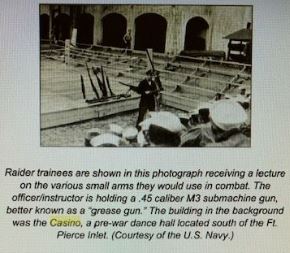
I received the above postcard image of the Fort Pierce casino from GM, who also sent the following picture of the casino being used during WW II. That caption refers to the casino as "a pre-war dance hall located south of the Ft. Pierce Inlet."


Thanks GM.


Nick, who sent the following pictures of the casino said, The casino was right where you make the left curve into ty he now jetty parking lot. 


Fort Pierce Casino (Bottom Right)
Submitted by Nick.


Fort Pierce Casino
Submitted by Nick.

Thanks Nick.
---


Guapo (GM) also sent me the following photos and captions showing the Sea Mist.  Sorry if it is a difficult to read, but you can see the original source - the Vero Beach Press Journal.


Thanks again GM.

---


Recent Beach Fossil Finds by Timothy M.
Photo submitted by Timothy M.

Timothy M. recently found the above fossils and sent the following message.


Hello again. My wife and I were out around low tide Monday afternoon just walking some beaches cleaning up trash and doing some eyeballing. She has an eye for sea glass and picked up a few nice greens. I had been talking about fossils when just north of middle cove I found a small bone with a joint, leg, wing? Little later on at the north end of Walton rocks, she found this nice dark black bone fragment with visible marrow! She trumps me again.

Your blog always encourages people to think above lost human treasures. We had a great time wondering about the origin of these obviously truly ancient objects.

Once again thanks for sharing your knowledge and joy of discovery.

Thanks for sharing Timothy.  Glad you enjoy the various types of treasure that can be found on the Treasure Coast beaches.

---

On the Treasure Coast the surf is still small, but we have some negative tides.

We are getting some dust from the Sahara dust storm.

Happy hunting,
TreasureGuide@comcast.net


Wednesday, May 1, 2019

5/1/19 Report - Florida Fort Found. Antiquarian Book Treasures. Victorio Peak. Numismatics.


Written by the TreasureGuide for the exclusive use of treasurebeachesreport.blogspot.com.

1615 Bible Stolen and Recovered.
I used to be amazed by the valuable treasures that you could find on the shelves of lending libraries.   Library staffs were not always aware of value of some of their books.  Back twenty or thirty years ago I noticed a very old book of Durer prints that was very valuable on the shelves of one library.  Someone was making photocopies of each of the valuable full-page Durer prints.  They evidently knew they were of value, but in the process of spreading the prints out on the photocopier were damaging the old book. I hated to see valuable antiquarian books like that being ruined.

It would have been easy for anyone to walk out of the library with an antique book worth tens of thousands of dollars and never return.  If they were to be charged with late fees, they could have probably paid a ridiculously low fee for "losing" such a rare book.  I was amazed that such books were on the shelves and that they didn't disappear.

The Bible above was part of the $8 million dollars of books stolen by one group, including an library archivist so I guess that some of those old books did disappear.  The stolen Bible shown above, and printed a hundred years before the wrecking of the 1715 Fleet was recovered in the Netherlands.

I noticed a rare collection of valuable books at one local library that was going to get rid of the entire collection of valuable books for essentially nothing.  I told one librarian what they were worth and that they should be saved.  Several of the books were worth hundreds, and a few, thousands of dollars.

Here is the link for more about the stolen and returned Bible.

https://abcnews.go.com/Entertainment/wireStory/400-year-bible-stolen-us-found-netherlands-62627071

---

Hurricane Michael uprooted trees in north Florida and revealed artifacts from 'Negro Fort' where 270 escaped slaves died.


Here is the link for more of that story.

https://www.tallahassee.com/story/news/2019/04/27/hurricane-michael-unearths-artifacts-historic-apalachicola-river-negro-fort/3472717002/

I always like to check in the roots and in the hole created by uprooted trees.

---

I posted a link the other day to the Doc Noss Victorie Peak treasure story.  Here is another.

https://dailyoddsandends.wordpress.com/2014/03/29/victorio-peak-treasure-milton-doc-noss-biggest-con-of-the-20th-century/

Thanks to Norbert B. for that link.

---

Here is a great video and discussion of some of the earliest ancient coins ever created.  It is very educational.

https://coinweek.com/ancient-coins/watch-talking-ancient-coins-with-mike-beall-and-mike-markowitz-part-i/

---

I once created a video while I walked along a good shell line and picked up a sea glass and fossils that I saw.  It wasn't a very good video.  It was my first attempt at doing something like that and every time I bent down to pick up a piece of sea glass the camera didn't catch a good picture of the item I picked up.  If you wanted to get a real good look at the find, you could stop the video and get s somewhat better look at it.

Yesterday I got notice of a comment on the video.  The comment was, "Horrible video."  I wouldn't argue with that.  My reply to the comment was, "Thanks. Great comment."

Another person had commented on the video a long time ago, and said that I was being intentionally evasive and I "wasn't fooling anybody."  I think I fooled him, but not intentionally.

I don't know what those people were looking for, but I  suspect the second person wanted to gain something from the video that he failed to get from it.  He was evidently unhappy about that.  People reveal a lot about themselves from their comments.

Those are the only two comments that the video received over maybe a year or so.  The video did get a lot of "thumbs up," and almost as many "thumbs down."  Some people evidently got something out of the video, and some people didn't.

Rightly or wrongly, I expect treasure hunters to be able to take advantage of small signs, and anything that might be provide a hint or clue.  I don't think a treasure hunter of any type should expect somebody to tell them exactly where to go and where to dig.  That would not be treasure "hunting."

Happy hunting,
TreasureGuide@comcast.net


Saturday, February 2, 2019

2/2/19 Report - More Metal Detecting Reports From Around the Treasure Coast.


Written by the TreasureGuide for the exclusive use of treasurebeacheserport.blogspot.com.

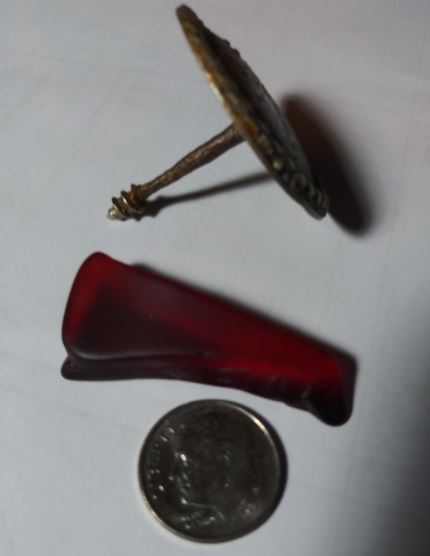
Antique Furniture/Upholstery Screw and Red Sea Glass Finds
Finds and photo by John L.
John L. was one of the guys that hit John Brooks beach early Thursday.  He then went down to Frederick Douglas, where he found these two items.

He is now most curious about the red glass.  After some research he found that it could possibly be hundreds of years old.

Same Treasure Coast Finds by John L.

He now believes the red sea glass is "gold ruby glass," which could be hundreds of years old.

He thinks the furniture screw could be a replica.  It does look in very good shape.

He found the following information relative to the red sea glass on the Corning Museum of Glass website.


"Gold ruby is arguably one of the most beautiful colors of glass. Beyond its aesthetic qualities, there is an alchemical connotation: Since ancient Greek times, descriptions of the sorcerers’ stone agree that it was believed to be a red substance and the key to the transmutation of metals, principally the making of gold (Ganzenmüller 1937;  idem 1956, pp. 85–128; Kerssenbrock-Krosigk 2001, p. 13). Whoever discovered how to color glass red must have thought himself to be on the right track to attaining the ultimate goal of alchemy. The 10th-century Persian physician and philosopher Rhazes (about 865–between 923 and 935) apparently believed that he had already fulfilled that objective. In his formula, the earliest known written account of a gold ruby glass, he stated that this glass attracted gold and silver like a magnet, and that it could convert 1,000 times its weight into gold. 1

About 800 years later, enthusiasm for gold ruby was at its peak. As far as can be determined from the legacy of princely treasures in today’s public collections, almost every central European sovereign seems to have owned one or more gold ruby glass vessels. This high point in the popularity of gold ruby glasses was confined to a relatively brief period: between about 1685 and 1705. It was preceded by a long history of developments that culminated in the production of large vessels that glow in a deep yet translucent ruby color. At its height, gold ruby glass was apparently considered to be not just another decorative folly but a genuinely new and precious material. It was ranked about as high as hard-paste porcelain, which came into production in Europe only a few decades later. During the 18th century, interest in gold ruby persisted in some regions and occasionally arose in others, but it never regained the widespread appreciation that it had engendered earlier.


The history of gold ruby has many beginnings. Red glass of some sort was produced almost from the time that glassmaking began. Knowledge was gained and then lost, and while there were rediscoveries on several occasions, this glass does not seem to have been produced again until it was revived in Brandenburg in the late 1670s and 1680s. It is here, with the arrival of the alchemist, pharmacist, and glassmaker Johann Kunckel (1637?–1703; Fig. 1) in early 1678, that the real story of gold ruby glass begins...

Interesting finds.  Thanks John!

---


Russ P. has done a lot of inland hunting, and found thousands of silver coins, was out to the beach this past week.  I've posted some of his research.

Here is what he had to report.


… I checked most of the known treasure beach access points from Sea Grape north, but only got my detector out at Bonsteel, with only a few trash finds. All the rest of the beaches seemed to have deteriorated from yesterday, in my opinion, with a lot of sand deposited at the base of cuts. Based on what I saw today, I don't think any of the cuts got close, at any point, to the size seen at John Brooks.

On the bright side, it was a beautiful day at the beach. I stopped at Melbourne Beach on the way home. It actually looked the most promising with a firm slope with black sand below a two foot cut. There were two other detectorists at the beach on my arrival. I have very little overall beach experience, but I found the coin line quickly. There weren't many coins, but it was stretched out over several hundred yards. There was no trash in the coin line. It was fun to put all the theoretical knowledge learned in this blog to good practical use. It really works!

Also, the Equinox 800 was superb. The coins were all six inches deep minimum, but gave strong signals. There was virtually no falsing, either in black sand or transition from dry/wet sand or vice versa. I picked up some very small pieces of fishing lures the size of earring backings. I was very impressed...


I've now heard from people from Juno to Melborne.  Various spots along the way eroded to some extent.  I haven't heard from Jupiter yet.

Although Russ hadn't done much beach hunting, he was able to apply what I've said about coins lines and quickly found one.

No matter if you walked away from the beach last week with a bunch of finds or not, you should walk away with some good new information.   Always be learning.

Depending upon how you define the Treasure Coast, it is around a hundred miles, more or less, long. That gives you over 5 million square yards of beach to scan.

Only a relatively small amount was actually detected, even if some beaches were hit by dozens of detectorists.  Many areas were just too far from the beach access for most people.  There are a lot of good spots that are far from the access.  Some of those will continue to hold good targets even after some of the other beaches fill in.

With the smaller surf, some areas (mostly higher on the beach) of the more productive areas will remain basically as they were a few days ago.  I know that there are coins just laying there still waiting to be detected.  I could get into that more some other time, but people tend to conclude it is all over just because the hottest of known spots have deteriorated.

We'll just have a two to four foot surf for a few days.

Happy hunting,
TreasureGuide@comcast.net


Friday, August 10, 2018

8/10/18 Report - New Beach Jewelry Find. My All-Time Favorite Sea Glass Find and The Secret That Made It Really Special.


Written by the TreasureGuide for the exclusive use of treaurebeachesreport.blogspot.com.

10K Ring Find.
Even when beach conditions are poor you can still find things that have just been lost by beach goers.  This time of year it is good and hot and people are eager to get in the water for a little fun.

This recent ring find is 10K gold.  I  don't know what the stone is yet.

I haven't done much beach detecting at all this year due to a variety of factors beyond my control, but the few times I did get to the beach,  I did ok.  The last few months I spent more time on an inland site, which took a lot of time.  I couldn't just walk out and detect that site.  I could only do it at certain times, and the site was challenging in a variety of ways.  I posted several of the coins from that site recently.

Then I got into studying coin finds.  I never guessed how involved that could get, but I found out there is a lot of study that can go into coin collecting if you get heavily into errors and varieties.  There is really a lot to learn. I looked at coins and then had to go back and look at the same coins several times as I learned more what to look for.

My curiosity and interest has always been active and far-reaching.  I can always find something interesting to study.  I'm not one to stay on a narrow path or limit myself to one subject for ever.  As a result my finds are varied.

Some people are more focused.  They want to find Spanish colonial coins, or maybe valuable modern jewelry, or maybe Civil War or Native American artifacts.  It seems that I like all of that and more, which makes it easy for me to be an opportunist.  I'll hunt what ever is available and accessible at the time.  That might include sea shells, fossils, bottles, jewelry, coins or artifacts or whatever else I might be able to find.

In each category I have my favorite finds.  Two pieces of sea glass finds stick out to me, for example.  It seems that for every category and type of find, there are a few, perhaps only one or two, that seem more interesting or that I like more than the others for some reason.  It can have to do with value, but that is not often the case with me.  It often has more to do with the story - either how or when the item was found or what I learned about the item.

One post that was read by thousands of people and is the third most read post of this blog  is about one of those favorite finds - a truly exceptional piece of sea glass.  It seems that other people liked the find as much as I did even though it was not a metal detector find.


I originally posted about that sea glass on 1/9/14.  It is a remarkable piece of sea glass - something that I didn't appreciate for quite some time because I didn't know that much about sea glass and there was something remarkable about that piece that I didn't understand for quite a while. Not only was it a good sea glass find, being a rare red color and a particularly nice size and shape - it would be very suitable for a piece of jewelry - but what I learned later really set it apart.  Not only was it an exceptional piece of sea glass but it glowed in the dark.


When you are like me, you often find things you don't know much about.  And when that happens, you might not appreciate the find until after you've held it for some time.  Then you learn more about it and learn to appreciate it more.

Well over a year after I found the item, I learned that the piece of sea glass held a secret.  Not long after I found the sea glass, I noticed that on one side under normal light, there appeared to be small yellow speckles in the depressions on one side.  I eventually found out that it was not only a nice piece of sea glass, but it was uranium glass.  It was treated to glow in the dark.  Additional research revealed that uranium glass was once used with a lantern on top of a buoy.

There are several reasons this is my favorite sea glass find.  It is attractive, well-formed and by far the most valuable piece, but there is more to it than that.  It held a secret and a story.  It is a part of history, and it took me through a journey of discovery.

---

There is no tropical cyclone activity in the Atlantic.

The surf is small, and we'll have some big tides today.  There will be a good low tide.  That will give you some opportunities in the wet sand and shallow water.

Happy hunting,
TreasureGuide@comcast.net


Saturday, December 23, 2017

12/23/17 Report - How Common Beach Finds Can Become Treasured Christmas Memories and Other Christmas Treasures.


Written by the TreasureGuide for the exclusive use of treasurebeachesreport.blogspot.com.

Vintage Brass Crotal Bell Ornament.
I got very much into Christmas activities this year and have been doing a lot of Christmas stuff.  I like to make use of the things I see on the beach and pick up a lot of things that aren't big treasures but which I find interesting or possibly useful.  Some of those things come in handy for Christmas.  I already showed the buoy that I turned into a silver bell and hung with other yard decorations.

Here is a crotal bell almost exactly like one that I once dug that makes a nice Christmas tree ornament.  You can buy them or make them out of your own finds.  I like to use my own finds.

I like hand-made ornaments or ornaments that have a story or that hold personal memories.  While at the beach, you will undoubtedly see shells or other nice items that can be made into ornaments too.

Wreathe Ornament Made From Beach Coral.
My wife makes those kinds of things.

Here is an example of drift wood and a beach shell that was made into an ornament.

Another Ornament Made By MyWife Out of Beach Finds.
Here is one more ornament made out of shells.  It is actually covered with glitter and very sparkly, which doesn't show in the photo.

Ornament Made of Sea Shells.
Nice ornaments can also be made of sea glass and found miniature bottles.  Bottles can be mirrored or decorated to make really attractive ornaments.

It is all about the story and memories for me.  Some of my ornmanets were made by my grandma and every time I decorate the tree, I'm reminded of her and things she did.

One of Many Ornaments Made by Grandma
Grandma's ornaments always have a special place on my Christmas tree.

If you remember the fifties at all, you might remember the little cardboard buildings that went under the tree.  They had cellophane windows that were always punched out by the children.  Here is one of those that survived.

Vintage Cardboard House For Under The Christmas Tree.
My wife made a little copy of the house I was raised in which my dad built.  That was a very thoughtful gift and is under the tree with the vintage cardboard houses and animals.

As I was saying, for me it is all about the story and memories.  Here is a special one for me.  Even though it is a purchased ornament, it is the story that goes with it that is important.  My mother purchased the ornament and typed up the story that goes with it.

The Box and The Typed Story That Goes With The Ornament.

Christmas Ornament With a Very Personal Story.
My mom and dad as 21 year-old country bumpkins starting a family just after World War II, had a truck like this, and as my mother explains, they rode around on the bumpiest roads they could find when I was long overdue hoping the jarring would induce labor.  My dad is now gone and my mother is 91.

I hope I got you to think of other kinds of treasures today and what can be done with some of the more common things you see on the beach and how they can become treasured parts of your Christmas and life.

---

That is where I'll stop today.


Happy hunting,
TreasureGuide@comcast.net


Saturday, September 26, 2015

9/26/15 Report - Pierced or "Holed" Coins: Characteristics and Uses. Slight Beach Improvement. Sea Glass Again.


Written by the TreasureGuide for the exclusive use of treasurebeachesreport.blogspot.com.


Pot Shard and Sea Glass Incidental Finds
Here are a couple beach finds from this morning, They were eye-balled while detecting near low tide.  The blue sea glass is well tumbled and has a nice elongated teardrop shape.


Before I get into my main topic for today, I wanted to mention that the high tides lately has done some good, but not enough for me to  change my Treasure Beaches Detecting Conditions Rating.

I should also say that I would bet that there will be a few small cobs found.  I suspect they will be very few and very small.  The high tides have been dropping shells near the high tide mark on some beaches.

There are some shells and pieces of fossils on a few beaches now.  More than I've seen in quite a while.

---

If you've dug many coins you've probably found some that were "holed" or "pierced."  Over the years I've found everything from holed pennies to holed reales.  Probably most common in my experience are holed wheat cents.

You might have noticed the holed large cent in yesterday's post.  I pointed out the hole in one of the large cents dug by GoldNugget.

Holed coins are thought to have served a variety of purposes.  For slaves, it is said that holed coins were worn on a cord around the neck and served as a type of wedding band.

Holed coins may also have been used as charms.  You've probably heard of lucky pennies.  Some people wear coins bearing their birth year or other important years.

Some holed coins are simply used as a nice shiny trinket or adornment.

One coin found by archaeologists was punched multiple times and may have been used as a button.

Coins bearing two holes, one on each side, may have been strung together as bracelets or necklaces.

It is also said that coins were sometimes pierced to be sewn into clothing to prevent loss.

The practice of piercing coins may have been replaced to some extent  by the practice of mounting coins in a bezel.

One study looked at hundreds of "holed" coins offered on eBay.  Most had one hole, were holded at the top of the obverse (side bearing the main design) as if holed for hanging, and the majority were from the mid 1800s.

I think this survey of auction coins is great, but on a site like eBay, you never know how many might be copies, fakes or simply misrepresented.  Still, I think this survey is a good start.

The title of that study is Pierced Coins: Insights From eBay, by William B. Lees and Monica L. Beck of the University of West Florida.

Here is the link.  http://uwf.edu/wlees/SEAC2007.pdf

Here is something interesting on the subject found at another web site.

Based on my study of old coins excavated in Virginia, on average about eight per cent of the older coins have holes. Almost all are holed near the rim. Coins holed at center are unusual to dig. I understand coins used in West African rituals to be holed at the center and buried at the corner of structures. The tradition served to help spirits who could recognize objects they possessed in life, to find their way back to visit their living relatives when taken away from familiar surroundings...

That came from the following linked site.

http://www.coinbooks.org/esylum_v14n26a07.html

---

Beach Near Low Tide Yesterday.

This particular beach has about twenty yards of flat sand out in the shallow water.  That sand came from the beach, which is now rather firm.  I chose to detect this beach rather than the steeper one with shells at the high tide mark.  This one had shells down near the water line.

We have a full moon tonight and will have another good high tide.  The surf will be increasing up to five feet in a couple of days, and the longer range prediction is for nine feet.  I can't get excited about the nine feet yet, because the long range predictions are not very accurate.

Nonetheless, it does look like we'll have some continued improvement in beach conditions.

Happy hunting,
TreasureGuide@comcast.net

Thursday, September 24, 2015

9/24/15 Report - Great New Beach Forecasting Tool. Beach With Cut Scenario. Surf's Up. Sea Glass Blog.


Written by the TreasureGuide for the exclusive use of TreasureBeachesReport.blogspot.com.

Still Clip Showing Wind Direction
Source:https://www.windyty.com/?30.477,-80.112,6
This is a great tool  You can select to see the wind, waves or swells and predictions for future dates.

The still clip above shows the wind.  You can see it streaming down from the northeast over the southern states and North Florida.  The center of a low pressure zone is sitting just north of Canevaral.  At the time shown,we were getting south/southwest winds.

You can see a lot of areas.  If you were traveling, you could tell where you would have a good chance of finding good detecting conditions.

The tool also allows you to look at the swells and waves.  It is a great beach forecasting tool that I'll be using a lot.

You can see a center of circulation just north of Canaveral.  In this clip they're getting northeast winds.  We're getting a west wind in the same clip.

To see this in motion, along with a lot of other neat and useful stuff, use the following link.

https://www.windyty.com/?30.477,-80.112,6

I'll add this to my Surf Conditions  and Waves link list as soon as I get around to it.

GoldNugget sent me the link.  Thanks!

---

Here is an illustration I showed yesterday.  I'll start with it so I have it to compare with the next illustration.


One thing is different in the illustration below.  It shows a cut instead of a gently sloping beach.  When there is a cut, as shown in the following illustration, the water bangs against the front of the cliff when it gets up that far.  That means that the surge can hit with a good amount of force, and instead of the water gently slowing and dropping off sand and other objects, the you get a more forceful backwash.
This illustration assumes the water hitting the beach straight on rather than at an angle.  One other thing that occurs in this situation is that the surge continually hits the backwash and they pretty much cancel out each other.

The point where the surge and backwash collide will often stop the flow enough to drop out any objects at the point of the collision.

Of course for any coins to be caught up in either the surge or backwash they must be exposed rather than protected by the sand.  That can be either down near the breakers, when they are carried up the slope, or on the slope.  They can also get carried either up or down, depending upon the force of the surge and backwash.

As the tide goes up, they tend to collide higher on the beach, and as the tide goes down, they tend to collide lower on the beach.

In this scenario there is not a lot of sustained momentum as there would be when the waves hit at an angle and slice away at the beach.

---

Dan B. found a sea glass blog site that has a post on red sea glass.  It shows a neat distress lamp with a red lens that was found near a shipwreck site.  It also talks about other sources of red sea glass. Thanks to Dan B, for sending me the link.

https://westcoastseaglass.com/blog/rare-red-sea-glass-beach-combed-seaglass

---

This morning the surf was up a bit on the Treasure Coast.  The water got up a little higher than usual.  While the waves weren't bit, they were nicely formed and big enough for a lot of surfers to be out.

I also saw a good number of detectorists out early this morning.

I suspect that in places where the beach is angled just right that you might be able to find a few modest cuts.

Happy hunting,
TreasureGuide@comcast.net

Wednesday, September 23, 2015

9/23/15 Report - One Way To Add Value And Interest To Your Treasures. North Carolina Beaches Producing. Sea Glass Web Sites.


Written by the TreasureGuide for the exclusive use of treasurebeachesreport.blogspot.com.

What's the most valuable thing you ever found?  That is a question that I hear a lot.  If you detect very much you've heard it too.

I'm never comfortable with that question.  For one thing, I don't know the answer.   I'm sure you've heard that an item is only worth what you can get somebody to pay for it.  If I do sell something, which is rare, I do some research, but I let the market tell me what the item is worth.

Since my primary interest isn't economic, and I know that is what I'm being asked, I don't know how to answer the question.  I could get into a long discussion, but that isn't what the person wants.  Their interest isn't complicated, but it doesn't mesh with my thinking.  The result is that I'm left with an uncomfortable feeling knowing that not only do I not know the answer, but I am also a little uncomfortable with how the question is posed and the underlying assumptions.

Even if you boil it down to a matter of dollars and cents, I'll bet that some of your finds will fool  you. You might have finds that are worth a lot more than you realize and vice versa.

Not long ago I talked about a red piece of uranium sea glass that I found.  I didn't know until very recently that it was uranium sea glass.  I didn't find that out until years after it was found when I finally looked at it under a black light.

Red sea glass is rare.  Only about one out of 5000 pieces of found sea glass are red.  But this piece is more rare than that.  It is nice extremely well tumbled and shaped.  It is more rare than that.  It is also uranium glass.  That puts it in another category altogether.  The fact is that the red piece of uranium sea glass that I found would probably sell for more than many of the silver reales that I've found.  Who would have guessed?  Most detectorists have no interest in sea glass.

My point with this discussion is not about sea glass.  It is about treasures and how easy it is to be fooled by the potential economic value of finds.  It is easy to over value or under value different types of items.

I think more mistakes are made by not not appreciating the value of items than by thinking that things are worth more than they are.  If you over-value something, you won't throw it away or sell it ridiculously cheaply.  You'll just be disappointed to find out that you can't get much out of it.

In the case of items that are not thought to have any value, they are often ignored, sold too cheaply or thrown away.  You might never find out about that mistake, or you might.

This is just as much about silver cobs or escudos or other kinds of treasures.  They can be over valued or under valued.  The key is knowledge.  Do your research.

Here's another question.  What is the oldest thing you've found?  You might think of coins that are hundreds of years old, or maybe an artifact.  In my case, I didn't know what my oldest find was for a long time.

My oldest coin find is about 5th century BC.   Obviously that is not a U. S. coin.  But that is far from my oldest find.  My oldest finds are millions of years old.  They are fossils.

The first fossil I found came up in a scoop of sand and shell when I was digging probably a penny or something.  I didn't know what it was at the time, but thought it was unusual, and as I often advise, I put it aside and kept it. I didn't know what it was for a number of years.

The knowledge you bring to a treasure can totally transform it.  You might not know something important about a find, but when you learn more about it, the find can be transformed.

It is knowledge that makes the item more interesting and possibly more important.  Knowledge can also actually make an item more valuable.

Take for example, a coin with a certificate of authenticity.  The certificate provides knowledge.  It should tell you something about the item, such as who found it, maybe what wreck it was associated with etc. etc.  That knowledge makes the item more valuable.  Having a coin graded can also make the coin more valuable.

Research can provide important information about an item.  Notice that auction catalogs provide as much relevant information as possible.  The catalog might tell you about any special features, rarity and anything else that might make the item more valuable.

As I learned more about my red sea glass, it became more valuable - in more ways than one.  That is another example of how what you bring to your treasure is important.  What you know about an item can add a lot of value - again, in more ways than one.

Most people look for the obvious treasures.  Anyone will recognize a coin, and value it if it is old or made of silver or gold, but there are treasures that aren't obvious to the eye.  There are treasures that you might not recognize at first.

I feel like I'm talking in code or symbolism here, but that was unintentional.  It is still there.  There are multiple levels to what I am talking about.

I'll bet that you have found better things than you know. I'll bet that you've seen and passed over or even thrown away some valuable treasures.  I have.  As they say, knowledge is power.

What you bring to a treasure is important, and adds value.

----

The surf on the Treasure Coast is a little rougher now.  It increased today and will be something like three of four feet for several days if the predictions are correct.

Ida is still out at sea, but that disturbance that has been slowly moving north should be affecting North Carolina.

I actually got a recent video clip from GoldNugget who is finding reales and other old coins on a North Carolina beach.

Here is the video.

https://www.youtube.com/watch?v=ToHgfXtNytI&feature=youtu.be

---

A package of pot was found on a Fort Pierce beach yesterday.

Some years ago, I found three large (4x4x4 foot bales) on a Fort Pierce beach early one morning.

---

Here are some good sea glass web sites.

This one is about uranium sea glass.

http://www.findseaglass.net/vaseline-uv-ultraviolet-and-uranium-treas-glass/

And this one presents a table showing the rarity of different colors of sea glass.

http://seaglassreinvented.blogspot.com/2012/02/sea-glass-color-rarity-chart-how-rare.html

---

Happy hunting,
TreasureGuide@comcast.net

Thursday, September 17, 2015

9/17/15 Report - How One Artifact Continues To Reveal More Of Its Story. Tropical Depression Nine.


Written by the TreasureGuide for the exclusive use of treasurebeachesreport.blogspot.com.

nhc.noaa.gov


We have tropical depression nine now.  It is supposed to stay out there.  Probably won't have much effect on us.

As you can see there is another disturbance behind that one, and one down by Key West.

Today we had around a three or four foot surf on the Treasure Coast.

The tides are moderate.  The surf will be down around one or two feet again this weekend.

---


I found this red sea glass quite a while ago.  It is in my opinion an exceptional piece of sea glass and would sell for a few dollars.

It is nicely worn and shaped and is a rare color.  Yellow is more rare, but red is right up there.

But what I wanted to talk about today is the detective story and how information about an item can be revealed slowly over time.

As I said, I found it a long time ago.  As with all finds, I'm always interested in trying to determine what things are and where they come from.  I didn't know, but I guessed that this piece was part of a lens.  If so, what kind of lens?

Well, it sat around for a good while without me gaining any more information about it.  I had inspected it with a loop and saw some very small yellow specks in the glass.  They weren't really on the surface - more like in the small air bubble depressions.  I didn't have any idea what that yellow residue was about.

Yesterday I showed how a black light could be used to reveal more information about fossil seashells.  That was just one example, but a good one.  What I was really trying to show is how to inspect items in various ways, such as under magnification and different types of lighting.

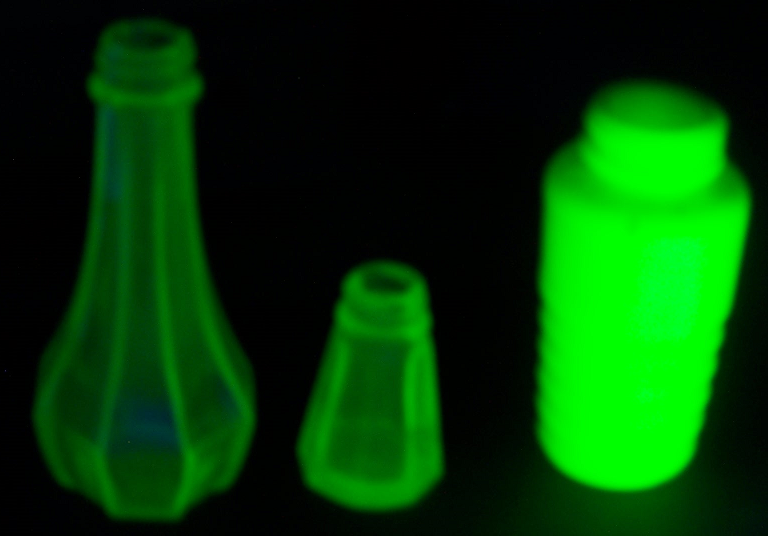
Vintage Glass Finds.
I often find old bottles and glass.  The above picture shows three such finds.  The two on the left are Depression glass and the one on the right is Vaseline glass.  I think those are the right terms.

There are a lot of collectors of both depression glass and vaseline glass.  I've sold some pieces in the past.

I'm not changing topics.  I'm going somewhere with this.

Depression Glass and Vaseline Glass Photographed Under Black Light.
I tried the black light on those items, and you see what I saw.  They glow.

Both types of glass were made with uranium.  Yes, uranium.  Vaseline glass has a more yellow color. To create the more green depression glass, iron oxide was added.

OK.  A black light can reveal some interesting things with some types of glass.  So now I tried the red sea glass under black light.

Red Sea Glass Under Black Light.
I shut out all the light and shined the black light onto the red glass.  The one side showed nothing.  I couldn't even see it in the dark room, let alone photograph it.

I turned it over, and saw a world of difference.  On this one side, it glowed!

It was the side with the yellow specks infused in the glass that glowed.  It glowed orange.

What does that say?  Uranium isn't used in glass nearly as much as it was back in the day, although people do copy depression glass and vaseline glass.  So is this glass older?  I thought it was older just judging from how it was worn into a very rounded cushion shape.  And why was it made to glow?

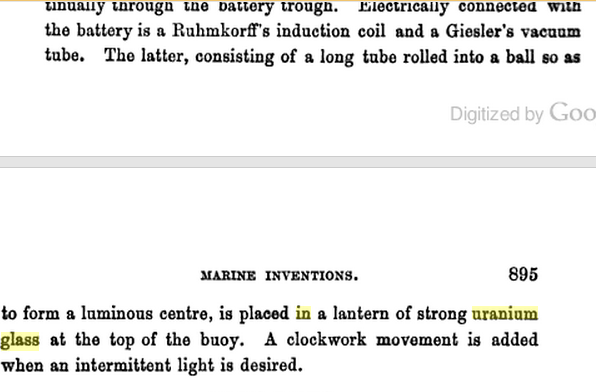
Then I ran across the following text.


This clip was found in an 1878 nautical magazine.  It is talking about how uranium glass was used on a buoy.  Is that what I have a piece of?  I don't know.  But the evidence is mounting that this red sea glass was once part of a lens, perhaps like was used on a nautical buoy.

Click here to link to the nautical magazine.

What I am talking about today is how an item can continue to reveal more about itself, and how various methods of inspection and research can help make a find come alive.

The same process can occur with almost any kind of item.  Even an item as simple and mute as a squarish little piece of glass will continue to tell you more of the story as long as you are curious and really want to know.

It is something like that with people too.


---

I was without internet most of the day, so that is it for today.  I didn't think I was going to get any kind of post done today.

Happy hunting,
TreasureGuide@comcast.net.

Friday, June 26, 2015

6/26/15 Report - Mystery Find For ID. Other June 2015 Finds. Anheuser-Busch Sea Glass. Pet Burial Urn Find.


Written by the TreasureGuide for the exclusive use of treasurebeachesreport.blogspot.com.

June 2015 Finds by Richard O. AKA GoldNugget Including 1800s Buttons and Coins.
First off today, I'd like to thank the people who expressed their kind get well wishes.  The readers of this blog are quality people.  I really feel that when I get such kind emails from people that I have never met.

I haven't got the stitches out yet but made some adjustments to my detector's arm cuff and took some other precautions, so was able to detect.  It was a little more awkward than usual, but OK.

Thanks for your thoughts!  It makes a difference.

----

Concerning the email I receive, I get a lot of response to my posts on beach dynamics.  If you go back through this blog you'll see that I discuss that from time to time.  Some of that material comes from the literature on beach dynamics that I then take and apply to the subject of metal detecting, and some of it comes from my own experimentation and observations.

Richard O., also known as GoldNugget, sent the following email along with some pictures.

I got to read the Post from June 23 , 2015 about Beach Sand.  Nothing is more true on the light sand. Since I have  been submitting  some of my Monthly Beach Finds for about 2 years I notice a lot of the light sand hitting the top of the ( Flat ) Dunes where I detect ( Overwash ), Also if the waves move about 4 more inches it takes and moves the Small Button and Real (Reales) I find along with some of the Coins that have been buried for about 175 years. If someone can Identify the Item that is in the Red Circle it would be appreciated...


...I am trying to get a Better Date on the Budweiser Bottle, currently 1940-1950's,  It's Beach Glass found also this month of June.

Below is a closer view of the mystery object for ID.  You can get an idea of size by looking at the picture at the top of this post.

 Richard has done a good bit of research on this but hasn't been able to ID the object yet.  Any help on ID would be appreciated.

Mystery Object For ID.
Cross In Circle Surrounded By Rays.

Below are more find photos from Richard.


 Below is a picture of a piece of Budweiser sea glass that Richard wanted to date.


Source: anheuser-busch.com web site at right.


The piece of sea glass (above) shows one eagle wing behind the A and one in front like the post-1933 examples shown in the third row down.

The eagle also appears to have an open mouth more like the eagle in the 1940s - 1950s example.

I think that narrows it down pretty well.


The A & Eagle trademark is the most widely recognized symbol of Anheuser-Busch Companies, Inc. and Anheuser-Busch, Inc. First used on the company’s beer products in 1872, the symbol was not registered with U.S. Patent Office until 1877. The trademark (No. 4623) soon became widely recognized as a symbol of quality throughout the world.

According to the company’s statements at the time, the essential elements of the design were “…the capital letter A and the figure of an eagle standing on the American shield…” The original eagle had its wings folded back into the “A.” Around the turn of the century, one or both of the eagle’s wings were spread outside of the “A” in an uplifted, flying motion. In 1939, the Union shield of stars and stripes was replaced with a horizontal striped shield...

Here is the link for more from that web site.

http://anheuser-busch.com/index.php/our-heritage/history/history-of-aeagle/

Great finds Richard.  Congratulations!

I like old sea glass with names and logos.  I'll show some more of those in the future.


---


Pet Burial Urn
Find and photo by Mitch King.

Mitch King identified the "heart art" object I posted yesterday as a pet burial urn.  Here is a photo he sent showing one that he found.

Thanks much Mitch.

The one I showed yesterday isn't quite that big, but they seem to come in a variety of sizes.  If you search the internet you'll find a variety of pictures of pet urns in various sizes, many are in the shape of small hearts.  One I saw on the internet also had a black bag like the bag I showed yesterday.

Surprising to me is the fact that there is no evident way for opening the urn.  I guess the ashes are sealed in the object.

My object is much smaller than the one Mitch showed, both in diameter and depth.

My Heart Art With Quarter.
The back seems very unfinished.

Signature On My Heart Object Find.
Could the signature be the name or the artist, owner, or pet?  Doesn't really seem like a pet's name.

Can you make out the name?

Unlike Mitch, I failed to provide a size comparison in my photo yesterday.  Sometimes that is most helpful.  Try to remember that when you send photos.  Thanks.

---

Again, no change in Treasure Coast beach conditions.

Happy hunting,
TreasureGuide@comcast.net
Tuesday, March 24, 2015

3/24/13 Report - Time To Analyze Your Find Records? It Might Tell You Something. What you do has a lot to do with what you find.


Written by the Treasure Guide for the exclusive use of treasurebeachesreport.BlogSpot.com.

Fossils And Sea Glass Recently Found In A Shell Piles
On A Treasure Coast Beach.

I got some email concerning the signal or ID you'll get from a Rolex watch.  As I said, using an Ace 250, if you are in coin mode, the test Rolex gave no signal, however in the Jewelry and All-Metals mode, you get an ID that shows up in the nickel to penny range, which also includes the pull-tab and gold/bronze range.  

The ID was different when the coil was swept over different parts of the watch.  If the coil was mostly over the band that produced a different ID than when the coil was more directly over the watch case. 

Robert H. said he got a good coin signal on a Rolex when using an Excal II in discrimination mode.  I don't know how much discrimination he was using.   He also said he almost gave up digging after a number of scoops because he thought it might be a can. Good thing he went for that last scoop.

Robert's observation is consistent with the ID I got when using the Ace in the Jewelry and All-Metals modes, but don't forget, the Rolex produced no audio signal in the Coins mode.  That is the critical point.  I don't know about you, but I don't want that to happen.  I'd gladly give up hundreds of clad coins for one good Rolex.  What I am talking about is making informed intentional strategic decisions that will maximize success however you may define success.  If success to you is a pile of clad coins, then  use the techniques and strategies that will accomplish that.  However if your goal is to find other types of targets, perhaps targets that are of a less determinate size or composition, you might choose to operate otherwise.

As I mentioned yesterday, one person said that the thing that motivates him is the possible big find that might come at any time.  In that case you want to be ready for the unexpected, not eliminating everything but the common.

I'm not trying to suggest that a Rolex will give one type of signal no matter what.  Just the opposite.  There are many types of Rolex watches.  They come in different sizes and are made of different materials.  Some are gold and others stainless steel.  And of course there are a variety of different types of bands too, which can affect your signal or ID.

There are also many types of detectors and different modes and settings you can select on each detector.  I've mentioned some of those differences.

The point is that you need to know the detector you are using because there is the distinct possibility that you could misidentify or entirely miss a very good target - perhaps repeatedly and consistently because of the way you hunt.  That is especially more likely if you always hunt the same way using the same settings.  You might habitually eliminate a specific set of good targets. 

I recommend a periodic review.  Analyze your record of finds.  What do you find a lot of?  What do you seldom find?  What have you never found that you would like to find?  The answer to those questions might tell you something about how you are detecting that you might want to change.

I've said this before, but back when I began detecting, I found a lot of men's rings but few women's rings.  I thought that men lost more rings.  That was wrong.  I was using a level of discrimination with my 1280 that made me miss many of the smaller and often more valuable women's rings.  After decreasing the discrimination setting on the 1280 I found out that there were as many women's rings to be found as men's.

Maybe you know everything there is to know, but I don't.  I intend to continue learning.  That is something that makes it all more interesting, and it is also something that helps me do better.

If you haven't made any changes in how you hunt for a long period of time, maybe that is a sign that you should think about that.  It is all too easy to fall into habits and get in a rut. 

I always like learning something new.  Not only does it improve performance but it also keeps it interesting. 

-----

The photo above shows some fossils and sea glass found on a Treasure Coast beach a few days ago.
Nothing great, but I do enjoy finding them.  Some, not these particular ones, can actually be worth some money.

If you keep your eyes open while detecting you can find things like this.  The fossils are much older than the cobs you might find.  And sometimes they can be worth more than a treasure coin. 

Nice pieces of sea glass can also worth something.  Fine examples of the less common colors, such as red or yellow, can be worth more.   They can also provide good clues.  An occasional Native American artifact can also occasionally be seen in shell piles.

------

Spike Found by Joseph G.
Photo by Joseph G.

I've been thinking of a bunch of things lately, but haven't put them together for a post. 

Did you ever hear of soil liquefaction?

Soil liquefaction is when saturated or partially saturated soil loses strength and stiffness in response to an applied stress, such as the vibrations caused by an earthquake or other  stress conditions, causing the soil to behave like a liquid.

Interesting!  Buildings can collapse etc. 

-----

I've really noticed huge differences in how some detectors eat batteries.  Battery life is much higher in some detectors than others. 

------

On the Treasure Coast we'll have a three or four foot surf for a couple of days with variable wind direction.  Nothing that will affect us much.

Happy hunting,
TreasureGuide@Comcast.net