Showing posts with label Melborne. Show all posts

Thursday, October 31, 2019

10/31/19 Report - A Variety of Nice Finds From Brevard and Indian River County. More on Spikes. Bigger Surf Coming.


Written by the TreasureGuide for the exclusive use of treasurebeachesreport.blogspot.com.

Items Found At Radar Site at Melborne Beach by TM
Photo by TM.

I received an email from TM and photos of some of his finds that came from Brevard and Indian River Counties.


I’ve been detecting the south Brevard and north Indian River county beaches for about a year and a half now.

Found many items and try to clean my share of trash up.

Just thought I’d share a few things. 


Also I really enjoy the treasure beaches report.


TM's finds included those in the photo above and the four following photos.  Each is labeled with the location of the find.  Really a nice and varied group, including some really great finds.

Ring Found North of Bonsteel Beach.


Bracelet Recently Found Near Seagrape Beach Access


Clovis Point Found North of Sebastian Inlet.

Congratulations TM. Great finds! Thanks much for sharing. The Clovis point would be somewhere around ten thousand years old. Now that is an old find. From Wikipedia: The Clovis culture is a prehistoric Paleoamerican culture, named for distinct stone tools found in close association with Pleistocene fauna at Blackwater Locality No. 1 near Clovis, New Mexico, in the 1920s and 1930s. It appears around 11,500–11,000 uncalibrated radiocarbon years before present at the end of the last glacial period, and is characterized by the manufacture of "Clovis points" and distinctive bone and ivory tools. Archaeologists' most precise determinations at present suggest this radiocarbon age is equal to roughly 13,200 to 12,900 calendar years ago. Clovis people are considered to be the ancestors of most of the indigenous cultures of the Americas. You might enjoy reading more about the Clovis culture. Here is a good link. https://www.smithsonianmag.com/history/the-clovis-point-and-the-discovery-of-americas-first-culture-3825828/ ---


The past few days I talked a little about Troy's chisel or spike find. At this point, I think the overwhelming consensus is that it is a broken spike. That is my opinion and the opinion of others that I've heard from. If you think about it, I suspect there are hundreds of shipwreck spikes out there for every old chisel. I've discussed some of the reasons for concluding that it is a spike, and posted some of the reader's thoughts that I've received on the subject. I just received an email from Jerry P., who also believes the find is a spike. Jerry also included some photos of those that he has found.
Spikes Found by Jerry P.
Photo by Jerry P.
Notice in particular the broken spike that looks very much like Troy's. I still haven't found the particular examples I was looking for. I wanted to take a close look at the break. I did look at the break on some others. I don't know how good the photos are yet. I haven't uploaded them yet. Also, notice the bent one. I plan on talking more about how they get bent and broken in the future. What do you think about that. I have some ideas, but I'd think it would take a lot of force to break a spike like that. I hope to talk about that more in the future. How do you think spikes get bent or broken? Troy sent me a closer photo of the top of his find.
Find and photo by Troy C.
That gives a better view. Thanks Troy. I was going to upload some photos that I took but found out I have to recharge the camera battery. First the upload utility was giving me trouble, and now the battery runs down. Sheesh. I get back into that topic, maybe tomorrow. One thing I've noticed, especially with broken bronze spikes, is how smooth the break can be. --- I'm just going to tell you about the surf instead of wasting any more time trying to upload the image. Expect a 4 - 6 foot surf on Friday and Saturday. You'll have to look it up yourself. I also asked TM if he could provide any more info on his finds. Happy hunting, Treasureguide@comcast.net

Tuesday, February 12, 2019

2/12/19 Report - 1715 Fleet Site In Melborne. Shipwreck Dispersion and Scatter. Muckelroy Model.


Written by the TreasureGuide for the exclusive use of treasurebeachesreport.blogspot.com.


Here is the Executive Summary and Conclusion of an article that you might enjoy reading.   It is by
Dr. Robert H. Baer, Professional Archaeologist, Seafarer Exploration Corp.

Executive Summary This paper provides evidence that the Melbourne Beach shipwreck scatter is derived from one of the missing Spanish 1715 Plate Fleet shipwrecks, the Santisima Trinidad y Nuestra Señora de la Concepción.

Conclusion From the evidence, it is concluded that the diagnostic artifacts – the Monteros Platter and the Ramirez Flintlock Pistol recovered at the Melbourne Beach site approxiamately 14 miles north of the 1715 shipwreck sites is undoubtedly cargo from a missing 1715 shipwreck. It is believed that the vessel scatter at the site is that of the Santisima Trinidad y Nuestra Señora de la Concepcieon, the vessel that transported the consigned box of presents including the Monteros Platter from Veracruz to Havana and from Havana to the Florida Treasure Coast where it was recovered almost 300 years later. 

Here is the link if you want to read the entire article.


Among other things you will find photos of artifacts, including but not limited to the pistol and silver plate.

Thanks to Dale J. for sending me that link.

The above article refers to the Muckelroy model, which describes the dispersion or scatter of shipwreck artifacts and materials.  I thought I once posted a flow chart of the Muckelroy model in this blog, but for some reason I can not find it now.  You might enjoy looking it up if you can find it somewhere in this blog or elsewhere.

If you are interested in looking into shipwreck dispersion processes or the Muckelroy model, here is a link that will help you get started.

https://en.wikipedia.org/wiki/Archaeology_of_shipwrecks#Muckelroy's_model

Here is a part of that article referring to a paper by Martin Gibbs (2006) that describes some of the human activities that affect a shipwreck site.

A paper by Martin Gibbs in 2006,[11] expands Muckelroy's model to consider human behaviour at the time of the disaster and the long term relationship between people and shipwrecks. This model uses studies of humans involved in disasters to characterise the human activity into phases around the time of the wrecking. This model considers:

  • Pre-impact threat phase, in which humans considering the risk may take avoiding action which results in there being no wreck, or may take unsuccessful action to mitigate the perceived threat, for example the wreck location may be the result of attempting to avoid some perceived greater threat. Stowage of cargo may also indicate consideration of threat.
  • Pre-impact warning phase, in which humans may take drastic action to avoid catastrophe, for example, running a vessel ashore, jettisoning cargo or running out anchors.
  • Impact, in which the decision is made to abandon ship or remain aboard, and, for example, attempt to refloat.
  • Post impact, where survivors regroup and, for example, salvage their own goods or make repairs.
  • Rescue and Post-disaster where the vessel is abandoned and in which third parties may be involved in salvage or in removing remains that present a hazard to navigation.

In addition to human activities there are the impacts of storms and other things that can affect the scatter hundreds of years later.  That is something I've talked about good bit.

I've wondered about some of these things, such as why there appears to be more smaller cobs found on the beach (especially some beaches) compared to the larger proportion of larger cobs found on the shipwreck site found by salvagers.  I've considered a number of possible reasons for that including both natural and human but won't get into that now.

Anyway, I think you'll find the above sources interesting reading.

You might also want to take a look at this one.


----

191 mph wind and 60-foot waves on Maui?  That is what it says.

https://www.usatoday.com/story/news/2019/02/10/hawaii-storm-brings-60-foot-waves-power-outages/2832866002/

---

MagicSeaWeed is predicting a two to four-foot surf for the next few days.

Happy hunting,
Treasureguide@comcast.net

Saturday, February 2, 2019

2/2/19 Report - More Metal Detecting Reports From Around the Treasure Coast.


Written by the TreasureGuide for the exclusive use of treasurebeacheserport.blogspot.com.

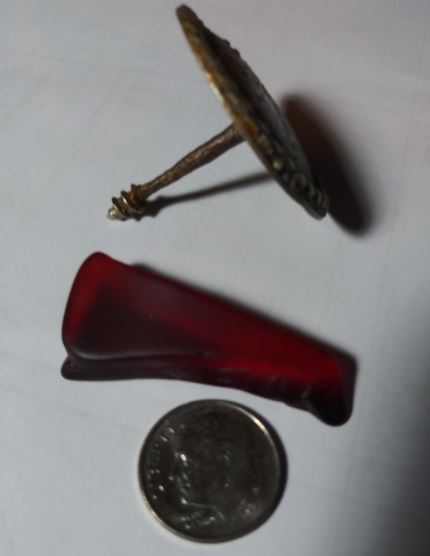
Antique Furniture/Upholstery Screw and Red Sea Glass Finds
Finds and photo by John L.
John L. was one of the guys that hit John Brooks beach early Thursday.  He then went down to Frederick Douglas, where he found these two items.

He is now most curious about the red glass.  After some research he found that it could possibly be hundreds of years old.

Same Treasure Coast Finds by John L.

He now believes the red sea glass is "gold ruby glass," which could be hundreds of years old.

He thinks the furniture screw could be a replica.  It does look in very good shape.

He found the following information relative to the red sea glass on the Corning Museum of Glass website.


"Gold ruby is arguably one of the most beautiful colors of glass. Beyond its aesthetic qualities, there is an alchemical connotation: Since ancient Greek times, descriptions of the sorcerers’ stone agree that it was believed to be a red substance and the key to the transmutation of metals, principally the making of gold (Ganzenmüller 1937;  idem 1956, pp. 85–128; Kerssenbrock-Krosigk 2001, p. 13). Whoever discovered how to color glass red must have thought himself to be on the right track to attaining the ultimate goal of alchemy. The 10th-century Persian physician and philosopher Rhazes (about 865–between 923 and 935) apparently believed that he had already fulfilled that objective. In his formula, the earliest known written account of a gold ruby glass, he stated that this glass attracted gold and silver like a magnet, and that it could convert 1,000 times its weight into gold. 1

About 800 years later, enthusiasm for gold ruby was at its peak. As far as can be determined from the legacy of princely treasures in today’s public collections, almost every central European sovereign seems to have owned one or more gold ruby glass vessels. This high point in the popularity of gold ruby glasses was confined to a relatively brief period: between about 1685 and 1705. It was preceded by a long history of developments that culminated in the production of large vessels that glow in a deep yet translucent ruby color. At its height, gold ruby glass was apparently considered to be not just another decorative folly but a genuinely new and precious material. It was ranked about as high as hard-paste porcelain, which came into production in Europe only a few decades later. During the 18th century, interest in gold ruby persisted in some regions and occasionally arose in others, but it never regained the widespread appreciation that it had engendered earlier.


The history of gold ruby has many beginnings. Red glass of some sort was produced almost from the time that glassmaking began. Knowledge was gained and then lost, and while there were rediscoveries on several occasions, this glass does not seem to have been produced again until it was revived in Brandenburg in the late 1670s and 1680s. It is here, with the arrival of the alchemist, pharmacist, and glassmaker Johann Kunckel (1637?–1703; Fig. 1) in early 1678, that the real story of gold ruby glass begins...

Interesting finds.  Thanks John!

---


Russ P. has done a lot of inland hunting, and found thousands of silver coins, was out to the beach this past week.  I've posted some of his research.

Here is what he had to report.


… I checked most of the known treasure beach access points from Sea Grape north, but only got my detector out at Bonsteel, with only a few trash finds. All the rest of the beaches seemed to have deteriorated from yesterday, in my opinion, with a lot of sand deposited at the base of cuts. Based on what I saw today, I don't think any of the cuts got close, at any point, to the size seen at John Brooks.

On the bright side, it was a beautiful day at the beach. I stopped at Melbourne Beach on the way home. It actually looked the most promising with a firm slope with black sand below a two foot cut. There were two other detectorists at the beach on my arrival. I have very little overall beach experience, but I found the coin line quickly. There weren't many coins, but it was stretched out over several hundred yards. There was no trash in the coin line. It was fun to put all the theoretical knowledge learned in this blog to good practical use. It really works!

Also, the Equinox 800 was superb. The coins were all six inches deep minimum, but gave strong signals. There was virtually no falsing, either in black sand or transition from dry/wet sand or vice versa. I picked up some very small pieces of fishing lures the size of earring backings. I was very impressed...


I've now heard from people from Juno to Melborne.  Various spots along the way eroded to some extent.  I haven't heard from Jupiter yet.

Although Russ hadn't done much beach hunting, he was able to apply what I've said about coins lines and quickly found one.

No matter if you walked away from the beach last week with a bunch of finds or not, you should walk away with some good new information.   Always be learning.

Depending upon how you define the Treasure Coast, it is around a hundred miles, more or less, long. That gives you over 5 million square yards of beach to scan.

Only a relatively small amount was actually detected, even if some beaches were hit by dozens of detectorists.  Many areas were just too far from the beach access for most people.  There are a lot of good spots that are far from the access.  Some of those will continue to hold good targets even after some of the other beaches fill in.

With the smaller surf, some areas (mostly higher on the beach) of the more productive areas will remain basically as they were a few days ago.  I know that there are coins just laying there still waiting to be detected.  I could get into that more some other time, but people tend to conclude it is all over just because the hottest of known spots have deteriorated.

We'll just have a two to four foot surf for a few days.

Happy hunting,
TreasureGuide@comcast.net


Sunday, January 27, 2019

1/27/19 Report - More On Melborne, Florida Artifact Find Reported In Some Sources As An Ican Funerary Mask. More Surf Tomorrow.


Written by the TreasureGuide for the exclusive use of treasurebeachesreport.blogspot.com

Find Reported As Incan Funerary Mask.
A couple days ago I reported on what was said to be an Incan funerary mask found on the beach somewhere near Melborne, Florida.  As I said then, a lot of it didn't seem to make sense to me.  It turns out that I was not the only one that felt that way.  The ancient-origins.net web site also found the stories confusing and offered some corrections.  It seems that the artifact is not as old as reported and is does not included metal from a meteorite.

The ancient-origins web site reports You are immediately forgiven if you have watched the News 6 video and are in a state of utter confusion, as was I. Sparvero’s introductory scene in the video confidently states the mask is “possibly 10 or 12,000 years old.” But in reality, the Inca formed in the Cusco area of modern Peru in the mid-12th century AD. Going with professor Torres’ suggestion that it’s an ‘Inca funerary mask’ it was forged no longer than 800 years ago, but other archaeologists claim “a native civilization smelted the mask possibly thousands of years BC” according to an article in Florida Today

While Torres says the mask is Inca, right after that he says “it might be the first evidence of smelting” in South America. But that was thousands of years before the Inca formed. Searching for hard facts, clarity can be found in an excellent research paper, Metallurgy in Southern South America , written by three of the world’s leading scholars on ancient metallurgy; Colin A. Cooke, Mark B Abbott, and Alexander P. Wolfe. The scientists state , “The earliest evidence to date for smelting activity in southern South America comes in the form of copper slag from the Wankarani site in the highlands of Bolivia dating between 900 and 700 BCE (Ponce 1970).”

Thanks much to Dale J.. who sent me the ancient-origins link, which is probably closer to the truth than much of what has been said and reported about the mask.

Here is the link.

https://www.ancient-origins.net/news-history-archaeology/inca-artifact-0011370

---

Today was the first day this year that made me want to run out to the beach.  The weather was what I consider excellent metal detecting weather, as long as you have a metal detector that can take the rain.  It was exactly the kind of weather I love for metal detecting - too bad I caught the flu and decided to stay in.

I don't know what happened to the beaches today.  I heard there was both an on-shore and long-shore currents, making it even the more tempting.

As you can see, it looks like we'll have a four to six foot surf tomorrow, along with some north wind.

Source: MagicSeaWeed.com.

If any of you went out Sunday, I'd like to see any photos you got of the beach.

That is all for today.

Happy hunting,
TreasureGuide@comcast.net


Saturday, November 18, 2017

11/18/17 Report - Modern Ring With Old Symbol: Pelican In Piety. Encrusted Bracelet.


Written by the TreasureGuide for the exclusive use of treasurebeachesreport.blogspot.com.

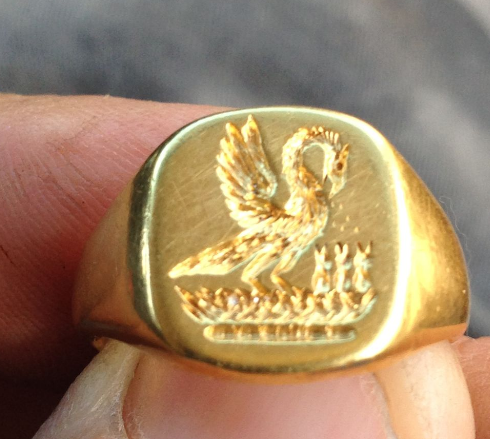
Interesting Modern Ring Find.
Find and photo by D. B.
This ring found on a 1715 Fleet beach is a modern ring but seems to have an interesting connection to one well known 1715 Fleet artifact.

I was asked what the image on the ring is?  As you can see, it is a bird feeding baby birds.  The question is why that would appear on a ring.

Do you remember the Pelican in Piety artifact and author Laura Strolia's research concerning that.  If not, you can use the following link to read about it.

http://treasurebeachesreport.blogspot.com/2012/11/11412-more-revealed-on-pelican-in-piety.html


I'm pretty sure the image on the ring represents the pelican in piety.  Here are just a couple images of a pelican in piety to illustrate that.

Two of Many Varieties of the Pelican in Piety Image.

You can find many more by doing a quick internet search.

Here are the marks on the inner band of the ring.

Hallmarks.
Photo by D. B.
First is a crown, then 750, then a shield and then 9 or 19.  I can't see the crown and shield real well from the photo.

I assume the crown indicates that the item is gold.  The 750 indicates 18 karat.  I don't have a good guess about the last two marks.

Author Laura Strolia says that the Pelican in Piety image was more rarely used after the 40s.

Cool find DB.  Congratulations!

---

Bracelet?
Find and photo by Scott.
This item was recently found in the Cape Canaveral area.  Currently in cleaning, we might find out more about it soon.

---

Some good items were found on the Treasure Coast last week.  I heard of quite a few.  Some nice items were also found in the Melborne area.

The beaches that were producing were scattered.  Many were not.  That makes it difficult for me to issue a beach conditions rating.  A few beaches were good, but many of them were not good at all.  

We'll have nothing greater than three to five feet for a few days.  It looks like the wind will be switching a lot.  That is not like what we had recently with days of north wind.

The weather is beautiful for the snow birds.

Happy hunting,
TreasureGuide@comcast.net


Thursday, February 12, 2015

2/12/15 Report - Beach Condition Photos Fort Pierce, Vero & Sebastian. Mystery Item.


Written by the TreasureGuide for the exclusive use of treasurebeachesreport.BlogSpot.com.


One of these items was found in the Melborne area.  Another identical item was found in the Deerfield Beach area about six years ago.

It is made of lead.


If you have any ideas about what it is please let me know.


----

When I awoke this morning I was disappointed to see that the wind wasn't blowing much.  I went out to survey the treasure beaches along the Treasure Coast this morning. 

Turtle Trail is now open.  They dumped new sand on the dunes and in front of the dunes.  It seemed renourishment projects are in progress or were recently completed on many of the beaches from Vero to Sebastian.

Seagraph Trail was now closed, as was Wabasso.  Golden Sands and Treasure Shores were open.  Renourishment projects were completed there not too long ago.

They were working on the area by the old salvage camp north of the McLarty Museum.  The informal beach paths used by fisherman and others were ribboned off.

Also, a project is underway at South Jetty Park in Fort Pierce.


Waves Last Night Came Up Over The Berm At Douglass Beach.

Nice Size Waves At Douglass Beach But No Erosion.
 
Looks like the wind is blowing the tops off of those waves.

Looking South at Turtle Trail.


Looking North at Turtle Trail.
Notice in both of these pictures how they put new sand over the front of the dunes.  I think that contrary to the predictions, the waves were actually higher down along Hutchinson Island this morning.


Amber Sands Beach Looking North.
 In the above picture you can see that they covered the dunes like they did down at Turtle Trail.

Cut South of Amber Sands Beach Access.
Here is a cut maybe 50 or a hundred yards south of the access.  It was in renourishment sand.

Overall conditions failed to improve despite the higher waves we had last night.  The waves were parallel to the beach this morning, as was the case yesterday.

The waves all along the coast were breaking far out from the beach.  It looks like there is a lot of sand piled up just off-shore. 

Tomorrow the surf is supposed to begin decreasing.  Too bad.  I didn't see anything that would make me increase my beach detecting conditions rating today. 


Don't forget to send your thoughts on the mystery item.

Happy hunting,
TreasureGuide@Comcast.net