Showing posts with label gold mining. Show all posts

Friday, June 19, 2020

6/19/20 Report - Metal Detecting Hobby Makes Contributions to Archaeology. Digging Gold Mining Camp. Old Postcard Treasure.


Written by the TreasureGuide for the exclusive use of treasurebeachesreport.blogspot.com.


Viking Era Coin Found by Detectorist.
Source: See news.err.ee link below.


Another archaeological find has been made on the island of Saaremaa, just weeks after a major haul including a 1,700-year-old gold bracelet came to light.
The recent find dates from a later era, the viking period, ERR's online news in Estonian reports, and includes a large number of silver coins, according to both the Heritage Protection Board (Muinsuskaitseamet) and Saaremaa Museum.

As with the earlier treasure trove, the latest find was the work of a metal detector hobbyist, who, in line with Estonian law, informed the authorities.

"We are grateful for the licensed hobby detector, who reported the findings to the Heritage Protection Board, which can now preserve some of the crucial history of Saaremaa," Saaremaa Museum stated on its social media page...

Here is the link for more about that.

---


Postcard Postmarked June 10, 1875.

This post card is postmarked June 10, 1875. It was written to Thomas Gillespie of Stephenstown, Ohio, by Charles Louis Loos, who was a noted professor of ancient languages at Bethany College. I've been to Bethany, which was not far from West Liberty University (formed in 1837) where I once taught. The town of West Liberty was named in the late 18th Century as the westernmost point of the new liberty provided through the Declaration of Independence.

Source: Wikipedia.


Back of Same Postcard.

Notice the signature from the Wikipedia site and the postcard- very good match.


The one cent that it cost to send this postcard in 1875 would be roughly equivalent to 20 cents today.  Not bad.

To me this is an interesting piece of history that found its way to me.  I enjoy ephemera as much as any type of treasure.  Unfortunately you can't find it on the beach, but I've found a lot of it.  

You can learn a lot of history from old books and postcards.  I especially enjoyed this postcard because I was able to research the person and already knew about the places.  It bears the handwriting of a famous and historic person.  

Reading old script isn't easy, but with some difficulty I was able to make it out.  Whether you are trying to decipher documents from the Spanish archives or something else, reading old script in any language can be a challenge.

I have a lot of old books and postcards.  A good number of the books I puchased at thrift stores years ago for one dollar a piece, but a lot of the old books and postcards just found their way to me.  I guess it was just because I appreciated them.

---

Here is a link to an article about digging through the remains of a old Chinese gold mining town.


---

Trivia question -  What language is aare the word for treasure?  Hint: the Finnish word aarre is very similar.   You'll find the answer in a June 2019 post.

---

It looks like the Treasure Coast will have a week or more of one or two foot surf.  The tides aren't big either, and there are no tropical storms to pay attention to now.

Happy hunting,
Treasureguide@comcast.net

Monday, November 24, 2014

11/24/14 Report - Watching Surf And Sand Movement. LIDAR Discovers Roman Gold Mining Nework. Beach Detecting Conditions Rating Downgrade.


Written by the TreasureGuide for the exclusive use of treasurebeachesreport.BlogSpot.com.

Breaking Wave As Seen Saturday Morning Near High Tide
Notice where the wave in the above picture is breaking, and where the water is flat in front of that.  That is where the water is moving over sand in front of the beach, and the rough water near the bottom of the picture is where the water meets the bottom of the slope and the water coming back down the slope.

There are three things I want you to watch in the following video.   First, where the waves are breaking.  Second, where the water surges over the sand in front of the beach after breaking.  And then something you didn't see in the above illustration, how it surges up the slope until it hits the cut and then back down again.


Here it is with lines and arrows added to show the area where the waves are breaking, surging across the bar and where the incoming water hits the water returning down the slope near the bottom of the slope.


You can clearly see where the wave is breaking (top horizontal red line).  That is where the water gets shallow enough  for the wave to break.

Then the surge across the sand in front of the beach (from the top red line to the blue line).

Then the rough water where the incoming water hits the water returning down the slope.

When you see waves breaking way out, you know the water is relatively shallow that far out. 

The waves at this beach were breaking fairly close to shore.  You can get an idea of where the water is deep and where there is a lot of sand from where the waves are breaking.  

The illustration immediately above is from six seconds in on the video.

Here is an illustration from sixteen seconds in where you can see the slope better.


The top line shows general area where the sand builds up and the waves are breaking.  The second line shows the approximate beginning of the slope.  And the arrows shows the slope where the water goes up and returns.

The angle of the video and perspective makes this difficult to diagram and illustrate, and I know that I didn't explain it very clearly.

One of main points is that you can tell a lot about where the sand is and how deep it is by where the waves are breaking and how the water is moving.  That is useful information.  Always figure out as much as you can about how the sand is moving. 

There is a lot more that you can see in this video, such as the angle of the waves as they hit the beach.

Here the waves are breaking closer to shore than some of the other beaches.  The sand in front of the beach will have to be moved or at least stirred up to uncover the older materials before they can be washed up. 

The next day (Sunday) a good number of coins were found on this slope in front of the cut.

I hope you got something out of that even though I didn't couldn't make it real clear. 

I advise watching the video a few times after reading this.

----------------

The most "google plused" post of October was the 10/4/2014 Report -  Tuning A Pulse Induction Metal Detector For Gold.  Permit To Take Photos In Florida.  Higher Surf Coming.

----------------

Hidden under the vegetation and crops of the Eria Valley, in León (Spain), there is a gold mining network created by the Romans two thousand years ago, as well as complex hydraulic works, such as river diversions, to divert water to the mines of the precious metal. Researchers from the University of Salamanca made the discovery from the air with an airborne laser teledetection system (LIDAR).

Here is more about that.

http://www.agenciasinc.es/en/News/Laser-from-a-plane-discovers-Roman-goldmines-in-Spain


---------------------

I got out to take a look at the beach this morning, and I am downgrading my beach detecting conditions rating back to a 1 (poor).  Beaches that eroded are filling again.

On the Treasure Coast the wind will be from the South for a couple of days and the surf will be slightly reduced.

Wednesday we'll have another front coming through and the wind will shift again and be coming from the North again but at the time the surf will be only around two or three feet.

I'll probably be going back to a "1" rating on my Treasure Coast beach detecting conditions rating scale before long.  I'm actually surprised that the beaches haven't refilled more already.

Happy hunting,
TreasureGuide@Comcast.net

Monday, September 8, 2014

9/8/14 Report - Great Finds on the SS Central America. Odyssey Marine Reports. Gold Coins and Artifacts. More On Beach Dynamics.


Written by the TreasureGuide for the exclusive use of treasurebeachesreport.BlogSpot.com.


A Few of the Gold Coins Salvaged From The
SS Central America July - Aug.
Source: See link below.
Odyssey Marine Explorations has been working on the SS Central America.  They have been recovering a lot of gold and artifacts and doing a lot of research.  They provide monthly reports on their web site, which I find both fascinating and informative. 

The reports show site maps with artifact distributions, photos of the site, items recovered, and even experiments conducted in the process, such as one experiment that studied how wood deteriorates on the ocean floor.

In the June/July report you will read about how they recovered loose gold that was lost in the wreck.  The gold was being returned from the gold fields when it was lost when the ship went down.  Now they are mining it for a second time, this time from the bottom of the sea.

I think it is interesting that they are using a dredge and a sluice, very much like the sluice that might have been used by the original miners.


I've mentioned before about the gold dust in the ocean off of Rio Mar.  At least one attempt was made to recover it, but it was very difficult and not very effective.


Source of photo: Odyssey report link.
I also find the idea of twice-found objects interesting.  I've mentioned an escudo that was mined and minted in Mexico, then lost in a shipwreck, then salvaged and put on another ship which sank, salvaged and sold, and then lost by whoever purchased it before I found it.  In other words, it was lost in the water and found three times.


Below is the link to the Odyssey Marine June16 to July 15 report.

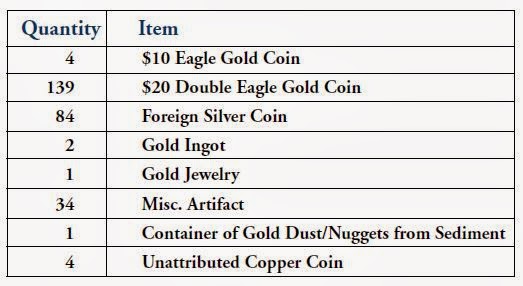
Also below is the summary of finds for that period.

To the left you see a photo of the sluicing operation on board the salvage ship.

http://www.shipwreck.net/documents/OMECourtReport14-3_000.pdf


Summary of Finds From the June - July Odyssey Report.
Source: Odyssey report link above.


And here is the link to their July 16 - Aug. 15 report.

http://www.shipwreck.net/documents/OMECourtReport14-4.pdf


They found a lot of coins during that reporting period.

Below is a photo of a neat pin manufactured from a gold nugget found in the gold fields.\

The report and nugget pin are both from the July16 - Aug. 15 report.


As you know I've done a few posts giving the results of some observations I made on how objects sink at the beach. 

Here is what Bill F., our resident oceanography expert, sent via email concerning objects sinking.

Why do objects sink rapidly?  Look at our beaches..coarse material, or
in some cases, stuff from offshore pumped onto our beaches.  Both of
these materials create a relatively steep beach front.  The high
velocity incoming wave moves material toward the shore. and it drops
out of suspension as the water velocity drops, forming a steep beach.
Now, another aspect takes over.  The water soaks into the coarse
substrate, with very of the wave actually running back out.
Basically, the beach surface churns in place, and the water slowly
returns to a lower elevation.  You've probably seen it running out of
the upper beach at low tide, usually along a line of denser material.

I'm sure you've encountered this well packed shell layer under all
this loose top material.  That's where objects will settle to.

Wave action moves a tremendous amount of material.  If you draw a line
from the dunes to the water, sand will move north and south across it,
but the NET TRANSPORT will be as much as 400,000 cubic yards SOUTH in
our area.

Bill
Thanks Bill!


On the Treasure Coast we still have a very small surf.  We'll have that for at least a few more days.

At least the tides are getting little bigger.  I suspect the rain kept a lot of beach goers from going to the beach this weekend.

There isn't much to be concerned with in the Atlantic.

Happy hunting,
TreasureGuide@Comcast.net