Showing posts with label Equinox. Show all posts

Tuesday, May 12, 2020

5/12/20 Report - Metal Detecting Silverware and Conductivity Numbers. Sterling Silver Finds. And Mystery Piece Identified.


Written by the TreasureGuide for the exclusive use of treasurebeachesreport.blogspot.com.

Silverware Used for Metal Detector Conductivity Readout Test.
As you probably know, I highly recommend testing your metal detector with a wide variety of types of targets so you get to know what your detector is trying to tell you.  I used the five examples shown above for a simple test I'll report on today.

From top to bottom is a two-tined for that I presumed to be made of steel.  Second is a spoon that is clearly marked stainless.  Third is a knife marked "Robeson 'Frozen Heat'".  Fourth is a fork marked "sterling" and then a marked sterling spoon.

Using the equinox the following conductivity numbers were obtained for each example, working from the top of the photo to the bottom.

Two-tined fork               -5 to -2
Stainless spoon              -5 to -2
Frozen Heat knife            2 -   5
Sterling fork                   18 - 22
Sterling spoon                28 - 32

Of course the numbers varied a little, but the above ranges are fairly good representations.  The position of the item matters, as does the shape.  

I believe the sterling spoon produced higher numbers than the sterling fork because of the flat round shaped area on the spoon.

My tentative conclusion is that you can tell the difference between an steel piece of flatware and a sterling or silver piece by the conductivity numbers.  The numbers for the sterling pieces was very much higher and in a relatively consistent range.  

I believe that experiments like this can help you better identify buried targets in the field, although when I'm in an interesting area, unless I have time constraints or something, I'm going to dig everything anyhow.

I should have included a silver plated item or two.  I might do that in the future.

---

A Couple Silver Forks Marked Sterling.

If you've been keeping up with my daily posts, you know that I've been going back and looking through some old tableware finds.  You'll find a lot of tableware if you search old home sites, and you'll find some on the beaches and in the water as well.  Some of it will be old, some fancy and some plain.  The fanciest or oldest pieces aren't always the most valuable.  With current silver prices of $15.65 per oz. or about $.50 per gram, as it was this morning, a plain piece of sterling silverware can be worth a few dollars in silver content.

The two forks shown top of this post both weigh over 1.5 ounces each.  That figures to be about $20 in silver content for each - not a big treasure, yet enough to pay for some batteries.

Sterling Silver Fork and Spoon.
The sterling fork shown above is just over 1.5 ounces and the spoon just under 1 oz.

Of course sterling silver is not pure silver -  only 92.5 percent, so you have to take that into account.

Unfortunately most tableware finds will be stainless steel or plated rather than sterling or coin silver, but the oldest or most ornate will not necessarily be worth the most.  The fork and spoon shown above look plain and modern, yet have good silver content.

As for the companies, it gets confusing.  Here is what Wikipedia says about the International Silver Company.
In Meriden and nearby Wallingford and Middletown, the companies that were banded together to form the International Silver Company included these companies: Meriden Britannia Company, Meriden Silver Plate Co. , Middletown Plate Company, C. Rogers & Brother, Simpson, Hall Miller and Co., Simpson Nickel Company, Watrous Manufacturing Company, and the Wilcox Silver Plate Co., In Hartford, the following silver companies also became part of the corporation: Barbour Silver Company, Rogers Cutlery and William Rogers Manufacturing Company. Other Connecticut companies that became part of the corporation also include Holmes & Edwards Silver Company in Bridgeport; Plate Silver Co. in Derby; Norwich Cutlery in Norwich; Rogers and Brothers, and Rogers and Hamilton in Waterbury. 
From outside New England were Manhattan Silver Plate in Lyons, New York; and Standard Silver Company, Ltd. in Toronto, Ontario, Canada. Into the 20th century, many silver designs carry either the International Silver Company brand, or the pre-existing brand continues, or both are listed as the design maker.

---

A couple days ago I posted a photo of what appeared to be an old spoon showing a globe with silverware maker's mark.  I asked for help identifying the mark and the readers of this blog came through.

Here is what they found.

American Silver Company Maker's Marks 
Found by Mike M. (left) and JorgeY. (right)


Moselle Pattern Spoon
Submitted by Dan B.
Mike and Jorge found the makers marks as shown above.  Then Dan added the photo of the Moselle pattern spoon, and Alberto looked up the patent number and found the following ad for an American Silver Company sugar spoon having the same patent number as the spoon I was asking about.

Submitted by Alberto S.

Thanks guys!  I think that nails it down.  It appears to be a Moselle pattern spoon made by the American Silver Company in the early 20th century.

As I mentioned above, it can get confusing.  The companies that made silverware were often bought out and changed names.  The American Silver Company was the result of a buyout and then later the International Silver Company bought the American Silver Company along with other similar companies.

I haven't identified any marks telling what it is made of but I assume that it is silver plated like the item shown by Alberto.  Perhaps some of the other numbers on the spoon tell that.  I'll have that tested some day.

---

The surf today is 2 - 4 feet with a northeast swell.


Source: MagicSeaWeed.com
Happy hunting,
Treasureguide@comcast.net

Friday, March 6, 2020

3/6/20 Report - Detectorist Finds Rare Artifact. Finds By Local Detectorist. Archaeologists VS Treasure Hunters. Bigger Surf Coming.


Written by the TreasureGuide for the exclusive use of treasurebeachesreport.blogspot.com

Source: See LincolnshireLive link below.


A metal detectorist has amazed experts after finding an incredibly rare Roman artifact in a Lincolnshire field.

Jason Price, from Grantham, was searching in a field near lesasingham when he unearthed a colourful horse brooch.

The 48-year-old, who is an armed forces veteran, was left gobsmacked by the find, which one local expert says has rewritten the understandings of Roman brooches.

The brooch, which is only the second of its kind to be found in the UK, was unearthed when Jason was on a 'Detecting for Veterans' weekend, and is set to go on displaylater this year...


Here is the link for more about that.

https://www.lincolnshirelive.co.uk/news/local-news/experts-amazed-after-incredibly-rare-3899808


It seems to me that in the past several years archaeologists have come to view detectorists less antagonistically - at least in the press.  Back then it seemed like detectorists were always called looters or something.  It seems a little better to me now.  I think it is at least partly because detectorists now have a voice such as this blog.

===

Al C. sent me the following email and photos.


As always, thank you for the blog. I look forward to reading it every day.

When I saw the weather coming a couple weeks ago I tried to fire up my old Soverign and she finally gave up. I think I had that machine for almost 20 years. Made some great finds with it.

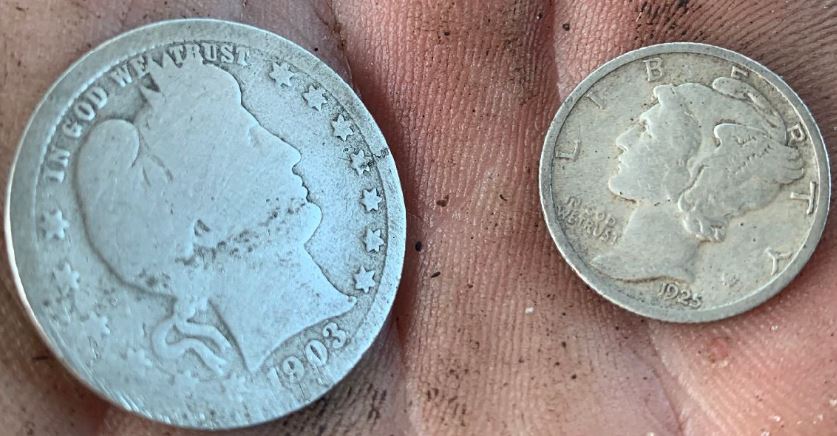
So I bought a Equinox. I have only used it once in a very trashy spot that had some construction going on and found the Mercury dime and Barber quarter. It was tough hunting. I plan to investigate the notch discrimination some and try more soon.

I also cant remember if I sent you a picture of the silver rings before. I found it years ago maybe a 100 yards north of where the stairs used to go up to Chucks Steak House. I also found two half reales at the same time/area.

I always wondered if it was ship wreck era. There are no markings on it. No way to tell I guess. I always think about it when the conversation of silver rings and the 1715 ships comes up.


Coins Found By Al C. In A Trashy Area Using His New Equinox.
Photo by Al C.


Intertwined Silver Rings Found by Al C.
Photo by Al C.

Thanks for writing Al.  Nice finds.  Congratulations.

I've found a few sets of intertwined rings but unfortunately at this time don't have the foggiest idea where.  They aren't marked either.  One set has one silver, one gold and one other ring.  None have markings.  I think I have one set that has more than three rings intertwined -  I think five.

Here is the one set I had handy.  They look much like yours.


I might be lucky enough to have some records that tell me when those were found.

==

Brian B. sent me the following email and link.

Hello.. Still enjoy your great reads daily. Hope all is swell and glad to see you have a bit of free time as of late on the shores. Ran across a Jan good read as might be a dupe to you but if not, it's a good recap about the latest battles over treasure finds. Thanks Brian


Below is the lead to the article and the link.


A Shipwreck Off Florida’s Coast Pits Archaeologists Against Treasure Hunters


The discovery of a legendary wreck raises questions about who should control sunken riches

Here is the link.


---


The surf today is supposed to be 0 - 1 foot, but Sunday it looks like  a 6 - 10 foot prediction.


Source: MagicSeaWeed.com


Happy hunting,
TreasureGuide@comcast.net

Monday, February 17, 2020

2/17/20 Report - Conductivity Numbers for Reales and Other Test Targets. Winding Unpaved Roads.


Written by the TreasureGuide for the exclusive use of treasurebeachesreport.blogspot.com.

Variety of Test Targets Including Among Other Types of Finds a Four-Reale and Half-Reale 

For whatever it is worth, I decided to look at the conductivity numbers for the recently found four-reale and half-reale.  I forgot what numbers they produced in the field and wanted to know that so I took them out to test along with some other targets for context.

Left to right in the photo above are the targets: (1) a 13 gram four-reale, (2) a 1 gram half-reale, (3) a small very thin bit of what looks like copper found at the same site, (4) a silver cross, (5) a silver ring, (6) another silver ring, (7) a copper alloy looking piece.

I used the factory presets, except I used the Beach 1 mode, which is what I used on the beach.

Below are the conductivity numbers that I got for each item using the Equinox 600 metal detector - the same detector that found the first three and the seventh item.

Item                                  Conductivity Reading

1.  13 gram four-reale -  29 - 31
2.   1 gram half- reale -   17
3.  very small copper  -    2
4.  silver cross             -   20-21
5.  silver ring               -   30-31
6.  oval silver ring       -   35
7.  copper alloy piece  -  20-21

I was most interested in knowing the numbers for the reales.  The reals consistently produced numbers that were distinct from most of the other targets, except the four-reale produced numbers in the same range as one of the silver rings.   The small half reale produced a very stable 17, while the numbers produced by the much larger four reale were less consistent.

I get the feeling that shape affects the conductivity number.  The more thin and irregularly shaped silver cross produced numbers that were between those of the two reales.  I should do a thorough experiment on that someday.

The conductivity numbers can be useful in some situations, but there is a lot of variability and overlap.   It seems that the position of the object and its depth can change the numbers somewhat.  And many different types of objects produce the same or overlapping numbers.

It does appear that reales will generally show conductivity numbers from around 17 and up.  I do find the numbers useful to some extent even though they may not always be precise or consistent.  Too much reliance on the numbers could be a big mistake. 

As detectorists we are always dealing with probabilities.  I would define skill as the ability to improve the probability of success through intentional action.

If there is one thing I regret not remembering from my college and professional years it is the math of probability theory and statistics.  Detectorists use a variety of types of clues or signals that if properly interpreted and used can dramatically increase the probability of success.   Although I don't actually need to do the math for field applications, it would be helpful for explanations

---

Some say heaven has streets paved with gold.  I don't really know what use I'd have for that.

I see it as unpaved roads winding up and down hills sparsely decorated at various distances by two or three tightly grouped small but happy homes built by struggling young families recently returned from the war and animated by children of various ages tumbling in the summer grass and exploring every nook and cranny of the nearby woods and streams, catching frogs and snakes or sledding in the snow.

That is what I see sometimes when I awake in the private threatre of night.  The gang is still there, just as it was.

In our plaid shirts and blue jeans, seven year-old David, a year older than I and a veteran at seven years of age, walks me down the road past the barns, farm fields and cows to my first day of school, neither one of us having any way of imagining what lies in the years ahead.   A special good fellow, I'd like to thank David for his company in those carefree days.

He's not the only one.  There was Eddie, Gary, Bobby, Loretta and Becky and others.  We shared the same hills, neighbors, schools and friends for our entire childhood.  We had a baseball team in summer, and a football team in the fall, even if we were a several positions short.

I'm sure I'm not the only one that awakens in the night and returns every once in a while to those green hills to meet old friends so many years and miles away. 

---

I've been eagerly watching the surf predictions and hoping that the predicted big surf doesn't disappear.


Source: MagicSeaWeed.com.

As of this morning, it still looks good.  Rather than decreasing, the predicted surf for next weekend has actually increased another foot.

Happy hunting,
TreasureGuide@comcast.net


Thursday, January 23, 2020

1/23/20 Report - T. C. Beach Conditions Rating Decreased. Beach Developments. One Find.


Written by the TreasureGuide for the exclusive use of treasurebeachesreport.blogspot.com.

Chunky Four-Reale Dug Yesterday.

I'll do some cleaning and close-up photography and show other finds some other time, but mostly what I want to do now is show what some of the beaches looked like this morning.

Yesterday I showed photos of Ambersands, Seagrape and Turtle Trails.  I have photos of those beaches from this morning so you can see how things changed since yesterday.

First Ambersands.

Ambersands 1/23

You can compare that with yesterday's photo, which was taken closer to low tide.

Damaged Stairs At Seagrape Trail 1/23

The bottom of the stairs at Seagrape have been damaged by the high water lately.  I'm surprised they haven't closed Seagrape Trail yet.  That could happen.


Seagrape Trail Beach 1/23

You can see that the water has been chipping away at the foot of the dunes.

Erosion Control Bags at Turtle Trail 1/23

Last night dumped several inches of sand over the bags at Turtle Trail, which were much more exposed yesterday.

Turtle Trail to the South Near the Second Flag Pole 1/23

Here is a picture of a cut that I posted yesterday from about the same area.  The cut was gone today and the slope was mushy.


Cut on Seen at Turtle Trail Yesterday 1/22

There was more sand on the slope today.  The cuts were smoothed out.  The beach was mushier, but the dunes were still being cut into.   Much of that was into renourishment sand.

Here is another photo of the same area today.

Turtle Trail 1/23

Yesterday the spot shown in the photo above had about seven inches of sand over the older orange sand.  With the additional sand today, there would be somewhere around a foot or more of sand over the old orange sand in that area.

John Brooks Beach Today 1/23

The water had been back pretty far at John Brooks, but the beach was pretty smooth, with only some small dips.


High Water Line At John Brooks This Morning 1/23

It looks like the surf was coming more directly onto the beaches today, rather than having the angle that created the cuts.

I'll get into that more some other time.  In recent years most of the windows of opportunity have been brief.  Lately they have often been occurring early when a front comes through but don't last long.

The more you know about the history of a beach, the better off you will be.  To get the most out of a single beach photo, it should be taken in its historical context.  A day old, or week old or year old photo has value if you know how to use it.  I'd love to have a photo of the same beach from the same  spot taken over the decades, for example,  That would show how it developed and put its current condition in context.  Where the beach was yesterday, last week, or last year, are all important and useful facts that help you better understand where it is today.    I'll get into that more some other time too.  There are a lot of things to talk about.

I was pleased with the performance of the Equinox in rough black sand beach conditions.  I'll get into that more some other time too.

Notice that I didn't decrease my conditions rating to a 1.  Just to a 2.  We'll see which way it goes from here.

The surf is still pretty high today.  It will be decreasing slowly for a couple days.

Happy hunting,
TreasureGuide@comcast.net

Friday, November 22, 2019

11/22/19 Report - Comparison of Equinox and ATX Metal Detectors. Tropical Storm Sebastien.


Written by the TreasureGuide for the exclusive use of treasurebeachesreport.blogspot.com.


Tropical Storm Sebastian
Source: nhc.noaa.gov

Almost December and there was a tropical storm in the Atlantic named Sebastian.  It is heading away from us and won't do much of anything for our beaches.

I found out yesterday that some of those formless beaches have a lot of scattered modern coins and maybe an occasional surprise.

The ring I picked up yesterday was a fancy ring with lots of stones - one big red one and numerous clear smaller stones.  Turned out it is junk though. 

The coin count was high, but mostly pennies.

---

I feel like I have enough experience with the Minelab Equinox 600 now to compare it to the Garrett ATX.  I'm just talking about general impressions.  I don't have as much experience with the Equinox yet.

First, the biggest difference to me is that the Equinox is a quick starter.  It doesn't take a long time to learn how to use it.  It seemed like it took me a really long time to get comfortable with the ATX.  They are very different types of detectors.

One thing that I like about the Equinox, and found surprising, is the effectiveness of the different detecting modes.  It has modes for Park, Field, Beach and Gold.  Each of those has two settings or sub-modes.  For example in the Beach mode there is a mode for detecting on the beach and one for detecting in the water.  You can easily select a mode and it will do a pretty good job for you.  At least that is my experience.  I was surprised, for example, how well the beach mode handled the black sand that you find on some Treasure Coast beaches.

The ATX has no preset modes but you can ground balance the detector for any type of ground.  Nothing wrong with that.  You can use either discrimination or all-metals modes.  Discrimination mode works well, but I prefer all-metals when going for the absolute maximum depth in wet salt sand.

If you aren't accustomed to ground-balancing a detector, you might find doing that tricky at first.

You can rebalance as you move to different areas of the beach.

One of the biggest differences between the two detectors is the weight.  The ATX is a heavy detector and the Equinox is light.  I'm sure there are people who would not want to lug around the ATX.

The ATX uses up battery power fairly quickly, while a fully recharged Equinox will run for a long time.

When you get a detector that like the Equinox has a meter readout, you might expect it to help you identify the type of target that is producing a signal.  I've found that very little help, and have in the past shown why.  Gold rings, for example, produce a wide range of numbers.  That makes no-dig decisions risky.

I believe you can learn to extract as much information from audio signals as you will get from a meter readout, although a meter readout can provide some useful additional information when used in conjunction with the audio and a good analysis of the site.

I didn't expect the Equinox to detect very small piece of metal like the ATX does, but it detects small pieces as well as the ATX as  long as they aren't iron.  The Equinox gives a barely audible signal on some pieces of iron that the ATX would scream.   That is the case even if you are not discriminating iron.  Sometimes you won't want to be bothered by barely visible pieces of iron or other metals.  The sensitivity of the ATX to small pieces of iron can be either a problem or a benefit, depending upon what you are trying to do.  I think most beach detectorists would not like that characteristic of the ATX.

The Equinox is a easy to use metal detector that in my opinion is very satisfactory for the vast majority of situations.  There are however still situations when I would select the ATX.  That would be especially true when I want to make extra-sure I'm not missing anything.  That is how I see it at this point.  I would use other detectors at times too, but for this discussion I'm just talking about the Equinox and ATX.

---

We are still getting some fairly high tides, but the surf is down to around two or three feet.  The surf will continue to decrease for the next several days.

The weather is beautiful now.  I like it much better than those nearly 100 degree days.

Happy hunting,
TreasureGuide@comcast.net

Friday, November 15, 2019

11/15/19 Report - Some Small Junk Finds. Dating Nails. Modern Tin Found On Ancient Wreck.


Written by the TreasureGuide for the exclusive use of treasurebeachesreport.blogspot.com.

Broken Small Possible Tack Or Other Connector.
Here is one find I was able to see after a little cleaning.  When I dug it all I saw was a small black lump, but a lot of the crust easily came off.   After getting a look at it, my first impression was that the top was brass but the stem looked iron.  That doesn't make much sense to me, and it might not be right.  I'll have to get it cleaned better.  That shouldn't take long.

It seems to be a tack or maybe a broken rivet or something.   Looks old, but no way to say at this point.  It was one of a few small pieces I found yesterday.  The shank is very square but broken.

I just happened to run across a nice web site on nails as clues to age.

Here is one of the diagrams from the site.


And here is the link for more information about that.


A couple other old small heavily-encrusted pieces I picked up yesterday included these two similar small pieces of what I think is lead - but very thin.  I'm pretty sure not they aren't aluminum.

Both pieces less than an inch at longest and very thin.


Nothing significant, but since it was the first time I used the Equinox in those types of conditions, I was happy to see it responding so well to small items in thick black sand.  In fact, I thought it handled the black sand very well in one of the standard modes. Some detectors I like to use in pin-point or all-metals mode in black sand - as odd as that might seem.

There is one piece that is starting to look like it might be silver and maybe a bit of a shield showing.  It definitely needs much more cleaning.

I'm sure there were some better finds, but I haven't received any more reports yet.

---


Work on the new Reidi tee in central Tallinn yielded another surprising archaeological find recently, this one providing something of a riddle, ERR's Novaator science portal reports.

Workers found a buried wooden ship which archaeologists later determined dated from the end of the medieval period/beginning of the early modern era. Since musket shot was found in situ, the ship could not have been from any earlier than the dawn of the firearms era. Firearms were in common use in Europe by the fifteenth century.

However, tinned food was not in use at that time, which raises the question why a can with an expiry date from 1972 was found within the ship's structure...

Here is the link for the rest of that article.

https://news.err.ee/996439/reidi-tee-work-yields-puzzle-as-modern-tin-can-found-in-ancient-shipwreck

Things of different ages can get intermingled.

---

Source: MagicSeaWeed.com.

Today the surf was down, but, as you can see, it will be building again by Saturday.  I hope the fronts keep on coming.

Happy hunting,
TreasureGuide@comcast.net

Wednesday, October 9, 2019

10/9/19 Report - Mystery of the Strange Looking Coin. Sedwick Auction. Observations on Several of the Metal Detectors I've Used.


Written by the TreasureGuide for the exclusive use of treasurebeachesreport.blogspot.com.

Interesting Lot in the Current Sedwick Auction Catalog.
Take a look at the above item.  What do you think it is?  Looks strange, doesn't it?

I was looking through the current Sedwick auction catalog and noticed the item shown above.  It is referred to as an "imitation cob."   Below is the lot description.

Caracas, Venezuela, 2 reales "imitation cob," date as 142 date (early 1800s), struck over a Spanish bust 2R (milled edge), rare, NGC XF 40. ,KM-C13.1. Well-centered pillars, off-center cross (with often off-the-flan M visible to right), faint toning around details, but most important aspect is that the edge shows traces of the rectangle-circle milling from a bust 2R (first we have seen). NGC #4841431-006.

So it looks like somebody for some reason turned a milled Spanish 2 reale into a fake cob, and didn't do a very good job of it.  The elements on the coin are very crude.  Was it made to fool people?  Maybe it was just somebody fooling around.  The date doesn't make sense at all.  There is a story behind that, but I can only wonder what it is.

Here is the link to the imitation cob.  


There is another imitation cob in the catalog that is very much like the one shown above.

Here is the link to the Sedwick auction site.  

https://auction.sedwickcoins.com/auctionlist.aspx

You need to register to bid.

Among the more interesting pieces, in my opinion, were the gold finger bars.  The finger bars had some of the highest auction estimates of the entire auction.  They were in the third session.   Look around lot 80 or 81.

I really think there will be a lot of reales that don't sell.    There is something for everybody though.

----

I wanted to rank the metal detectors that I've owned and used over the years.  I found out it wasn't easy to do that.  There are a lot of factors.

This isn't an objective ranking or comparison.

My favorites though are the Noga and MacDonald modified Nautilus detectors.  They were excellent at finding gold on the beaches and in the water.  That is what they were made for.  They nulled on iron, which I liked.   If I'd been hunting relics instead of gold at the time, it would have been a different story.  But they worked very well for what I was doing at the time, and back then I was doing it a lot and had a lot of success with it.  One story that I recall and that illustrates how those detectors worked, was when I detected a small gold bead very near the access at Turtle Trail.  I could easily detect the bead, but I could find it.  I put a handful of sand containing the bead on the coil and still couldn't see the bead.  I moved the sand around and the detector gave a signal.  The sand was course and a color that matched closely to that of the bead, but I eventually found the bead.

Herb claimed his detectors were better than the Noga ones, but I'm not sure that was true.

I know some of the coils for those detectors were hotter than others.

They were very easy to set up and use because they were made for one type of hunting and didn't require or allow much adjustment.

The reason it is so difficult to rank the detectors, is that most of them have things that I like and find very effective, but also negatives.

I'd tend to rank the Garrett GTX second among those I've owned, but it is very heavy, difficult to learn to use well, and loves iron.  Those sound might sound like serious problems, but when you learn to use it and if you aren't bothered much by trash, it is a powerful detector.  I have confidence that I won't miss much of anything with that detector.

Of course the best detector for you always depends upon what you want to do with it, and your style and even your personality.  There are some people who would never ever use the GTX.

In the middle of the pack are many others.  High in the middle of the pack I'd put the other Minelab detectors that I've owned, including the Excalibur and Sovereign.  

I used the Excalibur for several years.  It worked well, but I used it differently than most people.  I always used the pinpoint rather than the discrimination mode.  If I'd been able to get either the Noga or MacDonald detectors at that point, I would have been using them.

I'd rank the Fisher 1280 right up there with the Excalibur.   I used the 1280 a lot and found a lot with it.  It was a good detector and very reliable.  I eventually sold it for about as much as I bought it for.  Long before I sold it, I found enough coins to more than pay for it, not counting any jewelry.  I was keeping good records at the time and knew exactly when my coin finds went over the purchase price, which, if I correctly recall, was about $640.

The 1280 was also the detector that found my first silver and gold rings.  One of the things I learned while using that detector is the danger of using too much discrimination.  Overall, it was one of my favorites.

Maybe I rank it higher because it was the detector that I learned a lot from and it found me a lot in my early days of metal detecting.

I'd rank the Royal Sabre after that.  For such an old detector, it has a lot of nice features, but it I'd use it in dry sand or dry land only.

Then maybe the Stringray.   I had trouble with the Tesoro Stingray from the beginning.  I sent it back about three times and it was returned with the same problem.  They wanted to blame it on underwater cables or something in the area, so I told them to send me another one to try in place of the original one to see if it was the location or the detector's fault.   The replacement detector worked fine.  The original Stingray had a grounding problem and the replacement was hardwired.  

When I eventually sent the replacement in for repairs years later, they said it wasn't under warranty because it had been modified.  That is one way for them to get out of their Lifetime Warranty, but they should have had records showing it was the detector as I received it from them. 

When it worked, it was not the deepest seeking detector, but was good at detecting small gold.  It was never anything other than a back-up detector for me.

After that I can't say much good about the other metal detectors.  I probably didn't know enough about the White's CoinMaster to rank it fairly.  The same might also be the case for the Garrett pulse detector.  So I won't say much negative about them.  I know the CoinMaster didn't get a fair chance.  I just didn't know much about metal detectors or metal detecting when I had that one.

I know there metal detectors out there that might be better.  I'm just reporting my observations and feelings on some that I've owned and used.  The ranking is scientific and it isn't objective, but some of you might find my observations somewhat useful anyhow.

I didn't include anything about the Equinox today.  I plan on doing more precise testing on it.  So far I like it a lot.  It seems like an effective detector that could be useful in many situations.  Right now I'd rank it above the Excalibur and in some ways above the GTX.  I don't want to say much more about it yet, but it looks like I will be using it a lot in the future.

---

The surf is going to be about 3 - 4 feet for a couple days.  I'm not expecting much change to the beaches for a while.

Happy hunting,
TreasureGuide@comcast.net


Minelab Equinox. 
I'm just leaning the Equinox, but it appears to be an easy to use and adequate metal detector for a variety of situations.   I expected the visual displays to be more useful, so that was a bit of a disappointment.  You can avoid trash, but in the process can miss a lot of good targets.

Thursday, September 26, 2019

9/26/19 Report - Karen Turns Our Way. Software Update for Equinox. Metal Detector Maintenance.


Written by the TreasureGuide for the exclusive use of treasurebeachesreport.blogspot.com.

Tropical Storm Karen and Hurricane Lorenzo
Source: nhc.noaa.gov
We have two systems in the Atlantic to watch now, although neither is likely to affect us much, but they weren't sure about Dorian and Karen has already made a turn.

Projected Path of Karen.
Source: nhc.noaa.gov

Karen, which was heading north/northeast, has made a turn and is now heading west towards the Bahamas.  They are still saying she isn't anything for us to worry about.  That doesn't necessarily mean she won't eventually send us some nice surf.

Predicted Surf for the Fort Pierce Area.
Source: MagicSeaWeed.com.
As you can see the surf is supposed to increase next week.  Unfortunately I'm not seeing any north winds to go along with it.

---

Several people notified me of the 2.0 software update for the Equinox detectors.  I'll include the note from Joe D. because he added some other useful information, including his experience with the update.

Here is what Joe said.

   I hit Carlin Park today after a quick look, just before low tide! I really liked what i saw, and hunted multiple lines from dune cut to water line! And also amongst the rocks! I love hunting here when this much is exposed by the weather! Although there were some mushy spots, there was plenty of areas to search!  
    On the not to love side, there were few good targets! A lot of minute can slaw, and probably 50 pull and pop tabs! I was mostly aware of what the targets were, but dug everything anyway to reinforce 

sound differences! I pulled a few coins in the rocks that were near cemented in, and had to work to get out! But nothing old! Still and all, l still like it there!

     I got a notification from Minelab of a new software update! This was the first update since I've owned this machine! The process was fairly quick once i figured out where to find it on the site! It was listed under the specific detector, not the main page! 

    I also took the time to disassemble and clean my detector! I've used it a lot lately so the need was there to check out all the parts! I had noticed that the plastic arm cuff was creaking a lot when detecting, and i thought it may break a few times today! (Really the only cheap part) I added a temporary fix until i get a new aluminum Jeff Herke cuff from Steves Detector Rods; that i ordered today! I've emailed Steve several times in the last several days, and he was extremely helpful, and accommodating for the order!

     I also checked the silicone seal that i installed a few months ago in the handle, and cleaned before reinstalling! Its doing a great job keeping water and sand out of that area! Well worth the money! 

    The cleaning process reminds me a lot of cleaning my rifles!  I got nailed by a few carbon fiber strands from inside the shaft sections, but now I'm ready to go again! 

     Also, i pull the coil cover off and wash the coil out after every beach run! It can build up a lot of sand there, as well as the lower section of the shaft, which can clog and hold water and sand! Some people hate coil covers, but i would not hunt without one! Or my coil would be destroyed by now!

    I will send a few pics, as always!


 Joe D.

Thanks Joe, and thanks to all of those who took the time to notify me of the update.

Here is what Minelab describes as the benefits of the update.

Difficult ferrous targets — the common enemy for all detectorists. That is until EQUINOX. Hit the download on our EQUINOX update to make those pesky bottle caps, rusty nails and other falsing targets a thing of the past. Fire up the Minelab Update Utility and you’re on your way. It’s simple. You’ll experience the enhanced Iron Bias feature, improved EQUINOX 600 backlight and much more.

Improved Iron Bias

Iron Bias has been enhanced with the addition of a new Iron Bias settings profile. The original EQUINOX Iron Bias 'FE' settings will still be available, but there is now the option to switch to the new Iron Bias 'F2' settings, which have an improved capability to reject a much wider range of difficult iron targets, including bottle caps.

EQUINOX 600 Backlight Brightness

The EQUINOX 600 now has the ability to adjust the backlight brightness to an additional 'Low' setting that matches the minimum setting on the EQUINOX 800. This 'Low' brightness is ideal for detecting at night and in low light conditions.
And here is the link for the update.

https://www.minelab.com/usa/equinox-software-update-2-0?fbclid=IwAR3QcyFBFqKsq-uzIG0tAhWewoMFjvKAP2DCuqhRGGIrzB7cR2GZG9i4L9g

I really didn't have much trouble with iron or other trash using the Equinox 600.  I've discussed the reasons for that in the past.  It is more the possibility of skipping gold than hitting trash that bothers me.  There are a variety of ways of staying away from or identifying iron.  Sometimes you don't want to skip it though.

I think I'll quit there today.

Happy hunting,
TreasureGuide@comcast.net