Showing posts with label galleon. Show all posts

Monday, March 11, 2019

3/11/19 Report - Anchor of Merchant Royal (?) Recovered. Snorkeler and Whale. Increasing Surf.


Written by the TreasureGuide for the exclusive use of treasurebeachesreport.blogspot.com.

Anchor in Tangled Net
Source: https://www.foxnews.com/science/anchor-from-most-valuable-shipwreck-in-history-found

A scuba-diving treasure hunter said he now fears a “dangerous” gold rush after what is thought to be the anchor of the most valuable British shipwreck in history was found off the coast of Cornwall. The anchor is believed to be that of the Merchant Royal, which sank some 400 years-ago while carrying 100,000 pounds of gold and 400 bars of Mexican silver – thought to be worth more than £1bn today...

The Merchant Royal, a 17th-century English galleon, was known as “the El Dorado of the seas”, and traded with Spanish colonies between 1637 to 1640. As well as its golden and silver, the vessel sank while carrying nearly 500,000 pieces of eight and other coins – making it one of the most valuable wrecks of all time. Added Mr Milburn: “I know there are lots of anchors that look just like that one – it’s from a big wooden ship. “It’s an admiralty patterned long shank anchor, it’s the right type for the Merchant Royal...

Here is the link for more of that article.

https://inews.co.uk/news/uk/merchant-royal-anchor-shipwreck-billions-pounds-treasure-cornwall/

It seems that good reporting is quickly becoming a thing of the past.  They just go for attention-grabbing headlines these days and don't much bother to document what they are saying or give important details.   Both the inews article and Fox video leave out a lot that a careful reader might like to know.  For example, I'd like to know what makes them so sure they know what ship the anchor belongs to.  Is it only the style of anchor and location where it was found?  Or were they just eager to put something like "most valuable shipwreck ever" in the headlines.  I suspect the headline has a lot to do with it.  Why be careful about facts when you can get attention?

I'm not saying that it couldn't be the Merchant Royal.  I'd just like to know what makes them think it is.  Maybe I missed that somehow.

Odyssey Marine once thought they were on the Merchant Royal, but later it was later concluded that they were actually on the Mercedes and had to give the treasure to Spain.  If it was not easy for Odyssey Marine to know what wreck they were on, I don't know how a single anchor can be so conclusive.  Maybe I don't know anything, but that is how I see it.

Wikipedia says the following about the Merchant Royal.  (The links on that don't work, and I didn't take time to remove them all.)

Merchant Royal also known as Royal Merchant, was a 17th-century English merchant ship lost at sea off Land's End, in Cornwall County, in rough weather on 23 September 1641. On board were at least 100,000 pounds of gold (over 1.5 billion USD in today's money)[3], 400 bars of Mexican silver (another 1 million) and nearly 500,000 pieces of eight and other coins, making it one of the most valuable wrecks of all times.[4]

The Merchant Royal spent three years trading with Spanish colonies in the West Indies from 1637 to 1640. England was at peace with Spain at this time. The Merchant Royal and her sister-ship, the Dover Merchant, called into Cadiz on their way home to London. By all accounts she was leaking badly after her long voyage.

When a Spanish ship in Cadiz at the same time caught fire just before she was due to carry treasure to convert into pay for Spain's 30,000 soldiers in Flanders, the Merchant Royal's Captain Limbrey saw his chance to make a little more cash for his owners. He volunteered to carry the treasure to Antwerp on his way home.

The Merchant Royal went on leaking after she and her sister-ship left Cadiz and, when the pumps broke down, she sank off Land's End in rough weather on 23 September 1641.

Eighteen men drowned in the sinking. Captain Limbrey and 40 of his crew got away in boats and were picked up by Dover Merchant. It is not likely that the treasure was taken aboard the Dover Merchant.


Thanks much to Dean R. for pointing to that story with the inews.co link.

---

Source: See FoxNews link below.

One web site proclaimed, "modern day Jonah."  Well, it did involve and man and a whale.  And the the man, a snorkeler, did end up in the whales mouth.  You can see the man's bottom and legs above.  But he wasn't in the whales belly, and it wasn't for three days.  I'm sure Rainer was glad about that.

Rainer Schimpf, 51, was snorkeling off the coast of Port Elizabeth, South Africa, when he ended up in the path of a Bryde's whale, which opened his jaws and engulfed him headfirst...
Here is the link if you want to read more about that.

https://www.foxnews.com/world/diver-survives-after-being-scooped-up-in-whales-mouth-off-south-africa

---

Source: MagicSeaWeed.com.
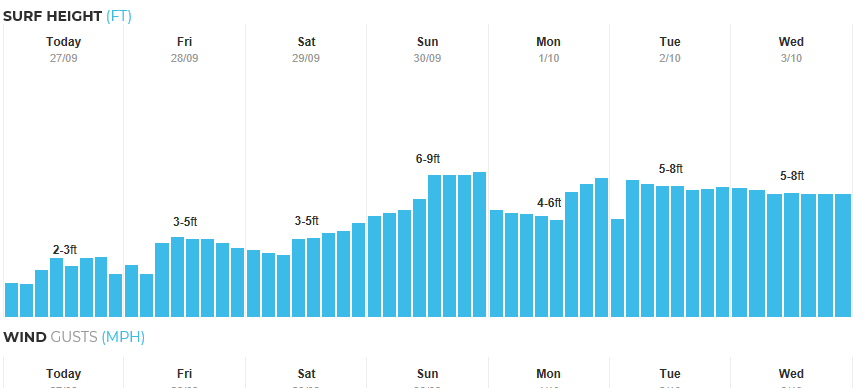
As you can see, there will be an increase in the surf up to three to five feet Wednesday.

Happy hunting,
TreasureGuide@comcast.net

Tuesday, October 30, 2018

10/30/18 Report - Life On Board a 17th Century Galleon. Serial Number Hunting. Survey Monuments. Hurricane Oscar.


Written by the TreasureGuide for the exclusive use of treasurebeachesreport.blogspot.com.

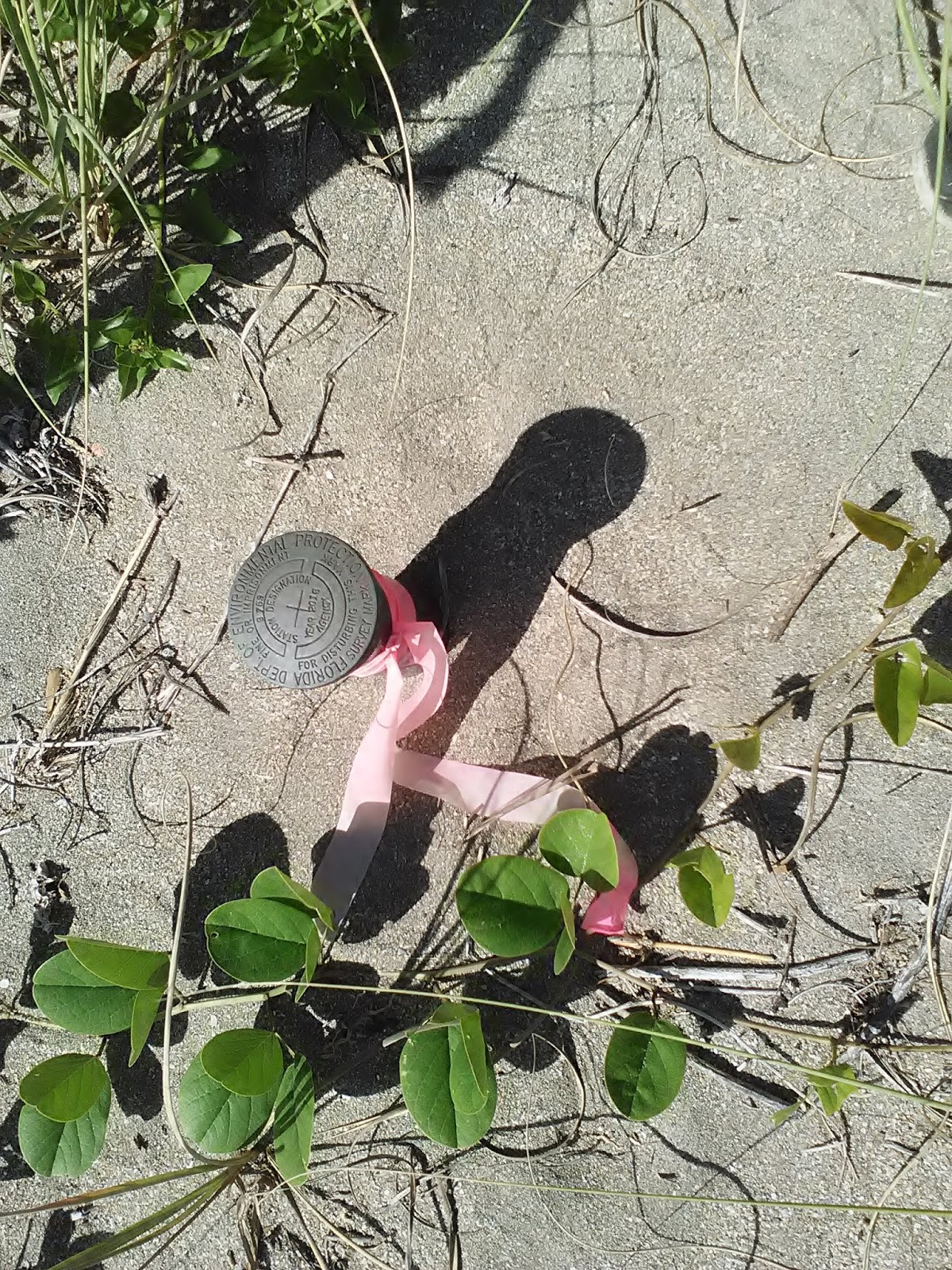
Survey Monument Near John Brooks Walk-over.
A couple of days ago I was talking about tracking the beach and how it has moved over the years.  In that post I showed a map with the survey monuments marked.  Here is one of those markers at John Brooks, just south of the walkover.

---

I've also been talking about serial number hunting.  Here is a near winner that I got recently in change.


The serial number is 21221912.  If the nine was either a one or a two, the bill would have been worth probably at least ten times the face value.  It would have been what they call a binary.  As it is, it is a tertiary (has three different numbers in the serial number) and still might be worth a little premium.

---

It is easy in this day and age to forget about the people and experience of daily life on board a 17th or 18th century galleon.  It is difficult, if not impossible, to have much of an idea of what it was like.  Below are a couple examples reported by passengers that will give you some idea of the rituals.

The watchglass (sandglass) and the compass box were both maintained with care.

At each half-hour turning of the watchglass, the page on duty calleed out a verse, with words specific to each of the eight turnings in the four-hour shift.

At the first turning, he would say, "Good is what's past,and better what comes; one glass is past and the second is filling; more will be filled if God be willing; to keep the right time makes the voyage fine." 


At nightfall after the evening meal those on board heard the Buenas Noches of the page bringing light to the compass box for the night: "Amen and God give us good night; good voyage, good passage for the ship, sir captain and master and good company."  Then two pages recited the evening prayers: Pater Noster, Ave Maria, Credo, and Salve Regina.  Once finished, the pages on duty went to care for the watchglass, which presumably had been running as usual while the prayers were being said, and recited the nightly blessing; 

Blessed be the hour God came to earth, 
Holy Mary who gave him birth,
and Saint John who saw his worth.

The guard is posted,
The watchglass filling,
We'll have a good voyage,
If God be willing.


On special occasions, there might be quite elaborate religious ceremonies in a fleet, particularly on the capitana and almiranta.  After surviving a thirty-six hour hurricane, one ship returning from the Indies in 1622 held a service of contrition dedicated to Our Lady of Carmen, patroness of mariners.  Everyone on board attended, with the image of the Virgin, adorned with what finery they could salvage, presiding over the gathering from a portable alter on the poop.  The Jesuit chronicler of this voyage led the service, including in his chronicle the long litany to the Virgin recited by those on board, with Latin phrases chanted by the priest answered by the Latin responses from his floating congregation.


For Holy Week, among other great festivals of the church year, crew and passengers participated more fully in the events, although Holy Week would have been rather early for voyages across the Atlantic.  One description of the events noted, 

Since there were religious in the fleet, most of the people confessed, and  on Holy Thursday, with silks and other things that had been brought along, each ship decked itself out in the manner of a monument , displaying images and crosses, and on many ships there were a large number of penitents attending the persons who carried the images.  Holy Saturday at the time of the "Gloria," the capitana first and afterwards the other ships made much rejoicing and fired all their heavy and light artillery, so much that it was quite something to see.  Easter Sunday, in the morning, all the ships, led by the almiranta, went to salute the capitana, which displayed its many flags and banners, and they saluted her with much artillery.  The capitana returned the salute of the almiranta with seven or eight pieces of heavy artillery and with music and trumpets and other instruments returning the salutes of the other shipwswith music alone.


The above excerpts in blue were taken from Six Galleons for the King of Spain by Carla Rahn Phillips.

---

Oscar is now a hurricane but is out in the middle of the Atlantic and headed away from us.

The surf will build Wednesday then start decreasing again Thursday.


Source: MagicSeaWeed.com.

Happy hunting,
TreasureGuide@comcast.net

Thursday, September 27, 2018

9/27/18 Report - Nine Foot Surf Possible This Weekend. Barber Dime From Rio Mar. People On the Galleons.


Written by the TreasureGuide for the exclusive use of treasurebeachesreport.blogspot.com.

Very Sharp 1915 Dime Once Found at Rio Mar
This dime is very sharp.  It was evidently almost like new when lost.  Look at the sharpness of the details.

You can often get an idea of a where a coin has been by just looking at it.  This one probably spent most of it's life in the dunes.  It doesn't take much salt water exposure to blacken a silver coin, but it evidently was not in the surf.  The details are too sharp for that.

Too bad about the surface oxidization, it would otherwise grade very well.  As it is, most coin collectors would not have much interest in a coin like this.

---

One day I talked a little about the variety of,people that would be on a galleon, from all the way at the top rank down to the cabin boy, but did you know that on warships there was a trumpeter?  In the sixteenth century there would be as many as six trumpeters on a warship, but by the seventeenth century there would be just one.

During battles, the trumpeter would stand on the afterdeck near the poop lantern and play continuously.  When there was no battle, he would play mornings and afternoons and at official ceremonies.

Galleons required a lot of maintenance on long voyages.  Of course skilled workmen were needed on each galleon.  They included carpenters, caulkers, a cooper, etc.  There was also a skilled diver.

The skilled workers had to supply there own tools and make repairs.  Even when there was no battle, rough seas could damage caulking.  Twice a day the caulker inspected the pumps and reported their condition to the captain and pilot.

During battles, the carpenter and caulker stayed below decks and repaired any damage from artillery.  They also worked on the ships during careening between voyages along with local workmen.

You can think of treasure and Spanish galleons and overlook the logistics and all of the daily duties that were conducted by the people on board.  It was no walk in the park.

If you are interested in learning more about that, and everything that went into the building of a galleon in the seventeenth century, I recommend Carla Phillips' book, Six Galleons for the King of Spain.

---

Last weekend the 4th Annual Pirate Fest was held in Vero.  Alberto S. said a there was a nice crowd and lot's of fun especially for the little ones, even a cannon demonstration. Carl Fismer was promoting two books and a sunken treasure workshop in Islamorada in October which includes dives to 2 wreck sites.  

I missed that one.

---

Kirk is still a tropical storm and headed towards the south Caribbean.


Source: nhc.noaa.gov
I'm hoping for some cooler weather.

It looks like a big Treasure Coast surf will be coming this weekend.


Source: MagicSeaWeed.com.
Happy hunting,
TreasureGuide@comcast.net


Monday, May 8, 2017

5/8/17 Report - Deep Water Galleon Salvage in 1950. Personal Flying Machine.


Written by the TreasureGuide for the exclusive use of treasurebeachesreport.blogspot.com.

Diver Using Metal Detector
Source: Oct. 1950 Popular Mechanics
See link below.
I ran across this neat article in an old issue of Popular mechanics. The title of the article is Quest for a Galleon's Gold.

The article is about the salvage of a Ship of the Spanish Armada, which was sunk in 1588.   The salvage rights were granted by Charles II to local Dukes.  There is a report on a salvage effort conducted as early as 1683,  Salvage continued from time to time over the centuries.

Besides the metal detector and airlift, they probed with an air-supplied nozzle to find the buried ship.

The ship is believed to be either the San Juan or Florencia and could have contained pay for the entire Spanish Armada and a king's crown.

I don't doubt that this wreck has been explored in more modern times, but I found the 1950 article very interesting, especially some of the illustrations, a couple of which I posted here.


Source: Oct. 1950 Popular Mechanics.
Link below.


---

Flying Machine.
Sunday I saw a couple of guys at the beach with these motorized propellers that they wear while strapped to a parasail or whatever you call it and go flying.

I've seen people use these on the beach before.  It could be quite handy for checking out the beaches, but I don't think I'll try it.  

If I did ever try it, I'd probably be flying about ten feet off the ground.  

---


Crumpled Copper Find.
I don't know what this went on or what it was for.  It obviously was attached to a surface (has a hole at both ends for a screw) and the round hole in the middle.

---

There is not much time left to respond to the blog poll.  Thanks to all those that responded.

Yesterday there were a lot of boaters and beach-goers, as well as the men with their flying machines.

We still have a couple of days of one foot surf.

Happy hunting,
TreasureGuide@comcast.net


Monday, February 13, 2017

2/13/17 Report - Shipwreck Galley Bricks. An Unlikely T. C. Shipwreck Beach Find: One of My Personal Favorites.


Written by the TreasureGuide for the exclusive use of treasurebeahesreport.blogspot.com.

Someone recently found an old brick along with shipwreck spikes.  They wanted to know if the brick could be from the shipwreck.  As you probably know, bricks were used for the galley ovens.

There are some shipwreck bricks shown in the Mel Fisher database.

I did a post some years ago on a possible galley brick found on a Treasure Coast beach along with some links to references about such bricks.  In that old post you'll also find an illustration of a galley oven.  I won't bother to repeat all of that.

Here is the link.

http://treasurebeachesreport.blogspot.com/2010/09/927-report-galleon-galley-bricks.html

---

A few days ago I was talking about finds that present challenges.  I had one that was a real challenge for me.  I didn't appreciate at the time how rare it was.  I didn't even know exactly what it was when I found it.  It would have been better if I found it today rather than years ago.

The find I'm talking about is a wax seal impression.  When I picked it up near the water's edge on a popular shipwreck beach, I could see a little of the design on it, but I wasn't sure what it was made of.  It was hard and had sand stuck on it.  It wasn't heavily encrusted, but was encrusted in spots enough to obscure part of the design.  I showed that seal in my 2/3/16 post, but that is not exactly how it looked when found

Wax Seal Impression Found on Shipwreck Beach Years Ago.
If you look just right of center, you can see a wing.  To the left of that is the birds body and below that the thighs, which look in the picture like two balls.

Below is an example of an eagle in a similar position, although the wax one has the wings closer to the body and the head is turned the other direction.  I can't see what if anything might be below the thighs, which are identifiable.


As I think you can see from the photo, it is still covered by some crust.  especially to the left of the bird and above the body.

Since I didn't know what it was made of when I first found it, I certainly didn't know how to clean and preserve it.  I've done a little research and what I've concluded so far is that it is a difficult problem. One of the best studies, which was conducted by a museum because the seals that they were displaying were crumbling, couldn't find a highly effective method and decided instead to recreate identical ones from ancient sealing wax recipes.  And that was an easier task, considering those wax seals were not on a salt water beach for hundreds of years.  Antique wax seals that had not endured that rough environment and were kept in near ideal conditions still crumbled over time.  I'm really amazed it survived at all.  Even though I didn't appreciate it when I found it, and still did not appreciate for some years after, it has become one of my favorite finds.  It is one example of a find that I found too early.  I would have been better prepared for it if I found it today, but I will probably never find another old wax seal impression on a beach.  That was probably one of those once-in-a-lifetime things.

Below is the link to a study in which wax seals were created from antique sealing wax recipes and various methods of preservation were tested.

http://cool.conservation-us.org/coolaic/sg/bpg/annual/v21/bp21-20.pdf

Maybe other wax seals have been found on a beach or shipwreck site, but I have not read or heard of any yet.

---

We'll have more small surf, but there will be some more big tides.

I'm starting to think we might not get any good winter storms this year.  Sometimes we get some rougher seas in March.

I know there will be more beach renourishment.  Some has already started and I've seen equipment being readied for Fort Pierce.

Happy hunting,
TreasureGuide@comcast.net


Monday, July 29, 2013

7/29/13 Report - Galleon Construction, $4K Ring Returned, More Sand and Princess Louisa Shipwreck


Written by the TreasureGuide for the exclusive use of treasurebeachesreport.blogspot.com.


New 14K Ladies Bracelet
Beach Find
.
Here is a web site that provides numerous detailed illustrations of Spanish galleons.  It is meant as an educational site for youth, but it does provide a number of interesting illustrations.

http://all-kids.us/ship-parts-page.html


The Treasure Coast isn't the only place being drowned under thousands of tons of dredged sand.  Tons of sand will soon be dumped on Broward County beaches.

Here is a map showing where the proposed beach widening will take place.

http://www.sun-sentinel.com/news/broward/fl-gx-beach-widening-7-25-eps-20130727,0,5158859.graphic

Thanks to Marsha R. for these links.


How can digging a hole a few inches deep in Florida's submerged waterways be considered to be in anyway destructive when thousands of tons of sand are routinely dumped by heavy equipment on beaches and in the shallow water and that is not considered destructive in any sense????  
That is like a nuclear bomb compared to a gnat.
 

A boy went snorkeling to find a lost $4000 ring when he heard that a lady lost it after falling in the water at the base of a waterfall.  He found it, returned it and received a reward.

Here is the link.

http://www.miaminewsday.com/national/15153-boy-13-who-heard-how-devastated-a-stranger-was-after-she-lost-her-4k-wedding-ring-in-a-waterfall-got-his-snorkel-and-mask-on-and-managed-to-find-it.html


I was browsing the web and looking at the number and variety of silver cobs and treasure coins now listed for sale on the internet.  Their appears to be no shortage.  If you enter the name of a sunken treasure ship, most of the time instead of finding information about the wreck, you'll find numerous web sites listing coins for sale.  Some of those sites will give some shipwreck history, but the history is primarily meant to excite interest in the coins. 

Such is the case for the Princess Louisa.   You'll find numerous Spanish coins from this British ship for sale on the internet, along with some history of the wreck itself. 

Here is one web site that provides some very interesting history on the Princess Louisa and its wrecking along with some history on a variety of other old shipwrecks.

I think you'll find the history of the Princess Louisa interesting.

http://capeverdeinfo.org.uk/sport_diving_wrecks.htm


If you read the comments by Robert K. in yesterday's post about fake cobs, you'll want to careful to purchase coins only from known reputable dealers.


How much gold is there in the world above ground?  Some estimates say just over 155,000 tonnes.  Other estimates say many times more.  The estimates vary widely.

One of the more interesting things I found in the following linked article is that, unlike in the past, gold is now being consumed.  That means it is used in ways that now make it impractical to be recycled after it is used.

Here is the link to that article on gold.

http://www.bbc.co.uk/news/magazine-21969100


Treasure Coast beach detecting conditions remain unchanged.  Another day of one to two foot surf.  It will increase a little, peaking around two to four feet on Wednesday and then decreasing again.

Only one day to respond to the blog poll now.  Thanks to all those who have responded.

Happy hunting,
Treasureguide@comcast.net

Wednesday, May 1, 2013

5/1/13 Report - Spanish Galleon Andalucia, Fort Jupiter & The British Period in Florida


Written by the TreasureGuide for the exclusive use of the treasurebeachesreport.blogspot.com.

Spanish Galleon Replica Visiting Port Canaveral
Photo from FloridaToday.com.

Have you ever wanted to see a Spanish galleon?  Now is your chance.

The Galeón Andalucía, a replica 17th century Spanish galleon, is now at Port Canaveral where visitors can take an up-close look for the next week.

It is 162 feet long, has a crew of 22 and 12 cast-iron cannons.

For more of the story and a video use the following FloridaToday.com.link.


http://www.floridatoday.com/article/20130430/NEWS01/130430006/Spanish-tall-ship-arrives-Port-Canaveral?gcheck=1&nclick_check=1

Thanks to Terry T. for sending this link.


Do you know where Fort Jupiter was?  You'll find out if you read this little history of Jupiter.

http://www.pbchistoryonline.org/page/Jupiter


The Jupiter Inlet was shown on a 1671 map, but it wasn't where it is today.  If you've been reading this blog very long, you probably know it wasn't always where it is today.  It was several hundred yards south of the current inlet.

For more information on the history of Jupiter, here is another link.

http://www.jupiterinletdistrict.org/history.htm


Not too long ago I talked about a couple of the Spanish salvage camps, and also what was thought to be a British salvage camp.  Then I received word that the Spanish salvage camp might have actually been a camp for British surveyors.

Ron J. sent me a link to an article where you can learn more about the British period in Florida, including British surveying parties.

When the British gained control of Florida, the Spanish had depopulated the area and laid waste to anything they could, and so with thoughts of repopulating Florida, ...King George III ordered a general survey to be made of the Florida coasts...

The best description of South Florida during the British Period comes from the pen of the surveyors. The first to arrive was William Gerald DeBrahm, who was appointed Surveyor General of East Florida in 1764. In early 1765, DeBrahm began a six-year survey of the eastern coast of the United States, including the area around Biscayne Bay and the Miami River. In DeBrahm's 1770 map, based on his 1765 survey, he named the Miami River the Garbrand River and Biscayne Bay, Sandwich Gulf...

A short time after DeBrahm's visit to South Florida, another surveyor, Bernard Romans, also explored the area. In 1775, Romans published a book to accompany his map of Florida called A Concise Natural History of East and West Florida.

Here is the link if you want to read more about the British period in Florida.

http://scholar.library.miami.edu/floridamaps/english_period.php

Thanks to Ron J. for sending me this link.


On the Treasure Coast the surf is around 3 - 5 feet today.  It will stay about the size, with a little variation, for the next several days.

The wind will be mostly out the east.

The tide changes are getting smaller.

I'm hoping for a good low low tide sometime after this surf slackens.


Happy hunting,
TreasureGuide@comcast.net

Monday, September 27, 2010

9/27 Report - Galleon Galley Bricks


Brick Found on the Beach.

You might be wondering why I am showing a stupid brick. In one of my recent posts, I mentioned using your eyes and scanning the beach for non-metallic objects. Not only can non-metallic objects sometimes be valuable, but they might also provide important information about the site or what went on there in the past.

A brick could indicate an old home or other structure, or it could even indicate the presence of a shipwreck.

If you know what you are looking for you can often get an idea of how old a brick is or where it might have come from.

Bricks are often found on old shipwreck sites because they were used in the galley.

Of course not all bricks come from shipwrecks, but there are some signs that will help you determine if it might be.

Brick Shown in the Mel Fisher Artifact Database.


Here is a brick found on either the Atocha or Margarita site. I forget which now.

Notice the black areas and the course materials in the brick. It shares many features with the brick in the first photo. Unfortunately the photo doesn't show the first brick well.

You can see that the brick from the database has a broader and flatter shape

The Mel Fisher artifact database also shows some bricks that seem to be modern bricks that were mixed in with the wreck debris.

I wonder if the black areas could have been created by smoke from the galley. I don't know.

The Exploring Florida web site mentions galley bricks found on the wreck site of the San Pedro. The web site says, "A Florida Underwater Archaeological Preserve is open at the San Pedro site for divers. The San Pedro is among the most picturesque of the 1733 wreck sites. She is located in a white sand pocket surrounded by turtle grass. Abundant marine life inhabits her grave. A large pile of ballast stones contains flat, red bricks from the ship’s galley."

That is another example.

Here is the link if you want to read more about that.

http://fcit.usf.edu/florida/lessons/shipwrecks/shipwrecks.htm

I've mentioned the Queen Ann's Revenge before. It is a wreck that has been studies a lot. I found a pdf file containing information on the bricks and tiles found on that wreck site.

They also show a picture of a ship's galley. Here is the galley.


The study mentions a variety of types of diagnostic information that could help determine the source of old bricks. Some have quartz inclusions, for example. And the dimensions of sample British and Spanish bricks differ, as do French, I believe.

You might want to take a look at the study. Here is the link.


http://www.qaronline.org/techSeries/QAR-B-07-03.pdf

I understand that bricks in Spanish are called ladrillos, which is also a word sometimes used to refer to more flat and broad bricks.

In summary, some bricks come from shipwrecks. Keep your eyes open for possible clues like that.

On a different subject, researchers have found that the Biblical account of Moses crossing the Red Sea is possible. They discuss how the wind could have affected the water levels, which were considerably different back then, to create a land bridge across the sea.

If you'd like to read more about that, here is the link.

http://www.theblaze.com/stories/research-bible-may-have-been-right-about-red-sea-miracle/

I don't know if you've ever seen the photos of what appear to be chariot wheels under the Red Sea. I think they were in National Geographic as well as other publications.

Forecast and Conditions.

Seas are relatively calm now with winds from the south. The high tides are still pretty high.

There is nothing much in the topics to watch.

Next weekend might have higher seas again. We'll have to wait a few days to see about that.

Happy hunting,
TreasureGuide@comcase.net