Showing posts with label Easter. Show all posts

Sunday, April 12, 2020

4/12/20 Report - Easter Greetings. Archaeological Artifact Investigation Suggesting Nailing of Heel Bone During Crucifixion.


Written by the TreasureGuide for the exclusive use of treasurebeachesreport.blogspot.com.

1911 Easter Card.
---


In what seems to be rare physical evidence of crucifixion, the method used to kill Jesus Christ according to the Bible, scientists say wounds found on the heel of a man buried some 2,000 years ago in northern Italy suggest he was nailed to a wooden cross before he died...

Here is the link for the rest of that article.

https://www.history.com/news/jesus-christ-death-crucifixion-archaeology


A multidisciplinary study of calcaneal trauma in Roman Italy: a possible case of crucifixion is a study providing a more in-depth investigation of the same injury.  The study was published in the April 2018 issue of Archaeological and Anthropological Sciences.

The study indicates that the puncture of the ankle bone was medial to lateral (inside to out). Here are a couple illustrations from that article showing how that could have been done.


The position shown on the right (b) is like the position I referred to yesterday in my discussion of the heel bone with a spike still in it, as being like a ballerina with turnout.  With the toes pointed out, the posture looks similar to a ballerina doing a pleiay.

Position a above is one I didn't suggest yesterday, but reminds me of the crucifix I showed two days ago from the Mel Fisher artifact database.  Just turn the feet a little more to the left (as you look at the picture).

Gold Crucifix From Atocha.
Source: Mel Fisher artifact database.

As any scientific analysis would, this study considered possible causes of the wound other than crucifixion, one of which was the practice of nailing corpses stationary in a coffin, but there was no coffin used in this case.

It would be difficult, and in my mind unlikely, that an aware person could have their feet held and nailed so precisely through the heel bone in the manner shown as illustration a.  Illustration b seems slightly more possible to me, but I don't feel like I have the answer yet.  Still I've learned a lot.

For the entire study and all the details click here.

---

Today I want to express my deepest sympathies to those who are unable, due to severe restrictions imposed because of COVID-19,  to tend to their sick and dying loved ones and unable to participate in funerals or otherwise share and express their mourning in the traditional manner.

Man is more than flesh.

May one and all be touched by a deeper peace and healing this Easter.
TreasureGuide@comcast.net

Saturday, April 11, 2020

4/11/20 Report - Heel Bone Pierced by Spike: Artifactual Proof of Crucifixion? A Personal Easter Story.


Written by the TreasureGuide for the exclusive use of treasurebeachesreport.blogspot.com.

The heel bone and nail from the ossuary of Yehohanan, discovered in Jerusalem in 1968.
 (photo credit: Courtesy of the Israel Museum. Photographer: Ilan Shtulman)
From TimesOfIsrael.com (See link below).

In Jerusalem around 2,000 years ago a Jew named Yehohanan, who was in his mid-twenties, committed a crime against Roman authority. The nature of his transgression has been lost to time, but his punishment is known — he was crucified.

Convicts were executed by crucifixion in the Roman Empire as a matter of course, and histories of the time regularly describe the practice, which was designed to make death prolonged, painful and public. After the famous slave uprising led by Spartacus was crushed in 71 BCE, for example, an estimated 6,000 rebels were crucified along a highway leading to the capital as an illustration of Roman power. 

It is therefore an odd fact that archaeological evidence of this punishment — crosses, for example, or perforated skeletons — has never been found anywhere in the world, with one exception: the stone box containing Yehohanan’s remains.
After Yehohanan’s body was removed from the cross, it would have been laid out in a burial cave. After the flesh had decomposed a year or so later, leaving only the skeleton, his bones were gathered in a simple stone box, an ossuary, in keeping with the Jewish practice of that time. Today, the box is displayed in a gallery at the Israel Museum alongside other artifacts from the period of Roman rule in Judea...


Here is the link for the rest of that article.

https://www.timesofisrael.com/in-a-stone-box-a-rare-trace-of-crucifixion/

Now there is an artifact.  It provides a good example of how artifacts provide evidence but do not tell the entire story.  As we've seen many times, artifacts can be difficult to identify, but the research can teach you a lot.

This artifact, like so often is the case, presents difficulties.  Below is an image of a heel bone.


One of the difficulties is that the spike goes through the side of the heel, which is not how crucifixions are pictured.  Like the crucifixes I showed yesterday, they usually show a single spike going through the top of both feet, with the two feet being on top of each other.

Scholars take this spike as evidence of a crucifixion.  It might be, but could it be something else?  Could it be some other type of torture other than crucifixion.  I don't think it would likely be accident.  To me, crucifixion seems like one of the better explanations, but there might be some other explanation.

Some have suggested that the feet of the person being crucified could have been placed on each side of the main vertical post of the cross and the feet nailed to the cross, one on each side of the upright post.

We can make the mistake of thinking that things were always done the same way.  That is probably not the case.  There can be different circumstances and different people that do things differently.

Some crucifixes show the feet on a bit of a stand attached to the cross.  If there was a vertical support for that stand, the heels could have been nailed to that rather than the sides of the main vertical post.  Or the fellow could have been terribly pigeon toed or had the turnout of a ballerina.  There are a lot of possibilities.  We just don't know the entire story of this artifact yet.

We can also wonder why the nail isn't all the way in the one or why on the other side it is bent over.   Many questions remain.

Part of the value of the artifact is what it tells us, and part of it's value is what it asks us.

---

You might enjoy reading other articles in the Israel Times,  Many of the articles are on Coronavirus, such as the ultra-Orthodox Jewish sect being hit ten times harder than the general population.  It seems the virus hit them even harder than it hit our black communities.  Also interesting is the article on a Holocaust survivor's reflections on the virus.

That reminds me of the 104 year-old WWII vet that had the Spanish flu and survived it and also had COVID-19 and survived.  That fellow is a survivor.

---

Among the most legendary of treasures are the Holy Grail and the Ark of the Covenant.  Probably no other treasures have been the subject of so many books, stories and movies.  Although they did exist, much of what has been written or portrayed about them is pure fiction.

There are other Biblical lost treasures, such as the priestly breastplate that was made of gold and covered with gems.  It has been claimed that one of those gems has been found.  I'll get into that more some other time.

---

My Easter Story.


They say you can never go home again, but last night I did.  It was before 4 AM when I awoke and vividly remembered an experience that put me at a particular time and place of my youth.

It was sixty-five years ago, late afternoon or early evening, the Saturday before Easter.  I and a few of the other kids had just finished our imaginary rendition of a major league baseball game on a field on top of a hill that would a little later in the year be covered by hay tall enough to hide in.

I could see my young mother in her apron  standing on the porch off the kitchen half way down the hill as she called me in.  The water for the Easter egg dye just reached a boil.

The kids scattered in four or five different directions, each towards their home, but I stood there for a moment and looked out over the green valley that was my world.  I had no way of understanding it at the time, but it felt like time froze for a moment as everything I saw and felt was being stamped indelibly into my mind.

At the bottom of the valley was a creek, and above that a red dog road, and on each side of the road at various distances were the few scattered homes, each one having a name, such as Bristers, Simpsons, Hamiltons, Harts and Mounts.

As I looked over that green valley with my young eyes, it was a scene that would never change for me.  I noticed a wisp of smoke rising from Brister's trash pile.  The smoke drew my attention.  It seemed slightly strange or out of place on such a bright clear beautiful scene.  

Mom was so young.  And dad was still here.  The kids are now scattered away from that valley.  Some of them are gone too, maybe like that wisp of smoke.

But I'm still that young boy.  Mom is still that young woman.  Dad is still here.  The valley never changed.  I know that because I visited that place again last night.

---


The surf is still small, but the tides are still big.

As they isolate and distance, Christians await Easter morning and Jews observe Passover.  Easter and Passover are inseparable.   You'll see that in the Bible.
Passover for the year 2020 starts on the evening of Wednesday, April 8th and ends at sunset on Wednesday, April 15th for Reform and progressive Jews living inside Israel who follow the Biblical text. For Orthodox, Hasidic, and generally Jews outside Israel the festival lasts 8 days ending at sunset on Thursday, April 16th.

Blessings,
TreasureGuide@comcast.net

Wednesday, April 17, 2019

4/17/19 Report - Seeing Beaches, Cuts, Bars and Dips Form. Reflections on Cathedral of Notre Dame.


Written by the TreasureGuide for the exclusive use of treasurebeachesreport.blogspot.com.


I have an free Easter present for you today.  It is a little early. and it wasn't what I planned on doing, but it is just too good.

I'm going to show you an excellent wave tank video.  It begins with small slow waves and increases the frequency of the waves and then the size of the waves. You will get a really good look at how waves of different frequencies and sizes affect a beach differently.

There are some things I want you to watch carefully, so I'll give you advance warning.

Here is a clip that comes from the beginning of the video when the waves are small and the time between them is relatively large.


Small Infrequent Waves Building a Beach.

Notice how the sand is agitated in the high energy area where the wave is breaking.  I've mentioned this before, but this is the best illustration that I've seen.  You can really see the sand being suspended.  The suspended sand is then dropped on the beach as the water slows on the slope.

Suspended Sand Under Front of Wave.

You can really see how the sand is suspended in this clip  That sand moves back and forth as the wave passes, almost seeming to vibrate.  If you watch it in the video, you can see how similar it looks to the liquefaction video that I posted yesterday.  You can really see the similarity when the waves are more frequent.

While there is a lot of sand movement both ways in that area, there is a net movement either landward or seaward, depending upon the size and frequency of the waves.

When the frequency is increased,, you'll see the sand start to erode.  A small cut is created when the waves are frequent but not large.

Then when the waves get bigger, the whole thing accelerates, and a lot of sand migrates down the slope.

Bigger Waves Has Moved Sand Down The Slope And Has Created a Sandbar.

Notice also the dip.  That is an area that can expose a lot of objects on a beach, especially when the dip is down close to a hard rock or clay bottom.  That can be a real bonanza.

In the last clip, the sand has been completely removed from in front of the end of the tank.  That is how it would work if there was a sea wall or something behind a beach.  A sea wall will accelerate sand loss, as will a cut.

Now watch the video and you will see how all of those things develop.

https://www.youtube.com/watch?v=SCirBRjYKSo

If you watched the entire video carefully several times, you probably got a lot out of it.

I watched it quite a few times and will probably watch it several more times.

Again, a wave tank is not exactly like a beach, but you will find some things the same.

---

I wanted to comment on the Cathedral of Notre Dame.  We all saw the images.

Alain de Botton, author of the The Art of Travel said, “A dominant impulse on encountering beauty is to wish to hold on to it, to possess it and give it weight in one’s life. There is an urge to say, ‘I was here, I saw this and it mattered to me."

I lost the original reference, but I read the following in a current article. Maybe it was the New York Post, but I'm not sure.

… In a world that increasingly feels impermanent, transactional, brittle and under threat, the stillness and solidity of an 850-year-old steeple stretching into the sky gave us hope that some things remain. That how we once were is how we will always be.

Indulgently, these monuments are also a backdrop to our younger, more adventurous selves. They remind us of who we were when we fell in love or explored with friends or opened ourselves to long unscheduled weeks in unfamiliar lands.

You cannot gaze at a shimmering stained-glass window or find yourself dwarfed by a sepia-toned fresco and not feel sharper, rawer, as if in glimpsing beauty it is indelibly etched on your soul.

I think that is all pretty true, but watching it burn and crumble, reminds us that all things in this world, the most wondrous and long-lasting, will eventually crumble and fall.  In that we recognize our own mortality. And in the thought of rebuilding, we share the joy of resurrection Sunday.

Happy Easter!
TreasureGuide@comcast.net

Tuesday, October 30, 2018

10/30/18 Report - Life On Board a 17th Century Galleon. Serial Number Hunting. Survey Monuments. Hurricane Oscar.


Written by the TreasureGuide for the exclusive use of treasurebeachesreport.blogspot.com.

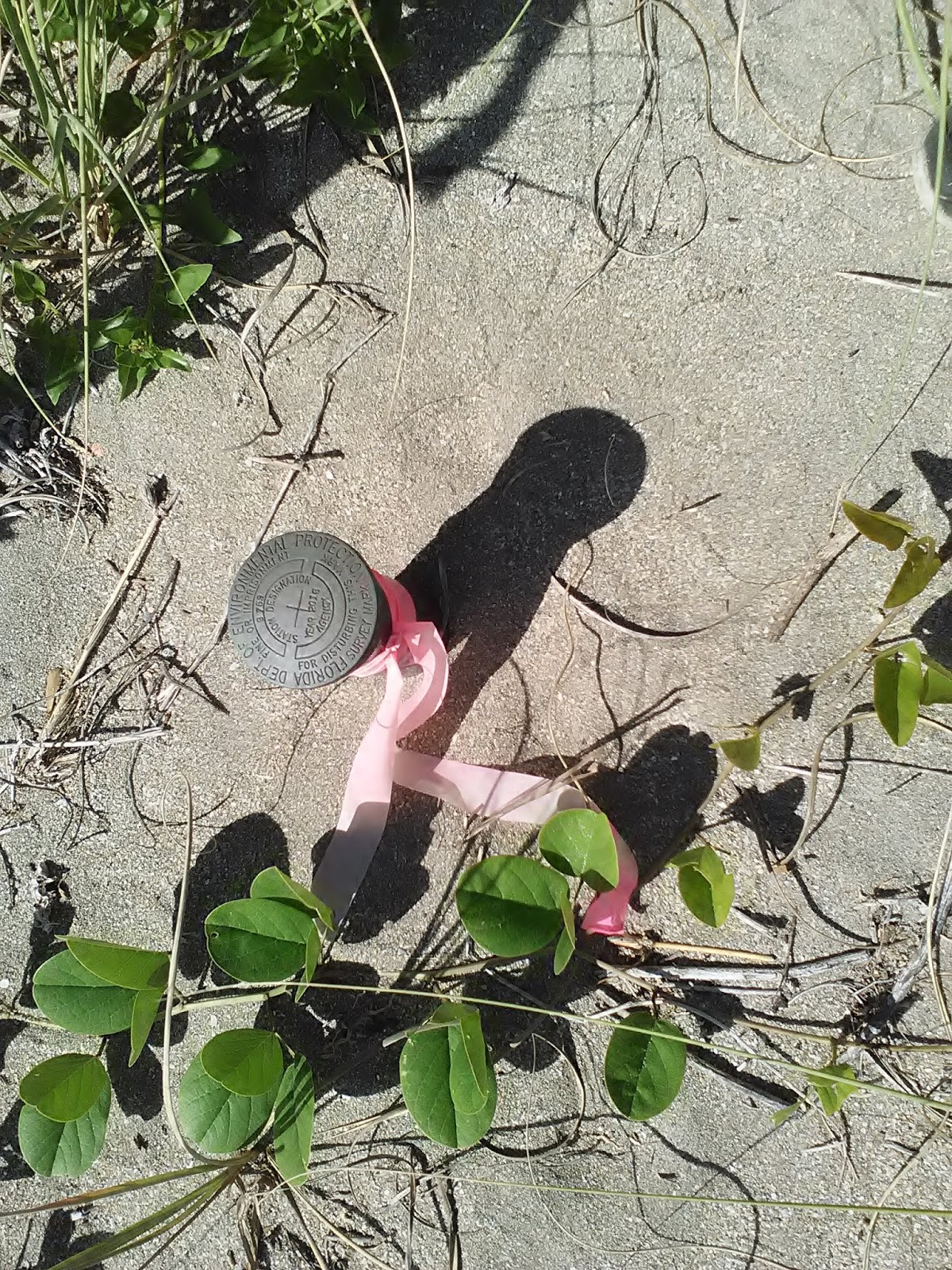
Survey Monument Near John Brooks Walk-over.
A couple of days ago I was talking about tracking the beach and how it has moved over the years.  In that post I showed a map with the survey monuments marked.  Here is one of those markers at John Brooks, just south of the walkover.

---

I've also been talking about serial number hunting.  Here is a near winner that I got recently in change.


The serial number is 21221912.  If the nine was either a one or a two, the bill would have been worth probably at least ten times the face value.  It would have been what they call a binary.  As it is, it is a tertiary (has three different numbers in the serial number) and still might be worth a little premium.

---

It is easy in this day and age to forget about the people and experience of daily life on board a 17th or 18th century galleon.  It is difficult, if not impossible, to have much of an idea of what it was like.  Below are a couple examples reported by passengers that will give you some idea of the rituals.

The watchglass (sandglass) and the compass box were both maintained with care.

At each half-hour turning of the watchglass, the page on duty calleed out a verse, with words specific to each of the eight turnings in the four-hour shift.

At the first turning, he would say, "Good is what's past,and better what comes; one glass is past and the second is filling; more will be filled if God be willing; to keep the right time makes the voyage fine." 


At nightfall after the evening meal those on board heard the Buenas Noches of the page bringing light to the compass box for the night: "Amen and God give us good night; good voyage, good passage for the ship, sir captain and master and good company."  Then two pages recited the evening prayers: Pater Noster, Ave Maria, Credo, and Salve Regina.  Once finished, the pages on duty went to care for the watchglass, which presumably had been running as usual while the prayers were being said, and recited the nightly blessing; 

Blessed be the hour God came to earth, 
Holy Mary who gave him birth,
and Saint John who saw his worth.

The guard is posted,
The watchglass filling,
We'll have a good voyage,
If God be willing.


On special occasions, there might be quite elaborate religious ceremonies in a fleet, particularly on the capitana and almiranta.  After surviving a thirty-six hour hurricane, one ship returning from the Indies in 1622 held a service of contrition dedicated to Our Lady of Carmen, patroness of mariners.  Everyone on board attended, with the image of the Virgin, adorned with what finery they could salvage, presiding over the gathering from a portable alter on the poop.  The Jesuit chronicler of this voyage led the service, including in his chronicle the long litany to the Virgin recited by those on board, with Latin phrases chanted by the priest answered by the Latin responses from his floating congregation.


For Holy Week, among other great festivals of the church year, crew and passengers participated more fully in the events, although Holy Week would have been rather early for voyages across the Atlantic.  One description of the events noted, 

Since there were religious in the fleet, most of the people confessed, and  on Holy Thursday, with silks and other things that had been brought along, each ship decked itself out in the manner of a monument , displaying images and crosses, and on many ships there were a large number of penitents attending the persons who carried the images.  Holy Saturday at the time of the "Gloria," the capitana first and afterwards the other ships made much rejoicing and fired all their heavy and light artillery, so much that it was quite something to see.  Easter Sunday, in the morning, all the ships, led by the almiranta, went to salute the capitana, which displayed its many flags and banners, and they saluted her with much artillery.  The capitana returned the salute of the almiranta with seven or eight pieces of heavy artillery and with music and trumpets and other instruments returning the salutes of the other shipwswith music alone.


The above excerpts in blue were taken from Six Galleons for the King of Spain by Carla Rahn Phillips.

---

Oscar is now a hurricane but is out in the middle of the Atlantic and headed away from us.

The surf will build Wednesday then start decreasing again Thursday.


Source: MagicSeaWeed.com.

Happy hunting,
TreasureGuide@comcast.net

Monday, April 10, 2017

4/10/17 Report - Religious Metal Detector Finds and Easter Traditions. A Letter From 1564 Fort Caroline


Written by the TreasureGuide for the exclusive use of treasurebeachesreport.blogspot.com.

Gold Metal Detector Find From The Beach Near The Nieves Wreck Site.

The figure shown above is about two inches high and was undoubtedly at one time attached to a cross.  It is truly old.  Both the method of manufacture and type of gold show that.  So does the style, wear and encrustation.  It is definitely centuries old.

It isn't a new find, and I posted it before but thought it was particularly appropriate for today's post.  

If you've been detecting the Treasure Coast very long or just reading this blog, you are aware of how many religious artifacts have been found on the shipwreck sites and beaches and how common religious symbols are on many finds.  You will find a cross prominently displayed on many treasure coins, and religious medallions are also common metal detector finds.  

The most important Christian season has begun.  You might think it would be Christmas by the way we celebrate today, but it is actually Easter. Yesterday, of course, was Palm Sunday. And Easter is next Sunday.

Easter is celebrated on the first Sunday after the first full moon after the Spring equinox.  You might have noticed the bright moon lately.

Easter isn't a new celebration at all.  Maybe it has changed some over the centuries, but it has been celebrated for many centuries, including the seventeenth and eighteenth centuries.

Even the Easter bunny and Easter eggs, which might seem to have no religious significance stem from ancient practises and meanings and still carry religious significance for some even if the same symbols carried different meanings at different times and places.  Ancient pagan beliefs and symbols related to fertility carry the meaning of redemption and rebirth for many today.

Spain is one place where Easter is celebrated with much fanfare.  I'm sure that the celebrations have changed over the centuries, but much has remained the same too.

In Spain Semana Santa (Holy Week) is the most important celebration.  

Here, the most important Catholic holiday is commemorated with a week full of color, art, religious fervor, and extravagant processions. The most spectacular events take place in Malaga and Seville, where the streets are taken over by flamboyant parades and intricate religious displays depicting biblical scenes.

Like everywhere in Spain, the festivities begin on Palm Sunday (Domingo de Ramos) and last until Easter Monday (Lunes de Pascua), with the most dramatic and passionate parades held on Maundy Thursday and Good Friday...


Although Easter celebrations in Malaga are of huge proportions, it’s the Seville Semana Santa that has crossed the boundaries becoming a world-famous event. During the Holy Week, the gorgeous Andalusian capital comes to life with thousands of pilgrims that gather here from all corners of the world to witness the city’s extravagant pasos.

See https://spainattractions.es/easter-spain/ for more.

Like many of our Christmas traditions, our Easter traditions were heavily influenced by German settlers.  That includes the Easter Bunny (Osterhase). According to the tradition, children would build brightly colored nests, often out of caps and bonnets, in secluded areas of their homes.  The “Oster Hase” would, if the children had been good, lay brightly colored eggs in the nest.  As the tradition spread, the nest has become the manufactured, modern Easter basket, and the placing of the nest in a secluded area has become the tradition of hiding baskets.

The same things we are acknowledging, remembering and celebrating this year have been celebrated for centuries and centuries.  We have a lot in common with our ancestors and the early settlers and explorers.  It is hard to imagine the same things being celebrated hundreds of years ago, but as much as things have changed, some things remain the same.  At the core and root of it all is something human and something Divine that transcends space and time.

---

Here is a letter written by a young French man from Fort Caroline in 1564.

http://ufdc.ufl.edu/UF00025123/00001/1x

---

I didn't post yesterday because I've been researching something and lost my sources.  I'll get back to it when I find them again.

It seems a lot of the snowbirds have gone home.  The beaches haven't been as busy lately.

The surf will be around three to five feet this week.

Happy hunting,
TreasureGuide@comcast.net


Sunday, March 27, 2016

3/27/16 Report - Happy Easter. Cross With Emerald Trace.


"Cross with Emerald Trace"
Find and photo by John C.

This is another fine Treasure Coast find by John C.

John sent me an email in which he described how he got into metal detecting on the Treasure Coast. He has also been a diver.  John sent the photo of this artifact as a reminder of the real meaning of Easter.

Thanks John!  Really great find and unique artifact. It was purchased by one of the Fishers.

---

Happy Easter.
TreasureGuide@comcast.net

Saturday, April 4, 2015

4/4/15 Report - $100,000 1715 Fleet Gold Bar. Charles Garrett Gone. More Palm Beach Renourishment.


Written by the TreasureGuide for the exclusive use of treasurebeachesreport.BlogSpot.com.

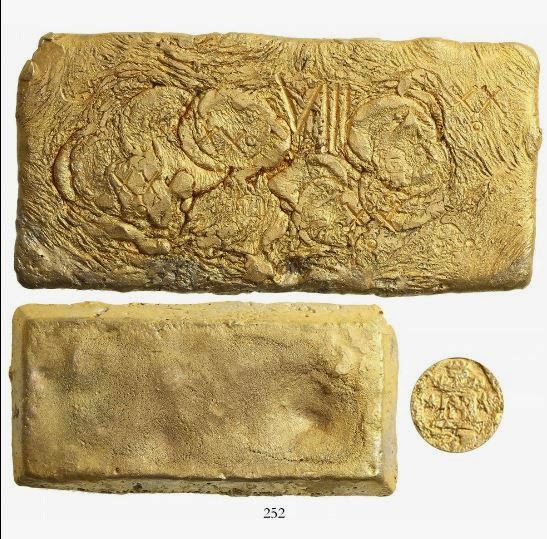
Unique $100,000 1715 Fleet Gold Bar
Photo source: Sedwick online auction catalog.


This Peruvian 2148-gram 20K gold bar from the 1715 Fleet with tax stamp and other markings requires a starting bid of $100,000.

The really neat thing to me about this brick is the incomplete melting of the cobs or whatever it is made of.  You can see some of those in the photo.

It seems to date to the reign of Charles V and the early 1500s.

The item is lot number 252 in the current SedwickCoins auction.

Online bidding has begun.


----


Photo Of Beach In Front Of Mar-a-Lago
Photo by Joe D.

Joe said, Yesterday I went on the beach in front of Trumps and the surrounding area, but finding beach access in this area is difficult to the say the least! This is one of the few areas that has not, as of yet, had beach renourishment! Lots of iron due to rotting groins, and the sand is building! There was some previous erosion (see pics), but nothing but some older encrusted clad! Had to be mindful of the "private" beach so I didn't attract unwanted attention from staff!

 Definitely favor beach hunting (less kneeling and bending), but with near eight foot depth by 200 foot width of renurishment sand being place, it looks like beach hunting will be about done here for a while! 

Notice the tops of the old groins showing. 

One of my best hunting spots was between some old rotting groins in South Florida.  They have now been covered up by tons and tons of sand.

That is one good picture Joe!  Thanks.

Renourishment Project
Photo by Joe. D.

----

A big name in metal detecting just passed away.   Any serious detectorist knows the name Charles Garrett.  If you don't own a Garrett detector, you've read his books and articles.

Mitch King sent me the following link to his obituary. 

http://www.garrett.com/charles_garrett_obituary.aspx

.---

There was a beautiful full moon out last night.  Easter is the first Sunday after the first full moon after the Spring equinox.

That tells you something.   I suppose man has closely observed nature's cycles as long as he has walked the earth.  There are always some people who observe things more carefully.  Those that observed most carefully often won a special role, maybe as shaman, priest or elder.

Holidays punctuate the year and provide cherished memories.  I have many and you probably do too.

If you don't celebrate Easter at this time of year you probably celebrate something - maybe Passover, which is intimately connected with and foreshadows Easter.  It all ties together.  Even Easter bunnies and eggs hint of new birth. 

---

The most read post of February was the 2/22/15 Report - New Authoritative Research On The Gold Pelican-in-Piety Of The 1715 Fleet. 

That one contained the most recent research by author Laura Strolia.  If you missed it you might want to go back and read it.

The most Google Plused posts of Feb were the following.

2/25/15 Report - Florida Coin Shooter's Dream Come True!  Reader Of This Blog Finds 335 Silver Coins On One Small Lot!

2/16/15 Report - Strategically Selecting Discrimination Settings.   Rechargeable Batteries.

There are literally hundreds of posts in this blog now.  They are still available.  You might find the search box on the first page useful.

----

\The surf today (Saturday was only one - two feet.  Easter it will be more like three or four feet, and Monday just a touch higher.

Happy Easter,
TreasureGuide@Comcast.net


Wednesday, April 1, 2015

4/1/15 Report - Cannon Ball Found On Beach. Cannon Fuses. Drained Lake. Easter To Bring Bigger Surf.


Written by the TreasureGuide for the exclusive use of TreasureBeachesReport.blogspot.com.

Granite Cannon Ball From Spanish Armada
Found On Beach
Source of photo: article link immediately below.


This cannon ball was found on a beach in Ireland by a man out for a walk.  He said, it was just sitting up there waiting to be found.
We’ve had a number of items discovered recently because of the winter storms with them washing up then on the spring tide ...  It really was as simple as that, I’ve been walking on that beach all my life and never found anything before, it’s quite incredible.
   
 Four wrecks from the Spanish Armada sank just off shore.


Here is the link for the rest of the article.

http://www.thejournal.ie/spanish-armada-cannonball-2022878-Mar2015/

---

Mid 1800s Cannon Fuses and Percussion Caps
From the 17th Sedwick Treasure Auction catalog now online.
I always like to see something different.  It is good to be familiar with things like this in case you ever dig one up.

----


What Was Uncovered When A Lake Was Drained.
This is the type of thing that makes me drool.

Here is the link for more about that.

http://www.aol.com/article/2015/03/31/drained-lake-tapps-in-washington-revealed-its-secrets/21159758/?ncid=webmail6

-----

August Beach. 
It looks like it but
April Fools!  Its really this morning.


The Treasure Coast beach conditions now are more like late summer beach conditions.  Really poor!   Sand is piled up on the beach fronts almost everywhere.

Notice the bathtub-like shallow water in the picture above.  Tomorrow is supposed to be a one-foot surf again.  That makes for very easy water hunting.  Too bad there is so much sand.

Notice the pipes at the back of the beach in the above picture.  I think they began this project and or some reason quit for a while, but it looks like they will start up again before long.  I don't know what that is all about.

Below is a quick video of one Treasure Coast treasure beach this morning.


I did see a lot of shells along the high tide mark at one beach.

On Easter Sunday the surf is supposed to increase.  The prediction is for something in the range of 4 - 7 feet.  That will be a very welcome change.   It is supposed to last for a few days too! 

Tomorrow will be a good chance to water hunt, but what I'm really hoping for is some good surf action that hits the beach just right.

I'll get back to talking more about peripheral sensitivity in the near future.

Happy hunting,
TreasureGuide@Comcast.net

Sunday, March 31, 2013

3/31/13 Happy Easter!


Happy Easter!


I really didn't plan to do a post today, but decided to quickly enter a few things but the above beach find seemed appropriate.


Here is a story about a hidden treasure chest full of gold.   And a man claims that if you follow the clues you might find it.

http://news.msn.com/us/man-claims-hes-hidden-treasure-chest-and-clues-to-find-it


The weather is beautiful, not for beach detecting but for taking time to soak it in and appreciate life.  The sun came up with a little bit of color.  Just right.


Three Trees


I'll leave it at that today.   Time for a little silent reflection and family.


Happy Easter!