Showing posts with label religious. Show all posts

Saturday, May 30, 2020

5/30/20 Report - Lead Coin. Sand and Object Movement. Various Religious Items.


Written by the TreasureGuide for the exclusive use of treasurebeachesreport.blogspot.com.


One of the interesting odd items in the Sedwick auction yesterday is the lead coin shown above.  As you can see, it was listed as lot 1201.

You don't often see lead coins, but that Nicaragua 10 peson coin is one that has an interesting history.

… fascinating relic from the rebellion of 1927-33 that pitted forces under revolutionary leader Augusto Cesar Sandino against the U.S. military, Sandino eventually being assassinated but still revered today as a national hero and symbol of resistance to U.S. domination in Central America. Tokens like this one were exchanged for goods from local merchants.

If you dug up a lead coin you might think it is some kind of token, weight or fake.

---

I've been thinking of doing this post for over a month now, but it isn't an easy one and I still don't have it together.   The topic is very complex and involves a number of factors and interrelationships, but I'll do my best to make it clear, which means keeping it simple to some extent.

I previously did a number of posts on the movement of sand and other objects.  Different objects move differently depending upon a variety of factors, and an object such as a coin can move in a variety of ways.

The main reason we are interested in the movement of sand is that it can cover or uncover the the types of objects we look for.  The uncovering can occur naturally, which is necessary for the beach detectorist, but if you are working a salvage lease you can move the sand using blowers.

What I want to describe today is the relative movement of sand and other objects.  First I must repeat one thing that is often neglected - it is not just about weight.  The density of the object - not it's weight - is important, but it's shape is also important.  A flat thin piece of copper will be washed around by the water differently than a coin of the same weight.  You'll frequently find small thin pieces of copper washed up and laying on or near the surface of the sand when you can find little else.  And an oval lead sinker will move around very differently than a flat or triangular one.


To get the basics, I'd recommend studying the following table shown above and a previous post in which I explained it.

Here is that link.

https://treasurebeachesreport.blogspot.com/2020/02/22620-report-reading-water-to-find.html

So a certain amount of force is required to move the sand and a certain amount of force is required to move an object such as a coin.  The amount of force required to move sand will typically be less than that required to move the coin.  Therefore, sometimes the sand will move, but not the coin.  The sand might then uncover the coin or let it sink down to the surface vacated by the sand.

In a previous post I mentioned five ways that coins move, so that can get complicated, however coins and items such as coins will move less often and not quickly as sand.  So the thing that is important is relative movement.

Imagine the situation in which the beach sand moves but the coin remains relatively stationary.  The coin will be uncovered and if the sand continues to move without the coin moving much, the coin will sink down to the new lower surface of the sand where it can stay until it is covered again.  That is not an unusual scenario.  One important thing to remember is that the coin will remain basically stationary as long as it remains covered.  If there is enough force the coin can move when the sand moves, but in most cases it won't move as much as the sand.

If you sketched a Christmas tree and took the side on one side, that would be a fairly typical coin movement pattern over the years.  Every time there is erosion it might drop with the sand surface and drift a little towards the surf.  It might get covered from time to time but seldom get washed back up.  Usually it would stay at its current position until it is uncovered again.

A ring, because of its shape, will get washed up less often than a coin because of its shape.  There is less surface area for the force of the water to act on.  Once either of them reaches a deep level they will seldom be washed up.  It would take a rare event for that to happen.  And once either reaches shelter in a rock crevice, it would be extremely rare for either to be washed up.

Where a lot of the action happens is where the wave breaks.  That produces a lot of turbulence and lifts sand, rocks and other things that can then be pushed up the slope by rushing water.  Again, it will take a lot to wash a ring up the slope because the lack of flat surface area.

What makes things especially complicated is the continually changing force of the water as it comes in and goes up the slope and then descends back down the slope and all of the interactions.  It would be much easier to figure out if the water simply flowed in a continuous stream, but that is far from what we are dealing with.

---

The Sedwick auction concluded today.  The last session included a variety of less expensive lots, including some rather large groups of coins, clumps, paper money and mounted coins.  Among the items were the following group of miscellaneous religious items.


Here is the lot description.

Lot of twelve crosses and religious medallions and other items in base metals, various periods (1600s-1900s). 47.95 grams total, 1/2" to 2". Cool little collection of objects, from a three-masted ship to a functioning miniature spur to various medallions and simple crosses to two crosses (one ornate though incomplete) with inlaid cabochon emeralds. Great for further study.

Some of the lots in the final session went unsold, but I thought the auction did much better than I expected.  For the most part, bidders were not deterred by the economic downturn.

---

It looks like we will have a two or three foot surf for a couple of days and then a possible increase.

Happy hunting,
TreasureGuide@comcast.net


Sunday, September 22, 2019

9/22/19 Report - $30,000 Find by Detectorist on Melborne Beach. Another Tropical Storm. Other Finds.


Written by the TreasureGuide for the exclusive use of treasurebeachesreport.blogspot.com.

Eroded Melborne Beach
Photo by Jerry P.
I received this message from Jerry P.


I had an interesting day on the Treasure Coast yesterday. I found the conditions much as you described them in your Friday Post. The Big surf had beaten up the dunes pretty good, but it was mostly renourishment sand that was knocked down. Then because the waves were hitting square on to the beach, that sand wasn’t moved off the beach. I didn’t find any shipwreck items but did find the most expensive item I’ve ever found.  It’s a one-kilo brick of cocaine (See below.) that washed up on the beach in Melbourne. Not my best find but definitely the most valuable. After turning it over to the local Sheriff deputy, he told me the wholesale value is about $30,000! My jaw hit the ground😎


Regards,

Jerry P.


$30.000 Brick of Cocaine
Photo by Jerry P.

That reminds me of the morning I arrived to see three huge bales of pot washed up on John Brooks beach.  Each bale was a cube of about five feet.

---

Plaque Washed Up On Melborne Beach
Source: FloridaToday.com


Talking of things washed up on Melborne Beach -

Bobbing amid then-Tropical Storm Humberto's swells, a wooden wall plaque bearing Jesus Christ's image reached the beach just as former professional surfer Bryan Hewitson and his daughter, Olivia, approached carrying bags of litter.
"It was still wet. It had just washed up," Bryan recalled from their beach cleanup walk shortly after sunrise Saturday...
Here is the link for the rest of that article.

https://www.floridatoday.com/story/news/2019/09/17/mystery-jesus-plaque-washes-ashore-near-melbourne-beach-tropical-storm-humbertos-waves/2343070001/

---

My Friday Finds.

I've done more detecting in the past three days than I've been able to do in a long time.  I went out three times and spent an average of about an hour detecting each time.  I also spent time scouting beaches that I didn't detect, but I averaged about 25 modern coins per hour detecting by working eroded renourishment sand.  That is not what I'd prefer to hunt, but it was easy, and I was also getting to know the Equinox detector so I wanted to hit a good number targets.  If I had a lot more time I would have spent time detecting for shipwreck items too, but that didn't look like a good bet under the circumstances.

If you look at that ring shown above, you'll notice it is broken.  It gave a much weaker signal because of the broken band.

---

Now a correction:  Yesterday I posted a photo of a watch that was like the one found by Joe D.  The way I mistakenly labeled the photo, you would have thought that the brand new watch was the one found by Joe.  It was not.  Joe's find was beat up.   Rather than taking the time make that clear in yesterday's post, I just removed the incorrectly labeled photo from that post.

Joe provided this handy link to a database on pocket watches, which provides detailed information on any watch that you can find in the database.  I've found a few pocket watches over the years that I have never researched, so when I get the time I'll be using that link.

https://pocketwatchdatabase.com/

And here is the link to the particular make and model found by Joe.

https://pocketwatchdatabase.com/search/result/hamilton/1752320

---

John Brooks Beach Saturday Evening Near Low Tide.
Notice all the sand between where the waves are breaking and where the water is on the sand.

The beach is still mushy even though the water has been getting pretty high.

John Brooks Beach Saturday Evening Near Low Tide.

The coins I picked up Saturday were not the easy ones.  They were deep in wet sand where the water was still coming and going at low tide.  That makes recovery more difficult.


Now we have another tropical storm - Karen.  Looks like she'll pretty much follow Jerry.

Source: nhc.noaa.gov.


For the next few days the surf will be decreasing.


Source: MagicSeaWeed.com.
Happy hunting,
TreasureGuide@comcast.net


Tuesday, October 30, 2018

10/30/18 Report - Life On Board a 17th Century Galleon. Serial Number Hunting. Survey Monuments. Hurricane Oscar.


Written by the TreasureGuide for the exclusive use of treasurebeachesreport.blogspot.com.

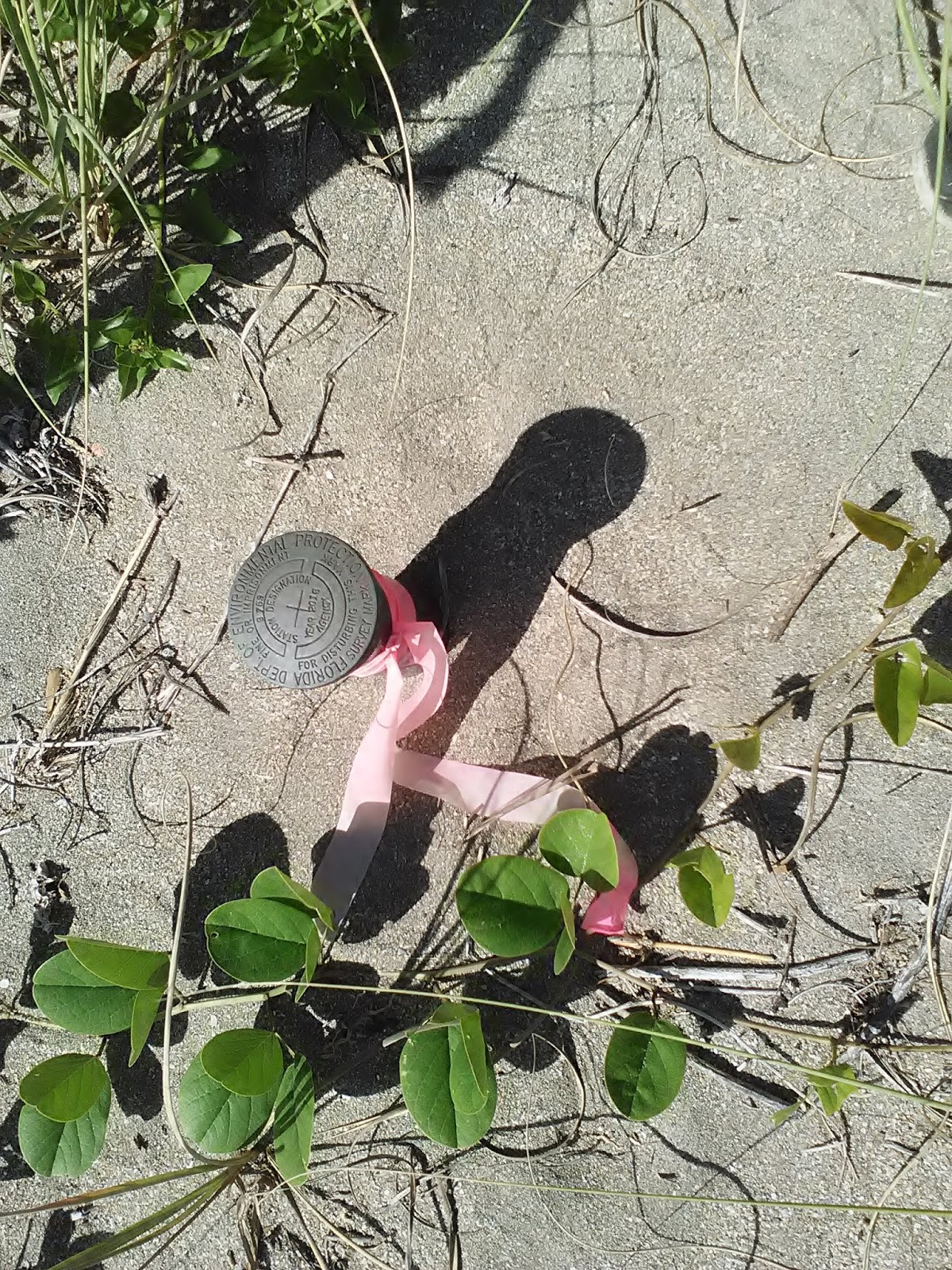
Survey Monument Near John Brooks Walk-over.
A couple of days ago I was talking about tracking the beach and how it has moved over the years.  In that post I showed a map with the survey monuments marked.  Here is one of those markers at John Brooks, just south of the walkover.

---

I've also been talking about serial number hunting.  Here is a near winner that I got recently in change.


The serial number is 21221912.  If the nine was either a one or a two, the bill would have been worth probably at least ten times the face value.  It would have been what they call a binary.  As it is, it is a tertiary (has three different numbers in the serial number) and still might be worth a little premium.

---

It is easy in this day and age to forget about the people and experience of daily life on board a 17th or 18th century galleon.  It is difficult, if not impossible, to have much of an idea of what it was like.  Below are a couple examples reported by passengers that will give you some idea of the rituals.

The watchglass (sandglass) and the compass box were both maintained with care.

At each half-hour turning of the watchglass, the page on duty calleed out a verse, with words specific to each of the eight turnings in the four-hour shift.

At the first turning, he would say, "Good is what's past,and better what comes; one glass is past and the second is filling; more will be filled if God be willing; to keep the right time makes the voyage fine." 


At nightfall after the evening meal those on board heard the Buenas Noches of the page bringing light to the compass box for the night: "Amen and God give us good night; good voyage, good passage for the ship, sir captain and master and good company."  Then two pages recited the evening prayers: Pater Noster, Ave Maria, Credo, and Salve Regina.  Once finished, the pages on duty went to care for the watchglass, which presumably had been running as usual while the prayers were being said, and recited the nightly blessing; 

Blessed be the hour God came to earth, 
Holy Mary who gave him birth,
and Saint John who saw his worth.

The guard is posted,
The watchglass filling,
We'll have a good voyage,
If God be willing.


On special occasions, there might be quite elaborate religious ceremonies in a fleet, particularly on the capitana and almiranta.  After surviving a thirty-six hour hurricane, one ship returning from the Indies in 1622 held a service of contrition dedicated to Our Lady of Carmen, patroness of mariners.  Everyone on board attended, with the image of the Virgin, adorned with what finery they could salvage, presiding over the gathering from a portable alter on the poop.  The Jesuit chronicler of this voyage led the service, including in his chronicle the long litany to the Virgin recited by those on board, with Latin phrases chanted by the priest answered by the Latin responses from his floating congregation.


For Holy Week, among other great festivals of the church year, crew and passengers participated more fully in the events, although Holy Week would have been rather early for voyages across the Atlantic.  One description of the events noted, 

Since there were religious in the fleet, most of the people confessed, and  on Holy Thursday, with silks and other things that had been brought along, each ship decked itself out in the manner of a monument , displaying images and crosses, and on many ships there were a large number of penitents attending the persons who carried the images.  Holy Saturday at the time of the "Gloria," the capitana first and afterwards the other ships made much rejoicing and fired all their heavy and light artillery, so much that it was quite something to see.  Easter Sunday, in the morning, all the ships, led by the almiranta, went to salute the capitana, which displayed its many flags and banners, and they saluted her with much artillery.  The capitana returned the salute of the almiranta with seven or eight pieces of heavy artillery and with music and trumpets and other instruments returning the salutes of the other shipwswith music alone.


The above excerpts in blue were taken from Six Galleons for the King of Spain by Carla Rahn Phillips.

---

Oscar is now a hurricane but is out in the middle of the Atlantic and headed away from us.

The surf will build Wednesday then start decreasing again Thursday.


Source: MagicSeaWeed.com.

Happy hunting,
TreasureGuide@comcast.net

Thursday, August 7, 2014

8/7/14 Report - Virgo Carmeli Pendant Find. JFK Gold Coin. Cobalt Ring. Silver Ring. Happy Birthday Memorial Penny.


Written by the TreasureGuide for the exclusive use of treasurebeachesreport.blogspot.com.


Two Sides of Very Small Copper Pendant

This a very small copper pendant that was found on a Treasure Coast beach.  It is very worn, as you can see.  Evidently it was a very important and well used religious item for some one.

What I like most about it is the heavy wear from use.

I wish I knew more about it.

I have no idea of the age.
It is ever so barely over one half an inch in diameter.

According to Wikipedia, Our Lady of Mount Carmel is the title given to the Blessed Virgin Mary in her role as patroness of the Carmelite Order. The first Carmelites were Christian hermits living on Mount Carmel in the Holy Land during tlhe late 12th and early to mid 13th centuries.

If you can provide any ideas or guesses on usage or age, please send me an email.


I found a picture of a ring that looks very much like the larger ring marked "TRITON" that I posted a few days ago along with a few other finds.  If that is the case, it is a cobalt ring and sells new from Zales for $200.

Cobalt is a hypoallergenic and tarnish resistant bright white metal that has been used since ancient times for jewelry. This strong solid contemporary metal is durable, dense, and similar in weight to gold and has been used in the medical industry for years.

With all the metals being used for rings these days, it isn't as simple as it used to be when a good acid test kit would identify most metals that might be of interest.


From the recent Kovels Komments:   A dumb thief took a 150-year-old gold jewelry box worth more than $250,000 from the Oakland Museum in Oakland, Calif., last year. Before he was caught earlier this year, he sold the box for $1,500. He then threatened to report the buyer to police if the buyer did not give him $10,000 more. The thief was sentenced in June 2014 to four years in federal prison.


Image Of One Ounce Gold Coin
From Ad.

JFK's profile debuted on the half dollar 50 years ago, and the image was subtly tweaked and sharpened in the 1990s. Now the U.S. Mint is producing collectors' coins that restore the original 1964 design, which incorporated suggestions from a grieving Jacqueline Kennedy...

Kennedy replaced Benjamin Franklin on the half dollar in early 1964, months after the president was assassinated on Nov. 22,

Here is the link for more about that.

http://xfinity.comcast.net/articles/news-national/20140724/US-JFK-Coin/?cid=hero_sf_jfkjr

The coins are one ounce of gold, and the image of JFK appears very realistic.


Today, August 7, is the birthday of the Lincoln Memorial cent, which replaced the wheat penny in 1959.  That makes the memorial cent 55 years old.


Silver Ring Found at the Site of the Roman Bath.
Source of photo: Link found here.

Archaeologists recently explored the remains of a Roman bath in England.

To the left is a picture of a silver ring found there.

Here is the link for the entire article.

http://www.culture24.org.uk/history-and-heritage/archaeology/art491723-Archaeologists-find-baths-sociable-Romans-early-evidence-Christianity-Durham


On the Treasure Coast, the ocean is about as smooth as it gets.   The surf predictions are for a one foot surf for about a week.

Despite the two hurricanes heading towards Hawaii, there is no activity in the Atlantic.

I'll wind it up there for today.

Happy hunting,
TreasureGuide@Comcast.net

Saturday, March 22, 2014

3/22/14 - Bogota Mint Platinum In The 18th Century & Gold Religious Medallion Beach Find


Written by the TreasureGuide for the exclusive use of treasurebeachesreport.blogspot.com.


14K Religious Medallion Find From The Treasure Coast
With the nice weather and the large number of tourists this year, there are a good number of modern jewelry items being lost and found on the swimming beaches even on the Treasure Coast.

Here is one new find.


It is easy to make a mistake by throwing something away before you really know enough about it.  I know because I made a number of mistakes like that in the past.  Unfortunately we often learn our lesson when it is too late.  We can keep learning though and cut down on the number of mistakes we make in the future. 

A few posts ago I showed some very small and very heavy lumps of metal that were detected on a wreck beach back a week or so ago when it was cut.  I know that a lot of people would quickly dismiss those small beads of material.  I can understand that, and the beads are probably not anything of interest, but due to the fact that I don't know exactly what they are yet, my curiosity is more than enough for me to hold onto them for a while.  I'll test them more thoroughly later. 

I haven't bothered to run many tests on them yet, partly because I'm out of some of my acids.  There is no harm in waiting anyhow.  I've learned that there is no harm in holding onto something that is probably nothing important.  If nothing else, the presence of items like that often leads to research and learning.  That has already been the case with these items even though they are most likely nothing very interesting. 
.
I ran across an interesting article last night that could possibly be remotely relevant.   It is an article published in Platinum Metals Review, 1992, 36, (I), 40-47, which discusses a manuscript written by an assayer at the Bogota mint dealing with platinum and its separation from gold and its refinement.

Here is the link to that article.

http://www.bing.com/search?q=platinum+in+the+18th+century&form=IE10TR&src=IE10TR&pc=CPNTDFJS

And here is the abstract of that article.

It is generally accepted that the first description of “platina” to appear in Europe was by a young Spanish naval officer, Antonio de Ulloa, whose famous work “Relacibn del Viaje a la America Meridional” was publishedin 1748. Important though this was, of even greater significance was the fact that the primary metallurgy of platinum must have been established much earlier, enabling it to be extracted, purified and manufactured. These processes appear to have been kept secret from
other European countries, and until recently their details had not been  deduced. Now manuscripts discovered in the Colombian Archives enable known methods of purification to be linked to the description of the primitive manufacturing process.

So it turns out that some of the earliest work, if not the first metallurgical work with platinum was conducted at the Casa de la Moneda de Santa Fe de Bogota.

Platinum for some time was thought to be little more than a waste product to be removed from gold, but later it was separated and used itself to construct items.

Jose Sanchez de la Torre y Armas was the assayer at the Bogota mint from January 1722 to 1732 and wrote extensively on the refinement and use of platinum.  It appears that much of what he wrote was known well before the time that he wrote it down.

More from the same article.

In the light of present knowledge, we consider that the platinum obtained by Sanchez would have been practically pure, although it is certain that his objective would have been the separation of platinum from the gold, rather than the refining of the platinum. Sanchez states that he produced calcined platinum and platinum grains, in which state the platinum could be readily hot-forged.

Notice the use of the word "grains."
\
 Assayer Sanchez wrote an explanation of a few says that platinum could be separated and the costs associated with the different methods.

Here is another paragraph from the article.

Of even greater importance is the fact that fabricated platinum articles existed in the first third of the Eighteenth Century, necessitating a refining or purification process and, in the absence of the means to melt it, a hot-pressing or sintering process that enabled the platinum to be worked subsequently.

So sometime in the first third of the 18th century, platinum that was mined with gold was separated and refined and actually used to manufacture things such as medallions, buckles, and even sword handles.

One last little interesting tidbit from the article.

The act of throwing the platinum into the rivers can easily be justified. The cost to the Spanish Crown of the introduction of just 5.4 per cent of platinum into the gold alloy would be the value of ...

Hmmmm.   Throwing platinum into the river!   


So what does all of that mean to us Treasure Coast detectorists.   One of the things that interested me is that items or parts of items were created from platinum early in the 18th Century.

Another thing is that when gold is less than 22k there could be platinum in it.  The heavy cost of removing the platinum provided enough incentive to overlook the "impurity."

And if gold nuggets were transported legally or illegally, is it possible that platinum in one form or another (including forms such as grains) was also intentionally or unintentionally transported with the ore.

Those are a just a few thoughts.  You might dismiss some or all of them quickly.

One thing I know is that the very small beads of heavy metal that I posted the other day will be tested more thoroughly because of what I learned in this article.  I still think they are more than likely lead, but am not ready to dismiss them without testing.

Lead or not, I learned something from the research and the remote possibility that the found beads could possibly be platinum rendered I read more interesting and meaningful to me.  And I learned a little more simply because they were on my mind and influenced my reading.

I did find it difficult to post from such a technical article.  It took a lot of time.  I hope you get something out of it.  I did.


I did a post on modern platinum items in my 6/6/13 post.  You might want to go back and read that.


On the Treasure Coast we now have a little bigger surf.  It is running around four feet and will not change much for several days.

I would expect to find some nice coin holes and modern gold other than recent drops out there during current conditions.


Happy hunting,
TreasureGuide@comcast.net


Saturday, January 18, 2014

1/18/14 Report - Metal Detecting Interests, Holed Pot Shard Mystery Solved & Religious Gold Pendant Find


Written by the TreasureGuide for the exclusive use of treasurebeachesreport.blogspot.com.

14K Pendant Beach Find.

What peaks your interest?  As I said the other day, different people like different things.  But people change over time too.  What interests you at one point, might not interest you at all a year later.

There is such a wide variety of types of targets that can be found on beaches, and that can help anyone remain interested.  If you get bored with modern jewelry, you can hunt fossils.  No matter what it is, there is always something else you can target.

When you are very much into one kind of item, such as maybe shipwreck items, you might not see how or why others are interested in other things.  But when you get to know more about those other things, you might learn what is interesting about them.

The more knowledge you have of different kinds of items, the easier it is to maintain a high level of interest.

I've never had the problem of being bored.  Yes my interest level rises and drops for certain things, but there is always something that has my interest.

I do tend to get bored with certain types of targets when they become easy and routine, and I often feel that the things that I haven't found as much are more interesting.

When I first started detecting my goals were small.  I counted coins and face value of finds.  My counts got higher and higher and I'd gradually change my expectations and goals.   It wasn't long before the number of coins wasn't really of much interest at all, then I started counting gold rings.  Coins then became primarily of interest as a sign or indicator of what the beach was doing at a given area.

Anytime I could find a hot spot (accumulation of coins that had been on the beach a while) I new there was also a good chance of also finding older jewelry that had also accumulated.

As time goes by I continue to raise my standards.  What was a good day when I started detecting would not be considered a good day today.  And what was a good day after ten years, would not be considered a good day today.   My standards and expectations keep increasing.

I think it is good to keep records and set goals.  It lets you know where you are and gives you a way of judging your performance.  It also pushes you to keep learning and improving.

Another change is that I'm less and less interested in the monetary value of finds.  Now I like things that either have some mystery about them or that have some style or history to them.

The pendant shown today, for example, isn't anything great, but it just seems to me to be more attractive than most, and it isn't a type that I've already found two or three times before.  It isn't hugely interesting to me, but I like it better than some simply because it is attractive to me.  Small, compact, nice square lines, not gaudy.  Just more attractive to me than most.

Another View.
I also like things that I haven't found before or don't know much about, like those pot shards with holes, like I showed yesterday.

The shards are most likely old, but the mystery remained for some time.  I couldn't figure out how it was used or what it came from.

You can see that photo in yesterday's post.

I did learn what it is just today.  William M. said that Native Americans drilled holes in pots that cracked and used ropes to tie them together.

It did look to me like it was a hole for a rope.  William also said he might be able to send photos of some examples.

The identity of that item was a long standing mystery for me, and I'm glad to have it figured out.

Thanks William.

In any case, metal detecting never gets boring if you keep learning, studying and raising your standards.  It might be difficult to get excited by things that have become routine, but there are always new things and new surprises.

One thing to remember is, you wont' continue to learn and improve if you think you already know everything.

On the Treasure Coast today the surf is around two or three feet.   The cool wind is still coming in from the West.  That is expected to not change for a while.

About a week out, they are predicting a higher surf, but as I usually note, the predicted higher surf when it is that far out, often does not happen.

Happy hunting,
TreasureGuide@comcast.net

Thursday, March 8, 2012

3/8/12 Report - Medallion, Spear of Destiny & Spanish Mission


Written by the TreasureGuide for the exclusive use of treasurebeachesreport.blogspot.com.


This medallion was submitted for help with identification. It was found with musket balls and other items including a button marked 1822.

I've received a lot of good information from this blog's readers about other religious medallions that were posted, so I'm hoping to hear from you about this one too.


One side seems to say: b virg sine yb cc orig concez

And the other side: s.igna.loy ol.soc.ies.f.


Here is a link to an article on the legend of the Spear of Destiny.

http://io9.com/5889471/what-is-the-spear-of-destiny-and-where-can-you-get-it


University of North Florida archaeologists are going to be looking for the location of Santa Cruz y San Buenaventura de Guadalaquini Mission on
St. Simons Island this month.

Here is a link for more about that.

http://m.jacksonville.com/news/georgia/2012-03-05/story/unf-archaeologists-looking-spanish-mission-during-dig-st-simons-island


Concerning the Cocoa ordinance against unsafe holes, Terry T. said 10 new beach patrols have been hired to issue fines if they deem a whole unsafe.

We had hall monitors in school, I guess they now have hole monitors.


I was going through some of my books the other day and noticed this inscription.


Bob lived in St. Lucie and is now gone like a number of the people that I met while detecting. I remember Bob mostly from the time he was working on the Nieves site on the Virgalona, if memory serves correctly. That was probably back in the eighties.

A few of his finds included a gold 8 Royal and a bunch of gold 1715 Fleet rings.


The seas are still a little rough, up around six feet today, decreasing just a little until Sunday when they are predicted to be up around seven feet again.

I'll keep my beach conditions rating at a 2 for now. Unfortunately the wind is coming from the southeast, so I'm not expecting much, if any, improvement for a while.


Have you ever heard the song The Circle of Life? I like the lyrics. Here is the beginning.

From the day we arrive on the planet
And blinking, step into the sun
There's more to see than can ever be seen
More to do than can ever be done
There's far too much to take in here
More to find than can ever be found


I suppose it is better if you know the music that goes with it. It's really nicely done in the Festival of the Lion King show at Disney's Animal Kingdom.

There are a bunch of ways I could go with those lyrics, but I'll just let you ponder it for yourself today if you are so inclined.

Happy hunting,
Treasureguide@comcast.net

Monday, January 2, 2012

1/2/12 Report - Silver Medallion Finds & Tapir Tooth


Written by the Treasureguide for the exclusive use of treasurebeachesreport.blogspot.com.

Religious Medallions Found with Metal Detector.

Religious medallions are relatively common detector finds. They can be centuries old or almost new, and made of gold, silver, or other metals.

The medallions shown here are a few decades old and fairly heavy silver.

These medallioins, as you might suspect from simply looking at them, were not found on a salt water beach. They were found in a fresh water lake near Minneapolis.

I've mentioned before how I like the silver coins found in the cold northern fresh water lakes. They tend to get a nice bluish patina. Silver that has been immersed in salt water, on the other hand, are often in very poor condition and sometimes nearly black.

You can often tell a lot about where silver was found by the patina.

Some pieces of silver jewelry can be a lot more valuable than the melt value. Watch out for more valuable designer pieces and Mexican silver.

One of the disadvantages of hunting in salt water or on the salt water beaches is the poor condition of older silver items. Silver coins found on salt water beaches are usually in poor condition. Gold, though, stays very nice even in salt water.

One thing you might do if you have a lot of badly corroded silver, is take a class on jewelry making or lost wax casting. You can then use damaged silver make jewelry of your own design.

I personally like some patina on my silver jewelry. The patina highlights the detail and gives it a nice seasoned vintage look.

Don't forget Bill's coin cleaning instructions that I have listed in my treasure link list to the left of these posts. Look on the left and scroll down until you find the treasure link list.

Silver is now about $28 per ounce.


A woman found her gold ring that she lost 16 years earlier on a carrot that she pulled from her garden.

http://spiritdaily.com/A11ring.htm

Protect your plants from the cold tonight. They might pay you back.


I heard of a shark bite down by Jupiter yesterday.


The fossil tooth that I posted recently isn't a peccary tooth as I conjectured. Fred D., our resident fossil expert sent me an email telling what it actually is.

Here is what he said.

The tooth is most definitely a tapir tooth and judging by the cone cusps, a very early species. Most likely Tapirus Haysi, early Plesitocene. A Perissocactyl related to the horse because it is hoofed.

Thanks Fred.


It is hard to imagine that it is already the second day of 2012.


A cold front will be coming through this afternoon and tomorrow night we'll probably have a freeze warning on the Treasure Coast. The wind is now out of the west and the seas calm but the seas will increase to about four or five feet soon. That probably isn't enough to change beach hunting conditions much, but it might improve a few spots just a little.


Happy Hunting,
TreasureGuide@comcast.net

Friday, August 5, 2011

8/6/11 Report - Spanish Armada & Remains of Emily Lingering


Back of Religious Medallion Found on 1715 Fleet Wreck Beach.

I've been working to get a better photo of this medallion. I've shown the front before. The back, shown here, has a prayer on it in Latin.

Getting good photos of artifacts has a lot to do with the lighting. Sometimes the lighting is just right and all of a sudden you can see things you never saw before.

When I originally dug this medallion, it was so encrusted I thought it was another encrusted coin. It wasn't until much latter when I partially cleaned it that I could see that it was a medallion rather than a coin. Since that time, it has been cleaned a lot more.

There is some remaining gilt on it.


Underwater archaeologists are exploring a shipwreck that appears to be from the Spanish Armada of 1588. The wreck is located in shallow waters in Rutland Harbour, near Burtonport.

Here is a link to that article.


http://www.belfasttelegraph.co.uk/news/local-national/republic-of-ireland/armada-wreck-discovered-off-donegal-16032885.html#ixzz1UHMOCN00


For more information on the Spanish Armada and its wrecks, here is a great article that includes artwork and maps of wreck locations.

http://factoidz.com/shipwrecks-of-the-spanish-armada-la-trinidad-valencera/


Treasure Coast Beach Forecast and Conditions


The remains of Emily are now poorly organized and just east of South Florida this afternoon. Maybe we'll get a little rain from it. It has a 80% chance of becoming a cyclone again.

On the Treasure Coast, the wind is from the east and there the waves are just a touch higher. The seas are up to about 2.5 feet. That's not much, but it could be enough to freshen up a few of the better low tide spots.

Conditions for finding shipwreck treasure coins on the Treasure Coast remains poor.

We'll have to see if Emily reforms or what and what other storms may come along.


Happy hunting,
TreasureGuide@comcast.net

Monday, December 13, 2010

12/14 Report - Religious Artifact Found & Santa Discovered


Nice Metal Detector Find From an Area Bordering the Treasure Coast.

Photo submitted by Will B. who found this great item. I really like religious artifacts like this.

I had a religious medallion from a 1715 Fleet site that was so encrusted that I thought it was a coin. I kept it with a bunch of coins that needed cleaned for the longest time. I didn't find out what was actually under the encrustation until I finally started to clean it with a bunch of coins.

If anyone has seen an item like Will's before or can offer any information or an opinion about the item, I'd be happy to receive any thoughts and pass along new information as we learn more.


The oldest known American figurine of Santa has been discovered at the site of an old toy factory in Akron Ohio.

http://www.prweb.com/releases/2010/12/prweb4882674.htm


A colonial American steel mill has been discovered. You might not think about steel mills as being part of the American revolution, but they were. The British discouraged enterprises like that because they wanted the colonies to ship raw materials to England where they would manufacture products to be sold back to the colonies. Still those rascally Americans persisted.

Here is the link to the story.

http://www.philly.com/inquirer/local/20101213_Historians_lament_plan_to_fill_in_Petty_s_Run_excavation_in_Trenton.html


Found Bottles Turned Into Christmas Ornaments.

Here is an idea if you dig old bottles. You can turn them into Christmas tree ornaments. Just put a wire hanger in the open end and paint them if you want. They tend to be large so are probably best for outdoor trees.


Forecast and Conditions.

The wind is still out of the north/northwest and the cold is pushing in. Seas will be decreasing for the next few days. I don't know, but you might be able to find some cuts out there. I wouldn't expect any real good ones, but still worth looking.

As the seas decrease you might want to scout around for low tide spots that look good.

We have been getting enough wave action that there should be some artifacts to be found.


Let me know what you think of Will's find.

Happy hunting,
TreasureGuide@comcast.net