Showing posts with label junk. Show all posts

Monday, September 16, 2019

9/16/19 Report - Big Surf Predicted For a Few Days as Humberto Moves Away. Usefulness of Target ID Numbers.


Written by the TreasureGuide for the exclusive use of treasurebeachesreport.blogspot.com.

Source: MagicSeaWeed.com.
Look at that!  If the predictions are correct you can expect four days of increasing surf and some pretty high surf for a few days.  On top of that, the swells are going to be coming from the north for a good while.  There is a heck of a lot of sand that needs to be moved, but we might get some openings.

Source: nhc.noaa.gov
Humberto did not move north and away from us as expected.  Looks like it will move more east rather than going north.  And there is still that system out in the Atlantic that is getting more organized.

Source: nhc.noaa.gov
 When it comes to shipwreck beach finds, the vast majority occur on a few days.  Yes there are those days when a few scattered finds might be made, but there are many more days and months when none are made.  And of course, there are those rare times when a lot of finds are made.  Everybody remembers those, and the stories are retold for decades.

When it is hot, it is hot, and when its not, its not.  That means you can't afford to miss those few special times when the window of opportunity opens.  You have to somehow endure and make the best of those long periods in between.

---

As you might know, I have long been a big advocate of digging everything.  I've explained my reasons in the past.  Those reasons include (1) the inability of any metal detector that I know about to accurately enough identify a broad range of targets, including some very valuable targets, and (2) the time wasted trying to identify buried targets before digging when it takes only seconds to actually dig them, and (3) the fact that you can drastically reduce the number of junk targets if you know something about target distribution patterns on a beach.  I also know that some people do not have the desire to dig trash even if it means missing valuable targets and some people have physical limitations that they must accommodate, so I am by no means saying that discrimination should never be used, but it should be done only with a full awareness of the risks.

With that background, I have been exploring the Equinox metal detector and video target ID generally.  I believe my conclusions can be generalized to many detectors even though I am using the Equinox for the majority of my tests.

I haven't used target ID very much, but I have spent lot of time listening to the audio signals of a wide variety of metal detectors and believe you can often tell a great deal about a buried target from the audio signal alone.

In my 9/11 post, I reported on a brief ground test that I conducted with the Equinox on a few gold objects and questioned the usefulness of the displayed numbers.  A couple readers sent links to videos showing the target ID numbers produced by the Minelab Equinox for a variety of objects, including many pieces of gold jewelry.  While I prefer to conduct my own tests for a variety of reasons, one reason being that not all detectors of the same make and model will always perform exactly the same, I took a look at those videos, which basically confirmed the opinions I got from my own very limited tests. 

One of the videos showed that gold rings and other gold items can produce numbers anywhere from the low end of the range to the high end of the range and everywhere in between.  To give one example, a few small gold rings produced exactly the same number as an aluminum pull tab.  One YouTuber that conducted an extensive test explained that you have to dig it all with the Equinox and showed why.   See https://www.youtube.com/watch?v=SsgspduZA_8 

The videos I viewed were slightly flawed, but I believe were basically correct in their conclusions.  They would run the coil past the object or the object past the coil directly under the center of the coil at what appeared to be an inch or so.  That is not what typically happens in the field.   In the field there is ground mineralization, objects are at different depths and laying at different angles, the coil is moving at different speeds and the object is seldom under the sweet spot of the coil.  I have not systematically tested the effect of all those things, but I have observed that some of those things definitely affect the readout.  I hope be able to be much more specific about that in the near future.  I know that the numbers are not very consistent in some environments.

While at this point (with me having very little personal experience with the Equinox) I have concluded that the visual target ID numbers have very limited utility for discriminating objects if you don't want to miss anything good, but I do think the numbers will be of some help, especially, when combined with other information, including the audio signal and some level of knowledge of the type of items that are most likely in the area.  I expect the numbers to be more useful when combined with other information but of very little help when used as the sole criterion for deciding whether to dig or not unless you don't mind missing valuable targets.

Being much more experienced with interpreting audio signals than display meters, I feel like I can get some good information about a target from the audio signal and it seems to me that the audio signal produced by the Equinox contains a lot of information.  I expect to learn to better interpret the audio signals as I gain more experience.

I know that it is often possible to get an idea of the shape of an object from the audio signal.  The easiest example, perhaps, is that of a long elongated object such as a nail.  I think I'll also be able to reliably distinguish other shapes by simply listening to the audio signal of the Equinox.  

Just the other day when doing a ground test with four gold objects, I noticed how a ring with a larger amount of mass on the one side made a different signal when swept over from different angles.  With some additional experimenting I think I might be able to tell an open object, such as a ring, from an a solid or closed object, such as a coin or round charm.  I need to study that more.

So far my conclusion is that you cannot use the target ID numbers alone on the Equinox, and probably no other metal detector, without a strong risk of missing valuable targets.  There is no doubt that you can use target ID numbers to avoid digging a lot of junk, but you will also miss a lot of good targets.  While the target ID numbers on the Equinox, are not as helpful as I hoped, the Equinox does provide a lot of benefits and will find a definite place in my arsenal or metal detectors.  So far I am impressed by its extremely light weight, stability in salt water environments, and good sensitivity to small and deeper targets.

Thanks to those who sent me the links to Equinox target ID tests.

---

Keep watching the weather.  I'll try to keep you informed on beach developments.

Happy hunting,
TreasureGuide@comcast.net

Tuesday, December 5, 2017

12/5/17 Report - Wabasso Beach Report. Best Resource I Know Of For Overview of History of 1715 Fleet Salvage.


Written by the TreaureGuide for the exclusive use of treasurebeachesreport.blogspot.com.

Wabasso Sunday
Photo by Eric H.

Eric H sent in these photos and a report on his Sunday Wabasso hunt.  Here is what he said.

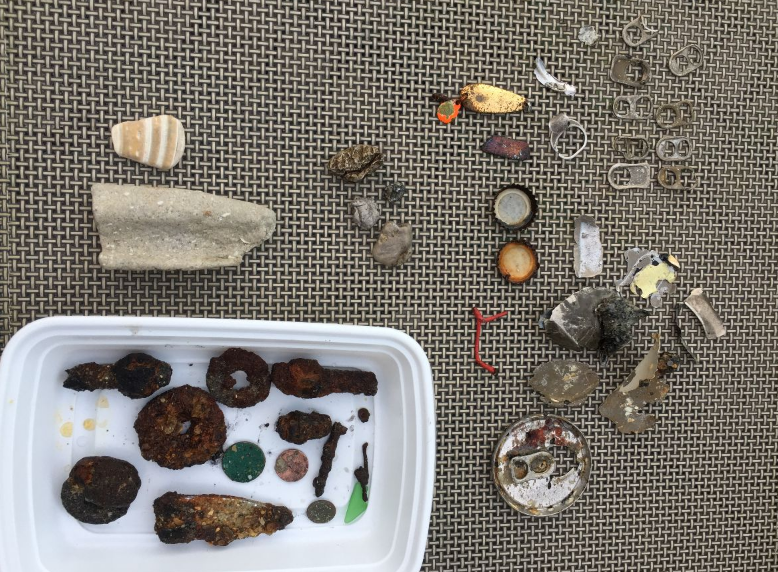
Just wanted to let you know I went out to do a little hunting today ( Sunday ) at Wabasso beach and had plenty of targets, but nothing exciting...

What was interesting is that I was getting deep targets.  I found an 18 inch long piece of rebar that was buried 20 inches deep and my Sea Hunter screamed out the signal. I was really excited there for a while until I saw that it was rebar. 

I got one iron target that was about 22 inches deep (lucky for me it was high enough on the beach that I could retrieve it, if it had been in the wet sand I would have had one heck of a time getting it out.  As it was I had to dig a huge hole.  One thing that surprised me was that I found all the heavy items higher up on the beach, and the trash aluminum was at the low tide line in heavy shells (where I thought the better targets were going to be). There were virtually no items in the small holes and pockets in the low tide line/shallow water.


Miscellaneous Targets Frm Wabasso Sunday
Photo by Eric H.

Depth Eric Was Digging.
Photo by Eric H.
\
Thanks for the photos and report Eric.  Your report should help anyone interested in evaluating beach conditions.

---

Detectorists remove a lot of junk from the beaches.  That is a benefit that the public doesn't realize.

It doesn't hurt to pick up some of those ropes, flip flops and plastic bags while you are out there.

Here is an article about how such things endanger the sea turtles.

http://www.spacedaily.com/reports/Sea_turtles_sad_fate_from_restaurant_menus_to_plastic_soup_999.html

---

The best book on 1715 Fleet salvage history that I've seen is the 241 page large format The Rainbow Chaser's Tricentennial Yearbook by T. L. Armstrong and Tommy Gore, published by Signum OPS, 2015.  I was sent a copy of that book some time ago by Jon Morgan, who does the Lets Talk Metal Detecting podcasts after he interviewed the primary author, and I found it to be the best and most comprehensive summary that I have seen.  There are sections on the wrecks, the finds, stories, techniques, dig boats, and the finders.  

The first sentence of the foreword refers to the Donald Rumsfield comment,"We don't know what we don't know."  That is something I said in this blog before I knew anyone famous said it, and it is something good to remember, especially as it relates to treasure hunting.  Sometimes things become commonly accepted as fact and, but when new information turns up, we sometimes have to change our minds.

There is new information concerning the location of at least part of one 1715 Fleet wreck that will be coming out before long, but I can't say more about that now.  I'm sure it will be published.

If you have access to the Rainbow Chaser's book, you might want to check out page 152, which is part of a section entitled Anchoring.  You'll see a photo taken by the author entitled A Mangled Anchor, Destroyed by the Reef  that looks very much like the one Darrel S. found and which I recently posted, though Darrel's was not mangled.  

Anyhow, good book.  Thanks Jon.

---

In the past I wrote a lot about beach dynamics.  I learned a lot of that when I was hunting modern gold on the beaches of South Florida before I moved to the Treasure Coast.   In retrospect, I can see that it was a good place to start detecting.  The crowds left a lot of coins on the beach, which made it easier to identify patterns.  As I said yesterday, beside goals, you need a way to quantitative measure to evaluate what you are doing.  Careful monitoring will teach you a lot by itself.  Learning is easier when you have a lot of data points.  Careful observation and constant monitoring helps the learning process no matter what you are trying to do.

---

I have a good post started for tomorrow.  It is about a ring lost by a famous person eighty years ago that was recently found on a Florida beach and returned to the family.

---

Don't wait until later to do the things that you want to do.  You might think you'll have all the time in the world to do those things when you are retired, but things can happen and it might not turn out like you expected.

The moon is beautiful and the tides are big.  The surf will be increasing a little in the next couple of days.

Happy hunting,
TreasureGuide@comcast.net

Wednesday, February 17, 2016

2/17/16 - Using Junk And Other Finds As Clues: A Simple Example. Talk To Local Old-Timers. Surf Increasing.


Written by the TreasureGuide for the exclusive use of treasurebeachesreport.blogspot.com.

Elementary School As Viewed On Google Earth.
Yesterday I said that artifacts are more than objects, and I attempted to illustrate that with an example from my own life.  With that example I wanted to illustrate how personal, meaningful and complex the story of an artifact could be even if it wasn't part of a big event in history.

Today I'll use something very different.  The diagnostic artifacts today are common.  It might be difficult to imagine that there could even be a story connected to these items.

Yesterday I suggested but did not elaborate on the idea that as you attempt to find the story behind an artifact, thinking about the possible story can lead you to more and better finds.  Today's example is very simple and clear, yet in my opinion, instructive.

Take a look at the Google Earth image at the top of the post.  The bottom one fifth of the image is a hill with the higher part at the very bottom of the screen, The hill gets higher as you to from left to right towards the very bottom of the image.  Sorry that isn't more clear.

Lets say I see the school shown above and decide to do a little detecting there.  First of all, I would be ahead of the game if I had done a little research, which would tell me that this school (the main building had only four rooms for eight grades) was in operation back in the 1930s.

If you just wandered around for a while without using too much discrimination, one of the most prominent things you would most likely find would be a very small dense area with a heavy concentration of soda bottle caps.  Not the more modern screw type.

The concentration of bottle caps are indicated by the orange dot on the image below.  Your first reaction, instead of cursing the darned things and turning up your discrimination, might be to wonder what if anything that might tell you.

Same View of Same School Yard With Additional Indicators Added.
What is the age range?  Why are there so many in that one small area?

The light blue line indicates the path of a small stream.  I just wanted to highlight that.

Notice how flat and even that area to the right of the buildings and just below the stream looks.  I'm sorry you can't see the lay of the land better in this illustration.

You keep detecting and run into two areas that are turning up almost exclusively silver coins from the 1950s and a little scattered junk.  The yellow lines indicate where the silver coins were found.

Now you have a heavy concentration of soda bottle caps and two areas where silver coins were located.  Have you figured it out yet?

That flat area was once a baseball field.  There is no longer any obvious sign of the baseball field, and trees have grown in what was once left field.

Below I've outlined in white where the baseball field and the infield was.  There were benches and a backstop, both of which are now gone.

Same View But Now Showing Outline of Baseball Field.
I actually detected this site and found the bottle caps and silver coins in the indicated areas, but I had an advantage and knew about the baseball field long before I detected there.  In fact I played Little League baseball there.  

Once I found the bottle caps, outlining the baseball field and locating the bench areas was easy. Where the baseball caps were found they had an ice cooler with a bottle opener on the side where they sold soda and a few candy bars.

The cooler looked something like this one, as I recall. 

Vintage Soda Cooler
Source: Ebay.
When I arrived to detect, it wasn't easy to align exactly where the baseball field had been,  Nearly fifty years had elapsed, and it looked very different.

The main point, once again, is to try to figure out the story behind finds, even if they are junk finds such as bottle caps.  They still have a story to tell and can provide good clues.

If you talked to some of the local old-timers they might also tell you about the arrow heads found on the hill to the right of the little brown roofed buildings just below the school buildings.  They might tell you about the path leading up the hill where the kids always went for sled riding. or the shade trees close to the building where people ate lunch on hot days.  They might tell you about the older one room school building that is now disguised by the facade of a pizza shop.  (That one room school building is barely out of this picture, arrow heads were routinely found behind that building near the creek when there was a potato field there.)  And they might tell you about the old out-buildings that are no longer there, one of which was filled with cork-top bottles with paper labels, and the nearby bottle dumps and other buildings that have disappeared, including the old wash house that has been rebuilt and modified many times.  You say there is no place left to hunt?  Think again.

And the same principles apply on a beach, even though it is a more dynamic environment.  

I don't think anyone really knows an area like the old-timers that grew up there.  They can be the best source of good leads, They can give you local information that can't be found anywhere else.

---

In the future I plan to talk about other types of artifacts that can point you to additional finds.  It doesn't matter what the age or type of find is if you can figure out the story behind it.  And when you figure out the story, that can be a reward by itself.  Remember, it is more than an object.  It was a part, however large or small, of some one's life.

I have a lot of different types of things to post.  It will take a while to get around to them all.

---

Have you ever heard of biomimetics?  I once found a box fish skeleton that I thought was so intricate and interesting that I posted a picture of it in this blog.  Who would have ever guessed that the picture is going to be used in a book on biomimetics for design engineers?  The more I look at that picture the more remarkable it seems to me.  Anyhow, biomimetics is the use of biological materials to inspire new designs for materials and things like Velcro, which, if I correctly recall, was inspired by the structure of sand spurs.  It is nice to contribute to science in small and unexpected ways.

---

We've been having a surf of bout 3 - 4 feet.  Late Thursdays it will bump up to 4 - 6 feet.  The wind is supposed to be more from the north too.  It could get interesting.

Happy hunting,
TreasureGuide@comcast.net

Saturday, October 3, 2015

10/3/2015 Report - One Reason I Dig So Much Junk. CSS Pee Dee. Dare Back South. Remembering Dave. Better Beach Conditions Possible Next Week.


Written by the TreasureGuide for the exclusive use of treasurebeachesreport.blogspot.com.

Here is one reason I dig junk.  This morning I was digging a big signal. The first thing that came up was a rusty big bolt or something.  It was nearly a foot long and completely covered by rust.  That object had a fishing line tangled around it, which was tied to a one ounce sinker. There was still a signal.  The next thing that came up was an encrusted nail.  There was still a signal.  It wasn't easy digging at this point.   I was trying to dig into shells and rock.  Finally out came this .75 troy oz. 14K ring.

The spot where I was working had a dip and some rocks.  As I said yesterday, it is one of the very few spots that I've been able to find lately where the sand has washed down to some older sand.

The eroded area moved farther south since yesterday.  I could tell that from the rocks and a couple of partly uncovered limbs or stumps.  Those things provide important markers.

While the north end of the dip that was there yesterday filled again, the south end extended farther to the south today.

Coins were found higher up on the beach near the foot of the cut.  Lower on the beach and down around the exposed rocks were a lot of corroded iron and junk.  I thought I might find a shipwreck spike, but failed at that.  A broken bronze spike was found right around there a year or two ago.

There was a lot of junk, it would have been an OK strategy to use discrimination if you just wanted to dig coins.  You would have got some coins and missed a lot of junk, but you probably would have missed the ring.

Strategic decisions always involve an associated risk.  If you want to discriminate, that can be a good strategy, but there is a definite risk.  You should be aware of the risks as well as the benefits when you make those kinds of decisions.

You never know what you missed unless you go back and check, but one thing you can do is keep good records and see if there is something missing.

My best example, and one that I've mentioned before, is from my early days of detecting, I was finding a lot of big men's rings but few small women's rings.  At first I thought women didn't lose as many rings as men.  Later, after I turned my discrimination down, I learned that there were a lot of small rings to be found, and I was missing them before.   Your records can give some indication about what you might be missing.

I have found lots and lots of watches.  I tend to think that a lot of people are discriminating them out.

---

Before the weather turned bad the Dare surveyed an area 27 nautical miles along the coast and 6.5 miles wide with side scan sonar and magnetometer.  Although a couple of areas were found for further inspection the site of Lost Merchant was not positively identified.  With the weather turning bad the Dare returned to work the Atocha and Margarita sites.

 ---

A team of underwater archaeologists from the University of South Carolina raised three Civil War cannons – each weighing upwards of 15,000 pounds – from the silty sediment of South Carolina’s Great Pee Dee River near Florence, S.C., on Tuesday (Sept. 29).

The two Confederate Brooke rifle cannons (11.8 and 12.25 feet each) and one captured Union Dahlgren cannon (8.9 feet) were artillery of the CSS Pee Dee, a 150-foot Confederate gunboat, a Macon-class gunboat built to patrol waterways and protect the coast...
To read more of that story here is the link.

http://www.newswise.com/articles/uofsc-archaeologists-raise-trio-of-civil-war-cannons-from-scuttled-css-pee-dee

---

Concerning the memorial brick that I posted yesterday, Al C. sent me this email.


It jumped right out to me but I could be wrong. Dave Rust passed away from cancer several years ago. He was a long time treasure diver spending most of his time in that area. He had a few partners and worked with many of the old timers including Harold Holden. He and Chris Tisak, who is currently diving that area I think, were good friends and worked together for at least a few seasons. They were both good, generous guys and let me work with them when my schedule allowed.

Anyway, that came to my mind immediately.

Thanks for the blog and info and all of your effort. I read most everyday.

Al Coffey

----

The waves are still hitting the beach straight on.  We have something close to a four or five foot surf.

The surf will be increasing, reaching up to possibly eight feet by Tuesday.  Now that is getting up there where you might expect some improvement in beach conditions.  The wind is also supposed to switch so that it is coming from the North beginning later Tuesday.  If we actually get the higher surf coupled with North winds, there is a very good chance that we'll finally get improved beach conditions.

Happy hunting,
TreasureGuide@comcast.net
Saturday, August 29, 2015

8/30/15 Report. Erika Gone. Supermoon Last Night. More on Trigger and Drop Points. Flying Aircraft Carrier Sunk.


Written by the TreasureGuide for the exclusive use of treasurebeachesreport.blogspot.com.


Two Disturbances
Erika has disappeared.  However, the remnants are just off of Cuba formed from the remnants of Erika.  At the time of the 8 PM update, this disturbance only had a ten percent chance of becoming a cyclone in the next 48 hours.  We will get a lot of rain from it.

There is another disturbance coming off Africa.  It has already turned into a tropical depression.

Erika fizzled out like Danny did.  The surfing web site are predicting something like a three to four foot surf on the Treasure Coast tomorrow.  Then it is supposed to decrease again on Monday.

---

Last night was a supermoon, the first of three supermoons to occur this Fall
...In fact, the term ‘supermoon’ is not astronomical. Scientists call this event a ‘perigee moon’: it takes place when the full Moon reaches the closest point to Earth on its oval orbit. This point is called perigee and it is about 50,000 km closer to our planet than the opposite side of the Moon’s elliptical path – apogee...

Here is a link for more about that.

https://www.rt.com/news/313812-supermoon-rising-saturday-august/
You might recall that it was worried that Erika would arrive during a supermoon.

---

I received the following email from Brian H.

I have been reading your blog and thought what if we had T-Shirts with Environmental Clean up Crew printed on them. Would make a great conversation point.

I have been studying your blog mainly on how objects move in the sand, fresh water lakes act different than the ocean but the fluid dynamics are the same. I do have the Great Lake Michigan in my back yard and it acts like an ocean.

I will hit a hot spot of 60's era flip tops and think no one has been here before? Then I will get into bottle cap heaven and dig like a hundred of them. One day I saw one in the water scooting across the surface of the sand and I started thinking differently.

It is when I get into the coins and nickels that I normally find the gold rings. Birds of a feather?

The weather on the lake for tomorrow will change to a Northeast and a Super Moon.

I will take a couple of machines and watch the sand movement.

Brian is right.  The water dynamics are the same.  Anywhere there is running water, even rain runoff, watch for the same basic principles at work.  Thanks Brian.  

Watching junk can tell you a lot.  Junk can help tell you how things are being distributed and therefor also where the good and bad areas are.

---

I really learned a lot about escudos lately.  It happened primarily as a result of looking at the recent Treasure Coast finds.

In the past couple of years I have also learned a lot more about how sand and objects move on beaches.  That is something I've studied for a long time, but I just made some new breakthroughs that help explain a lot. The more you learn, the more knowledge you have to build on, and that leads to learning new things.

A diver told me he was pretty sure that at least some of the escudos that were found this year down in the pot holes and cracks were up on the slabs before the blowers removed the sand.  A lot of the escudos were found on top of the slabs even after the blowers removed the sand.  That information was important to me for several reasons.  Basically it confirmed some things I suspected but was not absolutely sure about.

One of the books I mentioned the other day said that Frogfoot Weller wanted his blowers to run no faster than 600 rpm.  That was so the coins would settle down in the hole instead of being blowing around.

That provides an excellent example of how what I have named "trigger points" are important.  In case you haven't read what I've said about trigger points, a trigger point is the amount of water movement or force needed to get different objects to start moving.

Little force is needed to move silt or fine sand and more force is needed to move small pebbles and even more force is needed to move things like gold coins.  Every object has its trigger point.  If you know where each object lies on the scale, you know in what order things will be moved as the amount of force increases.  If you think about that continuum and how the various trigger points are  met as the amount of force increases, you'll understand how some objects are moved and others left behind as different amounts of force are produced.

The other important thing is the "drop point," which refers to the point at which different items drop out of moving water and settle.  As water movement decreases, different objects settle out at different times.

An important thing to watch is when and where the amount of force changes.  For example, there will be a lot of force directly in front of a breaking wave and less as the water goes up the slope on the front of the beach.  If the trigger point for an object, such as a coin was exceeded at the base of the slope, the "drop point" might be reached at some point as the water slows as it goes up the slope. Objects that are less easily moved will generally settle out first, but it is not a straight line function.

It gets more complicated since you also have to take into account such as back flow, which may have enough force to move sand or other objects back down the slope again.

Up to 600 rpm the force produced by Frogfoot's blowers moved the sand, but above 600 rpm the coins were also being blown around.  What they wanted was to blow the sand but not the coins, which would then tend to settle down into the hole.

---

Flying Aircraft Carrier
Source: see link below.
As early as 1916 the Navy had begun designing lighter-than-air (LTA) rigid airships, and by 1926 the focus had shifted to airships that could support aerial scouting missions. The first flying aircraft carrier, USS Akron (ZRS-4), was commissioned in 1931 – and after several incidents in two years, the airship crashed and sank off the coast of New Jersey in 1933...

I thought that was pretty interesting -  a flying aircraft carrier.  Note the size of the planes below the airship.  In the article there was is a picture of how the old planes were attached.  Really interesting idea that evidently didn't work out.

Here is the link.
http://news.usni.org/2015/08/19/exploring-the-wreck-of-uss-macon-the-navys-last-flying-aircraft-carrier

---

Happy hunting,
TreasureGuide@comcast.net

Thursday, July 23, 2015

7/23/14 Report - Sand Sucking Waves. Peopling the Americas. Silver Ups and Downs & Buried Coins. Clean Beaches.


Written by the TreasureGuide for the exclusive use of treasurebeachesreport.blogspot.com.


Breaking Shore Wave Sucking Sand.
Photo by Clark Little.  Source: link below.
A couple of days ago I posted a photo a wave seemingly sucking up some sand.  Here is another even better photo showing that.

This view of sand getting sucked up certainly suggests that other things like coins could be sucked up into and thrown by a wave like this.

Also note the ridge of water to the right in the photo.  You can see the water rolling down from that ridge and then up into the wave, taking sand with it.

These photos, as I said the other day, are by Clark Little.  He does amazing photography that is not only beautiful, but as I'm finding out, informative as well.

If you are wondering how Clark gets these photos, here he is.

Clark Little About To Get Crashed.
Source: link below.
If you think you got crashed, think about how this is going to feel.

If you look behind his left foot, you can see the sand rising there.

I started wondering if the sand being sucked up in the picture that I showed a couple of days ago could have been a reflection or illusion of some sort so I looked for more evidence.  I wanted to make sure it was really sand being sucked up.  These additional pictures seem to verify that to me, but better yet, in a video that you will find by using the link below, Clark himself referred to sand getting sucked up
 into a wave.  With these additional pictures and Clark's own words, I'm now certain that sand, and undoubtedly other things, get sucked up into waves.

If you go to the following linked site, scroll down and play the video, beginning at 28 seconds you'll hear him say "with the sand sucking up."

Here is the link.

http://www.mymodernmet.com/profiles/blogs/clark-little-shorebreak-photography

That adds a new and important factor to the whole discussion about the movement of sand and coins as it relates to treasure hunting and metal detecting and advances the science of beach metal detecting.

---

Here is a good article on the peopling of the Americas.  I might call it, Native Americans Are Immigrants Too. 

http://news.ku.dk/all_news/2015/07/the-population-history-of-native-americans/

---


When the market turned around it fell like a rock dropped into a canyon. You couldn’t sell at some slightly lower price. There were no buyers! As I watched bullion prices fall, I felt sick to my stomach. A few months later we moved to Virginia. As soon as we bought a house I buried all the bullion coins I still had in PVC pipe in my backyard. They lay there for 19 years. Recently a friend dug them up and I sold them for about four times face value.

That is the last paragraph in a story about the silver coin and bullion business back in the days when the Hunt brothers drove the price of silver up to $50 per ounce.

Here is the link.

http://www.coinweek.com/education/numismatic-history/tales-from-the-bourse-crazy-times-the-hunt-brothers-stir%E2%80%88things-up/
---

Despite the very sandy conditions we've been dealing with for many months now, there has been a surprising lack of junk targets relative to coins and better targets.  Considering the poor conditions, I'd expect to see more aluminum.  Not that I'm complaining.  I'm glad that people have removed a lot of the old trash.  Most of the heavily detected beaches are now pretty clean.  The predominate type of trash that I've seen lately consists of beer bottle caps, which at some spots are very plentiful, but at the most heavily detected areas, have been pretty much removed.

There is one spot with a lot of bottle caps that might be worth taking a look with a discriminating machine, but the areas where I've detected lately haven't had enough trash to bother using any discrimination.

No increase in surf is predicted for the Treasure Coast for the next few days.  And there is not tropical activity developing.

Happy hunting,
TreasureGuide@comcast.net

Friday, February 20, 2015

2/20/15 Report - Strategic Decision Making. Knowing Your Beaches.


Written by the TreasureGuide for the exclusive use of treasurebeachesreport.blogspot.com.

A few days ago I posted a chart showing that some of the most valuable rings are smaller.  I also showed the effect of two different discrimination settings in that chart.

In order to select the best detector settings, it helps to know the beach and what it most likely holds.  It usually takes more than one visit to determine the type and amount of junk that will be found on a particular beach, but it usually takes more visits to get a good feel for what type of good targets you can expect from a particular beach.

To give you a few examples of different beaches, there are some beaches where you'll find a good number of big bulky class rings.  For example Fort Lauderdale, back in the day when that was the place to Spring Break, was very much like that.   There were a lot of class rings, but relatively few engagement rings or quality gemstone rings. 

As you probably know, that has changed.  Now Fort Lauderdale draws a different crowd, and you won't find as many class rings, but you will find more engagement and other types of rings.

Beaches frequented by wealthy patrons do not generally produce a lot of bulky class rings, but they do produce gemstone rings, large men's rings and even a few Rolex watches.  Beaches like that might not produce a large quantity of good finds, but the quality can quickly make up for that.

Hollywood beach back in the eighties produced a good number of cheap bands.  Often they were gold plated, and if solid gold, seldom more than 10K.  The numbers were good but not the quality.  There were also a few high school class rings found there, but not the numbers you would find at Fort Lauderdale back in the day.

What I'm saying is that you should get to know your beaches and what kinds of targets are likely to be found there.  It can take a while, but you can not get an complete understanding if you always discriminate out an entire range of targets.

If you need to use discrimination, and you probably know that I try to discourage using too much discrimination, take into account the types of objects that you are likely to find or not find at a particular beach. 

If you are at a place where there are very few small valuable pieces, a strategic decision might be to focus on larger targets.  That might mean you can use a little more discrimination.

It also helps to know the predominant types of trash at a particular beach. It usually doesn't take as long to get to know the predominant types of trash, but you will need to check at least a few times without discrimination so you know what is or isn't there.  

The predominant type of junk at a particular beach is not only determined by the activities that take place there, but also by the detectorists that work the site and how they detect.  That depends to some extent upon what type of detector they use. 

Some beaches are very clean these days.  They have been cleaned by detectorists who do not use much discrimination.  Remember, there is no reason to use a lot of discrimination where there is no junk. 

Most beaches are predominated by a few types of junk. Some beaches have mostly one type of trash, while others have multiple types.

Some beaches have a lot of pull-tabs.  Others have a lot of beer bottle tops.  Others have a lot of small pieces of iron. 

One popular tourist beach on the Treasure Coast has virtually no trash in the middle 50 yards or so. The same beach, though, has tons of bottle caps just to the north of that.  And to the south of that middle section, not as many bottle caps as to the north, but a good number.  That beach has very few pull tabs now.  A few years ago it had tons of pull tabs.  

As you move from one part of that beach to the next, you might want to make some adjustments to your settings.

That is what I'm talking about - getting to know your beaches - both what is there and what is not there.  Once you know that, you can select your discrimination and other settings more strategically.

--------

Here is more on the Minelab GPZ 7000.  They are really promoting this.

http://www.minelab.com/products/gold-detectors/gpz-7000

--------

On the Treasure Coast today (Fri.) we'll have around a two or three-foot surf.  The tides are big though.  We'll have a good negative tide.

Yesterday morning William M. observed a cut that went from two inches to two feet in about twenty minutes.   You might have noticed the northerly winds yesterday morning.

Happy hunting,
TreasureGuide@comcast.net

Friday, January 2, 2015

1/2/15 Report - 2015 Beach Renourishment Projects. Dredging And Dredged Sand Around the Treasure Coast.


Written by the TreasureGuide for the exclusive use of treasurebeachesreport.blogspot.com.

Illustration of One Type of Dredge


Tourism brochures speak of unspoiled natural beaches, which in Florida are a thing of the past.  It seems like it is nearly impossible to find an unspoiled natural beach.   That is certainly the case on the Treasure Coast.

Here is an article listing beach renourishment projects that are currently being conducted or that will be conducted in 2015 from Jupiter south.

http://www.wptv.com/sports/recreation-sports/surfing-blog/here-come-the-dredgers-upcoming-beach-renourishment-projects-to-look-out-for-in-2015

Much of the Sebastian Inlet to Sandy Point area has been renourished in recent years, and Golden Sands and Treasure Shores have been renourished very recently.

While much of the Sebastian Inlet to Turtle and Seagrape Trail area has lost some of their renourishment sand, you can still see the unnatural white dredged sand that covers most of those beaches.

The beach at Fort Pierce South Inlet Park has already lost much of the sand from the last renourishment project.  The renourishment sand that remains is filled with so many mangled aluminum cans that you would think it is the county landfill instead of a beach.  Thoroughly disgusting!  The next contract should not permit so much junk to be pumped onto the beach.

The FPL area north of Walton Rocks received new sand not long ago (What was it a year ago?), and much of it has disappeared, but the dredged sand still covers the face of the dunes and the front beach.

I am seeing many turtle nests being lost all along the Treasure Coast as nests that were built in the dredged sand get destroyed as the unnatural renourishment sand erodes.

It seems Bathtub Beach is constantly being renourished.  

Jupiter Inlet Park down to Carlin is being renourished and there will be new projects there and farther south in 2015 as you'll read in the above linked article.

You'll have to look long and hard to find an "unspoiled natural beach" near the Treasure Coast.

I recently received a question about how they screen renourishment sand.  I'm sure it depends upon which system is used, but I think for the most part it comes down to sampling the borrow area to determine where acceptable sand can be dredged and then sampling and monitoring what is being pumped or dumped onto the beach.

Here is a link to an article telling how a 2007 Fort Pierce project was to be monitored.

http://bcs.dep.state.fl.us/env-prmt/st_lucie/issued/0269646_Ft.%20Pierce_Nourishment/001-JC_&_002-EV/FO&Variance/Stamped_Sediment_QAQC_Plan%20(12-29-06).pdf


As I said, I think they should control for the amount of trash in renourishment sand too.

Anyhow, what you are going to see around the Treasure Coast is a bunch of renourishment projects and other beaches partially covered with fine white unnatural looking sand from recent projects.

Mostly what you will find in renourishment sand is junk, however older items have been dredged onto the beach, but that occurs rarely.   I showed one that came out of renourishment sand not too long ago.


On the Treasure Coast expect about a three foot surf for a few days along with a South swell.

Happy hunting,
TreasureGuide@comcast.net

Monday, October 20, 2014

10/20/14 Report - Treasure Coast Beach Conditions. Another Reason To Not Discriminate. How To Know Where To Detect. Know Your Gem Stones.


Written by the TreasureGuide for the exclusive use of treasurebeachesreport.BlogSpot.com.

I took a look at the beach yesterday near low tide.  Here is the first beach I looked at.  The waves were breaking there right near the foot of the beach.  Course sand was piled up on the front of the beach.

A mile or two away, I saw a beach that was different (Second photo.).  The waves were about the same size, naturally, but they were breaking about 40 yards farther out.

On that beach the sand bar was farther out and there was a dip between the sand bar and the foot of the beach.

On the front of the second beach, the sand was even more course and the slope was covered by very course sand with shells and even small rocks next too the water.  I wish I got a picture of how that course sand transitioned.  There was a sharp division between the course material on the slope and more fine sand in the dip.


Notice the shells in this second picture, and also notice just above the center of the picture and a little to the left, how the water is piled up near the foot of the beach.  Just below that you can see the flat water covering a dip.

----------------------

The other day when I talked about discrimination, I ended by mentioning that when I talked about what I called "working the washing machine" I dug only one trash item while digging a good number of good targets.

Some beaches are so busy that you can always find some recent drops, no matter how poor the conditions in that area might be.  You can have a spot that is very mushy where anything good will sink quickly, but if the item was just dropped, you can still find it before it disappears.  I don't generally spend my time in areas like that,   though in some situations, if there might be high value targets and I don't have a lot of good alternatives or the time to travel, I might do that.

Normally I am always assessing the situation and trying to find areas where the good to bad target ratio is good, and I don't stick around in areas where I determine from any evidence that I can gather, that the area is not where I want to spend my time.

How do you know which is which?  First you can tell a lot by how it looks..  That is the first level of analysis.  Learn to read the beach, and also the water.

You can also tell a lot by checking.  Do a little sampling.   What are you digging?  Aluminum junk or dense objects?  That will tell you a lot.  Where are the dense items?  Maybe lead or coins?  You won't get all the information if you are discriminating. 

Not only is the type of item important, but also how deep it was found.  What can you tell about layers?

This type of hunting works well in wet sand and shallow water, but is also applicable to other types of areas as well.  What I focus on is finding a well defined area where I can really focus my efforts.  That would be an area where I can quit prospecting and begin mining, as I sometimes put it.  That would be an area where there are few trash items relative to the number of good targets.

There is more than one way that the distribution of items (good and bad) can be changed.  In wet sand and shallow water, the water action and movement of sand and other materials has a lot to do with it.

In the dry sand or even on dry ground there are still many relevant factors that can affect how good an area might be.  Inland, for example, besides the fact that there are still layers and the layers are occasionally changed by water, for example by rain or creeks, or falling leaves, or human events and activities, those areas can also be changed by other detectorists and how they hunt.

What I'm trying to say is that my focus is on learning how items are distributed, and finding those areas with concentrations of high value targets, and that junk as well as good targets provide good information about the area and which direction to go next. 

Things are not distributed randomly, and I want to locate and spend my time working the most productive spots.

Not only does the type of item provide information, but how old it is and how deep it was, also provides good information.   For example, how deep a pull tab was found is important, as is the age of the pull tab.

I'm always considering the type of item, depth, density, age and its history, and any other factors that might shed some light on if I should stay where I am or which direction I should move next.

I'm generally not going to spend my time in an area where the junk to good target ratio is poor.  There are a few exceptions.  For example, if I have reason to believe that a dip filled with course sand and aluminum also might contain a Rolex or other high value target, I might hunt that area.  The point is that there is an analysis of all evidence and an intentional calculated decision about where to go next.   It is not just a process of wondering around and hoping to hit something good.

As I said, when working the washing machine the other day, I was finding almost all coins or better items, and only one junk item.  Under the circumstances I was going to stay in that general area.  I was going to try to find any center point and return towards it if I started wander away from it.   If I started to wander one way or another and started to get into an area where I was only finding aluminum, I would try to find the center of the good area again.  It is better to spend a lot of time in a small area once a good area has been identified.  If the good area was cleaned out, I would move on and try to find another good area.

-------------------------------

What is the most expensive gem stone?  Here is a link that will show you several of the most expensive.  I bet you haven't heard of some of them.

http://www.gemstonesadvisor.com/most-expensive-gemstones-in-the-world/

Red diamond will bring a million dollars per carat. 

Mistaking your gemstones can cost you a lot of money.   Don't assume or guess.

----------------------------------


Tomorrow the surf on the Treasure Coast will be down to one or two feet again.

There is an interesting disturbance down by Central America that might come our way.


Happy hunting,
TreasureGuide@Comcast.net


Friday, May 9, 2014

5/9/14 Report - Relics and Vintage Jewelry Finds, Minelab SDC 2300 and The Value of Digging Beach Junk


Written by the TreasureGuide for the exlusive use of treasurebeachesreport.blogspot.com.

Finds From a Turn of the Century Site.
Finds and photo by William M.
As the most recent blog poll showed, many of the blog's readers hunt dry land sites.  William M. is one who is digging a lot of nice old relics. 

Here are some of William's finds.


American Defense Society Button
Find and photo by William.

Wikipedia says that the American Defense Society was ... a nationalist American political group founded in 1915. It advocated American intervention against Germany during Word War I and opposition to the Bolsheviks when they came to power in Russia after the October Revolution of 1917.


Gold Color Pin Dug by William

William says he doesn't get excited by modern finds, but likes to dig older items.  He did however get excited when he saw the gold color of he pin shown here.  These items haven't been tested yet.


A Piece of Vintage Costume Jewelry
dug by William.


Roofing Hatchet dug by William at the same site.
Despite the large number of relics, William says this site has only yielded three old coins so far.

Thanks for sharing all of the photos William.

A site like this can produce some real surprises if you keep at it.


One More Vintage Piece
dug by William at the same site.

 
The new Minelab SDC 2300 metal detector should be available soon.  You might have heard about that, but if not here is a link giving some of its features.

http://www.minelab.com/consumer/knowledge-base/news?article=215928


I'm probably not like most people, but I don't like a detector with a lot of features, programs, gidgets, gadgets, and doodlebobs.  For my main detector I want a simple sturdy reliable machine that does one job extremely well - detecting small gold and other precious and common metals very well in a variety of environments.  Some people like to play with a lot of adjustments, settings and programs - not me. 

I've talked about discrimination a lot.  You probably know that I seldom use it.  It isn't that I don't use it at all - I do, but I don't use it nearly as much as most people.  I used it too much before I learned better.

On the wet beach or in the shallow water, I almost never use any discrimination because I prefer to know exactly what is in the ground, how far down, and in what type of sand or layer a particular type of item is in.  It matters to me if a piece of junk is on the surface or down a few inches.  I want to know that.  It matters to me if the junk, as well as good targets, is in a one type of sand or layer or another.  I want to see that.  That information is critical to me and tells me where to go. 

What I focus on more than anything is finding the spots where the dense targets have settled and accumulated.  If I am where there are a lot of light junk targets, that simply tells me I'm not in the kind of area that I want to be in and tells me something about where to go.  Junk provides important information that I don't want to miss.

There are times when I'll resort to hunting dry sand or mucking around in less than optimal junky areas, but that is not my primary type of detecting.   That is not the type of detecting that I prefer, and it is far from the most efficient and productive type of hunting.

When you get in the right type of spot, you won't be digging junk anyhow.  You might have to dig a few pieces of junk before you get to that spot, but once there, there will be very little junk.  The junk that you do dig before you get to that spot will help tell you if you are getting closer to where you want to be.


Here is an article from Kovels about the new record for oldest message found in a bottle.

http://www.kovels.com/news-news-news/beer-bottle-found-with-oldest-message-in-a-bottle.html?utm_source=Listrak&utm_medium=Email&utm_term=http%3a%2f%2fwww.kovels.com%2fnews-news-news%2fbeer-bottle-found-with-oldest-message-in-a-bottle.html&utm_campaign=Kovels+Komments%3a+5+Mother%27s+Day+Gifts+a+Collector+Would+Love


On the Treasure Coast we are still stuck with East/Southeast winds, very small surf and flat tides.  None of that adds up to any improvement in beach detecting conditions.

Rip currents can cause good detecting spots by removing a lot of sand, however, as I explained the other day, unless you are very comfortable in the water and know about rip currents that is not the place to be.  Don't get into situations you can't handle.  The first time I got into a rip current, I was surprised by how hard it was to get out of it.  I didn't really know what to do then. 

Happy hunting,
TreasureGuide@comcast.net