Showing posts with label shark. Show all posts

Saturday, November 16, 2019

11/16/19 Report - Recent Finds: Musket Balls and Ring. Great White Sharks Migrating. Bigger Surf Coming Soon.


Written by the TreasureGuide for the exclusive use of treasurebeachesreport.blogspot.com.

Recent Treasure Coast Beach Finds.
Finds and photo by DJ
Here are some recent finds made by DJ. 


DJ had the following to say about the musket ball finds.


-Musket balls - pleased the Equinox found these so effortlessly. I think if there is a good target within 8-10 inches this machine will find it most times. 


-lots of lead bits, too small to identify. 


The musket balls were where one might expect; found on the 10th. The next day I went back and only found a small musket ball that was cut into a 1/8 piece. 

DJ wondered why some of the musket balls were cut down in size. What do you think?


He also found the following ring which he described as, Gold-ish ring - light weight ring and found in a large shell pile against the odds...


Ring Found by DJ.


The ring was found back when the shells were being thrown up, I hit 6 targets that sounded pretty good on the Equinox but each were the old pull ‘rings’. The 7th was this ring. I took it into West Bay for an opinion that turned out to be ‘not old’ I appreciate those folks opinions very much.

So I started to clean the ring, first soaking, then gently prying off the green, then 10% acid and when nothing else happened I tried electrolysis for an hour. Seemed to help and I was able to get enough crust off to determine a pattern engraved or stamped into the ring. So I began to use some (hand rubbed) light metal jewelry polish and broke it into four pieces.

Further reading I found a reference to 9k gold that was mixed with silver or brass and had gold applied to the surface. Someone else had a similar experience and thought that his gold and green ring was the base metal leaching out, giving it a green ‘silverish’ look. Hated that I broke but glad it was not a really old or valuable find. 


Ring Broken in Four Parts.
Photo by DJ

Thanks for sharing your finds and comments DJ!  Congrats.

---

A  great white shark measuring 9-foot-8 inches in length has been tracked entering Albemarle Sound—a large estuary on the coast of North Carolina...

OCEARCH has been tracking sharks off the North American east coast for several years, revealing how great whites often migrate thousands of miles from more northerly latitudes to the warmer waters off the coast of Georgia, the Carolinas and Florida during the winter...

Here is the link for more about that.

https://www.newsweek.com/great-white-shark-swimming-north-carolina-coast-1471951


By the way, I understand that the North Carolina beaches have had some good erosion lately.  But it is also cold there.

---


Source: MagicSeaWeed.com


November beach conditions have been better than they were the past few months.  With the beach sand levels reduced in some locations, further erosion could get us down to some good hunting.

One thing I noticed a few days ago when checking out a cut below the Fort Pierce inlet, the eroded beach was curved, as you would expect, and while the sand in front of most of the cut was mushy, there was a spot that was less mushy and where more targets were found.  I don't think it was a coincidence that the firmer sand and better targets were at the spot where the beach curved most sharply.

If you walk along the beach front and find a firmer spot, check it out.

Happy hunting,
TreasureGuide@comcast.net

Tuesday, July 9, 2019

7/9/19 Report - Secret Colonial Era Code Found on Jewel. Shipwreck Graveyard. Fossil ID Needed. Sedwick Auction of 1715 Fleet Cobs.


Written by the TreasureGuide for the exclusive use of treasurebeachesreport.blogspot.com.

Source: MSN.com link below.

A century ago, dozens of shipyards across the United States constructed a fleet of wooden steamships to aid the fight against Germany during World War I. Today, ospreys nest on the boats, and bats breed in the hull. More than 100 of these historic vessels survive, serving as a half-submerged home for fish, beavers, waterfowl, and vegetation along a stretch of the Potomac River next to Mallows Bay, Maryland.

On Monday, the National Oceanic and Atmospheric Administration designated the 18-square-mile area a national marine sanctuary—the first in nearly two decades. The Mallows Bay-Potomac National Marine Sanctuary holds not only remains of the “ghost fleet” of WWI vessels, but also Civil War-era shipwrecks, and Native American archaeological sites dating back 12,000 years...


Here is the link for more about that.

https://www.msn.com/en-us/travel/tripideas/ghost-fleet-of-sunken-warships-declared-a-national-marine-sanctuary/ar-AAE2kAr?ocid=spartandhp

Drones are providing some nice images.

---

Gaylen C. sent the following email and photo below.

The story of the young lady finding a big sharks tooth in an unusual place reminded me of one I also found in an unexpected spot. The tooth pictured was found in a brand new load of oyster shell that my father had ordered for his driveway. Just west of Lakeland! I have had this thing almost 30 years now. Maybe you or one of your followers is knowledgeable in shark tooth identification and could name the former owner, It's really big, but not the dark look of megalodon  at all. Those serrations are still pretty sharp. That load of oyster shell could have come from anywhere, including the phosphate mines all along Hwy 60. That shark had nothing to do with the missing finger, but that's not what I tell my grandchildren. LOL 


Also found what I believe is a gator tooth in some freshly mulched plant bed as I left a restaurant after lunch. Would a gator tooth be hollow? 

Loved the Declaration post.

Tooth Found by Gaylen C.
Photo by Gaylen C.
What do you think?

And here is the other one.


Again, what do you think?

You can find things in strange places.

I'll have more on this after I give you a chance to give your thoughts.

---

A clump of dirt initially dismissed as nothing more than a pebble has turned out to be one of the most significant 18th century artifacts ever found in North Carolina, archaeologists say.


“No bigger than a pea,” the clump was washed to reveal a pressed glass jewel, etched with a Colonial-era code: “Wilkes and Liberty 45.”


Archaeologist Charles Ewen told McClatchy those words were infamously seditious in the 1760s, and indicate the excavated tavern in Brunswick Town was likely a den of rebellious Americans.


“That was a rallying cry for those in opposition of King George III,” says Ewen, director of Phelps Archaeology Laboratory and professor at East Carolina University in Greenville...

Read more here: https://www.charlotteobserver.com/news/local/article232283702.html#storylink=cpy


You'll want to read more about that.  Here is the link.

https://www.charlotteobserver.com/news/local/article232283702.html


Don't pass up something just because it looks like a clump of dirt.

---

From Sedwick Auctions -

Now is not too early to consign to our Treasure, World, U.S. Coin & Paper money Floor Auction #26. Like last time, we have secured the DoubleTree Suites by Hilton Orlando - Disney Springs in Orlando, FL, and we have locked in the date: Oct 31- Nov. 2, 2019 (with lot viewing & Guest Speakers on Thursday, October 31 and Live Floor Auction on November 1-2, 2019). Please let us know now if you plan to attend, so that we can make a preliminary head count and expand the room-block reservation if necessary.

This will be the most important auction of the year, with exceptional exposure both from the LIVE FLOOR AND INTERNET BIDDING SIMULTANEOUSLY.

We recommend not waiting until the last week to consign to give you priority to your material. Please consult with us about your consignments now. Also, there is plenty of time to meet to discuss your consignment in person. You will be able to see us at two upcoming shows this summer: FUN (Florida United Numismatists) Summer Show in Orlando, FL July 11-13 (booth #730), and ANA World's Fair of Money in Rosemont, IL August 13-17 (booth #1429) As new members of the Professional Numismatist Guild, we're also setting up at the PNG Day event on Aug. 12. Will also be offering much new inventory at these shows!  We will travel to you for qualified consignments.

We are honored to announce the much anticipated Collection of John Pullin Mexican Silver and Gold Cobs, most of which come from the 1715 Fleet, featuring several finest and unique pieces with very sought-after pedigrees. A lot of collectors have been waiting for this opportunity and we know there will much spirited bidding in person. 


Mr. Pullin, a well-known numismatist and long time collector, will be part of our educational talks the day prior to the sale, giving participants a chance to meet the man behind one of the most interesting collections of Mexican cobs put together over the last two decades with a focus on 1715 Fleet pieces.

We look forward to hearing from you, with thanks in advance.

Daniel Frank Sedwick, LLC
P.O. Box 1964 | Winter Park, FL 32790
consign@sedwickcoins.com | Phone: 407.975.3325 / Fax: 407.975.3327 / Whatsapp: 407.975.33
25

---

Happy hunting,
TreasureGuide@comcast.net


Thursday, April 18, 2019

4/18/19 Report - Tumbaga Bar. Objects Migrating Along the Beach. Miss Costa the Great White.


Written by the TreasureGuide for the exclusive use of treasurebeachesreport.blogspot.com.

Tumbaga Bar
Lot 194 in the current Sedwick Auctionl
See link below.

Here is part of the lengthy lot description.

Large tumbaga gold ingot, 1816 grams, marked with fineness V and three dots (5.75 karat, or 23.96% fine), also marked with R and S and several tax stamps of Charles V, Holy Roman Emperor, ex-"Tumbaga wreck" (ca. 1528), Garcia-Barneche Plate. Approx. 12-1/2" x 2" x 1". This the largest and arguably most significant of the very few GOLD ingots found on the "Tumbaga wreck," which is the only known source of such ingots, all of which are very low in fineness (marked between 5-3/4 and 8 karats). Of the thirteen pieces known, all but two are cut down in their time, the intact two being a long and skinny rod and the present lot, which is somewhat club-shaped with a wide diameter and one end bulbous, the rounded bottom showing small marks of fineness V (incuse) and three dots in a column immediately followed by an S-shaped mark in a box plus a single dot in a box, the flat top of the bar showing four partial tax stamps (which show parts of CAROLVS IMPERATOR) and one mark with an R in a box (formerly seen as a B)... 

XRF analysis on this piece reports it as about 39% gold, 56% copper and 5% silver, a fineness (9.32K) that exceeds what is marked on the bar itself (5.75K) by over 60%! Curiously, the exposed metal in the "bite" at the end shows more of a gold color, leading us to speculate that the surface was purposefully tinted to pass off a fraudulently low assay. In any case, this bar and its shipmates are true tumbaga in that they were made from native artifacts created from a mix of copper and gold...

And here is the link.

https://auction.sedwickcoins.com/Large-tumbaga-gold-ingot-1816-grams-marked-with-fineness-V-and-three-dots-5-75-karat-or-23-96-f_i33011507

The bar is just a touch over 64 ounces, and has a current bid of $37,500, with an estimate of up to $70,000.

Tumbaga is relevant to some of the other posts I've done this year.

I've only found one tumbaga item.

Tumbaga is a word used by the conquistadors to describe the copper and gold alloys used by the pre-Columbian natives.  It varies widely in composition and often contains other metals. The natives would use acid to accomplish depletion gilding so the surface of the item would be a more pure gold than the rest of the item.

I've described the  depletion gilding process before.

---

I did an experiment the other day that I tried to catch with my video camera, but the glare off the water was too bright and I didn't get it, so I made a drawing.  It is rough.

I colored some small washers in bright colors and place them on the beach where the water would reach them.  At first the water only got some of them, and washed those into the water.  Eventually they all got washed into the shallow water.


The waves were probably more towards the north than shown in my drawing, but they were not directly north.  They had a definite slant to the left.

Anyhow, I followed the colored washers down into the shallow water and along the shoreline until they seemed to come to a resting place.  I could see them for a while, but had to use my detector to find them a good part of the time.

If the waves and currents changed, I'm suspect they would have been moved some more.

That seems to be what happens with coins on the beach.  There were several places I used to metal detect in South Florida where people would congregate on the beach, but I would consistently find a good collection of coins and things n the shallow water to the south.

I'm disappointed that I wasn't able to show a video of exactly how the waves moved the objects.  It took a while anyhow.

---

Miss Costa, a Great White shark of over 1600 pounds, was recently detected off the Florida Panhandle.

https://www.foxnews.com/science/great-white-shark-florida-panhandle-researchers-say

---

The surf is only one or two feet, but we are having some nice high tides and negative tides now.

Happy hunting,
TreasureGuide@comcast.net


Friday, January 12, 2018

1/12/18 Report - Palm Beach Beaches Low. John Brooks Beach. 17 Shipwrecks on Google Earth. Sea Level Rise Issue.


Written by the TreasureGuide for the exclusive use of treasurebeachesreport.blogspot.com.

Groin Showing at Palm Beach
Photo by Joe D.
Joe D. sent in the following message with photos from Palm Beach.


 Hit Palm Beach at low tide this morning! Some spots are as eroded as I've ever seen them in many years! TONS of iron from the exposed steel groins everywhere, making any finds hard to come by! Literally thousands of pieces seen and unseen! Even when discriminating ( which I rarely use) still drove my detector crazy! Also backed down the sensitivity! Ive been keeping track of the  erosion in certain spots with pictures each time I visit here, and hope to find more old stuff soon, if it continues!

There were some things exposed that I took some pics of that I have never seen before that were interesting! The steampunk looking pipes were brass or bronze and where in a strange spot for such items! I would love to know what they are part of, and would probably be valuable salvage! Also some old pilings exposed and a anchor point for something!


Sea Wall at Palm Beach
Photo by Joe D.


Pipes on Beach
Photo by Joe D.


Posts on Palm Beach.
Photo by Joe D.
Thanks much for the report and photos Joe.

The first picture reminds me of some detecting that I did many years ago between exposed groins that produced many very high quality finds.

---

John Brooks Thursday Near Low Tide


Surf at John Brooks Near Low Tide Thursday.

---

17 Mysterious Shipwrecks You Can Find On Google Earth.   That is the title given by Live Science - not me.

Anyhow you might find it interesting and perhaps possibly informative in some way.

Here is the link.

https://www.livescience.com/60505-mysterious-shipwrecks-on-google-earth.html

---

Whale saves snorkler from shark? That would really be an experience just to be so close to such a large animal.

http://www.foxnews.com/science/2018/01/08/hero-whale-saves-snorkeler-from-tiger-shark-in-pacific-ocean.html


---

Two days ago I mentioned an article that talked about how much we can expect the sea level to rise in the next hundred years  Champ F., a geologist, sent the following response to that.


As a geologist, one of my pet peeves is the brainwashing the media has done re sea level.
Yes, sea level is rising but a very important component of that is that the ground is subsiding too. Added to that fact is that for 100+ years we have greatly reduced our rivers' sediment load to the coastal areas by building dams and other flood control projects. sand is constantly being lost off the beach to deeper realms and if not resupplied, the beach will go away. (I am in No Way advocating for renourushment as it is currently done. Adding more sand at a point source, say at the mouth of a major river, over a long period of time and allowing nature to distribute that sand as she sees fit is probably a better way).

Its not just the sea level rise (and the implied 'global warming' or whatever the Tax/Spend politicians and their suckups call data falsifying these days), but also subsidence and sand resupply. and all this ignores that sea level rises and falls over time- thats the way it is and always has been.

I dont know costs, but there is an effective way to allow nature to resand a beach for you. just build a breakwater line x-feet offshore and the sand will fill in from the shore to the breakwater all by itself. probably best not to push this tho as it would lead to sanding in the area for ever. but remember, without the rivers resupplying sediments, all beach sand will eventually conveyor belt into deeper waters.

Good hunting!
Champ F.

Thanks Champ.

---

Bathtub beach is closed for repairs again.  It is really ripped, as is often the case.

I think they are digging near the Port of Fort Pierce and will probably be dumping more sand south of the Fort Pierce Inlet before long.

I remember back in the eighties, John Books beach was very different.  At the edge of the water there was about a four foot drop-off where now the sand extends out many yards.

While sand has not been dumped on John Brooks down by the beach access, a lot of it has been dumped on the beach to the north and the longshore currents washed it down to John Brooks.

One year the erosion was all the way back to right in front of the condos to the north.  Now the beach is nearly a hundred yards out to the east of there.

---

Google stats says the blog is drawing very close to having 2 million page views.

Back  a few year ago I started to work on a formula for metal detecting success and the factors that go into it.  I think that I'll refine and expand on that in the near future.

Another front will be coming through this weekend and the surf will bump back up to around six feet by Monday.

Happy hunting,
TreasureGuide@comcast.net

Tuesday, May 20, 2014

5/20/14 Report - What You Can Learn About Beach Detecting From Hunting Gold Nuggets, Great White and Magic Grapeshot


Written by the TreasureGuide for the exclusive use of treasurebeachesreport.blogspot.com.


The higher surf didn't help conditions any.  It was hitting the beach straight on instead of at an angle, which resulted in more filling.  It wasn't that much higher anyway.

One Treasure Coast Beach Just After High Tide Monday Afternoon.
I showed this beach the day before yesterday.  There isn't much left of the cuts now.  Notice the sea weed, which indicates that the beach is filling.

Another Similar Treasure Coast Beach Monday Afternoon.
This one is filling in too.  Again, notice the sea weed.

It just goes to show once again that the direction of the surf is as important as the size of the surf.


I've often said how good it is to try different types of detecting.  Most people who read this blog detect beaches or shallow ocean waters a lot.  Although I know there are some, most of this blog's readers do not hunt gold in streams, however, if you ever get the chance or opportunity, try it out, because you'll have some fun, might find something, and perhaps most importantly, will learn something that will open your eyes to new opportunities and supply you with new useful skills.

There are many web sites dealing with hunting gold in or around a river or creek.   Here is a little one that in a few short paragraphs provides some helpful tips.

http://voices.yahoo.com/where-look-gold-streams-5724340.html?cat=11

I'll summarize a few of the key points from this article that apply to beach or shallow water ocean detecting.

1. Look around bends in the stream.  Why?   Because the water slows and gold will settle and collect there.  

Notice any familiar principles?   Yes, the same thing happens on a beach.  Where the water slows, gold and other heavy items will settle. 

Understanding the movement of water and where things will collect will help you on a beach too.

2.  Work the banks, not just the water.  Why?  The stream bed and water level will change over time and flood waters can drop gold on the banks.

That happens on a beach too.  The same basic forces are at work, the force of moving water, changing water levels, and don't forget gravity.

3.  Hunt around obstructions, such as boulders or cracks in the bedrock where gold will accumulate. 

Do the same in the shallow water or on the beach, especially in the wet sand or where the water has once been.

In the water or on a beach, rocks or other obstructions such as jetties or sea groins will also collect targets.

4.  The article also says, The most important step in panning a stream for gold is to develop a plan. Looking for gold in random place after random place can be frustrating and is an inefficient use of your time.

That is something I always teach here.  Randomly hunting is what many beginners do, but if you are going to become more effective, you'll develop a plan that guides your hunting.   As you hunt more, your plan should become more detailed and systematic.

I know the above web site is not the best site in the world for giving the details on how to find gold in a stream, but it quickly shows how one type of hunting can help you better understand forces and develop techniques that will help you become more productive no matter where you detect.


Here is a video of diver who encountered a Great White Shark off of Vero.

http://xfinity.comcast.net/video/Scuba-diver-takes-on-great-white-shark-in-Florida/260293699851/Comcast/TopVideos/?cid=sf_vidtray


Here is a web site showing the excavation of a 1700s pirate hangout up the Belize river called the Barcadares.   This is a new piece in LiveScience but is actually a rehash of previously published material.  Nonetheless, you might want to take a look.

http://www.livescience.com/15865-photos-pirates-caribbean.html


Magic grapeshot?   Archaeologists imagine that 18th century grape shot found buried in post holes under a foundation of a Caribbean plantation were magical in nature.  That seems unlikely to me.  What do you think?

Get the details here.

http://www.livescience.com/45696-artifacts-unearthed-in-caribbean.html


Happy hunting,
Treasureguide@comcast.net


Saturday, July 27, 2013

7/27/13 Report - Beach Finds, Coin Downloads, Biggest Year for Shipwreck Discoveries, Dorian & More


Written by the TreasureGuide for the exclusive use of treasurebeachesreport.blogspot.com.


Mystery Encrusted Object.
Photo by William M.
As I said yesterday, people are seeing interesting things along the Treasure Coast beaches, but no cobs or treasure coins.  A good number of fossils are being seen in with the shells, some encrusted objects and other items that tend to appear along with shells are being seen.

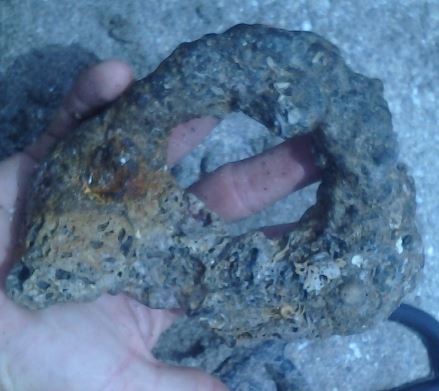
Here are a few photos from William M.  First is an encrusted object.  A museum is taking a look at this one.  Could it possibly be a hand guard?  That seems like one possibility.

Below is a connector that was found in the same hole as an olive jar neck.

Those are the kinds of things that are being seen on the Treasure Coast beaches right now.


A couple of days ago I also showed a 18th or 19th century button that showed up on one Treasure Coast beach recently too.

Thanks for the photos William.


As I often repeat, when beach conditions are not right for one kind of item, it is good for another.  Right now we are seeing these types of items that tend to go along with shell piles.

Old Connector
Photo by William M.

It appears that Dorian, much like Chantal did, is falling apart.  Now predicted to take a more southerly track, it is expected to reach Cuba as only a depression.


What do you think was the biggest year for important shipwreck discoveries?  I know that is a hard question, and probably impossible to answer, but one candidate has to be 1985.

From the online archives of People Magazine, December 1985, is this brief article mentioning three big shipwreck discoveries that year.   The discovery of the main pile of the Atocha, which occurred on July 20, 1985, and the Titanic and Whydah, both of which were found in 1985.

Below is the link to that People article.

http://www.people.com/people/archive/article/0,,20092640,00.html


The Numismatic News web site offers some very useful free downloads including a visual guide for grading circulated coins and another guide for handling and collecting coins.

Here is the site where you can get the downloads.

http://www.numismaticnews.net/


One waitress found $5000 in a diner booth and another woman found $20,000 along the side of the road.  Both women found the owners and returned the money and received a reward.

http://www.huffingtonpost.com/2013/07/26/georgia-waitress-jennifer-shaw-returns-money_n_3653696.html


Today's the day.   Most everybody knows that phrase and its role in treasure hunting.  The People article says that Mel Fisher said that almost every working day for 17 years.


In a very general sense, everyday is indeed the day.  Today is the only day you can grasp and work with.  It is the time at hand - it is where you make decisions and take action.  It is there to be used well or poorly.  The past is over and the future isn't here yet. 

If you take the phrase how I think it was meant - expecting that long-awaited big find - it seems to me that it was wrong hundreds of times before it was right.   But no matter if it is right or wrong, it represents a useful attitude.  It is the mind set of an optimist.   It enables a person to keep going with enthusiasm even when the odds are very long against you. 

A good positive attitude can be very helpful.   It is too easy to give up if you don't have a positive attitude.  Pessimists don't last long in treasure hunting.  And it would seems to me that pessimists struggle unnecessarily with life.

One way to maintain a good attitude is to have smaller goals as well as a large one.  Take pleasure in the little things as well as the big.  Don't define success too narrowly. 

Appreciate the little things in life.  The sun, the wind, the rain, the feel of sand between your toes, the relief of being in the water on a hot day, etc. 

Count your blessings.  Make it a habit.

Take advantage of obstacles and failures.  Learn from them.  Turn them around.  

Optimism leads to success, and success leads to optimism.   

Did someone need that today?  I thought about not posting it, but felt like I needed to.


Here is the new projected track of weakening Dorian.


Beach detecting conditions remain unchanged so far.  Most beaches are sandy and many have a lot of shells.

The ocean is smooth this morning.  The surf will be increasing up to a peak of about 2 - 4 feet Wednesday, and according to the predictions, decreasing again.

It looks like nothing is going to shake the beaches up for a while.


The poll is progressing nicely.  I hope the results will show our government officials the importance of detecting to the public and its impact on the region.

Thanks for responding.

Happy hunting,
TreasureGuide@comcast.net


Friday, July 20, 2012

7/20/12 Report - US Military Uniforms, Accoutrements and Weapons & Great White Sharks


Written by the TreasureGuide for the exclusive use of treasurebeachesreporort.blogspot.com.


Large Fossil Great White Tooth
I hope you liked Clausen's report on the Fort Pierce collection that I posted yesterday as much as I did.  It should be especially helpful when researching local military finds of that period.  The button collection is really great.

I've seen  a pewter feather holder for a Seminole head dress that was once dug in the Fort Pierce area.


Here is a great source of information.   It is a survey of US military uniforms, weapons and accoutrements, beginning in the early 1800s and continuing up through the modern day.

You can check out the change in uniforms, buttons, swords, insignia and all kinds of things.  It should be helpful in identifying the age of finds as well as the identity.

http://www.history.army.mil/html/museums/uniforms/survey_uwa.pdf

It is a large PDF file, so will take a while to load.


A Great White shark was sighted by divers near Fort Pierce.  They say it is not common to see Great Whites around here.

Here is that link submitted by Jim M.    Thanks Jim.

http://www.palmbeachpost.com/news/news/local/divers-encounter-great-white-shark-coast-fort-pier/nPttj/

I saw a whale breaching in the ocean a couple of months ago.

I'll mention this again because I'd like to get responses.   I have the feeling that sharks might sense and be repelled by the electornic pulses being transmitted by metal detectors.  I've seen them heading directly at me and then suddenly turn and quickly head off in another direction.  Of course that might not have anything to do with the metal detector.  Any ideas on that?

Great Whites may have been more common around here in ages past - even in the river. The photo at the top of this post shows a Great White fossil tooth found on the banks of the Indian River.  It is over two inches and has nice serrations.  Keep your eyes open while detecting.


Still no change in detecting conditions.  The seas are flat.  South/southeast winds.  Low tide around 3:30.


Happy hunting,
Treasureguide@comcast.net