Showing posts with label ocean. Show all posts

Thursday, May 16, 2019

5/16/19 Report - One Way To Accelerate Your Learning Curve. Beaches Where You Can Find Fossils. Finds. Trash and Treasure.


Written by the TreasureGuide for the exclusive use of treasurebeachesreport.blogspot.com.

Fossil Finds by DJ
Photo by DJ.

I received these photos and message from DJ about his first fossil hunt.  The photo above shows the finds of DJ's first fossil hunting trip.

I had read some past blogs on fossil hunting and Peace River. Saw some finds you posted from Bill and Dan.

I went with a guide since I believe if time is limited, that may be a good way to find things until you learn the ropes.

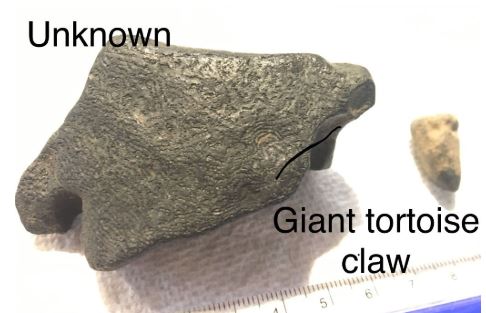
Our guide was very sharp and explained a lot of things, in the picture you can see many shark teeth, part of a broken mammoth tooth, several DuoGong rib bones, fossilized shell ‘molds’, stingray teeth plates and a claw from a giant tortoise.

Others found parts of Megladon teeth, horse teeth.

I like to hear the explanations and hunting techniques.

Like you have said, the story behind the find is fascinating, there is always something to find and most importantly (for me) don’t throw anything away until you get an ID.

And the places to look have to be learned, gravel holds the smaller stuff and deeper gravel holds larger better finds. Some people use a golf club with the head cut off as a probe to see how deep the gravel is. And the gravel moves and builds up over time like sand on the beach!

Learning where not to hunt is important as well, people have to throw out the stuff from their screens and it is easy to find yourself digging in someones spoil pile.

Here are a couple closer views of some of his finds.


Photos by DJ


Can anyone identify the unidentified bone?

I went with a paid fossil hunting guide on my first trip to the Peace River too.  It does save time on the learning curve.  They put you on some good spots so you don't waste hours trying to figure out where to hunt.  If you go with a guide, you will definitely find some fossils.  In my opinion, it is definitely worth the money if you are interested in fossils.

You'll do some sifting.  That might be a good introduction to a technique that can be used for other things.

Guides for some other types of treasure hunting and other locations may not be such a good idea, but for Peace River fossil hunting, I think you'll find it worth the money.

It is a lot like metal detecting.  It helps to know where to look and how to identify the good spots.  Find identification adds to the fun.

Nice finds DJ.  Thanks for sharing about your trip.

You can sometimes find fossils on Treasure Coast beaches, but it depends upon beach conditions.  There was a time a few years ago when they were plentiful.  One area was very rich with fossils, but they can be found form time to time all along the coast.  I've seen them at Ambersands, Wabasso, Seagrape Trail, Turtle Trail and along South Hutchinson Island down as far as Jensen Beach, and probably farther.  I also have seen some found at Rio Mar.  Some of the Indian River spoil islands also have fossils on them.

After some very high rough seas there were some large fossil bones, from mammoths, whales, etc. on the beaches.  Fossils have been scarce on the beaches for the last few years.

Native American artifacts can also be found on the beaches at times too.  They are more common when the fossils can be found, and I've seen them at some of the same beaches.

---

As part of RR Auction's The Fine Autographs and Artifacts Featuring JFK’ collection, the rosary beads used by Father James Thompson on the fateful day of President Kennedy's death were sold for $13,401.25...

https://spiritdaily.org/blog/news/rosary-beads-used-in-jfks-last-rites-auctioned-for-over-13k

---


On the deepest dive ever executed into the Mariana Trench, an American investor-turned-explorer discovered what appeared to be plastic bag and other litter nearly seven miles below the surface of the Pacific Ocean.

Victor Vescovo, a retired naval officer from Texas, broke the record for the deepest dive into a part of the Mariana Trench known as Challenger Deep, the deepest known point in the Earth’s seabed. His dive went 52 feet lower than a 1960 dive to the bottom of the Mariana Trench completed by U.S. Navy lieutenant Don Walsh and Swiss engineer Jacques Piccard in a vessel called the bathyscaphe Trieste...


https://www.foxnews.com/science/plastic-litter-discovered-deepest-dive-pacifics-mariana-trench

We all know how much junk there is out there.  We can all remove a little of it.

Removing junk metal can help you find good targets, and removing old worthless bottles can help you find good bottles.

I remember way back to high school when one day our gym teacher sent us out to pick up the junk on the football field.  I found a dollar under the bleachers.  Guess I liked eye-balling way back then.

---

The surf will be slowly increasing over the next few days.

Happy hunting,
TreasureGuide@comcast.net

Monday, November 24, 2014

11/24/14 Report - Watching Surf And Sand Movement. LIDAR Discovers Roman Gold Mining Nework. Beach Detecting Conditions Rating Downgrade.


Written by the TreasureGuide for the exclusive use of treasurebeachesreport.BlogSpot.com.

Breaking Wave As Seen Saturday Morning Near High Tide
Notice where the wave in the above picture is breaking, and where the water is flat in front of that.  That is where the water is moving over sand in front of the beach, and the rough water near the bottom of the picture is where the water meets the bottom of the slope and the water coming back down the slope.

There are three things I want you to watch in the following video.   First, where the waves are breaking.  Second, where the water surges over the sand in front of the beach after breaking.  And then something you didn't see in the above illustration, how it surges up the slope until it hits the cut and then back down again.


Here it is with lines and arrows added to show the area where the waves are breaking, surging across the bar and where the incoming water hits the water returning down the slope near the bottom of the slope.


You can clearly see where the wave is breaking (top horizontal red line).  That is where the water gets shallow enough  for the wave to break.

Then the surge across the sand in front of the beach (from the top red line to the blue line).

Then the rough water where the incoming water hits the water returning down the slope.

When you see waves breaking way out, you know the water is relatively shallow that far out. 

The waves at this beach were breaking fairly close to shore.  You can get an idea of where the water is deep and where there is a lot of sand from where the waves are breaking.  

The illustration immediately above is from six seconds in on the video.

Here is an illustration from sixteen seconds in where you can see the slope better.


The top line shows general area where the sand builds up and the waves are breaking.  The second line shows the approximate beginning of the slope.  And the arrows shows the slope where the water goes up and returns.

The angle of the video and perspective makes this difficult to diagram and illustrate, and I know that I didn't explain it very clearly.

One of main points is that you can tell a lot about where the sand is and how deep it is by where the waves are breaking and how the water is moving.  That is useful information.  Always figure out as much as you can about how the sand is moving. 

There is a lot more that you can see in this video, such as the angle of the waves as they hit the beach.

Here the waves are breaking closer to shore than some of the other beaches.  The sand in front of the beach will have to be moved or at least stirred up to uncover the older materials before they can be washed up. 

The next day (Sunday) a good number of coins were found on this slope in front of the cut.

I hope you got something out of that even though I didn't couldn't make it real clear. 

I advise watching the video a few times after reading this.

----------------

The most "google plused" post of October was the 10/4/2014 Report -  Tuning A Pulse Induction Metal Detector For Gold.  Permit To Take Photos In Florida.  Higher Surf Coming.

----------------

Hidden under the vegetation and crops of the Eria Valley, in León (Spain), there is a gold mining network created by the Romans two thousand years ago, as well as complex hydraulic works, such as river diversions, to divert water to the mines of the precious metal. Researchers from the University of Salamanca made the discovery from the air with an airborne laser teledetection system (LIDAR).

Here is more about that.

http://www.agenciasinc.es/en/News/Laser-from-a-plane-discovers-Roman-goldmines-in-Spain


---------------------

I got out to take a look at the beach this morning, and I am downgrading my beach detecting conditions rating back to a 1 (poor).  Beaches that eroded are filling again.

On the Treasure Coast the wind will be from the South for a couple of days and the surf will be slightly reduced.

Wednesday we'll have another front coming through and the wind will shift again and be coming from the North again but at the time the surf will be only around two or three feet.

I'll probably be going back to a "1" rating on my Treasure Coast beach detecting conditions rating scale before long.  I'm actually surprised that the beaches haven't refilled more already.

Happy hunting,
TreasureGuide@Comcast.net

Wednesday, October 1, 2014

10/1/14 Report - Gold and Jade Ring. Site Survey With Target ID. Poll Results. Where People Have Been Hunting Most. Antique Dog Tags.


Written by the TreasureGuide for the exclusive use of treasurebeachesrport.BlogSpot.com.

Unusual High Karat Gold and Jade
Hand Formed Ring Find/

For the type of hunting that I do the most, I do not use discrimination at all, and I seldom use a detector that has target ID. I've talked a lot about discrimination in the past and won't repeat that now.  I've also talked a lot about selecting detectors for different jobs and using multiple detectors on some sites.

I don't like to waste time reading screens and trying to figure out what the output is trying to tell me when I can just as quickly dig it up and look at it.  I also like to keep my eyes on the surroundings, reading the beach, sand, water and watching what people are doing.

A detector with target ID might be a good choice when simply evaluating a junky inland or dry beach site.  Before even deciding if you want to spend any real time at a site like that, you might just do a survey with target ID detector, maybe digging a few targets to see what they tell you about the site.

You might decide after doing a survey of the site like that to either move on to another site or stay there and get serious about detecting the site.

You can detect a site like that in steps.  I've described that system before.  Change detectors, modes, or settings after each step depending upon your additional analysis.


The most recent blog poll has concluded and the results are in.  The sample size is pretty good.  Here are the results indicating where people have been detecting most this summer.

Ocean or gulf in water.
  22 (25%)
 
Below the high tide line.
  29 (33%)
 
Dry sand at the beach.
  12 (13%)
 
Inland site.
  15 (17%)
 
Inland water ie stream, pond or lake.
  9 (10%)
 

Just over 70% of the respondents mostly detected the beaches or ocean.  The remaining nearly 30% mostly detect inland sites.

Don't forget that a lot of the readers of this blog are from other areas, and many of them detect inland unless they make a trip to Florida or something.

Of all the areas, the greatest number of respondents mostly detected the wet sand area at the beach, in fact more than twice as many than detected the dry sand.  I did not expect that.

Of those that mostly detected ocean or gulf beaches, about 1/3 detected mostly in the water. 

 I see few water hunters when I'm out.  Maybe it is because of when and where I tend to hunt.  I very often hunt when the water is rough and often around wreck beaches where water detecting isn't allowed.

The third greatest number of respondents detected dry inland sites.  Next to last was dry sand at the beach.  And the smallest number hunted inland bodies of water.
\\
Breaking it down into the categories of land versus water, the results indicate that nearly 30% do mostly water hunting.  That is a bit surprising to me too.

Of both beach and inland water hunters, a greater proportion of the inland hunters hunt "mostly" in the water as compared to the proportion of beach hunters that hunt in the water.  I would not have expected that either.

Beach hunting is easy, makes minimal physical demands and does not usually require getting permission.

Inland sites often require obtaining permission and recovering targets on dry land often requires more skill than simply sifting a scoop of sand.

---------------

You will occasionally find a vintage or antique dog tag while detecting.  There are people who collect dog tags.  Here is a link about collecting antique dog tags. 

http://thebark.com/content/collecting-antique-dog-tags


I still have no idea what the 2.5 ALABAMA tag that I posted the other day is.


Yesterday I told what the most read post of August was, but it wasn't the same as the post the received the most g+1s.  The post that was most "plused" in August was the 8/20/14 Report - Illustration Of The Development Of A Coin Hole. Five Metal Detector Annoyances. Okeechobee Battlefield. Indian Scout. Two Tropical Disturbances.

I use the number of g+1s as some indication of how much you liked a particular post.  By that measure, the 8/20 post was the favorite post of August.


I'm not so naive as to believe that any system is "all" good.  I did however presented a few things that I like about the PAS yesterday.  One of the biggest is recognition and reward for those who actually make discoveries.  There are others, but I won't get into all of that again.   Take a good look at the web site and decide for yourself.


The water was very gentle this morning.  Barely a ripple.  

Expect little surf on the Treasure Coast for the next couple of days.

Nothing in the Atlantic of interest.

Happy hunting,
TreasureGuide@Comcast.net

Wednesday, September 10, 2014

9/10/14 Report - Emerald City, Battle of Blair Mountain, Gem Stones, Vintage Costume Jewelry & Bigger Tides Today


Written by the TreasureGuide for the exclusive use of treasurebeachesreport.blogspot.com.

Artifact From Battle of Blair Mountain
Source: See link below.
As you might know, investors in the Mel Fisher operations down in the Keys are allowed to go out and dive with the salvage crews.   Investors that were diving with the crew of the JB Magruder in an area called Emerald City recently found 8 emeralds. 

You might remember the emerald from the Treasure Coast that Captain Jonah recently showed us.


 Here is a good article about gem stones.  It talks about which gems are popular and how prices are determined.

http://www.gemselect.com/other-info/gemstone-prices.php

Vintage costume jewelry can bring surprisingly high prices, sometimes hundreds of dollars.  Unfortunately, like coins, vintage costume jewelry found on a beach  has often been there a while and is probably in poor condition.  

Here is a great web site for researching old costume jewelry.  It gives information on designers, makers marks, patents, etc.

http://www.illusionjewels.com/costumejewelrymarks.html#art


Here is an article on a dig at a Revolutionary War prison camp site. 

http://www.eveningsun.com/local/ci_26412077/eighteenth-century-artifacts-including-british-half-penny-found?source=rss


Some of you will consider this off-topic, however I thought it was interesting.  It seems that mysterious cell phone towers have been appearing and no one seems to know who they belong to.  Are they being built by criminal organizations to hack or obtain information or is a covert government operation?  No one seems to know.

http://venturebeat.com/2014/09/02/who-is-putting-up-interceptor-cell-towers-the-mystery-deepens/


Unless you are from West Virginia or are familiar with the history of labor relations, you might not know about the the Battle of Blair Mountain, which occurred near Charleston WV in 1921.   The Battle of Blair Mountain involved more than 10,000 men and was the country’s largest civil conflict besides the Civil War. Though the battle is little known outside of union and historian circles, it was a key moment for the American labor movement.

Detectorists helped to determine where the skirmishes actually took place by scanning the area for gun shells and artifacts.  Now the historic site is in danger of being destroyed by mining operations.

Here is an article about the second largest civil conflict in US history.

http://archive.archaeology.org/1201/features/blair_mountain_coal_activism_west_virginia.html


If you ever had the opportunity of detecting a battle site, you might have found that the artifacts really speak to you.  Things like buttons, bullets, or gun parts all seem to make you wonder how they got lost and what happened to the person that once used them.

The first time I had a chance to hunt a battle site it was like that.  I found my first military button there, my first gun flint, my first musket part, my first grape shot, and a few other firsts, however, each and everyone of them seemed to be accompanied by an image.  I thought about sailing ships, soldiers and sailors hundreds of miles from home landing on a strange island, and attempting to climb up a very steep embankment to reach the fortified canon emplacements while being shot at.  There was evidence of hand to hand combat on that steep cliff.   I thought those images were nothing more than my imagination, but could they have been something more.  I doubt it, but it sometimes felt like a faint ghostly reenactment materialized in the air.


Seems the weather is finally getting a little cooler.  It has been one hot and rainy summer on the Treasure Coast..

There is a little weather system over the Bahamas that is headed our way.  Doesn't look like it will cause the surf to increase much though.  Also a system crossing the Atlantic headed towards the West Indies.  That won't affect us this week.

The tides are nice a big now.

Happy hunting,
Treasureguide@Comcast.net

Tuesday, May 20, 2014

5/20/14 Report - What You Can Learn About Beach Detecting From Hunting Gold Nuggets, Great White and Magic Grapeshot


Written by the TreasureGuide for the exclusive use of treasurebeachesreport.blogspot.com.


The higher surf didn't help conditions any.  It was hitting the beach straight on instead of at an angle, which resulted in more filling.  It wasn't that much higher anyway.

One Treasure Coast Beach Just After High Tide Monday Afternoon.
I showed this beach the day before yesterday.  There isn't much left of the cuts now.  Notice the sea weed, which indicates that the beach is filling.

Another Similar Treasure Coast Beach Monday Afternoon.
This one is filling in too.  Again, notice the sea weed.

It just goes to show once again that the direction of the surf is as important as the size of the surf.


I've often said how good it is to try different types of detecting.  Most people who read this blog detect beaches or shallow ocean waters a lot.  Although I know there are some, most of this blog's readers do not hunt gold in streams, however, if you ever get the chance or opportunity, try it out, because you'll have some fun, might find something, and perhaps most importantly, will learn something that will open your eyes to new opportunities and supply you with new useful skills.

There are many web sites dealing with hunting gold in or around a river or creek.   Here is a little one that in a few short paragraphs provides some helpful tips.

http://voices.yahoo.com/where-look-gold-streams-5724340.html?cat=11

I'll summarize a few of the key points from this article that apply to beach or shallow water ocean detecting.

1. Look around bends in the stream.  Why?   Because the water slows and gold will settle and collect there.  

Notice any familiar principles?   Yes, the same thing happens on a beach.  Where the water slows, gold and other heavy items will settle. 

Understanding the movement of water and where things will collect will help you on a beach too.

2.  Work the banks, not just the water.  Why?  The stream bed and water level will change over time and flood waters can drop gold on the banks.

That happens on a beach too.  The same basic forces are at work, the force of moving water, changing water levels, and don't forget gravity.

3.  Hunt around obstructions, such as boulders or cracks in the bedrock where gold will accumulate. 

Do the same in the shallow water or on the beach, especially in the wet sand or where the water has once been.

In the water or on a beach, rocks or other obstructions such as jetties or sea groins will also collect targets.

4.  The article also says, The most important step in panning a stream for gold is to develop a plan. Looking for gold in random place after random place can be frustrating and is an inefficient use of your time.

That is something I always teach here.  Randomly hunting is what many beginners do, but if you are going to become more effective, you'll develop a plan that guides your hunting.   As you hunt more, your plan should become more detailed and systematic.

I know the above web site is not the best site in the world for giving the details on how to find gold in a stream, but it quickly shows how one type of hunting can help you better understand forces and develop techniques that will help you become more productive no matter where you detect.


Here is a video of diver who encountered a Great White Shark off of Vero.

http://xfinity.comcast.net/video/Scuba-diver-takes-on-great-white-shark-in-Florida/260293699851/Comcast/TopVideos/?cid=sf_vidtray


Here is a web site showing the excavation of a 1700s pirate hangout up the Belize river called the Barcadares.   This is a new piece in LiveScience but is actually a rehash of previously published material.  Nonetheless, you might want to take a look.

http://www.livescience.com/15865-photos-pirates-caribbean.html


Magic grapeshot?   Archaeologists imagine that 18th century grape shot found buried in post holes under a foundation of a Caribbean plantation were magical in nature.  That seems unlikely to me.  What do you think?

Get the details here.

http://www.livescience.com/45696-artifacts-unearthed-in-caribbean.html


Happy hunting,
Treasureguide@comcast.net


Thursday, February 27, 2014

2/27/14 Report - Another Hoard, Factors Affecting Movement of Debris in the Ocean and Big Surf Predicted.


Written by the TreasureGuide for the exclusive use of treasurebeachesreport.blogspot.com.


Yesterday I mentioned how it seemed that there were a lot of treasure stories in the media lately.  Here is another.

A large hoard of Roman gold and silver jewelry worth around a million euros has been recovered after being found in a forest in Germany.

All of the rare coins, rings and brooches contain gold or silver, and many date back more than 1,200 years.

The article says, Experts say the find could be the largest and most magnificent collection of late antiquity pieces ever found in Germany. It also includes a solid silver bowl set with gold and stones and a set of gold and silver plated statuettes which formed part of a military commander's portable chair.

Here is the link.

http://www.thelocal.de/20140219/german-amateur-treasure-hunter-bags-sensational-roman-hoard

This find was made illegally.  That isn't good but something like the Portable Antiquities Scheme might have prevented the unfortunate way the whole thing went down.

Scientists have been tracking ocean debris caused by the Sept. 2012 tsunami in Japan.  They made improvements to the initial model to take into account the different shapes and buoyancies.  The amount of surface area exposed to the wind and currents causes the objects to drift at different speeds and trajectories.  The model predicted the timing and type of material that would wash up on the shores of Hawaii, which included very buoyant pieces such as oyster buoys, crates, small fishing boats and parts of refrigerators.

You might remember some of my discussions concerning the types of factors that affect how things will move and be distributed on a beach.

For example, a watch might act something little a refrigerator.  A watch can be fairly heavy, butsince it can contain air pockets and provides a lot of surface area relative to their size and weight, it would be moved more by currents and sink less quickly in sand.

If you've been reading this blog over the years, you've heard me discuss factors like these that are usually left out of the equation when people talk about "heavy objects," "density" or even "specific gravity," as if all objects were simple lumps.

Here is the link to the article about tracking the tsunamis debris.

http://www.spacedaily.com/reports/What_has_happened_to_the_tsunami_debris_from_Japan_999.html

You also have to take the same factors into account when trying to figure out where shipwreck debris will end up.   To some extent, different types of objects will be separated and distributed separately on the bottom of the ocean and along the beach.\


Did you know there are things that it is illegal for Americans to sell?  You probably know some of them but might be surprised by others.  Here they are.

http://www.cnbc.com/id/101424448/?__source=xfinity|hero&par=xfinity


While the seas around Florida have been very calm this winter I've talked about the rough seas, flooding and erosion in the North Atlantic on both sides of the pond.  25-foot waves have been pounding the shores of Lake Michigan.

Here is an article about those dangerous conditions.

http://www.mlive.com/news/grand-rapids/index.ssf/2014/02/monster_25-foot_waves_to_churn.html

Thank goodness our beaches aren't frozen.  I remember a few winters ago when it seemed my toes were freezing and had to go back to the car and get footwear.  Usually the water is warmer than the air on cold days, so I would dip my feet in the water for temporary warming.  This time I thought I could take it but didn't realize I was getting too soft and accustomed to Florida weather.

We've had some cool days, but not many cold days.

For the Treasure Coast there is a period of six to nine foot surf prediction about a week from now.  As I've often mentioned, when the surf web site predict a big surf a week or more in advance it usually never happens.  Only time will tell.

Happy hunting,
TreasureGuide@comcast.net