Showing posts with label sheathing. Show all posts

Thursday, October 3, 2019

10/3/19 Report - Sword Fragments Found. Lead Sheathing on Shipwrecks. A Lead Find. Beaches.


Written by the TreasureGuide for the exclusive use of treasurebeachesreport.blogspot.com.


Archaeologists have discovered fragments of about a hundred Viking swords, the largest find of Viking swords in Estonia to date, in northern Estonia.

Here is the link for more about that.

https://news.err.ee/986495/fragments-of-100-viking-swords-unearthed-in-north-estonia

---

Lead Showing Cloth Pattern Found Very Recently.
Find and photo by JD.
JD didn't know what it might be but thought of lead seals.  I sent him the following link about lead sheathing on the Santa Margarita, of which there were thousands of small pieces recovered.

https://www.academia.edu/4351205/Lead_Hull-Sheathing_of_the_1622_Galleon_Santa_Margarita?auto=download

I think you'll enjoy the Santa Margarita article along with some of the other related articles that are linked at the site.

Here is a brief excerpt starting with a list of some shipwrecks having similar lead sheathing.


---

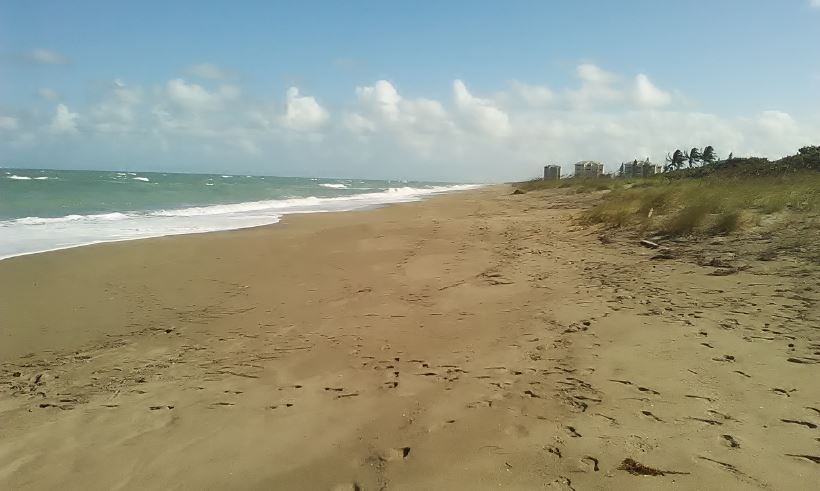
I looked at the beach yesterday afternoon before low tide.  Despite the high surf Tuesday, which was evident by the high tide line, the beach barely changed.

Here is John Brooks as it looked then.

John Brooks Beach Yesterday Afternoon.
John Brooks South Yesterday Afternoon.
I also looked a mile or two north of that.

North of John Brooks Yesterday Afternoon.
I don't know if the water was high enough to get into the dunes up in the Vero/Sebastian area or what happened up there.

--

It looks like there won't be much change to the beaches for the next several days.  If nothing happened Tuesday, I'm not expecting anything much new for a while.

Have you noticed that as you get more TV channels how they have to come up with more crap to fill the air time.  The population of ghosts, spirits, Big Foots, UFOs  seems to be growing exponentially, and that isn't to mention the worst of the lot.

Happy hunting,
TreasureGuide@comcast.net

Friday, April 26, 2019

4/26/19 Report - Artifact Find Initiates Journey of Discovery. Cannon Aprons. Good Resources.


Written by the TreasrueGuide for the exclusive use of treasurebeachesreport.blogspot.com.

Folded Lead Find From Treasure Coast Beach

This lead find has been sitting around for a while and I never thought of it being anything but a piece of lead sheathing, however after seeing some examples of cannon aprons, I decided I should take a better look at it.  

There is more to the piece than you can see.  It is tightly folded over a couple of times, which isn't like the other lead sheathing that I've found,  It looks like it could have been deliberately folded rather than simply crumpled by the wrecking or surf.

I found some photos of a cannon apron that came from the Queen Anne's Revenge.   That started me on a journey of discovery and learning.

The qaronline.org website says,

Sheets of lead with “fingers” were used to cover the touch hole of a cannon, protecting the powder and the fuse from water spraying into the gun ports. Lead is malleable and could be formed to the shape of the cannon barrel, while the fingers could be bent to create a tight fit around the breech of the cannon. A hole on either edge of the apron would fit a lash to keep the apron tied in place.


The same web site provides the following photo of a salvaged cannon apron.

'

In the case of the photo shown immediately above, the holes would be on the right and left sides. You can clearly see the hole on the right side.

You can also see what could be the "fingers" on the upper side of the apron in the photo. It looks like the middle finger is broken off or bent.

Although I'm far from concluding that my find is a cannon apron, I've at least learned that there is such a thing.

I discovered another very interesting resource.  It is a thesis presented to East Carolina University by Laura Kate Schnitzer - APRONS OF LEAD: EXAMINATION OF AN ARTIFACT ASSEMBLAGE FROM THE QUEEN ANNE’S REVENGE SHIPWRECK SITE.

This is a very interesting and informative thesis.  You might not want to read the entire thesis, but you will undoubtedly find sections that you do want to read.  It is well worth scanning.

The thesis presents the picture below showing a cannon apron in place on a cannon.


Cannon aprons come in different sizes and shaped depending in part upon the cannon.

The QAR apron illustrated above has a variety of scratched or etched markings on it.  Here is a picture in which those markings are drawn to make them easier to see.

Source: qaronline.org web site.
See link QAR link above.
The thesis discussed those markings and what they might indicate.  Some were thought to be superstitious marks for good-luck or protection.  That discussion makes for some interesting reading.

I recommend at least browsing the thesis for several reasons.  For one thing, it presents an evolution of artillery through the centuries.  It presents a lot of information in addition to what you'll learn about cannon aprons, including a very good bibliography.  It also illustrates a more academic approach to artifact interpretation that expands on some of my previous comments and criticisms of what I've called the "free association" method that you might have seen on TV.   There is a lot of academic jargon and maybe a lot that you won't find interesting, but you can skip the parts that don't like.  I'm sure you will find something that does interest you.

Here is the link.

http://thescholarship.ecu.edu/bitstream/handle/10342/3842/Schnitzer_ecu_0600M_10612.pdf?sequence=1&isAllowed=y

Back to my find.   Even though I've had it for a while, I have not yet really studied it.  Right now I'm trying to decide if I want to unfold it.  Whether I do that or not, I plan to look at the object more closely.

Digging up an object is one discovery, but a found object can become much more interesting when you do the research and really study it.  

---

I am highly supportive or archaeology, but have also commented on some of the problems created by some of the more radical members of the profession.  Here is a link to a post I once did on that subject.

https://treasurebeachesreport.blogspot.com/2018/02/22518-report-problem-with-archaeology.html

---

Jensen Beach As Seen a Couple Days Ago.
Photo by Mike A.
Mike said there was nothing but some crusty pennies.

---

The surf is running around two or three feet.

Happy hunting,
TreasureGuide@comcast.net

Sunday, September 16, 2018

9/16/18 Report - After Florence. A Couple Finds. Muntz Metal and Copper Sheathing.


Written by the TreasureGuide for the exclusive use of treasurebeachesreport.blogspot.com.

Gold Band Found a Couple Days Ago.


After all the weather, it looks like the things on the Treasure Coast are pretty much back to normal.  Although we got some good water, I didn't see hardly any erosion.  Still finds were made.

One gold band was found, but there were some older things found also.  Those shown below are among the oldest.

A Couple Treasure Coast Fossil Finds.

I think both of the fossils are turtle fossils.  The one on the left, I think is from the plastron - the flat part of the shell under the turtle.

I always enjoy finding interesting non-metallic items while detecting.

I haven't cleaned the encrusted objects yet.

---

Yesterday or the day before I posted a picture of a fake coin and a piece of copper found by D. Renken, and then below that I posted a picture of a nice wall display made of shipwreck finds.   James F. sent me an email and pointed out that what I referred to as copper might actually be Muntz metal instead.  

Muntz metal is an alloy of copper and tin.  I think James is probably right about the large piece in the wall display that bears the marker's mark.

In my 4/16/14 post I gave a link to a page about the use of copper in maritime history that tells about G. F. Muntz patenting his new brass alloy of 60% copper and 40% tin, called Muntz metal.  That patent was registered in 1832.

Here is that link again.


I posted a nice find of Muntz sheathing that showed a patent mark in my 4/19/14 post.  Since Muntz metal wasn't patented until 1832, that, of course, means that if it came from a shipwreck, the shipwreck would not be no earlier than 19th century.

In the area where D. Renken found the fake coin and the item I called copper, I know there is an 1800s  era shipwreck, but there is also an early 1600s or late 1500s shipwreck almost within a stones throw from there.  And not too far in the other direction is a possible 1715 wreck in an area of an exploratory lease that was investigated in the summer of 2017.

I have personally found a lot of copper, including some fairly large pieces, in the same area where the recent finds were made by D.  Renken.

Thanks to James F. for the note about Muntz metal.

---

What is the best thing you ever found?  I hear people ask that all the time.  I always have a hard time answering that question, and try to avoid it anyhow.  I think when most people ask, they are really asking what is the most valuable thing I found.  That isn't easy for me to answer either, and I'm not interested in saying anyhow.

One thing that makes answering that question more complicated, is that I don't always immediately know the value of things.  There were things that I thought weren't worth anything that I later found out were worth a lot more than I thought, and there were things I thought would be much more valuable than they actually were.  In the days before the internet it often took a lot longer to do the research or get good estimates of value.

----

There is nothing left in the Atlantic that is likely to affect us much.  Joyce and Helene are no threat to North America, and Florence seems to be heading north.

There is one wave down in the Caribbean that could develop.  I'll watch that one.

Source: magicseaweed.com

As you can see the surf will be decreasing throughout next week.

I'll be happy to get some nice fall weather.

Happy hunting,
TreasureGuide@comcast.net

Wednesday, December 28, 2016

12/28/16 Report - Shiver Me Timbers. Wood Shipwreck Remains.


Written by the TreasureGuide for the exclusive use of treasurebeachesreport.blogspot.com.

Worm-Riddled Shipwreck Wood From a Treasure Coast Beach.
I mentioned the other day that a lot of the visible wreckage of the treasure wrecks is not longer there. To a large extent it has deteriorated, been removed, or scattered about.  Once in a while, though, there is still some timber that gets uncovered and washes up on the beach.  That happens most after rough weather that removes protective layers.  It doesn't seem to happen very often anymore.

Of course things deteriorate and disappear, especially in rough salt water environments.  One thing that was always a problem for wood ships is the Toredo worms.  Various things were used over the years in the hope of preventing that type of damage, such as covering the hull with copper or lead or various materials or substances.

Prior to around 1800 hulls were made almost entirely of white oak, possibly with sacrificial planking on the outside of the hull. The sacrificial planking was used on ships that traveled in warm ocean waters, where wooden hulls are susceptible to damage by burrowing marine organisms such as teredo worms. Sacrificial planking was applied to hulls to decrease the risk of damage. This half-inch thick layer of wood, such as pine, was replaced regularly when infested with marine borers. By the late eighteenth century copper sheathing replaced sacrificial planking as the preferred method of hull protection.

As far back as the reign of Edward the III, in 1336, several compositions containing pitch, tar, sulphur and oil were employed for coating the hulls of ships to prevent the attack of sea worms and the adherence of barnacles and sea weeds. It was also a common practice to use a thin planking, secured by nails, over the main planking, in those olden times. In 1625, a patent was granted to one William Beale, in England, for a composition not described, but the object of which was to render the hull and rigging incombustible.  


(That excerpt is from http://www.globalsecurity.org/military/systems/ship/copper-sheathing.htm.)

There are places on the Treasure Coast where you can still find pieces of lead and copper sheathing.  I think the place that seems to produce the most copper sheathing is a later wreck and probably not a treasure wreck.

I've read that pieces of hull and other wood structures were observed on some of the 1715 wrecks into the mid-20th century.  I don't know how much wood the salvage crews see on the wrecks anymore.  I do know that it wasn't long ago that I found pieces of worm-riddled timbers on the beach.  Large sections were found over the years in the dunes at various locations.  It can be difficult to tell the age or source of small isolated wood finds like that.

At the top of this post you can see a close up of one piece that I found one time.

Often there will be the remains of iron or other types of metal such as spikes or rods.  This piece shown above has a piece of what appears to be a spike and a hole or two where there were once pieces of metal.

I've posted some beach found shipwreck wood in this blog in the past.   I suspect that there has to be a relatively unusual combination of weather conditions to uncover centuries old wood and wash it up onto the beach these days. A few years ago quite a few pieces washed up.  Of course it is also possible that wood covered by the dunes was washed out, but I don't think that was the case the last time I saw it happen, judging from the other things that were washing up onto the beach and where it happened.

---


KEY WEST, Fla., Oct. 11— After 364 years under water, 40 timbers from the sunken 17th-century Spanish galleon Nuestra Senora de Atocha, each weighing 1,600 pounds, have been raised from a depth of 54 feet in the Gulf of Mexico...

The timbers are ''the largest single collection of remains from a Spanish galleon,'' according to Dr. John Dorwin, senior archeologist for the treasure hunters who found the ships. ''And in terms of construction of such a galleon, very little is known.'' He predicts the timbers will help to break new ground in ship architecture.

Here are links to the article and a YouTube video about that.

http://www.nytimes.com/1986/10/12/us/spanish-galleon-s-timbers-made-accessible.html

https://www.youtube.com/watch?v=OAfrOmHeIzE

And here is an article that claims that as the result of global warming teredo worms are spreading farther north and damaging shipwrecks that in the past were safe from the pest.

http://news.nationalgeographic.com/news/2010/01/100119-viking-shipwrecks-worms-shipworms-global-warming/

---

If you're curious about the expression "shiver me timbers," here is a link.

http://www.historyextra.com/qa/pirate-history-origin-meaning-shiver-me%20timbers-why-say

---

We're having unusually warm weather for the season.  And the beaches aren't doing much.

Happy hunting,
TreasureGuide@comcast.net


Saturday, November 7, 2015

11/7/15 Report - Copper Finds - Kettle and Sheathing. USS Constitution. Tips For Identifying The Age Of An Old Kettle.


Written by the TreasureGuide for the exclusive use of treaurebeachesrepor.tblogspot.com
Old Copper Kettle Found On The Treasure Coast
After the Revolutionary War,  Paul Revere started a copper foundry and made bolts, spikes and nails for ship building.  He added other items to his product list and produced bells and canons.


REVERE Mark On Kettle
Here is the Revere mark on the piece that held the handle.  The piece attached with rivets.

The kettle looks old to me, but I've read that the Revere's company did not make cookware until much much later.  

Kettle parts were prominent in the archaeological record in many places, including a battle site in Wayne County, Michigan dated 1770 - 1813.

See for example, Timothy McGuire's book, An Identification Guide to Recovered Colonial and Revolutionary War Artifacts (2013).

Here is an excerpt from McGuire's book

Brass and copper kettles were widely used in the Colonial and Revoutionary War Period.  After much use, they would crack and start to leak.  A patch would be cut from a scrap kettle and riveted over the crack.  Heavy recycling was the norm...

When a kettle finally failed, it was cut up and used for many different purposes.

Many scrap pieces and trimmings from kettles were found and are shown in the book.

I don't know the date of the kettle yet.

---

A lot of you have found pieces of copper on shipwreck beaches.  Some are small and some are larger.  Some show holes from square nails or round rivets.


Pieces of Copper Found On Treasure Coast Beaches.
One beach that gives up a lot of copper pieces, both large and small is shipwreck beach but I think much of it is coming from a wreck that is not a treasure wreck and is also later than 18th century.  I don't know that, but several clues lead me to that conclusion.

Of course not all copper comes from a shipwreck.  There are other and later sources.

Back to the Revere company.  It was the Revere company that made the copper sheathing for the USS Constitution, also known as Old Ironsides, which was launched in 1797.

---

Here is an excerpt from a web site that provides some history and some good tips on identifying the age of copper kettles.


Early kettles were made of thick sheet copper hammered out by hand.  Before about 1850, most seams were folded over and hammered together; after this date, they were usually soldered.

Look at the riveting. Old rivets look their age, and you should be wary of sharp new work...

...Copper kettles were built to last, and one that was splitting at the seam wouldn't have been discarded, but would have been laid aside for the travelling tinker to repair...

Here is the link.

http://www.antiques-art-collectibles.com/collectible/copper_kettle.html

---

No change in beach conditions.

Happy hunting,
TreasureGuide@comcast.net

Wednesday, April 16, 2014

4/16/14 Report - Odyssey Marine, SS Central America, Copper Sheathing, Northeast Wind & Erosion


Written by the TreasureGuide for the exclusive use of treasurebeachesreport.blogspot.com.


Treasure Coast Beach This Afternoon.


We had a good northeast wind on the Treasure Coast this morning.   That surprised me a little.  After watching it a while, I thought I should go check out the beach even though the surf was supposed to be small.
 
This picture shows the same beach that I showed yesterday.  The top cliff is from yesterday.  The bottom cliff is from last night, or more likely, this mornings high tide during the northeast wind.
 
You can see that a foot or more of sand got removed since yesterday, and this wasn't the most eroded spot.


Same Beach Just a Little North.
In some spots more sand got removed today.  The second picture shows where there was about a four foot cut.  It ran a good distance too.  It was about a two foot cut yesterday and two more feet gone today.
 
This cut beach that I'm showing was the most cut of any that I saw today.  Other beaches were nothing like this one.
 
I checked it out simply because the wind looked promising.  There were very very few signals though.  I'm not going to increase my beach conditions rating despite the sizable cut on this one beach.  I will however issue an alert.  If things continue to improve we might get into something.


Tonight the high tide will be higher than normal.  If the wind remains favorable that should help.  Thursday we're supposed to get up to a six foot surf and again Sunday.   That could do some good.

Odyssey Marine Explorations had a profitable year.  They will be salvaging the SS Central America which hasn't been worked in a decade due to court proceedings.

Here are a couple of paragraphs from an Odyssey press release.

The SS Central America was a wooden-hulled, copper-sheathed, three-masted sidewheel steamship launched in 1852 as the SS George Law. The ship was in continuous service on the Atlantic leg of the Panama Route between New York and San Francisco. Owned and operated by the United States Mail Steamship Company, the SS Central America was caught in a hurricane and sank on September 12, 1857.

When it was lost, the SS Central America was carrying a large consignment of gold for commercial parties, mainly in the form of ingots and freshly minted U.S. $20 Double Eagle coins. Because of the large quantity of gold lost with the ship, public confidence in the economy was shaken, which contributed to the Panic of 1857.

Here is the link for more about Odyssey and their projects.

http://ir.odysseymarine.com/releasedetail.cfm?ReleaseID=831011

Did you notice that the SS Central America was copper-sheathed.  That practice started in the mid 18th Century.  So if you are finding copper hull sheathing it is from a wreck of that time or later and not earlier vessels such as those of the 1715 Fleet.   Of course, earlier wrecks do have copper items other than sheathing but copper sheathing would be later.

It can help a lot to know the approximate dates of things like that.

There is one beach on South Hutchinson Island that produces a lot of copper sheathing yet today.  I suspect a later shipwreck is there, in fact I think there is a mixture of wrecks there, but some of the copper bits could also come from things other than shipwrecks.  There is a lot of varied history there.

Here is a link to a site that gives some information on copper sheathing.

http://www.copper.org/education/history/60centuries/industrial_age/copperand.html

Later tin was mixed with the copper resulting in "Muntz metal."

Copper or copper alloy sheathing was no longer used on larger vessels after steel hulls became common, but it was still used later on smaller vessels.


Leo L. had this to say about Dan B.s key from yesterday's post.

Well the keys are likely from Allegheny County in Pennsylvania maybe likely keys from the jail?? or government building.


If the wind doesn't switch, and I think it will, we might get a beach conditions upgrade before long.

The trouble we've been having this year is the fronts have been moving through quickly and when the wind is right, it changes too soon and the cuts fill back in.

Happy hunting,
TreasureGuide@comcast.nt


Friday, November 19, 2010

11/19 Report - Copper Sheathing and Magnets


Picture of Copper Sheathing on Ships Bow.

A couple of days ago I posted a photo of a copper sheet found on the Treasure Coast. Mike T. sent a very informative email including a lot of good information on the use of copper sheathing including this picture.

One other thing that he mentioned is if you find copper sheathing make sure to clean and inspect the corners which is where you might find the mark of the manufacturer, patent information, etc.

I might include more of Mike's more detailed information in future posts.

David S. helped me to figure out the identity of the mystery disk that I showed a few days ago. He says, "The edge of the disk shown in the photo you posted looks to have the marks left by an oxyacetylene cutting torch on steel plate. Is it ferrous and does it respond to a magnet? If yes, then it may be a disk cut out of a piece of plate steel by a cutting torch."

David S. got it. I appreciate the expertise and help. One of the things I like about doing this blog is how much I learn.

That brings up another good subject. When you talk about treasure hunting tools, two that come immediately to mind are a metal detector and scoop or other digging tool. There are other tools that often come in handy though. One that I'll discuss now is a good magnet.

To test the disk, I used a magnet, and it stuck.

Photo of a Good Magnet.

You can use a magnet to help determine the type of metal you found.

I often use the magnet shown in this photo to test conglomerates. Some conglomerates will stick to the magnet, indicating iron contents. Heavily encrusted objects with dissolved iron in them may exhibit a light attraction to the magnet that you can feel even if the magnet won't pick up the object.

The photo below shows an encrusted object sticking to the magnet.

Don't forget that if there is a ferrous object inside, there could also be other types of objects inside the conglomerate such as coins or other things.

A good magnet can also be used with a cord or pole to retrieve iron artifacts from wells or other hard to reach places.

Overall, I think you might find a good magnet worth the investment.


Encrusted Object Sticking to a Magnet.


Caution: do not put your magnet close to magnetic computer storage media.


On another subject, laser scanners are being used to create 3-D images of caves. You can see how useful that might be.

This link provides some good examples.

http://news.bbc.co.uk/local/nottingham/hi/people_and_places/history/newsid_9172000/9172619.stm

Forecast and Conditions.

Seas are around 4.5 feet today with northeast winds and a high tide around noon. It is looking more promising than you would think with less than five foot seas. The wind is about right and the high tides are pretty high.

While I only would rate the beaches as poor right now, with tomorrow's increasing seas and everything else, that could possibly change.

I know last weekend didn't turn out as good as hoped, but there were still some interesting pieces found, although no cobs that I know of.

Thanks to all of you who have sent emails and information lately. It helps a lot.

Happy hunting,
TreasureGuide@comcast.net