Showing posts with label spoon. Show all posts

Wednesday, May 27, 2020

5/27/20 Report - Researching Silverware. Chronology of Nails. Lead Shipwreck Sheeting. Auction Goes Live.


Written by the TreasureGuide for the exclusive use of treasurebeachesreport.blogspot.com.


Even if you do not plan to bid, you can still watch the auction.  When it goes live, the lots go quickly.

---

A couple weeks ago I started to look at some of the tableware that I've found over the years.  I posted some of those and got some help with makers marks.  Today I'll post one of the larger and more ornate ones I've found.

Large Rose Pattern Ladle.


Makers Mark.

Looking at little closer, the marks are clearly visible.

Closer Look At Maker's Mark.

The makers is obviously Holmes and Edwards.  I'm not sure what the other two marks are.  It seems that most tableware show at least one number.  I assume it is the pattern number, but don't know that.

Here is what I found.

The Holmes & Edwards Silver Co began its activity in 1882 succeeding to Rogers & Brittin. The initial business was the production of low priced plated flatware using its own blanks or simply plating blanks of other manufacturers.


The qualitative leap in Holmes & Edwards production occurred with the acquisition of the invention patents obtained by William A. Warner of Syracuse for a technique of inlaying blocks of sterling silver at the wear points on the back of spoons and forks prior to plating them.


Warner went to work for Holmes & Edwards and his patents (December 9, 1884 and March 2, 1886) brought to the firm a gold medal at the Columbian Exposition in 1893 and a prominent place in silverplate industry.


The Holmes & Edwards plant was taken over in 1898 by the International Silver Company, continuing to operate in Bridgeport until 1931 when it moved to Meriden.

In 1956 the trademark "SILVER INLAID" was changed to "HOLMES & EDWARDS DEEPSILVER" and in 1960 to "INTERNATIONAL DEEPSILVER".

Silver inlaid production was discontinued in 1972 and later marketed by Wallace International Silversmiths Inc.

Trade marks used by Holmes & Edwards: STRATFORD SILVER CO, ORIENTAL MEXICAN CRAIG, HESCO, VIANDE, AZTEC COIN METAL. 


I've not researched this particluar piece to the point that I can place its date.

That is a good web site that has a lot of information on maker's marks and silverware companies.

---

If you hunted the Treasure Coast shipwreck beaches, there is a good chance you've found flat pieces of lead.  They come in various sizes and often have nail holes.  Often one side will show the imprint of a cloth weave.


Some have thought that the lead was nailed to the hull over a cloth undercoating.  An article published in 2001 issue of a Fisher newsletter throws doubt on that theory.

See

Here is the link.

https://www.academia.edu/4351205/Lead_Hull-Sheathing_of_the_1622_Galleon_Santa_Margarita?email_work_card=view-paper

---

Another thing you'll find is nails.  An article in Historical Archaeology will help you learn about the manufacture of nails through history and identify the date of your nail finds.


Here is a very helpful table from that article.


And here is the link.


https://uccshes.files.wordpress.com/2012/09/nail-chronology-the-use-of-technologically-derived-features.pdf

---

It looks like we'll have a two to three foot surf for several days.

Happy hunting,
Treasureguide@comcast.net


Tuesday, May 12, 2020

5/12/20 Report - Metal Detecting Silverware and Conductivity Numbers. Sterling Silver Finds. And Mystery Piece Identified.


Written by the TreasureGuide for the exclusive use of treasurebeachesreport.blogspot.com.

Silverware Used for Metal Detector Conductivity Readout Test.
As you probably know, I highly recommend testing your metal detector with a wide variety of types of targets so you get to know what your detector is trying to tell you.  I used the five examples shown above for a simple test I'll report on today.

From top to bottom is a two-tined for that I presumed to be made of steel.  Second is a spoon that is clearly marked stainless.  Third is a knife marked "Robeson 'Frozen Heat'".  Fourth is a fork marked "sterling" and then a marked sterling spoon.

Using the equinox the following conductivity numbers were obtained for each example, working from the top of the photo to the bottom.

Two-tined fork               -5 to -2
Stainless spoon              -5 to -2
Frozen Heat knife            2 -   5
Sterling fork                   18 - 22
Sterling spoon                28 - 32

Of course the numbers varied a little, but the above ranges are fairly good representations.  The position of the item matters, as does the shape.  

I believe the sterling spoon produced higher numbers than the sterling fork because of the flat round shaped area on the spoon.

My tentative conclusion is that you can tell the difference between an steel piece of flatware and a sterling or silver piece by the conductivity numbers.  The numbers for the sterling pieces was very much higher and in a relatively consistent range.  

I believe that experiments like this can help you better identify buried targets in the field, although when I'm in an interesting area, unless I have time constraints or something, I'm going to dig everything anyhow.

I should have included a silver plated item or two.  I might do that in the future.

---

A Couple Silver Forks Marked Sterling.

If you've been keeping up with my daily posts, you know that I've been going back and looking through some old tableware finds.  You'll find a lot of tableware if you search old home sites, and you'll find some on the beaches and in the water as well.  Some of it will be old, some fancy and some plain.  The fanciest or oldest pieces aren't always the most valuable.  With current silver prices of $15.65 per oz. or about $.50 per gram, as it was this morning, a plain piece of sterling silverware can be worth a few dollars in silver content.

The two forks shown top of this post both weigh over 1.5 ounces each.  That figures to be about $20 in silver content for each - not a big treasure, yet enough to pay for some batteries.

Sterling Silver Fork and Spoon.
The sterling fork shown above is just over 1.5 ounces and the spoon just under 1 oz.

Of course sterling silver is not pure silver -  only 92.5 percent, so you have to take that into account.

Unfortunately most tableware finds will be stainless steel or plated rather than sterling or coin silver, but the oldest or most ornate will not necessarily be worth the most.  The fork and spoon shown above look plain and modern, yet have good silver content.

As for the companies, it gets confusing.  Here is what Wikipedia says about the International Silver Company.
In Meriden and nearby Wallingford and Middletown, the companies that were banded together to form the International Silver Company included these companies: Meriden Britannia Company, Meriden Silver Plate Co. , Middletown Plate Company, C. Rogers & Brother, Simpson, Hall Miller and Co., Simpson Nickel Company, Watrous Manufacturing Company, and the Wilcox Silver Plate Co., In Hartford, the following silver companies also became part of the corporation: Barbour Silver Company, Rogers Cutlery and William Rogers Manufacturing Company. Other Connecticut companies that became part of the corporation also include Holmes & Edwards Silver Company in Bridgeport; Plate Silver Co. in Derby; Norwich Cutlery in Norwich; Rogers and Brothers, and Rogers and Hamilton in Waterbury. 
From outside New England were Manhattan Silver Plate in Lyons, New York; and Standard Silver Company, Ltd. in Toronto, Ontario, Canada. Into the 20th century, many silver designs carry either the International Silver Company brand, or the pre-existing brand continues, or both are listed as the design maker.

---

A couple days ago I posted a photo of what appeared to be an old spoon showing a globe with silverware maker's mark.  I asked for help identifying the mark and the readers of this blog came through.

Here is what they found.

American Silver Company Maker's Marks 
Found by Mike M. (left) and JorgeY. (right)


Moselle Pattern Spoon
Submitted by Dan B.
Mike and Jorge found the makers marks as shown above.  Then Dan added the photo of the Moselle pattern spoon, and Alberto looked up the patent number and found the following ad for an American Silver Company sugar spoon having the same patent number as the spoon I was asking about.

Submitted by Alberto S.

Thanks guys!  I think that nails it down.  It appears to be a Moselle pattern spoon made by the American Silver Company in the early 20th century.

As I mentioned above, it can get confusing.  The companies that made silverware were often bought out and changed names.  The American Silver Company was the result of a buyout and then later the International Silver Company bought the American Silver Company along with other similar companies.

I haven't identified any marks telling what it is made of but I assume that it is silver plated like the item shown by Alberto.  Perhaps some of the other numbers on the spoon tell that.  I'll have that tested some day.

---

The surf today is 2 - 4 feet with a northeast swell.


Source: MagicSeaWeed.com
Happy hunting,
Treasureguide@comcast.net

Saturday, May 9, 2020

5/9/20 Report - 1733 Wrecks. All About Privateering. Mystery Maker's Mark.


Written by the TreasureGuide for the exclusive use of treasurebeachesreport.blogspot.com.

Unidentified Maker's Mark.
I've found a lot of silverware in the past, but recently found some new silverware that I researched.  I recently got one big ornate spoon from very deep on the back beach.  I'll get that one photographed before long, but it got me interested in going back and looking at some other finds that I hadn't yet taken the time to research. Some came from near the same area.

One that I cleaned a little and just looked at is an ornate spoon bearing the above maker's mark which I haven't yet found.  I photographed it both ways because I don't know which way it is supposed to go and it appears to have numbers both above and below the mark.  Between the globe and the Pat. is what appears to maybe be 1851.  On the other side of the crossed silverware appears to be 4800 or A.8.00 and maybe a 9 or 6.

I'm hoping someone can help me out with this.

Here is the spoon.

Dug Spoon.

I cleaned it a bit and took a photo of the handle.


Spoon Motif.

And here is what appears to be the patent date.  I cleaned it to show better.

Spoon Patent Mark.

It has enough good information on it.  I hope someone can identify the maker's mark.

I noticed I have some other interesting ones.  I'll be going through some of those, but am most interested in the big one recently dug from about two feet in old sand at the back of the beach.

---

As published in: Creating a shipwreck trail: documenting the 1733 Spanish Plate Fleet wrecks, by Jennifer McKinnon.
Here is the link.


---

You might enjoy this academic article by Sean Kingsley, The Art and Archaeology of Privateering: British Fortunes and Failures in 1744.  Here is the abstract.

Two shipwrecks discovered by Odyssey Marine Exploration in the English Channel in 2008 are embedded in the history of the War of the Austrian Succession (1739-48) and specifically the year 1744. The First Rate Royal Navy warship HMS Victory was lost in the western English Channel on 5 October that year, while returning from escorting to sea one outgoing commercial convoy and liberating another blockaded down the River Tagus in Lisbon.  The date of 1744 inscribed on the bell recovered from Site 33c in the same part of the Channel, alongside the name La Marquise de Tourny, revealed that Odyssey had also discovered the wreck of a Bordeaux corsair launched in the year when France joined the war. Both ships actively participated in the protection of trade and the art of privateering. This article contextualizes both wrecks by examining the objectives, character, structure and scales of privateering and securing prizes during the War of the Austrian Succession before discussing the few comparable wrecks to assess whether it is realistic to refer to an archaeology of privateering.
© Odyssey Marine Exploration, 2010

Here is the link.


And if you didn't look at the article on near-shore shipwrecks, I posted a link for that yesterday.  I think you'll find it interesting. 
---

I saw a few minutes of the Palm Beach County Commission meeting yesterday and I'd bet they are about to open the beaches.  Their medical person seemed to be in favor of it.

I get word that Sebastian Inlet State park is open with limitations.  You can go on the beach.  I think most of the Indian River County beaches are now open 7AM to 7PM except for Seagrape Trail.  The stairs at the Seagrape access are broken.

---

The surf will be smooth today with some pretty big tides.  At low tide you should be able to get pretty far out on the beach today.

Tomorrow the surf will begin to increase again, reaching four to six feet in a few days.

Happy hunting,
TreasureGuide@comcast.net


Monday, May 6, 2019

5/6/19 Report - Mystery Find. Old Rat Tail Spoon. Shipwreck Silverware. Silver Coins As Investments.


Written by the TreasureGuide for the exclusive use of treasurebeachesreport.blogspot.com.


Rat Tail Spoon
Photo submitted by Dan B.

Dan B. has been reading and researching while recovering from surgery.  One of the things he learned is that his spoon (shown above) is called a "rat tail" spoon.  You can see why.  It is because of the supporting ridge that extends part way down the bowl.  Dan says he has found mostly pewter examples.

The rat tail helps date the spoon.  Here is a couple paragraphs from the Queen Anne's Revenge web site.

Of particular interest to us in dating our spoons is the evolution of the spoon during the second half of the 17th century. During this period, the bowl became wider and eventually the join of the bowl to the stem was reinforced with a spinal rib extending down the bowl. This feature is called a rat tail and can be seen not only on the backs of the spoons pictured here, but also clearly in the X-ray.  (See original article.)

All four of the bowls we have at present have the rat tail. Though this detail helps us with a generic dating of the spoon, it is difficult to identify them more specifically as their handle is shortened or missing entirely. Furthermore, we have not determined if our spoons were shortened intentionally  or broken before or during the wrecking of the QAR; however, this modification is a historically and archaeologically documented practice among sailors in the late 18th century. Why? So sailors’ personal spoons would more easily fit within their pockets. Could this be why we find so few spoons – they simply left the ship in the pockets of their respective pirate owners? Granted, its only one answer among many possibilities, but it does make one think how different shipboard life was 300 years ago.


Here is the link.

https://www.qaronline.org/blog/2019-04-03/artifact-month-pewter-spoon

The evolution of silverware is well documented, making it fairly easy to associate examples with a particular time period.  Many items are much more difficult.

That is an interesting example of how shipboard culture results in discrepancies between finds from shipwreck sites and land sites.  There are some interesting unanswered questions having to do with apparent discrepancies between submerged shipwreck finds and shipwreck beach finds.

There was a rat tail spoon from a 1798 wreck listed in the recently completed Sedwick auction with an estimate of between $500 - $700.

A silver fork from the 1715 Fleet was listed at a much lower estimate -  $100.  Tjhere have been quite a few of them found.  They aren't much different from the spoons you use.  Although forks started out with two tines, the one in the auction had four, which it seems became the most common.

---

Mystery Item.
Photo and find by John E.


John E. found this item Saturday.

It seems to show a trident over water.

In Ancient Greece, the trident was a symbol of abundance and that’s why it was depicted on coins and talismans to attract wealth. It symbolized the unlimited treasures of the sea.
John thought the item might be an earring.

It looks like an earring to me, except it looks like it would be very difficult to put in.  That part just doesn't look right to me.


What do you think?


---

Jacksonville, Florida.

Two teens swept out into the ocean prayed for help. Then along came a boat named 'Amen.'
Eric Wagner said he was taking his boat from Delray, Florida, to New Jersey when he found the teens about two miles from shore...

https://www.nbcnews.com/news/us-news/two-teens-stranded-ocean-prayed-help-then-along-came-boat-n1001576

That is a reminder to watch those rip tides.

---

I was looking at a Peace Dollar the other day.  It wasn't struck very well.  That is common with Peace Dollars.  Most of them aren't worth a lot.  A lot of peace dollars in average circulated condition aren't worth any more than nineteen or twenty dollars.  I would have expected more appreciation.  Peace Dollars were made from 1921 through 1935, so they are nearly a hundred years old.

As investments that doesn't seem very good.  Due to inflation, a dollar in 1920 is equivalent to about $12.50 in today's money.  So the majority of the gain in the value of your average condition Peace Dollar is mostly just inflation.

If you put a dollar in the bank and let it accumulate interest over the last hundred years, I think you'd have a lot more.  I won't look it up right now, but you can if you want to.

Of course if your Peace Dollar was a rare example or in much better condition, the story could be different.  In MS60or 60+ condition, the values are in the hundreds of dollars, and a 1934 S could be worth over a thousand dollars.

What I'm saying is that you can't just take any coin and put it away and expect it to be a good investment in the future.  Like with so many things, rarity and condition are very important, and if you want to pick a good investment, it helps immensely if you can select those examples that have a good chance of appreciation.

The value of silver has dramatically changed over the past hundred years.  If you are dealing with  common silver coins in average or poor condition, the price will be affected a lot by the bullion value, which varies wildly.

Here is a hundred year chart for the price of silver.


That is amazing to me.  The dollar value of silver has varied from down around $5 up to around $116 per ounce.  If you decided to sell such coins at the peak when the Hunt brothers were manipulating the price of silver, you would have done well.

---

The surf will be only one to two feet for a couple of days, increasing some around Thursday.

Happy hunting,
TreasureGuide@comcast.net

Wednesday, January 24, 2018

1/24/18 Report - Various Shipwreck Finds From the Treasure Coast. Slave Ship. Bigger Surf Coming Soon.


Written by the TreasureGuide for the exclusive use of treasurebeachesreport.blogspot.com.

Finds and photo by Terry S.
I received the find pictures and the following message from TerryS.  Terry said,  While out there detecting we often find things that we need to research to determine what it is that we just found. These items often look old and of course the first thing we wonder is if is from the 1715 Spanish Plate fleet. They could be valuable or of no value but if you have a metal detector and it looks old it’s neat and research is half the fun.

Finds by JP

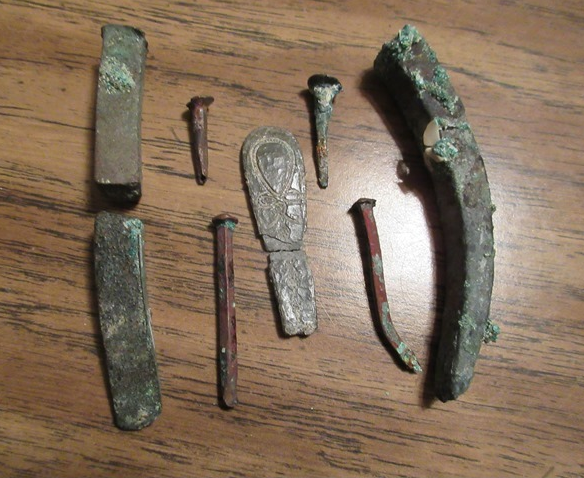
Terry continued, These are some items that JP found.  A large bronze ships spike, a brass fastener of some sort and a small silver half reale coin. The second picture is really neat and we thought it may be the butt of a pistol. I took it to the coin show at Vero and two experts said it was a pistol butt. The third expert I showed it to said it’s behind the handle of a sword and holds a spike used in close in fighting. He said he was pretty sure because he had found a sword that had a piece just like this one. Apparently research is never an exact science but I tend to believe the sword theory.


Found by JP.
This is a bent ornate key and DB showed it to an expert treasure diver and he said that it’s from the 1715 fleet. It really would be nice to find the treasure box that this key opened. It probably opened a box that held some wealthy ladies jewelry and I know right where DB found it.

Bent Ornate Key Found by DB.

Congratulations guys!  Thanks for sharing.

More tomorrow.

---

Gulf Coast Wreck Could Be Last U. S. Slave Ship.  Below is the link for more about that.

http://www.columbian.com/news/2018/jan/23/report-gulf-coast-wreck-could-be-last-u-s-slave-ship/

---

The surf predictions from MagicSeaWeed show a four to seven foot surf for the Fort Pierce area by on Friday.  That has held up pretty good.  They may have improved their prediction models.

Happy hunting,
TreasureGuide@comcast.net


Friday, March 21, 2014

3/21/14 Report - Artifacts of Historic Battle Between Spanish and Native Americans, Colonial Silver Spoon & Clay Shaman


Written by the TreasureGuide for the exclusive use of treasurebeachesreport.blogspot.com.


Olive Jar Sherds Found in the Midwest.

Five years after the sinking of the 1715 Fleet along the Treasure Coast a historic battle between the Spanish and Native Americans took place in what is now Nebraska.

The battle was known but these sherds are among the first artifacts giving evidence of the battle.  The Spanish jars are thought to be loot resulting from the battle.

The battle ended the incursion of the Spanish eastward into the US from Mexico.

Here is some information from the article that might help you tell the difference between early Spanish sherds and Native American sherds.

... analysis revealed important similarities among the samples, like granite-based sand that had been added to the pottery mixture, unlike indigenous ceramics made using natural clays, and telltale horizontal “throwing marks” that are still visible on the vessels’ interiors.
“Olive jars were thrown on a potters wheel, a forming technique unknown in the New World,” Hill said. “The parallel throwing marks on the exterior of the olive jar sherds are evidence of this technique.”
Here is the link for more on this historic battle and the artifacts.


This 1500-year-old shaman sculpture was found guarding bodies in a burial shaft in Mexico.

The square shaft, which is around one-and-a-half metres deep, is thought to date to between 300 AD and 600AD and leads to an underground vault measuring approximately two metres squared, containing bones of either one or two individuals...

Here is the source link.

http://www.dailymail.co.uk/sciencetech/article-2581154/Ancient-shaman-discovered-Mexican-tomb-1-500-year-old-sculpture-guarding-bodies-underground-shaft.html


How much is a silver American colonial spoon worth?   Of course that depends upon a lot of things.

The spoon shown here was offered for nearly $223,000.

Source: Kovels Komments
Link below.
Here is what Kovels Komments says about the spoon.

A marrow spoon attributed to silversmiths Daniel Henchman and Nathaniel Hurd will be for sale at an antiques fair in England in April. Asking price: almost a quarter million dollars. The spoon has a cast 3-D hand at the end of the handle and a scalloped bowl. It's dated 1766-68. The high price is based on the quality of the silver work and the spoon's history (provenance), proven by the engraved words "John Wentworth Esq to Thomas Smith." Wentworth was the wealthy British Colonial governor of New Hampshire from 1767 to 1775, and Smith, also important in the Colonies, was his friend. It is suggested that the hand on the spoon's shaft represented their friendship. Recorded high prices for other pieces of antique American silver have been $708,000 for a coffeepot (c.1770-1775) by Paul Revere Jr. that sold in 2004; $775,750 for a wine cup (c.1660) made by John Hull and Robert Sanderson Jr. that sold in 1993; and a punch bowl by Cornelius Kierstede (c.1700-1710) for $5,906,500 that sold in 2010.


The word for the day is "adaptability."

On the Treasure Coast we have around a four foot surf.  It isn't too much different than yesterday.  Still a lot of tourists on the beach.  

There are new modern gold jewelry beach finds.  I'll show some in future posts.

Happy hunting,
TreasureGuide@comcast.net


Monday, November 29, 2010

11/29 Report - Couple Mystery Finds & Preserving Finds


Spoon Found on the Treasure Coast.

I'm trying to get information to identify this spoon. When I first saw it I thought it could be real old. I think it might be pewter. It doesn't test as high grade silver.

I don't think it is as old as it looks. I found a mark reading "ITALY." I don't know when Italy was first called Italy, but I think it was maybe in the 1860s. I'll have to do some more research on that.

Any ideas will be appreciated.

Below I have another little mystery find for the day that I'd like some help with. It is about 1.25 inches across the top, 1 inch across the bottom, and about one inch tall. It seems to be made out of a fairly rough stone like a grinding wheel, but as you might be able to see, is lop-sided and would wobble all over the place if turned on it's axis. I think that means it is probably not a grinding wheel.


I'm thinking that it might be a stopper similar to what you see on some old beer or soda bottles. What do you think?


Here is a good web site by Captain Dan Berg that gives the basics for preserving shipwreck artifacts including, wood, pottery, iron, tin, lead, glass, etc.

http://www.shipwreckexpo.com/shipwreckdivingartifactpreservation.htm

Preserving your artifacts will keep them nice for a long time and make them more presentable and perhaps even more valuable.

I always recommend keeping good notes on when and where items are found. That helps in a variety of ways. Not only does it add information that can actually add to the value of finds, but it also will help you figure out what if any wreck an item might be associated with, and it will help you evaluate different beaches and detecting sites for future detecting.

I recently saw a guy on a beach with a detector and s scoop and a sifter. That is a lot of equipment to carry, but it can be worthwhile.

If you find a good spot, especially one that might contain small non-metallic items, a sift screen can be a good thing to use.

You can use a screen to sift materials in either dry sand or wet. Wave action can be used to more quickly sift wet sand.

Some things are so small that you will have a hard time finding in any case. I once found a very small gold bead. After detecting the bead, it took me a long time to find it in the sand even though I was looking right at it. I finally found it after throwing a handful of sand, bead included, on the coil of my detector and moving it around on the coil with my fingers. Still it didn't really stand out from the sand very much visually.

Of course in the water you can find items that keep going though the holes in your scoop. That can make it really hard to find. A dive mask can help in situations like that sometimes.

Gold chains can be hard to keep in a scoop. At least I've had trouble with them. They tend to want to slip out of the front of the scoop. Thankfully they are usually big enough to see without too much difficulty if you have any visibility in the water.

Forecast and Conditions.

The seas are what I would call moderate this week, predicted to reach 5.5 feet on Tuesday and 6 feet on Thursday. That isn't too bad, and even if it doesn't cause beach erosion, it might move some of the sand in front of the beach.

My theory is that as the winter weather progresses, sand is removed from in front of the beach and makes heaveier items more available so that when we finally do get some good cuts they aren't buried in the shallow water. Just a theory though.

As I've mentioned in the past, my best cob hunting has typically been November through April, and my very best days have been in Decemember and January.

Happy hunting,
TreasureGuide@comcast.net