Showing posts with label tropical depression. Show all posts

Tuesday, July 23, 2019

7/23/19 Report - Tropical Depression Three. Eagle Badge. Roman Fish. Epistemology and Identifying Artifacts.


Written by the TreasureGuide for the exclusive use of treasurebeachesreport.blogspot.com.

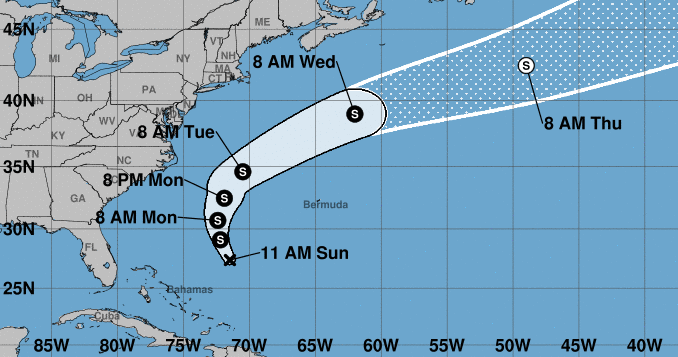
Tropical Depression Three
Source: nhc.noaa.gov

It's that time of year when the Atlantic gets active and you have to be ready and alert.  Make sure your batteries are charged and your equipment is in good repair.

In the last couple of days, Tropical Depression Three formed just off the coast of Florida.  The projected path was north along the coast, but it has already fallen apart.

---


Here is a find for ID.  It is about one and three sixteenths high and wide.  I'd say it is a hat badge (maybe WW II) but it is smaller than others I've found.

It should be easy enough to ID.  I just haven't taken the time to check it our yet.  Maybe someone can do it for me.

Thanks.

---

Here is a good article illustrating the difficulty of artifact identification.

Source: See TheGuardian.com link below.
A fragment from a Roman bottle so exceptionally rare that it has taken glass experts from around the world two years to conclusively identify it has been discovered thousands of miles from where it was made.

The discovery at Checkworth Roman Villa  in Gloucestershire of the small shard of patterned green glass, part of an 1,800-year-old fish bottle, has astonished archaeologists...

The distinctive profile of the glass indicated it came from a long bottle with an oval shape and a sharp taper at the end. Price eventually found it matched a restored fish-shaped bottle in the collection of the Corning Museum of Glass in New York.

In an indication of its rarity, the only other example of a Roman fish bottle comes from a 2AD burial at Chersonesus in Crimea...
Here is the link for more about that.

https://www.theguardian.com/science/2019/jul/22/mystery-of-chedworth-1800-year-old-roman-glass-shard-solved

So will it now be repatriated?

---

The main subject of this blog for me, you might be surprised to learn, is epistemology.  It is the subtext of so much of what I post.

Epistemology is the theory of knowledge, especially with regard to its methods, validity, and scope. Epistemology is the investigation of what distinguishes justified belief from opinion.  Put more simply, and in the words sung by award winning Amy Adams in the movie Enchanted, it attempts to answer the question, "How do you know."

Whether you are attempting to determine where you will find things on a beach or what some dug object such as the Roman glass artifact really is, there is a process, and that process is very interesting and important to me.  The question you might ask about any belief, natural or spiritual, is "How do you know?" You should have an answer for that question, whether it satisfies anybody else or not.

Much of the time, consensus is what people are looking for.  If most people agree, or if the experts agree, then it is accepted, but there are many times when the general view has been wrong and there have been many times when the experts were wrong.  If you look at why they were wrong, you can learn a lot from that.  What types of mistakes did they make?

The article about the Roman fish bottle is a good example.  They went through a process.  They started out, like we all do at times, not having a clue, then doing the research and eventually coming to a conclusion.

Recently I've talked several times about how difficult it can be to determine the age and identify of items.   In this case, the top experts with all their resources took years to identify a single artifact.  They were lucky they found an exact match.  That doesn't always happen.

The professionals make assumptions too - sometimes more than other people.  They accept the dogma of their professional community.  It is required to a large extent.

How did they identify the Roman fish artifact?  They found an artifact that matched their piece.  How convincing is that?  Could they be wrong?  How and why?

In the near future I plan to talk about the factors that we can use to identify the age of an dug artifact. In fact, I was going to start that today, but at the last minute decided to provide this background first.  That was partly because I ran across the article about the Roman fish.

---

Lightning on Clearwater Beach recently killed and injured people.

https://www.foxnews.com/us/florida-lightning-strike-beach-8-injured

Be careful.

---

Let me know what you think of the eagle pin/badge.

Happy hunting
TreasureGuide@comcast.net

Sunday, August 13, 2017

8/13/17 Report - Old Maps From the Internet. The Watch Videos. Different Terms. D.B. Cooper Treasure Mystery. Tropical Storm Forming.


Written by the TreasureGuide for the exclusive use of treasurebeachesreport.blogspot.com.

Super Old Map For Locating Metal Detecting Sites.

The internet provides so much good research material.  I found this 1876 map showing the area where I grew up and where many of my ancestors settled in the 1800s.  There farms are well marked on the map.  You can see where the old school house was, and you might be able to see the Plank Road running down the middle of the map, which was actually covered with planks back in the day.  Now it looks like any other road.  And near there used to be an old one-room school house that has been remodeled many times so that you would never guess that it was either a school house or old.  These kinds of old maps are invaluable for locating good metal detecting sites.

I also found an early 1700s map showing where one of my ancestors had land near Lancaster PA.  As I've said before, I really enjoy digging up (in more ways than one) my own family's history.

---

The past few days I showed some videos.  One thing you should get out of that series is the need to be careful about selecting the mode you use when you metal detect.  I generally prefer an All Metals or Pinpoint mode.   If you used coin mode for those watches, for example, you probably would have missed them a lot of the time, and even if you used All Metals mode and were going by the signal tone or ID meter, you still could have missed some of the watches.  Other artifacts could be missed just as easily.

I used the Garrett Ace for the videos.  It is not a high-end detector, but the circuitry is basic and similar to that used in many detectors.  I might demonstrate how different types of detectors woud respond some time in the future.

---

I remember once reading that someone didn't like the use of the word "detectorist."  I forget their reasoning, but for me the term is a good one.  They preferred the label "coinshooter."

I prefer the word detectorist because it is more general.  Few people who are out there hunting coins would not want to find a nice gold ring or something else of value.  Most people who search the treasure beaches hunt for and find things other than coins, including rings, spikes and other artifacts. And those that too narrowly focus on coins, might not realize how many other types of nice shipwreck items they are missing.

Treasure hunting is an even more general term.  There a lot of different kinds of treasure that can be found on a beach.  Some aren't even metallic.  The 1715 Fleet wax seal impression that I found is one example.  There are also pottery, stone, fossil and other types of treasure that can be found while detecting.  I don't like being too restrictive.  I don't like to miss much of anything that I might find interesting.  I'm not just interested in coins or jewelry or silver or gold.  Even when I really want to find one type of thing and go out with that intent, I do not see any reason to pass over any other interesting things that might be there.  You can be looking for one thing and find something else even better.  Also, the other things you see along the way, such as a pot shard or musket ball, might provide just the clue you need to help you find the thing you set out to find.  Everything that has been on a beach for a while provides some indication of how the beach and other things are moving and therefore can provide very important and useful information.

---

A crew of volunteer cold-case investigators in the Pacific Northwest, led by a former FBI agent, has uncovered what they believe to be “potential evidence” in the 46-year-old mystery of D.B. Cooper...

Here is the link for more about that.

https://dbcooper.com/2017/08/1382/

Thanks to Dean for the link.

---

Tropical Storm Eight.
Source: nhc.noaa.gov
Tropical Depression Eight looks like it will be a storm, but it won't come our way.  I'm not expecting to get anything off of this one at all.  It has been a very long sustained period of south and southeast wind and building beaches.  Someday that will change.

Happy hunting,
TreasureGuide@comcast.net

Friday, September 18, 2015

9/18/15 Report - Rip Currents. Tropical Depressions Nine and Ten. The Heart Of Any Good Treasure Story.


Written by the TreasureGuide for the exclusive use of treaurebeachesreport. blogspot.com.


nhc.noaa.gov.

There are two tropical depressions in the Atlantic now - numbers nine and ten.

it is hard to tell what they will do, but at this time neither is predicted to become anything stronger than a depression in the next five days.

We also have a little disturbance just off shore near the Daytona area.

I don't expect any of that to affect the Treasure Coast significantly in the next few days.  

---

The Woods Hole Institute is doing a lot of research on waves and beaches.  I just ran across a nice article on rip currents.  Detectorists should know about rip currents, especially if they detect in the water.  If you unintentionally wander into a rip current it can be frightening if you don't know rip currents and what to do.  I think most people know to not struggle to swim directly against the rip current, but if you don't know what to do, you should look it up.  Be prepared.

I remember my first time.  It surprised me.

In this Woods Hole article 150 foot channel near shore using a landing craft and revving the engines to create the trench.  I'd love t see a picture of how they did that.

According to my understanding they weren't using anything like blowers.  I can imagine how they did it but would like to see it.


Rip currents can wash away sand and expose a firmer layer of rocks or other bottom.  If that happens in the right place, it can be a very good hunting spot, but by all means, do not jump into the dip until it is safe.

Rip Current
Source: whoi.edu link below.
The rip current shown above does not look exactly like a natural rip current to me.  It looks like it could be the one that made.

Notice the scientific monitoring equipment floating in the rip.

The dark water in the middle of the white water is the deep water where the water would be rushing out.

As the article points out, the waves will break on each side of the rip current, but not in the deep part. You'd expect that because waves break when the water becomes to shallow.

You might want to look at this article.  Here is the link.

http://www.whoi.edu/oceanus/feature/the-riddle-of-rip-currents

---


The crew of the Dare has been surveying the Lost Merchant site, 

----

Yesterday's post was a story about how an found item can continue to reveal more about itself over time.  Any treasure story consists of various threads.  Most treasure stories are told as if they were about items.  You've read the articles and books.  They tell what was found,  where it was found, how it was found, what it was worth and who found it, but the best part of the story is left out.  The part of the story that is most often left out is the contemporaneous human story.  

The best of the story is about people -  real people, fragile people, strong people, people with hearts and souls, people with emotions who act and react.  It is about ups and downs, successes and failures, relationships, friends, family, time and change.  It is about chance, cause and effect, and consequences. The crux of any treasure story is really about people and how they live, learn, feel and change.  It is about heart and soul.


I talk a lot about items, but if you look a little deeper, the other part of the story is always there to be found if you look deep enough for it.  In this blog, I don't have the space or time to bring it out like I should.  Maybe sometime in the future I'll be able to give that part of the story the justice it deserves.


Good stories make people think.  Great stories make people feel.

---

Happy hunting,
TreasureGuide@comcast.net

Saturday, September 5, 2015

9/5/15 Report - Colonial Numismatic Presentations With Sedwick Auction. Sacred Heart Reales. Tropical Depression Seven.


Written by the Treasureguide for the exclusive use of treasurebeachesreport.blogspot.com.

Sedwick Coins Treasure Auction 18 Coming In October
The Potosi mint produced some oddly shaped cobs.  Some appear to represent the Sacred Heart.  The exact purpose or use is unknown, but some think they were used by church officials.

Many were "holed," and I've read they were sometimes sewn into clothing.

Here is a link to a Sedwick report on the heart shaped cobs

http://www.sedwickcoins.com/articles/hearts.htm

There are other events associated with the auction that you might want to attend.  Here is a schedule of events.


LOT VIEWING: OCT 28 10:00-6:30 = Evergreen Room.

Ricardo De León Tallavas (Evolution of Mexican Numismatics)
12:45-1:30 PM EST - Buena Vista Ballroom
-------------
Jorge Proctor (Mexican Assayers under Philip V)
2:00-3:00 PM EST - Buena Vista Ballroom
-------------
Glenn Stephen Murray Fantom (Colonial Mintage Statistics for Lima and Potosí:
Historical Context and Analysis) 
3:30-4:30 PM EST - Buena Vista Ballroom
-------------
Herman Blanton (Mysteries of Colombian Cobs)
4:45-5:30 PM EST - Buena Vista Ballroom
-------------
Luis Roberto Ponte (Venezuelan Numismatics) 
6:00-7:00 PM EST - Buena Vista Ballroom       

 -------------
Pre-Auction Dinner 7:30 PM EST 

- October 29, Floor & Internet Auction 10AM->
-------------   
- October 30, Numismatic Forum and Breakfast. Moderator: Jorge Ortiz Murias.


These events will be at the Doubletree by Hilton at Lake Buena Vista in Orlando.

---


Very Soft Sand Treasure Coast Beach This Morning.
You can see where the last high tide stopped.

I visited four beaches this morning before finally finding one I thought was worth detecting.  At that last beach I found a good number of coins in a small area and slightly more sinkers.  I think it was something like 60 per cent sinkers to 40 percent coins.  All fairly new coins.  I've found old stuff at that location before, but the conditions were so poor I was lucky to find as many coins as I did.  I'll be happy when we get cooler weather.  I was soaked with sweat from digging all those deep coins - and sinkers.

Even at low tide, the sand seems to extend out another twenty or so yards into the water before dropping off.  That is a lot of sand that needs to be moved.  Hopefully some day it will get moved.

Fred is still out there but not coming this way.  Tropical depression seven might come this way though.  It is still way over by Africa at this point.

We're going to have a flat surf through Labor Day.

Happy Hunting,
TreasureGuide@comcast.net

Monday, June 30, 2014

6/30/14 Report - Depression Forming Off Florida, Detecting Community, Early Mexican Reales, Airplane Coil & Pippa


Written by the Treasure Guide for the exclusive use of treasurebeachesreport.blogspot.com.

Source of photo: USA Today
Pippa tells Matt Lauer that she reads the treasurebeachesreport every morning!

Just kidding!  I saw this photo and thought that was funny.


Here is the real news for today.   It has been quite a while, but there is something happening.  This is what this blog was formed to do - report on changing Treasure Coast beach and detecting conditions.

As you know we've been stuck with poor conditions and no changes, but now a depression is forming to the East of us.  According to NOAA it might become a depression by mid week.

I'm not expecting it to affect us much, but it is something to watch.

http://www.weather.com/news/tropical-update-atlantic-pacific-hurricane-season-20140513


Tropical Depression Forming.
A few days ago I talked about how the metal detecting has grown and things that might make that growth appear large than it is.  I talked about how the internet has affected how much more information is shared and how much more you know about what is going on in the metal detecting and treasure hunting communities.

Back before the internet, maybe you subscribed to one of the metal detecting magazines.  It came once a month.  Or you visited a club meeting where you would learn what people were finding or what they were doing.  Again, it was once a month.

A few guys hung out at a local detector shop and got in on the gossip on a more regular basis, but that news was mostly local.

There were a few small groups that had their own newsletters such as the one started by Glenn Carson.  That group ended up investing in a silver mine in Mexico.  The project ended poorly with the money disappearing.

Now people read about everything that is going on whenever they want to, and that is often on a daily basis.

I do believe that there are more detectorists these days, but one important factor is that many detectorists are more informed, not only on detecting sites, but also on strategies and techniques.  The are also more informed about metal detectors and how to use them.

I'm convinced that back in the old days a lot of the guys had no idea how much they were missing.  I don't think they knew the weaknesses of particular detectors and especially how much good stuff you can miss by using too much discrimination.

Some guys today still over discriminate.  They simply don't want to dig trash.  And some don't realize how much they are missing.

Just to once again mention something important that I've mentioned before,  one of the best things you can do is practice with various types of targets and the different settings of your computer - even if you have been using that detector for a long time and think you know it well.  It is easy to fall into a habit of using the same old settings and focusing on the same small range of targets.  With some test targets, try various settings and listen and watch you your detector responds.  I bet you'll learn a few things.  Also, vary your sweep speed when doing you tests and observe the results.


Check The Coil On This Plane.

Try the same things inland and on a dry beach, wet beach and in the water and observe the signals.

Try different types of targets, not just the coins and rings.   Try watches, iron spikes, etc. etc.


This plane carries a coil, but not a detector coil, though it has something in common.

It is a coil used to detonate magnetic sea mines during WW II.   Just one of those neat and interesting things I ran across while doing some genealogical research.


The mint was created in Mexico City in 1535.   Although we are accustomed to quickly identifying cobs from Mexico from the Florenza cross, the first coins minted there did not have that cross.

Here is a look at some of the first coins from the Mexico City mint.


This is from the book, Monedas Espanolas desde Juana y Caros a Isabel II 1504 a 1868, by Calico, Calico & Trigo.

These 4-reales are undated and very rare.  Probably minted very near 1535.

Happy  hunting,
TreasureGuide@comcast.net

Sunday, September 29, 2013

9/29/13 Report - $2.5 Million Gold Coin, Tropical Depession 11, Fossil Find, and Beach Conditions


Written by the TreasureGuide for the exclusive use of treasurebeachesreport.blogspot.com.

We now have Tropical Depression Eleven.  It doesn't seem to be much of a threat to Florida right now.  It is out in the Atlantic and pretty far north.

National Hurricane Center Map.
The low pressure area down below Cuba has a 20% chance of developing.

The rare gold coin shown below recently sold at auction for $2.5 million.  Only eleven are known to exist.


That is one beauty.

Click this link for more of the story.

http://www.mining.com/rare-american-stella-gold-coin-sells-for-2-5-million-usd-47624/


Mitch P. recently picked up the following horse tooth fossil on a beach near Sebastian.

Fossil Tooth Found on Treasure Coast Beach
Picture and find by Mitch P.
Mitch describes himself as an occasional THer and frequent beach comber,

I think the first fossil I saw on a Treasure Caost beach was a horse tooth too.  I didn't know what it was at the time.

My very first fossil find, though, came up in a scoop of sand when digging a target in the water down south.  I didn't know what it was at the time either.   Now I could identify either of those at first glance - at least generally.  But not specifically like some people.   Some people can tell the age period sub-species or whatever and everthing.   I'm not a fossil expert at all but usually know a fossil when I see one.


Here is an underwater heart rate monitor.  Learn to keep your heart rate down and not use oxygen so quickly.

http://www.dcrainmaker.com/2011/07/finis-aquapulse-in-depth-review.html


The tides have been fairly flat lately.   Not a lot of variation from high to low tide.

Here is a quick video clip of what it looked like out there yesterday.


Low tide (what there is of it) Sunday will be around 10:30 AM.   The surf will remain about two to four feet for a few days.

Happy hunting,
TreasureGuide@comcast.net