Showing posts with label story. Show all posts

Friday, November 9, 2018

11/9/18 Report - Coins With a Story: Holed Coins.


Written by the TreasureGuide for the exclusive use of treasurebeachesreport.blogspot.com.

1960 Philippines One Centavo Coin with Hole.
I noticed this "holed" coin this morning and wished I had all of my "holed" coins in one place, or at least where I could easily find them.  One of the things I often find myself wishing is that I had labeled and organized my finds better.

I know I've found a variety of "holed" coins, including everything from a half reale to a 1982 penny.   Holed wheat pennies seem to me to be fairly common.

Below is what the centavo would have originally looked like.  Actually, the reverse side would be upside down when the obverse is right side up.  It is oriented like a US coin, not a Canadian coin.  That means the hole will be at the top of one side and on the bottom of the other side.

1960 Philippines One Centavo.
Below is the other side of the centavo shown at the top of the post.  Notice that the hole is on the bottom of this side.

Other Side of Same Centavo Shown at Top of Post.
It is about the size of a US penny.

You can often tell which side was thought to be most important and made to show.  You can also tell which side was facing up when the hole was made.  The hole will most often be top center on the side that is most important.

Often there will be metal that was pushed through the hole on the opposite side and often the coin will be bent a little by the pressure.  This one doesn't show excess metal from the hole, but the coin is bent in from the pressure of making the hole.

I'm talking today about coins that were holed by an individual after the coin was in circulation, but some coins were minted with a hole.

Ancient Chinese coins were made with a square hole in the middle.  That permitted insertion of a square rod that facilitated filing the shape of the coin.  It also allowed coins to be strung on a rod much like modern coins are rolled or bagged.

I noticed one dug coin from Denmark (below) this morning that was created with a round hole in the center.  I don't know if there was is any functional reason for that hole. I doubt it.


25 Ore


I'm interested in the story behind why a person would select a particular coin and put a hole in it.  There is often an interesting story there.

People obviously sometimes put holes in coins so they can be used as charms or worn as lucky pieces or jewelry.

I suspect that sometimes coins are chosen because of the date, which coincides with a birthday or some other important date.

Holes were made so that coins could be sewn into clothing for safe keeping during dangerous times or situations.

I've also posted information provided by Laura Strolia concerning the often "holed" heart shaped cobs of Potosi and their significance.

Except for special cases, a "holed" coin will often be considered a damaged coin and the hole will diminish any collector value.

There was a time when coins were used as washers for slate roofs or as buttons for clothing.

There are many other reasons that coins were holed.  I've heard of "hate" tokens, for example.  And sometimes coins were nailed to walls, and had a significance or just a decorative function.  The examples are too many to mention.

This centavo from the Philippines is more interesting to me because of the hole.  Somebody selected that particular coin for a reason. I don't know how it got to Florida from the Philippines  I don't know if it was the date or something else that made it significant, but it has a story.  I just don't know what it is.

---

Evidently there are other people who find "holed" coins interesting.  There is a site that buys and sells "holed" US coins.  They have quite a variety for sale, including some very old and beautiful coins.

Here is the link.

http://holeduscoins.com/product-category/indian-cents/

---

A front will be moving into the Treasure Coast and we'll get some cooler air and bigger surf.  Here is the MagicSeaWeed surf chart.


Source: MagicSeaWeed.com
Happy hunting,
TreasureGuide@comcast.net


Wednesday, August 29, 2018

8/29/18 Report - Another Conglomerate: X-ray Says... Standard Oil Token Info. Taking Time To Learn The Story of a Find.


Written by the TreasureGuide for the exclusive use of treasurebeachesreport.blogspot.com.

X-Ray Image of  Conglomerate Found by Fred B.
Photo submitted by Fred B.
Fred B., who found the conglomerate containing a cannon ball, had another conglomerate that he wanted to have x-rayed so he could decide whether to open the conglomerate or leave it how it was.  He could see  that there was a piece of lead and a spike in the conglomerate, but he didn't know what else might be in it.

One of this blog's readers offered to have the item x-rayed.  Above is the x-ray image of that conglomerate.  The bright white object is the lead.

It appeared that there were no coins or other items in the conglomerate other than the lead and spike, so Fred decided to leave it how it was found.

Fred offered a big thanks to this blog for hooking him up and to the reader who made it happen.

Thank much J. Y.

---

One thing I like about writing this blog is that when I make a mistake, I am quickly corrected.  Hundreds of people read this blog daily, and that readership includes experts and hobbyists that are knowledgeable about all kinds of subjects.  That helps me a lot because and I write about a lot of different types of things.  I don't think anyone can be really expert in more than one or two subjects, so I certainly need and gladly receive the help of my readers.

Just yesterday I posted a Standard Oil advertising token that I didn't know much about and asked if anyone might help me narrow down the date.  Well, as usual, some one came through.  Ben M. did some research and was able to add valuable information.  Below is what Ben said.

Hi Treasure Guide -

I enjoyed reading your blog for today regarding the Standard Oil token. Tokens in general are a favorite metal detecting find for me - in my opinion, they are more intriguing than coins. Local merchant and trade tokens can often be researched to reveal interesting individuals or unique local history which just isn't possible with coins. 

Anyway, I did a little poking around on the internet for your Standard Oil token in an attempt to narrow down the date a little. The best I could come up with so far is this website, which shows the same design listed along with a second design for the Standard Oil Company (Indiana) used from 1882-1931:


The website obviously isn't official, so the credibility of the info is somewhat suspect. The first design appears to be the logo for the top of an old service station gasoline dispenser, and maybe not used company-wide as a letterhead style logo. I've confirmed from other sources that the second logo in that date range was used by Standard Oil (Indiana) starting in 1926, and apparently was the first "official" logo used by Standard Oil according to wikipedia (again, not necessarily definitive information): https://en.wikipedia.org/wiki/Amoco (see the logo section).  

Looking at newspaper advertisements from the 1920s, there were absolutely no logos used in Standard Oil (Indiana) ads until early 1927, and then suddenly every add included the "Service" logo referred to in each web page link - that sort of confirms the info from the wikipedia page. Anyway, all of this might imply that your token may pre-date 1926, otherwise I think it would have used one of the "official" Standard Oil logos from one of the later time periods.

Anyway, I hope that helps...it certainly was fun to do the research, especially since I haven't had a new token find of my own investigate lately :) 

Thanks Ben!  Excellent research and report.  I appreciate your help and I'm sure others do too.  

Ben not only provided information about the token, but he also provided a good link about logos that you might find useful in the future.

---

I often tell people to take their find to a jeweler or pawn shop to have it tested.  That is a good way to find out what metal your find is made of, but don't expect the jeweler or pawn shop owner to be able to tell you much of anything about your coins.  They have testing equipment for metals, but they probably won't know a lot about coins - especially treasure coins.  We all have our limits, and as I said above, you can know something about a lot of different things, but you can't be a real expert on a lot of different topics.

I've been finding out how complicated coin collecting can be.  If you get into collecting even just modern varieties and errors, there is really a lot to learn.  I was really surprise to find out how complicated it is.

I haven't yet mastered identifying doubled die errors.  Doubled die errors looks to a novice (me) very much like a lot of other types of doubling.  I have a hard time telling the difference between machine doubling and doubled die errors.  One problem is that true doubled die errors are pretty rare, which means you most often see them in books, which, of course, only show two dimensional pictures, which make them all look pretty flat.

Despite how much there is to learn, I'm enjoying what I am learning.

There is also a lot to learn about treasure coins.  There are so many of them and they were produced for so many years and there are so many different designs.  To make it more difficult, if you find one on a beach, it can be covered by a lot of corrosion or encrustation, and half of it might not even be there.

The complexity can be confusing, but doing the research and learning can also make it that much more rewarding.

Don't just look for a coin and then ask how much it is worth.  Even if it is difficult and takes a long time, do your research, learn more about the coin, and enjoy the process.  You will then have something that has a whole story to go along with it.

As I always say, Keep an item until you learn its story.    It might not look like much, and you might not think it is worth anything, but wait until you are sure.  It might not be worth anything, but I am often surprised by what I eventually learn about an item.

---

There are still no storms or big changes in beach conditions.

Happy hunting,
TreasureGuide@comcast.net


Friday, September 18, 2015

9/18/15 Report - Rip Currents. Tropical Depressions Nine and Ten. The Heart Of Any Good Treasure Story.


Written by the TreasureGuide for the exclusive use of treaurebeachesreport. blogspot.com.


nhc.noaa.gov.

There are two tropical depressions in the Atlantic now - numbers nine and ten.

it is hard to tell what they will do, but at this time neither is predicted to become anything stronger than a depression in the next five days.

We also have a little disturbance just off shore near the Daytona area.

I don't expect any of that to affect the Treasure Coast significantly in the next few days.  

---

The Woods Hole Institute is doing a lot of research on waves and beaches.  I just ran across a nice article on rip currents.  Detectorists should know about rip currents, especially if they detect in the water.  If you unintentionally wander into a rip current it can be frightening if you don't know rip currents and what to do.  I think most people know to not struggle to swim directly against the rip current, but if you don't know what to do, you should look it up.  Be prepared.

I remember my first time.  It surprised me.

In this Woods Hole article 150 foot channel near shore using a landing craft and revving the engines to create the trench.  I'd love t see a picture of how they did that.

According to my understanding they weren't using anything like blowers.  I can imagine how they did it but would like to see it.


Rip currents can wash away sand and expose a firmer layer of rocks or other bottom.  If that happens in the right place, it can be a very good hunting spot, but by all means, do not jump into the dip until it is safe.

Rip Current
Source: whoi.edu link below.
The rip current shown above does not look exactly like a natural rip current to me.  It looks like it could be the one that made.

Notice the scientific monitoring equipment floating in the rip.

The dark water in the middle of the white water is the deep water where the water would be rushing out.

As the article points out, the waves will break on each side of the rip current, but not in the deep part. You'd expect that because waves break when the water becomes to shallow.

You might want to look at this article.  Here is the link.

http://www.whoi.edu/oceanus/feature/the-riddle-of-rip-currents

---


The crew of the Dare has been surveying the Lost Merchant site, 

----

Yesterday's post was a story about how an found item can continue to reveal more about itself over time.  Any treasure story consists of various threads.  Most treasure stories are told as if they were about items.  You've read the articles and books.  They tell what was found,  where it was found, how it was found, what it was worth and who found it, but the best part of the story is left out.  The part of the story that is most often left out is the contemporaneous human story.  

The best of the story is about people -  real people, fragile people, strong people, people with hearts and souls, people with emotions who act and react.  It is about ups and downs, successes and failures, relationships, friends, family, time and change.  It is about chance, cause and effect, and consequences. The crux of any treasure story is really about people and how they live, learn, feel and change.  It is about heart and soul.


I talk a lot about items, but if you look a little deeper, the other part of the story is always there to be found if you look deep enough for it.  In this blog, I don't have the space or time to bring it out like I should.  Maybe sometime in the future I'll be able to give that part of the story the justice it deserves.


Good stories make people think.  Great stories make people feel.

---

Happy hunting,
TreasureGuide@comcast.net

Thursday, September 17, 2015

9/17/15 Report - How One Artifact Continues To Reveal More Of Its Story. Tropical Depression Nine.


Written by the TreasureGuide for the exclusive use of treasurebeachesreport.blogspot.com.

nhc.noaa.gov


We have tropical depression nine now.  It is supposed to stay out there.  Probably won't have much effect on us.

As you can see there is another disturbance behind that one, and one down by Key West.

Today we had around a three or four foot surf on the Treasure Coast.

The tides are moderate.  The surf will be down around one or two feet again this weekend.

---


I found this red sea glass quite a while ago.  It is in my opinion an exceptional piece of sea glass and would sell for a few dollars.

It is nicely worn and shaped and is a rare color.  Yellow is more rare, but red is right up there.

But what I wanted to talk about today is the detective story and how information about an item can be revealed slowly over time.

As I said, I found it a long time ago.  As with all finds, I'm always interested in trying to determine what things are and where they come from.  I didn't know, but I guessed that this piece was part of a lens.  If so, what kind of lens?

Well, it sat around for a good while without me gaining any more information about it.  I had inspected it with a loop and saw some very small yellow specks in the glass.  They weren't really on the surface - more like in the small air bubble depressions.  I didn't have any idea what that yellow residue was about.

Yesterday I showed how a black light could be used to reveal more information about fossil seashells.  That was just one example, but a good one.  What I was really trying to show is how to inspect items in various ways, such as under magnification and different types of lighting.

Vintage Glass Finds.
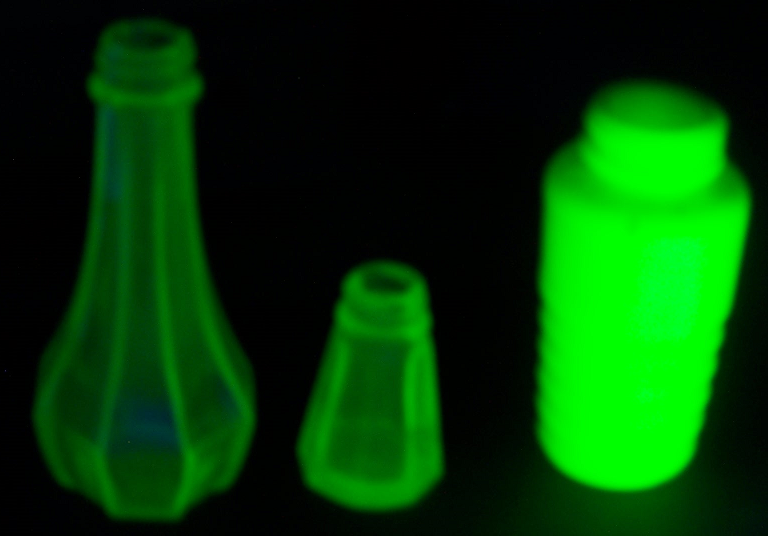
I often find old bottles and glass.  The above picture shows three such finds.  The two on the left are Depression glass and the one on the right is Vaseline glass.  I think those are the right terms.

There are a lot of collectors of both depression glass and vaseline glass.  I've sold some pieces in the past.

I'm not changing topics.  I'm going somewhere with this.

Depression Glass and Vaseline Glass Photographed Under Black Light.
I tried the black light on those items, and you see what I saw.  They glow.

Both types of glass were made with uranium.  Yes, uranium.  Vaseline glass has a more yellow color. To create the more green depression glass, iron oxide was added.

OK.  A black light can reveal some interesting things with some types of glass.  So now I tried the red sea glass under black light.

Red Sea Glass Under Black Light.
I shut out all the light and shined the black light onto the red glass.  The one side showed nothing.  I couldn't even see it in the dark room, let alone photograph it.

I turned it over, and saw a world of difference.  On this one side, it glowed!

It was the side with the yellow specks infused in the glass that glowed.  It glowed orange.

What does that say?  Uranium isn't used in glass nearly as much as it was back in the day, although people do copy depression glass and vaseline glass.  So is this glass older?  I thought it was older just judging from how it was worn into a very rounded cushion shape.  And why was it made to glow?

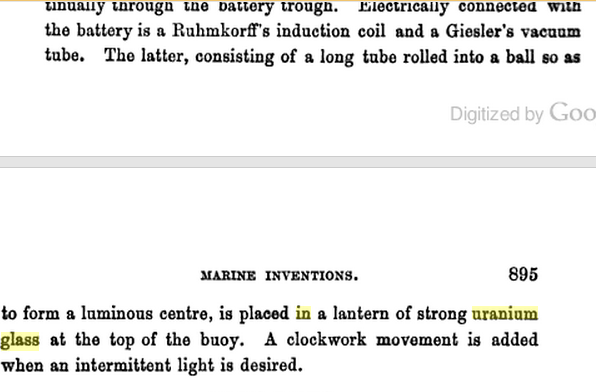
Then I ran across the following text.


This clip was found in an 1878 nautical magazine.  It is talking about how uranium glass was used on a buoy.  Is that what I have a piece of?  I don't know.  But the evidence is mounting that this red sea glass was once part of a lens, perhaps like was used on a nautical buoy.

Click here to link to the nautical magazine.

What I am talking about today is how an item can continue to reveal more about itself, and how various methods of inspection and research can help make a find come alive.

The same process can occur with almost any kind of item.  Even an item as simple and mute as a squarish little piece of glass will continue to tell you more of the story as long as you are curious and really want to know.

It is something like that with people too.


---

I was without internet most of the day, so that is it for today.  I didn't think I was going to get any kind of post done today.

Happy hunting,
TreasureGuide@comcast.net.