Showing posts with label tropical depression nine. Show all posts

Thursday, September 17, 2015

9/17/15 Report - How One Artifact Continues To Reveal More Of Its Story. Tropical Depression Nine.


Written by the TreasureGuide for the exclusive use of treasurebeachesreport.blogspot.com.

nhc.noaa.gov


We have tropical depression nine now.  It is supposed to stay out there.  Probably won't have much effect on us.

As you can see there is another disturbance behind that one, and one down by Key West.

Today we had around a three or four foot surf on the Treasure Coast.

The tides are moderate.  The surf will be down around one or two feet again this weekend.

---


I found this red sea glass quite a while ago.  It is in my opinion an exceptional piece of sea glass and would sell for a few dollars.

It is nicely worn and shaped and is a rare color.  Yellow is more rare, but red is right up there.

But what I wanted to talk about today is the detective story and how information about an item can be revealed slowly over time.

As I said, I found it a long time ago.  As with all finds, I'm always interested in trying to determine what things are and where they come from.  I didn't know, but I guessed that this piece was part of a lens.  If so, what kind of lens?

Well, it sat around for a good while without me gaining any more information about it.  I had inspected it with a loop and saw some very small yellow specks in the glass.  They weren't really on the surface - more like in the small air bubble depressions.  I didn't have any idea what that yellow residue was about.

Yesterday I showed how a black light could be used to reveal more information about fossil seashells.  That was just one example, but a good one.  What I was really trying to show is how to inspect items in various ways, such as under magnification and different types of lighting.

Vintage Glass Finds.
I often find old bottles and glass.  The above picture shows three such finds.  The two on the left are Depression glass and the one on the right is Vaseline glass.  I think those are the right terms.

There are a lot of collectors of both depression glass and vaseline glass.  I've sold some pieces in the past.

I'm not changing topics.  I'm going somewhere with this.
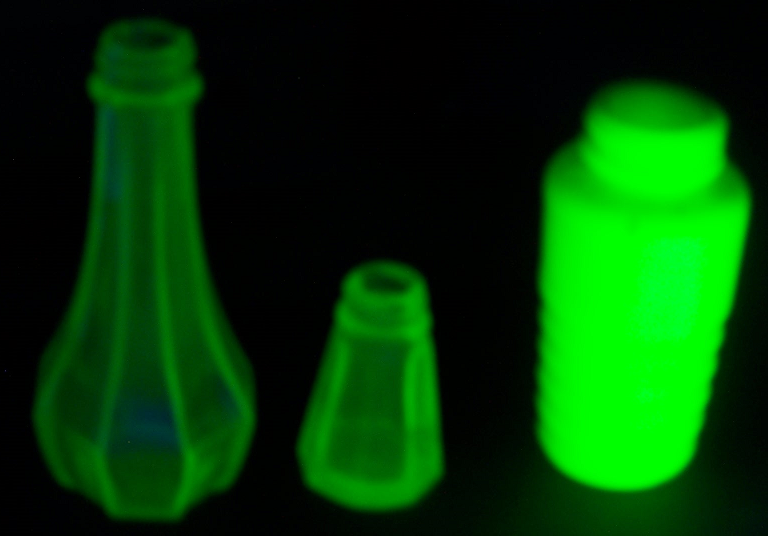
Depression Glass and Vaseline Glass Photographed Under Black Light.
I tried the black light on those items, and you see what I saw.  They glow.

Both types of glass were made with uranium.  Yes, uranium.  Vaseline glass has a more yellow color. To create the more green depression glass, iron oxide was added.

OK.  A black light can reveal some interesting things with some types of glass.  So now I tried the red sea glass under black light.

Red Sea Glass Under Black Light.
I shut out all the light and shined the black light onto the red glass.  The one side showed nothing.  I couldn't even see it in the dark room, let alone photograph it.

I turned it over, and saw a world of difference.  On this one side, it glowed!

It was the side with the yellow specks infused in the glass that glowed.  It glowed orange.

What does that say?  Uranium isn't used in glass nearly as much as it was back in the day, although people do copy depression glass and vaseline glass.  So is this glass older?  I thought it was older just judging from how it was worn into a very rounded cushion shape.  And why was it made to glow?

Then I ran across the following text.
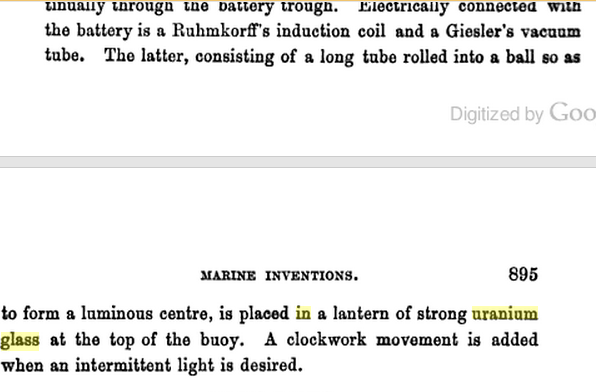


This clip was found in an 1878 nautical magazine.  It is talking about how uranium glass was used on a buoy.  Is that what I have a piece of?  I don't know.  But the evidence is mounting that this red sea glass was once part of a lens, perhaps like was used on a nautical buoy.

Click here to link to the nautical magazine.

What I am talking about today is how an item can continue to reveal more about itself, and how various methods of inspection and research can help make a find come alive.

The same process can occur with almost any kind of item.  Even an item as simple and mute as a squarish little piece of glass will continue to tell you more of the story as long as you are curious and really want to know.

It is something like that with people too.


---

I was without internet most of the day, so that is it for today.  I didn't think I was going to get any kind of post done today.

Happy hunting,
TreasureGuide@comcast.net.

Friday, October 24, 2014

10/24/14 Report [UPDATED] - Davis Zerkle Lumber Token Found. Huge Firearms Auction Listings. More Coin Grading Apps. New Beach Cuts.


Written by the TreasureGuide for the exclusive use of treasurebeachesreport.BlogSpot.com.

Trade Token Found By William M.
Photo by William M.
Afternoon Update:  There are a few cuts on some of the Treasure Coast beaches.  I saw cuts of up to two feet this afternoon, but I am not yet changing my Treasure Beach Conditions Rating yet.  Not enough erosion at this point.  Photos will be posted later.

------------------------

William M. recently found this very nice Davis Zerkle Lumber Company token.  Since the company closed in 1926, that would the be the likely upper limit on the date.  William hasn't found any other examples of the 10 cents denomination of this token.'

Great find William!  

---------------

Yesterday I showed a variety of Florida dug Walking Liberty Half Dollar coins.  I also gave links for a couple of web sites you can use to help determine the grade of your coins.  Chris S. wrote in and gave a couple more good resources.

Chris said, You can also get the photograde app by PCGS for your iphone. While you're at it, you can download the PCGS price guide. Both are good for reference in the field if you just can't wait to get back home to check it out.

Thanks for the tips Chris!

----------------------- 

The National Park Service noticed hundreds of artifacts when they dredged a pond in the Everglades back in 1968.  They logged the finds but an excavation was not conducted on the site, which was under about ten feet of water.

Now that the Park Service wants to install a boardwalk over the area so archaeologists will be taking a better look at the site.

Here is the link.

http://phys.org/news/2014-10-everglades-trail-surveyed-cultural-artifacts.html

----------------------

Want to buy an 18th Century cannon for you front lawn?  You just missed the James Julia firearms auction that was conducted on Oct. 7 -9.  Cannons brought high prices.  According to Kovels Komments,  A 1750 Spanish siege mortar captured in Florida in 1862 from Confederates defending Fernandina Island during the Civil War sold for $97,750. It was sold as scrap metal in 1956 but then was sold again and saved.

It took $80,500 to buy a 1681 Dutch Falconette on a carriage. It appears to have the original bronze patina--it was never polished. A bronze Ames Model 1841 six-pounder cannon used in the Civil War brought $63,250.

Other expensive firearms: Model 1906 Krupp 50mm mountain cannon, $70,800; Dahlgren heavy 12-pounder boat howitzer, $92,000; and a rare Winchester Model 1873 lever action rifle, $258,750.

At least five cannons did not sell. The logistics of organizing and selling tons of firearms included solving the problem of what to do with leftovers. If you plan to buy [or sell] a cannon, be sure to consult this auction for prices.
Canon From Auction.

Here is the auction link.

http://jamesdjulia.com/auction/369-october-2014-firearms-auction/

There are many lots in this auction to browse.


As I said yesterday, Tropical Depression Nine fell apart, however it looks like it is reforming.  I wouldn't be surprised to see it emerge in the Gulf again before long.   I'll keep an eye on that.

The wind is blowing and the weather is beautiful.  We have about a three foot surf today along the Treasure Coast.  That is about what we'll have for a week or so.   After that there is a possibility of something significantly bigger.

Happy hunting,
TreasureGuide@Comcast.net


Wednesday, October 22, 2014

10/22/14 Report - Mystery Of The Quartz Crystal Cross Of Mission San Luis. Tropical Depression Nine Has Formed.


Written by the TreasureGuide for the exclusive use of treasurebeachesreport.blogspot.com.

Quartz Crystal Cross Pendant
One of the most unique and interesting artifacts of the early Spanish Contact period is a quartz crystal cross.  The cross was found at the site of the Mission San Luis.

No longer existing except as an archaeological site, Mission San Luis once had the appearance of a European city and was second in size and importance to only St. Augustine.  The inhabitants were Native Americans and Spanish explorers and missionaries.

Thriving since the mid 1600s, Mission San Luis was burned to the ground in 1704.  The majority of Native American inhabitants then moved west while the Spanish moved to St. Augustine after the destruction of the mission.

The mission was formed in the Appalachee Province of Florida after native leaders visited St. Augustine and asked for the mission to be established.  Over 5000 natives were baptized by the Franciscans there.

When you see the cross, you might not think it is hundreds of years old.  In fact you could easily pass it off as something modern.  And if you are told it is old, you might think it is a hoax, or maybe something like the crystal skulls that have been widely discussed, studied and faked.

The cross was first thought to be made of European molded glass, but additional study showed that is made of quartz crystal and was formed using Native American techniques such as flaking and biconic drilling but finished using an iron file.

Quartz crystal had special significance and was used for charms and amulets by both Native Americans and Spanish prior to the establishment of Mission San Luis.

The Spanish often carved rock crystal for rosary beads and other items.  The Christian cross was a design motif widely adopted and used by Christianized Native Americans.

The rock crystal cross represents a unique blend of Native American and European influence and belief.

It is thought that the cross was made by an Apalachee artisan employing both indigenous and European tools. 

Questions remain.     Who owned the cross?  How was it used?  How did traditional Native American traditions and beliefs, especially those concerning quartz crystal, blend with Christian beliefs in the form of the cross?


Primary resources.

http://www.academia.edu/1248161/A_quartz_crystal_cross_from_Mission_San_Luis_Florida

http://www.missionsanluis.org/_docs/Journal_of_ArchScience_97-.pdf

http://www-tc.pbs.org/opb/historydetectives/static/media/transcripts/2011-05-11/407_crystalcross.pdf

----------------------

On the Treasure Coast we have a fairly calm surf today that will increase only a little tomorrow.

The big news is that we now have Tropical Depression Nine, which is in the Southern Gulf of Mexico.  It looks like it will cross the Yucatan Peninsula and head towards Jamaica.  It could possibly head our way if it does not fall apart.

Happy hunting,
TreasureGuide@comcast.net