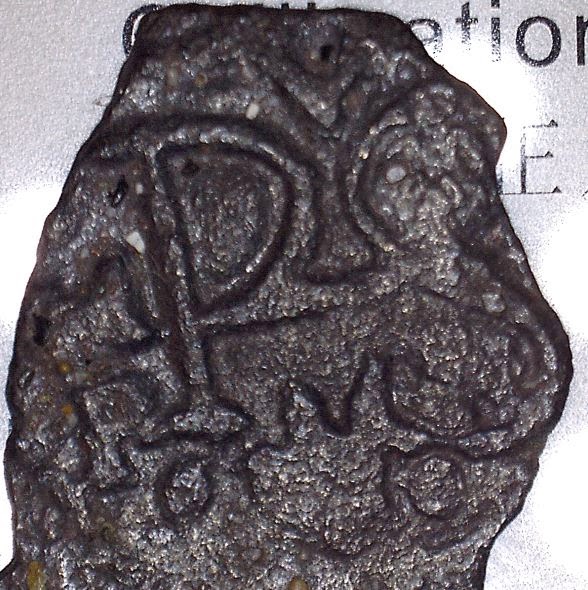
Showing posts with label photograph. Show all posts

Thursday, September 17, 2015

9/17/15 Report - How One Artifact Continues To Reveal More Of Its Story. Tropical Depression Nine.


Written by the TreasureGuide for the exclusive use of treasurebeachesreport.blogspot.com.

nhc.noaa.gov


We have tropical depression nine now.  It is supposed to stay out there.  Probably won't have much effect on us.

As you can see there is another disturbance behind that one, and one down by Key West.

Today we had around a three or four foot surf on the Treasure Coast.

The tides are moderate.  The surf will be down around one or two feet again this weekend.

---


I found this red sea glass quite a while ago.  It is in my opinion an exceptional piece of sea glass and would sell for a few dollars.

It is nicely worn and shaped and is a rare color.  Yellow is more rare, but red is right up there.

But what I wanted to talk about today is the detective story and how information about an item can be revealed slowly over time.

As I said, I found it a long time ago.  As with all finds, I'm always interested in trying to determine what things are and where they come from.  I didn't know, but I guessed that this piece was part of a lens.  If so, what kind of lens?

Well, it sat around for a good while without me gaining any more information about it.  I had inspected it with a loop and saw some very small yellow specks in the glass.  They weren't really on the surface - more like in the small air bubble depressions.  I didn't have any idea what that yellow residue was about.

Yesterday I showed how a black light could be used to reveal more information about fossil seashells.  That was just one example, but a good one.  What I was really trying to show is how to inspect items in various ways, such as under magnification and different types of lighting.

Vintage Glass Finds.
I often find old bottles and glass.  The above picture shows three such finds.  The two on the left are Depression glass and the one on the right is Vaseline glass.  I think those are the right terms.

There are a lot of collectors of both depression glass and vaseline glass.  I've sold some pieces in the past.

I'm not changing topics.  I'm going somewhere with this.
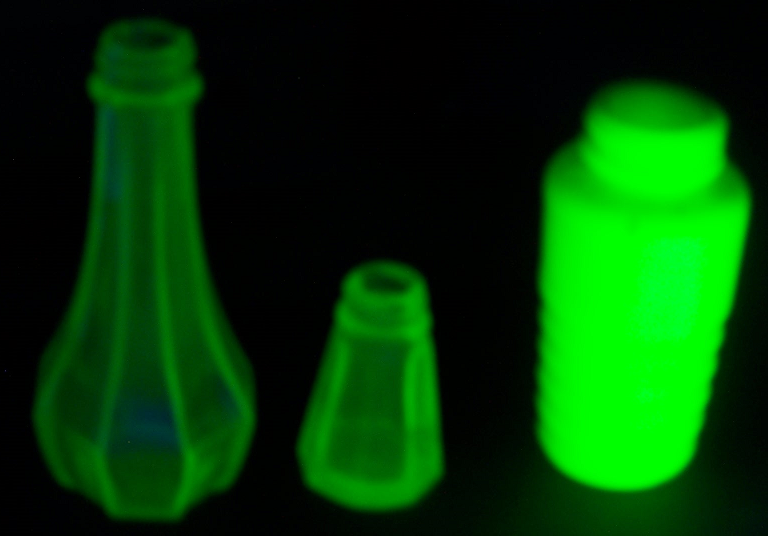
Depression Glass and Vaseline Glass Photographed Under Black Light.
I tried the black light on those items, and you see what I saw.  They glow.

Both types of glass were made with uranium.  Yes, uranium.  Vaseline glass has a more yellow color. To create the more green depression glass, iron oxide was added.

OK.  A black light can reveal some interesting things with some types of glass.  So now I tried the red sea glass under black light.

Red Sea Glass Under Black Light.
I shut out all the light and shined the black light onto the red glass.  The one side showed nothing.  I couldn't even see it in the dark room, let alone photograph it.

I turned it over, and saw a world of difference.  On this one side, it glowed!

It was the side with the yellow specks infused in the glass that glowed.  It glowed orange.

What does that say?  Uranium isn't used in glass nearly as much as it was back in the day, although people do copy depression glass and vaseline glass.  So is this glass older?  I thought it was older just judging from how it was worn into a very rounded cushion shape.  And why was it made to glow?

Then I ran across the following text.
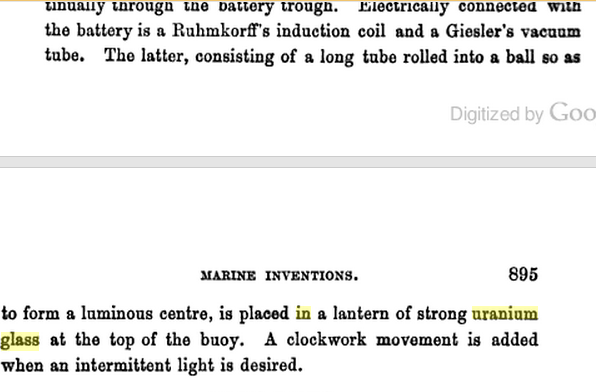


This clip was found in an 1878 nautical magazine.  It is talking about how uranium glass was used on a buoy.  Is that what I have a piece of?  I don't know.  But the evidence is mounting that this red sea glass was once part of a lens, perhaps like was used on a nautical buoy.

Click here to link to the nautical magazine.

What I am talking about today is how an item can continue to reveal more about itself, and how various methods of inspection and research can help make a find come alive.

The same process can occur with almost any kind of item.  Even an item as simple and mute as a squarish little piece of glass will continue to tell you more of the story as long as you are curious and really want to know.

It is something like that with people too.


---

I was without internet most of the day, so that is it for today.  I didn't think I was going to get any kind of post done today.

Happy hunting,
TreasureGuide@comcast.net.

Friday, December 27, 2013

12/27/13 Report - Microscopic Inspection of Dug Coins and Cobs and Comparison of Two Half Reales


Written by the TreasureGuide for the exclusive use of treasurebeachesreport.blogspot.com.

I got some new equipment that can be used to take good photos of coins and other small objects.

Here is an example of one of the first photos that I took of a coin using the Celestron microscope.

I plan to use the microscope to study and photograph beach cobs as well as other things.

If you look at the penny shown here you can see the steps, you can see the figure of Lincoln between the two center columns, and you can see the surface of the coin pretty well.  There is some glare that obscures some of the details.

What I found is that the resolution of the microscope far exceeds that of my computer monitor so if I want to see more detail, I'm going to have to get a higher resolution screen.  Some of the lack in detail in this photo is due to lighting too.

Nonetheless, as is, I expect the microscope to be useful and I expect you'll see the results in future posts.

Here are a couple more of my first attempts with the new device.

Here is a photo of a half reale that was recovered from a Treasure Coast beach in November of 2013.  I posted a photo of it before, but that photo wasn't nearly this good.

In this photo you can see the P assayer mark more clearly (to the left of the bottom of the large P).

You can also clearly see the M mint mark above that, indicating the Mexico mint.

Notice other details, such as the circles and the figure below and between the big P and S.

I think it makes a nice photo even with the limitations in computer screen resolution.

You can also see a few grains of sand still attached to the surface of the cob.

Below is a photo of another half reale found in November of 2013 at the same beach.  I think you can clearly see that this cob was made by another die.

Not only were there many different dies, but dies also were reworked as they wore out and needed to be sharpened up.

Unfortunately this cob does not show the assayer mark.  It does however show part of the M mint mark.

Look just to the left of the big P about half way down the P.  You can see the right side of the M.

So this cob is also a Mexico minted cob.  You could also tell that by looking at the style of cross on the other side of the cob.

You can see the part of the figure below and between the P and S on both cobs - representing a pomegranate, I believe.

One of the big differences I see between the two cobs is the V above and between the P and S.

On the top cob it is complete and entirely between the P and S.  On the bottom cob, it appears to overlap with the S.

I will be using this microscope to make good photos of coins and finds.  Too bad screen resolution is such a limiting factor.  I think the photos look good nonetheless.


Today on the Treasure Coast the surf is around five feet today, but will be diminishing over the next week or so, so don't expect any improvement in beach detecting conditions real soon.

Thats all for now.
Happy hunting,
TreasureGuide@comcast.net