Showing posts with label wedge. Show all posts

Sunday, October 27, 2019

10/27/19 Report - Turtle Trail Beach Conditions. A Mystery Item and a Couple Other Finds.


Written by the TreasureGuide for the exclusive use of treasurebeachesreport.blogspot.com.

Turtle Trail Friday.
Photo by Joe D.
Yesterday I mentioned that I hadn't been to the Vero/Sebastian area and didn't know what was going on there.  Joe D. sent these photos of Turtle Trail that he took Friday, which would have been after a lot of the higher surf.


Turtle Trail Friday.
Photo by Joe D.
Thanks for the photos Joe.

Joe said he met a couple detectorists there that were back from a detecting trip to Thailand.

---

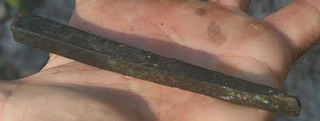
Troy C.  found the following item he would like to know more about.

Find Found by Troy C.
Photo by Troy C.
Below is what Troy said.


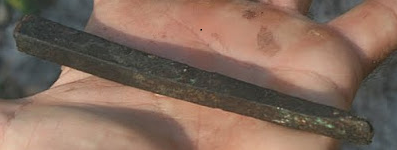
My name is Troy and recently I had found an item while I was free diving the southernmost edge of the Treasure Coast. I wasn't out very deep but I do believe this item to be an old chisel that was either coated in bronze or copper. I was hoping maybe to get feedback to see if what I had found... If this is something from the 1600s that would be pretty incredible.


Another View of the Same Find.

Let me know what you think about Troy's item.

And any thoughts on age?

---


I made some similar finds in the past.  Below are some of those.  The first seems to be about the same size as Troy's.


I learned a bit from researching those finds.  A reader informed me back a few years ago, that the large item in the second photo is a wedge rather than a chisel.

A wedge is for separating things.  A chisel is for removing material, such as wood or stone.

Both types of tools would be handy on sailing or later ships.

I posted information about that in an old post, which you can find by using the following link.

https://treasurebeachesreport.blogspot.com/2016/08/81316-report-wedges-and-chisels-and.html

That post also provides a nice link or two to articles about tools that you might enjoy.

---

Here is a find that I wasn't sure about for a long time.  Now I'm pretty sure I know what it is.

Mystery Item.

What do you think it is?


---

The high tides are going to be big, but the surf only two to three feet the next couple of days.


Happy hunting,
TreasureGuide@comcast.net

Thursday, January 3, 2019

1/3/19 Report - A Great Web Site for Conducting Research on Finds. Tools on Galleons. Calm Surf This Week.


Written by the TreasureGuide for the exclusive use of treasurebeachesreport.blogspot.com.

Source: MaterialCulture18t.wixsite.com/18thcmcrc

In addition to the recreation, exercise, and finds, metal detecting has provided an enjoyable and broad education.  I've learned a lot about a variety of subjects, including but not limited to numismatics, metallurgy, history, and geology.  Research provides a lot of the education.  I highly recommend metal detecting as a way to interest young people in any those fields of study.

Given the range of things one encounters in the hobby, you'll never master it.   There is always a lot left to learn, so research is very important, both before the hunt and after the find.

I was researching some finds recently when I discovered a really super web site: The 18th Century Material Culture Resource Center.

Here is an excerpt from the introduction.


Welcome to the website of the 18th Century Material Culture Resource Center. This little project of our's was created to serve the community as a reference library for the study of everyday objects used by the inhabitants of North America, her mother country, England, and those countries of Continental Europe who, in one way or another, had an impact on the 13 British Colonies in North America between the years 1600 to 1785.

The material presented within this "Virtual Encyclopedia" is for EDUCATIONAL PURPOSES only. We have not received any financial gain by this endeavor. We are greatful to the countless museums, libraries, auction houses, and private collectors from around the world for making their material publicly available so that we could categorize it and present it to you within our slideshows...


So much quality education is provided freely by amateurs in various fields.  If the agencies of government and education were half as effective, we would be much farther ahead.

There are many categories and sections included in that web site.  One category included bottles and cases such as that shown at the top of this post.

The wedges below aren't new finds.  When I first found the top one I referred to it as a chisel.  It is not, and one of my readers quickly informed me of that.

A Couple Treasure Coast Beach Finds.

A wedge is used to separate things.  A chisel is made to lift material from one thing, and therefore they will often have a beveled edge.

I know the one on the bottom looks something like a spike, but that is just the angle of the picture.

I don't have any idea of the age of these wedges.

In 1607, the Spanish crown required carpenters and caulkers who worked on the galleons to provide their own tools.  The 1607 ordinances required each carpenter to provide his own hatchet, saw, three sizes of auger, a claw hammer, a sledge hammer, and two chisels.

Each caulker had to provide a mallet, five sizes of caulking irons, a centering chisel, a rave hook, a sledge hammer, a claw hammer, and oakum remover, and three size of auger.  (Source: Six Galleons for the King of Spain, by Carla Phillips.)

Looking in the 18th Century Material Culture Resource Center you'll find a lot of pictures of tools, including this beautiful 18th century auger.


Here is another illustration of carpenters tools from the same excellent web site.


Those are just a few examples of what you can find on the 18th Century Material Culture web site.  I'll add it to my reference links on the first page of my blog.

Although the web site focuses on 18th Century American and English artifacts, I think  it will be useful in researching artifacts of the 18th century no matter what country they come from.

---

The surf is predicted to be only one foot for a few days.  That means that you might find some easy shallow water hunting.

Enjoy browsing the various sections of the Material Culture web site.

Happy hunting,
TreasureGuide@comcast.net

Saturday, August 13, 2016

8/13/16 Report - Wedges and Chisels and Other Old Nautical Tools. Iron Artifacts of Port Royal. Conservation of Iron Artifacts.


Written by the TreasureGuide for the exclusive use of treasurebeachesreport.blogspot.com.

Artifacts Found On Treasure Coast Beaches.
There are more than coins and gold and silver to be found on the 1715 Fleet wrecks.  Besides the cargo there were all the necessities of daily life, and the nautical tools that were needed to keep a sailing ship in good working order.  While those things might not be as glamorous or valuable as the queen's jewels they can be just as interesting and meaningful.

After finding information on the awl or fid that I showed yesterday, I decided to research a couple more iron beach finds a little more.  They fall into the category of tools.  They are shown above.

The larger one is not a chisel.  That is what I called it for a while, but then one helpful reader informed me that it is not a chisel.  It is a wedge.

A chisel removes material.  A wedge separates things, like boards on a ship when they are going to be caulked.

I'm not sure if the smaller one is a wedge or chisel.  I suspect it is a wedge too.  If it is a chisel, it would be for wood - maybe stone.

Years ago I found the bronze one shown immediately below.


While doing research on nautical tools, I found a great resource.  It is a master's thesis by Katie Custer, entitled Wrought Iron Hand Tools From The Underwater Archaeological Excavations of Colonial Port Royal, Jamaica, C. 1692.

The thesis is a very informative paper that you will probably want to browse.  As the title suggests, it describes iron tool artifacts having to do with various trades active in Port Royal in the late 17th Century.

Not only does the thesis look at the artifacts, it also considers historical records and inventories.  And of course there is a very useful reference list at the end.

Here is the link.

http://anthropology.tamu.edu/papers/Custer-MA2004.pdf

---

If you learn to interpret and appreciate iron artifacts, you will also want to be able to properly clean and conserve them.

One good reference is a PDF file entitled, The Care and Preservation of Historical Iron.  This article was authored by Clara Deck, Senior Conservator of The Henry Ford Museum.

This one has a lot of good useful information too.

https://www.thehenryford.org/docs/default-source/default-document-library/the-henry-ford-iron-conservation.pdf?sfvrsn=2

---

Horsing Iron.


Here is another web site you might want to look at.  It shows a lot of antique nautical tools, including this horsing iron, which would be used for caulking.

http://www.ageofsail.net/aosbt.asp


---

I wanted to comment on the mystery item that I posted on 8/11.  I received an number of excellent thoughts from helpful readers of this blog.

My opinion is that the item is likely more modern.  A couple of knowledgeable and well-known shipwreck experts told Bob C. that the mystery item could be from a shipwreck.  The item was found near other items that I believe are probably 1715 Fleet. I don't presume to be more knowledgeable than the well-known experts, who also had the advantage of seeing the item in person, but my opinion after viewing the picture, is that it is most likely more modern.  My confidence level is 70 or 80 percent that it is modern.  Of course I could be wrong.

The item might be easier to identify after it is cleaned.

Thanks to all who offered opinions.

---

There is no tropical activity of interest right now and the surf will remain calm for at least a few days.

Happy hunting,
TreasureGuide@comcast.net