Showing posts with label conservation. Show all posts

Wednesday, July 3, 2019

7/3/19 Report - Old Buttons Cleaning and Preservation. What You Might Need To Know To Be Ready For Your Big Find.


Written by the TreasureGuide for the exclusive use of treasurebeachesreport.blogspot.com.


Back of Flat Button As Found.

This button was found near the 54th Regiment of Foot and 76th Regiment of Foot buttons that I showed recently.  It is a flat button with a gold wash or gilt.  Much of the detail is obscured.  There is no detail on the front, and the gilt is gone from the front.

As I've explained many times, be careful when you clean a coin or other item.  Use the least aggressive or dangerous method that will do the job and monitor the progress very closely to prevent any damage.  If you don't know for sure how to do it, it is better to wait.

Well, this is an example of not doing it right.  I decided to clean this one, and decided to see how a quick immersion in acid would do.  A very quick immersion would have been alright, but I put in the Muriatic Acid and forgot about it, leaving it in overnight.  That was not good.

This is what happened.

Flat Button After Overnight Immersion in Muriatic Acid.

As you can see some of the dirt came off but so did some of the gilt.  That is a good example of what not to do.

You can now see the flourishes but the word ORANGE, which is at the top and bottom between the flourishes.

I've found gilded pieces tricky.  You don't want to lose any gilding, but it can easily be damaged and removed.

I would not have even considered using the acid if the button was one of the better ones, but thought I could get away with a quick dip.  Unfortunately it was more than a quick dip.

Aluminum Jelly or Naval Jelly is often recommended for use on buttons having gold or silver gilt.

The change in color on the above photos is due mostly to a change in lighting.  I should have been more careful about that too.

Here is an article that will help you do it right.  Additional methods are described including heated hydrogen peroxide.


Beside cleaning, buttons will often need some type of treatment for conservation.  Pewter, for example, is fragile.  When you find a pewter button the first thing to do is keep it moist.

After you properly clean it, then you need to protect it, otherwise the edges will start chipping.

If you look at the edges of the two buttons below, you'll see chips around the edges.


People often coat pewter buttons with a 50% mixture of Elmers glue and water or a thin cover of urethane.

Neither of the of the above have been cleaned or preserved yet.

I've learned many lessons the hard way and post them here so you won't have to repeat them.

I once did a post asking "Are you really ready for your big find."

Everybody is eager to make a big find, but there are many mistakes you can make when that happens before you are ready.

These were the first old buttons I found and I didn't have the knowledge or experience to treat them properly.  If you are like me, you will make a lot of mistakes the first time you find different kinds of items.  Here are some of the kinds of mistakes you can make.

1.  Not carefully digging.  You can easily destroy or damage finds during recovery.  That can be very disappointing when you find out that the item was something especially nice.

2.  Not identifying the item correctly.  When an item comes out of the ground, it can tell you something important.  Its age and quality might tell you that the area deserves more serious attention, but if you don't recognize the item, you can miss that important clue, or worse yet, discard an item that has more value or is more interesting than you recognize.

3. Not carrying the item safely.  I broke some nice bottles while carrying them down the beach and lost a gold chain out of a hole in my shirt pocket.  I walked back about a mile and refound the chain, but it was a lot of extra effort.

4.  As I showed today, a nice item can easily be damaged by the wrong cleaning method.

5.  After proper cleaning comes conservation.

6.  You might also fail to record information about the time, location and other details of the find.  Again, if you are like me, after a few years you'll discover that you wish you had done that.

For example, I just ran across some arrowheads I stored in a plastic bag.  I had some information in the bag written on paper with the items.  The paper crumbled and I can no longer read what it said.

More often, I never wrote down the information that I later wish I had.

7.  Then there are legal, partnership and media issues that might need to be handled properly.


In summary, if you don't yet have the knowledge or experience to deal with things well. there are a lot of things that can be done to ruin or diminish what otherwise would be a great find.  In my case, it hasn't been anything huge, but there are many cases when I wish I had done things differently.  Most of those happened early in my treasure hunting days, and many of them were "first" finds of a particular type.


Here is a nice web site showing a lot of button backmarks.

http://relicman.com/buttons/Button9900-Backmark-Index-PAGE2.html

---

I asked people to send in photos of their Native American Treasure Coast beach finds, particularly points, but haven't received any yet.  I know that people find them.  On a couple occasions I've had tourist come up to me and show me an arrowhead they picked up.  One of those was at Wabasso.  A tourist staying at the Disney Resort showed me one she found and asked me about.

---

I was so glad that the Medicare helpline helped Joe Nemeth.  I could just see him hanging on the phone in his Tequesta home waiting for an agent to help him.

And Terry Bradshaw didn't do very well with his Weight Watchers program, but he got a walk-in bath.

---

I plan to do some more posts on old buttons as well as Native American finds.

---

No change in beach conditions is expected real soon.

Happy hunting,
TreasureGuide@comcast.net

Tuesday, October 24, 2017

10/24/17 Report - More Post-Irma Finds. The Meaning and Derivation of Names Such as Nuestra Senora de las Nieves. Preserving Iron Artifacts.


Written by the TreasureGuide for the exclusive use of treasurebeachesreport.blogspot.com.

Lead Shot and Half Reale
Finds and photo by DB
I've shown a number of Irma finds, including a lot of musket balls and a piece of gold.  Here is another post-Irma find.

With the photo I received the following email from DB.

Hello,

I started reading your blog not too long ago. I've learned a lot from them and always like to see cool finds from the area. I found my first Spanish coin and wanted to share with you. A half reale and little musket ball from a beach in IR County...

Thanks and keep up the good work!

Congratulations on your first Spanish cob DB!  Thanks for sharing.

---

The shipwreck off of John Brooks is commonly thought to be the Nuestra Senora de las Nieves

Nieves is a Spanish surname and a female given name from the title of the Virgin Mary Nuestra SeƱora de las Nieves meaning "Our Lady of the Snows."

Many of the names of Spanish ships refer in Mother Mary in one say or another.  Here is an article about various names and references to Mary.

It begins, Mary has many names, or shall we call them titles? The Litany of Loreto refers to many different titles of Mary, but not all of them. Some of her titles refer to a city name corresponding to an apparition location, for example, Our Lady of Lourdes or Our Lady of Fatima. There are also devotional titles of Our Lady such as Our Lady, Undoer (or Untier) of Knots. And then there are many variations of titles which all have a unique history. One such devotion is to Mary under the title of Our Lady of Good Help...

Here is the link for the rest of the article.

http://catholicexchange.com/our-lady-of-good-what

---

In my previous post I showed an an old anchor find.  Here is another smaller one.  It isn't as old.

Anchor Find Before Conservation and Coating.
I showed this anchor before, but what I wanted to say about it today is how I finally coated it.  I used clear Rustoleum after getting it stabilized.  Since coating it with Rustoleum, which I did five or more years ago now, it has shown absolutely no signs of deterioration.  It is very important to get it stabilized first before putting on any coating.

I like the clear glossy finish for some items, but you can chose any finish you like.

Here is what it looks like after it was cleaned and coated.

Anchor Coated With Clear Glossy Rustoleum.

It can take a good while to stabilize iron, especially if it has been in salt water.  I've talked about that before, but will refer you to the TAMU web site for tips on how to conserve iron items.

---

The Treasure Coast surf is calmer now.  It is only a couple of feet, which will give you a chance to get a little farther out at low tide.

We're supposed to get some nice cool air, which I like a lot better than the 90 degree summer stuff.

Happy hunting,
TreasureGuide@comcast.net

Saturday, August 13, 2016

8/13/16 Report - Wedges and Chisels and Other Old Nautical Tools. Iron Artifacts of Port Royal. Conservation of Iron Artifacts.


Written by the TreasureGuide for the exclusive use of treasurebeachesreport.blogspot.com.

Artifacts Found On Treasure Coast Beaches.
There are more than coins and gold and silver to be found on the 1715 Fleet wrecks.  Besides the cargo there were all the necessities of daily life, and the nautical tools that were needed to keep a sailing ship in good working order.  While those things might not be as glamorous or valuable as the queen's jewels they can be just as interesting and meaningful.

After finding information on the awl or fid that I showed yesterday, I decided to research a couple more iron beach finds a little more.  They fall into the category of tools.  They are shown above.

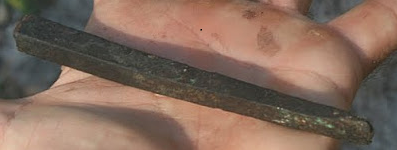
The larger one is not a chisel.  That is what I called it for a while, but then one helpful reader informed me that it is not a chisel.  It is a wedge.

A chisel removes material.  A wedge separates things, like boards on a ship when they are going to be caulked.

I'm not sure if the smaller one is a wedge or chisel.  I suspect it is a wedge too.  If it is a chisel, it would be for wood - maybe stone.

Years ago I found the bronze one shown immediately below.


While doing research on nautical tools, I found a great resource.  It is a master's thesis by Katie Custer, entitled Wrought Iron Hand Tools From The Underwater Archaeological Excavations of Colonial Port Royal, Jamaica, C. 1692.

The thesis is a very informative paper that you will probably want to browse.  As the title suggests, it describes iron tool artifacts having to do with various trades active in Port Royal in the late 17th Century.

Not only does the thesis look at the artifacts, it also considers historical records and inventories.  And of course there is a very useful reference list at the end.

Here is the link.

http://anthropology.tamu.edu/papers/Custer-MA2004.pdf

---

If you learn to interpret and appreciate iron artifacts, you will also want to be able to properly clean and conserve them.

One good reference is a PDF file entitled, The Care and Preservation of Historical Iron.  This article was authored by Clara Deck, Senior Conservator of The Henry Ford Museum.

This one has a lot of good useful information too.

https://www.thehenryford.org/docs/default-source/default-document-library/the-henry-ford-iron-conservation.pdf?sfvrsn=2

---

Horsing Iron.


Here is another web site you might want to look at.  It shows a lot of antique nautical tools, including this horsing iron, which would be used for caulking.

http://www.ageofsail.net/aosbt.asp


---

I wanted to comment on the mystery item that I posted on 8/11.  I received an number of excellent thoughts from helpful readers of this blog.

My opinion is that the item is likely more modern.  A couple of knowledgeable and well-known shipwreck experts told Bob C. that the mystery item could be from a shipwreck.  The item was found near other items that I believe are probably 1715 Fleet. I don't presume to be more knowledgeable than the well-known experts, who also had the advantage of seeing the item in person, but my opinion after viewing the picture, is that it is most likely more modern.  My confidence level is 70 or 80 percent that it is modern.  Of course I could be wrong.

The item might be easier to identify after it is cleaned.

Thanks to all who offered opinions.

---

There is no tropical activity of interest right now and the surf will remain calm for at least a few days.

Happy hunting,
TreasureGuide@comcast.net

Tuesday, September 30, 2014

9/30/14 Report - Portable Antiquities Scheme And The PAS Web Site. Switching It Up.


Written by the TreasureGuide for the exclusive use of treasurebeachesreport.BlogSpot.com.

Treasure Coast Lion Head Gold Ring
Find Marked 10K.

I've talked about England's Portable Antiquities Scheme (PAS), which as their web site says, was developed ... to encourage the voluntary recording of archaeological objects found by members of the public in England and Wales. Every year many thousands of objects are discovered, many of these by metal-detector users, but also by people whilst out walking, gardening or going about their daily work.

The PAS has been highly successful because it respects the public and encourages them to be involved and rewards those that make properly reported finds.  That is very much unlike what we have in the United States, which presents the public with a confusing mess of rules and regulations, topped by intimidating penalties.  I once wrote to Tallahassee asking what a person finding a Native American artifact on the beach should do and who they should contact or whatever.  I never received a reply.  A person in this country that finds something would not know what to do and might well be afraid of doing anything.

One of the big problems is that here almost anything and everything is considered historic and is protected.  PAS, on the other hand, defines treasure as being over 300 years old.  In Florida, anything 50 years old is considered historic and protected.  That would include my high school class ring and a lot of my other possessions. 

In Florida, at least the fossil collecting laws are reasonable.  You can obtain a permit to collect fossils on state land (which includes all waterways in the state) for $5.00 per year.  Reporting finds is required.  

But what I wanted to do today is simply point you to the PAS web site.  The web site is a useful tool.  It illustrates the public-friendly attitude of the program.

Here is the link.

http://finds.org.uk/

The PAS web site makes it clear who to contact, explains the program, answers many questions, explains how to conserve items, how to collect and display items, provides a database of finds, and even gives people advice on selling items that do not qualify under the program if a person finds something that he eventually wants to sell.  In short, it is helpful, treats the public with respect and consideration instead of as a mistrusted enemy, invites participation, and most of all has been very effective.

Take a look.

Don't write and ask me what the metal detecting laws and regulations are in Florida.  As I just said, it is a confusing mess, and I'm not going to try to explain it even if I could.

I noticed a YouTube video testing the Minelab 5000.  It is a  detector costing over $5000 and is designed to be used in the gold fields.  But what struck me most is that it has a setting for fine gold and another setting for larger gold.  In the test that I saw on the video, the "fine gold" setting detected two small nuggets but not two larger nuggets.  Then the other setting was used and the other two nuggets were detected, but not the smaller ones.

To me that just emphasized to me something that I have been learning to appreciate more and more myself.  It takes more than one shot to cover an area well, and using more than one detector can be very helpful.   That is true in any area of size, but especially true in a junky area.  You'll find things with one detector that will be missed by another.  And you'll find things in one mode that will be missed in another mode while using the same detector.  An area that is worth detecting can be covered many times and good targets will still show up.   I challenge you to put that to the test.  If you don't find it true, I'll bet that you are hunting the area the same way every time instead of changing where you focus or how you use your detector or detectors.

I'll also bet that if five different detectorists visit the same site, four of them will hit the same spots.  The tendency is to go to the nice flat open areas.  Some areas simply appear more inviting.  While the types of areas that draw people will most likely be over-hunted, the probability is that there will also be areas that remain overlooked.

To give just one example.  The tag that I showed yesterday was in a yard that had been hunted several times with different detectors.  The tag was found in an area less than a foot wide between a concrete driveway and bushes.  A large coil could not be used there.  And many detectors would have been nearly useless there because of the rebar in the concrete drive way.   To top that off, there was also a iron item buried close to the tag.

Most people tend to see and approach a site the same way over and over again.  If you make an effort to switch things up, I think you'll find that there is more to be found even though you might have hunted the same site before. While most people will make a bee line to those nice inviting areas, the little nooks and crannies can contain a lot of goodies.


Now that September is nearly over I can report that the most read post of August 2014 was the 8/6/14 Report -  Young Boys Find Very Rare and Old Gold Hair Tress.   Fake or Real Escudo?  Error Dime.  Poor Beach Conditions.  It's All About ...  

It is interesting that the most read post was not the post that received the most g+1 clicks.

Coincidentally, the gold hair tress was an item covered by the PAS.

There are only a few hours left to respond to the blog poll.


One area of disturbed weather has been sitting off of North Carolina for a few days now, but it is not likely to form, and it is not likely to affect us.

On the Treasure Coast we are having a two-foot surf.   It will be just a touch less for the next few days.

Happy hunting,
Treasureguide@Comcast.NET


Sunday, August 10, 2014

8/10/14 Report - 60 Pounds of Silver Coins Discovered! Great Bronze Shipwreck Spikes Found. Wreck of the Olivette Explored. Fine Watch. Big Tides.


Written by the TreasureGuide for the exclusive use of treasurebeachesreport.BlogSpot.com.


Bronze Spikes Found by UB
Photos submitted by UB
Here are some great finds.   Bronze spikes!   One is still in wood.  That is really neat. 

Also the one with the washer or ring around it is unusual.

Great finds and photos UB!


UB was wondering if anyone had seen one with something like this washer thing on it, and if anyone had any thoughts about their possible age or any other ideas they might be able to offer.

He was also wondering about how to conserve them.

UB has a proven technique for conserving wood, but was wondering how to conserve the combination of wood and bronze.


The Olivette, was an American steamer that was turned into a hospital ship, and was used in the Spanish American War to treat injured Spaniards as well as Americans.  It sank in 1918. 

Here is a nice video showing divers exploring the discovered wreck.

http://xfinity.comcast.net/video/USS-Olivette-Shipwreck/316563523637/Comcast/TopVideoClips/?cid=sf_vidtray


Source: Orlando Sentinel link.


This old house was condemned and demolished.  In the process 60 pounds of silver coins from the early 1900s were discovered in the walls.


Tek sent me the link to this article published in the Aug. 10 Orlando Sentinel.

Thanks Tek!


The link below will give you the entire story and a video on the treasure in the old house.

http://www.orlandosentinel.com/news/local/breakingnews/os-silver-dollars-chimney-st-cloud-20140808,0,1921056.story


Due to the poor beach conditions, I've been targeting modern jewelry at tebeach..  There has been a good bit of it at a few of the Treasure Coast beaches.

Here is the type of thing you can find, and no target ID meter would get it exactly right.


That is about the most attractive watch that I've seen.  And in great condition!


On the Treasure Coast the surf is very small, but the tides today were unusually big.  

There is a little weather just coming off of Africa that has about a 10% of becoming a cyclone in the next 48 hours.

That one is very far away yet, but could be worth watching.

Happy hunting,
TreasureGuide@Comcast.net