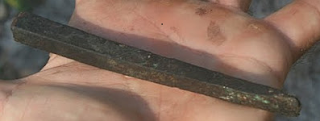
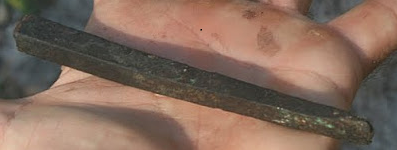
Showing posts with label chisel. Show all posts

Monday, October 28, 2019

10/28/19 Report - Wabasso Beach. Chisels, Wedges and Spikes. How To Date Screws? Mystery Item Positively Identified.


Written by the TreasureGuide for the exclusive use of treasurebeachesreport.blogspot.com.

Wabasso Area Beach Sunday Afternoon.
Photo by Scott B.

Along with the beach photo shown above, Scott B. sent a picture of an old screw he found in that general area about a month ago.  The screw is just under two inches long.  He wondered how long screws have been around.

Old Screw Found by Scott B.

Thanks for the photos and question Scott.

Witold Rybczynski's book on the history of screws and screwdrivers, One Good Turn: A Natural History of the Screwdriver and the Screw, says screws as we know them with threads and heads shaped for a driving tool used to attach two pieces together were used as far back as the 15th century.
On what I believe to be some of the oldest screws that I've found, you can tell that the threads are irregular, unlike those on more modern machine made screws.  The next time I run across one of those I'll try to remember to take a good closeup photo of the threads.
According to an article in AntiqueTrader.com handmade old handmade screws started out pretty much like square nails. 

... But the form used for the screw was a more or less round shallow depression into which the top of the shaft was hammered flat, producing a screw head. The slot for the bladed screwdriver was cut with a hacksaw.

So far so good. We’ve got the column and the head but what about the ramp, also known as the worm or the threads? Lacking a cold hardened steel die with which to cut the thread, the craftsman had to cut it himself by hand. This was usually done in laborious fashion with a file. When the smith had the length he thought was needed for the job, he simply cut or snipped the threaded shaft.

This entire hand-done process leaves a multitude of clues on the handmade screw, just waiting for our inspection. Starting with the top of the screw, the head, evidence of handwork is abundant. In most cases the head is not perfectly round and is not centered perfectly on the shaft. The hand cut slot is seldom perfectly centered on the off-center head. Below the head, on the smooth portion of the shaft above the threads, is the most likely place to find areas that still show a flat side of the original iron nail stock. This portion of the shaft is almost never totally round or totally smooth.

But the most obvious clue to the handwork is the thread. The pitch, the angle of the thread to the shaft, will vary considerably from thread to thread as will the depth of the cut into the shaft that produces the thread.

The edges are often flat since they were filed into shape, and the tip is invariably blunt since the smith just cut it off. And the overall shape of the entire screw is cylindrical rather than tapered, as is the case in modern screws. Because of the individual nuances and variables in the handwork process, no two handmade screws are identical.

Screws with these characteristics were produced until early in the 19th century. Around 1812 a machine was introduced that made screws on a lathe but the War of 1812 slowed its distribution and development. After the War, the new machine went right to work, turning out virtually identical screws with sharp even threads, but the heads still had to be hand forged and the slots were still cut with a hacksaw, producing slight variations caused by this last bit of handwork.

These new machine-made screws also resembled their ancestors in that they were still almost perfectly cylindrical and had a blunt tip.

The introduction in 1848 of the completely machine-made gimlet screw, with a tapered shaft and a pointed tip, marked the beginning of the modern era in screw production.


Source: https://www.antiquetrader.com/articles/furniture-detective-screws-give-valuable-clues-when-in-search-of-antique-furniture-origins/
---

Yesterday I posted a find made by Troy C.  He thought it might be a chisel.  Here it is again.

Item Found by Troy C.

I asked for opinions on the find, and John C. wrote the following.

Possibly a bronze spike, Just missing the head, It's very hard to find an intact spike of this size, usually 5 1/2 to 6"in, They seem to be very brittle,  Most of the ones that I've found over the years are Broken, midway, Or 3/4, But occasionally they do break at the head, as shown in the photo. One thought is, Maybe Someone attempted to removed the spike from a plank, many years ago when much of the wreck was still somewhat intact and only removed the head in the process?


I think John could be right.  The tip doesn't look like it is shaped to remove material.  It is pretty blunt now, but it does look to me like the tip was intentionally angled both up and down at the same angle.  The shape isn't graduated like I'd expect of a wedge.

In the small amount of research I did, I found that it can be more complicated than I expected.  That is often the case.  The more you learn the more complicated it becomes.  For example, there are hot chisels and cold chisels.

Hunker.com presents the following distinction between hot and cold chisels, which might not be as familiar as wood-working chisels.


A cold chisel is a metal working chisel with a solid, hardened steel cylindrical shaft about 6 inches long. The tip is shaped to about a 60-degree angle on both sides to form a wedge-shaped point. It is is designed to cut steel and other metals that have either not been heated or have previously cooled down. The chisel is typically used in conjunction with a steel hammer, such as a ball-peen hammer, or 3-pound sledge.


A hot chisel is exclusively used in blacksmithing. It is used to cut and shape red-hot steel pieces. Since heated steel is many times softer than cold steel, these chisels are not typically hardened or tempered. They are of roughly the same size and shape as cold chisels, but feature a blade that is cut at a 30-degree angle, making them virtually useless for other cutting tasks.


The tip on Troy's has an angle on both sides.  It would be nice to be able to take a close look at the  head to see if you can tell if the head looks like it was broken off or if it has been struck as you'd expect of any chisel that has been used at all.

If it looks broken, I think I'd lean more in the direction of Troy's find being a broken spike, but I'm still wouldn't be certain.

Thanks John!

---

I posted a mystery object yesterday, and DJ positively identified it.

Here is what he found.

Helena Rubenstein Lipstick Case.
Photo submitted by DJ.

That is what it is for sure.

One thing that was confusing me on this one is that I couldn't get it open.  Now I know how it is supposed to open so maybe I'll be able to get it open without breaking it.

---

Happy hunting,
TreasureGuide@comcast.net


Sunday, October 27, 2019

10/27/19 Report - Turtle Trail Beach Conditions. A Mystery Item and a Couple Other Finds.


Written by the TreasureGuide for the exclusive use of treasurebeachesreport.blogspot.com.

Turtle Trail Friday.
Photo by Joe D.
Yesterday I mentioned that I hadn't been to the Vero/Sebastian area and didn't know what was going on there.  Joe D. sent these photos of Turtle Trail that he took Friday, which would have been after a lot of the higher surf.


Turtle Trail Friday.
Photo by Joe D.
Thanks for the photos Joe.

Joe said he met a couple detectorists there that were back from a detecting trip to Thailand.

---

Troy C.  found the following item he would like to know more about.

Find Found by Troy C.
Photo by Troy C.
Below is what Troy said.


My name is Troy and recently I had found an item while I was free diving the southernmost edge of the Treasure Coast. I wasn't out very deep but I do believe this item to be an old chisel that was either coated in bronze or copper. I was hoping maybe to get feedback to see if what I had found... If this is something from the 1600s that would be pretty incredible.


Another View of the Same Find.

Let me know what you think about Troy's item.

And any thoughts on age?

---


I made some similar finds in the past.  Below are some of those.  The first seems to be about the same size as Troy's.


I learned a bit from researching those finds.  A reader informed me back a few years ago, that the large item in the second photo is a wedge rather than a chisel.

A wedge is for separating things.  A chisel is for removing material, such as wood or stone.

Both types of tools would be handy on sailing or later ships.

I posted information about that in an old post, which you can find by using the following link.

https://treasurebeachesreport.blogspot.com/2016/08/81316-report-wedges-and-chisels-and.html

That post also provides a nice link or two to articles about tools that you might enjoy.

---

Here is a find that I wasn't sure about for a long time.  Now I'm pretty sure I know what it is.

Mystery Item.

What do you think it is?


---

The high tides are going to be big, but the surf only two to three feet the next couple of days.


Happy hunting,
TreasureGuide@comcast.net

Thursday, January 3, 2019

1/3/19 Report - A Great Web Site for Conducting Research on Finds. Tools on Galleons. Calm Surf This Week.


Written by the TreasureGuide for the exclusive use of treasurebeachesreport.blogspot.com.

Source: MaterialCulture18t.wixsite.com/18thcmcrc

In addition to the recreation, exercise, and finds, metal detecting has provided an enjoyable and broad education.  I've learned a lot about a variety of subjects, including but not limited to numismatics, metallurgy, history, and geology.  Research provides a lot of the education.  I highly recommend metal detecting as a way to interest young people in any those fields of study.

Given the range of things one encounters in the hobby, you'll never master it.   There is always a lot left to learn, so research is very important, both before the hunt and after the find.

I was researching some finds recently when I discovered a really super web site: The 18th Century Material Culture Resource Center.

Here is an excerpt from the introduction.


Welcome to the website of the 18th Century Material Culture Resource Center. This little project of our's was created to serve the community as a reference library for the study of everyday objects used by the inhabitants of North America, her mother country, England, and those countries of Continental Europe who, in one way or another, had an impact on the 13 British Colonies in North America between the years 1600 to 1785.

The material presented within this "Virtual Encyclopedia" is for EDUCATIONAL PURPOSES only. We have not received any financial gain by this endeavor. We are greatful to the countless museums, libraries, auction houses, and private collectors from around the world for making their material publicly available so that we could categorize it and present it to you within our slideshows...


So much quality education is provided freely by amateurs in various fields.  If the agencies of government and education were half as effective, we would be much farther ahead.

There are many categories and sections included in that web site.  One category included bottles and cases such as that shown at the top of this post.

The wedges below aren't new finds.  When I first found the top one I referred to it as a chisel.  It is not, and one of my readers quickly informed me of that.

A Couple Treasure Coast Beach Finds.

A wedge is used to separate things.  A chisel is made to lift material from one thing, and therefore they will often have a beveled edge.

I know the one on the bottom looks something like a spike, but that is just the angle of the picture.

I don't have any idea of the age of these wedges.

In 1607, the Spanish crown required carpenters and caulkers who worked on the galleons to provide their own tools.  The 1607 ordinances required each carpenter to provide his own hatchet, saw, three sizes of auger, a claw hammer, a sledge hammer, and two chisels.

Each caulker had to provide a mallet, five sizes of caulking irons, a centering chisel, a rave hook, a sledge hammer, a claw hammer, and oakum remover, and three size of auger.  (Source: Six Galleons for the King of Spain, by Carla Phillips.)

Looking in the 18th Century Material Culture Resource Center you'll find a lot of pictures of tools, including this beautiful 18th century auger.


Here is another illustration of carpenters tools from the same excellent web site.


Those are just a few examples of what you can find on the 18th Century Material Culture web site.  I'll add it to my reference links on the first page of my blog.

Although the web site focuses on 18th Century American and English artifacts, I think  it will be useful in researching artifacts of the 18th century no matter what country they come from.

---

The surf is predicted to be only one foot for a few days.  That means that you might find some easy shallow water hunting.

Enjoy browsing the various sections of the Material Culture web site.

Happy hunting,
TreasureGuide@comcast.net

Tuesday, December 12, 2017

12/12/17 - Y2K Treasure Recovered in Back Yard. Very Old Chisel. Old Metal Detecting Records. Artifact ID Guide.


Written by the TreasureGuide for the exclusive use of treasurebeachesreport.blogspot.com.

2000 Year Old Chisel
Source: Haaretz.com web site (link below)

Archaeologists Find 2,000-year Old Chisel Used to Build the Western Wall

The metal tool was discovered at the bottom of the wall, which hadn't been build by Herod at all, other evidence shows...

Here is the link for more about that.

https://www.haaretz.com/jewish/archaeology/.premium-1.586670

---

I can't believe it.  I just ran across what has to be some of my first metal detecting records.  It seems like it would have been from the first days or weeks that I had a serious metal detector.

My records include the detecting site, date (day, month), total face value of coins found up to that time, number of each type of coin found on each hunt broken down by the decade of the coin and a few additional notes.

Old Coin Shooting Records.

At that point, I would call myself a coin shooter.  ( I don't anymore.)  That is mostly what I was finding and recording in considerable detail.

On 9/26, near the beginning of the entries I had $7.53 total face value of coin finds, and on the back of the page the last row shows that by 1/3 I had found a total of 2653 coins with a total face value of $197.48.  including 432 quarters, 622 dimes, 300 nickles and 1299 pennies.  Dollar coins and halves were not included in the total value (don't know why except possibly their relative rarity).  Foreign coins were noted by not counted.  I see some Susan Anthony dollar finds, for example. The math seems to be off by less than a dollar.

As I said, I recorded the number of coins from each decade for each denomination.  Most of the hunts resulted in coins from the 60s, 70s, and 80s.  As I scan the records, I see that the first time I got many coins from the 20s, 30s and 40s was when I made a trip to Pennsylvania and West Virginia.

Old Coin Shooting Records.

Well, that looks like it was my very earliest detecting.  I was surprised to see that I kept so much data when I started and can see from the records that I improved steadily and fairly quickly.  It wasn't long after that when I started targeting jewelry and quit keeping records on common coin finds, and then I only recorded jewelry finds.

I vaguely remember counting and recording finds, but I didn't remember keeping so much detail.

This goes along with very well with my 12/4 post on focus, goals, feedback loops and analysis.

Keeping good records helps you to know which sites are producing, what they produce and when they produce.  Consistent record keeping provides feedback that helps more than you might expect.  If you are trying to keep your weight or blood pressure down, for example, just monitoring those levels on a regular basis might help.

You might also want to take notice of things such as when you start to get older coins at a particular site.  That can be an important clue.

The data will also bring up important questions.  If you are seeing a decrease in finds, it will cause you to ask yourself why and what is going on.

Besides all of that, old records bring back memories.  I just wish I would have included the year along with the day and month.  When I made those records I never would have guessed that I would be looking them once again after thirty or forty years.

---

I got this interesting note from Stephen L.


Hi,
Thanks so much for your daily posts, very well done.  I bought a detector a while ago to find some treasure that I buried in my back yard before Y2K.  I am embarrassed to say that I could not find it when recently tried, after a grid of about 15 test holes with a post hole digger, but after I bought my detector, found it within 30 seconds.  Since then I have only used my detector on private property with permission, relatives and such...

Thanks for writing Stephen.

---

Iron Tools From 1770 - 1813
Source: An Identification Guide to Recovered Colonial and Revolutionary War Artifacts.
I've been talking a lot about pointed iron tool finds from the Treasure Coast.  One good source that might help with the identification of such artifacts is the identification guide by Timothy J. McGuire.  The picture above show shows an awl in the middle along with some files and a chisel (right) found at the site of the battle of Brownstown Creek in Wayne County Michigan.  Good resource.

---

Small surf on the Treasure Coast today.  Not much change expected for a week or two.


Saturday, August 13, 2016

8/13/16 Report - Wedges and Chisels and Other Old Nautical Tools. Iron Artifacts of Port Royal. Conservation of Iron Artifacts.


Written by the TreasureGuide for the exclusive use of treasurebeachesreport.blogspot.com.

Artifacts Found On Treasure Coast Beaches.
There are more than coins and gold and silver to be found on the 1715 Fleet wrecks.  Besides the cargo there were all the necessities of daily life, and the nautical tools that were needed to keep a sailing ship in good working order.  While those things might not be as glamorous or valuable as the queen's jewels they can be just as interesting and meaningful.

After finding information on the awl or fid that I showed yesterday, I decided to research a couple more iron beach finds a little more.  They fall into the category of tools.  They are shown above.

The larger one is not a chisel.  That is what I called it for a while, but then one helpful reader informed me that it is not a chisel.  It is a wedge.

A chisel removes material.  A wedge separates things, like boards on a ship when they are going to be caulked.

I'm not sure if the smaller one is a wedge or chisel.  I suspect it is a wedge too.  If it is a chisel, it would be for wood - maybe stone.

Years ago I found the bronze one shown immediately below.


While doing research on nautical tools, I found a great resource.  It is a master's thesis by Katie Custer, entitled Wrought Iron Hand Tools From The Underwater Archaeological Excavations of Colonial Port Royal, Jamaica, C. 1692.

The thesis is a very informative paper that you will probably want to browse.  As the title suggests, it describes iron tool artifacts having to do with various trades active in Port Royal in the late 17th Century.

Not only does the thesis look at the artifacts, it also considers historical records and inventories.  And of course there is a very useful reference list at the end.

Here is the link.

http://anthropology.tamu.edu/papers/Custer-MA2004.pdf

---

If you learn to interpret and appreciate iron artifacts, you will also want to be able to properly clean and conserve them.

One good reference is a PDF file entitled, The Care and Preservation of Historical Iron.  This article was authored by Clara Deck, Senior Conservator of The Henry Ford Museum.

This one has a lot of good useful information too.

https://www.thehenryford.org/docs/default-source/default-document-library/the-henry-ford-iron-conservation.pdf?sfvrsn=2

---

Horsing Iron.


Here is another web site you might want to look at.  It shows a lot of antique nautical tools, including this horsing iron, which would be used for caulking.

http://www.ageofsail.net/aosbt.asp


---

I wanted to comment on the mystery item that I posted on 8/11.  I received an number of excellent thoughts from helpful readers of this blog.

My opinion is that the item is likely more modern.  A couple of knowledgeable and well-known shipwreck experts told Bob C. that the mystery item could be from a shipwreck.  The item was found near other items that I believe are probably 1715 Fleet. I don't presume to be more knowledgeable than the well-known experts, who also had the advantage of seeing the item in person, but my opinion after viewing the picture, is that it is most likely more modern.  My confidence level is 70 or 80 percent that it is modern.  Of course I could be wrong.

The item might be easier to identify after it is cleaned.

Thanks to all who offered opinions.

---

There is no tropical activity of interest right now and the surf will remain calm for at least a few days.

Happy hunting,
TreasureGuide@comcast.net

Monday, June 13, 2011

6/13/11 Report - Cleaned Iron Artifact & Great Pirate Site


Chisel As Found in January.

This chisel is ten inches long and the head is 2 inches by 1.5 inches.

I like it better with the crust, but it started to deteriorate so I decided to clean and preserve it to keep it from falling apart.

I should have immediately put it in a solution of water and sodium bicarbonate and let it soak until I got around to cleaning it.

Don't take the crust off until you decide to clean it though. The crust can actually prevent further rusting.

I don't know why I didn't think of doing that at first. When it started to deteriorate I decided to clean it.

Even though I didn't do everything the way I should have, it has been a good experiment. It took several days of electrolysis to clean it this well.


Same Chisel After Several Days of Electrolysis.

Electrolysis takes a lot longer for a larger item like this than for smaller spikes.


I wanted to see if there were any marks on the chisel that would help me identify it better. I could find none other than the a long series of parallel lines along the one side. You can see some of them in the photo up near the head of the chisel on the narrow side.

I have what appears to be a bronze chisel that is much smaller that didn't need any cleaning. It came off of another Treasure Coast shipwreck beach.


If you want to read what the experts have to say about treating iron artifact, here is a good link.

http://search.aol.com/aol/search?query=iron+artifact+conservation+tamu&s_it=keyword_rollover


On the subject of iron artifacts, Bill P. thought the strange iron item that I showed in my 5/8/11 post might possibly be a caltrip. That is certainly as close to the mystery object as anything that I have seen. I'll probably never know what that strange item is because it is too far gone.

Nonetheless Bill P's message was very helpful. It gave me one good idea of what the iron item might be, but it also pointed me to a very good web site about pirates and nautical items in general.

First, here is the link if you want to learn what a caltrip is.

http://www.thepirateking.com/historical/caltrop.htm

The web site containing that information is loaded with all kinds of good information on a wide range of subjects that will be of interest to anyone interested in shipwrecks or pirates.

It includes information on sailing ships, weapons, historical documents, etc. etc. It is so good that I added the link to my Treasure Site Link List, which you will find to the left of my posts and under the survey and Followers List.

It is the first link on the link list. For now I have it listed as A Great Nautical & Pirate Web Site.

Take a look at that link as well as the other links in my link list.


The survey isn't done yet, the results have been pretty much the same all the way through.

Most people travel by car when they travel to detect. That isn't surprising. It is easy to throw your detector and other equipment in the trunk of the car. When you travel by plane and cruise ship, you have all of the security checks to go through and everything. There is one thing about that survey that if the results don't change by the conclusion surprises me a little.


You might want to take a look at your Mercury dimes. Everyone knows that the 1916- is the key, but there are other interesting dimes in the series that are of interest. In fact some are even higher to find than the 16-D in higher grades.

Here is a good article about that.

http://www.numismaticnews.net/article/1931-mercury-dime-reflection-of-its-time


Treasure Coast Beach Forecast and Conditions.


There is nothing going on in the tropics and the wind is now coming out of the west. There is nothing to change beach conditions, but the water will be getting flat.

Tomorrow the sea will be really down. And it will remain flat for about a week. It looks like the best hunting might be in the water for this week.

Remember, no detecting in the salvage lease areas.


Happy hunting,
TreasureGuide@comcast.net

Saturday, June 4, 2011

6/4/11 Report - History of Shipwrecks Book & More on Fake Coins & Survey Results


Large Chisel Found on a Treasure Coast Wreck Beach.

This was found earlier in the year and is now shown partly cleaned. Electrolysis was used and some of the crust has been removed.

While I like the crust, if left uncleaned and unconserved the spike would deteriorate badly.

The top shows that the spike has been heavily used.

I hope to find some marks revealed when the crust is removed from the chisel, but doubt that I will.


The blog survey results are just in. This survey was very consistent from beginning to end. Some of my surveys started out one way and then somewhere along the line shift, but in this case the percentage of respondents in each category stayed pretty much the same throughout the period of the survey.

One thing that totally surprised me is that none of the over 100 respondents admitted that they would mislead others about a treasure coin that they found. But would you really expect someone who would mislead you to answer that question honestly? I don't know. What I do know is that no one said that they would mislead others. And I suspect that most respondents were honest about that even though there were a few who wouldn't admit to their tricks. I have known detectorists who intentionally gave misleading information. That is the reason I find it hard to believe that no one would provide misleading information.

What seems certain from the results of the survey, is that most detectorists will not tell everything they know when they find a treasure coin. About one third of the respondents said they wouldn't mention the find to hardly anyone. That is a lot of people who would just keep their find secret. And even more, nearly half of the respondents said they would tell that they found a coin, but not where. I believe the percentages for those two answers are probably fairly accurate.

Nearly one quarter of the respondents said they would share all details of a treasure coin find openly and honestly. I don't doubt that a lot of detectorists do share very openly. I've met quite a few detectorists who freely share information about their finds. I always enjoy those conversations and when someone shares with me, I generally try to make sure to return the favor by providing some information that might be useful to them.


There is an astounding amount of shipwreck information to be found online. In addition to the many web sites, there are a large number of digitized books that can be browsed either entirely or in part. One such book that I just found is The History of Shipwrecks By Angus Konstam. Although the entire book can not be read online, you see a lot of it, much of which concerns Florida and other Spanish shipwrecks. There are also a lot of good photos.

The book starts out talking about the Emanuel Point Shipwreck up near Pensacola, off the tip of Santa Rosa Island. It was one of the earlier shipwrecks in the New World, and was possibly from Tristan de Luna's 1559 expedition. It is well worth a look.

If you want to read about that and many other Florida and other Spanish shipwrecks, here is the link.

http://books.google.com/books?id=qKEdrqnExSkC&pg=PT39&dq=florida+history+shipwreck+florida&hl=en&ei=wPjoTZG1NonL0QH7h6GOAQ&sa=X&oi=book_result&ct=result&resnum=4&ved=0CEAQ6AEwAw#v=onepage&q=florida%20history%20shipwreck%20florida&f=false


Thursday there was a problem with my links. One reader emailed me about that but I didn't get the email until later in the day, so then I took care of that, but left the post on for an additional day so you could go back and check the fixed web addresses.

The site on fake coins had so much good stuff, that I thought I'd provide another link to it today - this time directly to the gallery on fake coins. You won't want to miss that.

Here it is.

http://www.forumancientcoins.com/gallery/thumbnails.php?album=54


The Mel Fisher investors will be having some fun this June. July 6 – 13 they will be able to search for emeralds on the Atocha site. The Dare will be on the Lost Merchant at that time.


Treasure Coast Beach Forecast and Conditions.

The wind is still from the east and the seas are running about 3 to 4 feet. It hasn't changed much for a while. Certainly no change in conditions to report this week.

I'm still looking ahead to after this weekend when the seas are supposed to get down to about one foot. That will be a good chance to check the beach fronts for more relics, and maybe get out in the water a little in some of the places that aren't leased.


Happy hunting,
TreasureGuide@comcast.net

Friday, December 31, 2010

1/2/2011 Report - Sunken Car Treasure & More


First Treasure Coast Sun Rise of 2011.

Hard to believe that 2010 is over. Time flies.

The weather is really nice and there were a lot of hunters out this morning. The cuts that were fresh a few days ago have gone stale and have been hunted. I'm sure there are some cuts that haven't even been worked yet - the ones that are a t distance from beach accesses or not in the popular hunting areas, but will now be a little harder to find fresh holes.

It is good to know where the cuts are even if they aren't producing. If the wind and waves are right, they could easily be replenished. Of course, if the wind and waves are wrong, those old cuts can easily disappear altogether.

I took the photo of this cut yesterday. It looked pretty much the same this morning, but the front is mushy and I don't think it will produce much. Again, you have to watch these old cuts for possibe improvement.


First Cut I Hunted in 2011.

I think I showed the same cut on New Year's Eve. Anyhow, it didn't improve any since I was last there. You can see some seaweed here, which tells you that most recently sand had been accumulating rather than eroding here. Even though it was cut about three feet deep and ran for hundreds of yards, there were very few signals here. I suppose that is in part due to the fact that the eroded sand was recently accumulated sand.

Cuts that are far back towards the back of the beach are generally better than those towards the front of the beach, and those that are down close to the water level, better than those up above a slope.


We often talk about sunken treasure ships, but here is a story about a sunken car that turned out to be quite a treasure. It was broght up from 160 feet deep in a lake and was sold for over $300,000.

http://www.timesonline.co.uk/tol/news/world/europe/article6981551.ece


First Artifact I Found With Metal Detector in 2011.

I think it is probably a heavy-duty chisel.


Forecast and Conditions.

The wind is continuing out of the south. The seas will be calm for the next few days. It looks like beach conditions will continue to deteriorate. I'll probably be dropping my beach conditions rating back to a 1 very soon.

You'll have to hunt hard to find any good spot on the beach. I hope I'm wrong. It looked like 2011 was going to get off to a better start.


Happy hunting,
TreasureGuide@oomcast.net