Friday, April 17, 2015

4/17/15 Report - Most Popular Posts. Marginal Signals. Detector Adjustments & Sensitivity. Shipwreck Gold Nugget.


Written by the TreasureGuide for the exclusive use of treasurebeachesreport.blogspot.com.

Ancient Gold Pendant
Found With Metal Detector.
You probably noticed that I made a change to the first page of the blog.  It now displays eight of the most popular posts of the past.

I think this is a great feature because there are six or seven years of posts now, and that can be overwhelming.  This provides a good new way to see if there is anything you missed or simply want to revisit.

The post about this gold pendant is one of those popular posts.  It is listed at the top of the list.

Last night I stumbled upon an old post reporting on the find of a gold nugget on a Treasure Coast shipwreck treasure beach last year about this time of year.  That particular post didn't make the top eight list.   See the 3/17/14 post for that and more on gold nuggets.

Enjoy.

----

Back a few days ago I talked briefly about rounding your curves on your sweep pattern as shown in the illustration below.  In wet sand an abrupt change in direction at the end of each sweep can cause false signals at the end of the sweeps.  This especially occurs when the change in direction occurs where a recent wave stopped and left a line dividing wet sand from dry sand.  If you have your discrimination up or your sensitivity low, you won't hear those transitions, but there can be a cost to that.

An increase in noise near the end of sweeps can cause you to miss what I have called marginal signals, which also frequently occur near the end of the sweeps.  Marginal signals can sound a lot like the noise caused by the coil passing over the line between the wet and dry sand.  Ignoring marginal signals can result in a significant reduction in finds. It can be difficult to distinguish between noise and marginal signals, but double checking will do the job.  When you sweep in both directions over the questionable signal, signals that remain consistent will be good signals.

Adjusting your detector to avoid all false signals can cause a loss in sensitivity that will cause you to miss good but borderline targets that are either small or deep.  Experience can help you distinguish between noise and marginal signals.  Double checking some of those hard to distinguish signals is always a good idea.

It is also a good idea to sweep your coil parallel to the water instead of East/West or towards and away from the water's edge.  That way your detector will not have to adapt to the changes in moisture levels and mineralization on each swing.  That will give you more depth, and if you are running hot, fewer false signals.


If you run your detector hot in all-metals or pinpoint mode, you can hear all of the changes in the moisture and salt levels etc., but you can learn to distinguish those sounds from real targets.  The same goes for black sand.

Many people feel like their detector doesn't work over black sand.  They hear the black sand and give up.  In an all-metals mode you definitely can hear the black sand, but you can also hear many of the targets in or under the black sand.  

An edge in the black sand, made by a scoop or foot print or something, can cause a signal that can be difficult to distinguish from a signal caused by a good target.

It is a good idea to work in different areas of the beach (dry sand, wet sand, and in the water) one at a time instead of making your detector adjust as you go back and forth from one to another.  With some detectors, you will want to ground balance again if and when you go from one of those areas to the next.

One time a fellow using a high-end Minelab gold detector told me that when he was sweeping North/South along the water he could detect targets deeper than when he swung perpendicular to the water.   He said he thought it had to do with the earth's magnetic fields.  He was a very bright fellow, but what he was really observing was the loss in sensitivity caused by his detector trying to adjust to the rapid changes in moisture and salt when sweeping East/West.

----

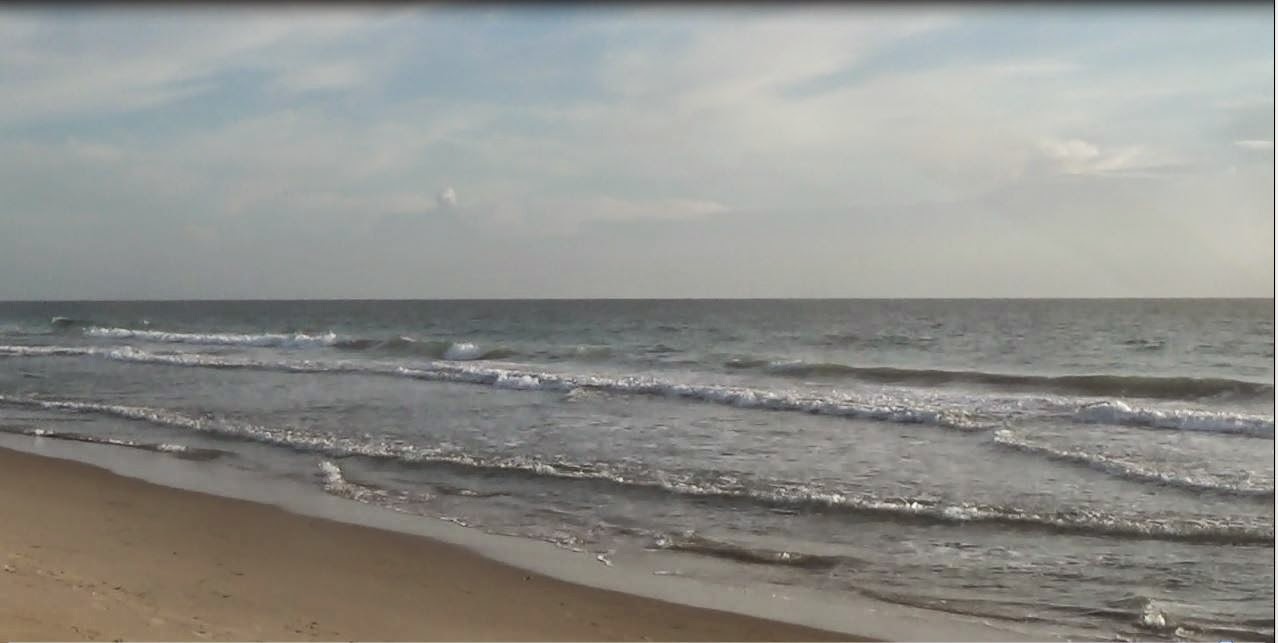
On the Treasure Coast today the surf is a touch higher.  We are having some good negative low tides though. 

Happy hunting,
TreasureGuide@Comcast.net

Thursday, April 16, 2015

4/16/15 Report - Atocha Gold Finger Bar. John Wilkes Booth Tour. Nimrud Destroyed. Buttons Found.


Written by the TreasureGuide for the exclusive use of treasurebeachesreport.blogspot.com.

Atocha Gold Bar In April 29 Sedwick Coins Treasure Auction.
Photo Source: See Sedwick Coins link.
Here is the description from the auction catalog.

Complete gold "finger" bar #1526, 699 grams, marked with fineness XXIII: (23.5K) and serial number 152-1, from the Atocha (1622). 5-1/4" x 7/8" x 1/2". From a series of mysteriously high grade bars without foundry/assayer markings and tax stamps (also no assayer's "bite"), hence purported to be either the property of the Church or representative of the "king's fifth" (tax), this example with very bold fineness but light serial number (both hand-engraved), two dimples on top where the metal settled during cooling. From the Atocha (1622), with Fisher photo-certificate #A84-1526.

Here is a link to the Ingots and Bullion session of the Sedwick Coins Auction.

http://auction.sedwickcoins.com/Treasure-World-and-U-S-Coin-Auction-17-April-29-30-2015_a24016?m=all&p=1&ps=50&ca=860002&so=1&q=

And here is link to a short video showing some of the highlights of the Sedwick Coins Treasure Auction that goes live on April 29.  Take a look some of the great treasure bars and cobs.

https://www.youtube.com/watch?v=hTDsxWexQN4

----

Now that you have your taxes done maybe you want to think about a summer vacation.  How about a tour following the trail of John Wilkes Booth that he made in the after shooting Lincoln up until his capture.  This year is the 150th year since the assassination of Lincoln.

Here is the link showing some of the stops.

http://www.aol.com/article/2015/04/14/lincoln-assassination-road-trip-john-wilkes-booth-escape-route/21171737/

----

This video shows ISIS  destroying the 3000 year-old remains of the city of Nimrud in Iraq.

http://www.cbsnews.com/news/iraqi-city-of-nimrud-stood-for-3000-years-until-isis/

----

Buttons Dug By Dan B.
Photo by Dan B.

Dan B. is still digging inland sites.  He found four of these buttons showing a locomotive and coal car.

Nice buttons Dan!  Thanks for sharing.


---


Have you seen the Gold Rush Nugget Bucket?  Pretty neat.  I'd like to live close to the gold fields.

http://www.goldrushnuggetbucket.com/

----


Here is a very short video clip made near low tide on Thursday.   There were a few rain showers up and down the beach.

Thursday on the Treasure Coast we'll have one more day of smooth surf and some good negative tides.  Friday the surf will increase a little.   According to the predictions we'll have a few days of rainy weather.

Happy hunting,
TreasureGuide@comcast.net

Wednesday, April 15, 2015

4/15/15 Report - Different Detectors For Different Beach Hunting Jobs. Rosie and Merc.


Written by the TreasureGuide for the exclusive use of treasurebeachesreport.BlogSpot.com.


Two Silver Dimes With Different Patinas.


Before I start my main topic for today, here are two dimes with different patinas.  The Rosie is a 1963 that was graded by a coin dealer as proof.  The Merc is a 1944 and was graded AU.

The Rosie has a lot of lustre.  The Merc is more the color that you might expect, but the surface is duller.

Under magnification you can see that the bluish color on the Rosie is a very thin coating that has not affected the sharpness of the coin's details.   Both have been stored in a plastic coin holder for a good twenty plus years.

Just an example.  Now on with my main topic for today.

-----

Yesterday I began a comparison of three different types of metal detectors that could be used for beach hunting, but I only got the first done.  Today I'll get to the other two.

The purpose of talking about these three detectors isn't so much about the three specific detectors, it is more about how different types of detectors have different strengths and weaknesses and about how strategic decisions of detector selection should be made.  This discussion is therefore not a detailed analysis of each of the detectors or a analysis of depth or performance, but rather more of a discussion of features and how those features help determine how different types of detectors might be used strategically.

I started with the Ace 250 yesterday, which is a detector that would be a decent choice if and when the strategy is to quickly sift through dry sand for modern coins and jewelry, especially when there is some junk.  The disadvantage of the small stock coil on the Ace is compensated by the ability to quickly pinpoint and identify targets and the ability to hunt close to metal obstacles such as beach chairs.

The Excalibur is used by many Treasure Coast beach hunters who tend to be more oriented to old shipwreck items.  Treasure Coast beach hunters, as contrasted with South Florida beach hunters, tend to focus more on targeting old shipwreck items and generally hunt less crowded beaches that are visited by more conservative beach-goers.

The Excalibur, of course, costs about four or five times what the Ace costs.  The Excalibur is water proof and can be submerged for water hunting.   That makes it more versatile.  If you want similar performance at half the price and don't need a waterproof detector, the Minelab Sovereign would do about the same job while costing less.

Unlike the Ace, the Excalibur has simple linear discrimination.  One discrimination knob is used for discrimination and another for sensitivity.

The Excalibur is simple to operate.  There is no ground balancing.  It performs about equally well in dry sand, wet sand and under water.  It will do a good job almost anywhere on a Florida beach.  You can start in wet sand and decide to scan a little dry sand or go into the water and dive with it. That is all good and easy.  You can discriminate but even with no discrimination, the Excalibur is not as hot for iron as some detectors.

The biggest difficulty that I see with the Excalibur is with the casual detectorist who tries to use the Excalibur in the wet sand in motion mode.  The less experienced detectorists can find detecting difficult where the water is coming and going.

I once had a guy come up to me and ask me what settings I was using because he saw me working the wet sand where the water was moving in and out and he was trying to do the same and was having trouble.   The main difference was that he was working in the motion mode and hadn't made any other adjustments, while I was using the pinpoint mode, as I almost always do with the Excalibur.

Anyhow, the Excalibur is a good sturdy general-purpose detector with some discrimination that has a good response to gold and small targets such as small cobs or small gold rings.  If you are hunting shipwreck items in wet sand, it is an easy choice over the Ace, whereas if you are hunting the dry sand, the Ace might be the best choice in some situations.  The Ace is also much lighter to swing on dry land.

While the Excalibur is used by many on the Treasure Coast, the Minelab CTX 3030 is very prominent on South Florida beaches.  The CTX costs about twice as much as an Excalibur.

The CTX has a lot more features and settings than the Excalibur, including a screen for target ID, various program selection, GPS, etc.  Instead of a few knobs, the CTX provides a lot of flexibility and options.

South Florida beaches have a lot more valuable modern jewelry and that is what the hard-core guys down there focus on most of the time.   It is also easier to justify the additional cost of a more expensive detector in South Florida where you can hunt in the water more of the year and where there is a lot more expensive jewelry to be found.  The additional expense can often be paid off by a single find.

I mention the relative prominence of the Excalibur on the Treasure Coast as compared to the CTX in South Florida only to point out how situations affect detector selection.

The third detector that I want to discuss is the Garrett ATX.  The ATX is often used in the gold fields and has good sensitivity to small gold.  The cost of the Garrett ATX (just over $2000) is close to that of the Minelab CTX.

The ATX is very different from the Ace, the Excalibur and the CTX, which I just discussed in passing.

I've discussed the ATX some in recent posts.  The keep it short, the ATX is a not the easiest detector to use straight out of the box - at least not if you want to be absolutely sure that you are getting good performance from it.

The ATX is a Pulse Induction detector and is very sensitive to small iron.  If you are someone who likes using a lot of discrimination, the ATX is not for you. The Excalibur is not overly sensitive to iron, but the ATX is very sensitive to iron.  Yes the ATX offers discrimination, but if you use much of it, you will really reduce sensitivity to good low conductive targets and negate the very features you paid for.

The ATX has both a non-motion and motion mode.  The non-motion mode is the most sensitive, but also the most difficult to use.  Even the manual states that the non-motion mode is not for beginners.

To get near optimal performance out of an ATX requires experience and skill.  If you want maximum sensitivity and depth, which is considerable with the ATX, you need to get the settings right.

So when would you use the ATX on a beach or in the shallow water?  My answer is, When you want the best depth on small valuable targets and have the patience and skill to deal with junk.  

The ATX will detect near microscopic pieces of iron, but it also gives you good sensitivity to small gold.  It will detect a small gold ring deeper than it will detect a clad dime. You will get good depth on small gold IF you use the ATX well.

There are a lot of options and settings on the ATX.   Careful adjustment and proper use will pay off in good performance.

There are times when the ACE, costing around $250, would be the better choice than the ATX, which costs about ten times as much.  The ACE might well be the choice in dry sand when you want to quickly skim for modern finds, as one example.

This post is not about three or four detectors.  It is about making calculated strategic decisions based upon how features of different detectors match the circumstances and your goals.

----

Odyssey Marine Explorations stock has really fallen off as they are being sued by the Securities and Exchange Commission. 

-----

On the Treasure Coast we have another couple of days of smooth surf and South winds.  Nothing new or exciting about that.

Happy hunting,
TreasureGuide@Comcast.net

Tuesday, April 14, 2015

4/14/15 Report - Comparing Very Different Types of Metal Detectors For Beach Detecting.


Written by the TreasureGuide for the exclusive use of treasurebeachesreport.blogspot.com.

Treasure Coast Gold Dug Yesterday.

Here is just over one ounce (1.05) of 14K gold dug yesterday.  It is marked Italy and 14K.  Acid test verifies the marking.

This is a common man's bracelet design. 

----

I plan to give a brief summary of three very different detectors for beach hunting.  I'll start at the inexpensive end today with the Garrett Ace 250.

I'll preface this by saying that for many years I was not a fan of Garrett detectors..  One reason is that my first Garrett detector was a water proof PI detector. That was back sometime in the eighties.  My history up until that point included only VLF detectors including some very good custom modified gold detectors.  The custom detectors that I used almost exclusively for years nulled iron.  That was a convenient feature when looking for modern gold and when you didn't care about artifacts such as shipwreck spikes.

 I quickly learned the pulse machine was very hot on iron, and I detected many swimming holes that had a lot of bobby pins, nails and other iron trash, but that wasn't my main concern.  I couldn't get a good smooth threshold.  I didn't know at the time that the threshold tone I was getting was pretty normal for PI detectors.  I expected something more like the detectors that I had used.  I sent the detector for repairs two or three times and nothing changed.  That was my fault, but we didn't have the video instruction DVDs in those days and I just didn't know any better, so it was my ignorance combined with a lack of good information that was the problem.  It wasn't the best choice for the type of hunting that I was doing anyway, but I like to experiment and try different things.  That one didn't work out.

Another reason I didn't care for Garrett back then is that I saw that a lot of people were using Garrett detectors and not very well.  I would see what they were missing and blame the detector.  That wasn't completely fair. 

One thing that contributed to my failure with the Garrett PI was that I ordered the detector via mail order, so I didn't see it operated before I got it.  If I had gone to a retail dealer who could demonstrate the detector and provide good information, I probably would not have made that mistake, which turned out to be a poor purchase and gave me a bad impression of Garrett.  Lesson learned.

There are a number of lessons there.  If you are a beginner, or not, it might be a good idea to get a demonstration of any detector you are considering.   Sometimes a friend will let you try a detector like the one you are considering, but if it is new on the market that might not be possible.  You can get good information and a hands-on demonstration from a dealer.  That will help you make a good decision and get started quicker with your new purchase. 

As I said before, most of what I learn I learn by personal experience.  That is just the way I am and always have been.  Anything I read or hear,  I test for myself.  I do a lot of testing and enjoy that sort of thing, but you can avoid mistakes by talking to others and reading.

This is also something that dealers should remember.  You might be able to avoid a bad customer experience by providing good thorough information. 

Back to the Ace 250.  One very good thing is the price - around $250.  It is an effective detector with target ID, discrimination and multiple hunting modes.  The coil is small but that isn't all bad. You can change coils if you want.  There are others that you can buy.  For me, the small coil works fine.  Quick and easy pinpointing even without going into pinpoint mode.

It doesn't eat batteries like Godzilla either - another good thing.

It works very well on dry sand.  Depth isn't the greatest in the world, but is good for the price.  It does a good job on small objects and gold.  Not bad for a back up or as one more tool in your personal arsenal.  Also not a bad starter detector. 

The small coil can be changed if you want.  I wouldn't change it for dry beach detecting, but maybe you want to cover more ground. 

The vast majority of good targets on a dry beach are not very deep. 

The Ace and the small coil works well close to objects such as metal beach chairs.  It is also good on small gold.

In this blog I gave you a report on my first few hours with the Ace 250, which included a number of finds at an inland site.  Wheat pennies were found within the first hour and the second day netted an 1829 large cent. It was easy to assemble and begin detecting. 

Working in wet sand requires some adjustments and less depth.  Remember this is a very inexpensive detector and can not fairly be compared to detectors costing much more.  I would, however, not feel handicapped if I were using the Ace on a dry sand beach. 

It is light and easy to swing, has acceptable target ID, and won't miss much if you use it well.  It does have a fairly small coil, which is not all bad.  In my opinion, if used well it will do nearly as well as more expensive detectors on dry sand beaches. 

What I tell you is what I've personally tried and tested.  It comes from personal experience not theory or reading what somewhat else had to say. 

I've never been one to care much about how things are engineered or supposed to work.  I only care about how they actually work, as tested and proven by careful experiment and observation in real-life conditions. 

I'll get to the other detectors tomorrow or soon. 


----

The Fishers estimate that there is still over $280 million to be found from the Atocha and Margarita.

---

On the Treasure Coast we'll have smooth seas and South winds for a few more days.  That makes for easy water hunting if you can find some decent dips.

Happy hunting,
TreasureGuide@Comcast.net

Monday, April 13, 2015

4/13/15 Report - 1711 LIma 8 Escudo From 1715 Fleet. Lots of Sand on Treasure Coast.


Written by the TreasureGuide for the exclusive use of treasurebeachesreport.blogspot.com.

1711 Lima 8 Escudos In The Current Sedwick Coins Auction.
This 8 escudo is from the 1715 Fleet, and is encapsulated NGC MS 64, which is the highest grade certified for any Lima eight.   It is lot 28 in the auction.

You can see why it grades so well.  Very bold strike.  Look at the detail in the castle, for example.
A very bold strike and good luster.

You can see the three digits of the year 1711.  Also the mint mark in the upper left, assayer initial upper right, and denomination upper middle.

It comes with a Fisher photo-certificate.

It has an auction estimate of 20 to 40 thousand dollars, and already has a bid of $23,000.  I expect it to go much higher.

----

One Treasure Coast Beach This Morning Near Low Tide.
 
There were a couple of spots where the front beach was a little steeper where there were some modest coin clusters.  This beach was steeper than I expected.

The dry sand here showed evidence of heavy weekend use.  There was a bunch of junk strewn around and the sand looked like a football game had been played there.

I visited another beach this morning, one that is one of my favorites and found it to be worse than this beach.  It had accumulated about two feet of sand since the last time I was there.  As a result I was digging a lot of DEEP holes in very fine compact sand that was not easy to dig.  Thank goodness one of those deep holes paid off.  I must be getting lazy in my old age.

The Treasure Coast beaches are as clean as I've ever seen (target wise). People have evidently been removing the pull tabs, bottle caps, etc.  I wonder if I had anything to do with that?

When the junk targets are removed from beaches there is less and less benefit in using discrimination.

I mentioned just the other day how I had cleaned up one beach for myself and now even with zero discrimination, there is little junk to be detected.

Surf At One Treasure Coast Beach Near Low Tide This Morning.
One thing about the Excalibur is that it isn't too hot to iron.  That isn't what I was using today.  I was using a PI detector and there still was very little iron.

I've been really learning to make the optimal use of a detector that is fairly new to me.  I've spent a lot of time experimenting with it and the various settings and techniques.

I want to be able to use it to best advantage when a storm finally comes along that uncovers some older items on the beach.

I much prefer hunting a beach with features, including dips, cuts, holes, etc.  It is more interesting to me to hunt for accumulations even when it is easier to go for the recent drops.

Some spots accumulate coins and things consistently over a period of years or even decades.  Others seem to come and go more quickly.

I'll talk about that more some other time and maybe a few detectors as they shape up as beach machines.

I'll have to make some find photos later today.

Nothing more than a three-foot surf in the predictions for the Treasure Coast for the next week or so. We have to get a storm sometime.

That's all for now.

Happy hunting,
TreasureGuide@Comcast.net


Saturday, April 11, 2015

4/11/15 Report - Lot Of Sand On Treasure Coast Beaches. Cutting False Signals With Sweep Control.


Written by the TreasureGuide for the exclusive use of treasurebeachesreport.blogspot.com.


Treasure Coast Beach This Morning.


Friday, April 10, 2015

4/10/15 Report - To Clean Coins Or Not. Places Where Coins Are Lost. SAR At Battle of Okeechobee Reenactment


Written by the TreasureGuide for the exclusive use of TreasureBeachesReport.blogspot.com.

Yesterday I talked about marginal signals.  Marginal signals for good targets are often confused with noise.  What I wanted you to know is that with practice you can learn to tell the difference between many of those marginal signals produced by good targets and most noise.

I really liked the linked articles I gave you about coin patinas and toning in recent days.  They really contained a lot of good information.

A lot of the time it is hard to decide if you want to clean a coin or not.  My best advice is when in doubt, don't.  You can always put it off, but once you clean a coin there is no going back.

The good thing about waiting is that while you wait you might learn more about how to do it properly and safely and you might be more informed to make a better decision about if you should do it at all.

Dug coins are a little different than non-dug coins.  Many dug coins have been through rough treatment in the natural environment or have accumulated a good bit of surface dirt or corrosion.  Those that are heavily corroded can't be damaged much by a little cleaning.  Yet I'm not advising that.  It is a case by case decision.

As one of the articles pointed out, value is partly determined by the coins attractiveness, and beauty, as they say, is in the eye of the beholder.  Some like their coins one way, perhaps as found, and others might like them clean and shiny.

There are also those rare times when you find a coin in excellent condition.  I've dug coins in the water that were near mint and still in a protective plastic case.  Others that must have been dropped very recently were still in lustrous condition.

I really like some patinas.  The nice gun-metal blue of silver coins found in Northern fresh water lakes is one of my favorites.   I also like some rainbow patinated old silver coins.   For silver cobs, I like enough of the patina left to highlight the details.  I like some of that on old silver jewelry too.

Anyhow, to sum it up, when in doubt, don't clean.   There is no harm in waiting until you are better informed to make a good decision and better equipped to do a better job. 

Practice on old junk coins that can't be done any harm.

----

The St. Lucie County Chapter of the Sons of the American Revolution  participated in the reenactment of the Battle of Okeechobee.  The reenactment was held February 28th and March 1. 

One of the many interesting things you could see were the U.S. soldiers wearing large leather caps which were used to feed and water horses.  The Seminole tribe also participated in colorful Seminole costume and provided horses.

-----

You've been there.  Taking off your shoes, emptying your pockets, lap top in one bin, tooth paste, cosmetics, liquids in a plastic bag.  Air port security is a mess. 


...the Transportation Security Administration, which last year collected almost $675,000 in spare change left behind by travelers... While 2014 represented the biggest lost-change haul for the TSA, it's collected several hundred thousand dollars in unclaimed money during each fiscal year since 2008. All together, forgotten loose change at American airports has amounted to more than $3.5 million in the past seven years.

Coins are always lost where there is chaos and confusion.

From the same article...

One dedicated coin hunter told The New Yorker magazine since the iPhone rolled out in 2007, he's picked up an average of $95 per year from New York's sidewalks, or 63 percent more than in the two decades before that.

Here is the link for the rest of the story.

http://www.valleynewslive.com/home/headlines/No-chump-change-TSA-netted-675K-in-lost-coins-299034311.html

---

It looks like the Treasure Coast is in for a week or two of very calm surf.

The Lagoon has some white water this afternoon.  Waves from the Southeast. 

I have some neat photos for you, but didn't have time to upload them today.

Happy hunting,
TreasureGuide@comcast.net