Thursday, May 19, 2016

5/19/16 Report - 1715 Fleet Silver Ring Shown in Deagan Book. Found Claddagh Ring. Danger of Cracked Rings.


Written by the TreasureGuide for the exclusive use of treasurebeachesreport.blogspot.com.

Not long ago I talked a lot about silver rings not being found on 1715 Fleet wrecks.  I did a little research and what I saw supported the idea that there were few, if any, silver rings on the 1715 Fleet.
There were, however, silver rings found at Spanish colonial land sites.  That was documented by Kathleen Deagan, a Distinguished Research Curator of Archaeology and Adjunct Professor of Anthropology at the University of Florida's Florida Museum of Natural History and one of the top researchers on the Spanish colonial period in Florida.  

In her book on Spanish Colonial artifacts, Deagan shows a silver ring that is reported to be from the 1715 Fleet.  Immediately below is part of a figure in her book showing the designs of some 1715 Fleet rings.  Notice F.  That one, and only that one, is described as being silver.  

Part of the crown over the heart is missing.


That ring is called a Claddagh ring.  It is very common type of ring, even today.

Here is one legend of the source of what we now call Claddagh rings.

Though there are several legends about the origin of Claddagh rings, the one believed to be most accurate involves a member of the Joyce clan from Galway who sailed to the West Indies, and who was captured and sold into slavery, working for a Moorish goldsmith in Algiers. During his 14 years imprisonment, he learned the goldsmith’s art and created the Claddagh ring design as a tribute to his love back in Ireland. When William III became king in 1650, he demanded that the Moors release all British prisoners. The prisoner Joyce brought back the jewelry design with him, and became a successful goldsmith in Ireland.

And from another source, here is more about Claddagh rings.  (Sorry I forgot the original source of both of these excerpts.)

Claddagh rings became widely known in America after Irish immigrants brought them over, mainly in the 18th century. They remain popular, both as wedding rings and decorative adornments. Many of the rings are now passed down through Irish-American families and heirlooms.

Here is a Claddagh ring that I once found on a Treasure Coast wreck beach.

Claddagh Ring Found On A Treasure Coast Wreck Beach.
I always thought this was silver, but I never tested it because I like the black patina, which is a little sparkly even though that doesn't show in the photo.  I didn't want to remove any of the patina.  I like it the way it is.

Here is a closer look at the illustration of design of the Claddagh ring that Deagan attributes to the 1715 Fleet.  She doesn't give any more detail on the source of the ring.


There are many similarities between the found ring shown above and the ring illustrated in Deagan's book. That isn't surprising.  Claddagh rings are Claddagh rings, and they haven't changed much over the centuries.

There are some differences too.  The hand positions and how the hand holds the heart is very similar on both rings.  The hands on both rings have slightly different cuffs.  The heart and crown is a little different on both rings.

While silver rings are very rare for the 1715 Fleet, there is a documented exception in the Deagan book.

The dug example shown today has no marks on the inside of the band or elsewhere.  A sterling mark or a makers mark can tell you a lot about the age of a ring.

This ring has a great black patina, but one of the most impressive things to me is the carved look. You can see it throughout in person.  In the photo you can perhaps see it best in the crown.

I might break down and clean it and test it to see if I can learn anything more about it.

---

Here is another item with a familiar ring to it.

On 5/10 I showed an encrusted ring (shown below) that I cleaned.  Here it is.

Old Dug Encrusted Treasure Coast Ring

After it was cleaned I could see some serious cracks in the metal.  I put it on just the other day for cleaning and it fell off.  It broke on three cracks and fell off.  If I was doing something when it happened I would not have even noticed it being gone.

The reason I bring this up is to alert you to how easily that can happen.  Any cracked ring can break and fall off at any time, so it might not be a good idea to put new finds on your finger until you have checked for cracks.  I have heavy gold rings with cracks too.  The same thing could happen.

---


The first day of the current Sedwick auction concluded yesterday.  The remaining lots will be sold today.  You can view the auction results online as it happens.  They move from lot to lot very quickly.

---


Nothing has changed on the beach.  Still a one-foot surf.  Probably more afternoon thunder storms.

Happy hunting,
Treasureguide@comcast.net

Wednesday, May 18, 2016

5/18/16 Report - 14,000 Year-Old Florida Artifacts. Large Assembly of Maritime Artifacts Recovered. Free Robert Marx Lecture Coming Soon.


Written by the TreasureGuide for the exclusive use of treasurebeachesreport.blogspot.com.

Photo Credit: Ran Feinstein
Source: See link below.

A treasure trove of bronze statues and coins bearing the images of Roman emperors has emerged from the waters of the ancient Mediterranean harbor of Caesarea, the Israel Antiquities Authority (IAA) announced Monday.

The discovery, hailed as the largest assemblage of marine artifacts recovered in the country during the past 30 years, was initially made by two divers who stumbled across the remains of a large merchant ship. It is estimated the vessel sank during the Late Roman period some 1,600 years ago....


Besides the Old Vero Man site, there is another archaeological site in Florida linking man to mastodons.  It is the Page-Ladson site on the Aucilla River.


...In 1983, eight stone artifacts and butchered mastodon remains were discovered at the Page-Ladson site, and were investigated through 1997. The sediments surrounding the finds were dated to 14,400 years ago, but at the time, it was unthinkable to suggest that humans arrived in North America more than 1,000 years prior to the Clovis, the authors of the new study explained. Experts back then argued that even if the sediments were over 14,000 years old, it was possible that the artifacts themselves were not, and that they had been carried to that part of the site by river currents...

A mastodon tusk bearing the marks of stone tools was found at that site. Here is the link to read more about that.

Here is information about a free lecture that you might want to attend.  It is open to the public.


The lecture will be at the FIT Gleason Performing Arts Center in Melbourne Florida.

Below is the link for more information.


---

The Sedwick auction goes live from the floor today.

---

It looks like we have a week of smooth surf coming up, probably interrupted by a few thunder storms.

Happy hunting,
TreasureGuide@comcast.net

Tuesday, May 17, 2016

5/17/16 Report - Pewter Artifacts. Punta Cana Shipwreck. Factors Leading to Success.


Written by the TreasureGuide for the exclusive use of treasurebeachesreport.blogspot.com.

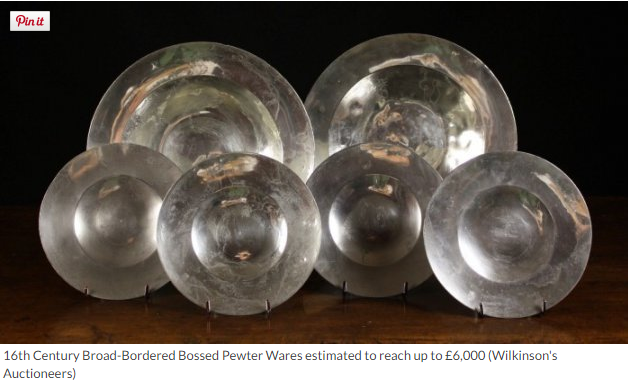
Pewter Shipwreck Plates.
Source: ibtimes link below.


Pewter is an attractive metal which has been used for the production of household and other items in Britain since Roman times. It is an alloy consisting mostly of tin which has been mixed with small amounts of other metals such as copper, lead or antimony to harden it and make it more durable...

During the 17th and 18th centuries pewter would have been found in every household. Jugs, plates, buttons, pilgrim badges, tankards, wine cups, inkwells, candlesticks and spoons are just some of the many items for which it was used.


That is from the link immediately below.


The Pewter Society gives the following tip for cleaning encrusted pewter.

Whilst hydrochloric acid is commonly used to remove calcareous encrustation from objects recovered from the seabed, it should not be used on pewter objects. This is because of the destructive action of chlorides on tin, which can continue despite best efforts to rinse the acid away after treatment. You should instead use dilute nitric acid (a 5 – 10% solution). This will remove the encrustation safely. It usually has no effect at all on the underlying patination, but at very worst it will simply put a thin oxide layer on the surface.

Pewter items were found on the Atocha site.  Many of those were kitchen wares such as plates or spoons.  There are three pewter spoons listed in the Mel Fisher database, and a photo of one of those.

One wreck that was carrying a lot of pewter is the Punta Cana wreck, which was found off the Dominican Republic.  Over 1200 pieces of pewter tableware were salvaged from that wreck.

Findings show the wreck was a Spanish ship that was lost in the 1540s near the end of its journey from Seville to the colonies. It is one of the earliest European wrecks discovered in the Americas.


Many of the pewter plates bore the same mark found on items discovered in the wreck of Henry VIII's warship the Mary Rose, which sunk in the Solent in 1545. Around a third of the pewter has the mark of Sir Thomas Curtis, one of the most important pewter makers from the 16th century.


Here is that source link.

http://www.ibtimes.co.uk/punta-cana-pewter-wreck-dominican-republic-shipwreck-519437

You might find the  story about that wreck interesting.  Although it was a Spanish ship, much of the pewter on it was from an English maker.

There are, of course, huge differences between what you might expect to find on a ship coming to the New World as opposed to one taking treasure back to Spain.

As with most artifacts, proper care and storage is required in order to maintain the item in the best condition possible.

Antiques Magazine had the following to say.

Apparently, then, pewter disease (tin pest, it is sometimes called) is born of the unholy wedlock of cold and moisture, each of which by itself is fairy innocuous. The first principle of conservation, therefore, is: keep pewter both warm and dry; but at any rate, do not allow it to become simultaneously cold and damp.


Here is that link.

http://www.themagazineantiques.com/news-opinion/from-the-archives/2013-03-11/care-of-pewter/


---

The current Sedwick Coins auction goes live from the floor on May 18th and concludes on the 19th.

---

Maybe I've talked about this before, but it appears to me that some of the biggest obstacles to success are internal.  Take a look at Hilary and Donald.  Both are very successful and both are very driven - perhaps too much.  Although they might both think that they are uniquely intelligent and able, there are probably many people who are just as capable but not nearly as successful.  Some would say that those two people are uniquely gifted or had opportunities or situations that most other people have not had. They might say that Donald inherited millions or that Hilary rode into the White House on her husbands coat tales, and that would seem to me to be at least partly right, but what I am more focused on is the personal qualities that has permitted their success.

Both are very driven.  You might say obsessed.  And while you might wonder if that is healthy, it is a big factor in where they are.  People with similar levels of wealth or opportunity have not done nearly as much.

I'm not talking politics today.  I'm talking about success or the lack of success, and that applies to everybody and everything you might want to do, even metal detecting.

Do you detect just to pass some time?  Is it just a hobby for you?  How badly do you want to succeed? What do you want to accomplish?  Why?

There is no right answer, but I think those are all important questions. Your answer will have an effect on how much you find.

Those who find the most generally hunt the most.  Yes, there is the element of luck to some extent.  You might be one of those rare people who finds a gold coin on your first hunt - as unlikely as that is.  Or you might stumble on the world's largest treasure while walking your dog.

Those kinds of things do happen, but the odds are very long against it.  Generally speaking, those who find the most, hunt the most and work the hardest.  They have the drive, and when they encounter obstacles they overcome them one way or another.  They are willing to pay the price.  They might work smarter than someone else, but they also work harder.

Don't expect big success to come easy.  If you want it enough, there is a better chance that you will achieve it.

I'm not saying you should want it.  For me there are other things in life that are much more important. Each and every person has to determine what is important to them.  I think you'll benefit from being clear about your goals and what you want to accomplish with your life.  Wishing won't make it true.  If you really want it, you should be willing to work for it.  Your drive and effort should match your goals and priorities.

---

The surf will be a little rougher today, but not much.  It will decrease back to about one foot the next couple of days, and we'll have mostly a south wind.

Happy hunting,
TreasureGuide@comcast.net

Sunday, May 15, 2016

5/16/16 Report - Diamond, Gold and Silver Surf Finds. 1930 Silver Canadian Dime Find. Bones of Extinct Species of Bison Found in Old Vero Man Site.


Written by the TreasureGuide for the exclusive use of treasurebeachesreport.blogspot.com.

Diamond Ring Finds by Tony M.
Photo by Tony M.
As you know, beach conditions have not been good for finding old items, but the water has been smooth, making it easy to do some water hunting.  As a result some modern items have been found. Tony M. fond these.

Gold Necklace and Silver Ear Ring and Medallion Finds.
Finds and photos by Tony M.

Here is what Tony M. said about these finds in an email that came with the photos.

...Found the 2 rings in the surf on Monday morning. Over 2 cts in diamonds and 18k of gold.
Found the 10k necklace and 925 ear ring and medallion in the surf this morning. Things are looking up.

Thanks for sharing the pictures of your finds Tony!

---


You probably know about the importance of the Vero Man site in Vero.  Another important find was made there - the bones of an extinct species of bison.

Archaeologists uncover 13,000-year-old bones of ancient, extinct species of bison - reports from what is considered one of the oldest and most important archaeological digs in North America, where scientists have uncovered what they believe are the bones of a 13,000- to 14,000-year-old ancient, extinct species of bison at the Old Vero Man Site in Vero Beach, Florida...

The bone was found below a layer that contained material from the Pleistocene period when the last Ice Age was thought to have occurred. The archaeologists identified the bison using an upper molar, which is thought to be representative of a Bison antiquus, a direct ancestor of the American bison that roamed North America until it became extinct. Because bison was a grassland-adapted animal, nearly 100 percent of their bones disintegrated after death unless they were preserved in some way.


Ancient extinct species of Bison excavated in Florida
At the Old Vero Man Site in Vero Beach, Florida. 
Image: Harbor Branch Oceanographic Institute, Florida Atlantic University
Here is the link for the article.
http://www.bradshawfoundation.com/news/index.php

---

One thing nice about the Florida beaches is the number of visitors from other locations.  You can find items from all around the U. S. and all around the world.

Here is one example.  When I first picked it up I thought it looked silver.  Turns out that was right.

1930 Silver Coin Find.
This is a fairly unusual find considering current beach conditions.

This is a fairly surprising find considering current beach conditions.

In MS60 condition this coin would be worth $175 US.  Of course it is nothing near that.  The melt value is just over a dollar.  It is .80 silver.

---

We;re going to have several days of smooth surf.  It is getting warm.  That means the beaches will get some traffic.

Happy hunting,
TreasureGuide@comcast.net

Saturday, May 14, 2016

5/14/16 Report - Contributions By Amateurs, Hobbyists, Detectorists and Treasure Hunters. TV Shows. The Florida Collection.


Written by the TreasureGuide for the exclusive use of treasurebeachesreport.blogspot.com.

A Small Part of the Multi-million Dollar Staffordshire Hoard Found by a Detecting Hobbyist In a Farm Field.

I recently received an email from a casting director for a TV production company that is casting a new show designed to. in their words, "bring credibility back to the treasure-hunting world."  I don't know exactly what that means, but it sounds good.

I didn't followed up on several previous inquiries from TV production companies, but I am considering this one and suspect that I will do one someday when I find the right one.  It would be good to help set the record straight.

Despite their many contributions, treasure hunters have been vilified by some.  To read some sources, you'd think that treasure hunters are nothing but looters.  But looters are just that - looters.  There are unethical opportunists that will take advantage of any opportunity, but one quack doctor does not mean that the medical profession is bad.

I've been critical of some TV shows about metal detecting or treasure hunting, but this one, from the little I now know, seems like it could be something that I could support.  I can think of a couple shows that gave into the need for drama and ratings and presented treasure hunting in an inaccurate or unrealistic light.  I hope they keep this one honest and clearly portray the many benefits and contributions of treasure hunting.

I've discussed some of the issues concerning treasure hunting before and won't try to repeat all of that now.  I will, however, quickly remind the reader of the many contributions made by treasure hunters as well as amateurs, including those that might be considered amateur archaeologists.  Just yesterday I told about how one fifteen-year-old enthusiast discovered a previously undiscovered Maya city.

Detectorists, treasure hunters and amateurs have made a lot of very significant contributions.  I ran across a web site presenting what the authors felt were the six biggest treasure finds made by amateurs. They can be called treasure finds, but they are also important archaeological discoveries.

To get an idea of how significantly amateurs have contributed to archaeology, here is a link to a site that shows six of the most important discoveries made by amateurs in Britain.  The photo at the top of the post shows a small part of the Staffordshire Hoard, now owned by the British Museum and valued at around $6 million dollars.

Immediately below is the link to see the other amazing treasure finds made by amateurs.

http://www.moneysupermarket.com/money/treasure-hunt-finds.aspx

In the past year, I showed some of the important finds made by Treasure Coast salvage crews.  Not long ago the State of Florida selected and took possession of their share of the 2015 treasure salvage finds, and the Florida collection was vastly enriched.  I hope to have a future post giving some detail about the 2015 distribution.

If you ever read one of Alan Craig's books about the silver or gold coins in the Florida collection, you know that a lot of the Florida Collection was provided by treasure hunters, and Mr. Craig acknowledges that in his books.

Those who work the 1715 Fleet wrecks work under a detailed agreement with the state.  Without the salvage crews our state collections would not be anything like what they are.  Our history would not be as well preserved, and we would not be able to enjoy and study the many items that are now available for viewing and research.

Only a small portion of the Florida collection is on public display and it is not easy to gain access to what the state holds in its vaults. We can't forget that the purpose, as I understand it, is to preserve history for the people.  I would like to see the Florida Collection better documented online for viewing by the public.  It would not seem difficult for good photos of yearly distributions to be posted online.

---

It looks like we're going to have a continued small surf for several days.  Take advantage of the smooth water.

With the 2015 distribution now completed, the 2016 salvage season is just getting underway.

I have been receiving photos of nice modern jewelry finds lately too.

Happy hunting,
TreasureGuide@comcast.net

Friday, May 13, 2016

5/13/16 Report - How To Find Lost Cities. New Technology To Analyze Metals and Artifacts. 16th and 17th Century Voyages Documented.


Written by the TreasureGuide for the exclusive use of treasurebeachesreport.blogspot.com.

Google Maps Image Showing Evidence of Lost Maya City.
Source: see link below.

William Gadoury, 15, was fascinated by the ancient Central American civilization and spent hours poring over diagrams of constellations and maps of known Mayan cities.


And then he made a startling realisation: the two appeared to be linked...


After he discovered that the location of Maya cities corresponded to the position of the brightest stars in the constellations, he searched Google Maps to see if there were undiscovered cities where the stars indicated they should be.  He found one which now bears his name.


Here is the link for more about that.

ADVERTISI

Interesting what you can do from your arm chair these days if you make good use of the technologies and do a lot of research.

---

Here is a great digital book that you can read online.  It includes descriptions of  16th and 17th century voyages, about half of which were originally published before 1600 in a single volume as well as other added works.  It is Voyages and Travels Mainly During the 16th and 17th Centuries with an introduction by Charles Beazley.

---

Recently I mentioned that gold and other precious metals can be scientifically analyzed to determine the original source of the gold.  Captain Jonah told me that a local pawn shop was now using technology that can analyze items and tell you the percentage of copper, silver and gold in an item.  I looked into the recent technologies and learned that there are portable devices that can tell you even more than that about the composition of items.  This new technology employs x-ray flourescence.  If you want to see a video showing a demonstration of how it works, click here.

---

I found a very technical scientific monograph on the internet about testing ancient metals.   The title is Analysis of Ancient Metals, International Series of Monographs on Analytical Chemistry, Vol. 19.  It is very difficult to read unless you are a chemist and will tell you much more than you ever wanted to know, but you might find some of the procedures interesting and the explanation of various problems and the difficulty of getting good accurate samples.  Click on the title to go directly to the monograph.

---

We'll have a very smooth surf today and through this weekend.

Happy hunting,
TreasureGuide@comcast.net

Thursday, May 12, 2016

5/12/16 Report - Diamond Ring Found In Shallow Water. Amphoras Full of Coins. Recovery Skills and Over-Scooping.


Written by the TreasureGuide for the exclusive use of treasurebeachesreport.blogspot.com.


Diamond Ring Find by Shannon F.

Here is an email from Shannon F telling about finding the above diamond ring.

I'm dropping you a line to tell you a quick story about detecting in chest deep water at the beach. I went out at around dark with the tide almost low and started hunting. After about an hour I had found 2 silver rings and about a coffee can worth of trash. I was walking out in about knee deep water when I got a quick silver/gold tone/number. So I dug a 2 foot deep hole and couldn't find the target. I said heck with it and was walking up the beach. I was almost to the showers but couldn't let it go. I went back and dug like a man possessed. Moral of the story: NEVER GIVE UP ON A TARGET. 18kt with a nice real diamond.

Thanks for sharing Shannon!

---

Amphoras Filled With Coins Found By Construction Crew.


Some 1,300 pounds of bronze Roman coins dating to the 3rd and 4th centuries have been unearthed by construction workers digging ditches in Spain.


The find, in 19 amphoras — storage containers — is unique not only because of the volume of coins but because the coins appear to have never been in circulation, making them almost pristine by comparison with other discoveries.


Workers in the city of Tomares, in Andalusia, were working on installing a water line to a park in the city of 24,000, according to the Spanish newspaper El País, when they noticed irregular terrain inside a ditch about a meter below ground level...


Here is the link.

https://www.washingtonpost.com/news/morning-mix/wp/2016/04/29/construction-workers-in-spain-unearth-huge-trove-of-ancient-roman-coins/

---

Pinpointing and recovery skills can save a lot of time.  It is a big waste of time to over-scoop.  By that I mean scooping up more sand than is needed.  That can be caused by digging too deep.

Even if you don't have or use a depth meter you can learn to tell about how deep an object is buried.  Besides giving a louder signal objects near the surface will often give a more distinct sound.  The edges of the target will sound sharper, while deeper targets will give a softer sound, and the signal will not appear as sharp or distinct.

Pinpoint or non-motion mode will often make it easier to determine depth and size of the object from the sound of the signal.

If the object is right on the surface, just skim the surface with your scoop and no sifting will be necessary.  Of course you don't want to hit the object with your scoop in case the object is something that might be damaged.

Just dig as deep as necessary and no deeper.  Wet sand makes sifting a lot more difficult, as does shells and rocks.  Use the surf when possible, to help sift sand through your scoop more quickly.

Sometimes it is actually faster to take multiple scoops rather than filling the scoop and having the object slip off the top of the sand as the scoop is raised,  That is particularly true in the water where object might not fall straight down.  Objects that fall off as you raise the scoop might take a few seconds or more to find again, especially if the water is rough.

---

On the Treasure Coast today we'll have a two to three foot surf, a south wind and moderating tides.

Happy hunting,
TreasureGuide@comcast.net