Showing posts with label Pensacola. Show all posts

Thursday, December 29, 2016

12/29/16 Report - Archaeology Book. More Sand Coming. Very Old Wall Falls.


Written by the TreasureGuide for the exclusive use of TreasureBeachesReport.blogspot.com.


When your childhood follows you like a little fuzzy puppy bounding through the grass on a lazy summer day, you are lucky.


I'm lucky.

(photo borrowed from an anonymous source on the internet)

---

Here is a useful book.  It is The Archaeology of Colonial Pensacola, edited by Judith Pense and published by the University of Florida Press.  Very helpful.   Tons of information.  Since the area changed hands from time to time, you'll read about both Spanish and English sites and artifacts.

One of the things I found helpful were the lists giving the total number of features and artifacts found at various sites.  That can be useful in many ways.  I might elaborate in the future on how you can use those numbers when you visit a site.

You can view some of the book online.

Click here to see the preview.

I did a fair amount of detecting in the Pensacola area when I was doing contracct work at the Naval Air Station and flying up there about every other week for a few years.  It was always an interesting place to detect with a lot of history

---

The Space Coast beaches, which were hit hard by Matthew, will get new sand starting in January.  I'm sure that will only be the beginning.  Look for a lot of replenishment in 2017 along the Treasure Coast.

Here is link.

http://www.fox35orlando.com/home/225447972-story

Thanks to James F. for the link.

---

I recently mentioned all the replenishment sand reducing old finds on the Treasure Coast and received this response from one reader.  (Very minor edits made by TG.)

You are on target. it is all the sand being dumped on beach. destroyed all in close habitat for marine life as well. Take one beach in pic Bathtub Beach. Had live rock everywhere, French angel fish,snowflake ells, swarms of fish now it's all gone. Covered in sand. very sad how it's all being taken away.

Thanks RY.  Sad indeed.

---

Israel, which was very much in the news yesterday, is also now in the Treasure Beaches Report.

A wall dating back to 1750 BC was damaged by a heavy downpour.

http://www.timesofisrael.com/biblical-era-tel-dan-wall-collapses-as-storms-hit-northern-israel/

---

We're going to have a couple weeks of small surf.

Happy hunting,
TreasureGuide@comcast.net

Saturday, October 22, 2016

10/22/16 Report - Post-Matthew Finds. Musket Balls, Cross and Reales. Florida's Cyber Treasure Hunt. New Luna Wreck Found.


Written by the TreasureGuide for the exclusive use of treasurebeachesreport.blogspot.com.

10-Year-Old Kaylee M.
Showing Her Hurricane Matthew Finds
10-year old Kaylee M. dug five musket balls and an old silver cross after Hurricane Matthew.  Great finds!

Not only does Kaylee like using detectors and finding treasure, but she also got dive certified already! Congratulations Kaylee!!

---

The Spaniard Luna and about 1,500 soldiers, colonists, slaves and Aztec Indians traveled in 11 ships from Veracruz, Mexico to Pensacola. A hurricane struck Pensacola about a month later, sinking six ships into the bay and wiping out a significant portion of their supplies.

This might be the third Luna expedition shipwreck that has been found.  It is being referred to as Emanuel Point III.  Nearby is a land site that could be associated.

Here is the link.

http://www.pnj.com/story/news/local/pensacola/2016/10/21/third-shipwreck-luna-fleet-uncovered/92487848/

---

The blog poll will soon be coming to an end.  I hope you responded.

If you've been watching the poll, you've seen that there were treasure finds made after Hurricane Matthew both on the Treasure Coast and elsewhere.

Here are some cobs and a couple indistinguishable pieces of silver that were found towards the northern end of the Treasure Coast after Hurricane Matthew.

Cobs and Silver Found On The Treasure Coast
After Hurricane Matthew By One Reader.
---

As wealth becomes digital, future treasure hunters will be scouring networks to find lost or abandoned wealth like we scour the beaches today.  In fact that is already being done.  Maybe you've received an email from someone that found unclaimed funds that are due you.  That is in some cases legitimate.  See for example the State of Florida's https://www.fltreasurehunt.org/

It actually works.  I and others have claimed funds through that web site.

Were you affected by the DDos attacks yesterday?  Our country is skating on very very thin ice. The government seems to have their head stuck in the sand.  One report said, The massive outage drew the attention of the FBI which said Friday that it was "investigating all potential causes" of the attack.  From recent events, I would have thought it would be near impossible to get their attention.

Amazing that the politicians didn't seem to care about computer security until they got the idea that it might affect them getting elected.  They are trying to blame the leakers instead of admitting that they've been leaving the door wide open to the entire world by being so careless about computer security.  When one server is vulnerable, every computer that communicates with it is more at risk. Therefore you see a wide range of related users being affected.  The leakers did us a big favor if it wakes up some people.
.
---

I'm dropping my Treasure Coast Beach Detecting Conditions Rating back down to a 1.  It could very well increase again in a few days if the predictions are correct.

We'll have a few days of smaller surf and then towards the end of next week some pretty big surf again.  Looks promising.

Happy hunting,
TreasureGuide@comcast.net

Sunday, September 11, 2016

9/11/16 Report - Oldest Multi-Year European Settlement in North America Found. Two Sides of the Same Cob and What's That Mark.


Written by the TreasureGuide for the exclusive use of treasurebeachesreport.blogspot.com.

Source: nhc.noaa.gov

We have one disturbance that seems to be headed this way, but it will probably not become much of anything.

The surfing web sites aren't predicting anything much bigger than a three foot surf for the Treasure Coast for the next couple of weeks.

---

The search is over. The longstanding mystery is solved. The location of the oldest established European multi-year settlement in the United States is indeed in the heart of Pensacola.

Discoveries by local historian Tom Garner in October and research afterward by University of West Florida archaeologists confirmed where Don Tristan de Luna established his Spanish colony in August 1559 – six years before the St. Augustine settlement and nearly 48 years before the English settled in Jamestown, Va.

The historical site is in an urban downtown neighborhood within view of the two shipwrecks linked to the Luna expedition in Pensacola Bay. UWF declined to reveal the exact location to protect the neighborhood and integrity of the site...

Here is the link.

http://www.pnj.com/story/news/2015/12/17/we-found-lunas-colony/77449884/


---

Yesterday I showed a silver cob with one side that was much better than the other.  Here is a cob that on one side shows some detail, even though it is heavily corroded, while the other side shows no detail.

Potosi Two-Reale, Assayer R.
Other Side of Same Reale
As you can see, the second side has been wiped clean like a Clinton server.

An Odyssey paper that I referred to the other day, mentioned that cobs found on the outside of a conglomerate, corrode more than those that were on the inside of a conglomerate.  I suspect that the same thing might be true of the two side of a cob.  One side would be exposed, while the other side would be more protected.

As I also mentioned recently, galvanic corrosion might also be a factor.

On the same cob, I've been wondering about the little bulls-eye shown in the picture below.  The red arrow points to it.


Anyone have any thoughts or ideas about that?   I'd like to hear what you think.

Note the touch of iron to the right of the bulls-eye where iron leached onto the cob.

---

Of course the big news today is the fifteenth anniversary of the 911 disasters.  It doesn't seem that long ago.

TreasureGuide@comcast.net

Friday, December 18, 2015

12/18/15 Report - Settlement Site Earlier Than St. Augustine Discovered In Florida. Wind Shift This Afternoon.


Written by the TreasureGuide for the exclusive use of treasurebeachesreport.blogspot.com.

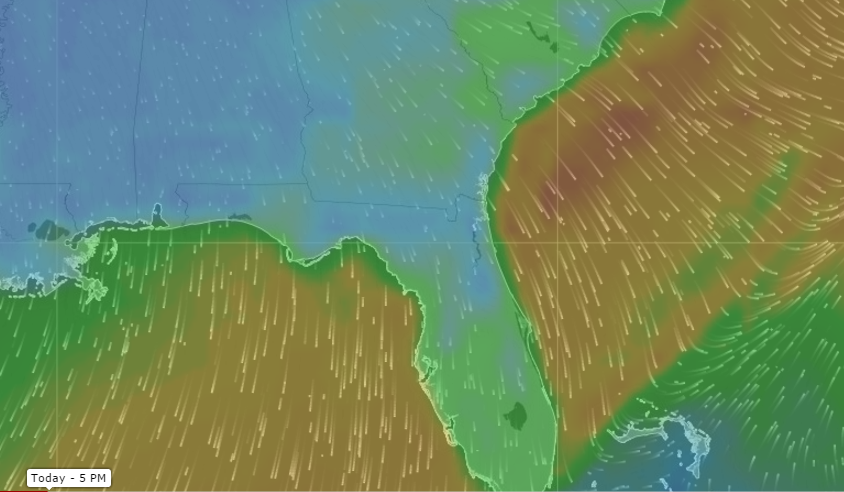
5 PM Wind.
https://www.windyty.com/?2015-12-19-00,30.477,-80.112,6
As you know, the south wind dumped a lot of sand on our beaches.  The wind will change today around 4 PM.  It will then be coming from the north.  According to the surfing web sites, the surf will remain small today, then increase tomorrow.

---

The other big news today is about the Luna Settlement site that has been discovered.  Here is a bit of that story.

UWF archaeologists recovered numerous sherds of broken 16th century Spanish ceramics found undisturbed beneath the ground surface. They are believed to be pieces of assorted cookware and tableware, including liquid storage containers called olive jars. Small personal and household items were also among the findings – a lead fishing line weight, a copper lacing aglet and wrought iron nail and spike fragments. Additionally, the team recovered beads known to have been traded with Native Americans. These items are consistent with materials previously identified in the shipwrecks offshore in Pensacola Bay.

The artifacts were linked to the Spanish expedition led by Tristán de Luna y Arellano, who brought 1,500 soldiers, colonists, slaves and Aztec Indians in 11 ships from Veracruz, Mexico, to Pensacola to begin the Spanish colonization of the northern Gulf Coast in 1559. One month after they arrived, the colony was struck by a hurricane, sinking many of their ships and devastating their food supplies. After two years, the remnants of the colony were rescued by Spanish ships and returned to Mexico.

The Luna settlement inhabited Pensacola from 1559 to 1561, which predates the Spanish settlement in St. Augustine, Florida, by six years, and the English settlement in Jamestown, Virginia, by 48 years...

Here is the link for the rest of the University of West Florida press release.


Here is another link about the Luna site.  This article is longer.


---

I saw a bag of coffee floating in the Indian River today.  I assume it is part of the lost cargo but don't know how it got into the river.

Happy hunting,
TreasureGuide@comcast.net

Tuesday, April 29, 2014

4/29/14 Report - Gold Religious Medallion, Early Gulf Coast Settlement, and Genealogical Research


Written by the TreasureGuide for the exclusive use of treasurebeachesreport.blogspot.com.


Gold Religious Medallion Find

This medallion is larger than most and is intricate.  You can see the remains of a black encrustation that has been partly removed. 


When I first posted yesterday's post there were a lot of problems with it.  Fortunately I went back later and fixed some of the problems.

One big thing was that I originally left out of the post was a link to a great article on the earliest European Gulf Coast settlement.  I put it in later, but in case you missed it, here it is.

http://archeologyink.com/LaRuaBluff.pdf

Below is an excerpt from that article.

Fig. 16: During the 1940s several young boys were roaming along the shoreline
of a peninsula jutting into Pensacola Bay . They had learned how to find
artifacts. The railroad crews would come down the line on occasion and dig
out the banks to protect the tracks. When it rained the kids would scour the
exposed banks for artifacts. On one day, they found a coin which dated to the
time of the Tristan de Luna colony. One the kids, Harry Bonifay, found it.
The coin and the area are figured in the next few pages. Sixty something
years later marine archeologists found two shipwrecks of the period just
offshore from the same bayshore.

It says the kids checked newly disturbed soil.  I've recommended checking any disturbed soil many times in this blog.  


The kids also knew to check after rain.  That is another strategy that I've mentioned before.  Those are two good reminders.

Curren, as contrasted with the quotes I gave a couple of days ago from the shipwreck articles reveals a much more constructive style and approach.  He gives even children recognition for their finds and treats the public as a part of the process.  That is exactly the approach that will promote and advance the field of study.

Below is another good tip found in the same article

Fig. 18: ...  The coin was found in a dredge spoil pile near the mouth of Bayou

Texar.

Most often you'll find junk, such as mangled aluminum cans in dredged material, however there are times when more interesting things are found in dredged material.  There have been times when interesting old materials have been found in dredged material in Southeast Florida and the Treasure Coast. 

Thanks to Caleb Curren, author of archaeologink.com and that particular article. 


I would encourage you once again to do some genealogical research.  I've learned a lot of history through research into my own ancestors.   One line goes back to the Pilgrims at Plymouth Colony in the 1640s.  Of course that was after the Mayflower.  One thing I found particularly interesting is that John Greenleaf Whittier actually wrote a ballad about one of my ancestors.  She was said to be the first white woman sold into slavery in America.  Her crime was not exactly, but basically being too friendly to the Quakers.  The sea captains refused to take to Virginia or Barbados to be sold though.  It might have had something to do with the fact that her father was a boat carpenter.  She did spend time in leg stocks.  Anyhow, the ballad is Cassandra, which is actually her mother's name.

Along another ancestral line was a Ranger in the Revolutionary War that fought Indians in the Ohio Valley.  He was captured, escaped, swam the river, etc. etc.  It was a violet time on both sides, and both sides actually collected scalps.  With all the political correctness these days, I was surprised to learn how violent and brutal it actually was. 

It can be really interesting when you put enough time into the research to locate ancestors which were written about in detail like that. 

Those are only two of the things that I found most interesting.  I was lucky to be able to locate so much material.  I'm sure you can find some interesting things about your ancestry too.  The most interesting thing would be to go to some of those areas and do a detector search where your ancestors lived.  It really makes the history come alive.


On the Treasure Coast the wind picked up around noon and white caps formed on the river. 

We are still having high high tides, but the surf is still small.

A 3 - 5 foot surf is predicted for Wednesday.  That is a little increase.

Happy hunting,
TreasureGuide@comcast.net