Showing posts with label Potosi. Show all posts

Sunday, January 26, 2020

1/26/20 Report - Still Looking At Treasure Coast Beach Finds Including Cobs and Things.


Written by the TreasureGuide for the exclusive use of treasurebeachesreport.blogspot.com.

Uncleaned Four Reale Found Last Wednesday.
A day or two ago I showed a picture of the above four-reale which was found last week.  This is the other side of it.

I wanted to take a photo before I starting cleaning it.  I can't believe I waited so long before starting the cleaning, but I've had plenty to keep me busy.

After one hour in a diluted Muriatic solution, I could see the denomination mark emerging.

Details Emerging After Hour in Diluted Muriatic Solution.
The "4" is just to the right of the edge of the shield.  I think you'll be able to see it.

This one might be Charles II era (1665 - 1700)?  That's my guess now, but I'm not sure yet.  What do you think?

I also got a close-up photo of the half-reale I showed the other day.  Here is a closer look at that one.

One Gram Half Reale Found Last Week.
The little tail is interesting.  Does it remind you of anything?  Remember the Potosi "heart" reales?

Rare Potosi Heart Reales.
Very interesting heart reales were produced at Potosi, and they have a very similar little tail.

If you look at the top of the newly found half reale you might be able to see that it looks like maybe the top part was chipped off.  And if you stand that half reale so that the tail is at the very bottom, the cross is unusually well centered and oriented.  Most likely all of that is coincidence, but I sure would have liked to know what the top originally looked like.

---

Yesterday I showed a variety of small items found on the Treasure Coast in recent months.  That included the little piece found by Captain Jonah.  Mark Myer sent me a photo that he sent me back in September of September of 2017 that shows a very similar small find along with a hinge.  Below is that photo from Mark


2017 Finds by Mark M.

Part of what I've been doing in this blog, without really starting out with that intention, is documenting and cataloging Treasure Coast beach finds.

---

One thing I should have mentioned about the group of small items that I showed yesterday, is that there is a mixture of old and new items that were found in the same area on the same day.   While a small half reale was found with other old small items, there was also some obviously newer items.  One appears to be an electrical connector.  That goes along with the series I started not long ago on how difficult it can be too determine the age of finds and how context can be misleading when you are talking about beach finds.  Just because an item is found with older items does not mean it is also old.  It improves the chances some, but it doesn't guarantee anything.

Here is one way, and I'd say one of the most prevalent ways, that older and newer items get mixed together.

In the back dunes there are layers of material with older items buried deeper and under newer items. So when the dune erodes, it erodes from the bottom, and a vertical slab falls to the base of the cliff and the items are then redistributed by whatever waves might still be hitting the base of the cliff.  Depending upon various factors, those items will be redistributed over a small or large area.   If that area is relatively small, there won't be much sorting or classifying happening.

---

I haven't received any beach photos the last couple of days and might have some for you tomorrow.  We have been getting some ENE swells and decent, but not large, surf.

Let me know if you have and ideas on these objects or any corrections.

Happy hunting,
Treasureguide@comcast.net

Friday, December 13, 2019

12/13/19 Report - Looking More Closely At Your Coin Finds For Fun and Profit. Coin Chips and Cracks. Surf's Up.


Written by the TreasureGuide for the exclusive use of treasurebeachesreport.blogspot.com.


Potosi Half Reale From Jupiter Beach.

I enjoy studying my finds.  Sometimes it is more than fun.  Occasionally it can be profitable.

When you look more closely at your coins you can discover all kinds of things.  For example on the Potosi half reale shown above, one thing that might jump out at you is the multiple impressions of the S at the bottom of the coin.

When you look at a cob this closely, you can see some of the workmanship of the fellow that cut the die and you might also see artifacts of the minting process.  That brings you closer to the person who made the die and the person that punched the coin.


Closer Look at the Multiple Impression of the S on a Potosi Half Reale.


Unfortunately most beach found cobs are worn and corroded so you can't see the details very clearly.  The side of the cob shown above was complete covered by a thick crust of sand, which preserved the details.

Think for a minute about the man that created the die.  He had to carve the design into the steel die.  Each of those dots was hand carved into the die.   Then the die was used to punch the cob.  

Some of the details you see are the result of workmanship, but some are the result of accident.  I don't know now if the multiple impressions of the S were made by multiple strikes, a bouncing die or recutting of the die.  Perhaps someone can tell me.  I was told something about that at one point but forget now.


Another View of the Same Cob.
It looks to me like the dash in the middle of the monogram might have been recut. Again, maybe  a more knowledgeable person can tell me for sure.

Modern coins also show a lot of interesting details if you look at them very closely.  You might see die chips or cracks, for example.

Below are a few examples.


Die Chips on the Face of Roosevelt.
Modern Roosevelt dimes often show die chips.  On the dime shown above you can see die chips on Roosevelt's cheek, beside the corner of his mouth and above his eye.   I have found numerous examples showing die chips on Roosevelt's face, often more obvious than those shown above.

Roosevelt dimes also often show die chips on the reverse on the olive and oak branches.


Die Chip on Oak Branch on Reverse of Roosevelt Dime.

You can see the die chip between the lower right branches of the oak branch in the picture above.

Die chips are also often found on recent Jefferson nickels.  Below you can see a small die chip between the e and r.

Small Die Chip on Jefferson Nickel.


Die Chips on the O, T, and S.
Above is another example of a Jefferson nickel showing die chips.  There are die chips on the O of Montecello as well as on the T and S in CENTS.

You can also find a lot of die cracks on modern coins if you look closely.  Many memorial cents show a die crack running from a corner of the memorial building to the edge of the coin.

Below is shown a die crack running down the steps and then to the edge of the coin.  Those are very common and insignificant.


Lincoln Memorial Die Crack.
A die crack will be raised on the coin.  It is caused by a crack in the die - not the coin.

Here is a larger and more significant example of a die crack that is actually cataloged.  This die crack runs from the edge of the coin all the way down to Lincoln's neck.

Crack Running From Edge of Coin Down to Lincoln's Chin.

By far my best die crack find is a die crack with retained cud.  A cud is a die break that has not yet fallen out.  You can find that coin cataloged online as well.

My point today is that you can get more enjoyment out of your coins and possibly find a coin worth some decent money if you look at your coin finds more closely.

---

The surf is up a bit - maybe up to six or seven feet.  I hope to get out today to inspect some beaches.

Happy hunting,
TreasureGuide@comcast.net

Wednesday, September 11, 2019

9/11/19 Report - Exploring the Equinox With Gold Test Targets. Reader Emails. Three Systems to Watch.


Written by the TreasureGuide  for the exclusive use of treasurebeachesreport.blogspot.com.

Top: Small 2.9 gram 14K ring.
Second Row: ,.8 gram 14K charm, and thin 1.5 gram 10K bent ring
Bottom: 6.1 gram 18K ring
I did some tests with a few gold targets (shown above) and the Equinox 600 metal detector

The first thing I found is that the EQX11 Double-D smart coil that came with the Equinox does indeed have a blunt sensitivity profile as you would expect from a double-d coil.  There appears to be some center effect though.  I'll have to do more testing to be more precise about that.  I observed some interesting effects under different areas of the coil, but need to do more testing before saying much more.

I wanted to test the conductivity numbers for the different test targets to see what I could learn.  I was testing in an environment with a lot of nearby cables and electrical interference, and would like to do my tests again in a cleaner environment.

The conductivity number for the first item, the small 14 K ring, was 12.

The conductivity number for the charm 14K charm was 9 - 12.

The conductivity number for the 10 K bent pearl ring was 6 -8.

The conductivity number for the 18K band was 26.

I'm not sure how much I can make of those numbers at this point.  Will 10K gold items consistently show a lower conductivity number than a 14K item?  I'll find out before long.

I was going by the markings on the items and did not test the gold purity.  I assume they were right, but I'll have to make sure of that when I get a chance.

At this point I'm really wondering how much use I'm going to get out of the conductivity numbers.  The small gold items were producing numbers that are similar to a lot of other things, and the numbers do seem to jump around a lot.  It might just be my lack of experience with this metal detector, but I would not presently use these numbers to determine if I should dig an item or not.  They seem too inconsistent at this point.  I'll do more testing and see how it comes out.  And maybe I'll learn enough to be able to use the numbers better in the future.

While I'm not yet sold on the practical value of the conductivity numbers, with the possible exception of those in the iron range, I'm impressed by what I'm able to tell from the audio signal.  For example, standing the charm on edge results in a double blip when the coil is swept at a 90 degree angle to the edge, but very little signal when swept the same direction as the edge.  And the 14K ring made a double signal when it was turned in one direction and a single blip when turned the other.  It does seem to me like there is a lot of information in the audio signal.

I'm accustomed to using audio signals to determine the depth, size and shape of objects, so maybe that is why I found the audio signals so informative.  I'm more skilled at that.  I'm not accustomed to using conductivity numbers to discriminate.  Time will tell.

I will be doing more testing.  I have a long way to go before feeling confident that I know how to get the best out of this metal detector.  At the same time, I am growing more confident that the detector generally works well.  I have a lot of questions though about the practical value of the conductivity numbers.  Again, that might just be because I have not yet learned to use them well.  And it might also be because my tests were conducted in a difficult environment with a lot of electrical interference.

---


Here is an email I just received from Bill G. on the subject of beach closings.

My mother had a place across the street and 2 streets down from the main public beach access just south of Riomar. My understanding is all the houses have deeded right to beach access. Her access was a designated path between two ocean front condos with a boardwalk over dunes.  Back in the early 2000s I was going down to stay a few days and do some fishing (didn't detect back then, dont fish now) and she mentioned they had put up a fence and gate at her access and it was only open sunrise to sunset. Police would come by and open/close. She said she asked around and it turns out a councilman had a relative in one of the condos and they were having an issue with people sneaking in and having sex in their pool. She said he abstained from the vote for obvious reasons. If it was me I would have challenged it and made it very public. I grew up there, but no longer a resident. 


And catching up after a busy week or so, here is an email from Russ P. that I received a few days ago after I talked about the costs and risks of hurricane preparation.


I could not agree more with your post today.  

Two personal stories of the cost of 10 days of essentially fear-mongering from media, government, and forecasters:

One of my cousins owns a hardware store and lumber yard in Belle Glade, south of Lake Okeechobee.  He sold 2000 sheets of plywood on Friday.   On Saturday, people were still purchasing the more expensive finish plywood despite all the models now showing that the storm would turn north and miss Belle Glade.  He actively tried to dissuade folks from buying the unnecessary plywood because so many of the people were clearly very poor and had other important necessities to spend their money on, but people had been so worked up by a week of worse case reporting that they wouldn't hear it.  

We have a family reunion every Labor Day weekend which is one of the highlights of the year.  The event is on Anna Maria Island, south of Tampa.  About half the family did not attend (from the Panhandle), because they were so nervous about the hurricane.   We had some of the best weather and beach conditions ever, so it was really disappointing they were not there to enjoy it.

I know everyone has stories like this, but you are right on when you talk about the costs.  The economic cost is huge, but so are the intangible costs, including the stress of watching 10 days of doomsday scenarios.  

Russ


And another one from DJ.

I spent the last three days getting everything stowed away and battened down! Your right about cost! Even with a generator already, it probably cost me between 500 and a 1,000 dollars to stock up on fuel, food, etc... 

---

I couldn't really see the recent post-Dorian reale find that I posted yesterday, but at first glance it looks like it might be a Potosi two-reale.

---
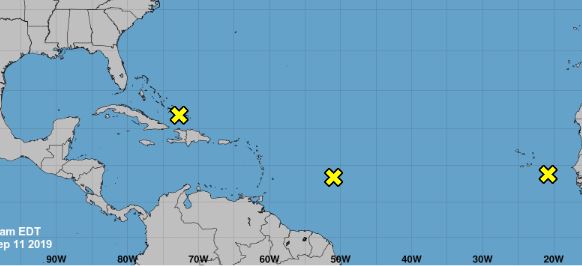
Source: nhc.noaa.gov

There is a lot to watch in the Atlantic.  The first system in line will probably not become very strong but will bring us some rain this weekend.

It is too seeon to tell about the others.

Happy hunting,
TreasureGuide@comcast.net


Sunday, September 11, 2016

9/11/16 Report - Oldest Multi-Year European Settlement in North America Found. Two Sides of the Same Cob and What's That Mark.


Written by the TreasureGuide for the exclusive use of treasurebeachesreport.blogspot.com.

Source: nhc.noaa.gov

We have one disturbance that seems to be headed this way, but it will probably not become much of anything.

The surfing web sites aren't predicting anything much bigger than a three foot surf for the Treasure Coast for the next couple of weeks.

---

The search is over. The longstanding mystery is solved. The location of the oldest established European multi-year settlement in the United States is indeed in the heart of Pensacola.

Discoveries by local historian Tom Garner in October and research afterward by University of West Florida archaeologists confirmed where Don Tristan de Luna established his Spanish colony in August 1559 – six years before the St. Augustine settlement and nearly 48 years before the English settled in Jamestown, Va.

The historical site is in an urban downtown neighborhood within view of the two shipwrecks linked to the Luna expedition in Pensacola Bay. UWF declined to reveal the exact location to protect the neighborhood and integrity of the site...

Here is the link.

http://www.pnj.com/story/news/2015/12/17/we-found-lunas-colony/77449884/


---

Yesterday I showed a silver cob with one side that was much better than the other.  Here is a cob that on one side shows some detail, even though it is heavily corroded, while the other side shows no detail.

Potosi Two-Reale, Assayer R.
Other Side of Same Reale
As you can see, the second side has been wiped clean like a Clinton server.

An Odyssey paper that I referred to the other day, mentioned that cobs found on the outside of a conglomerate, corrode more than those that were on the inside of a conglomerate.  I suspect that the same thing might be true of the two side of a cob.  One side would be exposed, while the other side would be more protected.

As I also mentioned recently, galvanic corrosion might also be a factor.

On the same cob, I've been wondering about the little bulls-eye shown in the picture below.  The red arrow points to it.


Anyone have any thoughts or ideas about that?   I'd like to hear what you think.

Note the touch of iron to the right of the bulls-eye where iron leached onto the cob.

---

Of course the big news today is the fifteenth anniversary of the 911 disasters.  It doesn't seem that long ago.

TreasureGuide@comcast.net

Sunday, November 8, 2015

11/9/15 Report - Dug Silver Christ Figure. Sacred Heart Confraternities In Colonial Potosi.


Written by the TreasureGuide for the exclusive use of treasurebeachesreport.blogspot.com.

Silver Christ Pendant Showing Sacred Heart
Find and photo by Larry.

Laura Strolia found some great new information conerning the heart-shaped cobs. Here is what she said.
In regards to the later produced heart cobs (1690-1750), I believe there is an angle to this mystery that has been overlooked.
Timothy Terrance O’Donnell wrote in his book, Heart of the Redeemer, pp. 147-148, “Between 1690 and 1740 (the nadir of the “new” devotion) Rome showed her warm approval by granting briefs which established over 700 Sacred Heart confraternities. The Jesuits, inspired by Fr. Galliffet’s zeal and passionate love for the Heart of Jesus, took the lead in promoting these confraternities.”
The Jesuits happened to be all over the world and the Spanish King was a consistent supporter of religious confraternities.  It was customary for members to wear special accessories, such as a certain badge or belt. Wearing a heart cob would have been a way to show which confraternity one belonged to, and at the same time, he would have been promoting this symbol of devotion.
In Early Modern Confraternities in Europe and the Americas, p. 190, authors Christopher F. Black and Pamela Gravestock said this: “Much more than other regions in the Viceroyalty of Peru, confraternities proliferated in Potosí as an indication of the wealth and religious piety of its residents.”
Perhaps the answer to these heart cobs will be in the Archivo Histórico of Potosí, in documents concerning the last wills and testaments of Potosí confraternity members.
Laura
Thanks Laura!  

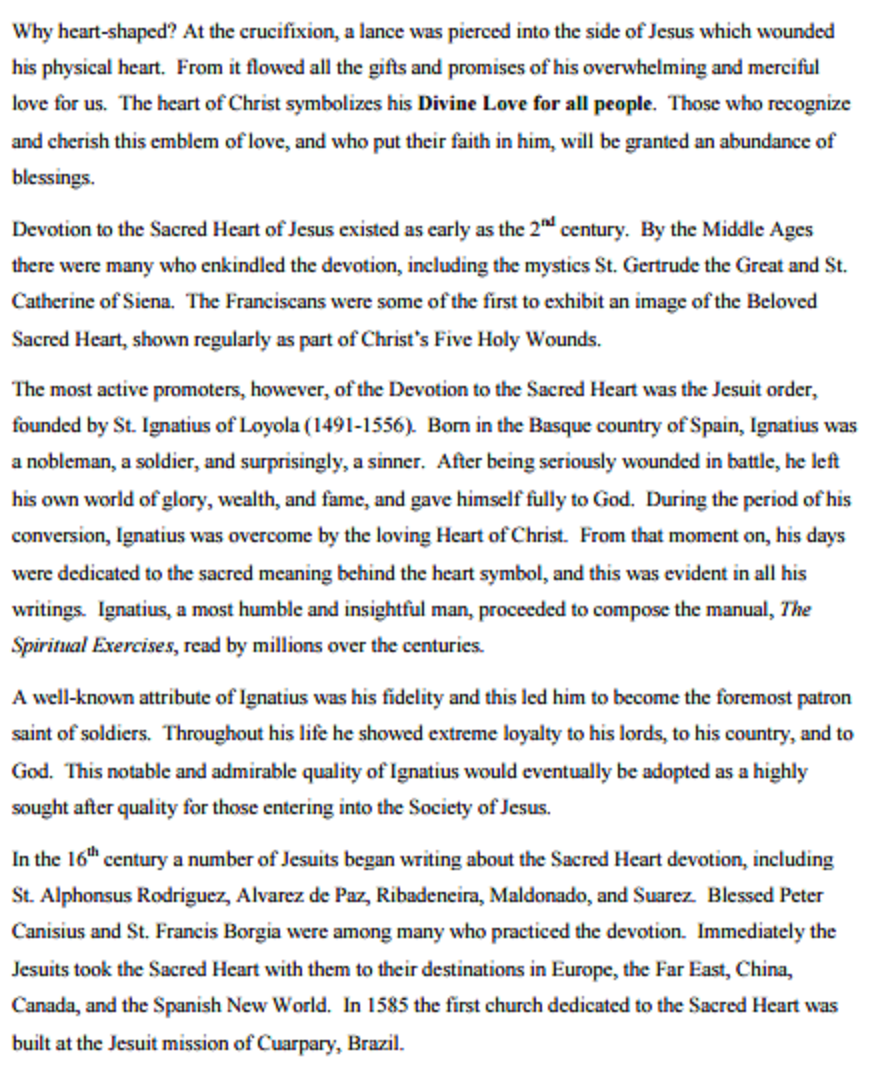
Notice in particular that Black and Gravestock say that the Sacred Heart confraternities proliferated in Potosi, which is where the heart-shaped cobs that we've been talking about were minted.

Laura mentions that it was customary for members to wear special accessories, such as a badge or belt.  Could the heart-shaped cobs have been used as such a badge to show membership and wealth and piety, as Black and Gravestock suggest.   That seems like a good possibility to me.  

It looks like we are getting closer to an answer.  At least I am learning a lot in the process.

---

Larry dug the Christ figure shown at the top of the post a few years ago in South Florida.  Note the heart on the figure.

Thanks for the picture Larry.

---

The other day I talked about old copper objects such as copper kettles.  I found a great web site that sells historic reproductions of colonial brass and copper cookware, kettles, flasks and other things.  It is a good site to look if you want to see what such items looked like and how they were made.  


One Example of The Historic Reproductions 
Shown On The Goose Bay Workshop Web Site.
Here is the link if you want to check it out.

http://goosebay-workshops.com/Coffee-Tea-Chocolate-and-Spirits

---

Happy hunting,
TreaureGuide@comcast.net

Sunday, November 1, 2015

11/1/15 Report - Inexpensive Heart-Shaped Cob From Potosi. A Casual Sunday Morning Walk.


Written by the TreasureGuide for the exclusive use of treasurebeachesreport.blogspot.com.

1701 1-Reale From Recent Sedwick Coins Online Auction Catalog.

Yesterday I showed a heart-shaped cob that sold for $100,000 in the recent Sedwick Coins auction.  It is a truly exceptional example.   There were other heart-shaped cobs that went for lower prices.  The least expensive of the heart-shaped coins in that auction was lot number 784.

Here is the item description.

Potosi, Bolivia, cob 1 real Heart, 1701Y, Charles II (posthumous), very rare. S-P43; KM-unl.; CT-unl. 3.77 grams. Unaligned axes and a departure from the "usual" shape but full weight and clearly less crude than the regular issues, with full king's name in legend, full but partially flat cross and pillars, AVF with toned fields, holed in top stem and at one right end of cross. Pedigreed to the Santa Rosa de Lima collection.

This one sold for $2600, a big difference from the one that sold for $100,000.
This one wasn't made with nearly as much care.  I think you can see that if you look at the pictures.

The designs on this cob are not aligned.  One side is slanted several degrees.  The shape just isn't as nice.  And this one has two holes, one of which is in one lobe of the heart.

I find the holes interesting.  Some of the heart-shaped cobs have no holes, some one, and some, like this one, have two holes.  And the placement of the holes varies.

One of the two-holed hearts has a very neat hole, one carefully placed at the top and one, just as carefully placed at the bottom.  Both holes were very neatly made.

It seems to me that if you could figure out why the holes are placed the way they are, you might be closer to figuring out how these cobs were used and why they were made.

For now it is just another fascinating little puzzle.

---

I took a little walk to look for bottle or other surface finds today.  I haven't done that for quite a while.

Handy Tool.
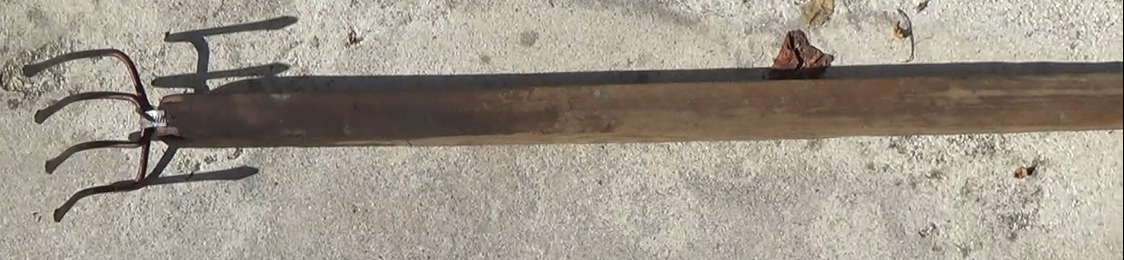
This tool is very useful.  It can be used to scratch through sand or muck.  It saves a lot of back bending work and can be used to turn over or pick up things like bottles or shells.

Bottle Found This Morning.
I didn't find anything good on my walk this morning, but did find this one cork-top bottle.  It isn't marked at all.  I did pick up some shells and drift wood pieces and some copper wire, which I'll probably use for something rather than scrapping it.

---

On the Treasure Coast we'll have at least a few days of two or three foot surf.  That won't be any help. I'll be happy if we can simply avoid a lot of refilling until we have some more erosion.  The weather is nice, but I'd rather have wind and rain.

There is only one more day left to respond to the blog poll.  I hope you'll do that if you haven't already.

Happy hunting,
TreasureGuide@comcast.net

Saturday, October 31, 2015

10/31/15 Report - $100,000 Eight-Reale. Ancient Shipwreck Cemetary. Sword Found. Ghosts of Treaures Past.


Written by the TreasureGuide for the exclusive use of treasurebeachesreport.blogspot.com.


Lot 720 as shown in the Sedwick Coins
Online Auction Catalog.


This heart-shaped eight reale brought a winning bid of $100,000 in the Sedwick Coins treasure auction that concluded this week.  It is the best example known.

I held this reale myself and inspected it carefully.  It is beautiful.  Unlike many heart-shaped cobs, this one is not holed.

Potosi was the only mint to make cobs in this shape.  Heart-shaped cobs from other mints do exist, but they were shaped into hearts later instead of being struck on a heart-shaped flan.

The purpose of these special cobs is not known for certain.  There is an article about that on the Sedwick  Coins web site.


---


Underwater archaeologists have discovered 22 shipwrecks around a small Greek archipelago, revealing what may be the ancient shipwreck capital of the world...

"Surpassing all expectations, over only 13 days we added 12 percent to the total of known ancient shipwrecks in Greek territorial waters," Peter Campbell, of the University of Southampton and co-director from US based RPM Nautical Foundation, told Discovery News...
Here is the link to that article.

http://news.discovery.com/history/archaeology/22-shipwrecks-found-in-single-greek-location-in-greece-151028.htm

---

A hiker travelling the ancient route between western and eastern Norway found a 1,200-year-old Viking sword after sitting down to rest after a short fishing trip. Further studies of the area will take place next spring...


That sword was in really amazing condition too.

Here is that link for that article.

http://www.thelocal.no/20151021/hiker-finds-1300-yr-old-viking-sword

One more example of how amazing objects can be found without a metal detector.

---


A lonely beach can be as busy as Times Square on New Years Eve if you really listen to your finds and use your imagination a little.  Fossils tell of giant sloths, mammoths, tapirs and Megalodons. Treasure coins conjure up ghosts of pirates, missionaries, conquistadors, sailors, and half-drowned survivors. Arrow heads and shell artifacts echo early man hunting and going about the business of survival.  Badly corroded World War II dog tags announce in sad muted tones the names of young men who trained in Florida for a landing in Europe that would change the world.  Modern coins and jewelry items tell of those who played, grew up and raised families on the Treasure Coast as well as tourists who came to enjoy the sun, sand and surf.  It is all there.  You can feel it if you are quiet enough.  You can see it if you respect it enough.

---

It looks like we are in for a week or so of 2 to 4 foot surf.  Not very encouraging.

Please respond to the blog poll if you hunted the Treasure Coast beaches during the last half of October.  It will help me evaluate my beach detecting conditions ratings as well as tell us what was or was not found.

Happy hunting,
TreasureGuide@comcast.net


Saturday, July 11, 2015

7/11/15 Report - Colonial Silver- Potosi (Bolivia) and Guanajuato (Mexico). History of Metals In The Colonies.


Written by the TreasureGuide for the exclusive use of treasurebeachesreport.blogspot.com.


Ancient Silver
Refining Technique

Source: see lecture link below.

If you are interested in Potosi cobs or other South American silver objects, you'll like this.  It shows where the silver that you find on the Treasure Coast came from.

The source is a lecture from the University of Texas on silver.  The title is Colonial Silver- Potosi (Bolivia) and Guanajuato (Mexico).  It tells about everything related to silver, but really has a lot of information about Potosi, the geology, early mining and refining techniques, etc, as well as Guanajuato.  I think anyone interested in Spanish colonial silver will find this information fascinating.


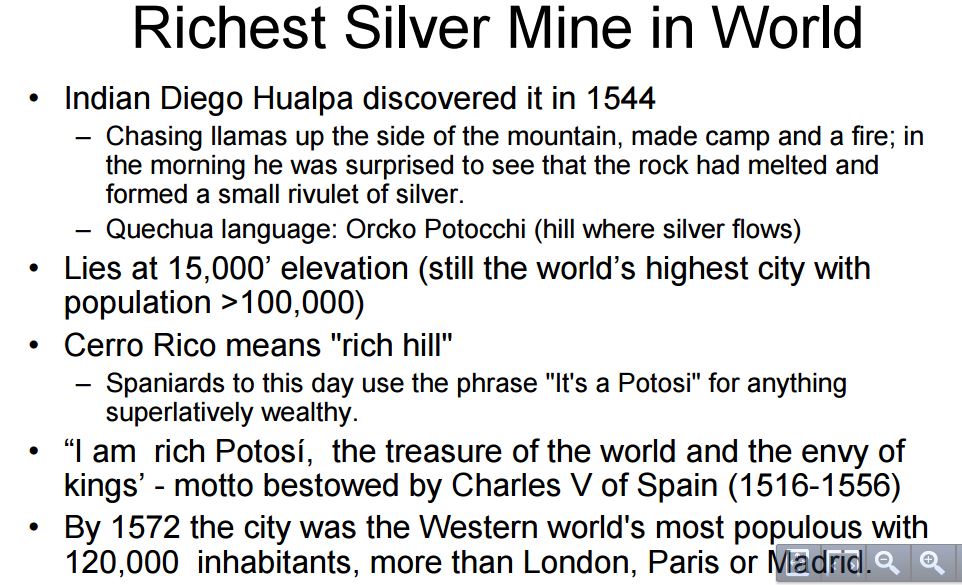
Below is one slide with some great trivia about Potosi.


In 1572 Potosi had more inhabitants than London, Paris or Madrid.  Who would have thought?

And below is a cool slide from the same lecture showing how the Incas smelted silver.


Take a look.  Here is the link.

http://www.utdallas.edu/~pujana/latin/PDFS/Lecture%209-%20Colonial%20Silver-%20Potosi%20(Bolivia)%20and%20Guanajuato.pdf

---

Sterling silver is 925 parts silver to 75 parts copper, thus 92.5% silver. 

Some countries use other standards for silver. Here are a few.
  • .950 – Japan, France
  • .925 – US, UK, Australia, Mexico
  • .900 – all early American silver is .900 or “coin silver”. Even Paul Revere’s work is not “sterling”
  • .875 – Soviet Union and the Baltic States
  • .830 – Scandinavian countries
  • .800 – Germany and France
---

You might also find this book interesting.  History of Metals In Colonial America, by James Mulholland, 1981.

This book concerns the colonies and does not address Spanish Florida.  Still, very interesting.

You can view a substantial sample of the book free online.  There is a lot of interest reading in that book.  It covers iron, copper, silver, etc.

This book explains how silver coins were melted and made into other objects such as silverware.  Those silver objects were marked and more easily identified if stolen.  And if and when cash was needed the silver could be easily converted again.

You'll find a lot of interested facts about metals in the early days of the colonies.

Click above to read the free sample sections of that book.

----

When I had an injury C Man sent me an email telling me about a detector harness.  He got one for his wife.  If your arm gets tired when detecting, you might think about getting one.

Here is a YouTube video C Man sent me showing the harness in use.

https://www.youtube.com/watch?v=sF15vnBV32k

I actually have one that came with a detector that I bought, but haven't tried it out yet.

---

Still nothing more than a two foot surf predicted for the Treasure Coast for several days.  Beach hunters will be hunting mostly modern items, and there are a few of them out there due to the hot weather and the vacation time of year.

Happy hunting,
TreasureGuide@comcast.net

Wednesday, January 28, 2015

1/28/14 Report - Treasure Coast Eight Reale. What Civil War Artifacts Will Be Found On The Bottom of The Congaree River. Tommy Thompson Found.


Written by the TreasureGuide for the exclusive use of treasurebeachesreport.blogspot.com.

Photos by Captain Jonah.

Here is a neat Treasure Coast Potosi Pillar and Waves Eight-Reale.

You can see the Potosi mint mark.  Also a three digit date in the bottom column of the middle row.

The picture below is the other side of the same cob.

I'm not certain I am reading the date correctly, but it looks like (1)715 to me.  What do you think?

It appears to nicely match some examples that are in Menzel's book.  That book shows a 1715 eight-reale that is also chunky and cracked like this one.

Menzel says that mint production for that decade was low and quality control was poor.  The book said that is rare to find a well struck Potosi cob around that time period.


Another excellent Treasure Coast find by a Treasure Coast salvage crew.

You might remember my comment from a recent post indicating that in 1700 and after, Potosi Pillars and Waves cobs had a three digit date while earlier Pillars and Waves cobs had a two digit date.


---------


COLUMBIA, SOUTH CAROLINA—A planned environmental clean-up of the Congaree River in South Carolina could recover Confederate munitions that Union troops, under the command of General William T. Sherman, captured in 1865. Sherman’s army burned a third of the city and captured 1.2 million ball cartridges; 100,000 percussion caps; 6,000 unfinished arms; 4,000 bayonet scabbards; and 3,100 sabers. The soldiers reportedly dumped what they couldn’t carry in the river. Since then, fishermen and swimmers have recovered some of the weapons...

Here is the link to read the article.

http://www.thestate.com/2015/01/17/3934680_exclusive-congaree-to-be-dammed.html?rh=1

---------

One thing I continue to be impressed by is the importance of the threshold setting on a pulse induction metal detector.   A threshold that is either too high or too low will cause a loss of depth and signals.  It is so important that I often test my threshold by using a well known gold test target so that I know I have the best threshold setting.  In my opinion, selecting the threshold is too important to do casually.

-------

When learning a new detector learn first in a familiar test garden if that is possible.  Then move to an easy setting such as dry sand.  Then to wet sand, and finally in water.

I think if you become very familiar with a detector in a less challenging environment first, it will make it easier to move to a more challenging environment.

---------

When I was at the beach yesterday, almost all the targets I found were discolored, corroded, and deep.  The recent surface drops had already been picked up, yet there were a good number of deep targets remaining.

It was also my observation that there is less junk out there these days.  I think more people are removing the junk.   There were a good number of bottle caps at some beaches.  There are also some beaches with a lot of small iron.

---------

Just got the news that Tommy Thompson was captured.  I did a post giving a link about him missing a few months ago.  You can find that post by using the blog search box.

---------

On the Treasure Coast, the wind changed direction.  It was coming from the North.  Tomorrow the surf will be a little higher.

Happy hunting,
TreaureGuide@Comcast.net

Saturday, January 24, 2015

1/24/15 Report - Potosi Pillars and Waves Reales Date Designations. Gusty West Winds Saturday. Coins of the Lost Galleons Book.


Written by the Treasure Guide for the exclusive use of treasurebeachsreport.BlogSpot.com.

1726 Eight Reales Illustration and Photo
Source: Seawall Menzel book Cobs, Pieces of Eight and Treasure Coins
I recently received a picture of a very interesting Treasure Coast Potosi Eight-Reales.  As a result I did a little research to see what I could learn about the cob.  One thing I learned is that before 1700, and back until when the Potosi Pillars and Waves cobs were first produced in 1652, a two digit date was typical, while 1700 and later a three digit date was typical on such cobs.

As you might know, there can be many varieties for a cob made by a specific mint in any given year.  Since different dies were used and the same die reworked and reused over the period of time, the large number of existing varieties can be over-whelming, but each difference can provide an important clue that can be used to help date and identify the cob.

The Potosi Pillars-and-waves eight reale that I recently looked at had some features that were similar in many ways to the one shown at the top of this post, although it was not the same year.

You seldom if ever are able to see all of the design features on a salvaged or dug cob.  They just aren't that perfect.  Even if the strike is near perfect, years in the ocean or sand will take a toll.

Not long ago I discussed the subject of Royals and some questions regarding their true purpose.  Royals are cobs that are produced in exceptional quality and are often considered to be presentation pieces for the king, thus the name, however their true purpose is not so certain.  (See the previous post discussing the Sedwick article on that topic.)

The above illustration from the Menzel book shows a three digit date displayed on the bottom row between the pillars, in this case "726" indicating the year 1726.   Of course that date is later than 1715 and would not normally be found on 1715 Fleet wrecks or beaches, however it does illustrate one thing that I was interested in, and that is how the dates were displayed on Potosi Pillars and Waves eight-reales beginning in 1700.

As I said above, Pillars and Waves cobs manufactured in Potosi prior to 1700 showed a two-digit date between the pillars.  "52," for example, would indicate 1652. 

On the top row between the pillars in the example shown above, you see the mint mark "P," followed by the denomination, "8," followed by the assayer intial "Y." 

In the second row, "PLVSVLTR."  Plus Ultra can be interpreted as "more beyond," referring to the New World. 

In the example above, in the third row you have the assayer initial and mint mark plus a three digit date between the columns, as is typical of Potosi eight reales produced from 1700 on.

Just one additional note: Lima also produced Pillars and Waves cobs. 

-----

While on the subject of cobs, I just came across a book that I evidently forgot that I had.  It is a small paperback by Kathryn Budde-Jones entitled Coins of the Lost Galleons, second edition published 1993.

------

On the Treasure Coast the wind was coming from the South and West early in the day.   According to the buoy data, the waves didn't get much over three feet.  Later in the day the wind was more out of the West and North.

It doesn't look like we'll get much more than a two or three foot surf for a few days.  We do have a negative tide now.  That is one good thing.

_____

I've had a chance to give an ATX a few tests and one thing that I've seen that I like a lot compared to some other pulse detectors that I've used or tested is that a small thin gold ring gave a better signal than a clad dime.  That was observed under various conditions.

-------

Happy hunting,
TreasureGuide@Comcast.net