Showing posts with label black sand. Show all posts

Friday, November 15, 2019

11/15/19 Report - Some Small Junk Finds. Dating Nails. Modern Tin Found On Ancient Wreck.


Written by the TreasureGuide for the exclusive use of treasurebeachesreport.blogspot.com.

Broken Small Possible Tack Or Other Connector.
Here is one find I was able to see after a little cleaning.  When I dug it all I saw was a small black lump, but a lot of the crust easily came off.   After getting a look at it, my first impression was that the top was brass but the stem looked iron.  That doesn't make much sense to me, and it might not be right.  I'll have to get it cleaned better.  That shouldn't take long.

It seems to be a tack or maybe a broken rivet or something.   Looks old, but no way to say at this point.  It was one of a few small pieces I found yesterday.  The shank is very square but broken.

I just happened to run across a nice web site on nails as clues to age.

Here is one of the diagrams from the site.


And here is the link for more information about that.


A couple other old small heavily-encrusted pieces I picked up yesterday included these two similar small pieces of what I think is lead - but very thin.  I'm pretty sure not they aren't aluminum.

Both pieces less than an inch at longest and very thin.


Nothing significant, but since it was the first time I used the Equinox in those types of conditions, I was happy to see it responding so well to small items in thick black sand.  In fact, I thought it handled the black sand very well in one of the standard modes. Some detectors I like to use in pin-point or all-metals mode in black sand - as odd as that might seem.

There is one piece that is starting to look like it might be silver and maybe a bit of a shield showing.  It definitely needs much more cleaning.

I'm sure there were some better finds, but I haven't received any more reports yet.

---


Work on the new Reidi tee in central Tallinn yielded another surprising archaeological find recently, this one providing something of a riddle, ERR's Novaator science portal reports.

Workers found a buried wooden ship which archaeologists later determined dated from the end of the medieval period/beginning of the early modern era. Since musket shot was found in situ, the ship could not have been from any earlier than the dawn of the firearms era. Firearms were in common use in Europe by the fifteenth century.

However, tinned food was not in use at that time, which raises the question why a can with an expiry date from 1972 was found within the ship's structure...

Here is the link for the rest of that article.

https://news.err.ee/996439/reidi-tee-work-yields-puzzle-as-modern-tin-can-found-in-ancient-shipwreck

Things of different ages can get intermingled.

---

Source: MagicSeaWeed.com.

Today the surf was down, but, as you can see, it will be building again by Saturday.  I hope the fronts keep on coming.

Happy hunting,
TreasureGuide@comcast.net

Friday, November 4, 2016

11/4/16 Report - Real Found This Week. Corrigan's Beach Status and Fakes Found. Higher Surf Coming Soon.


Written by the TreasureGuide for the exclusive use of treasurebeachesreport.blogspot.com.

Find and photo by Brent P.
Brent found the above while hunting modern jewelry north of Cocoa.  He hasn't yet determined if it is real.  Certainly looks more real than most fakes.  I'll take a closer look later.

At first glance it looks like a 1696 (really unsure about that) Potosi.  If that isn't the precise date, from the design I'd suspect that it is close.  Can't see the assayer mark, which would help.

I've mentioned several times that North Florida was more heavily affected by Matthew than the Treasure Coast.

Let us know when you have a positive ID Brent.  Thanks for sharing.

Locally the surf has been up and we've had a good amount of wind.

---

I got a report that at Corrigan's the blue bags were showing at Corrigan's.  That is a good sign.

Corrigan's at Low Tide.
Photo by Darrel S.
There was also black sand, which is another good indicator.

Black Sand At Corrigan's.
Photo by Darrel S.

Darrel said he found some fake reales.  He tested them with a magnet.  That is a good first test.

Conditions there look good enough that a few real reales might be found as well.

It looks like that beach got better this week than immediately after Matthew.

Thanks to Darrel S. for the report.

---

Source: MagicSeaWeed.com

As you can see we're supposed to get 4 -7 foot surf Sunday and Monday and possibly a northeast wind.  On top of all the high surf we've been having lately that could be good.  We'll see.

Happy hunting,
TreasureGuide@comcast.net


Monday, July 11, 2016

7/11/16 Report - Local Treasure Coast Beach Detecting Conditions and Photos. 19 Amphoras of Coins Found in Spain by Construction Crew.


Written by the TreasureGuide for the exclusive use of TreasureBeachesReport.blogspot.com.


Small Part of Hoard Found in Spain.
Source: See link immediately below.

Construction workers laying pipes in a park in southern Spain have unearthed a 600kg trove of Roman coins.

The bronze coins dating from the late 4th Century were found inside 19 Roman amphoras, a type of jar.

Here is the link.

http://www.bbc.com/news/world-europe-36172538


---


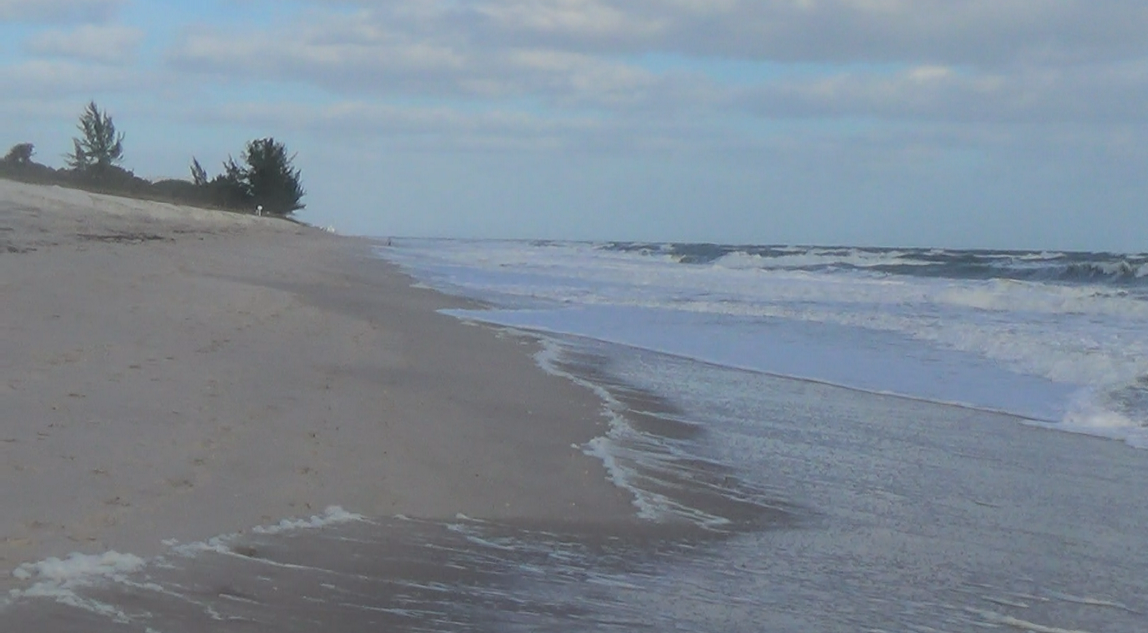
I went out to the beach this morning to do a little detecting.  I was surprised by how few people were at the beach this morning.  I've seldom seen fewer at this beach.  Of course, it was early and I would guess beach goers would be showing up later.

Another View of the Beach This Morning.
As you can see, it was near low tide.  The beach front was built up.  Beach conditions were poor.

With all of this small surf we've been having, sand and not much else, not even anything other than small shells, has been washing up onto the beach front.

The shallow water was also very sandy.  There was a little bit of a dip in front of the beach, but hardly any at all.  Even the dip was shallow and had a lot of fine sand in it.  It was very sandy and shallow for many yards out.

The entire beach had very few targets, including the dry sand, which had been well detected.  Although targets were very few, there were some good ones, which were deep and difficult to recover.

Wet Sand Area This Morning.
This sand is fine and very packed.  You can see the ripples in the photo above.  There was also some black sand there. Getting maximum depth required some adjusting. 

There were some targets in the dip where sand was accumulating at the water line.  Targets were difficult to recover there.  The silty sand made deep targets very difficult to recover.  I left a couple.

---


Close-up Of Small Piece of Coral Found This Morning.


Happy hunting,
TreasureGuide@comcast.net

Saturday, December 19, 2015

12/19/15 Report - Conditions Moving In Right Direction But Not Enough This Morning.


Written by the TreasireGuide for the exclusive use of treasurebeachesreport.blogspot.com.

One Small Cut This Morning.
The wind shifted yesterday as predicted.  I heard it all night, so when I got up I went out to check the beaches.

The first beach had previously accumulated tons of sand.  There was a small cut there less than a foot high.  That barely scratched the surface of all the new sand.

I then took a look at Turtle Trail.  There was less erosion there, but there had been less recent accumulation too.  Still it wasn't quite ready to produce, in my opinion.

You can see the black sand.  In the cut you could see the layers of black sand (shown in the picture below).

Layers of Black Sand Showing In Cut.
North of Seagrape Trail This Morning Near Low Tide.
There was very little erosion around Turtle Trail near low tide this morning.  There were some nice shell piles.

Wabasso This Morning.
In summary, it looked like it was too early.  There was a small amount of erosion but not much.

The wind is continuing from the North this afternoon and could create more erosion today and tonight.  Hard to tell if it might be enough.

The surf today is 3 - 5 feet.  Tomorrow expect 4 - 6 feet.

The wind later today will be shifting from north to northeast, then tomorrow it will be more easterly.

Monday we'll be back to a south wind.

I expect a little more improvement today and tonight.  I don't know if it will be enough.

Happy hunting,
TreasureGuide@comcast.net

Friday, October 3, 2014

10/3/14 Report - Unbelievable Silver Shaker Box From Treasure Coast Shipwreck Like New. Ace 250 Field Test At The Beach.


Written by the TreasureGuide for the exclusive use of treasurebeachesreport.BlogSpot.com.

Silver Shaker Box Found On Treasure Coast Wreck Site
 By Crew of the Capitana
Photo submitted by Captain Jonah Martinez.


The crew of the Capitana made some great finds this summer off the Treasure Coast.  I showed you some of them.   Some of them have now been conserved.  Captain Jonah Martinez sent me a picture of the cleaned shaker box. 

UNBELIEVABLE ! 

That box looks like it is brand new but is hundreds of years old! 

Thanks for the great pictures Captain.

Below is a close up showing the top of the same box.


Top of Same Silver Shaker Box
Photo submitted by Captain Jonah Martinez.


Very ornate and intricate.  As fine as it gets.


We would not get to see stuff like this without the work of the early treasure hunters that worked the beaches and waters along the Treasure Coast decades ago.  They were the ones that invested time and effort and to find these wreck sites, and led to the eventual development of the field of underwater archaeology.


Back a few months ago I did a test of the Ace 250.  I first used it on an old yard and by an old wooded wagon trail.  It worked very well in those inland tests, but I suspected that it might not be good for hunting in wet sand. 

This morning I took it for its first test at the beach.  What I suspected was proved to be true.  It did not work well in wet sand.  It gave many false signals, especially in All Metals mode. 

In Coin mode it worked better than in All Metals mode in the wet sand but still gave a good number of false signals.

[Added 10/4.  One thing I forgot to mention is that the factory default sensitivity was use.  I did not attempt to reduce the sensitivity.]

The sand was not only salt water wet, but there was also a scattering of black sand.

I took it up to the dry sand where it did everything you could possibly expect out of an inexpensive detector.

It performed excellently in a very junky area, correctly identifying coins and junk.

One thing about the 250, and I suspect most detectors with target ID, is that if the ID is consistent, the ID is correct a very high percentage of the time.  However if the ID jumps around, for example between pull tab and penny, it is likely junk rather than a penny.   Consistent good target IDs are almost always correct.

In summary, the 250 is in my opinion an excellent machine for the money. As far as I'm concerned, it will do the job very well on a dry sand beach.  It is not, however, a good choice for salt water wet sand.

I also tested the 250 on a thin gold ring.   It gave a good clear loud signal on that particular thin gold ring in the Coin, Jewelry, and All Metals Mode.

Some more expensive detectors that would far out-perform the 250 in the wet sand would not do as well as the 250 in the dry sand. 

As I've said before, a detector that is good in one situation might not be good in another situation.  There are situations when an expensive detector will not work as well as an inexpensive detector.


On the Treasure Coast we had a one to two foot surf again.  Sunday the surf will increase a little, but probably not enough to do us much good.

The low tides are not going down very much.

Happy hunting,
TreasureGuide@Comcast.net

Wednesday, June 4, 2014

6/414 Report - Half Cent, More Glitz, TV Treasure Hunt, Queen's Coach & Three Characteristics of Metal Detector Signals


Written by the TreasureGuide for the exclusive use of treasurebeachesreport.blogspot.com.

Find and photo by Steve S.
Steve S. is from Iowa, but like many detectorists, visits the Treasure Coast where he does some metal detecting.

Here is how he found this half cent.

He said, Went out last Sunday to a nearby village and detected a residence built in the 1840s. This 1829 Half Cent was all that I found. Nice shape for Iowa.

That is a very nice find.  In uncirculated condition it would be worth well over two hundred dollars.

Congratulations Steve!
Photo of find by Steve S.


Half cents are rare finds.


Here is a web site that discusses and gives values of half cents.

http://www.coinstudy.com/half-cent-values.html


NBC's Today Show has been having a daily treasure hunt.  They hide an envelope containing prizes in the city of the day and then give clues to where the envelope can be found.

http://www.today.com/allday/al-roker-launches-todays-treasure-hunt-inspired-hidden-cash-craze-2D79739309


The Queen of England got a new coach.  It is Covered in around 400 books of gold leaf, it contains timbers from king Henry VIII's flagship the Mary Rose, which sank in 1545, and Isaac Newton's apple tree, which inspired him to form his theory of gravity.

Here is the link for more about that.

http://news.yahoo.com/queens-state-coach-encapsulates-british-history-220653016.html

Timbers from Henry VIII's flagship!  Is that saving history for the public?   Maybe it is.  Doesn't seem the best use to me.


Find and photo by Robert H.

I've been showing some of the finds of Robert H. lately.  I posted his trash finds one day too when I was talking about how much trash is picked up by detectorists.

Here is another one of Robert's finds.  This one is really glitzy!

Congrats Robert.  


A few posts ago I was talking about signal detection theory as it relates to metal detecting.  I talked about how signals usually exist in a field of noise.  I wanted to talk a little about three features of good signals when you are using all-metals or pin-point modes.

First, of course, is loudness.  Obviously a loud signal will tend to stand out, but not necessarily, if you have a lot of noise, including a very rough threshold or poorly ground balanced detector.  Increasing volume can increase noise as much as the signal and therefore won't necessarily be of much help.

Signal loudness, when considered in conjunction with other variables, can tell you something about the depth, size and composition of a target - even in all metals mode.  Of course shallow targets will tend to be louder.  Larger targets will tend to be louder.  And more conductive targets will tend to be louder.

Distinctness is another quality of a signal.  Signals will be more distinct (have a more sudden onset and termination) sound, when the target is more shallow.  Distinctness will generally make a good signal easier to identify in a field of noise.  However, as the target gets deeper the signal will appear more smooth.  It will not be as loud and will not be as distinct.

A third signal quality is duration - how long the signal remains loud as you sweep your coil.

You can get a very good idea of how shallow a target is by combining these three signal characteristics.  A small target near the surface will be loud and distinct.   The duration of the signal will, however, vary depending upon the size of the target.  Duration and distinctness, as I've defined them are different things.

A deeper object of the same size and composition will produce a signal that is not as loud and not as distinct.

A larger object of the same composition at the same depth will produce a signal that is as louder but the signal will not be as distinct, and the duration will be larger (The signal will be more spread out.).

If you sweep multiple times over an object in all metals mode and vary the direction of your sweep, you can get some idea of its size and shape.

One peculiarity that I've talked about before is the double signal produced by narrow long objects such as nails when you sweep in one direction and single beep when you sweep at 90 degrees to that.  I've gone over that in detail in the past.

With practice you can use your detector in all metals mode to gain a lot of information about suspected targets from the loudness, distinctness and duration of the signal.

Back to the signal in noise problem.  Signals giving faint signals are more difficult to detect in noise, as are signals that are less distinct.   Faint indistinct signals will often be lost in noise such as that created by black sand and salt mineralization or even an erratic threshold tone, however you can easily detect near surface objects in black sand from the more distinct signals. 

Learn to understand what your detector is telling you.  It might be saying more than you would guess.


I showed a photo of two detectorists on a beach a day or two ago.  They wrote in.  The detectorists are Tim and Betty M. 

Thanks to all of you who write and submit finds and information.  I really appreciate it.


On the Treasure Coast the surf today is three to five feet.  The surf will be decreasing the nest few days and we'll be back down to something like a two foot surf.  Don't expect any improvement in beach conditions.  The tides are pretty flat now too.

Happy hunting,
TreasureGuide@comcast.net


Monday, June 2, 2014

6/2/14 Report - UPDATED. Metal Detecting in Black Sand, Salt Sand, and Noisy Environments, Gold Rings From Fresh Water Lake, and Increasing Surf


Written by the treasureGuide for the exclusive use of treasurebeachesreport.blogspot.com.

Gold Ring Found by Robert H.
Photo submitted by Robert H.
On the Treasure Coast the wind has increased and the surf has increased as well.  We'll have to see what that does.  I don't like the angle right now.  I expect the waves to be too much from the East.

------------------------------

UPDATE:  I went to the beach this afternoon after high tide.  I looked at about 8 different spots along a stretch of just over twenty miles.
I didn't see any erosion except for some little six inch cuts at the best of all the spots (not counting Fort Pierce South Jetty Park where the new sand has washed away to create a six plus foot cut already). 

Below are pictures of two beaches that I saw. 

Jensen beach had deteriorated since I last showed it.  Notice the sea weed.  That is a bad indicator.

And also shown below is the best of the natural beaches.  Still nothing but six inch cuts.


Jensen Beach Just After High Tide Today.


The Only Cuts I Found on South Hutchinson Island Other Than At South Jetty Park.

It seems I was right about the angle of the wind and waves.  The waves were a good four to six feet but the angles were wrong and the beach detecting conditions remain poor.

-----------------------------------------------------------

Robert H. detected a fresh water lake close to his home and found three small gold rings and a pendant. 

Above is shown one of the gold rings.  It is a very common type.  If you've been detecting very long you've probably found more than one of these.

----------------------

The signal you get from your metal detector even if it is a good signal, always occurs in a background of noise.  Noise can keep you from hearing a signal, and therefore cuts down the effective depth that you can detect targets.  Generally speaking, the more noise there is, the more good signals you will miss.

Signal detection theory was developed during World War II when they were developing radar systems and trying to identify blips on a screen indicating the presence of planes.

We all know that you don't have to talk so loud when you are in a quiet room with one other person, and you have to talk much louder to be heard and understood in a noisy room.  That is a simple illustration of the signal in noise problem.

There are a variety of sources of noise when you are detecting.  Some are external, such as wind and the noise of waves breaking.  Some internal, such as tinnitus (that ringing sound you might hear in your ears, and even distracted thoughts.  And some noise come from your detector and the ear phones, such as the signals caused by black sand or minerals, or static in the ear phones caused by various things such as lightening or power lines or nearby metal detectors.

When you do an air test some sources of noise are eliminated or minimized and the noise level can be relatively low.  That results in unnatural results, sometimes better than what you would expect in the field.  In an air test, however, the results can also be worse than what you would get in the field.

Usually there is little difficulty in detecting large shallow targets that create a loud distinct signal, however, when you are trying to detect smaller or deeper targets that give a more faint signal, many of those signals can easily get lost in the noise.

Some detectors give very steady or stable threshold sounds.  That is the sound you hear when the detector is not detecting a target.  Others have a rough or unstable threshold.  An unstable threshold is a source of noise that can cause you to miss perfectly good signals and targets.

If you can adjust your threshold so that it is more steady, you might increase the probability of hearing good signals.  I say "might" because there are other factors that must be taken into account.

If you just increase the volume you will be increasing the loudness of the good signals, but would also be increasing the noise level.  That will not necessarily help you hear the more subtle signals, which can still get lost in the noise.

Here is a key point.  Lowering the threshold level too far to either eliminate the threshold or even to create a very stable threshold is not always a good thing to do.  The threshold level that is best for you will be determined by both your detector and your own operating characteristics.

When you lower the threshold too much, besides eliminating a lot of the noise, you can also lose a lot of the good signals. 

I personally run my detector very sensitive and fairly loud.  I hear the salt mineralization and other noise.   That doesn't bother me much, because I can usually identify those sources and distinguish those sounds from the good signals. 

Since we always operate in a more or less noisy environment, you should be aware that you are always attempting to discriminate between good signals and noise (bad signals.)    Sometimes that is relatively easy and sometimes more difficult.  One good thing to do is make any adjustments you can that will help  reduce the noise to signal ratio, without losing much good information.  That includes changing detector settings, headphone adjustments, and even your mental state.

If you hunt in all-metals or pin-point mode, you will hear a lot of things, many of which are not good targets.  You might, for example, hear concentrations of black sand or salt mineralization.  I'm talking about VLF detectors here.  Some people have a lot of trouble with that.  They think they can't hunt in black sand or salt areas without decreasing sensitivity.  They complain about their detector "falsing."  I don't have much trouble with that.  I generally run my detector the same over black sand as over non-magnetic sand, and over salt mineralized sand as over dry sand.  I hear those effects, but am not bothered by them because I know what they are and can distinguish between those effects and signals produced by targets.   I almost never decrease my sensitivity settings.   I really can't remember having done that.

If you are working over layers of black sand for example, your detector will respond to the black sand.  I say it sounds like a twang.  Smooth undisturbed layers will create a gradual sound, while a footprint or distinct edge in the black sand will sound more like a target.

Watch as you detect these things and you will see what it is that your detector is responding to.

If there is a coin in the black sand you will have a lot of noise but you will still be able to identify good signals.  Coins in black sand will cause signals that are more distinct than the twang of smooth black sand. 

Don't try to avoid all noise.  I've heard very experienced detectorists using very high-end detectors complain that they could not detect in black sand.  I used the same type of detector and detected in black sand every time I saw it and didn't make any adjustments to my settings at all to adjust for the black sand.  I simply listen to the sounds made by the black sand, but can distinguish other sounds created by targets in the black sand too.

The same thing goes for wet salt sand.  Where the salt water has just come up and stopped and then receded, at that edge, you might get a false signal.   Many times you will be able to see the edge that you are detecting. (Anther reason to keep your eyes open while detecting.)

That doesn't bother me.  I know what is creating the signal (noise in this case), and it doesn't bother me at all.  That is part of getting to know your detector.

If you learn to understand your detector and what it is telling you, you won't be bothered by noises like this.  In fact when you understand what it is, the noise becomes information. 

You might be surprised by the types of environments you will be able to detect when you learn how.

Don't try to avoid all noise.  Some noise is actually information when you learn what it is.

Don't be deterred by some falsing.   Try to identify the cause the falsing, which might not be falsing at all.


I'll be watching to see how the beach develops.


Happy hunting,
TreasureGuide@comcast.net

Tuesday, December 17, 2013

12/17/13 Report - Black Sand and Some Tips for Detecting In It and a Couple of Sunken Ships Discovered


Written by the TreasureGuide for the exclusive use of treasurebeachesreport.blogspot.com.

You'll occasionally see black sand on our Treasure Coast beaches.  Some black sand is slightly magnetic.  It is ilmenite, an iron titanium oxide.  Florida ilmenite occurs in round sand-size particles.


Closeup of Black Sand
From the site linked below.
Sometimes you'll see very thin layers and other times thick layers of back sand.  It gets concentrated when the other lighter sand particles such as quartz are moved by wind and waves leaving concentrations of the heavier black sand.  When black sand appears, it is sometimes a sign that conditions are better.

Other heavy minerals on Florida beaches include rutile, zircon, and staurolite.

Ilmenite has industrial uses such as being used in the manufacture of titanium.

Some detectorists have a lot of trouble detecting in black sand.  I don't find it particularly problematic.   It will give false signals, but you can learn to distinguish most signals coming from actual targets from the false signals. 

One thing that will help is swinging your coil with the flow of the black sand instead of across it.  Edges will cause more false signals.  So will foot prints or holes.   Foot prints and holes create sharp edges in the black sand which will cause louder false signals.   It can be difficult to determine if you removed the target from a hole dug in black sand or if you didn't get the target.  

Detecting in black sand is a little like detecting in wet salt sand. 

Here is a nice web site that talks about some different kinds of sand and shows some nice photos of different kinds of sand.

http://www.microscope-microscope.org/applications/sand/microscopic-sand.htm

If you read that site carefully you'll see a couple of nice useful hints.


A shipwreck was discovered on  a Florida beach back in October.  I think I missed that one then.  This one might be only about a hundred years old or so.

http://www.clickorlando.com/news/shipwreck-discovered-on-florida-beach/-/1637132/22526280/-/r3wnrv/-/index.html


An 1861 steamer possibly containing gold was found in Lake Huron.  Here is the link to learn more about that.

http://www.dailymail.co.uk/news/article-2522233/Shipwreck-hunter-finds-missing-Keystone-State-1861-ship-Lake-Huron.html


Here are some good prices reported by Kovels Komments.


Jesse Owens' 1936 Olympic gold medal set a record for any piece of Olympic memorabilia. SCP Auctions of Laguna Niguel, Calif., sold it on Dec. 8, 2013, for $1,466,574.
 
Norman Rockwell's 1951 painting, "Saying Grace," brought $46 million at a Sotheby's auction on Dec. 4, 2013. It's the highest price ever paid at auction for an American painting and is about 1,500 times as much as Rockwell was paid to paint it (he was paid $3,500, which is equivalent to about $30,500 today).

The lead statue of the Maltese Falcon used as a prop in the 1941 movie sold at a Bonhams auction on Nov. 25, 2013, for $4,085,000.


I always find it interesting what people are willing to pay big bucks for.


On the Treasure Coast we only have about a two-foot surf.  That will increase in a couple of days but not nearly enough to improve beach detecting conditions.


Happy hunting,