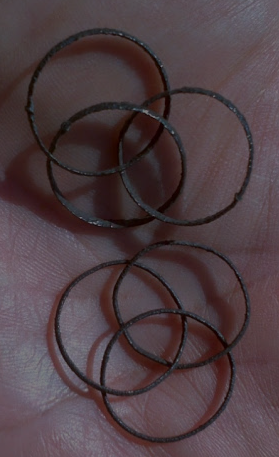
Showing posts with label silver rings. Show all posts

Thursday, February 27, 2020

2/27/20 Report - Cuts and Eroding Beaches That Expose Treasure. Photo Comparison. 1715 Fleet Silver Rings.


Written by the TreasureGuide for the exclusive use of treasurebeachesreport.blogspot.com.

Seagrape Trail As It Looked Last Saturday

I distinctly remember watching Monday Night Football maybe thirty years ago when Howard Cosell commented to Dandy Don, "You have a tremendous grasp of the obvious."  It was meant as a humorous insult, but it strikes me now as something of a complement.  Advances in understanding are often made painfully slowly and often involve gaining a deeper appreciation of what was hiding in plain sight all along.

Were you ever metal detecting when a surprise wave hit you and almost knocked you off your feet?   It has happened to me numerous times over the years.   In fact I remember once actually getting knocked off my feet.  Inspiration can come with a sudden rush too.

I've talked a lot about the importance of what I call cuts.   If you looked at some of the beaches that were eroded last week, you might not have noticed any cuts, but there were cuts.  Those cuts were very high though.  The face of the dunes was cut.  At the bottom of the dunes you could see a layer of black sand over a layer of the old orangish sand exposed in some locations.

It is not often that we get a surf of over ten feet, but that happened on the Treasure Coast in both January and February.  And shipwreck treasures were found both times.

On the 22nd the high tide was bouncing off of the dunes, and the water was rushing with good force back down the slope carrying sand and other materials with it.  You can see from the photo above where probably two feet or more of sand was removed.  Old wooden posts that were previously buried were exposed, and stairs were left hanging two feet off the ground.

If you take a volume of sand two feet deep by maybe thirty by fifty yards, that is a volume of 3000 cubic yards of material being classified.  That can easily happen in one six hour tidal period, and that is undoubtedly a small part of what actually happened on the beaches that day.

So what is it about cuts that makes them so significant to the beach detectorists?  I mentioned it above.  When the water hits the face of a cut, or dune, the water rushes back down the hill with a lot of force.  If you get caught in it, you can feel how strong the flow is.  There are times when it can knock you off your feet.  That is obviously strong enough to carry sand - and other materials with it.

Yesterday I talked about the amount of water velocity required to suspend different kinds of particles and objects, and the amount of force required to transport those objects.  When the force decreases below the amount required to transport objects, they drop out and settle.

My main point today is that even though there weren't any obvious cuts on the slope of the beach last Saturday, there were cuts to the dunes at the top of the beach, and at high tide the water was bouncing off the face of the dunes and flowing down the slope, carrying sand and other objects until the flow slowed enough to drop whatever objects were being carried.

If you look at the photo above, the yellow line runs parallel to the beach.  There is something of a momentary dead spot.  The incoming water hits the water rushing back down the slope there.  But that is only momentary, as the next wave is already on the way.

Obviously that area will move as the tide comes in and goes out.  It proceeds up the hill towards the dunes during the incoming tide and then recedes down the slope and out as the tide recedes.

The red line shows how much sand has been removed from under the steps.

Compare these two photos.


It is always handy to have more than the most recent photo.   Old photos give you a base line.   You can compare different times and see what is happening.

If I know a beach is especially high, for example, then I know it will take more weather and erosion to make it productive.

The fluctuation on a beach is seldom two feet or more over a wide area.  Down at Turtle Trail, when the sand is low you can see a foot or so of the blue bags, but when the sand is high they are covered again.  There are posts down there that also appear and disappear.

Notice  the foot of the dunes and the slope right in front of the dunes in the last photo.

Thanks to DJ for those photos.

---

Silver Finger Rings From the 1715 Fleet.

One of the most experienced Treasure Coast salvage divers said that no silver rings have been found on 1715 Fleet wrecks.  That is something that has interested me for a number of years, especially because of how commonly old silver rings are found on the wreck beaches.

I know of three examples of documented silver rings that have been correctly or incorrectly attributed to the 1715 Fleet.  That is such a small number that even if they are all correctly attributed, they are undoubtedly personal property rather than cargo.

Below are those I have seen listed as being from the 1715 Fleet.

1.  In Artifacts of the Spanish Colonies of Florida and the Caribbean, 1500-1800, Vol. 2: Portable Personal Possessions, by Kathleen Deagan, a silver Claddagh ring shown on page 126 is attributed to the 1715 Fleet.

2.  In the Winter Beach Salvage Camp, by Doubglas R. Armstrong (2012 revision), on page 52 a gold plated silver ring is attributed to the 1715 Fleet.

3.  And just this year, VeroNews reported that West Bay Trading Company certified a silver ring found by Jeff Emlet on a Vero area beach as being from the 1715 Fleet.  See my 2/6/20 post, https://treasurebeachesreport.blogspot.com/2020/02/2620-report-first-silver-ring-beach.html, for more information about that.

Without some type of specific markings and historical documentation, I do not know how you could tell that an isolated ring find would be from a particular fleet or wreck rather than from some other source, including, for example, contemporary salvage efforts.

In any case, I'd like to keep a list of silver rings attributed to the 1715 Fleet.   If you know  of any others, I'd like to add them to my list.  Please be specific about the source of information.

---

Despite the most recent cold front, we're supposed to have nothing higher than a two or three foot surf for the next week.

Happy hunting,
TreasureGuide@comcast.net


Sunday, February 9, 2020

2/10/20 Report - 1715 Fleet Beaches: Rings and Reales. Private Beaches. Big Surf Predicted.


Written by the TreasureGuide for the exclusive use of treasurebeachesreport.blogspot.com.


Among other things, yesterday I posted some comments from Jammin Jack.  The following comments and photo album picture is from Jack.

Below is a page from Gary Daemer's salvaging during the 1990s. Billy Elam was involved and I think put the album together. You will see many rings been found, but no silver! Possibly, more fragile and did not survive the beating of the ocean or silversmiths did not make many because silver harder to work with. 


Jack continued saying, The rings in the above picture are all gold.  Most were low karat, except for one, which was about 14K, according to the text by the photo.

---

It is accepted that very few, if any, silver rings have been found on 1715 Fleet wrecks. (Deagan shows at least one.)  And now we have a beach silver ring "certified" as being from the 1715 Fleet.  So the question is why silver rings are so rare on 1715 Fleet wrecks.  The archaeological record of Spanish colonial land sites does document a few, but again, not many.   It appears they were not the rage at the time.  

Some people have suggested that the scarcity of silver finger rings might be made more extreme by fact that they didn't survive well in a rough salt water environment.


Despite the fact that very few silver finger rings have been attributed to 1715 Fleet ships, a lot of old silver finger rings have been found on the wreck beaches.  Being isolated finds having no substantial context, it would be really difficult to attribute such a find to a particular source without definitive markings.

We can not forget that items of roughly the same time period could come from 18th century salvage efforts and other activities drawn to the beaches by the wrecks.  I wonder, for example, if some finds might be trade goods used to pay/reward indigenous divers and other workers after the wreck.

Another question that is possibly related is why are so many half reales found on the 1715 Fleet beaches while cobs salvaged from the submerged wreck sites include such a high proportion of higher denomination cobs relative to half reales.  Below are a few possibilities.

Could it be because the lighter half reales are more likely to get washed onto the beach?

Are the half reales more difficult to find in the water as compared to larger cobs?

Do small denomination reales corrode and disappear more quickly (as some have suggested of silver rings) in submerged salt water environments?

Did contemporary salvage efforts affect the pattern significantly?


I have my opinions, but since they are nothing more than opinions I'll leave those questions to you.

One huge difference appears obvious: half reales were carried on the fleet in great numbers while finger rings were very scarce.  Nonetheless, both natural and human actions could affect the distribution and finds of both half reales and silver rings.

---  

Private beaches for the wealthy paid for by taxpayers: that is the subject of the following article, which I am sure will stir up some people.  The same subject had people up in arms a few years ago.

https://www.tcpalm.com/story/news/newswire/2020/02/03/privatization-coming-beach-near-you-opinion/4643308002/

You might want to be informed on that subject.  It is not a new one, but has not been settled.

---

The tides are getting bigger, as is the surf.  We are now up to around 3 - 5 feet, but that isn't the best news.  Look out to next weekend.  The predictions are interesting.

The longer term predictions have been good recently - much improved over a couple years ago.


Source: MagicSeeWeed.com.


Happy hunting,
TreasureGuide@comcast.net


controversial article

Friday, April 5, 2019

4/5/19 Report - More Thoughts On The Gold Mystery Item. Treasure Beach Ring Find. Tide Coefficient Tip.


Written by the TreasureGuide for the exclusive use of treasurebeachesreport.blogspot.com.

Corroded Old Silver Ring Treasure Coast Find
Photo and find by Richard W.

It is not uncommon for me to receive a photo of a heavily corroded small silver ring that was found on a  Treasure Coast shipwreck beach.  When found on one of the beaches where old shipwreck coins and items are found, it is natural to wonder if the ring came from a treasure wreck.  After finding the ring shown above, Richard W. sent me the above photo with the following email.

Detected this ring at Golden Sands Beach on March 19 with my Minelab Equinox 800. I took it to the Mel Fisher Treasure Museum and they said it looked “very interesting”. Back home here in Colorado my Jeweler just examined it and she said it’s silver and very old. Also it could have been cast from a mold as opposed to hammered. I detected all the beaches every day from Bonsteel to John Brooks from March 5 thru March 20 and this was the only thing of interest I found except clad coins and lead fishing weights. Met some nice people and had fun at the TCAS Hunt at Wabasso. Hope to be back next year!

It is very difficult to put a date range on these types of rings, but they are obviously old enough to be very heavily corroded, but that can happen in much less than three hundred years.

Without more information or perhaps some kind of inscription or something, I can't say any more than Richard has already been told.

The most experienced treasure diver on the Treasure Coast has said that no silver rings have been found on 1715 Fleet wrecks.  We do, however, know that they have been archaeologically found on land sites of similar age, so it is difficult to ignore the possibility.

I wonder if they might be trade rings. They are generally small and thin and do not show any outstanding design work that would in any way suggest that they belonged to anyone of high status.

---

I received a couple more emails on Terry's gold mystery item.  That post received a lot of attention,

Sal G. thought Terry's gold mystery item could have be Incan.  He pointed out the similarity between the gold mystery item and the gold pendants hanging on the Incan funerary mask shown below.


Picture of Incan Funerary Mask
Submitted by Sal G.
\

Closer View of Pendants.
Submitted by Sal G.

Bill K added these thoughts on the mystery object.

...One thing that came to mind when I saw pictures, was that there was a lot of contraband on those old wooden sailing ships and I wouldn't have put it past one of the crew to snitch some, pound it together and punch a hole through it, then tie around his/her neck with a leather strand and try to smuggle it back into Spain. Thus the crude workmanship and punched hole.


Thanks Sal and Bill.

---

A lot of my recent posts have been very popular.  I judge by the number of people that read them and also comments I received in emails.

Some topics attract a lot of readers, while other topics do not attract as many readers, they are deeply appreciated by some individuals.

My posts commenting on Oak Island attract more than the average number of readers, and I get nearly universal positive comments about those discussions.  No matter what you think of the show, it gives me examples and illustrations that a lot of people are familiar with and provides a lot of sharp contrasts with my approach.  If you  read what I wrote yesterday and notice how I approach things,, I think you might be able to see some very basic differences.  

Although I don't always know why a particular post gets a lot of readers and others do not, big finds are always popular, as are big changes in beach conditions.  

There are some posts that are read by a huge numbers of people, and i don't know why.  I suspect that they are picked up elsewhere.  One of my all-time most popular posts was the post I published the day after I was interviewed by CNN.  That naturally drove a lot of people to the blog.

On the other hand, there are some posts that I really like that aren't read by many people.  Even though they are read by fewer people, they can be very meaningful to those people that relate to them in some special way, and I get emails telling me so. 

When I started doing this blog I never thought I would have something to talk about everyday, but that hasn't been much of a problem.  In fact right now I have about a hundred pages of content on my mind that might make good posts.  In fact, I keep delaying some items.

---

DJ sent the following tip.

... I use the fishing tide tables to scope out future high and low tides that may be good. This site has a handy “Tide Coefficient” that lets you look for a number 90 or higher - they also show the noon phase. You can choose the location - make sure it is for the ocean not river. 

Thanks DJ,

For the next week the surf will be gradually decreasing from the two to three foot range down to about one foot.

The tides will be a bit higher.

Happy hunting,
]TreasureGuide@comcast.net

Monday, August 28, 2017

8/28/17 Report - Famous 1715 Fleet Find From the Past. More on Silver and Gold Rings. Silver Corrosion and Wear. Storm Situation.


Written by the TreasureGuide for the exclusive use of treasurebeachesreport.blogspot.com.

Famous Find From the 1715 Fleet
Photo submittted by Darrel S.

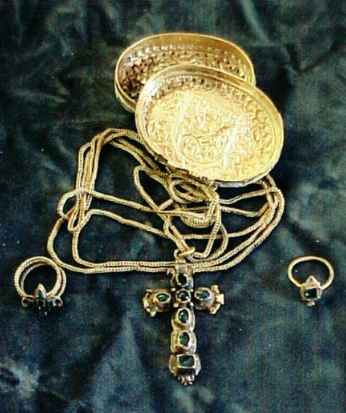
Darrel S.sent the above and following photos, about which he said, I remember when Capt. Jon Wilson found the gold box with these items inside near the Cabin Wreck. Steve Hancock received one of the rings, Jon got the necklace, state got the box, AND TAFFI GOT THE CROSS (displayed in their Sebastian Museum.)

It isn't a recent find. Darrel also said, The gold box with cross, necklace, cross, and rings was found 6/1/03.  [I originally posted 01, but the correct year is actually 03.]

 The photos are Darrel's personal photos, which he said were originally taken in the Fisher lab in Sebastian.

In the past couple of posts, I've been talking about intertwined or interlinked rings.  That discussion started with a couple of silver rings found by John C. along with a couple of cobs.  

The rings shown in the above and following picture have a very common design that I might describe as a twisted rope design.  Three gold twisted rope bands make one ring that has a gold setting with emeralds.  

Here is a closer picture of that.

Gold Ring Found by Captain Jon Wilson.
Photo submitted by Darrel S.
The twisted rope design is a very common design still used today.  You'll see that type of ring in silver and gold and other metals.

Thanks much to Darrel S. for the great pictures.


John C., after sending me the photos of the intertwined rings that were found with a couple of cobs, also sent me the following picture of a very thin silver ring and said, Some may be thinking, a silver wire ?  No it's what's left of a very badly worn silver ring .I guess it depends on the original size, but how many years does it take for a ring to become so badly worn ?

Thin Silver Ring.
Find and photo by John C.
Of course gold is not subject to the same type of corrosion as silver.  Some silver cobs found on the beaches are worn very flat and thin - by my estimation, sometimes to less than half the original weight.  The above ring is certainly worn down a lot, but I suspect was originally fairly thin to begin with. You can often find a joint on rings like that where they were cut and soldered together.

I think this kind of silver wear and corrosion can take place surprisingly quickly.  I think that kind of corrosion can take place in a matter of a few decades.  If I remember, and I run across the examples I'm thinking of, I might post them in the next few days.

Not long ago (8/3/17 post) I showed a paper thin silver Roosevelt dime that was found on a beach.  It is shown below.  I have others that are literally paper thin, and when I say literally, I mean it.

Paper Thin Silver Dime.
My first possible reale find was what I would call a razor.

Obviously, some silver coins and rings are not as worn.  Some show very little silver loss.  The amount of corrosion and material loss depends to a large extent on exactly where it has been, how much the item as been tumbled in the sand and rough surf and how much air and salt water it has been exposed to.

I still don't know why divers almost never find silver rings on the 1715 Fleet.  I have shown one example attributed to a 1715 Fleet source by our state archaeologist, who also has documented silver rings to Spanish colonial archaeological sites.  I suspect that more than one factor is involved.

Some jewelry found on the Nieves site suggests the presence of a jeweler on board.  Incomplete pieces, as well as materials and jeweler's tools, have been found on that site.

---

I hope I didn't make too many mistakes in this post.  I kept finding them, but I hope I got most of the typos corrected.

---

Maybe in the near future I'll post more examples of the kind of thing I was talking about today.

---

Source: nhc.noaa.gov
The low pressure area that has been hanging over Florida looks like it will become a tropical storm and skirt South and North Carolina.  We'll have a small surf for most of the week.

Havey looks to be headed towards Arkansas rather than going back out into the Gulf.  He won't affect us much.

There is still time to respond to the blog poll.

Happy hunting,
TreasureGuide@comcast.net

Saturday, August 26, 2017

8/26/17 Report - Intertwined Rings and Mixing of Old and New Metal Detecting Targets.


Written by the TreasureGuide for the exclusive use of treasurebeachesreport.blogspot.com.

Gold Intertwined Rings Found by John C.
Photo by John C.
Yesterday I was discussing a couple silver intertwined rings that were found by John C. along with some cobs on a shipwreck beach.  He also sent the above picture showing gold intertwined ring finds. The ring on the right is marked Cartier, which didn't have a U. S. office until 1909.

I'm afraid I made no progress in determining the age or source of the silver rings shown yesterday, although I did find that such rings have been used long enough that they could be of such an early date.  I also mentioned the extreme rarity of silver rings found by divers on 1715 Fleet shipwreck sites.

The difficulty of determining the age of unmarked items on a beach should be no surprise.  That is exactly why archaeology can not be conducted on a beach.

A beach is a dynamic environment.  Nothing stays in place.  Things get mixed together - even things from different centuries.  The same thing applies to shallow water sites.

There are a variety of ways that items from different time periods can get mixed together.  I'll try to describe one of those ways today.

Things lost in the dunes get buried as the dunes sand blows back and the dunes build.  Older things will naturally be deeper.  In the illustration above, the three colored lines represent layers from three different time periods that can be decades or even centuries apart.
Three Layers of Old Items In Dune Eroded Down to Beach Level.

When the dune face erodes, the items from various layers and age periods fall to the level of the beach, where they are then shuffled around when the waves come up to the bottom of the dunes. Items from different time periods get mixed together.

Something similar happens on the beach slope, but to a lesser extent because the beach slope gets stirred more often.  Still, when the beach gets cut, older items are mixed together with newer items, including those that were recently dropped.  The age range of items deposited in the mixture will probably not be as large as the various ages represented in the layers of the dunes.

Once the items of various ages get mixed together, the water distributes them primarily by shape and density.

Silver rings on a salt water beach corrode. That could make any markings difficult or impossible to find.  And silver was not always marked.  Silversmith in England and France began stamping sterling silver objects in the 14th century, but there was no requirement for marking silver in the United States until 1906.  That leaves a large gap of 191 years between 1715 and 1906.

The number and variety of older silver rings found on the beaches is huge.  I'm left with a lot of unanswered questions and my recent investigations have not answered any of them.  I am a little more informed though, and I hope you are too.

I wonder if large number of silver rings might have been used at some time as trade goods or might have something to do with later salvage efforts, either large scale or undocumented small scale efforts.

It is my opinion that a lot of the silver ring finds, even some that look quite old, are 20th century.  Are there exceptions?  Definitely!  But it seems difficult or impossible to identify the date of many of the examples we see with the information available.

There are other related questions that I'll discuss in future posts.

Couple Intertwined Rings Found by Author.
I wanted to go back and find a particular example - a triple ring composed of gold, silver and another metal - I think platinum.  I didn't find that one right off, but ran across the two examples shown above while looking.  The one on the left has three intertwined rings and the one on the right, five.

---

I'm hoping that everyone will respond to the blog poll.

On the Treasure Coast we're going to have one and two foot surf for a week or so.  I'll be watching our low pressure area for any developments.

As you undoubtedly know, Harvey hit Texas hard.  It could go back out into the Gulf again.

You can check out the live webcam from Galveston.

Here is the link.

http://www.galveston.com/seawallvideocam/

Thanks to GoSports for that one.

Happy hunting,
TreasureGuide@comcast.net

Friday, August 25, 2017

8/25/17 Report - Up To 14 Foot Surf From Hurricane Harvey To Hit Texas Coast. Shipwrecks of Padre Island. More Intertwined Silver Rings.


Written by the TreasureGuide for the exclusive use of treasurebeachesreport.blogspot.com.

Intertwined Silver Rings Found by John C.
Photo by John C.
John C. said, Both these rings were found in the same cut. maybe 20' feet apart..no markings.

Thanks much for the pictures and emails John.

These are really worn very thin and show the characteristic patina and corrosion of rings that have been on the beach a good while.

If these were found on a shipwreck beach, it would seem the evidence of a shipwreck source for some of these types of rings would be building.

I've asked John and expect to hear from him soon.

I've found intertwined rings before.  I think one set had one ring of gold, one of silver, and one of some other metal.  I'll have to look for my records and see if I can find where they were found.  I'm pretty sure it was found down south rather than on the Treasure Coast though.

If others can add to this discussion, especially if they've found similar rings, that would be helpful.

---

Harvey is now sitting off the Texas coast creating havoc.  The surf, according to MagicSeaWeed will be up to possibly fourteen feet at Matagorda.  I feel sorry for those people.  Harvey could remain stationary as a major hurricane for a matter of days.  Pray for the safety and welfare of the people.

Below is a MagicSeaWeed chart showing the predicted surf for the Matagorda area.


Hurricane Harvey almost died a couple of times before he even got started but then ended up being one of the strongest hurricanes to hit the Gulf Coast in years.  It just goes to show how quickly things can change.

You probably know about the Padre Island shipwreck treasures and coins.  Harvey will undoubtedly bring some of that treasure to the surface.  Here is a bit of an introduction from the National Park Service.

In April 1554, three Spanish naos (a type of cargo and passenger ship similar to Columbus’s Santa Maria) went aground on Padre Island following a storm that had blown them across the Gulf of Mexico from the coast of Cuba. At the time this was the greatest disaster to ever befall the Spanish fleet in the New World. Tons of treasure bound for Spain was lost in addition to the lives of approximately three hundred passengers and crew who died from hunger, thirst, and attacks by natives as they attempted to walk back to the port of Vera Cruz. 

But the story of the 1554 shipwreck does not end there nor does it end with the conclusion of the salvage operations that took place later that year. As with any important historical event, its effects resonate through the centuries and can still be felt today—if one looks for them.

First of all, the wrecks were the first documented occurrence of Europeans on the island and one of the first occurrences of Europeans in what was to become Texas. The salvage operation was the first documented instance of Europeans intentionally coming to the island and staying for an extended period.

Second, the three ships that wrecked (the Santa Maria de Yciar, the Espiritu Santo, and the San Esteban) are the oldest shipwrecks ever found in North America (excluding the Caribbean and Latin America)...


Here is the link to that web site.

https://www.nps.gov/pais/learn/historyculture/1554-1.htm

And here is link to a good article on the same subject by the Texas State Historical Association.


https://tshaonline.org/handbook/online/articles/etpfe


---

We have a good start on the blog poll about what brand metal detector you all use.  It seemed like the Minelab users showed up as a block very suddenly last night.  Strange!

Hoping for the safety and welfare of the people of the Texas Gulf Coast.
TreasureGuide@comcast.net

Thursday, August 24, 2017

8/24/17 Report - Hurricane Aiming At Texas. Intertwined Ring. Silver Rings and the 1715 Fleet. New Blog Poll.


Written by the TreasureGuide for the exclusive use treasurebeachesreport.blogspot.com.

Texas Might Get Hurricane Harvey
Source: nhc.noaa.gov

Looks like Harvey became a hurricane and will hit Texas.  As you can see from the map, there is another area off the West Coast of Florida to watch, but it will probably not become a cyclone anytime soon, but it might bring us some more rain.  It probably won't do much more than that.

We still have some good tides along the Treasure Coast, but the surf won't be much for at least a couple of days.

---

Intertwined Silver Knots
Submitted by Al C.

Al C. sent the above photo of a ring he found along with the following eamil message.

A while back you talked about silver rings not being found on the 1715 wrecks much. I found this years ago right near the stairs that used to go up to the old Chuck’s Steakhouse building. There was a tropical storm going by at the time. I cant remember which one, but that same day I found a couple ½ reales in the same area and no junk to speak of. There are no markings at all on this. Just thought it might be something of interest if that subject ever comes up again.
Thanks for your picture and email Al.

Those kinds of rings have been made and used for a long time.  It could be old.  It is similar to a design known as  the Trinity Knot, which, according to Wikipedia was "designed to honour the Mother, Maiden ad Crone of the Neo-pagan Triple Goddess, which represents the three life-cycles of a woman in relation to the phases of the moon.  In modern times, it has come to represent the Father, Son and Holy Spirit.."  I've also seen similar rings referred to as a Celtic Trinity knot.

Similar intertwined rings are still made today.  You can find quite a variety on the internet.   I've seen them and found intertwined rings with both two and three loops.  I think they are sometimes referred to as Russian rolling rings.  In mathematic terms such a ring might be referred to as a Borromean ring (See Wikipedia again.).

Intertwined rings can't be dated by the design alone.  Similar rings have been used from ancient times to the present.  You certainly might expect a modern silver ring to be marked.  Al's is not.

One of the top 1715 Fleet treasure hunters, who undoubtedly knows as well as about anyone in the world, says that silver rings are not found on 1715 Fleet wreck sites.  Kathleen Deagan, in her book Artifacts of the Spanish Colonies of Florida and the Caribbean 1500 to 1800 does show a silver Claddagh ring, which in her book is said to be from the 1715 Fleet.  It could be from the 1715 Fleet, but you can't be sure of that without additional evidence.  Context is not always enough.  It wasn't long ago that I showed a 1968 class ring found by a Capitana diver searching the 1715 Fleet this year.  Obviously it wasn't from the 1715 Fleet.

My personal conclusion is that there might be a few (very few) silver rings from the 1715 Fleet, but they are evidently rare.  Deagan's book shows many more copper alloy rings from the colonies, along with gold rings and numerous rings made of other substances, including glass and jet.  Only a very few are silver.  One silver ring that Deagan shows is from a mission site.  Although it appears there are some examples, it seems to me that the vast majority of rings in Spanish colonial America were not silver.

There is still a lot left to learn.  That is part of the fun of it all.

---

I heard that after reassigning a sports announcer named Robert Lee who was going to work a Virginia game, they are now going to remove a duck named Donald from all the parks.  Just kidding, but that isn't much more crazy than the Robert Lee thing, which is real and was followed by a decrease of more than a dollar per share for Disney stock.  No wonder ESPN is going down the drain.

---

I posted a new poll on the blog.  I hope you'll respond.  We'll find out what kind of detector people are using these days.

---

I also heard from people that were glad to see the YouTube videos that I made.

Happy hunting,
TreasureGuide@comcast.net

Monday, May 23, 2016

5/23/16 Report - The Journey Of A Cob. Finds: Beach Silver Rings. Ocean Gold Coin. Crushed Cup.


Written by the TreasureGuide for the exclusive use of treasurebeachesreport.blogspot.com.


Two Old Silver Rings.
Finds and photos by Bernie C.


Both of the above were found by Bernie on a Treasure Coast wreck beach.  They are thought to be silver trade goods from the early 1700s.

---

The Journey.

The cobs that are found on the Treasure Coast went through a lot before they came to the Treasure Coast.  Maybe you did too.

Lets follow the journey of a small Potosi reale.

It started out in Cerro Rico, where it was laboriously mined by poor miners under very difficult conditions.  You might want to look into that sometime.  It is an interesting topic by itself.

Cerro Rico is known as 'mountain that eats men' because of the large number of workers who died in the mines. Some writers such as Eduardo Galeano in his work Open Veins of Latin America estimate, quoting Josiah Conder,[4] that up to 8 million men have died in the Cerro Rico since the 16th century.

Long tunnels carved out of the mountain lead down to the silver.  After being dug out, the ore was carried up repeated lengths of leather rung ladders to the surface where it was hand-sorted and then carried by pack animals to the grinding mills and then amalgamated before going to the smelters and being turned into refined bars that were taxed and marked.  Then it was sold to the mint before being turned into cobs.  From there it was transported to Panama and across the isthmus to be loaded for shipment to Havana where it was loaded onto another ship to leave with the fleet for Spain.

As we know, then there was the hurricane and wrecking and attempts at salvage.

Then one day, you decide to go metal detecting, and on the beach somewhere after hundreds of years,  you meet up with that one little piece of silver.

Then where did it go?  Maybe into your pocket.  Maybe to auction.  Maybe to a friend or collector.

How unlikely the meeting!  You were born, raised, worked, searched, and then you met.  And the journey isn't over yet for either of you.  Where will the journey lead next?

---

Here is a good web site that lists the major events relating to the price of gold and silver since the 1600s.   It gives a good international overview.  Very informative.

http://info.goldavenue.com/info_site/in_arts/in_mill/18thcentury.htm

---

I heard from people from Rosewood, a TV program on Fox.  Evidently they are developing one episode on a treasure hunting story.

---


The Fisher HAUV Dolores has been pin-pointing small non-ferrous targets, such as most recently, what appears to be a smashed metallic cup found on the Atocha site.

Smashed Cup
Dolores is doing a good job of pinponting targets as small as 2" by 2".

---

The 2016 salvage season is underway on the Treasure Coast and off to a great start.  The first gold coin has already been found.

Way to go guys!

---

Happy hunting,
TreasureGuide@comcast.net

Monday, May 2, 2016

5/2/16 Report - Old Beach Ring Finds and More On The Apparent Lack Of Silver 1715 Wreck Rings.


Written by the TreasureGuide for the exclusive use of treasurebeachesreport.blogspot.com.

Two Rings and Cobs Found in One Beach Cut Back Years Ago.
Finds and photo by John C.
Back a few days ago I was discussing the observation that no silver rings have been found on 1715 Fleet wrecks.  Concerning that, I received the above and following photos and an email from John C. Here is what John said.

So here's some pictures that may, or may not,shed some light on the controversy. The coins and rings in the picture were found over 20 years ago, and all came out of the same cut, maybe fifty yards long, But I think the Rings in the photo, are a perfect example of the different classes of people that may have been on these ships, at the time, the top ring in the picture is obviously crudely made hand carved notice the file marks on the inside of the Ring where it was tapered, I would say copper or bronze or maybe even very low kt gold, there has been quite a few rings as low as 8 kt,found off these wrecks. The ring , Possibly belonging to a common sailor or crew member, with some extra time on his hands as they sailed across the ocean.  The bottom ring is beautifully crafted, very high kt possibly 22,... So is the ring personal , possibly belonging to a higher class passenger on the ship ? Or is it just cargo, maybe originally crafted in China then brought over on the trade routes from Manila ? Who really knows...

More Rings Accumulated Over Years
Finds and photo by John C.
So now on the topic of silver rings.. the next photo shows 6 Rings with no markings on the inside. 4 out of the 6 Rings show evidence of gold. The two plain rings in the middle are huge one is bigger than a quarter, 4 out of the 6 Rings also have a design or pattern on the outside, one ring I partially cleaned years ago to try to find some markings. Some of the designs on these rings are very similar to rings found off these wrecks over the years.. the broken ring in the photo is very fragile almost paper thin, there's no evidence of gold on this ring, but I think it was gold plated at one time, just like the other rings in the picture. But notice the diamond pattern on the outside the same pattern that's on the 22 karat gold ring in the previous photo.. just a coincidence" could be,, but I don't think so I know where I found it,... the 4th photo also shows a ring with a pretty common shipwreck pattern. There was one found years ago I think it was 1989 by one of the salvers. it was High kt. and had the same Arrow design on the outside. But the inside had those strange abbreviations and Crosses Zachariah blessings !, or what we used to refer to as a nun's ring....

Another important factor to consider is Beach finds,, and water finds,, have two completely different environments. If you think about what these coins and artifacts had to endure to finally end up in the dry sand. These items are in a very high energy environment being pounded by waves and tidal currents for hundreds of years.. most of us treasure Hunters have been on the beach during a strong Nor'easter and remember how fast the current is moving from north to south many of these items may have originated hundreds of yards or more further north up the beach.. I'm not saying that the items found in the water,, especially being relatively shallow water don't get banged around. They do,, But in many cases they're protected by rocks or Ledges or pockets in The Reef , in some cases even Coral growth protects these items,

So did we get any closer in answering question ,, has there ever been silver rings found off the 1715 Fleet ? Probably not ' I just think that many more of these silver artifact and rings were gold plated then we thought,, but by no means do I consider myself an expert,, and I'm not saying that those six rings I showed you are shipwreck rings. I don't really do a lot of research,, I just try my best to find the stuff.

Great photos and email John!  Thanks for sharing.  I think we all benefit from sharing our experiences and observations.

It is important to note that these rings were found in a cut along with shipwreck coins.  That suggests that the rings are shipwreck rings too.

I've heard it said that the huge rings were sometimes made to be worn over a glove.  I'll have to see if I can find a picture of something like that sometime, maybe in an 18th century painting.

My conclusion so far is that silver rings on the 1715 Fleet are very rare, but there must have been a few - perhaps only personal belongings and very possibly worn by missionaries.  We know that silver rings have been documented from Spanish colonial land sites, although the majority were copper alloy or gold.

It seems to me, that you would have the cargo, and then personal belongings, with the personal belongings being predominately those of the rich, and then the meager belongings of the lower class, with few middle class passengers at all.  Maybe someone can provide real data about the people that were on board some of these vessels.

There is also the matter of non-metallic rings such as those made out of jet or glass.  It is documented that a lot of those were brought in as cargo on ships coming from the Old World, but they, as far as I know, have not been found on the wrecks, at least not in numbers - perhaps because they broke up and disintegrated and partly because they would not be detected by a metal detector.  It must also be remembered that some of those would have been trade goods, or for use by colonists and would not be returning to the Old World.

I still hope to photo some other old beach rings.  Hope to get around to that some day soon.

It is good to have some good ideas to research.  One thing leads to another and in the process we learn a lot.

You probably don't remember but this all started with a mystery silver ring and wondering if it might be from a shipwreck.  And then there was the comment that no silver rings have been found on 1715 wrecks.  As I said, one thing leads to another.

---

We have a two to three foot surf, decreasing even more for a couple of days.  Not much to comment on there.

Happy hunting,
TreasureGuide@comcast.net

Wednesday, April 27, 2016

4/27/16 Report - More On Shipwreck Silver Rings Question. Florida Scenic National Trail. Nazi Treasure.


Written by the TreasureGuide for the exclusive use of treasurebeachesreport.blogspot.com.


Couple Old Silver Beach Finds.

If you want to do a little exploring off the beaten path, you might try the Florida National Scenic Trail.

The Florida Trail (FNST) is a congressionally designated National Scenic Trail.  It is approximately 1,300-miles long, and is intended to offer a continuous, permanent non-motorized recreation opportunity for hiking and other compatible activities.  Over its length, it showcases the incredible biodiversity, history, and rich culture of Florida.
The Florida Trail begins on the edge of the everglades ecosystem in Big Cypress National Preserve. It’s end point lies in the white sands of Gulf Islands National Seashore. at historic Fort Pickens. The Florida Trail is one of the United States 11 National Scenic Trails and offers an experience that is unique to Florida. No other trail in the world compares to the Florida Trail...
https://www.floridatrail.org/fnst/floridatrail/

---

Some consider it "the world's most valuable piece of lost art," says Reuters and according to a Polish historian, the Russian treasure may have been located. Bartlomiej Plebanczyk on Friday told his country's TVN24 he's "almost certain" the Amber Room, a chamber made of gold leaf and amber panels, lies under an old World War II German bunker in northern Poland. Plebanczyk's theory was born out of his use of ground-penetrating radar at the site, he tells the Mirro, which reports the previously unknown room measures only 65 square feet. "We need to drill into the room in the bunker and lower a camcorder there," says Plebanczyk, who feels confident he'll find the Amber Room, which is valued at around $500 million and was stolen by the Nazis from Russia's Catherine Palace in 1941, the AP reports...

Here is the link for the rest of that article.

http://www.newser.com/story/224063/historian-ive-found-500m-treasure-in-old-nazi-bunker.html?intcmp=hpdm

Thanks to Dean R. for this link.

---

The past couple of days I've been talking about silver rings not being found on 1715 wrecks.   I haven't seen much to dispute that and wonder why it would be.  I have been doing some research on that, and am hoping to learn why silver rings are so scarce when gold and copper alloy rings are as scarce.  I haven't concluded that research yet, but have already learned a lot in the process.  I'll be following up with more research and ideas on that topic in the future.

It appears that the finding of few or no silver rings may not be limited to the 1715 Fleet but also to the Atocha and Margarita.  That is what I found when I used the Mel Fisher Artifact Database.  A search for "silver rings" turned up no silver rings for the Atocha, Margarita or the 1715 Fleet.  That seems even more surprising and difficult to account for.

Searching for "gold ring" in the database, I found 37 gold rings listed, but no silver rings.  More than half were from the 1715 Fleet.  Again, no silver rings were listed at all, when the search included both the 1715 Fleet and the Atocha and Margarita.

I'm not sure how complete the database is, and I'm not sure how the filters work.  I assume that the database works fairly well, and it includes over 200,000 artifacts, so that sounds like a very good sample.

I'm going to continue researching this question.  I don't know if it can be answered.  I'm sure that there have been silver ring beach finds that have been attributed to Treasure Coast shipwrecks.  Are those attributions wrong, or are they exceptions.

We know that archaeologists have found some silver rings at Spanish colonial sites.  So far I have not been able to account for the reported total or relative lack of silver ring finds on the 1715 Fleet wrecks.

At the top of this post I'm showing two old silver beach finds.  It is difficult to determine how old they might be or where they came from.  They have no markings other than what you can see in the photo.

By the way, does anyone recognize the symbol on the ring.  If so, please let me know.

---

The wind and tides are not particularly favorable for beach hunting.  The surf is 2 to 3 feet.  It will be calm this weekend.

Happy hunting,
TreasureGuide@comcast.net
Monday, April 25, 2016

4/25/16 Report - Spanish Colonial Finger Rings and Deagan's Book. Book On Finger Ring Lore.


Written by the TreasureGuide for the exclusive use of treasurebeachesreport.blogspot.com.

Yesterday I talked about the observation that silver rings are not found on 1715 wrecks.  The day before that I showed a silver ring that was in question.  Deagan's book on Spanish colonial artifacts shows that some, though not a lot of silver rings have been found at Spanish colonial land sites, but even those are few, especially in comparison to finger rings made of other materials such as copper alloys.

Deagan's book includes an extensive table showing the number of personal items of adornment going to the New World between 1526 and 1613 as indicated by shipping records of the period.  To give an example of one of the largest quantities of finger ring shipments in the table, 7,200 sortijas de vidrio (rings of glass) were shipped in 1590.

I haven't really looked into it, but don't recall any detectorists or treasure salvors reporting glass ring finds.  In fact, I just looked in the Mel Fisher artifact database and found glass items, but no glass rings.  There were beads, buttons and unidentified glass fragments, but no finger rings.

In the metal detecting world, you would expect that most finds would be metal.  Besides not being detectable, glass might be broken into small pieces and might not be easy to see in different environments.

That is just one reason there might be a big difference between what is out there and what is found. Some items are found more easily than others and some items are preserved much better than others. Metal items, big items and durable items will be found disproportionately when compared to items lost in similar numbers.

There are differences between what items were shipped to the colonies and the types of items shipped from the New World back to Spain.  Large numbers of cobs are found because they are metal, do not generally break down completely in the surf, were shipped from the New World in large quantities, and are detected by metal detectors.

I often talk eye-balling, which will help you find non-metallic items.  From time to time I also talk about techniques such as sifting.

Just as an example, the table shows 36 annilos de alquimia (gilded rings) being shipped in 1592.  Also, 432 sortijas de alquimia (rings with metalwork) were shipped in 1602.  Those are still small numbers when compared to rings made of non-metallic materials.  Compare that, for example, with the 7200 glass rings shipped in 1590 alone.

I'll have to do some research, but I'm not aware of glass finger ring finds made either by detectorists or treasure salvors.   Neither am I aware of finds of  rings made of other non-metallic materials, despite the large number that were shipped to the new world. Not surprisingly, underwater finds appear to be heavily skewed in the direction of metal items.  One of the more significant exceptions seems to be the emeralds that have been found on some shipwrecks.

I am wondering why silver rings seem to be so scarce on 1715 Fleet ships while gold and copper alloy rings are not so scarce.   I'll eventually throw out some ideas for your consideration.  At this point I have a few ideas.  I am considering sociological as well as economic and other reasons.  I want to do a little more research before putting those ideas out there.

I am still looking for ideas to explain the apparent lack of silver rings being found on the 1715 wrecks.

---

Correction/Clarification.

The picture of the eroded renourishment sand at Jupiter in my 4/23/16 post was not a recent picture.  It was from early 2015.  Sorry for any confusion.  I didn't post those pictures as an indication of current conditions.  I just wanted to use the pictures to talk about renourishment sand.

---

Here is an interesting book, Finger Ring Lore; Historical, Lengendary, Anecdotal by William Jones.

You can read it online by clicking on the title.

---
\
Sailors and shipwrights have long believed a silver coin under the mast brings good luck.This practice started with the Romans, whose custom was to place a coin in the mouth of a dead person to pay Charon, the boatman who ferried the souls.

---

Happy hunting,
TreasureGuide@comcast.net

Sunday, April 24, 2016

4/24/16 Report - Top Treasure Coast Treasure Hunter Says No Silver Rings Ever Found On 1715 Wrecks.


Written by the TreasureGuide for the exclusive use of treasurebeachesreport.blogspot.com.

One of the best things about doing this blog is all of the great information I receive from readers. Last night I got a very interesting email from Captain Jonah.  He told me what one of the most experienced treasure hunters, who, by the way, has been in the treasure hunting and treasure salvage business about as long as anybody, said.  The fellow said that there has never been a 1715 Fleet silver ring found.  Although I'm not giving you the name of the person, I'll assure you that he is one of the most knowledgeable sources you could ever find.  I would tell you his name if I received the email directly from him, but since I got it second hand and without express permission to give his name, I'll leave him nameless for now.

We know that all kinds of things found on 1715 Fleet sites are made of silver, but now we learn that there has never been a silver ring found from a 1715 Fleet wreck.  Very interesting!

I'm very cautious with what I say - maybe too cautious.  I seldom say words like "never."  I'm always thinking that there might be some exception somewhere.

Even if there is some exception somewhere, I now feel very confident in concluding that silver rings from the 1715 Fleet are extremely rare, if they exist at all.

I'm glad to have that new information. I will now assume that any silver rings are not be from a 1715 Fleet source unless I have good evidence to prove otherwise.

In order to test my new knowledge, I first went to the Mel Fisher artifact database and searched for silver rings.  I found no silver rings in the database.  That supports the idea that there are none, or if there are any at all, they are very rare.

The next source that I checked was Deagan's book, Artifacts of the Spanish Colonies of Florida and the Caribbean, `1500 - 1800.   The book includes artifacts found on both land sites and under water. Thousands of finger rings are documented.  Many are non-metallic.  Many were made of jet, presumably because of the presumed supernatural qualities or the symbolic or cultural significance. Other non-metallic rings were made of glass, stone, wood and even horse hair.

Of the rings made of metal, the vast majority are made of copper alloys, and a smaller number are made of gold.

There are a very few examples of silver Spanish colonial rings mentioned in that book.  Only one was specifically described and pictured.  It was from Santa Catalina and shows a flame-crowned heart that is very similar in to the heart-shaped cobs that I've discussed in the past.

I find it fascinating that no silver rings have been found on the 1715 Fleet wrecks and wonder why. Silver rings were common from much earlier times as well as the 18th century and common around the world, so why not on the 1715 Fleet?  That is an interesting question and the answer might prove significant.

I can think of a number of possibilities, but none are any more than possibilities.  Can you think of any reason why there might not be any 1715 Fleet silver rings?  Or why they haven't been found? Maybe it is a matter of numbers.

I've only entertained this idea for less than one day, so maybe this is all premature.  I'm glad to put it out there to be investigated and tested.  We'll see where it goes.

I also wonder how many non-metallic rings have been found from 1715 wrecks.  I'll investigate that. Deagan's book documents hundreds and hundreds.   Obviously a metal detector would not detect  non-metallic rings, and they might be destroyed in the surf.   Explaining the apparent absence of silver rings seems more difficult.  That will make for a good research project.

If we assume that there were none and none will be found on the 1715 wrecks and too quickly dismiss each possible exception, we have created a self-fulfilling prophecy.

I want to thank Jonah and the person who told him there are no silver rings that have been found on the 1715 wrecks for sharing.  I appreciate that knowledge and am eager to see what more we can learn about that.

What I believe today might not be what I believe tomorrow.  I'll be glad to learn something new.  Let me know what you think, especially if I got any of this wrong.

In looking through Deagan's book once again, I also noticed some other interesting facts.  I'll discuss some of those in the future.

Happy hunting,
Treasureguide@comcast.net