Written by the TreasureGuide for the exclusive use of treasurebeachesreport.blogspot.com
Source: See LincolnshireLive link below.
A metal detectorist has amazed experts after finding an incredibly rare Roman artifact in a Lincolnshire field.
Jason Price, from Grantham, was searching in a field near lesasingham when he unearthed a colourful horse brooch.
The 48-year-old, who is an armed forces veteran, was left gobsmacked by the find, which one local expert says has rewritten the understandings of Roman brooches.
It seems to me that in the past several years archaeologists have come to view detectorists less antagonistically - at least in the press. Back then it seemed like detectorists were always called looters or something. It seems a little better to me now. I think it is at least partly because detectorists now have a voice such as this blog.
===
Al C. sent me the following email and photos.
As always, thank you for the blog. I look forward to reading it every day.
When I saw the weather coming a couple weeks ago I tried to fire up my old Soverign and she finally gave up. I think I had that machine for almost 20 years. Made some great finds with it.
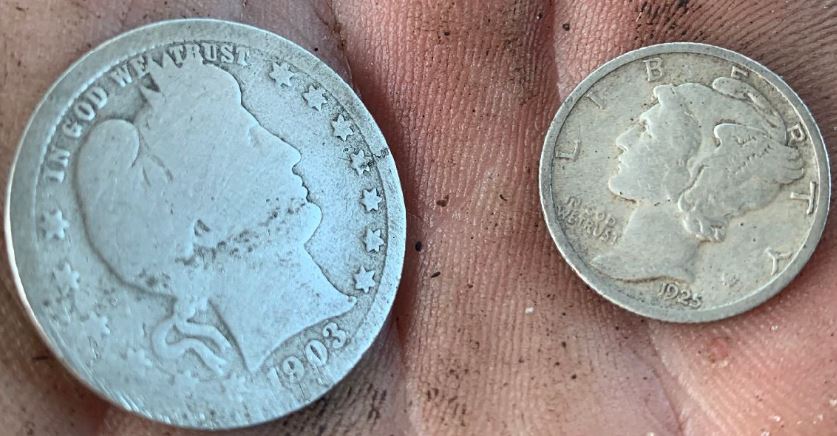
So I bought a Equinox. I have only used it once in a very trashy spot that had some construction going on and found the Mercury dime and Barber quarter. It was tough hunting. I plan to investigate the notch discrimination some and try more soon.
I also cant remember if I sent you a picture of the silver rings before. I found it years ago maybe a 100 yards north of where the stairs used to go up to Chucks Steak House. I also found two half reales at the same time/area.
I always wondered if it was ship wreck era. There are no markings on it. No way to tell I guess. I always think about it when the conversation of silver rings and the 1715 ships comes up.
Coins Found By Al C. In A Trashy Area Using His New Equinox.
Photo by Al C.
Intertwined Silver Rings Found by Al C.
Photo by Al C.
Thanks for writing Al. Nice finds. Congratulations.
I've found a few sets of intertwined rings but unfortunately at this time don't have the foggiest idea where. They aren't marked either. One set has one silver, one gold and one other ring. None have markings. I think I have one set that has more than three rings intertwined - I think five.
Here is the one set I had handy. They look much like yours.
I might be lucky enough to have some records that tell me when those were found.
==
Brian B. sent me the following email and link.
Hello.. Still enjoy your great reads daily. Hope all is swell and glad to see you have a bit of free time as of late on the shores. Ran across a Jan good read as might be a dupe to you but if not, it's a good recap about the latest battles over treasure finds. Thanks Brian
Below is the lead to the article and the link.
A Shipwreck Off Florida’s Coast Pits Archaeologists Against Treasure Hunters
The discovery of a legendary wreck raises questions about who should control sunken riches
Written by the TreasureGuide for the exclusive use of treasurebeachesreport.blogspot.com.
Gold Intertwined Rings Found by John C.
Photo by John C.
Yesterday I was discussing a couple silver intertwined rings that were found by John C. along with some cobs on a shipwreck beach. He also sent the above picture showing gold intertwined ring finds. The ring on the right is marked Cartier, which didn't have a U. S. office until 1909.
I'm afraid I made no progress in determining the age or source of the silver rings shown yesterday, although I did find that such rings have been used long enough that they could be of such an early date. I also mentioned the extreme rarity of silver rings found by divers on 1715 Fleet shipwreck sites.
The difficulty of determining the age of unmarked items on a beach should be no surprise. That is exactly why archaeology can not be conducted on a beach.
A beach is a dynamic environment. Nothing stays in place. Things get mixed together - even things from different centuries. The same thing applies to shallow water sites.
There are a variety of ways that items from different time periods can get mixed together. I'll try to describe one of those ways today.
Things lost in the dunes get buried as the dunes sand blows back and the dunes build. Older things will naturally be deeper. In the illustration above, the three colored lines represent layers from three different time periods that can be decades or even centuries apart.
Three Layers of Old Items In Dune Eroded Down to Beach Level.
When the dune face erodes, the items from various layers and age periods fall to the level of the beach, where they are then shuffled around when the waves come up to the bottom of the dunes. Items from different time periods get mixed together.
Something similar happens on the beach slope, but to a lesser extent because the beach slope gets stirred more often. Still, when the beach gets cut, older items are mixed together with newer items, including those that were recently dropped. The age range of items deposited in the mixture will probably not be as large as the various ages represented in the layers of the dunes.
Once the items of various ages get mixed together, the water distributes them primarily by shape and density.
Silver rings on a salt water beach corrode. That could make any markings difficult or impossible to find. And silver was not always marked. Silversmith in England and France began stamping sterling silver objects in the 14th century, but there was no requirement for marking silver in the United States until 1906. That leaves a large gap of 191 years between 1715 and 1906.
The number and variety of older silver rings found on the beaches is huge. I'm left with a lot of unanswered questions and my recent investigations have not answered any of them. I am a little more informed though, and I hope you are too.
I wonder if large number of silver rings might have been used at some time as trade goods or might have something to do with later salvage efforts, either large scale or undocumented small scale efforts.
It is my opinion that a lot of the silver ring finds, even some that look quite old, are 20th century. Are there exceptions? Definitely! But it seems difficult or impossible to identify the date of many of the examples we see with the information available.
There are other related questions that I'll discuss in future posts.
Couple Intertwined Rings Found by Author.
I wanted to go back and find a particular example - a triple ring composed of gold, silver and another metal - I think platinum. I didn't find that one right off, but ran across the two examples shown above while looking. The one on the left has three intertwined rings and the one on the right, five.
---
I'm hoping that everyone will respond to the blog poll.
On the Treasure Coast we're going to have one and two foot surf for a week or so. I'll be watching our low pressure area for any developments.
As you undoubtedly know, Harvey hit Texas hard. It could go back out into the Gulf again.